REVIEW 3 major objections 5 minor 37 references
Finite-size effects of the excess entropy computed from integrating the radial distribution function
T0 review · 3 major / 5 minor · reviewed 2026-08-07 · deepseek-v4-flash
Pith's one-line read Corrected radial distribution function reproduces excess entropy within 5% below density 0.1.
desk verdict A useful finite-size correction study for RDF-based excess entropy; the central equation has a missing 1/V factor, but the empirical recommendations survive. read the letter →
The pith
A machine-rendered reading of the paper's core claim, the machinery that carries it, and where it could break.
The reading
What carries the argument
The load-bearing object is the geometric weight function for a spherical volume, $w(r,L)=4\pi r^2(1 - \frac{3r}{2L} + \frac{r^3}{2L^3})$, which reduces the double integral over two particle positions to a one-dimensional integral of $q(r)$. A Taylor expansion of the finite-volume integral in $1/L$ (Eq. 6, kept to third order) produces corrected estimates $X^1_\infty$, $X^2_\infty$, $X^3_\infty$; for excess entropy the running integral $X^*(L)=4\pi\int_0^L q_S(r)r^2\,dr$ is shown to be the fastest-converging estimator because $q_S(r)\approx (g(r)-1)^2$ is positive and small. For simulation RDFs, the finite-size correction of Eq. 18 rebuilds $g(r)$ so that it approaches 1 at the cut-off, and this corrected $g_\infty(r)$ is what makes the truncated integral accurate at small $N$.
What would settle it
Run the same NVT protocol at $\rho=0.01$, $N=100$, $r_c=2$ but compute $X(L)$ with the spherical weight $w(r,L)$ of Eq. 3 and compare it with a simple truncation of Eq. 1 at the cubic box edge; the paper does not state which of these was used, and a difference beyond statistical error would show that the claimed convergence ordering does not describe the actual simulation geometry. A second check is to take the analytic model with $\chi=20$ and a cubic-box running integral without spherical weighting; if $X^*(L)$ no longer lies between $X^1_\infty$ and $X_\infty$, the faster-convergence proof fails for that geometry.
Extended reading notes
Core claim
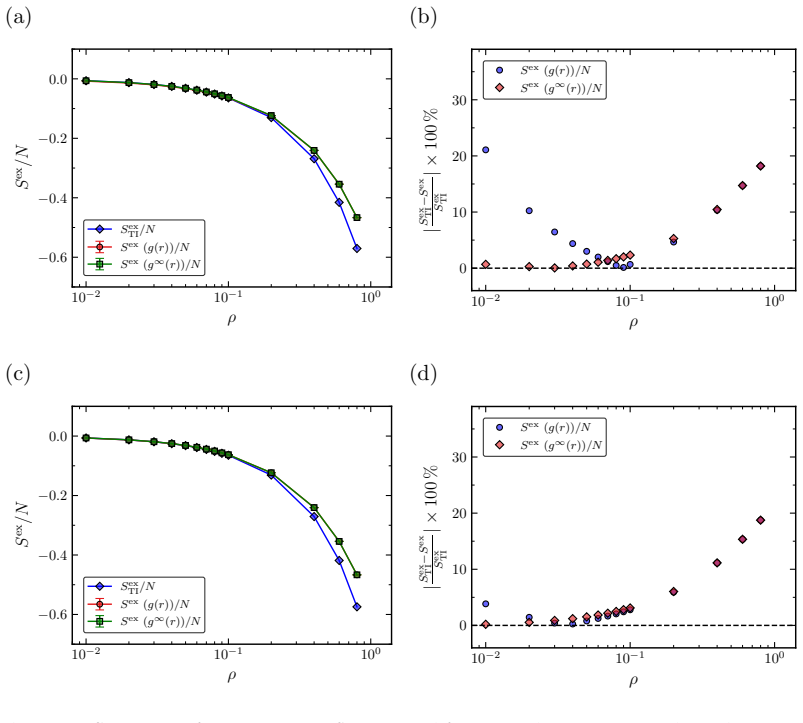
The paper's central claim is that finite-size effects in the excess-entropy integral are manageable and differ in kind from those in Kirkwood-Buff integrals. For the excess-entropy integrand $q_S(r)=g(r)\ln g(r)-g(r)+1$, the running integral $X^*(L)=4\pi\int_0^L q_S(r)r^2\,dr$ satisfies $0<X^1_\infty(L)<X^*(L)<X_\infty$ and therefore converges to the thermodynamic limit faster than the first-order corrected estimate. Consequently, Eq. 1 can be truncated at the simulation box edge provided the RDF is first corrected to the thermodynamic limit. The Monte Carlo results support this: for $\rho<0.1$ and for both $r_c=2$ (Lennard-Jones-like) and $r_c=1.2$ (colloid-like) Wang-Ram\'irez-Dobnikar-Frenkel fluids, the corrected-RDF route agrees with thermodynamic integration to within a few percent at $N=100$ and $N=500$, while uncorrected RDFs can be off by more than 20% at the lowest densities in small systems. Above $\rho=0.1$ both RDF-based values agree with each other but deviate from thermodynamic integration by 20\textendash 25%, which the paper attributes to the second-order density expansion itself.
Load-bearing premise
The central assumption is that the finite-volume entropy integral has a convergent $1/L$ Taylor expansion, which is accurate only when correlations in $q(r)$ decay over a finite length; for long-ranged correlations the system sizes tested here would not capture 95% of the excess entropy.
Editorial extensions
If this is right
- For $\rho<0.1$, excess entropy can be computed from one short NVT simulation with as few as 100 particles by integrating the corrected RDF to the box edge, with no thermodynamic integration needed.
- The finite-size-corrected RDF should be used in all excess-entropy calculations; at very low density the uncorrected RDF in a 100-particle box can give errors above 20% for colloid-like interactions.
- For excess entropy, the raw running integral $X^*(L)$ is the right estimator, so existing codes that report running integrals are already using the faster-converging quantity.
- At $\rho>0.1$, discrepancies of 20\textendash 25% against thermodynamic integration are not a finite-size artifact but the low-density approximation in Eq. 1; higher-order density expansions or thermodynamic integration are needed there.
Reading between the lines
- The paper's ordering argument uses $q_S(r)>0$; a strongly associating fluid where $q_S(r)$ is negative over a wide range would not automatically inherit the running-integral advantage, so the protocol should be re-tested before transferring it to such systems.
- The derivation assumes a spherical integration volume, while the simulations use cubic boxes; whether the same convergence ordering holds for a cubic-box cutoff without spherical weighting is a testable extension the paper does not report.
- The 95% low-density result suggests a practical screening workflow: estimate $S_{\rm ex}$ from one 100-particle run and feed it into entropy-scaling transport correlations, reserving thermodynamic integration for dense states.
Editorial analysis
A structured set of objections, weighed in public.
Referee Report
Summary. The paper investigates finite-size effects in computing excess entropy Sex from the second-order density expansion, i.e., from the radial distribution function (RDF). It derives finite-volume expressions for Sex and Kirkwood-Buff (KB) integrals using a spherical weight function, proposes Taylor extrapolations in 1/L up to third order, and studies their convergence using an analytic model RDF. It then presents Monte Carlo NVT simulations of the Wang-Ramírez-Dobnikar-Frenkel potential for densities 0.01–0.8 and system sizes N=100 and N=500, comparing Sex from thermodynamic integration with Sex obtained from integrating the RDF with and without the Ganguly–van der Vegt finite-size correction. The central claims are that the running integral X*(L) converges fastest for the excess-entropy integrand, that the corrected RDF g∞(r) is needed for accurate low-density results in small systems, and that Eq. (1) used with g∞(r) captures about 95% of Sex for ρ<0.1, while deviations up to about 20% occur at higher densities due to the low-density approximation inherent in Eq. (1).
Significance. If the finite-volume definitions are corrected, the paper provides practically useful guidance: for ρ≲0.1, small systems with finite-size-corrected RDFs give excess entropy within a few percent of thermodynamic integration, while at higher densities the second-order density expansion is the dominant source of error. The analytic comparison of convergence orders for qS and qKB is a useful contribution, and the algebra of the Taylor extrapolation in Eqs. (6)–(12) is correct. A strength is that the simulation results are benchmarked against thermodynamic integration, an independent method, and the statistical uncertainties are reported to be below 10^-3. The main weaknesses are the factor-V inconsistency in the central finite-volume definitions, the unclear RDF integration protocol in the simulations, and an incorrect-looking derivative expression in Eq. (17). These issues are fixable but currently prevent the theoretical and numerical parts from being evaluated as a single consistent story.
major comments (3)
- [Section 2, Eqs. (2) and (4)] The relation between the double integral and the single-integral weight function is missing a factor V. With q(r)=1 and a spherical volume of diameter L, the left side of Eq. (4) equals V^2=(πL^3/6)^2, while the right side equals V=πL^3/6. The standard finite-volume Kirkwood-Buff relation is ∫∫ q dr1dr2 = V · 4π∫ w(r,L) q(r) dr, or equivalently X(L)=V^{-1}∫∫ q dr1dr2 = 4π∫ w q dr. As printed, Eq. (2) is also dimensionally inconsistent: -ρ/2∫∫ has the dimension of volume in reduced units, whereas the intended excess entropy per particle is dimensionless. Because Eqs. (6)–(12) and the ordering proof are all formulated in terms of the X(L) defined in Eq. (4), this normalization error is load-bearing: the extrapolated X∞ and the claim that X*(L) converges faster than X∞^1 are statements about the normalized KB-type integral. Please correct the definitions and re-state the results accordingly.
- [Section 3, Eq. (17)] As typeset, Eq. (17) cannot be the derivative of Eq. (15). It appears as a product of two rational functions, each with denominator (α(1-λ)+r^2)^4, whereas direct differentiation of uWF = λ(1-y)(r_c^2-r^2)^2/y^3 with y=r^2+α(1-λ) yields the single rational function (r_c^2-r^2)^2[y(1-y)+αλ(3-2y)]/y^4. Since Eq. (17) is the quantity averaged in the thermodynamic integration that defines Sex_TI, the printed formula must be corrected or replaced by a reference to the code; without this, the benchmark values in Tables 1–6 cannot be reproduced.
- [Sections 3–4, MC integration protocol] The manuscript does not state the upper limit used when evaluating Eq. (1) for the simulated RDFs, nor whether the spherical weight function w(r,L) of Eq. (3) is applied. The theoretical analysis in Section 2 is for a spherical volume of diameter L, but the simulations are carried out in cubic boxes. If Eq. (1) is simply truncated at half the cubic box length without the spherical weighting factor, the convergence properties derived in Section 2 do not directly apply to the numerical data. Please specify the RDF integration cutoff, bin width, and weighting procedure for each system, and state how the box size L is defined; this is needed to assess the '95% for ρ<0.1' claim and to make the simulations reproducible.
minor comments (5)
- [Abstract and Conclusions] The word 'identical' overstates the body's results: at ρ=0.1 the absolute percentage errors for g∞(r) are about 3–4% in Tables 1–6. Suggest replacing 'identical' with 'in agreement within a few percent' or a similar quantitative statement.
- [Section 2, convergence proof] The statement 'Since 0 < qS(r) < 1' is not generally true: qS = g ln g - g + 1 exceeds 1 for g > e, which can occur near contact in dense fluids. The argument only needs qS(r)>0 to conclude X∞^1(L) < X*(L) < X∞, so the proof is easily repaired, but the stated bound should be corrected.
- [Section 2, notation] In the proof after Eq. (12), the inequality '0 < X1(L) < X*(L) < X∞' introduces X1(L), while the object defined in Eq. (10) is X∞^1; please align the notation.
- [Section 1] The phrase 'kB is the Boltzmann factor' should read 'kB is the Boltzmann constant'.
- [Keywords] The keyword 'Finitie-size effects' contains a typo; it should be 'Finite-size effects'.
Circularity Check
No significant circularity: the excess-entropy predictions are benchmarked against independent thermodynamic integration, and the finite-volume framework is re-derived rather than merely imported from self-citations.
full rationale
The paper's central empirical claim—that Sex computed from Eq. 1 with the finite-size-corrected RDF g∞(r) agrees with thermodynamic-integration results within about 5% for ρ < 0.1—is tested against TI, an independent route to Sex based on the free energy. No parameter is fitted to Sex_TI and then renamed as a prediction; the Ganguly–van der Vegt correction (Eq. 18) is an externally established method, not a fit to the present data. The finite-volume weight function w(r,L) and the 1/L Taylor extrapolation originate in the authors' earlier KB-integral papers, but Section 2 re-derives them explicitly (Eqs. 3–12) using the Leibniz rule, and they are parameter-free mathematical identities with clearly stated assumptions (finite correlation length of q(r)). These are therefore independent support, not a circular self-citation chain. The convergence comparison between X*(L) and the X∞ approximations is performed on an analytic model RDF rather than on the same MC data used for the 95% claim, so the theoretical and empirical conclusions are not mutually defining. The only notable issue in Section 2 is a dimension mismatch in Eq. 4: the double integral ∫∫q dr1dr2 equals V times the single-integral expression shown, not the expression as written. This is an internal-consistency or correctness problem, not a circular reduction, and it does not change the circularity verdict.
Assumptions & free parameters
assumptions (5)
- domain assumption Equation 1 (second-order density expansion of entropy) is a valid low-density approximation for Sex in the thermodynamic limit.
- domain assumption For a spherical volume of diameter L, the double volume integral of a function q(r) reduces to a single integral with weight function w(r,L) = 4πr²(1 - 3r/(2L) + r³/(2L³)).
- domain assumption X∞ can be expanded as a Taylor series in 1/L, and the truncation at third order is adequate for finite-correlation-length q(r).
- domain assumption The Ganguly-van der Vegt correction (Eq. 18) maps the finite-system RDF g(r) to the thermodynamic-limit estimate g∞(r).
- domain assumption The analytic model RDF g(r) = 1 + (3/2)exp[(1-r)/χ]cos(2π(r-21/20))/r for r>19/20, else 0, is representative of fluid correlations with tunable range χ.
Cite this review
Pith. "Pith review of Finite-size effects of the excess entropy computed from integrating the radial distribution function." pith.science (2026). https://pith.science/paper/MQF47HJX
@misc{pith2026250522239,
  author       = {Pith},
  title        = {Pith review of: Finite-size effects of the excess entropy computed from integrating the radial distribution function},
  year         = {2026},
  howpublished = {\url{https://pith.science/paper/MQF47HJX}},
  note         = {Machine review of arXiv:2505.22239}
}
read the original abstract
Computation of the excess entropy from the second-order density expansion of the entropy holds strictly for infinite systems in the limit of small densities. For the reliable and efficient computation of excess entropy, it is important to understand finite-size effects. Here, expressions to compute excess entropy and Kirkwood-Buff (KB) integrals by integrating the Radial Distribution Function (RDF) in a finite volume are derived, from which Sex and KB integrals in the thermodynamic limit are obtained. The scaling of these integrals with system size is studied. We show that the integrals of excess entropy converge faster than KB integrals. We compute excess entropy from Monte Carlo simulations using the Wang-Ramirez-Dobnikar-Frenkel pair interaction potential by thermodynamic integration and by integration of the RDF. We show that excess entropy computed by integrating the RDF is identical to that of excess entropy computed from thermodynamic integration at low densities, provided the RDF is extrapolated to the thermodynamic limit. At higher densities, differences up to 20% are observed.
Figures


Figures from the paper (6 more)


Reference graph
Works this paper leans on
-
[1]
B.B. Laird and A. Haymet, Calculation of the entropy from multiparticle correlation functions, Physical Review A 45 (1992), pp. 5680–5689
work page 1992
-
[2]
S.A. Ghaffarizadeh and G.J. Wang, A picture is worth a thousand timesteps: Excess entropy scaling for rapid estimation of diffusion coefficients in molecular-dynamics simulations of fluids , Journal of Chemical Theory and Computation (2024), DOI: 10.1021/acs.jctc.4c00760 (In press)
- [3]
-
[4]
S.A. Ghaffarizadeh and G.J. Wang, Excess entropy scaling in active-matter systems , Journal of Physical Chemistry Letters 13 (2022), pp. 4949–4954
work page 2022
- [5]
-
[6]
I.H. Bell, R. Messerly, M. Thol, L. Costigliola, and J.C. Dyre, Modified entropy scaling of the transport properties of the Lennard-Jones fluid , Journal of Physical Chemistry B 123 (2019), pp. 6345–6363
work page 2019
-
[7]
M. Hopp and J. Gross, Thermal conductivity from entropy scaling: A group-contribution method, Industrial & Engineering Chemistry Research 58 (2019), pp. 20441–20449
work page 2019
-
[8]
Dyre, Perspective: Excess-entropy scaling, Journal of Chemical Physics 149 (2018), p
J.C. Dyre, Perspective: Excess-entropy scaling, Journal of Chemical Physics 149 (2018), p. 210901
work page 2018
Show all 37 references
-
[9]
Frenkel and B
D. Frenkel and B. Smit, Understanding molecular simulation: from algorithms to applications, 3rd ed., Academic Press, Elsevier, UK, 2023
2023
-
[10]
Ravech´ e,Entropy and molecular correlation functions in open systems
H.J. Ravech´ e,Entropy and molecular correlation functions in open systems. i. derivation, Journal of Chemical Physics 55 (1971), pp. 2242–2250
1971
-
[11]
Baranyai and D.J
A. Baranyai and D.J. Evans, Direct entropy calculation from computer simulation of liquids, Physical Review A 40 (1989), p. 3817
1989
-
[12]
Samanta, S.M
A. Samanta, S.M. Ali, and S.K. Ghosh, Universal scaling laws of diffusion in a binary fluid mixture, Physical Review Letters 87 (2001), p. 245901
2001
-
[13]
J. Hoyt, M. Asta, and B. Sadigh, Test of the universal scaling law for the diffusion coefficient in liquid metals , Physical Review Letters 85 (2000), p. 594
2000
-
[14]
Zhang, L
Y. Zhang, L. Dong, L.M. Wang, R.P. Liu, and S. Sanvito, Towards quantifying (meta-) stability of multi-principal element alloys: from configurational entropy to characteristic temperatures, Acta Materialia 281 (2024), p. 120415
2024
-
[15]
Piaggi and M
P.M. Piaggi and M. Parrinello, Entropy based fingerprint for local crystalline order , Journal of Chemical Physics 147 (2017), p. 114112
2017
-
[16]
Piaggi, O
P.M. Piaggi, O. Valsson, and M. Parrinello, Enhancing entropy and enthalpy fluctuations to drive crystallization in atomistic simulations , Physical Review Letters 119 (2017), p. 015701
2017
-
[17]
Wallace, Statistical mechanical theory of liquid entropy , International Journal of Quantum Chemistry 52 (1994), pp
D.C. Wallace, Statistical mechanical theory of liquid entropy , International Journal of Quantum Chemistry 52 (1994), pp. 425–435
1994
-
[18]
Wallace, On the role of density fluctuations in the entropy of a fluid , Journal of Chemical Physics 87 (1987), pp
D.C. Wallace, On the role of density fluctuations in the entropy of a fluid , Journal of Chemical Physics 87 (1987), pp. 2282–2284
1987
-
[19]
Huang and M
Y. Huang and M. Widom, Entropy approximations for simple fluids , Physical Review E 109 (2024), p. 034130
2024
-
[20]
Kirkwood and E.M
J.G. Kirkwood and E.M. Boggs, The radial distribution function in liquids , Journal of Chemical Physics 10 (1942), pp. 394–402
1942
-
[21]
Kr¨ uger and T.J.H
P. Kr¨ uger and T.J.H. Vlugt,Size and shape dependence of finite-volume Kirkwood–Buff integrals, Physical Review E 97 (2018), p. 051301
2018
-
[22]
Ganguly and N.F
P. Ganguly and N.F. van der Vegt, Convergence of sampling Kirkwood–Buff integrals of aqueous solutions with molecular dynamics simulations , Journal of Chemical Theory and Computation 9 (2013), pp. 1347–1355
2013
-
[23]
Salacuse, A
J. Salacuse, A. Denton, and P. Egelstaff, Finite-size effects in molecular dynamics simulations: Static structure factor and compressibility. i. theoretical method , Physical 12 Review E 53 (1996), p. 2382
1996
-
[24]
Kr¨ uger, S.K
P. Kr¨ uger, S.K. Schnell, D. Bedeaux, S. Kjelstrup, T.J.H. Vlugt, and J.M. Simon, Kirkwood–Buff integrals for finite volumes , Journal of Physical Chemistry Letters 4 (2013), pp. 235–238
2013
-
[25]
Amazigo and L.A
J.C. Amazigo and L.A. Rubenfeld, Advanced calculus and its applications to the engineering and physical sciences , 1st ed., Wiley, New York, USA, 1980
1980
-
[26]
Ben-Naim, Molecular theory of solutions , 1st ed., Oxford University Press, Oxford, UK, 2006
A. Ben-Naim, Molecular theory of solutions , 1st ed., Oxford University Press, Oxford, UK, 2006
2006
-
[27]
Verlet, Computer experiments on classical fluids
L. Verlet, Computer experiments on classical fluids. ii. equilibrium correlation functions , Physical Review 165 (1968), p. 201
1968
-
[28]
Dawass, P
N. Dawass, P. Kr¨ uger, J.M. Simon, and T.J.H. Vlugt, Kirkwood–Buff integrals of finite systems: shape effects , Molecular Physics 116 (2018), pp. 1573–1580
2018
-
[29]
Santos, Finite-size estimates of Kirkwood-Buff and similar integrals , Physical Review E 98 (2018), p
A. Santos, Finite-size estimates of Kirkwood-Buff and similar integrals , Physical Review E 98 (2018), p. 063302
2018
-
[30]
Dawass, P
N. Dawass, P. Kr¨ uger, S.K. Schnell, O.A. Moultos, I.G. Economou, T.J.H. Vlugt, and J.M. Simon, Kirkwood-Buff integrals using molecular simulation: estimation of surface effects, Nanomaterials 10 (2020), p. 771
2020
-
[31]
Schnell, X
S.K. Schnell, X. Liu, J.M. Simon, A. Bardow, D. Bedeaux, T.J.H. Vlugt, and S. Kjelstrup, Calculating thermodynamic properties from fluctuations at small scales , Journal of Physical Chemistry B 115 (2011), pp. 10911–10918
2011
-
[32]
X. Wang, S. Ram ´ ırez-Hinestrosa, J. Dobnikar, and D. Frenkel,The Lennard-Jones potential: when (not) to use it , Physical Chemistry Chemical Physics 22 (2020), pp. 10624–10633
2020
-
[33]
R. Hens, A. Rahbari, S. Caro-Ortiz, N. Dawass, M. Erd¨ os, A. Poursaeidesfahani, H.S. Salehi, A.T. Celebi, M. Ramdin, O.A. Moultos, D. Dubbeldam, and T.J.H. Vlugt, Brick-CFCMC: Open source software for Monte Carlo simulations of phase and reaction equilibria using the Continuo...
2020
-
[34]
Polat, H.S
H.M. Polat, H.S. Salehi, R. Hens, D.O. Wasik, A. Rahbari, F. De Meyer, C. Houriez, C. Coquelet, S. Calero, D. Dubbeldam, and T.J.H. Vlugt, New features of the open source Monte Carlo software Brick-CFCMC: Thermodynamic integration and hybrid trial moves, Journal of Chemical In...
2021
-
[35]
1) provides better convergence compared to other approximations
In contrast to KB integrals, truncation of excess entropy integrals (Eq. 1) provides better convergence compared to other approximations
-
[36]
Finite-size corrected RDFs suggested by Ganguly and van der Vegt [22] must be used for computing the excess entropy, irrespective of the system size
-
[37]
Eq. 1 is a low-density approximation, for ρ >0.1 thermodynamic integration or other approximation methods suggested by Huang and Widom [19] using higher-order density expansion of entropy are preferred. 20 (a) 0.0 0.1 0.2 0.3 1/L −30 −20 −10 0 10 20 30 X∞ X(L) X 1 ∞ X 2 ∞ X 3 ...
Reviewed August 7, 2026 · model on record in the stance chip above.
Discussion (0). Sign in to comment.