REVIEW 3 major objections 4 minor 2 cited by
B-XAIC Dataset: Benchmarking Explainable AI for Graph Neural Networks Using Chemical Data
T0 review · 3 major / 4 minor · reviewed 2026-08-07 · deepseek-v4-flash
Pith's one-line read Even when a graph neural network nails a molecular task, its explanations routinely point at the wrong atoms.
desk verdict A genuinely useful molecular explainability benchmark with a thorough evaluation, but the headline claim overreaches because the paper never shows that its high-F1 GNNs reason with the exact annotated substructures. read the letter →
The pith
A machine-rendered reading of the paper's core claim, the machinery that carries it, and where it could break.
The reading
What carries the argument
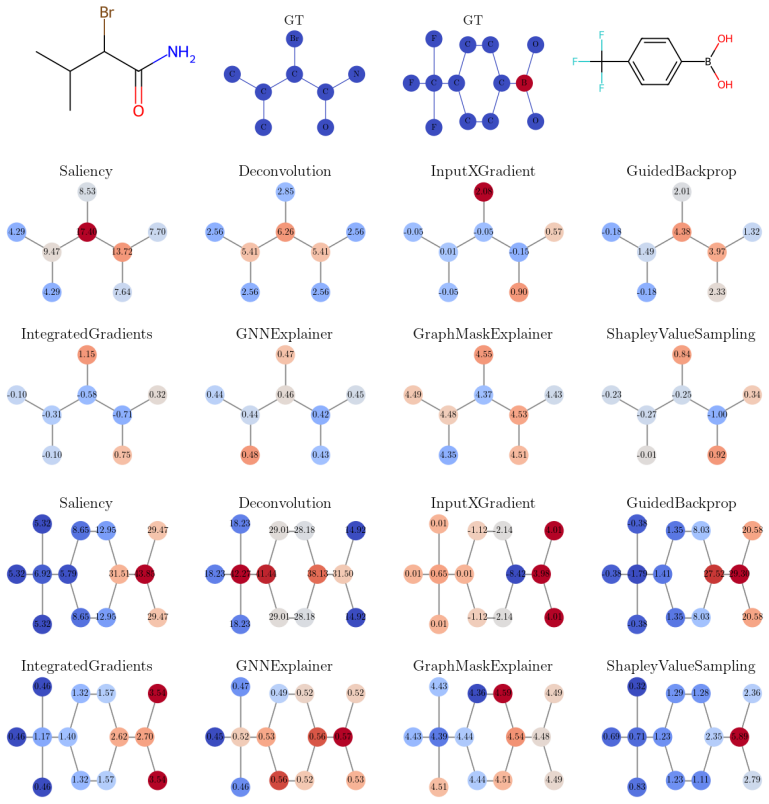
The benchmark's central object is the B-XAIC dataset, which pairs 50,000 real drug-like molecules with seven binary tasks defined by the presence of chemical substructures: a single boron or phosphorus atom, any halogen, an indole ring, a PAINS alert pattern, a ring count over four, and a maximum ring size over six. Each molecule carries ground-truth atom and edge explanation masks, and the evaluation splits explanations into two regimes: subgraph explanations, where a specific substructure must be highlighted and is scored by AUROC, and null explanations, where no substructure is relevant and the explanation must be uniform, scored by an interquartile-range outlier test. This two-regime design is what lets the benchmark distinguish 'wrong localization' from 'uninformative noise,' avoiding the thresholding problem of prior benchmarks.
What would settle it
Train a GIN on B-XAIC tasks, take positive molecules, and mask or remove the atoms belonging to the ground-truth substructure; if the predicted probability stays high after masking, the model is using other features and the explainers' failures would not demonstrate an XAI deficiency, whereas if predictions collapse, the explainers are truly failing to find the causal substructure.
Extended reading notes
Core claim
The central discovery is that explanation quality and prediction accuracy decouple in molecular GNNs: a model can be nearly perfect at a substructure-detection task while every tested explainer fails to recover that substructure. On B-XAIC, the GIN architecture reaches F1 scores above 98% across all seven tasks, yet the average subgraph-localization AUROC for the best node explainer is 0.82 and for the best edge explainer is 0.65, with many methods scoring close to chance on the null-explanation half of the benchmark. The paper attributes this systematic failure to the architectural principles of GNNs, arguing that message-passing diffusion impairs precise localization of salient features, and it positions B-XAIC as a resource to expose and address this gap.
Load-bearing premise
The benchmark assumes that a model with high F1 on a structure-detection task is actually predicting from the labeled substructure, so when an explainer does not highlight that substructure, the failure is attributed to the explainer rather than to the model having learned some other shortcut.
Editorial extensions
If this is right
- If correct, B-XAIC provides a ready testbed for any new XAI method targeting molecular GNNs, making it straightforward to check whether an explainer recovers known chemical substructures.
- The reported decoupling implies that high task accuracy cannot be used as evidence that an explainer is faithful, so benchmarks with ground-truth rationales become necessary for validation.
- The null-explanation scoring regime offers a template for evaluating explanations in situations where no single element is more important than others, which many existing evaluation metrics handle poorly.
- The results suggest that post-hoc gradient and mask-based explainers, despite their popularity, may need architectural changes or additional constraints to localize substructures in message-passing networks.
- The benchmark can also stress-test self-interpretable models: prototype-based GNNs underperform on ring-counting tasks, indicating that inherently interpretable designs are not automatically more faithful.
Reading between the lines
- A natural next step would be to use B-XAIC to test whether explanations improve when GNNs are trained with explicit substructure supervision or when message passing is restricted to local neighborhoods; the paper does not run such experiments.
- The same evaluation design could be extended to other graph domains with known rationales, such as citation or social graphs, which would show whether the observed decoupling is chemical in origin or a general property of message-passing architectures.
- Because the benchmark's tasks are all binary substructure-presence problems, a harder extension would be multi-class or multi-label tasks where overlapping rationales must be weighed, which the paper lists as ongoing work but does not validate.
- The paper's own limitation suggests a concrete diagnostic: measuring how much predicted probabilities drop when the ground-truth substructure is masked would separate explainer failure from model shortcut learning, a distinction the benchmark alone cannot draw.
Editorial analysis
A structured set of objections, weighed in public.
Referee Report
Summary. The paper introduces B-XAIC, a benchmark of 50K molecules sampled from ChEMBL with seven structure-detection tasks (single-atom presence, halogen presence, indole, PAINS, ring counting, and large-ring detection), each providing ground-truth node and edge rationales. The evaluation protocol distinguishes null explanations (NE), scored by a binary IQR outlier test, from subgraph explanations (SE), scored by AUROC. The authors evaluate eight explainers across GCN, GAT, GIN, and ProtGNN backbones and report that GIN achieves very high F1 scores on all tasks while most explainers obtain moderate or low explanation scores, especially on ring-related tasks. The paper concludes that current XAI techniques consistently fail to identify the relevant molecular structures and that B-XAIC is a needed benchmark for developing better GNN explainers.
Significance. If the central finding were fully established, B-XAIC would be a valuable real-world benchmark for GNN explanation evaluation, and the reported failure of existing explainers on simple substructure-recovery tasks would be an important result for the field. The dataset and code are released openly, the tasks are grounded in chemically meaningful patterns, and the NE/SE distinction is a useful design idea that goes beyond top-k thresholding. The paper also provides a broad evaluation across several architectures and explainers. However, the headline conclusion depends on an untested premise: that high predictive accuracy implies the GNN uses exactly the annotated substructure. The paper's own Limitations section concedes this confound, and the evaluation lacks random or uniform baselines and a robustness analysis of the binary NE metric. The benchmark itself remains useful as a resource, but the paper's central claim needs additional support or a more conditional formulation.
major comments (3)
- [Section 4.3 and Section 4.2] The conclusion that 'the explanations generated by the explainers consistently fail to properly identify and highlight the relevant molecular structures' rests on the assumption that a GIN with F1 above 98% on each task makes predictions by detecting exactly the substructure used to define the label. This premise is not tested. The Limitations section explicitly concedes: 'We cannot definitively guarantee that the trained models base their predictions on the intended underlying chemical principles.' For PAINS, rings-count, and rings-max in particular, high F1 is achievable through correlated shortcuts such as atom-type frequencies, molecular size, or generic ring counts, none of which require localizing the annotated pattern. If the model uses a shortcut, a faithful explainer would highlight the shortcut, not the ground-truth substructure, and the low SE AUROC would measure disagreement between the explainer and the label-derived ground truth rather than explainer unfaithfulness. I request either (i) experiments that test the premise, for example by measuring how predictions change when the target substructure is masked or removed, by training on label-permuted or shortcut-controlled splits, or by adding a random/uniform attribution baseline; or (ii) a reformulation of the conclusion as conditional on the model using the intended substructure.
- [Section 3.2 and Appendix A.4] The NE metric is a binary IQR outlier test with a hand-chosen 1.5 multiplier: a prediction is scored 1 if no outliers are detected and 0 otherwise. This is a coarse, distribution-dependent measure, and no random or uniform baseline is provided for comparison. A method that outputs a perfectly flat attribution will trivially pass, while a method with slightly heavy tails but otherwise reasonable behavior may fail, and the binary pass/fail outcome discards calibration information. The choice of 1.5 is arbitrary and no sensitivity analysis is reported. I recommend reporting NE with continuous alternatives (e.g., variance, entropy, or a Kolmogorov-Smirnov test against uniformity), showing how results vary with the IQR multiplier, and including a random attribution baseline so that NE scores can be interpreted.
- [Section 3.2 and Table 1] The NE/SE categorization for the counting tasks is not clearly specified and the Table 1 caption is inconsistent with the body text. The caption states 'SE denotes relevant subgraphs in positive instances, while NE denotes negative instances without explanations,' but for rings-count and rings-max the reported NE proportions are only 1.49% and 1.35%, respectively, which implies that most negative examples are assigned subgraph explanations rather than null explanations. It is not explained how the relevant substructures are defined for negative examples in these tasks, for example whether all rings are annotated in a molecule with three small rings, or how overlapping ring systems are handled. This ambiguity directly affects the construction of the SE ground truth and therefore the interpretability of the SE AUROC values for two of the seven tasks.
minor comments (4)
- [Section 2 (Related Work)] In the description of Alkane-Carbonyl, the text reads 'alkane (F-) and carbonyl (C=O) groups,' but the parenthetical '(F-)' appears to be a copy-paste error from Fluoride-Carbonyl; alkane groups should not be denoted with an F- label.
- [Section 3.1] The first two tasks are described as 'Detection of organoboron and organophosphorus compounds,' but the actual task is the presence of a single boron or phosphorus atom; consider renaming these to 'boron atom presence' and 'phosphorus atom presence' for accuracy.
- [Section 4.2] The text says the tasks are 'synthetic tasks' and that GIN achieves 'near-perfect performance across our synthetic tasks'; the B-XAIC tasks use real molecular graphs with pattern-derived labels, so 'synthetic tasks' is misleading and should be replaced with something like 'structure-detection tasks.'
- [Section 3.2] The definition of NE as 'no nodes or edges are more important than others' is intuitive for single-atom tasks but needs a precise operational rule for ring-counting tasks; please specify the exact annotation procedure for negative examples in rings-count and rings-max.
Circularity Check
No significant circularity; B-XAIC is an empirical benchmark whose evaluation scores are measured outcomes, and the acknowledged model-usage confound is a validity limitation, not a circular argument.
full rationale
B-XAIC is an empirical benchmark, not a derivation. The ground-truth rationales are generated from the same chemical pattern definitions that produce the labels; this is a standard design property of any substructure-detection benchmark and does not make the explanation evaluation circular, because explainer outputs are computed independently of those definitions. No parameter is fitted to the SE/NE scores and then reported as a prediction; the SE and NE scores are direct measured outcomes on held-out test data. The paper's Limitations section explicitly concedes that high-F1 models may not rely on the intended substructure ('We cannot definitively guarantee that the trained models base their predictions on the intended underlying chemical principles'), which is a threat to construct validity of the headline interpretation, not a circularity. The only author-overlapping citation (Rymarczyk et al., Progrest, ref [29]) is used in related work for prototype models and is not load-bearing. No equation or definition reduces a claimed result to its inputs, and no self-citation is used to justify the benchmark's central claim. Therefore the paper is self-contained against external benchmarks and warrants a circularity score of 0.
Assumptions & free parameters
free parameters (1)
- IQR outlier multiplier =
1.5
assumptions (3)
- domain assumption High task accuracy implies the model's predictions are based on the intended chemical substructures.
- domain assumption IQR outlier detection is a valid criterion for a correct null explanation.
- domain assumption Programmatic substructure matching for indoles, PAINS, and rings produces correct ground-truth explanations.
invented entities (1)
-
Null explanation (NE) vs. subgraph explanation (SE) protocol
Cite this review
Pith. "Pith review of B-XAIC Dataset: Benchmarking Explainable AI for Graph Neural Networks Using Chemical Data." pith.science (2026). https://pith.science/paper/MNO72Y5V
@misc{pith2026250522252,
  author       = {Pith},
  title        = {Pith review of: B-XAIC Dataset: Benchmarking Explainable AI for Graph Neural Networks Using Chemical Data},
  year         = {2026},
  howpublished = {\url{https://pith.science/paper/MNO72Y5V}},
  note         = {Machine review of arXiv:2505.22252}
}
read the original abstract
Understanding the reasoning behind deep learning model predictions is crucial in cheminformatics and drug discovery, where molecular design determines their properties. However, current evaluation frameworks for Explainable AI (XAI) in this domain often rely on artificial datasets or simplified tasks, employing data-derived metrics that fail to capture the complexity of real-world scenarios and lack a direct link to explanation faithfulness. To address this, we introduce B-XAIC, a novel benchmark constructed from real-world molecular data and diverse tasks with known ground-truth rationales for assigned labels. Through a comprehensive evaluation using B-XAIC, we reveal limitations of existing XAI methods for Graph Neural Networks (GNNs) in the molecular domain. This benchmark provides a valuable resource for gaining deeper insights into the faithfulness of XAI, facilitating the development of more reliable and interpretable models.
Figures


Figures from the paper (13 more)




Forward citations
Cited by 2 Pith papers
-
Fragment-Wise Interpretability in Graph Neural Networks via Molecule Decomposition and Contribution Analysis
SEAL makes GNN predictions inherently interpretable by decomposing molecules into fragments and defining the prediction as a sum of per-fragment contributions, enforced with regularized fragment-local message passing.
-
Measuring What Matters: A Unified Evaluation Framework for GNN Explainability
A dual feature/edge, ground-truth-free metric suite and large multi-task benchmark show Input×Gradient as a robust Pareto choice among eight GNN explainers, with no universal winner.
Reference graph
Works this paper leans on
-
[1]
Towards a unified framework for fair and stable graph representation learning
Chirag Agarwal, Himabindu Lakkaraju, and Marinka Zitnik. Towards a unified framework for fair and stable graph representation learning. In Cassio P. de Campos, Marloes H. Maathuis, and Erik Quaeghebeur, editors,Proceedings of the Thirty-Seventh Conference on Uncertainty in Artificial Intelligence, UAI 2021, Virtual Event, 27-30 July 2021, volume 161 ofPro...
work page 2021
-
[2]
Evaluating explainability for graph neural networks.Scientific Data, 10(144), 2023
Chirag Agarwal, Owen Queen, Himabindu Lakkaraju, and Marinka Zitnik. Evaluating explainability for graph neural networks.Scientific Data, 10(144), 2023
work page 2023
-
[3]
Graphframex: Towards systematic evaluation of explainability methods for graph neural networks, 2022
Kenza Amara, Rex Ying, Zitao Zhang, Zhihao Han, Yinan Shan, Ulrik Brandes, Sebastian Schemm, and Ce Zhang. Graphframex: Towards systematic evaluation of explainability methods for graph neural networks, 2022
work page 2022
-
[4]
Global explainability of gnns via logic combination of learned concepts
Steve Azzolin, Antonio Longa, Pietro Barbiero, Pietro Liò, and Andrea Passerini. Global explainability of gnns via logic combination of learned concepts. InThe Eleventh International Conference on Learning Representations, ICLR 2023, Kigali, Rwanda, May 1-5, 2023. OpenReview.net, 2023
work page 2023
-
[5]
Jonathan B Baell and Georgina A Holloway. New substructure filters for removal of pan assay interference compounds (pains) from screening libraries and for their exclusion in bioassays.Journal of medicinal chemistry, 53(7):2719–2740, 2010
work page 2010
-
[6]
Robust counterfactual explanations on graph neural networks
Mohit Bajaj, Lingyang Chu, Zi Yu Xue, Jian Pei, Lanjun Wang, Peter Cho-Ho Lam, and Yong Zhang. Robust counterfactual explanations on graph neural networks. In Marc’Aurelio Ranzato, Alina Beygelzimer, Yann N. Dauphin, Percy Liang, and Jennifer Wortman Vaughan, editors,Advances in Neural Information Processing Systems 34: Annual Conference on Neural Informa...
work page 2021
-
[7]
Borgwardt, Cheng Soon Ong, Stefan Schönauer, S
Karsten M. Borgwardt, Cheng Soon Ong, Stefan Schönauer, S. V . N. Vishwanathan, Alex J. Smola, and Hans-Peter Kriegel. Protein function prediction via graph kernels.Bioinformatics, 21(1):47–56, 2005
work page 2005
-
[8]
Grease: Generate factual and counterfactual explanations for gnn-based recommendations, 2022
Ziheng Chen, Fabrizio Silvestri, Jia Wang, Yongfeng Zhang, Zhenhua Huang, Hongshik Ahn, and Gabriele Tolomei. Grease: Generate factual and counterfactual explanations for gnn-based recommendations, 2022. 10
work page 2022
Show all 52 references
-
[9]
Bronstein, Emanuele Rodolà, Luca Rossi, and Andrea Torsello
Luca Cosmo, Giorgia Minello, Alessandro Bicciato, Michael M. Bronstein, Emanuele Rodolà, Luca Rossi, and Andrea Torsello. Graph kernel neural networks.IEEE Transactions on Neural Networks and Learning Systems, 36(4):6257–6270, April 2025
2025
-
[10]
Towards self-explainable graph neural network, 2021
Enyan Dai and Suhang Wang. Towards self-explainable graph neural network, 2021
2021
-
[11]
Lopez de Compadre, Gargi Debnath, Alan J
Asim Kumar Debnath, Rosa L. Lopez de Compadre, Gargi Debnath, Alan J. Shusterman, and Corwin Hansch. Structure-activity relationship of mutagenic aromatic and heteroaromatic nitro compounds. correlation with molecular orbital energies and hydrophobicity.Journal of Medicinal Ch...
1991
-
[12]
This looks like what? challenges and future research directions for part-prototype models.ArXiv preprint, abs/2502.09340, 2025
Khawla Elhadri, Tomasz Michalski, Adam Wróbel, Jörg Schlötterer, Bartosz Zieli´nski, and Christin Seifert. This looks like what? challenges and future research directions for part-prototype models.ArXiv preprint, abs/2502.09340, 2025
2025
-
[13]
Moghaddam, and Roger Wattenhofer
Lukas Faber, Amin K. Moghaddam, and Roger Wattenhofer. When comparing to ground truth is wrong: On evaluating GNN explanation methods. In Feida Zhu, Beng Chin Ooi, and Chunyan Miao, editors, KDD ’21: The 27th ACM SIGKDD Conference on Knowledge Discovery and Data Mining, Virtua...
2021
-
[14]
Kergnns: Interpretable graph neural networks with graph kernels
Aosong Feng, Chenyu You, Shiqiang Wang, and Leandros Tassiulas. Kergnns: Interpretable graph neural networks with graph kernels. InThirty-Sixth AAAI Conference on Artificial Intelligence, AAAI 2022, Thirty-Fourth Conference on Innovative Applications of Artificial Intelligence...
2022
-
[15]
Chembl: a large-scale bioactivity database for drug discovery.Nucleic acids research, 40(D1):D1100–D1107, 2012
Anna Gaulton, Louisa J Bellis, A Patricia Bento, Jon Chambers, Mark Davies, Anne Hersey, Yvonne Light, Shaun McGlinchey, David Michalovich, Bissan Al-Lazikani, et al. Chembl: a large-scale bioactivity database for drug discovery.Nucleic acids research, 40(D1):D1100–D1107, 2012
2012
-
[16]
Drug discovery with explainable artificial intelligence.Nature Machine Intelligence, 2(10):573–584, 2020
José Jiménez-Luna, Francesca Grisoni, and Gisbert Schneider. Drug discovery with explainable artificial intelligence.Nature Machine Intelligence, 2(10):573–584, 2020
2020
-
[17]
A survey on explainability of graph neural networks, 2023
Jaykumar Kakkad, Jaspal Jannu, Kartik Sharma, Charu Aggarwal, and Sourav Medya. A survey on explainability of graph neural networks, 2023
2023
-
[18]
Kipf and Max Welling
Thomas N. Kipf and Max Welling. Semi-supervised classification with graph convolutional networks. In 5th International Conference on Learning Representations, ICLR 2017, Toulon, France, April 24-26, 2017, Conference Track Proceedings. OpenReview.net, 2017
2017
-
[19]
Taylor, and Mohamed R
Boris Knyazev, Graham W. Taylor, and Mohamed R. Amer. Understanding attention and generalization in graph neural networks. In Hanna M. Wallach, Hugo Larochelle, Alina Beygelzimer, Florence d’Alché-Buc, Emily B. Fox, and Roman Garnett, editors,Advances in Neural Information Pro...
2019
-
[20]
Explaining the explainers in graph neural networks: a comparative study.ACM Computing Surveys, 57(5):1–37, January 2025
Antonio Longa, Steve Azzolin, Gabriele Santin, Giulia Cencetti, Pietro Lio, Bruno Lepri, and Andrea Passerini. Explaining the explainers in graph neural networks: a comparative study.ACM Computing Surveys, 57(5):1–37, January 2025
2025
-
[21]
ter Hoeve, Gabriele Tolomei, Maarten de Rijke, and Fabrizio Silvestri
Ana Lucic, Maartje A. ter Hoeve, Gabriele Tolomei, Maarten de Rijke, and Fabrizio Silvestri. Cf- gnnexplainer: Counterfactual explanations for graph neural networks. In Gustau Camps-Valls, Francisco J. R. Ruiz, and Isabel Valera, editors,International Conference on Artificial ...
2022
-
[22]
Parameterized explainer for graph neural network
Dongsheng Luo, Wei Cheng, Dongkuan Xu, Wenchao Yu, Bo Zong, Haifeng Chen, and Xiang Zhang. Parameterized explainer for graph neural network. In Hugo Larochelle, Marc’Aurelio Ranzato, Raia Hadsell, Maria-Florina Balcan, and Hsuan-Tien Lin, editors,Advances in Neural Information...
2020
-
[23]
Salient deconvolutional networks
Aravindh Mahendran and Andrea Vedaldi. Salient deconvolutional networks. In Bastian Leibe, Jiri Matas, Nicu Sebe, and Max Welling, editors,Computer Vision – ECCV 2016, pages 120–135, Cham, 2016. Springer International Publishing
2016
-
[24]
Teixeira, Luis Pinheiro, and Andre O
Ines Filipa Martins, Ana L. Teixeira, Luis Pinheiro, and Andre O. Falcao. A bayesian approach to in silico blood-brain barrier penetration modeling.Journal of Chemical Information and Modeling, 52(6):1686–1697, 2012. PMID: 22612593. 11
2012
-
[25]
Deeptox: Toxicity prediction using deep learning.Frontiers in Environmental Science, V olume 3 - 2015, 2016
Andreas Mayr, Günter Klambauer, Thomas Unterthiner, and Sepp Hochreiter. Deeptox: Toxicity prediction using deep learning.Frontiers in Environmental Science, V olume 3 - 2015, 2016
2015
-
[26]
Brenner, and Lucy J
Kevin McCloskey, Ankur Taly, Federico Monti, Michael P. Brenner, and Lucy J. Colwell. Using attribution to decode binding mechanism in neural network models for chemistry.Proceedings of the National Academy of Sciences, 116(24):11624–11629, 2019
2019
-
[27]
Interpretable and generalizable graph learning via stochastic attention mechanism
Siqi Miao, Mia Liu, and Pan Li. Interpretable and generalizable graph learning via stochastic attention mechanism. In Kamalika Chaudhuri, Stefanie Jegelka, Le Song, Csaba Szepesvári, Gang Niu, and Sivan Sabato, editors,International Conference on Machine Learning, ICML 2022, 1...
2022
-
[28]
From anecdotal evidence to quantitative evaluation methods: A systematic review on evaluating explainable ai.ACM Computing Surveys, 55(13s):1–42, July 2023
Meike Nauta, Jan Trienes, Shreyasi Pathak, Elisa Nguyen, Michelle Peters, Yasmin Schmitt, Jörg Schlöt- terer, Maurice van Keulen, and Christin Seifert. From anecdotal evidence to quantitative evaluation methods: A systematic review on evaluating explainable ai.ACM Computing Su...
2023
-
[29]
Progrest: Prototypical graph regression soft trees for molecular property prediction
Dawid Rymarczyk, Daniel Dobrowolski, and Tomasz Danel. Progrest: Prototypical graph regression soft trees for molecular property prediction. InProceedings of the 2023 SIAM International Conference on Data Mining (SDM), pages 379–387. SIAM, 2023
2023
-
[30]
Wei, Brian K
Benjamin Sanchez-Lengeling, Jennifer N. Wei, Brian K. Lee, Emily Reif, Peter Wang, Wesley Wei Qian, Kevin McCloskey, Lucy J. Colwell, and Alexander B. Wiltschko. Evaluating attribution for graph neural networks. In Hugo Larochelle, Marc’Aurelio Ranzato, Raia Hadsell, Maria-Flo...
2020
-
[31]
Interpreting graph neural networks for NLP with differentiable edge masking
Michael Sejr Schlichtkrull, Nicola De Cao, and Ivan Titov. Interpreting graph neural networks for NLP with differentiable edge masking. In9th International Conference on Learning Representations, ICLR 2021, Virtual Event, Austria, May 3-7, 2021. OpenReview.net, 2021
2021
-
[32]
Not just a black box: Learning important features through propagating activation differences, 2016
Avanti Shrikumar, Peyton Greenside, Anna Shcherbina, and Anshul Kundaje. Not just a black box: Learning important features through propagating activation differences, 2016
2016
-
[33]
Deep inside convolutional networks: Visualising image classification models and saliency maps, 2014
Karen Simonyan, Andrea Vedaldi, and Andrew Zisserman. Deep inside convolutional networks: Visualising image classification models and saliency maps, 2014
2014
-
[34]
Striving for simplicity: The all convolutional net, 2015
Jost Tobias Springenberg, Alexey Dosovitskiy, Thomas Brox, and Martin Riedmiller. Striving for simplicity: The all convolutional net, 2015
2015
-
[35]
An efficient explanation of individual classifications using game theory.J
Erik Štrumbelj and Igor Kononenko. An efficient explanation of individual classifications using game theory.J. Mach. Learn. Res., 11:1–18, 2010
2010
-
[36]
Axiomatic attribution for deep networks
Mukund Sundararajan, Ankur Taly, and Qiqi Yan. Axiomatic attribution for deep networks. In Doina Precup and Yee Whye Teh, editors,Proceedings of the 34th International Conference on Machine Learning, ICML 2017, Sydney, NSW, Australia, 6-11 August 2017, volume 70 ofProceedings ...
2017
-
[37]
Learning and evaluating graph neural network explanations based on counterfactual and factual reasoning
Juntao Tan, Shijie Geng, Zuohui Fu, Yingqiang Ge, Shuyuan Xu, Yunqi Li, and Yongfeng Zhang. Learning and evaluating graph neural network explanations based on counterfactual and factual reasoning. In Proceedings of the ACM Web Conference 2022, WWW ’22. ACM, April 2022
2022
-
[38]
Graph attention networks
Petar Velickovic, Guillem Cucurull, Arantxa Casanova, Adriana Romero, Pietro Liò, and Yoshua Bengio. Graph attention networks. In6th International Conference on Learning Representations, ICLR 2018, Vancouver, BC, Canada, April 30 - May 3, 2018, Conference Track Proceedings. Op...
2018
-
[39]
Comparison of descriptor spaces for chemical compound retrieval and classification
Nikil Wale and George Karypis. Comparison of descriptor spaces for chemical compound retrieval and classification. InSixth International Conference on Data Mining (ICDM’06), pages 678–689, 2006
2006
-
[40]
A compact review of molecular property prediction with graph neural networks.Drug Discovery Today: Technologies, 37:1–12, 2020
Oliver Wieder, Stefan Kohlbacher, Mélaine Kuenemann, Arthur Garon, Pierre Ducrot, Thomas Seidel, and Thierry Langer. A compact review of molecular property prediction with graph neural networks.Drug Discovery Today: Technologies, 37:1–12, 2020
2020
-
[41]
Graph information bottleneck
Tailin Wu, Hongyu Ren, Pan Li, and Jure Leskovec. Graph information bottleneck. In Hugo Larochelle, Marc’Aurelio Ranzato, Raia Hadsell, Maria-Florina Balcan, and Hsuan-Tien Lin, editors,Advances in Neural Information Processing Systems 33: Annual Conference on Neural Informati...
2020
-
[42]
Discovering invariant rationales for graph neural networks
Yingxin Wu, Xiang Wang, An Zhang, Xiangnan He, and Tat-Seng Chua. Discovering invariant rationales for graph neural networks. InThe Tenth International Conference on Learning Representations, ICLR 2022, Virtual Event, April 25-29, 2022. OpenReview.net, 2022
2022
-
[43]
Zhenxing Wu, Jihong Chen, Yitong Li, Yafeng Deng, Haitao Zhao, Chang-Yu Hsieh, and Tingjun Hou. From black boxes to actionable insights: a perspective on explainable artificial intelligence for scientific discovery.Journal of Chemical Information and Modeling, 63(24):7617–7627, 2023
2023
-
[44]
How powerful are graph neural networks? In7th International Conference on Learning Representations, ICLR 2019, New Orleans, LA, USA, May 6-9, 2019
Keyulu Xu, Weihua Hu, Jure Leskovec, and Stefanie Jegelka. How powerful are graph neural networks? In7th International Conference on Learning Representations, ICLR 2019, New Orleans, LA, USA, May 6-9, 2019. OpenReview.net, 2019
2019
-
[45]
Gnnexplainer: Generating explanations for graph neural networks
Zhitao Ying, Dylan Bourgeois, Jiaxuan You, Marinka Zitnik, and Jure Leskovec. Gnnexplainer: Generating explanations for graph neural networks. In Hanna M. Wallach, Hugo Larochelle, Alina Beygelzimer, Florence d’Alché-Buc, Emily B. Fox, and Roman Garnett, editors,Advances in Ne...
2019
-
[46]
Improving subgraph recognition with variational graph information bottleneck, 2021
Junchi Yu, Jie Cao, and Ran He. Improving subgraph recognition with variational graph information bottleneck, 2021
2021
-
[47]
Explainability in graph neural networks: A taxonomic survey, 2020
Hao Yuan, Haiyang Yu, Shurui Gui, and Shuiwang Ji. Explainability in graph neural networks: A taxonomic survey, 2020
2020
-
[48]
On explainability of graph neural networks via subgraph explorations
Hao Yuan, Haiyang Yu, Jie Wang, Kang Li, and Shuiwang Ji. On explainability of graph neural networks via subgraph explorations. In Marina Meila and Tong Zhang, editors,Proceedings of the 38th International Conference on Machine Learning, ICML 2021, 18-24 July 2021, Virtual Eve...
2021
-
[49]
Relex: A model-agnostic relational model explainer, 2020
Yue Zhang, David Defazio, and Arti Ramesh. Relex: A model-agnostic relational model explainer, 2020
2020
-
[50]
Protgnn: Towards self-explaining graph neural networks
Zaixi Zhang, Qi Liu, Hao Wang, Chengqiang Lu, and Cheekong Lee. Protgnn: Towards self-explaining graph neural networks. InThirty-Sixth AAAI Conference on Artificial Intelligence, AAAI 2022, Thirty-Fourth Conference on Innovative Applications of Artificial Intelligence, IAAI 20...
2022
-
[51]
Towards robust fidelity for evaluating explainability of graph neural networks
Xu Zheng, Farhad Shirani, Tianchun Wang, Wei Cheng, Zhuomin Chen, Haifeng Chen, Hua Wei, and Dongsheng Luo. Towards robust fidelity for evaluating explainability of graph neural networks. InThe Twelfth International Conference on Learning Representations, ICLR 2024, Vienna, Au...
2024
-
[2024]
13 A Full Evaluation Results Here we provide the full set of results that were shown partially in the main paper
OpenReview.net, 2024. 13 A Full Evaluation Results Here we provide the full set of results that were shown partially in the main paper. These results accompany the introduction of our benchmark and offer a detailed view of node and edge explanation performance across different...
2024
Reviewed August 7, 2026 · model on record in the stance chip above.
Discussion (0). Sign in to comment.