REVIEW 4 major objections 7 minor 36 references
Neural Restoration of Greening Defects in Historical Autochrome Photographs Based on Purely Synthetic Data
T0 review · 4 major / 7 minor · reviewed 2026-08-07 · deepseek-v4-flash
Pith's one-line read The paper's central claim is that greening defects in autochrome photographs can be removed automatically by a restoration network trained purely on synthetic defect simulations, with a modified loss that focuses color correction on…
desk verdict A sensible, narrowly scoped first step on autochrome greening restoration, with an honest synthetic-data pipeline but real-world effect shown only qualitatively. read the letter →
The pith
A machine-rendered reading of the paper's core claim, the machinery that carries it, and where it could break.
The reading
What carries the argument
The load-bearing mechanism is the synthetic defect generator paired with a defect-weighted loss on the ChaIR channel-interaction restoration network, a model that combines spatial and frequency-domain losses with dual-domain channel attention. The simulator turns clean autochromes into defected/ground-truth pairs by drawing irregular ellipses (origins inside the image for spot defects, outside for large liquid-leak defects), interpolating intensity by $I = -d^2 + 1$, applying a per-ring dictionary of percent changes to red, green, and blue channels, and smoothing with a Gaussian filter; the resulting masks annotate the defect regions. The loss modification replaces ChaIR's uniform spatial L1 term with a weighted version in which $W(x,y)=1.0$ where input and ground truth differ by more than threshold $t=0.1$ and $w\in\{0.1,0.5\}$ elsewhere, so the model is penalized 2–10 times more for color errors inside defects while preserving the frequency-domain loss.
What would settle it
Run the trained model on autochromes from a different archive or digitization setup and inspect whether green stains disappear without bluish color casts, smoothed grain texture, or missed small spots; if the simulator's per-channel ratios are specific to one collection's aging and scanning conditions, defects from other collections will either persist or be over-corrected.
Extended reading notes
Core claim
Greening in autochromes is not a uniform green overlay: analysis of real defects shows the green channel is least affected, often increasing in intensity, while the red and blue channels drop sharply, in concentric rings with dark cores and orange borders. The paper's central claim is that a restoration network trained purely on synthetic reproductions of this channel-wise corruption can automatically de-green real autochromes. The authors simulate defects as irregular ellipses with intensity falloff $I = -d^2 + 1$, per-ring RGB corruption percentages from a hand-built dictionary, and Gaussian smoothing, and they fine-tune ChaIR on these synthetic pairs using a weighted spatial loss $l_s = \frac{1}{N}\sum_{x,y} W(x,y)|\hat{Y} - Y|$ with weights two to ten times higher in defect areas. Their evaluation reports higher PSNR and MS-SSIM than the baseline network, and qualitative removal of large and spotting defects on real images, where generic restoration and inpainting tools fail.
Load-bearing premise
The entire pipeline rests on the assumption that the synthetic defect simulator faithfully reproduces real greening; its geometry and per-channel color changes come from visual analysis of only seven autochromes from a single collection, with the per-ring RGB percentages in the dictionary hand-set to fit those observations.
Editorial extensions
If this is right
- Autochrome collections without defect annotations can still be restored by training exclusively on synthetically generated defects from defect-free scans.
- The defect-weighted loss improves color fidelity inside damaged regions compared to a uniform loss, with larger gains at weight 10 than at weight 2.
- The approach preserves the characteristic autochrome grain texture, unlike histogram matching or generative inpainting, so restored images remain plausible for curators.
- The degreened output can serve as a starting point for further targeted inpainting of very small remaining defects.
Reading between the lines
- The same per-ring channel-corruption dictionary could be re-fit for other systematic dye defects, such as the 'oranging' the paper names as future work, giving a parameterized family of synthetic defect generators for historical color photography.
- Because the weighted loss only needs input/ground-truth pairs during training, the method could be extended to semi-supervised settings: a learned defect detector could supply masks for real images and let the same loss train on unpaired data.
- A direct testable extension would be to train on synthetic defects derived from several collections with different scanners and compare per-collection restoration quality; this would quantify how tightly the simulator is tied to the original seven-image analysis.
- The code and dataset release promised by the paper would let conservators generate bespoke training sets for their own digitized autochromes, effectively turning the simulator into a reusable restoration tool.
Editorial analysis
A structured set of objections, weighed in public.
Referee Report
Summary. The paper targets automatic removal of "greening" color defects in digitized autochrome photographs. Since no paired real-world data with defect-free ground truth exists, the authors design a synthetic degradation simulator based on visual inspection of seven autochromes from the Harold Taylor collection, generate defected/undamaged training pairs from 306 defect-free autochromes, and train a ChaIR-based restoration network with a modified loss that upweights defect regions. The method is compared quantitatively against Pix2Pix, CycleGAN, and a pretrained ChaIR variant on synthetic test images, and qualitatively against Photoshop Generative Fill and InstructIR-based restoration on real autochromes. The paper claims to be the first learning-based approach for automatic greening removal and to provide efficient and effective restoration.
Significance. If the central assumption holds—that the synthetic defect simulator faithfully represents real greening in autochromes—the paper would offer a practical tool for cultural heritage preservation and a reusable synthetic-data recipe. The authors provide a concrete pipeline, a publicly promised dataset and code release, a modified loss for color-imbalanced defects, and a useful discussion of failure modes. However, the quantitative evidence is currently self-referential: the network is trained and evaluated on outputs of the same simulator, so the reported PSNR/MS-SSIM values largely measure the model's ability to invert its own synthetic corruption model. The real-image evaluation is qualitative and anecdotal, with no metrics, statistical tests, or independent validation. The significance of the contribution therefore depends on future evidence that the simulator generalizes, which the paper itself flags as open future work.
major comments (4)
- [§5, Tables 2–3] The central quantitative evaluation is circular in a practical sense. The test images in Tables 2 and 3 are generated by the same synthetic degradation algorithm used to create the training data, so the reported PSNR and MS-SSIM scores measure self-consistency with the simulator rather than restoration performance on real greening defects. The paper's abstract and conclusion claim "efficient and effective restoration" of the considered defects, but this claim is not supported by the quantitative evidence. The authors should add a quantitative real-image evaluation protocol—for example, expert ratings on a defined scale, no-reference image quality metrics, or paired scans where available—or at minimum provide a cross-validation study that fits the simulator on a subset of real defects and tests on held-out real defect samples.
- [§3, Table 1] The synthetic simulator is fitted to an extremely small and homogeneous evidence base: visual analysis of seven autochromes from one collection (Harold Taylor). The per-ring RGB corruption percentages in Table 1 are hand-set, the random adjustment factor 0.2 is chosen "empirically," and there is no quantitative comparison of the simulated defect statistics (color distributions, ring geometry, transparency, edge behavior) against a held-out set of real greening defects. Because the real-image claims rest entirely on this simulator, the authors should provide evidence that the synthetic defect distribution matches real greening beyond the seven training examples, and should test the trained model on autochromes from other collections or under different digitization conditions. The future-work statement that the synthetic dataset "must be expanded to support digitized autochromes from other collections" implicitly concedes that this generalization is currently unverified.
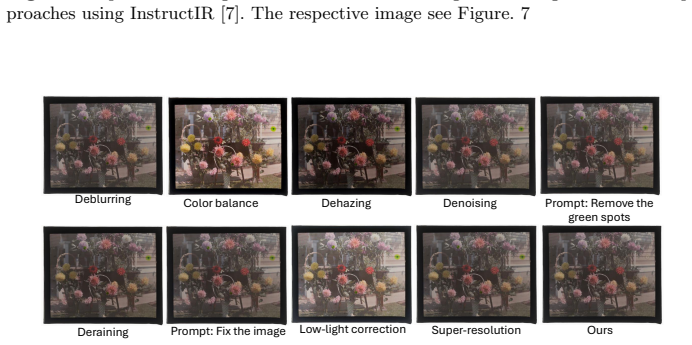
- [§5, Table 4 and "Quantitative results"] The comparison against Photoshop Generative Fill is reported only on synthetic test images, with two aggregate metrics and no sample size, variance, or statistical test. The claim that the method "outperforms" a state-of-the-art photo-editing tool is therefore not statistically established. The authors should specify the number of test images, report per-image or error-bar results, and ideally include a real-image comparison with a defined scoring protocol, since the practical claim is about real autochromes.
- [§3, Eqs. (3)–(4)] The weighted loss identifies defect areas during training by thresholding |I_in − I_GT| at t = 0.1. In the synthetic setup, both I_in and I_GT are generated by the same pipeline, so the defect mask is known by construction and is perfectly aligned with the corruption. This does not demonstrate that the model can localize or correct defects in real images, where no ground-truth difference is available. The qualitative "affected areas" shown in Fig. 7(c) appear to rely on the same input-minus-output comparison and should not be presented as evidence of accurate defect detection on real images. The authors should clarify how the loss weighting transfers to inference and provide an independent real-image defect-localization evaluation if they wish to claim automatic detection.
minor comments (7)
- [Abstract and §1] The phrase "first approach" appears twice in the abstract and again in the introduction; given the breadth of the restoration literature, the authors should either substantiate the novelty claim with a more exhaustive literature search or temper the wording.
- [§4] The labeling procedure is described only as "with assistance from an expert"; the authors should specify the labeling protocol, the number of experts, and any inter-rater agreement measure, since the 306/95 split is used to justify the simulator design.
- [§3, Eqs. (1)–(2)] The symbol S_i in the spatial and frequency losses is not defined. It should be stated whether S_i is the number of pixels, the spatial size, or a normalization constant.
- [§5, Tables 2 and 3] Table 2's caption notes that the loss weights defect and non-defect areas equally (W(x,y)=1.0) for those results, which is inconsistent with the method section that defines w ∈ {0.1, 0.5}. Please clarify which configuration corresponds to which table and why W=1.0 is used for the baseline comparison.
- [§5, Table 1] The first column "Label" contains entries such as '9', '1', '2', '3', '4', '99', and '20' with no explanation of what these labels mean or how they correspond to rings; the final row labeled "Surface" further confuses the schema. Please replace with a clear ring-index or name convention.
- [§6] The conclusion states that "AI based inpainting methods enable targeted defect removal in stationary regions in small areas" while earlier sections argue Generative Fill is unsuitable; the authors should reconcile this apparent contradiction or clarify the intended workflow (e.g., using their model as a preprocessing step plus inpainting).
- [References] References [10] and [11] appear to be the same arXiv preprint; please consolidate and use a consistent citation format. Also, the training/test split and the number of synthetic test images are not reported; these details are necessary for reproducibility.
Circularity Check
Quantitative restoration scores measure the network's ability to invert the paper's own hand-fitted synthetic greening simulator, so the central real-image claim rests on qualitative examples only.
-
fitted input called prediction
[Section 3 (Synthetic generation of greening defects, Table 1) and Section 5 (Tables 2-3)]
"For each ring, a change in percent of the individual color channels in the defect areas is defined. These are randomly adjusted by a factor of 0.2 (chosen empirically to avoid drastic color channel changes and maintain realism of the defects) in both directions for each image. Table 1 shows the definition of the individual modifications per channel and ring in a dictionary. ... The intensity change ΔIc for color channel c is calculated as ΔIc = ( pc ∗ Ic) − Ic. ... The results in Table 2 and Table 3 present PSNR and SSIM scores between synthetic references and outputs."
The per-ring channel multipliers pc in Table 1 are hand-set from visual inspection of seven autochromes, and the same dictionary drives the simulator that produced both the training pairs and the quantitative test images. A network trained to invert this exact generative model is then scored on further outputs of the same model, so the high PSNR/MS-SSIM numbers in Tables 2-3 demonstrate synthetic-model inversion rather than restoration of real greening defects. The only real-image evidence is qualitative (Fig. 7), and the conclusion concedes the method 'sometimes struggles to accurately reproduce the original colors' and produces bluish tones.
full rationale
The paper's synthetic-data pipeline is internally consistent: training and testing on the same synthetic defect generator is a standard supervised benchmark for the narrow claim that the network can undo that generator. That part is not circular in a strict sense. The circularity arises when the paper elevates these in-distribution synthetic PSNR/MS-SSIM numbers into evidence for the central claim of automatic greening removal in real digitized autochromes. The defect model's parameters are not fitted by an objective procedure to a large corpus; they are hand-set from seven images from one collection, and the same parameters define the test distribution. Thus the quantitative evaluation is, by construction, an inversion test of the paper's own simulator. The paper does provide qualitative real-image results and explicitly lists limitations and future work, which prevents the problem from being a fully forced self-citation or definitional equivalence, but the strength of the central claim still exceeds the independent evidence. No load-bearing self-citations or imported uniqueness theorems were found.
Assumptions & free parameters
free parameters (5)
- random adjustment factor for channel percentages =
0.2
- loss weight threshold t =
0.1
- non-defect weight w in loss =
0.1 or 0.5
- per-ring per-channel corruption percentages =
Table 1, e.g., blue 0.6, green 0.85, red 1.05 for the outer ring
- defect geometry parameters =
spot diameters 1-5% of image width, large defects up to 1/3, 1-7 spots or 1-2 large defects, intensity falloff I=-d^2+1
assumptions (4)
- domain assumption The greening defects observed in 7 autochrome images from the Harold Taylor collection are representative of greening defects in autochromes generally.
- domain assumption Greening manifests as increased green-channel intensity and decreased red and blue intensity in defective areas.
- ad hoc to paper The weighted loss with threshold t=0.1 correctly identifies defect areas from input minus ground-truth differences during training.
- domain assumption Autochrome grain texture should be preserved during restoration.
Cite this review
Pith. "Pith review of Neural Restoration of Greening Defects in Historical Autochrome Photographs Based on Purely Synthetic Data." pith.science (2026). https://pith.science/paper/FPAUYHF6
@misc{pith2026250522291,
  author       = {Pith},
  title        = {Pith review of: Neural Restoration of Greening Defects in Historical Autochrome Photographs Based on Purely Synthetic Data},
  year         = {2026},
  howpublished = {\url{https://pith.science/paper/FPAUYHF6}},
  note         = {Machine review of arXiv:2505.22291}
}
read the original abstract
The preservation of early visual arts, particularly color photographs, is challenged by deterioration caused by aging and improper storage, leading to issues like blurring, scratches, color bleeding, and fading defects. Despite great advances in image restoration and enhancement in recent years, such systematic defects often cannot be restored by current state-of-the-art software features as available e.g. in Adobe Photoshop, but would require the incorporation of defect-aware priors into the underlying machine learning techniques. However, there are no publicly available datasets of autochromes with defect annotations. In this paper, we address these limitations and present the first approach that allows the automatic removal of greening color defects in digitized autochrome photographs. For this purpose, we introduce an approach for accurately simulating respective defects and use the respectively obtained synthesized data with its ground truth defect annotations to train a generative AI model with a carefully designed loss function that accounts for color imbalances between defected and non-defected areas. As demonstrated in our evaluation, our approach allows for the efficient and effective restoration of the considered defects, thereby overcoming limitations of alternative techniques that struggle with accurately reproducing original colors and may require significant manual effort.
Figures


Figures from the paper (7 more)


Reference graph
Works this paper leans on
-
[1]
Afifi, M.: Semantic white balance: Semantic color constancy using convolutional neural network. CoRR abs/1802.00153 (2018)
arXiv 2018
- [2]
- [3]
-
[4]
Barker, G., Hubicka, J., Jacobs, M., Kimrov´ a, L., Meyer, K., Peterson, D.: Finlay, thames, dufay, and paget color screen process collections: Using digital registration of viewing screens to reveal original color. CoRR abs/2211.16076 (2022)
work page Pith review arXiv 2022
-
[5]
IEEE Multimedia 7(2), 34–37 (2000)
Barni, M., Bartolini, F., Cappellini, V.: Image processing for virtual restoration of artworks. IEEE Multimedia 7(2), 34–37 (2000)
work page 2000
-
[6]
Barron, J.T., Malik, J.: Intrinsic scene properties from a single RGB- D image. IEEE Trans. Pattern Anal. Mach. Intell. 38(4), 690–703 (2016). https://doi.org/10.1109/TPAMI.2015.2439286, https://doi.org/10.1109/TPAMI. 2015.2439286
arXiv 2016
-
[7]
In: Proceedings of the European Conference on Com- puter Vision (ECCV) (2024)
Conde, M.V., Geigle, G., Timofte, R.: Instructir: High-quality image restoration following human instructions. In: Proceedings of the European Conference on Com- puter Vision (ECCV) (2024)
work page 2024
-
[8]
Knowledge-Based Systems 282 (2023)
Cui, Y., Knoll, A.: Exploring the potential of channel interactions for image restora- tion. Knowledge-Based Systems 282 (2023)
work page 2023
Show all 36 references
-
[9]
In: 2008 IEEE Computer Society Conference on Computer Vision and Pattern Recognition (CVPR 2008)
Enzweiler, M., Gavrila, D.M.: A mixed generative-discriminative framework for pedestrian classification. In: 2008 IEEE Computer Society Conference on Computer Vision and Pattern Recognition (CVPR 2008). IEEE Computer Society (2008)
2008
-
[11]
arXiv preprint arXiv:2401.01629 (2024), http://arxiv.org/abs/2401.01629, visited on 10/26/2024
Hao, S., et al.: Synthetic data in ai: Challenges, applications, and ethical implica- tions. arXiv preprint arXiv:2401.01629 (2024), http://arxiv.org/abs/2401.01629, visited on 10/26/2024
2024 arXiv
-
[12]
adobe.com/uk/products/photoshop/generative-fill.html, visited on 10/30/2024
Inc., A.: Generative fill - ai fill in image - adobe photoshop (2024), https://www. adobe.com/uk/products/photoshop/generative-fill.html, visited on 10/30/2024
2024
-
[13]
In: CVPR
Isola, P., Zhu, J., Zhou, T., Efros, A.A.: Image-to-image translation with condi- tional adversarial networks. In: CVPR. pp. 5967–5976 (2017)
2017
-
[14]
Kovalev, A.: Autochrome print midjourney style (2024), https://midlibrary.io/ styles/autochrome-print, accessed: 2024-10-26
2024
-
[15]
Archives of Computational Meth- ods in Engineering (2024)
Kumar, P., Gupta, V.: Preserving artistic heritage: A comprehensive review of vir- tual restoration methods for damaged artworks. Archives of Computational Meth- ods in Engineering (2024)
2024
-
[16]
Getty Publications (2013)
Lavedrine, B., Gandolfo, J.P., Capdero, C.: The Lumiere Autochrome: History, Technology, and Preservation. Getty Publications (2013)
2013
-
[17]
IEEE Trans
Li, B., Ren, W., Fu, D., Tao, D., Feng, D., Zeng, W., Wang, Z.: Benchmarking single-image dehazing and beyond. IEEE Trans. Image Process. 28(1), 492–505 (2019)
2019
-
[18]
In: ACM Multimedia
Mao, H., Cheung, M., She, J.: Deepart: Learning joint representations of visual arts. In: ACM Multimedia. pp. 1183–1191 (2017)
2017
-
[19]
ACM Trans
Mao, H., She, J., Cheung, M.: Visual arts search on mobile devices. ACM Trans. Multim. Comput. Commun. Appl. 15(2s), 60:1–60:23 (2019) 14 Authors Suppressed Due to Excessive Length
2019
-
[20]
In: AICCM Symposium 2006, Conservation of Paper, Books and Photographic Materials
M¨ uller, U.: A method of consolidating delaminated autochrome plates from the photograph collection of the albertina museum in vienna. In: AICCM Symposium 2006, Conservation of Paper, Books and Photographic Materials. Post-prints and Posters. 4th Book, Paper & Photographs Sym...
2006
-
[21]
Arts & Communica- tion (11 2023)
O’brien, C., Hutson, J., Olsen, T., Ratican, J.: Limitations and possibilities of digi- tal restoration techniques using generative ai tools: Reconstituting antoine fran¸ cois callet’s achilles dragging hector’s body past the walls of troy. Arts & Communica- tion (11 2023)
2023
-
[22]
Paulin, G., Ivasic-Kos, M.: Review and analysis of synthetic dataset generation methods and techniques for application in computer vision. Artif. Intell. Rev. 56(9), 9221–9265 (2023)
2023
-
[23]
In: Leibe, B., Matas, J., Sebe, N., Welling, M
Richter, S.R., Vineet, V., Roth, S., Koltun, V.: Playing for data: Ground truth from computer games. In: Leibe, B., Matas, J., Sebe, N., Welling, M. (eds.) Computer Vision - ECCV 2016 - 14th European Conference. Lecture Notes in Computer Science, vol. 9906, pp. 102–118. Spring...
2016
-
[24]
Saunders, N.: Enhancement of old colour photographs using generative ad- versarial networks (2021), https://nsaunders.wordpress.com/2021/12/23/ enhancement-of-old-colour-photographs-using-generative-adversarial-networks/, accessed: 22.01.2025
2021
-
[25]
In: The 24th IEEE Conference on Computer Vision and Pattern Recognition (CVPR 2011)
Shotton, J., Fitzgibbon, A.W., Cook, M., Sharp, T., Finocchio, M., Moore, R., Kipman, A., Blake, A.: Real-time human pose recognition in parts from single depth images. In: The 24th IEEE Conference on Computer Vision and Pattern Recognition (CVPR 2011). pp. 1297–1304. IEEE Com...
2011
-
[26]
In: 2024 International Conference on Cyberworlds (CW)
Sinha, S.N., K¨ uhn, P.J., Koppe, J., Graf, H., Weinmann, M.: Digital restora- tion of visual art using synthetic training, deep segmentation and inpainting. In: 2024 International Conference on Cyberworlds (CW). pp. 338–339 (2024). https://doi.org/10.1109/CW64301.2024.00062
2024
-
[27]
In: W ACV
Suvorov, R., Logacheva, E., Mashikhin, A., Remizova, A., Ashukha, A., Silvestrov, A., Kong, N., Goka, H., Park, K., Lempitsky, V.: Resolution-robust large mask inpainting with fourier convolutions. In: W ACV. pp. 3172–3182 (2022)
2022
-
[28]
In: 19th International Conference on Pattern Recognition (ICPR 2008)
Targhi, A.T., Geusebroek, J., Zisserman, A.: Texture classification with minimal training images. In: 19th International Conference on Pattern Recognition (ICPR 2008). pp. 1–4. IEEE Computer Society (2008)
2008
-
[29]
Taylor, H.A.: Harold Taylor slide collection. California Revealed (1896), https://californiarevealed.org/search?search api fulltext=&f%5B0%5D= search page series title:Harold%20Taylor%20Slide%20Collection, visited on 11/26/2024
2024
-
[30]
In: Proceedings of the 21st International Conference on Pattern Recognition (ICPR 2012)
V´ azquez, D., L´ opez, A.M., Ponsa, D.: Unsupervised domain adaptation of virtual and real worlds for pedestrian detection. In: Proceedings of the 21st International Conference on Pattern Recognition (ICPR 2012). pp. 3492–3495. IEEE Computer Society (2012)
2012
-
[31]
In: W ACV
Vitoria, P., Raad, L., Ballester, C.: Chromagan: Adversarial picture colorization with semantic class distribution. In: W ACV. pp. 2434–2443 (2020)
2020
-
[32]
In: Fleet, D.J., Pajdla, T., Schiele, B., Tuytelaars, T
Weinmann, M., Gall, J., Klein, R.: Material classification based on train- ing data synthesized using a BTF database. In: Fleet, D.J., Pajdla, T., Schiele, B., Tuytelaars, T. (eds.) Computer Vision - ECCV 2014 - 13th Eu- ropean Conference, Zurich, Switzerland, September 6-12, ...
2014 doi
-
[33]
IEEE Access (2023)
Zhai, L., Wang, Y., Cui, S., Zhou, Y.: A comprehensive review of deep learning-based real-world image restoration. IEEE Access (2023). https://doi.org/10.1109/ACCESS.2023.3250616
2023
-
[34]
CoRR abs/2403.10520 (2024)
Zhang, Z., Han, J., Gou, C., Li, H., Zheng, L.: Strong and controllable blind image decomposition. CoRR abs/2403.10520 (2024)
2024 arXiv
-
[35]
CoRR abs/2203.11947 (2022)
Zheng, H., Lin, Z., Lu, J., Cohen, S., Shechtman, E., Barnes, C., Zhang, J., Xu, N., Amirghodsi, S., Luo, J.: CM-GAN: image inpainting with cascaded modulation GAN and object-aware training. CoRR abs/2203.11947 (2022)
2022 arXiv
-
[36]
In: ICCV
Zhu, J., Park, T., Isola, P., Efros, A.A.: Unpaired image-to-image translation using cycle-consistent adversarial networks. In: ICCV. pp. 2242–2251 (2017)
2017
-
[37]
In: CVPR
Zou, Z., Lei, S., Shi, T., Shi, Z., Ye, J.: Deep adversarial decomposition: A unified framework for separating superimposed images. In: CVPR. pp. 12803–12813 (2020)
2020
Reviewed August 7, 2026 · model on record in the stance chip above.
Discussion (0). Sign in to comment.