REVIEW 3 major objections 5 minor 1 cited by
Fully Offline Reinforcement Learning
T0 review · 3 major / 5 minor · reviewed 2026-08-07 · deepseek-v4-flash
Pith's one-line read A Bayesian posterior's information loss bounds the regret of an offline-trained policy, letting hyperparameters and deployment timing be decided entirely offline.
desk verdict Promising offline-RL framework with a genuine PIL regret bound, but the deployment decision rests on an untested heuristic and Theorem 2 has a fixable typo. read the letter →
The pith
A machine-rendered reading of the paper's core claim, the machinery that carries it, and where it could break.
The reading
What carries the argument
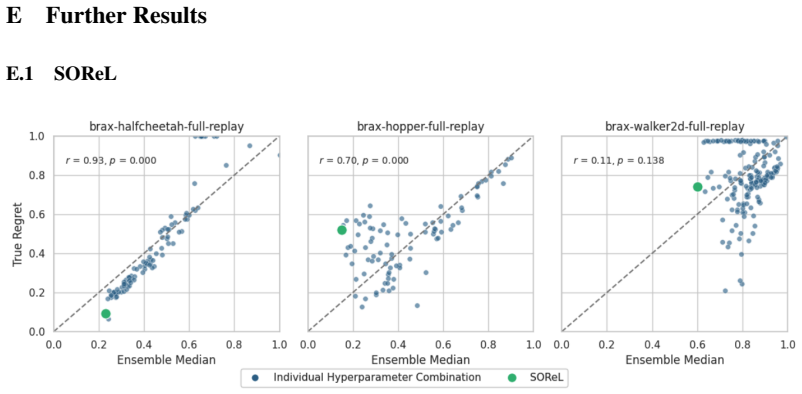
The load-bearing object is the posterior information loss (PIL), $I^\pi_N=\mathbb{E}_{\theta\sim P_\Theta(D_N)}\mathbb{E}_{(s,a)\sim\rho^\star_\pi}\mathrm{KL}(P^\star_{R,S}(s,a)\|P_{R,S}(s,a,\theta))$, an expected KL divergence between true and model dynamics weighted by the arithmetico-geometric ergodic state-action distribution $\rho^\star_\pi$, which downweights state-action pairs reached only after many steps. Theorem 1 converts PIL into a regret bound through the Bretagnolle-Huber inequality, so the information rate, the rate at which PIL falls with more data, becomes the object that governs regret decay. For Gaussian world models, PIL decomposes into a mean-squared-error term plus a predictive-variance term, both estimable from offline data, and Theorem 2 derives the $\sqrt{d/N}$ rate from this decomposition under local asymptotic normality. The second mechanism is the posterior predictive median of returns in Eq. (10), which serves as the offline proxy for regret by rolling out the Bayes-optimal policy under posterior-sampled dynamics; SOReL tunes the BAMDP solver against this proxy and checks the MSE/variance balance as a reliability signal.
What would settle it
Train SOReL on an offline dataset with deliberately limited coverage, such as one that contains no transitions in the state-action region the optimal policy visits, using a Gaussian world model that is known to be misspecified; compute approximate regret from Eq. (10) and then deploy to measure true regret. If approximate regret falls below $R_{\mathrm{Deploy}}$ while true regret is above it, the proxy is falsified, and the paper's own 'unreliable' shaded region for MSE/variance misalignment is exactly the regime where this should be tested.
Extended reading notes
Core claim
On the paper's own terms, the central discovery is that Bayesian offline RL has a clean frequentist regret theory: the true regret of the Bayes-optimal policy trained on the posterior from offline data is controlled by how much information the posterior still lacks about the true dynamics. Theorem 1 bounds regret by $2R_{\max}\sup_\pi\sqrt{1-\exp(-I^\pi_N/(1-\gamma))}$, with $I^\pi_N$ defined as the expected posterior KL divergence between the true transition-reward distribution and the model, weighted by an arithmetico-geometric ergodic state-action distribution. Theorem 2 shows that, under standard local asymptotic normality assumptions, the expected regret of parametric Gaussian world models decays at the parametric minimax rate $O(\sqrt{d/N})$, the same rate as frequentist parametric density estimation. The paper then operationalizes this: SOReL estimates regret before deployment as $\hat{R}_{\max}$ minus the median predictive return from posterior rollouts, monitors the PIL and the alignment between mean-squared error and predictive variance to tune model and inference hyperparameters offline, and deploys only when approximate regret falls below a threshold $R_{\mathrm{Deploy}}$. The empirical claim is that this approximate regret tracks true regret in the tested control environments and that TOReL's fully offline hyperparameter selection is competitive with online tuning while sparing large numbers of online samples.
Load-bearing premise
The deployment certificate rests on the unproven hypothesis, introduced in Section 6.1 rather than derived, that the posterior predictive median of returns in Eq. (10) approximates true regret closely enough that the safety threshold $R_{\mathrm{Deploy}}$ is meaningful; that proxy is validated on only five control environments.
Editorial extensions
If this is right
- A practitioner can set a safety threshold $R_{\mathrm{Deploy}}$ and use only offline data to decide whether the Bayes-optimal policy is ready to deploy, breaking the train-deploy-fail-retune loop.
- The information rate becomes a fully offline diagnostic: a flat PIL curve signals that more data, a different model class, or different approximate-inference settings are needed before deployment.
- For parametric Gaussian world models, the $\sqrt{d/N}$ regret rate means the number of offline transitions needed for a target regret grows roughly linearly with the effective dimension of the dynamics model.
- TOReL's PIL-based selection can replace online hyperparameter sweeps for both model-free and model-based offline RL algorithms, with no measured sacrifice in final regret.
- Because the safety decision is made through posterior predictive rollouts, the guarantee is only as strong as the posterior's coverage of the true MDP; outside that support the bound still holds, but the proxy in Eq. (10) may not.
Reading between the lines
- Editorial inference: the regret bound in Theorem 1 applies to an exact Bayes-optimal policy and exact posterior, while SOReL's experiments use approximate inference and an approximate BAMDP solver; a natural sharper check is to measure how approximation error enters the gap between the Eq. (10) proxy and true regret.
- Editorial inference: if the posterior-predictive-median proxy is taken as calibrated, the same construction could estimate other deployment metrics of interest, such as the probability of constraint violation in safety-critical control, not just discounted return.
- Editorial inference: the $\sqrt{d/N}$ rate suggests that lowering effective model dimension, for example by a structured prior or by model reduction, should directly reduce the data needed to reach a given regret level; the paper's plateau curves imply this but do not test it.
- Editorial inference: the current empirical support for the proxy covers five control environments with deliberately diverse full-replay datasets; testing on misspecified model classes or datasets with missing coverage in the optimal-policy region would clarify whether the proxy remains conservative where the posterior is least trustworthy.
Editorial analysis
A structured set of objections, weighed in public.
Referee Report
Summary. The paper introduces SOReL, a Bayesian model-based offline RL method that learns a posterior over environment dynamics and uses the posterior information loss (PIL) to bound true regret and to tune hyperparameters entirely offline, and TOReL, a tuning framework that applies the same offline tuning principles to general model-free and model-based ORL algorithms. The theoretical contribution is a regret bound in terms of the PIL (Theorem 1) and a claimed parametric minimax rate for the expected regret of a Bayes-optimal policy in Gaussian world models (Theorem 2). The empirical sections evaluate SOReL's approximate regret proxy and TOReL's offline hyperparameter selection on brax and D4RL MuJoCo benchmarks, reporting near-oracle performance for ReBRAC+TOReL and large savings in online samples relative to UCB bandit tuning.
Significance. If the central claims hold, the paper makes a valuable contribution: it gives a principled information-theoretic handle on offline RL regret and shows, on standard benchmarks, that hyperparameter tuning can be moved fully offline. The manuscript ships public code, includes detailed proofs, and reports concrete sample-complexity savings in the TOReL experiments. However, the printed statement of Theorem 2 is internally inconsistent with its own proof, and the deployment safety gate in SOReL rests on a heuristic approximation that is not validated in the suboptimal-data regime. The theoretical and empirical ideas are significant, but the main safety claims are not yet supported in their current form.
major comments (3)
- [Section 5.2, Eq. (5) and Section D.3] The displayed expected-regret bound in Eq. (5) is 2Rmax * exp(1 - sqrt(Cd/((1-gamma)N))), which tends to 2e Rmax as N grows and never decays to zero. The proof at the end of Section D.3 instead derives 2Rmax * sqrt(1 - exp(-C'd/((1-gamma)N))), which decays at the claimed O(sqrt(d/N)) rate. The theorem statement and Figure 2 must be aligned with the proof; as printed, Theorem 2 does not establish the claimed parametric minimax rate.
- [Section 6.1, Eq. (10) and Algorithm 1] The deploy/no-deploy decision in Algorithm 1 is gated by the approximate regret Rhat_max minus the median posterior predictive return, where Rhat_max is estimated from the maximum return in the offline dataset. When the offline data is collected by a suboptimal or narrow policy, Rhat_max can be much smaller than J(pi*), so the proxy can be near zero even when the deployed policy is far from optimal. The theoretical bound in Theorem 1 is not evaluated for the deployed policy, so Eq. (10) is the only safety certificate. Appendix C.2 attempts to justify a variance-based proxy by replacing J^pi(M*) with J^pi_Bayes, which assumes the model posterior is unbiased, and Eq. (10) is not even that bound. The empirical validation in Section 7.1 covers only five environments with random or full-replay datasets that include poor, medium and expert trajectories; it does not cover the suboptimal-data regimes where the proxy is most dangerous. The authors should either derive a conservative proxy with coverage corrections or validate Eq. (10) across dataset qualities, and should state explicitly that the safety guarantee is conditional on data diversity and on the true MDP lying in the posterior support.
- [Section 6.1 and Proposition 1] The PIL in Eq. (3) is defined as an expectation under the true dynamics' state-action distribution rho^star_pi induced by the policy of interest. In the practical estimation described just below Eq. (9), the term E(DN,M*) is computed as the empirical MSE on the offline dataset, i.e., under the data-collection distribution. If the behavioral policy does not cover the state-action regions visited by the deployed policy, the estimated PIL can be systematically smaller than the true PIL appearing in Theorem 1, and the tuning constraint E(DN,M*) approx V(DN) does not detect this coverage mismatch. This gap matters because the paper claims in Section 1 that the PIL can be tracked offline to gauge online performance; as it stands, that claim is not supported by the theory unless coverage assumptions are made explicit and justified.
minor comments (5)
- [Section 5.3 vs. Section D.2] The Gaussian-world-model identity is called Proposition 1 in the main text but is labelled Proposition 2 in the proof appendix; please renumber for consistency.
- [Section 5.2, Figure 2] The caption says 'Normalised Regret Curves for C=1', but the plotted curve resembles the corrected bound sqrt(1 - exp(-d/((1-gamma)N))) rather than the expression in Eq. (5); after fixing the theorem, please make the figure consistent with the corrected formula.
- [Section 2.1] The sentence 'Let X be a X subset of R^n-valued random variable' contains a typo; it should read 'Let X be an R^n-valued random variable'.
- [Section D.3, Lemma 3] The integrand in the lemma statement is missing a closing parenthesis: it should be '(ell^star - ell(theta)) exp(N ell_N(theta))' rather than '(ell^star - ell(theta) exp(N ell_N(theta)))'.
- [Table 3] The brax-walker2d-full-replay row for ReBRAC reports a p-value of 'nan'; please clarify how the correlation analysis handled this case, for example by stating that the metric was constant or the correlation was undefined.
Circularity Check
No significant circularity: the regret bounds are derived from external inequalities and standard asymptotic assumptions, and the main practical proxy is an explicitly labelled heuristic validated against held-out deployment rather than a fitted restatement of the target.
full rationale
The theoretical chain is self-contained. Theorem 1 is proved from the total-variation representation of rewards, the Bretagnolle–Huber inequality, and Jensen's inequality; the PIL is not defined in terms of the regret it bounds, so Eq. (4) is a genuine contraction inequality rather than an identity. Theorem 2 follows from the stated local asymptotic normality conditions in Assumption 1 and a standard Laplace-style posterior expansion, resting on external asymptotic references; no constant is fitted to the regret being predicted. The deployment proxy in Eq. (10) is explicitly introduced as a hypothesis ('We hypothesise that the sample median offers a good compromise') and the empirical validation compares it against true regret obtained by actually deploying the policy, so it is held-out evidence. A biased or unvalidated Eq. (10) would be a correctness and safety limitation, not a circular reduction: the dataset-maximum return is not definitionally equal to the optimal return, and the median posterior return is not the true regret. The paper's self-citations (notably to the authors' own Unifloral framework and to normalization references) concern implementation and benchmarking choices, not the load-bearing theoretical derivations, and therefore do not make the argument circular.
Assumptions & free parameters
free parameters (3)
- E-vs-V balance threshold =
0.25
- Rhat_max estimator =
maximum return in the offline dataset
- Normalization percentiles =
2.5th and 97.5th percentiles
assumptions (5)
- domain assumption The true MDP has a parameterization in the model class and the prior puts mass near it (Assumption 1i and 1iv)
- domain assumption Local asymptotic normality, C2 likelihood, unique local maximizers, and SLLN/CLT for score and Hessian (Assumption 1)
- ad hoc to paper The predictive median of returns is a reliable proxy for true regret (Eq. 10)
- ad hoc to paper When predictive variance and MSE are balanced, the approximate posterior spans the true dynamics
- domain assumption The offline dataset has diverse coverage across poor, medium, and expert regions of performance
Cite this review
Pith. "Pith review of Fully Offline Reinforcement Learning." pith.science (2026). https://pith.science/paper/MVUATXYV
@misc{pith2026250522442,
  author       = {Pith},
  title        = {Pith review of: Fully Offline Reinforcement Learning},
  year         = {2026},
  howpublished = {\url{https://pith.science/paper/MVUATXYV}},
  note         = {Machine review of arXiv:2505.22442}
}
read the original abstract
Offline RL (ORL) promises safe and sample-efficient deployment but existing methods rely on undocumented online interactions for hyperparameter tuning and lack reliable fully offline estimates of initial online performance. We introduce SOReL, a fully offline Bayesian model-based RL method that learns a posterior over dynamics, estimates policy value via predictive uncertainty, and enables complete offline hyperparameter selection. We further propose TOReL, which extends this tuning framework to arbitrary model-free and model-based ORL algorithms. We provide a regret analysis showing that Bayesian offline RL achieves the minimax-optimal parametric rate under standard regularity conditions. Together, our methods establish a practical and theoretically grounded framework for fully offline RL.
Figures


Figures from the paper (8 more)




Forward citations
Cited by 1 Pith paper
-
Is Inter-Seed Cross-Play Enough? Evaluating the Robustness of Zero-Shot Coordination Algorithms to Implementation Details
For Other-Play in Yokai, agents trained with different implementation details coordinate across implementations about as well as across seeds, supporting inter-seed cross-play as a proxy for cross-implementation evaluation.
Reference graph
Works this paper leans on
- [1]
-
[2]
Alaa and Mihaela van der Schaar
Ahmed M. Alaa and Mihaela van der Schaar. Bayesian nonparametric causal inference: Information rates and learning algorithms.IEEE Journal of Selected Topics in Signal Processing, 12(5):1031–1046, 2018. doi: 10.1109/JSTSP.2018.2848230. 5.1
-
[3]
Uncertainty-based offline reinforcement learning with diversified q-ensemble
Gaon An, Seungyong Moon, Jang-Hyun Kim, and Hyun Oh Song. Uncertainty-based offline reinforcement learning with diversified q-ensemble. In M. Ranzato, A. Beygelz- imer, Y . Dauphin, P.S. Liang, and J. Wortman Vaughan, editors,Advances in Neural Infor- mation Processing Systems, volume 34, pages 7436–7447. Curran Associates, Inc., 2021. URL https://proceed...
2021
-
[4]
Asymptotically minimax bayes predictive densities.The Annals of Statistics, 34(6):2921–2938, 2006
Mihaela Aslan. Asymptotically minimax bayes predictive densities.The Annals of Statistics, 34(6):2921–2938, 2006. ISSN 00905364. URL http://www.jstor.org/stable/ 25463538. 5.1, D.3
2006
-
[5]
Augmented world models facilitate zero-shot dynamics generalization from a single offline environment
Philip J Ball, Cong Lu, Jack Parker-Holder, and Stephen Roberts. Augmented world models facilitate zero-shot dynamics generalization from a single offline environment. In Marina Meila and Tong Zhang, editors,Proceedings of the 38th International Conference on Machine Learning, volume 139 ofProceedings of Machine Learning Research, pages 619–629. PMLR, 18–...
2021
-
[6]
Andrew R Barron. Information-theoretic characterization of bayes performance and the choice of priors in parametric and nonparametric problems. InBayesian Statistics 6: Proceedings of the Sixth Valencia International Meeting June 6-10, 1998. Oxford University Press, 08
work page 1998
-
[7]
A.R. Barron.The Exponential Convergence of Posterior Probabilities with Implications for Bayes Estimators of Density Functions. Department of Statistics, University of Illinois, 1988. URLhttps://books.google.co.uk/books?id=8raEnQAACAAJ. 5.1, D.3
work page 1988
-
[8]
Bass.Real Analysis for Graduate Students, chapter 21
R.F. Bass.Real Analysis for Graduate Students, chapter 21. Createspace Ind Pub,
Show all 83 references
-
[9]
A survey of meta-reinforcement learning, 2024
Jacob Beck, Risto Vuorio, Evan Zheran Liu, Zheng Xiong, Luisa Zintgraf, Chelsea Finn, and Shimon Whiteson. A survey of meta-reinforcement learning, 2024. URL https://arxiv. org/abs/2301.08028. 4.2
2024 arXiv
-
[10]
A problem in the sequential design of experiments.Sankhy ¯a: The Indian Journal of Statistics (1933-1960), 16(3/4):221–229, 1956
Richard Bellman. A problem in the sequential design of experiments.Sankhy ¯a: The Indian Journal of Statistics (1933-1960), 16(3/4):221–229, 1956. ISSN 00364452. URL http: //www.jstor.org/stable/25048278. 2.2
1933
-
[11]
Dynamic programming and stochastic control processes.Information and Control, 1(3):228–239, 1958
Richard Bellman. Dynamic programming and stochastic control processes.Information and Control, 1(3):228–239, 1958. ISSN 0019-9958. doi: https://doi.org/10.1016/S0019- 9958(58)80003-0. URL https://www.sciencedirect.com/science/article/ pii/S0019995858800030. 2.2
1958 doi
-
[12]
Foster, and Daniel M
Blair Bilodeau, Dylan J. Foster, and Daniel M. Roy. Minimax rates for conditional density estimation via empirical entropy.The Annals of Statistics, 2021. URL https://api. semanticscholar.org/CorpusID:237592759. 5.1, 5.2
2021
-
[13]
On the foundations of statistical inference.Journal of the American Statistical Association, 57(298):269–306, 1962
Allan Birnbaum. On the foundations of statistical inference.Journal of the American Statistical Association, 57(298):269–306, 1962. doi: 10.1080/01621459.1962.10480660. URL https: //www.tandfonline.com/doi/abs/10.1080/01621459.1962.10480660. 6
1962
-
[14]
J. L. Bretagnolle and Catherine Huber. Estimation des densités: risque minimax.Zeitschrift für Wahrscheinlichkeitstheorie und Verwandte Gebiete, 47:119–137, 1978. URL https: //api.semanticscholar.org/CorpusID:122597694. D.1, 1
1978
-
[15]
Bayes adaptive monte carlo tree search for of- fline model-based reinforcement learning, 2024
Jiayu Chen, Wentse Chen, and Jeff Schneider. Bayes adaptive monte carlo tree search for of- fline model-based reinforcement learning, 2024. URL https://arxiv.org/abs/2410. 11234. 3
2024
-
[16]
Conser- vative uncertainty estimation by fitting prior networks
Kamil Ciosek, Vincent Fortuin, Ryota Tomioka, Katja Hofmann, and Richard Turner. Conser- vative uncertainty estimation by fitting prior networks. InEighth International Conference on Learning Representations, 04 2020. 4.2, 7.1, C.1
2020
-
[17]
Clarke and A.R
B.S. Clarke and A.R. Barron. Information-theoretic asymptotics of bayes methods.IEEE transactions on information theory, 36(3):453–471, 1990. ISSN 0018-9448. 5.1, D.3
1990
-
[18]
J. L. Doob. Application of the theory of martingales. InLe calcul des probabilités et ses appli- cations [The calculus of probabilities and its applications], number 13 in CNRS International Colloquia, pages 23–27. Centre National de la Recherche Scientifique, Paris, 1949. (Ly...
1949
-
[19]
Observation of a markov process through a noisy channel.PhD Thesis, 1962
Alvin Drake. Observation of a markov process through a noisy channel.PhD Thesis, 1962. B
1962
-
[20]
Fast reinforcement learning via slow reinforcement learning
Yan Duan, John Schulman, Xi Chen, Peter Bartlett, Ilya Sutskever, and Peter Abbeel. Fast reinforcement learning via slow reinforcement learning. 1987. 4.2
1987
-
[21]
PhD thesis, 2002
Michael O’Gordon Duff.Optimal Learning: Computational Procedures for Bayes-Adaptive Markov Decision Processes. PhD thesis, 2002. AAI3039353. 1, 4.1, 4.2, 4.2, B
2002
-
[22]
Bayesian exploration networks
Mattie Fellows, Brandon Kaplowitz, Christian Schroeder de Witt, and Shimon Whiteson. Bayesian exploration networks. InICML, 2024. 4.2
2024
-
[23]
D4rl: Datasets for deep data-driven reinforcement learning, 2020
Justin Fu, Aviral Kumar, Ofir Nachum, George Tucker, and Sergey Levine. D4rl: Datasets for deep data-driven reinforcement learning, 2020. 7.2
2020
-
[24]
A minimalist approach to offline reinforcement learn- ing
Scott Fujimoto and Shixiang (Shane) Gu. A minimalist approach to offline reinforcement learn- ing. In M. Ranzato, A. Beygelzimer, Y . Dauphin, P.S. Liang, and J. Wortman Vaughan, editors, Advances in Neural Information Processing Systems, volume 34, pages 20132–20145. Curran A...
2021
-
[25]
A new proof of the likelihood principle.The British Journal for the Philosophy of Science, 66(3):475–503, 2015
Greg Gandenberger. A new proof of the likelihood principle.The British Journal for the Philosophy of Science, 66(3):475–503, 2015. doi: 10.1093/bjps/axt039. URL https://doi. org/10.1093/bjps/axt039. 6 13
2015 doi
-
[26]
Efficient bayes-adaptive reinforcement learn- ing using sample-based search
Arthur Guez, David Silver, and Peter Dayan. Efficient bayes-adaptive reinforcement learn- ing using sample-based search. In F. Pereira, C. J. C. Burges, L. Bottou, and K. Q. Wein- berger, editors,Advances in Neural Information Processing Systems, volume 25. Curran Asso- ciates...
2012
-
[27]
Scalable and efficient bayes-adaptive reinforcement learning based on monte-carlo tree search.Journal of Artificial Intelligence Research, 48:841– 883, 10 2013
Arthur Guez, David Silver, and Peter Dayan. Scalable and efficient bayes-adaptive reinforcement learning based on monte-carlo tree search.Journal of Artificial Intelligence Research, 48:841– 883, 10 2013. doi: 10.1613/jair.4117. 4.2
2013 doi
-
[28]
Bayes-adaptive simulation-based search with value function approximation
Arthur Guez, Nicolas Heess, David Silver, and Peter Dayan. Bayes-adaptive simulation-based search with value function approximation. In Z. Ghahramani, M. Welling, C. Cortes, N. Lawrence, and K.Q. Weinberger, editors,Advances in Neural Information Processing Systems, volume 27....
2014
-
[29]
J. A. Hartigan. The maximum likelihood prior.The Annals of statistics, 26(6):2083–2103, 1998. ISSN 0090-5364. 5.1, D.3
1998
-
[30]
A clean slate for offline reinforcement learning.arXiv preprint arXiv:2504.11453,
Matthew Thomas Jackson, Uljad Berdica, Jarek Liesen, Shimon Whiteson, and Jakob Nicolaus Foerster. A clean slate for offline reinforcement learning.arXiv preprint arXiv:2504.11453,
-
[31]
Relu to the rescue: Improve your on-policy actor-critic with positive advantages
A Jesson, C Lu, N Beltran-Velez, A Filos, J Foerster, and Y Gal. Relu to the rescue: Improve your on-policy actor-critic with positive advantages. 2024. 8
2024
-
[32]
Littman, and Anthony R
Leslie Pack Kaelbling, Michael L. Littman, and Anthony R. Cassandra. Planning and acting in partially observable stochastic domains.Artif. Intell., 101(1–2):99–134, may 1998. ISSN 0004-3702. B
1998
-
[33]
The validity of posterior expansions based on laplace’s method.Bayesian and Likelihood Methods in Statistics and Economics, pages 473–488, 1990
Robert E Kass, Luke Thierney, and Joeseph B Kadane. The validity of posterior expansions based on laplace’s method.Bayesian and Likelihood Methods in Statistics and Economics, pages 473–488, 1990. URL https://www.stat.cmu.edu/~kass/papers/validity. pdf. D.3
1990
-
[34]
Morel: Model-based offline reinforcement learning
Rahul Kidambi, Aravind Rajeswaran, Praneeth Netrapalli, and Thorsten Joachims. Morel: Model-based offline reinforcement learning. In H. Larochelle, M. Ran- zato, R. Hadsell, M.F. Balcan, and H. Lin, editors,Advances in Neural Information Processing Systems, volume 33, pages 21...
2020
-
[35]
Adam: A method for stochastic optimization.arXiv preprint arXiv:1412.6980, 2014
Diederik P Kingma and Jimmy Ba. Adam: A method for stochastic optimization.arXiv preprint arXiv:1412.6980, 2014. F.2
2014 arXiv
-
[36]
Kleijn and A.W
B.J.K. Kleijn and A.W. van der Vaart. The Bernstein-V on-Mises theorem under misspecification. Electronic Journal of Statistics, 6(none):354 – 381, 2012. doi: 10.1214/12-EJS675. URL https://doi.org/10.1214/12-EJS675. D.3
2012 doi
-
[37]
On asymptotic properties of predictive distributions.Biometrika, 83(2):299–313, 06 1996
FUMIYASU KOMAKI. On asymptotic properties of predictive distributions.Biometrika, 83(2):299–313, 06 1996. ISSN 0006-3444. doi: 10.1093/biomet/83.2.299. URL https: //doi.org/10.1093/biomet/83.2.299. 5.1, D.3
1996 doi
-
[38]
Offline reinforcement learning with implicit q- learning.CoRR, abs/2110.06169, 2021
Ilya Kostrikov, Ashvin Nair, and Sergey Levine. Offline reinforcement learning with implicit q- learning.CoRR, abs/2110.06169, 2021. URL https://arxiv.org/abs/2110.06169. 1, 1, 3, 7.2
2021 arXiv
-
[39]
Danie G. Krige. A statistical approach to some basic mine valuation problems on the witwater- sand.Journal of the Chemical, Metallurgical and Mining Society of South Africa, 52:119–139,
-
[40]
Conserva- tive q-learning for offline reinforcement learning
Aviral Kumar, Aurick Zhou, George Tucker, and Sergey Levine. Conserva- tive q-learning for offline reinforcement learning. In H. Larochelle, M. Ranzato, R. Hadsell, M.F. Balcan, and H. Lin, editors,Advances in Neural Information Processing Systems, volume 33, pages 1179–1191. ...
2020
-
[41]
Springer Berlin Heidelberg, Berlin, Heidelberg, 2012
Sascha Lange, Thomas Gabel, and Martin Riedmiller.Batch Reinforcement Learning, pages 45–73. Springer Berlin Heidelberg, Berlin, Heidelberg, 2012. ISBN 978-3-642-27645-3. doi: 10.1007/978-3-642-27645-3_2. URL https://doi.org/10.1007/978-3-642- 27645-3_2. 1, 2.2
2012 doi
-
[42]
On some asymptotic properties of maximum likelihood estimates and related bayes’ estimates
Lucien Le Cam. On some asymptotic properties of maximum likelihood estimates and related bayes’ estimates. volume 1, pages 277–300, 1953. 5.1, D.3
1953
-
[43]
Efficient backprop
Yann LeCun, Leon Bottou, Genevieve B Orr, and Klaus-Robert Mueller. Efficient backprop. In Neural Networks: Tricks of the Trade, pages 9–50. Springer, 1998. F.2
1998
-
[44]
Offline reinforcement learning: Tutorial, review, and perspectives on open problems, 2020
Sergey Levine, Aviral Kumar, George Tucker, and Justin Fu. Offline reinforcement learning: Tutorial, review, and perspectives on open problems, 2020. URL https://arxiv.org/ abs/2005.01643. 1, 2.2
2020 arXiv
-
[45]
D. V . Lindley. Approximate bayesian methods.Trabajos de Estadistica Y de Investigacion Operativa, 31(1):223–245, 1980. D.3
1980
-
[46]
Discovered policy optimisation.Advances in Neural Information Processing Systems, 35:16455–16468, 2022
Chris Lu, Jakub Kuba, Alistair Letcher, Luke Metz, Christian Schroeder de Witt, and Jakob Foerster. Discovered policy optimisation.Advances in Neural Information Processing Systems, 35:16455–16468, 2022. F.3
2022
-
[47]
Cong Lu, Philip Ball, Jack Parker-Holder, Michael Osborne, and Stephen J. Roberts. Re- visiting design choices in offline model based reinforcement learning. InInternational Con- ference on Learning Representations, 2022. URL https://openreview.net/forum? id=zz9hXVhf40. 1, 3
2022
-
[48]
J. J. Martin.Bayesian decision problems and Markov chains [by] J. J. Martin. Wiley New York,
-
[49]
Reinforcement learning: An overview, 2024
Kevin Murphy. Reinforcement learning: An overview, 2024. URLhttps://arxiv.org/ abs/2412.05265. 1, 2.2
2024
-
[50]
Ian Osband and Benjamin Van Roy. Why is posterior sampling better than optimism for reinforcement learning? In Doina Precup and Yee Whye Teh, editors,Proceedings of the 34th International Conference on Machine Learning, volume 70 ofProceedings of Machine Learning Research, pag...
-
[51]
Randomized prior functions for deep reinforcement learning
Ian Osband, John Aslanides, and Albin Cassirer. Randomized prior functions for deep reinforcement learning. In S. Bengio, H. Wallach, H. Larochelle, K. Grauman, N. Cesa-Bianchi, and R. Garnett, editors,Advances in Neural Information Processing Systems 31, pages 8617–
-
[52]
Hyperparameter selection for offline reinforcement learning.CoRR, abs/2007.09055, 2020
Tom Le Paine, Cosmin Paduraru, Andrea Michi, Çaglar Gülçehre, Konrad Zolna, Alexander Novikov, Ziyu Wang, and Nando de Freitas. Hyperparameter selection for offline reinforcement learning.CoRR, abs/2007.09055, 2020. URL https://arxiv.org/abs/2007.09055. 3
2007 arXiv
-
[53]
K. B. Petersen and M. S. Pedersen. The matrix cookbook, nov 2012. URL http: //localhost/pubdb/p.php?3274. Version 20121115. 3
2012
-
[54]
Puterman.Markov Decision Processes: Discrete Stochastic Dynamic Programming
Martin L. Puterman.Markov Decision Processes: Discrete Stochastic Dynamic Programming. John Wiley & Sons, Inc., USA, 1st edition, 1994. ISBN 0471619779. 2.2 15
1994
-
[55]
Carl Edward Rasmussen and Christopher K. I. Williams.Gaussian Processes for Machine Learning. The MIT Press, 2006. URL https://gaussianprocess.org/gpml/. 4.1, B
2006
-
[56]
Roberts and Jeffrey S
Gareth O. Roberts and Jeffrey S. Rosenthal. General state space Markov chains and MCMC algorithms.Probability Surveys, 1(none):20 – 71, 2004. doi: 10.1214/154957804100000024. URLhttps://doi.org/10.1214/154957804100000024. D.3
2004 doi
-
[57]
Proximal policy optimization algorithms.CoRR, abs/1707.06347, 2017
John Schulman, Filip Wolski, Prafulla Dhariwal, Alec Radford, and Oleg Klimov. Proximal policy optimization algorithms.CoRR, abs/1707.06347, 2017. 3, 4.2, 7.1
2017 arXiv
-
[58]
The edge-of-reach problem in offline model-based reinforcement learning
Anya Sims, Cong Lu, Jakob Nicolaus Foerster, and Yee Whye Teh. The edge-of-reach problem in offline model-based reinforcement learning. InThe Thirty-eighth Annual Conference on Neu- ral Information Processing Systems, 2024. URL https://openreview.net/forum? id=3dn1hINA6o. 1, 3
2024
-
[59]
Smallwood and Edward J
Richard D. Smallwood and Edward J. Sondik. The optimal control of partially observable markov processes over a finite horizon.Operations Research, 21(5):1071–1088, 1973. ISSN 0030364X, 15265463. URLhttp://www.jstor.org/stable/168926. B
1973
-
[60]
A strong baseline for batch imitation learning, 2023
Matthew Smith, Lucas Maystre, Zhenwen Dai, and Kamil Ciosek. A strong baseline for batch imitation learning, 2023. URLhttps://arxiv.org/abs/2302.02788. 3
2023 arXiv
-
[61]
Sriperumbudur, Kenji Fukumizu, Arthur Gretton, Bernhard Scholkopf, and Gert R
Bharath K. Sriperumbudur, Kenji Fukumizu, Arthur Gretton, Bernhard Scholkopf, and Gert R. G. Lanckriet. On integral probability metrics, ϕ-divergences and binary classification.arXiv: Information Theory, 2009. URL https://api.semanticscholar.org/CorpusID: 14114329. D.1
2009
-
[62]
Model-Bellman inconsistency for model-based offline reinforcement learning
Yihao Sun, Jiaji Zhang, Chengxing Jia, Haoxin Lin, Junyin Ye, and Yang Yu. Model-Bellman inconsistency for model-based offline reinforcement learning. In Andreas Krause, Emma Brunskill, Kyunghyun Cho, Barbara Engelhardt, Sivan Sabato, and Jonathan Scarlett, editors, Proceeding...
2023
-
[63]
Sutton and Andrew G
Richard S. Sutton and Andrew G. Barto.Reinforcement Learning: An Introduction. The MIT Press, second edition, 2018. URL http://incompleteideas.net/book/the- book-2nd.html. 2.2
2018
-
[64]
Algorithms for Reinforcement Learning.Synthesis Lectures on Artificial Intelligence and Machine Learning, 4(1):1–103, 2010
Csaba Szepesvári. Algorithms for Reinforcement Learning.Synthesis Lectures on Artificial Intelligence and Machine Learning, 4(1):1–103, 2010. ISSN 1939-4608. doi: 10.2200/ S00268ED1V01Y201005AIM009. URL http://www.morganclaypool.com/doi/ abs/10.2200/S00268ED1V01Y201005AIM009. 2.2
2010 doi
-
[65]
Revisiting the minimalist approach to offline reinforcement learning
Denis Tarasov, Vladislav Kurenkov, Alexander Nikulin, and Sergey Kolesnikov. Revisiting the minimalist approach to offline reinforcement learning. InThirty-seventh Conference on Neural Information Processing Systems, 2023. URL https://openreview.net/forum?id= vqGWslLeEw. 1, 1, 3, 7.2
2023
-
[66]
Luke Tierney and Joseph B. Kadane. Accurate approximations for posterior moments and marginal densities.Journal of the American Statistical Association, 81(393):82–86, 1986. ISSN 0162-1459. D.3
1986
-
[67]
Kass, and Joseph B
Luke Tierney, Robert E. Kass, and Joseph B. Kadane. Fully exponential laplace approximations to expectations and variances of nonpositive functions.Journal of the American Statistical Association, 84(407):710–716, 1989. ISSN 0162-1459. D.3
1989
-
[68]
A. W. van der Vaart.Bayes Procedures, page 138–152. Cambridge Series in Statistical and Proba- bilistic Mathematics. Cambridge University Press, 1998. doi: 10.1017/CBO9780511802256.011. 5.1, D.3
1998 doi
-
[69]
Information rates of nonparametric gaussian process methods.J
Aad van der Vaart and Harry van Zanten. Information rates of nonparametric gaussian process methods.J. Mach. Learn. Res., 12(null):2095–2119, July 2011. ISSN 1532-4435. 5.1, 5.2 16
2011
-
[70]
No more pesky hyperparameters: Offline hyperparameter tuning for RL.Transactions on Machine Learning Research, 2022
Han Wang, Archit Sakhadeo, Adam M White, James M Bell, Vincent Liu, Xutong Zhao, Puer Liu, Tadashi Kozuno, Alona Fyshe, and Martha White. No more pesky hyperparameters: Offline hyperparameter tuning for RL.Transactions on Machine Learning Research, 2022. ISSN 2835-8856. URLhtt...
2022
-
[71]
Foster, and Sham M
Ruosong Wang, Dean P. Foster, and Sham M. Kakade. What are the statistical limits of offline rl with linear function approximation?, 2020. URL https://arxiv.org/abs/2010. 11895. 3
2020
-
[72]
Differential-space.Journal of Mathematics and Physics, 2(1-4):131–174, 1923
Norbert Wiener. Differential-space.Journal of Mathematics and Physics, 2(1-4):131–174, 1923. doi: https://doi.org/10.1002/sapm192321131. URL https://onlinelibrary.wiley. com/doi/abs/10.1002/sapm192321131. 4.1, B
1923 doi
-
[73]
Information-theoretic determination of minimax rates of convergence.The Annals of Statistics, 27(5):1564 – 1599, 1999
Yuhong Yang and Andrew Barron. Information-theoretic determination of minimax rates of convergence.The Annals of Statistics, 27(5):1564 – 1599, 1999. doi: 10.1214/aos/1017939142. URLhttps://doi.org/10.1214/aos/1017939142. 5.1, 5.2
1999
-
[74]
Mopo: Model-based offline policy optimization
Tianhe Yu, Garrett Thomas, Lantao Yu, Stefano Ermon, James Y Zou, Sergey Levine, Chelsea Finn, and Tengyu Ma. Mopo: Model-based offline policy optimization. In H. Larochelle, M. Ranzato, R. Hadsell, M.F. Balcan, and H. Lin, editors,Advances in Neural Informa- tion Processing S...
2020
-
[75]
Combo: Conservative offline model-based policy optimization
Tianhe Yu, Aviral Kumar, Rafael Rafailov, Aravind Rajeswaran, Sergey Levine, and Chelsea Finn. Combo: Conservative offline model-based policy optimization. In M. Ranzato, A. Beygelz- imer, Y . Dauphin, P.S. Liang, and J. Wortman Vaughan, editors,Advances in Neural Infor- matio...
2021
-
[76]
On the importance of hyperparameter optimization for model-based reinforcement learning
Baohe Zhang, Raghu Rajan, Luis Pineda, Nathan Lambert, André Biedenkapp, Kurtland Chua, Frank Hutter, and Roberto Calandra. On the importance of hyperparameter optimization for model-based reinforcement learning. In Arindam Banerjee and Kenji Fukumizu, editors, Proceedings of ...
2021
-
[77]
Varibad: A very good method for bayes-adaptive deep rl via meta- learning
Luisa Zintgraf, Kyriacos Shiarlis, Maximilian Igl, Sebastian Schulze, Yarin Gal, Katja Hofmann, and Shimon Whiteson. Varibad: A very good method for bayes-adaptive deep rl via meta- learning. InInternational Conference on Learning Representations, 2020. URL https: //openreview...
2020
-
[78]
N−1X i=0 1 N D 2 log(2π) + 1 2 D−1X d=0 logσ 2 θd (xi) + (yid −µ θd (xi))2 σ2 θd (xi) !!# , =Ei∼UN
Åström, Karl Johan. Optimal Control of Markov Processes with Incomplete State Information I. 10:174–205, 1965. ISSN 0022-247X. doi: {10.1016/0022-247X(65)90154-X}. URL https://lup.lub.lu.se/search/files/5323668/8867085.pdf. B 17 A Broader Impact This paper presents work whose ...
1965
-
[83]
Eθ∼PΘ(DN )
Noting that B(θ ⋆ j , r 2 )⊂Θ\ ¯Θ and 0≤exp (N ℓN (θ)), this allows us to lower bound the integral: Z Θ\ ¯Θ exp (N ℓN (θ))p(θ)dθ≥ Z B(θ ⋆ j , r 2 ) exp (N ℓN (θ))p(θ)dθ, ≥exp Nmin θ′′∈B(θ ⋆ j , r 2 ) ℓN (θ′′) ! Z B(θ ⋆ j , r 2 ) p(θ)dθ, = exp Nmin θ′′∈B(θ ⋆ j , r 2 ) ℓN (θ′′) ...
-
[1999]
doi: 10.1093/oso/9780198504856.003.0002
ISBN 9780198504856. doi: 10.1093/oso/9780198504856.003.0002. URL https: //doi.org/10.1093/oso/9780198504856.003.0002. 5.1, D.3
-
[2013]
URL https://books.google.co.uk/books?id= s6mVlgEACAAJ
ISBN 9781481869140. URL https://books.google.co.uk/books?id= s6mVlgEACAAJ. D.3, 2 12
-
[2025]
1, 1, 2.2, 3, 7.2, 7.2, F.2, F.4
-
[8629]
URL http://papers.nips.cc/paper/8080- randomized-prior-functions-for-deep-reinforcement-learning.pdf
Curran Associates, Inc., 2018. URL http://papers.nips.cc/paper/8080- randomized-prior-functions-for-deep-reinforcement-learning.pdf . 4.2, 7.1, C.1
2018
Reviewed August 7, 2026 · model on record in the stance chip above.
Discussion (0). Sign in to comment.