REVIEW 4 major objections 4 minor 6 references
AI instructional agent improves student's perceived learner control and learning outcome: empirical evidence from a randomized controlled trial
T0 review · 4 major / 4 minor · reviewed 2026-08-07 · deepseek-v4-flash
Pith's one-line read This paper claims that an AI instructional agent that delivers lectures and answers questions in real time raises students' perceived learner control and post-test scores above both a human-taught lecture and a MOOC-style video.
desk verdict A decently designed small RCT whose primary PLC measure was built post hoc on the same sample and whose posttest table contradicts the text, so the conclusions are real but conditional. read the letter →
The pith
A machine-rendered reading of the paper's core claim, the machinery that carries it, and where it could break.
The reading
What carries the argument
The load-bearing mechanism is the AI instructional agent built on the MAIC platform: an LLM-driven virtual 'Teacher L.' that delivers lecture content with a synthesized voice and responds to students' real-time questions, letting them pause and control pacing. Because the PowerPoint slides, lecture scripts, and audio were identical across conditions, the design isolates the delivery-and-interaction mode as the source of group differences. The study also relies on the four-item Perceived Learner Control scale (pace, participation, method, and time allocation) as the subjective measure, supported by behavioral indicators—question frequency and learning duration—and by a regression model linking perceived control to post-test score.
What would settle it
Run a larger replication that first validates the PLC scale with confirmatory factor analysis and tests measurement invariance across the three conditions, or uses an independently validated autonomy scale; if the AI group's PLC advantage disappears under invariant measurement, or if a pre-registered re-analysis with item-level response-style controls eliminates the group differences, the central claim fails.
Extended reading notes
Core claim
The paper's central discovery is that the mode of instructional delivery changes both felt autonomy and measured learning even when content, slides, and the teacher's voice are held constant. Students in the AI instructional agent group reported significantly higher perceived learner control than the human teacher group (M difference = 0.732, $p < .001$) and the MOOC group (M difference = 0.416, $p < .05$). They also scored higher on the 16-item post-test than both the human teacher group (M difference = 0.128, $p < .01$) and the MOOC group (M difference = 0.112, $p < .01$). Behavioral data aligned with the subjective reports: the AI group asked more questions and finished the learning task faster, and perceived learner control predicted post-test scores in a regression that controlled for prior knowledge and background ($\beta = 0.055$, $p < .05$).
Load-bearing premise
The four-item Perceived Learner Control scale was constructed and pruned only after data collection, with no reported measurement-invariance check or external validation showing the items capture the same construct across the human, MOOC, and AI conditions; if the scale measures different things in different modes, the reported PLC differences could be artifacts of the measure.
Editorial extensions
If this is right
- An AI agent that delivers lectures and fields questions in real time can produce higher perceived learner control than a live human lecturer or a self-paced MOOC while content, slides, and voice are held constant.
- The same agent produced higher immediate post-test scores than both comparison conditions (mean difference = 0.128 vs. human teacher, 0.112 vs. MOOC, both $p < .01$).
- Students who felt more in control completed the task faster and asked more questions, and perceived learner control predicted post-test score after controlling for pre-test, gender, age, and self-regulated learning.
- The advantages are demonstrated for immediate outcomes in a moderate-difficulty lecture course; the paper does not claim long-term retention, transfer, or effects in problem-based or inquiry courses.
Reading between the lines
- Because the human-teacher condition had a fixed classroom period, part of the AI group's shorter completion time is structural; a self-paced recorded-human condition would separate the freedom to stop early from the agent's interactivity.
- The PLC scale was constructed and pruned after data collection, so the clearest confirmation of the subjective-control claim is a replication using a pre-validated autonomy scale or a formal measurement-invariance analysis across the three conditions.
- If perceived control is the active mechanism, then independently varying the agent's pause, question, and pacing features should reproduce or split the observed effects; this is a direct design experiment the paper does not run.
- The test-score differences are modest in proportion-correct units and measured only immediately after the lesson; whether they compound over a full course or vanish with harder, more discussion-heavy material is an open empirical question.
Editorial analysis
A structured set of objections, weighed in public.
Referee Report
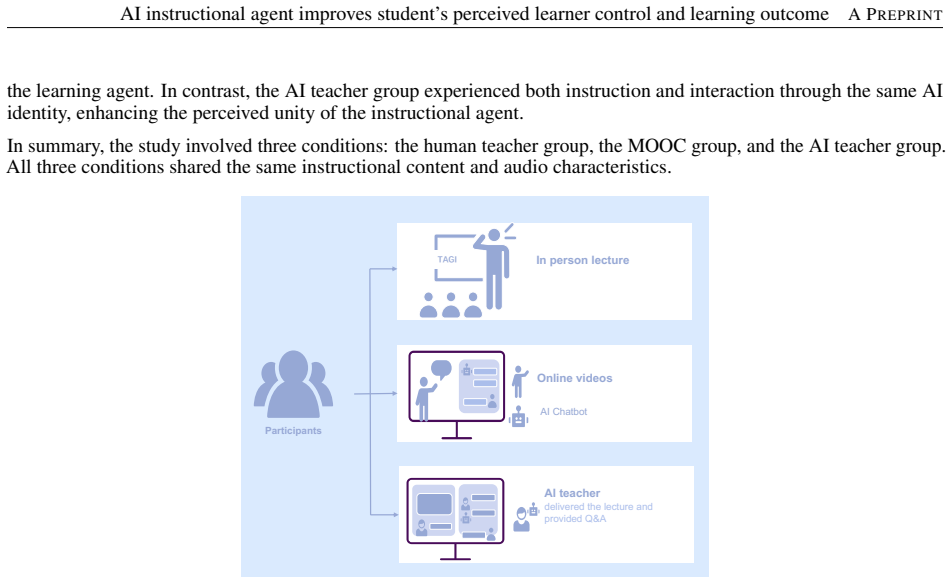
Summary. This paper reports a randomized controlled trial comparing three instructional conditions for a university general-education course: a human teacher, a self-paced MOOC with a separate chatbot, and an AI instructional agent integrated with the MAIC platform. The authors analyze data from 125 students (after excluding 15 with near-uniform response patterns) and report that the AI-agent condition produced significantly higher perceived learner control (PLC) than both the human and MOOC conditions, higher interaction frequency, shorter learning duration, and—according to the Section 4.1 text—significantly higher posttest scores than both comparison groups. A regression model is used to argue that PLC predicts posttest performance. The paper concludes that AI instructional agents, when designed to combine lecture delivery with real-time interactive responsiveness, can improve both students' subjective sense of control and immediate learning outcomes.
Significance. If the findings withstand scrutiny, the paper provides valuable experimental evidence on a timely question: whether integrated AI instructional agents can improve perceived learner control and performance over traditional instruction and over less-integrated online learning. The RCT design, the use of identical lecture scripts and audio across conditions, and the inclusion of behavioral indicators are notable strengths. However, the primary outcome rests on a scale constructed and item-selected after data collection, with no measurement-invariance evidence, and the posttest performance claim is contradicted by the reporting in Table 2. These issues are load-bearing for the paper's central claims, so the significance can only be realized after those concerns are resolved.
major comments (4)
- [4.1 / Table 2] The text in Section 4.1 states that 'Students in the AI group achieved significantly higher post-test scores than those in the human teacher group (M difference = 0.128, p < .01), and also outperformed the MOOC group (M difference = 0.112, p < .01).' Table 2, however, reports the posttest pairwise differences as 'MOOC-human 0.112 **' and 'AI-human 0.128 **', with no AI-MOOC row. These two presentations are mutually inconsistent: if the 0.112 difference is MOOC-human, then the text's claim that AI outperformed the MOOC is not supported by the reported pairwise contrasts. Because the posttest result is central to the paper's title and conclusion, the authors must correct this discrepancy, report the actual AI-MOOC contrast if it was tested, and adjust the claims in the abstract, Section 4.1, and Section 5 accordingly.
- [3.3] The Perceived Learner Control scale was newly developed for this study, and Section 3.3 states that 'After data collection and reliability and validity analysis, four items were retained.' This item selection was performed on the same 125 participants used for all subsequent analyses, and no confirmatory factor analysis or measurement-invariance test across the three experimental arms is reported. The four retained items—'decide how to participate,' 'decide the pace,' 'control the way I learn,' and 'decide how to allocate my time'—closely mirror the very features that distinguish the AI condition from the others. Without evidence that the scale measures the same construct in the human, MOOC, and AI groups, the ANOVA F(2,122)=12.155 and the Tukey contrasts for PLC cannot be unambiguously interpreted as differences in a common latent construct. The authors should report the full item-development process, test for measurement invariance, or substantially temper the primary-outcome claim.
- [3.4] The authors excluded 15 of the 140 participants (10.7%) because their responses showed over 90% identical ratings, and the final valid sample is 41, 43, and 41 for the human, MOOC, and AI groups, respectively. The exclusion is applied after random assignment, but the manuscript does not report how many excluded participants came from each condition. If exclusions are differential across groups, the randomization's integrity could be compromised. The authors should provide per-group exclusion counts and conduct sensitivity analyses that either retain all participants or apply alternative data-quality filters to confirm that the substantive findings are robust.
- [4.1 / Table 2] The comparison of learning duration between the human-teacher condition and the self-paced (AI/MOOC) conditions is problematic as evidence of efficiency. In the human condition, students attended a fixed-duration in-person lecture, whereas in the AI and MOOC conditions they studied self-paced videos and could finish at any time. The large duration difference (about 30 minutes) is therefore partly a design artifact rather than a behavioral indicator of more efficient time use. The statement that 'reduced learning time alone... may reflect more efficient time usage and self-management by learners' should be reanalyzed using only the two self-paced conditions, or else qualified to acknowledge the structural difference.
minor comments (4)
- [3.4] The regression model specification lists the predictors 'perceived learner control, gender, age, srl, pretest' but then states 'β1 to β9 are the regression coefficients'; the notation should be β0 to β5 for consistency.
- [3.3] The posttest item retention (22 multiple-choice questions reduced to 16 after 'item response analysis') is also a post hoc selection on the same dataset; please report the criteria used to retain or exclude items.
- [4.2] The regression model in Section 4.2 does not include condition dummies. Because both PLC and posttest scores differ by condition, the reported coefficient for PLC (β = 0.055) may partially reflect condition effects; adding condition indicators or discussing this limitation would clarify the interpretation.
- [3.3 / Table 1] There are several formatting and typographical issues: 'ANOV A' appears instead of 'ANOVA' in Section 3.4; Figure 2 appears to have duplicated panels; and 'self-determined theory' in Section 2.1 should read 'self-determination theory.'
Circularity Check
No significant circularity: the outcome claims are empirical RCT results, not re-statements of inputs.
full rationale
The paper's central derivation chain is an empirical randomized controlled trial: students were randomly assigned to three conditions with identical lecture content, and the headline performance claim rests on an instructor-designed post-test, while the perceived-learner-control claim rests on self-report plus convergent behavioral indicators such as interaction frequency and learning duration. No equation in the paper is obtained by substituting the outcome into the predictor or by fitting a parameter that is then renamed a prediction. The strongest potential concern is that the four PLC items were retained after data collection on the same 125 participants, and the items approximate the design features of the AI condition (pace, participation, time allocation). That is a measurement/construct-validity and multiple-testing concern, not a circular reduction: the between-group contrast was not used in item retention, and the post-test and behavioral results are independent of the PLC scale. Self-citations to Yu et al. (2024) and Hao et al. (2025) describe the MAIC platform but do not carry the empirical claim; the RCT itself supplies the evidence. The discrepancy between the text's AI-MOOC post-test difference and Table 2's MOOC-human row is a reporting inconsistency, not a circular step. Honest non-finding: no significant circularity.
Assumptions & free parameters
assumptions (3)
- domain assumption Perceived learner control is adequately captured by the four self-report items retained after factor analysis.
- domain assumption Post-test scores measure the relevant learning outcome and are comparable across conditions.
- ad hoc to paper Excluding responses with over 90% identical ratings does not bias group comparisons.
Cite this review
Pith. "Pith review of AI instructional agent improves student's perceived learner control and learning outcome: empirical evidence from a randomized controlled trial." pith.science (2026). https://pith.science/paper/SFW6ZP5D
@misc{pith2026250522526,
  author       = {Pith},
  title        = {Pith review of: AI instructional agent improves student's perceived learner control and learning outcome: empirical evidence from a randomized controlled trial},
  year         = {2026},
  howpublished = {\url{https://pith.science/paper/SFW6ZP5D}},
  note         = {Machine review of arXiv:2505.22526}
}
read the original abstract
This study examines the impact of an AI instructional agent on students' perceived learner control and academic performance in a medium demanding course with lecturing as the main teaching strategy. Based on a randomized controlled trial, three instructional conditions were compared: a traditional human teacher, a self-paced MOOC with chatbot support, and an AI instructional agent capable of delivering lectures and responding to questions in real time. Students in the AI instructional agent group reported significantly higher levels of perceived learner control compared to the other groups. They also completed the learning task more efficiently and engaged in more frequent interactions with the instructional system. Regression analyzes showed that perceived learner control positively predicted post-test performance, with behavioral indicators such as reduced learning time and higher interaction frequency supporting this relationship. These findings suggest that AI instructional agents, when designed to support personalized pace and responsive interaction, can enhance both students' learning experience and learning outcomes.
Figures


Reference graph
Works this paper leans on
-
[1]
Al Nashrey, A. A. (2020). Does Giving the Learner Control Improve Learner Success? International Journal of Education, 12(3),
work page 2020
-
[5]
Hung, M.-L., Chou, C., Chen, C.-H., & Own, Z.-Y . (2010). Learner readiness for online learning: Scale development and student perceptions. Computers & Education, 55(3), 1080–1090. Ji, H., Han, I., & Ko, Y . (2023). A systematic review of conversational AI in language education: Focusing on the collaboration with human teachers. Journal of Research on Tec...
work page 2010
-
[9]
Folley, D. (2010). The lecture is dead, long live the e-lecture. Electronic Journal of e-Learning, 8(2), 93-100. 10 AI instructional agent improves student’s perceived learner control and learning outcomeA PREPRINT French, S., & Kennedy, G. (2017). Reassessing the value of university lectures. Teaching in Higher Education, 22(6), 639654. Fulford, A., & Ma...
arXiv 2010
-
[26]
Siegle, R. F., Schroeder, N. L., Lane, H. C., & Craig, S. D. (2023). Twenty-five Years of Learning with Pedagogical Agents: History, Barriers, and Opportunities. TechTrends, 67(5), 851–864. Sikström, P., Valentini, C., Sivunen, A., & Kärkkäinen, T. (2022). How pedagogical agents communicate with students: A two-phase systematic review. Computers & Educati...
arXiv 2023
-
[63]
Publicly Available Content Database; Research Library; SciTech Premium Collection; Social Science Premium Collection. Dowson, M., & McInerney, D. M. (2004). The development and validation of the Goal Orientation and Learning Strategies Survey (GOALS-S). Educational and Psychological Measurement, 64(2), 290-310. Fazlollahi, A. M., Bakhaidar, M., Alsayegh, ...
work page 2004
-
[135]
Arkün-Kocadere, S. & Özhan, ¸ S. Ç. (2024). Video Lectures With AI-Generated Instructors: Low Video Engagement, Same Performance as Human Instructors. International Review of Research in Open and Distributed Learning, 25(3), 350–369. 9 AI instructional agent improves student’s perceived learner control and learning outcomeA PREPRINT Ayeni, O. O., Al Hamad...
work page 2024
Reviewed August 7, 2026 · model on record in the stance chip above.
Discussion (0). Sign in to comment.