REVIEW 4 major objections 6 minor 79 references
Scaling-up Perceptual Video Quality Assessment
T0 review · 4 major / 6 minor · reviewed 2026-08-07 · deepseek-v4-flash
Pith's one-line read Scaling video-quality instruction data to 400K pairs, built by a human-in-the-loop machine pipeline, yields state-of-the-art LMM video quality understanding and rating.
desk verdict Large, genuinely useful VQA instruction set with competitive rating results, but the fine-grained benchmark headline is inflated by an in-distribution machine half; the human half shows only a 0.51-point lead. read the letter →
The pith
A machine-rendered reading of the paper's core claim, the machinery that carries it, and where it could break.
The reading
What carries the argument
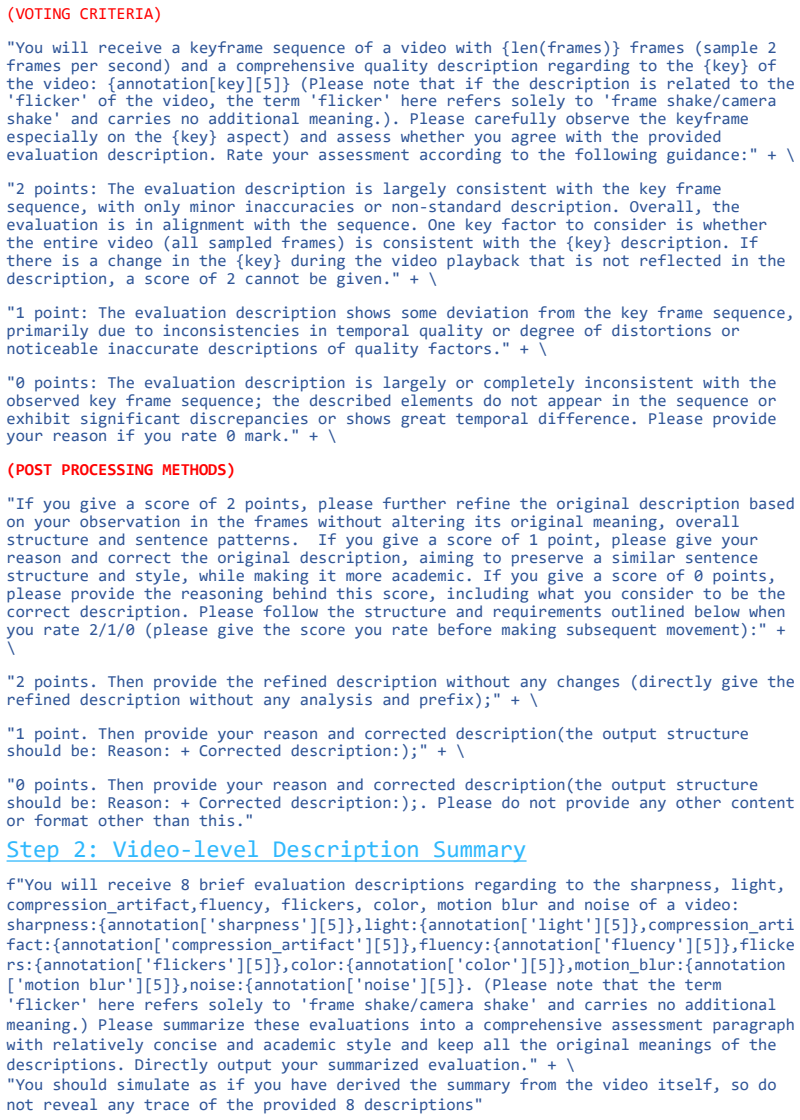
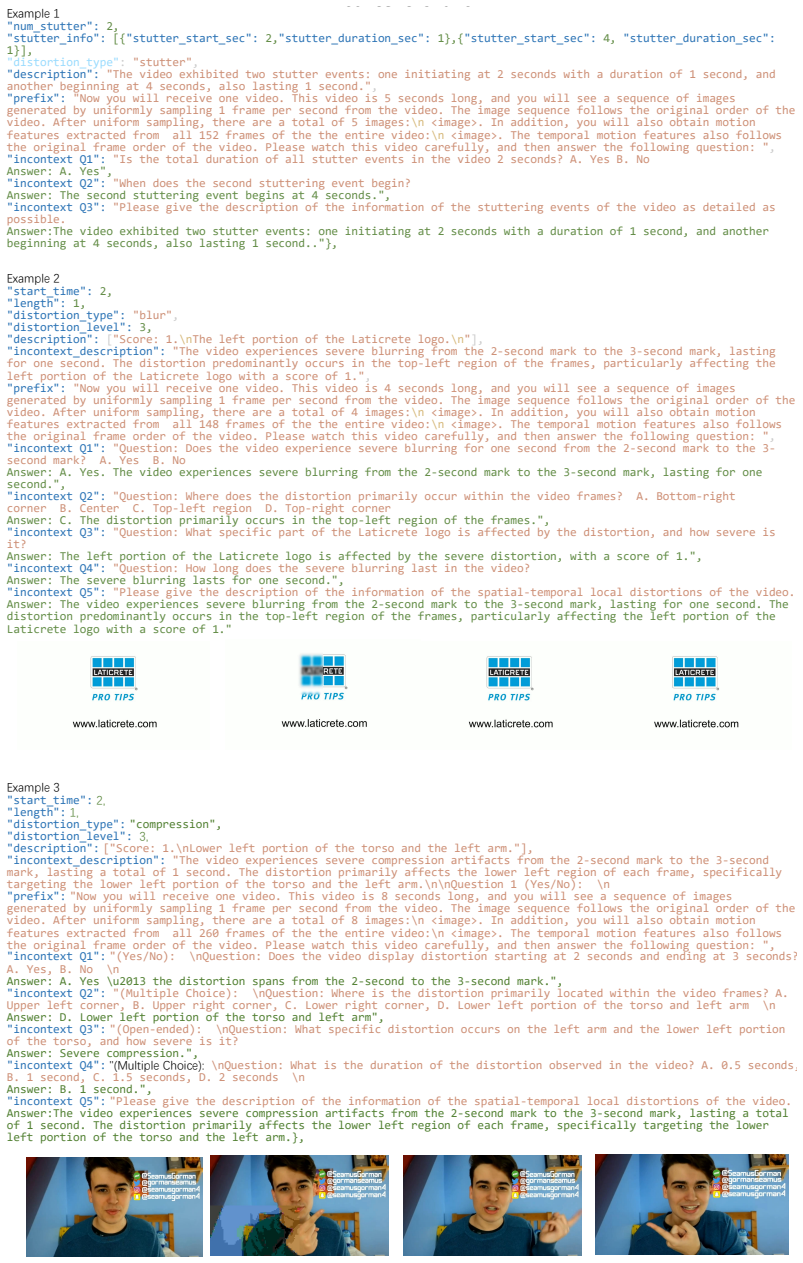
The mechanism that carries the argument is the rejection-sampling annotation chain combined with complementary training. In the technical branch, a domain-expert LMM is asked the same quality question five times with different phrasings; a reasoning LLM merges answers that recur at least three times into a summary and discards contradicted ones, a state-of-the-art LMM then votes 2/1/0 on whether the summary matches the keyframes, and a human expert resolves any zero-score vote. This converts direct annotation, which general LMMs do poorly, into a voting and verification task, which they do better. Complementary training then trains the same 7B base model sequentially on one task family before the other, letting the rating data act as pretraining for the understanding data instead of mixing both into the same batch. The in-context branch contributes a second mechanism: synthetic distortions of known location, duration, and severity, so the training signal for spatiotemporal questions has ground-truth geometry.
What would settle it
Take a held-out set of about 200 UGC videos with known human MOS, run the full technical-branch pipeline but corrupt the expert sampling by flipping the polarity of the five answers on half the videos, then fine-tune Chatter identically; if the corrupted version matches the reported Q-bench-video and OmniVQA-FG-Bench scores, the quality of the expert annotations is not carrying the result, while a collapse would show it is load-bearing. A complementary test is to evaluate Chatter on a fine-grained spatiotemporal quality benchmark built independently of the authors' training and evaluation data, where a large drop relative to same-group numbers would show that the understanding ability does not transfer.
Extended reading notes
Core claim
The central claim is that scaling, not architecture, is what is missing in perceptual video quality assessment, and that scaling can be done cheaply and reliably. The authors construct a machine-annotation pipeline organized into three branches: a technical branch that samples eight quality factors from a domain-expert model (VQA 2-Assistant), summarizes five paraphrasings with a reasoning LLM, and lets a stronger LMM vote on each summary with human judges called in when a vote scores zero; an in-context branch that synthesizes local spatial and temporal distortions with bounding boxes and semantic object descriptions so the model learns spatiotemporal localization; and an aesthetic branch that annotates style, spatiotemporal composition, and evoked emotion. They report that Chatter (7B) reaches 58.50% overall accuracy on Q-bench-video test and 59.08% on dev, and 65.32% overall on their new OmniVQA-FG-Benchmark versus 54.12% for VQA 2-Assistant, while Rater reaches 0.902 SRCC and 0.905 PLCC on LSVQ-test and top-two or top-three performance on five other rating sets. The paper's conclusion is that mostly machine-generated data, with humans only at the decision points, can substitute for fully manual annotation at scale.
Load-bearing premise
Everything rests on VQA 2-Assistant's single-factor annotations being trustworthy enough that a five-sample majority, an LLM summary, and an LMM vote can correct the occasional error; if that expert has systematic perceptual blind spots, the 400K set inherits them and Chatter's benchmark gains will not transfer to new videos.
Editorial extensions
If this is right
- A mostly machine-generated, human-vetted instruction database of 400K pairs is enough to push a 7B model past general LMMs, including 72B ones, on video quality understanding benchmarks.
- The data-scaling curve on Q-bench-video rises from 100K to 400K pairs but flattens at the 7B scale, so larger parameter counts, not just more data, are the next lever.
- Training for quality rating first and quality understanding second, or vice versa, avoids the interference that random mixing causes and improves both tasks over direct training.
- The in-context branch produces a large margin in spatiotemporal fine-grained understanding: Chatter scores 69.87% on the machine-annotated fine-grain subset versus 55.33% for VQA 2-Assistant.
- A human-labeled 20K MOS dataset with hidden-reference supervision gives the best or second-best rating correlation across LSVQ, KoNViD-1k, LIVE-VQC, YT-UGC, and the new MOS-20K test.
Reading between the lines
- The same three-branch pipeline could be pointed at image quality assessment or other perceptual judgment tasks; the paper describes the cost falling to near zero once open-source LMMs replace paid APIs, but does not test that regime.
- The expert model can be iteratively replaced: after Chatter is trained, it could re-annotate the technical branch and bootstrap a second-generation 400K instruction database, a recursion the paper mentions as a possible application but does not run.
- The reported understanding gains are measured on benchmarks drawn from the same data ecosystem as the training set; on an independent fine-grained benchmark built by a different group, the margin over VQA 2-Assistant could shrink if the bias of the expert judge chain transfers.
- The in-context branch's synthetic distortions, with known time intervals and bounding boxes, could serve as a data engine for video grounding and temporal anomaly localization beyond quality assessment.
Editorial analysis
A structured set of objections, weighed in public.
Referee Report
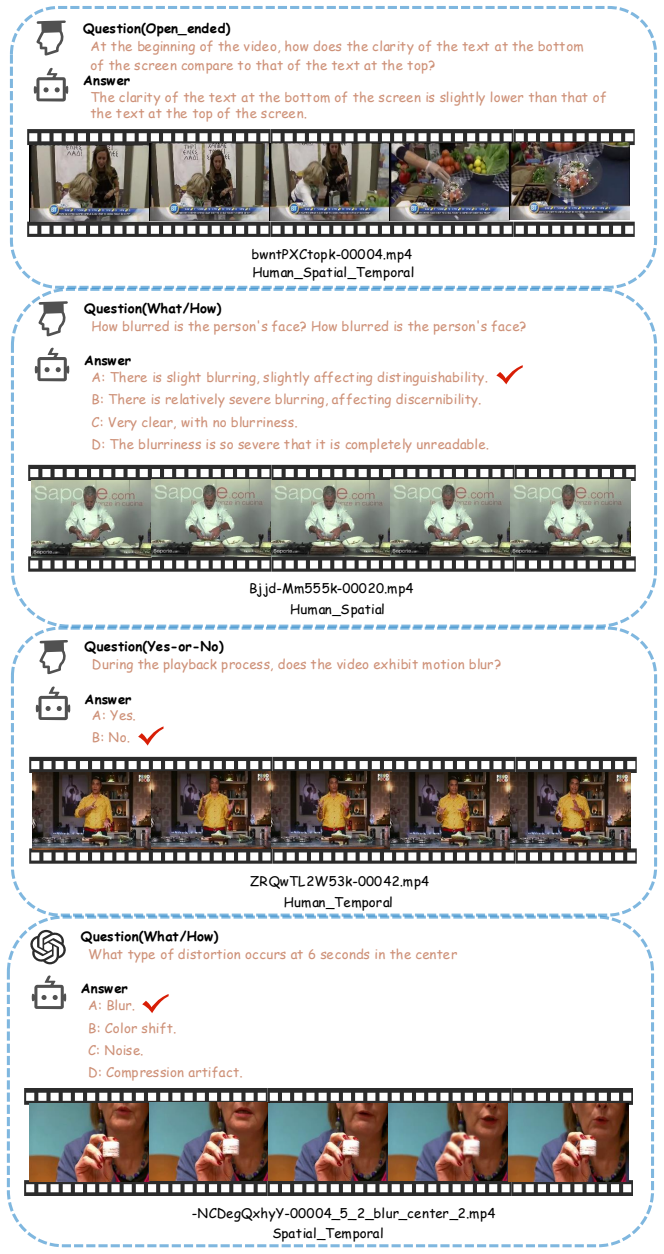
Summary. The paper proposes OmniVQA, a framework for scaling perceptual video quality assessment instruction data through a human-in-the-loop, machine-annotation pipeline. It introduces OmniVQA-Chat-400K, a 400K-pair MIDB with technical, aesthetic, and in-context branches; OmniVQA-MOS-20K, a human-labeled rating dataset; and OmniVQA-FG-Benchmark, a fine-grained understanding benchmark. The authors train a 7B 'Chatter' model for quality understanding and a 7B 'Rater' model for quality rating using a task-specific complementary training strategy. They report state-of-the-art results on Q-bench-video and on the new FG-Benchmark, and strong rating results on LSVQ, KoNViD-1k, YT-UGC, LIVE-VQC, and MOS-20K.
Significance. If the claims hold, the paper would make a useful contribution: it provides a large-scale, multi-branch VQA instruction dataset, a new fine-grained benchmark, and a complementary training recipe that shows clear gains over direct and mixed training. The rating results on external datasets (LSVQ, KoNViD-1k, YT-UGC, LIVE-VQC) are credible and provide independent support for the Rater. The data-scaling study in Fig. 7 is a valuable empirical finding. However, the central understanding claim is weakened by two load-bearing issues: the fine-grained benchmark's machine-annotated half is generated by the same synthetic-distortion pipeline as the training data, and the general-understanding comparison on Q-bench-video may not have been scored on a common filtered question set. The MIDB annotation chain also relies on a single in-house expert model with limited independent validation. These issues do not invalidate the rating contribution, but they require substantial revision before the state-of-the-art understanding claim can be accepted.
major comments (4)
- [Sec. 3.3 vs. Sec. 5] The machine-annotated half of the OmniVQA-FG-Benchmark is generated from the same candidate pool and the same synthetic spatial/temporal distortion scheme used to build the in-context training branch: source videos with objective quality above 70, a 1/4-frame rectangular region, 1-3 second durations, three intensity levels, and the same distortion-type/location set. Chatter achieves 69.87% versus VQA2-Assistant's 55.33% on machine items, but only 47.01% versus 46.50% on human-annotated items. Because the overall score (65.32% versus 54.12%) is dominated by the in-distribution machine portion, the claim of state-of-the-art fine-grained understanding is not established on independent data. Please report the human-only subset as the primary comparison, and either remove or clearly subordinate the machine-annotated part when drawing conclusions about generalization.
- [Sec. 7.3] The paper removes multi-video comparison questions from Q-bench-video because the training data do not include them, but it does not state whether every baseline was rescored on the identical filtered question subset. If the baseline numbers in Table 2 include multi-video questions, the comparison is not apples-to-apples. Please clarify the filtering procedure and, if necessary, rerun all models on the same filtered question set, reporting the number of questions removed.
- [Sec. 3.2 and Supp. Sec. E.2] The technical-branch annotations are produced by VQA2-Assistant (7B) - the authors' own prior model - followed by LLM summarization and sota-LMM voting, with human intervention only when a voting round receives a score of 0. No independent human agreement study is reported for the full 400K set, so the risk of systematic bias inherited from the expert/judge chain is not quantified. Because the quality-understanding state-of-the-art claim depends on the accuracy of these labels, please provide a human-annotation agreement analysis on a random sample of the technical branch, or an external validation showing that the machine annotations are not systematically biased relative to independent human perception.
- [Sec. 4] The MOS-20K collection protocol rejects any human score that deviates by two or more quality levels from an objective-quality reference derived from four objective VQA models. This makes the human ratings conditional on the objective estimators' ranking, so MOS-20K(test) is not an independent measure of rating performance and the MOS-20K column in Table 1 should be interpreted cautiously. The external rating datasets (LSVQ, KoNViD-1k, YT-UGC) provide independent support for the Rater, but the paper should nevertheless validate a subset of MOS-20K with unconstrained human ratings and report agreement between the filtered and unfiltered scores.
minor comments (6)
- [Sec. 5] The first sentence of Section 5 contains a typo: 'QmniVQA-FG-Benchmark' should be 'OmniVQA-FG-Benchmark'.
- [Table 7] The row labeled 'OmniVQA-MOS-400K' appears to be a naming error; the text consistently refers to 'OmniVQA-Chat-400K'. In addition, the row 'OmniVQA-Chat-20K' does not correspond to any dataset described in the paper and should be corrected or removed.
- [Abstract] The phrase 'the potential of scaling law remains unprecedented' is unclear; 'unprecedented' should likely be 'underexplored' or 'unverified'.
- [Sec. 3.2] 'Openai-o1' should be written consistently as 'OpenAI o1'.
- [Sec. 7.1] The statement 'we set almost unified system prompts' is vague; please specify which system-prompt components differ across models and evaluation settings.
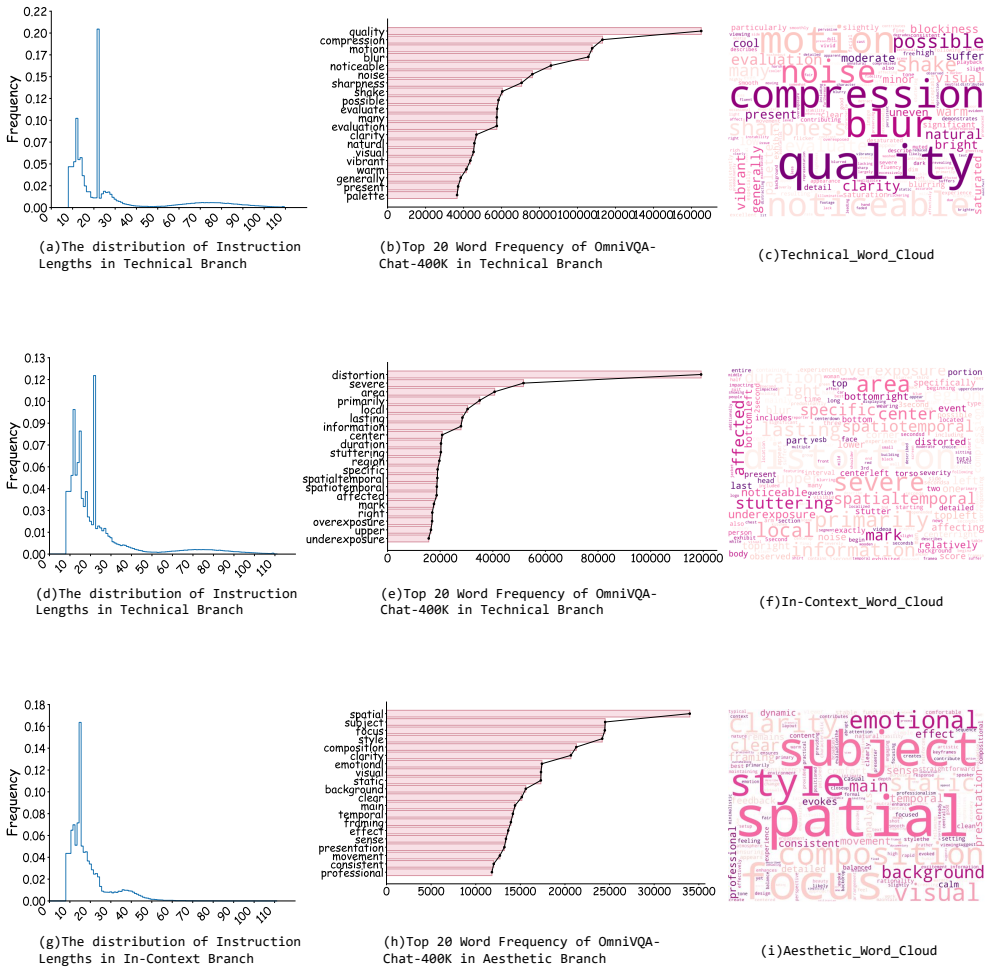
- [Supp. Fig. 8] The subfigure captions in Fig. 8 appear misassigned: labels (d) and (e) are marked 'Technical Branch' but seem to describe the in-context branch, and subsequent labels are similarly offset. Please correct the caption-to-content mapping.
Circularity Check
No circular derivation found; the machine-half overlap of the FG benchmark is an evaluation limitation, not a circular step.
full rationale
The paper's derivation chain is: construct a 400K MIDB via rejection sampling with VQA2-Assistant as expert plus human-in-the-loop voting and LLM summarization, construct OmniVQA-MOS-20K with human ratings, SFT the Chatter/Rater models, and evaluate on external rating datasets (LSVQ, KoNViD-1k, YT-UGC, LIVE-VQC), Q-bench-video, and OmniVQA-FG-Bench. None of the reported predictions is an algebraic transform of training labels or a fitted parameter renamed as a prediction; the external rating benchmarks are independent human-MOS tests, and the rating SOTA does not reduce to the training pipeline. Q-bench-video is from partially overlapping authors, and the paper filters out multi-video questions, which is a comparability caveat rather than a circular step. The machine-annotated half of OmniVQA-FG-Bench is generated from the same Sec. 3 candidate pool and distortion protocol as the in-context training branch, so the large machine-part margin (69.87 vs 55.33) is an in-distribution result and is weak as evidence of transfer; however, the benchmark answers are not used in training, and the paper separately reports the human-annotated half (47.01 vs 46.50), so this is an evaluation-design limitation, not an equation-level circularity. Self-citation to VQA2 is load-bearing as an annotation tool, but it is supplemented by human-in-the-loop voting and is not invoked as an external theorem; no uniqueness claim or ansatz is imported via self-citation. Overall, the central claims rest on independent rating benchmarks and on a transparently reported, if partially in-distribution, fine-grained evaluation.
Assumptions & free parameters
free parameters (5)
- omega weights for quality-level scoring =
[1, 0.75, 0.5, 0.25, 0]
- N=5 expert samples per factor =
5
- 3-of-5 positive answer threshold =
3/5
- objective quality threshold for branch selection =
70
- hidden-reference deviation threshold =
2 quality levels
assumptions (6)
- domain assumption VQA2-Assistant's single-factor quality annotations are a reliable source for training supervision.
- domain assumption SOTA LMMs can accurately judge whether a quality-factor summary matches the video via voting.
- domain assumption Averaged objective labels from four NR-VQA models provide a valid quality prior for stratification and for filtering human MOS.
- domain assumption Human scores deviating by two or more levels from the objective reference are annotation errors, not valid perceptions.
- domain assumption Synthetic distortions (blur, exposure, noise, JPEG, stutter) approximate real distortions well enough to transfer to in-the-wild videos.
- domain assumption Q-bench-video is an independent external benchmark despite sharing authors and pipeline with the training data.
Cite this review
Pith. "Pith review of Scaling-up Perceptual Video Quality Assessment." pith.science (2026). https://pith.science/paper/QF7XK2PE
@misc{pith2026250522543,
  author       = {Pith},
  title        = {Pith review of: Scaling-up Perceptual Video Quality Assessment},
  year         = {2026},
  howpublished = {\url{https://pith.science/paper/QF7XK2PE}},
  note         = {Machine review of arXiv:2505.22543}
}
read the original abstract
The data scaling law has been shown to significantly enhance the performance of large multi-modal models (LMMs) across various downstream tasks. However, in the domain of perceptual video quality assessment (VQA), the potential of scaling law remains unprecedented due to the scarcity of labeled resources and the insufficient scale of datasets. To address this, we propose \textbf{OmniVQA}, an efficient framework designed to efficiently build high-quality, human-in-the-loop VQA multi-modal instruction databases (MIDBs). We then scale up to create \textbf{OmniVQA-Chat-400K}, the largest MIDB in the VQA field concurrently. Our focus is on the technical and aesthetic quality dimensions, with abundant in-context instruction data to provide fine-grained VQA knowledge. Additionally, we have built the \textbf{OmniVQA-MOS-20K} dataset to enhance the model's quantitative quality rating capabilities. We then introduce a \textbf{complementary} training strategy that effectively leverages the knowledge from datasets for quality understanding and quality rating tasks. Furthermore, we propose the \textbf{OmniVQA-FG (fine-grain)-Benchmark} to evaluate the fine-grained performance of the models. Our results demonstrate that our models achieve state-of-the-art performance in both quality understanding and rating tasks.
Figures


Figures from the paper (24 more)










Reference graph
Works this paper leans on
-
[1]
Gpt-4 technical report.arXiv preprint arXiv:2303.08774,
Josh Achiam, Steven Adler, Sandhini Agarwal, Lama Ah- mad, Ilge Akkaya, Florencia Leoni Aleman, Diogo Almeida, Janko Altenschmidt, Sam Altman, Shyamal Anadkat, et al. Gpt-4 technical report.arXiv preprint arXiv:2303.08774,
-
[2]
Shuai Bai, Keqin Chen, Xuejing Liu, Jialin Wang, Wenbin Ge, Sibo Song, Kai Dang, Peng Wang, Shijie Wang, Jun Tang, et al. Qwen2. 5-vl technical report.arXiv preprint arXiv:2502.13923, 2025. 7
arXiv 2025
-
[3]
Christos G Bampis and Alan C Bovik. Feature-based predic- tion of streaming video qoe: Distortions, stalling and mem- ory.SPIC, 68:218–228, 2018. 2
work page 2018
-
[4]
Christos G Bampis, Zhi Li, Ioannis Katsavounidis, Te-Yuan Huang, Chaitanya Ekanadham, and Alan C Bovik. Towards perceptually optimized adaptive video streaming-a realistic quality of experience database.IEEE TIP, 30:5182–5197,
-
[5]
Q-ground: Image quality grounding with large multi-modality models
Chaofeng Chen, Sensen Yang, Haoning Wu, Liang Liao, Zicheng Zhang, Annan Wang, Wenxiu Sun, Qiong Yan, and Weisi Lin. Q-ground: Image quality grounding with large multi-modality models. InACM MM, pages 486–495, 2024. 2
work page 2024
-
[6]
Panda-70m: Captioning 70m videos with multiple cross-modality teachers
Tsai-Shien Chen, Aliaksandr Siarohin, Willi Menapace, Ekaterina Deyneka, Hsiang-wei Chao, Byung Eun Jeon, Yuwei Fang, Hsin-Ying Lee, Jian Ren, Ming-Hsuan Yang, et al. Panda-70m: Captioning 70m videos with multiple cross-modality teachers. InCVPR, pages 13320–13331,
-
[7]
Zhe Chen, Weiyun Wang, Yue Cao, Yangzhou Liu, Zhang- wei Gao, Erfei Cui, Jinguo Zhu, Shenglong Ye, Hao Tian, Zhaoyang Liu, et al. Expanding performance boundaries of open-source multimodal models with model, data, and test- time scaling.arXiv preprint arXiv:2412.05271, 2024. 7
arXiv 2024
-
[8]
Zheng Chen, Xun Zhang, Wenbo Li, Renjing Pei, Feng- long Song, Xiongkuo Min, Xiaohong Liu, Xin Yuan, Yong Guo, and Yulun Zhang. Grounding-iqa: Multimodal lan- guage grounding model for image quality assessment.arXiv preprint arXiv:2411.17237, 2024. 2
arXiv 2024
Show all 79 references
-
[9]
A quality-of-experience index for streaming video.IEEE JSTSP, 11(1):154–166, 2016
Zhengfang Duanmu, Kai Zeng, Kede Ma, Abdul Rehman, and Zhou Wang. A quality-of-experience index for streaming video.IEEE JSTSP, 11(1):154–166, 2016. 2
2016
-
[10]
A quality-of-experience database for adaptive video streaming
Zhengfang Duanmu, Abdul Rehman, and Zhou Wang. A quality-of-experience database for adaptive video streaming. IEEE TBC, 64(2):474–487, 2018. 2
2018
-
[11]
A bayesian quality-of-experience model for adaptive streaming videos
Zhengfang Duanmu, Wentao Liu, Diqi Chen, Zhuoran Li, Zhou Wang, Yizhou Wang, and Wen Gao. A bayesian quality-of-experience model for adaptive streaming videos. ACM TOMM, 18(3s):1–24, 2023. 2
2023
-
[12]
Slowfast networks for video recognition
Christoph Feichtenhofer, Haoqi Fan, Jitendra Malik, and Kaiming He. Slowfast networks for video recognition. In ICCV, pages 6202–6211, 2019. 6
2019
-
[13]
Lmm-vqa: Advancing video quality assessment with large multimodal models.arXiv preprint arXiv:2408.14008,
Qihang Ge, Wei Sun, Yu Zhang, Yunhao Li, Zhongpeng Ji, Fengyu Sun, Shangling Jui, Xiongkuo Min, and Guangtao Zhai. Lmm-vqa: Advancing video quality assessment with large multimodal models.arXiv preprint arXiv:2408.14008,
-
[14]
In- capture mobile video distortions: A study of subjective be- havior and objective algorithms.IEEE TCSVT, 28(9):2061– 2077, 2017
Deepti Ghadiyaram, Janice Pan, Alan C Bovik, Anush Kr- ishna Moorthy, Prasanjit Panda, and Kai-Chieh Yang. In- capture mobile video distortions: A study of subjective be- havior and objective algorithms.IEEE TCSVT, 28(9):2061– 2077, 2017. 2
2017
-
[15]
The konstanz natural video database (konvid-1k)
Vlad Hosu, Franz Hahn, Mohsen Jenadeleh, Hanhe Lin, Hui Men, Tam´as Szir ´anyi, Shujun Li, and Dietmar Saupe. The konstanz natural video database (konvid-1k). InQoMEX, pages 1–6. IEEE, 2017. 7
2017
-
[16]
Aesexpert: Towards multi-modality foun- dation model for image aesthetics perception
Yipo Huang, Xiangfei Sheng, Zhichao Yang, Quan Yuan, Zhichao Duan, Pengfei Chen, Leida Li, Weisi Lin, and Guangming Shi. Aesexpert: Towards multi-modality foun- dation model for image aesthetics perception. InACM MM, pages 5911–5920, 2024. 2, 3, 5
2024
-
[17]
Vqa2: Visual question answering for video quality assessment.arXiv preprint arXiv:2411.03795,
Ziheng Jia, Zicheng Zhang, Jiaying Qian, Haoning Wu, Wei Sun, Chunyi Li, Xiaohong Liu, Weisi Lin, Guangtao Zhai, and Xiongkuo Min. Vqa2: Visual question answering for video quality assessment.arXiv preprint arXiv:2411.03795,
-
[18]
Rs-dpo: A hybrid rejection sampling and direct preference optimization method for alignment of large lan- guage models.arXiv preprint arXiv:2402.10038, 2024
Saeed Khaki, JinJin Li, Lan Ma, Liu Yang, and Prathap Ra- machandra. Rs-dpo: A hybrid rejection sampling and direct preference optimization method for alignment of large lan- guage models.arXiv preprint arXiv:2402.10038, 2024. 3
2024 arXiv
-
[19]
Two-level approach for no-reference con- sumer video quality assessment.IEEE TIP, 28(12):5923– 5938, 2019
Jari Korhonen. Two-level approach for no-reference con- sumer video quality assessment.IEEE TIP, 28(12):5923– 5938, 2019. 2
2019
-
[20]
Blindly assess quality of in-the-wild videos via quality-aware pre-training and motion perception.IEEE TCSVT, 32(9):5944–5958, 2022
Bowen Li, Weixia Zhang, Meng Tian, Guangtao Zhai, and Xianpei Wang. Blindly assess quality of in-the-wild videos via quality-aware pre-training and motion perception.IEEE TCSVT, 32(9):5944–5958, 2022. 2, 7
2022
-
[21]
Llava-onevision: Easy visual task transfer
Bo Li, Yuanhan Zhang, Dong Guo, Renrui Zhang, Feng Li, Hao Zhang, Kaichen Zhang, Peiyuan Zhang, Yanwei Li, Zi- wei Liu, et al. Llava-onevision: Easy visual task transfer. arXiv preprint arXiv:2408.03326, 2024. 7
2024 arXiv
-
[22]
Quality as- sessment of in-the-wild videos
Dingquan Li, Tingting Jiang, and Ming Jiang. Quality as- sessment of in-the-wild videos. InACM MM, pages 2351– 2359, 2019. 2
2019
-
[23]
A comparative study of state-of-the-art video encoders on 4k videos.Image Anal- ysis and Recognition
Z Li, Z Duanmu, W Liu, and Z Wang. A comparative study of state-of-the-art video encoders on 4k videos.Image Anal- ysis and Recognition. LNCS, 11662. 2
-
[24]
Statistical rejec- tion sampling improves preference optimization
Tianqi Liu, Yao Zhao, Rishabh Joshi, Misha Khalman, Mo- hammad Saleh, Peter J Liu, and Jialu Liu. Statistical rejec- tion sampling improves preference optimization. InICLR. 3
-
[25]
End- to-end blind quality assessment of compressed videos using deep neural networks
Wentao Liu, Zhengfang Duanmu, and Zhou Wang. End- to-end blind quality assessment of compressed videos using deep neural networks. InACM MM, pages 546–554, 2018. 2
2018
-
[26]
Perceptual video quality assessment: A sur- vey.SCIS, 67(11):211301, 2024
Xiongkuo Min, Huiyu Duan, Wei Sun, Yucheng Zhu, and Guangtao Zhai. Perceptual video quality assessment: A sur- vey.SCIS, 67(11):211301, 2024. 2
2024
-
[27]
No-reference image quality assessment in the spa- tial domain.IEEE TIP, 21(12):4695–4708, 2012
Anish Mittal, Anush Krishna Moorthy, and Alan Conrad Bovik. No-reference image quality assessment in the spa- tial domain.IEEE TIP, 21(12):4695–4708, 2012. 2
2012
-
[28]
completely blind
Anish Mittal, Rajiv Soundararajan, and Alan C Bovik. Mak- ing a “completely blind” image quality analyzer.IEEE SPL, 20(3):209–212, 2012. 2
2012
-
[29]
Cvd2014—a database for evaluating no-reference video quality assess- ment algorithms.IEEE TIP, 25(7):3073–3086, 2016
Mikko Nuutinen, Toni Virtanen, Mikko Vaahteranoksa, Tero Vuori, Pirkko Oittinen, and Jukka H ¨akkinen. Cvd2014—a database for evaluating no-reference video quality assess- ment algorithms.IEEE TIP, 25(7):3073–3086, 2016. 2
2016
-
[30]
Improving language understanding by gen- erative pre-training
Alec Radford, Karthik Narasimhan, Tim Salimans, Ilya Sutskever, et al. Improving language understanding by gen- erative pre-training. 2018. 2
2018
-
[31]
Large-scale study of perceptual video quality.IEEE TIP, 28(2):612–627, 2018
Zeina Sinno and Alan Conrad Bovik. Large-scale study of perceptual video quality.IEEE TIP, 28(2):612–627, 2018. 2, 7
2018
-
[32]
A deep learning based no-reference quality assessment model for ugc videos
Wei Sun, Xiongkuo Min, Wei Lu, and Guangtao Zhai. A deep learning based no-reference quality assessment model for ugc videos. InACM MM, pages 856–865, 2022. 2, 7
2022
-
[33]
Analysis of video quality datasets via design of minimalistic video quality models.IEEE TPAMI,
Wei Sun, Wen Wen, Xiongkuo Min, Long Lan, Guangtao Zhai, and Kede Ma. Analysis of video quality datasets via design of minimalistic video quality models.IEEE TPAMI,
-
[34]
Gemini 1.5: Unlocking multimodal understanding across millions of tokens of con- text.arXiv preprint arXiv:2403.05530, 2024
Gemini Team, Petko Georgiev, Ving Ian Lei, Ryan Burnell, Libin Bai, Anmol Gulati, Garrett Tanzer, Damien Vincent, Zhufeng Pan, Shibo Wang, et al. Gemini 1.5: Unlocking multimodal understanding across millions of tokens of con- text.arXiv preprint arXiv:2403.05530, 2024. 2, 7
2024 arXiv
-
[35]
Ugc-vqa: Benchmarking blind video quality assessment for user generated content.IEEE TIP, 30:4449–4464, 2021
Zhengzhong Tu, Yilin Wang, Neil Birkbeck, Balu Adsumilli, and Alan C Bovik. Ugc-vqa: Benchmarking blind video quality assessment for user generated content.IEEE TIP, 30:4449–4464, 2021. 2
2021
-
[36]
Rapique: Rapid and accurate video quality prediction of user generated content
Zhengzhong Tu, Xiangxu Yu, Yilin Wang, Neil Birkbeck, Balu Adsumilli, and Alan C Bovik. Rapique: Rapid and accurate video quality prediction of user generated content. IEEE OJSP, 2:425–440, 2021. 2
2021
-
[37]
Qwen2-vl: Enhancing vision-language model’s perception of the world at any resolution.arXiv preprint arXiv:2409.12191, 2024
Peng Wang, Shuai Bai, Sinan Tan, Shijie Wang, Zhihao Fan, Jinze Bai, Keqin Chen, Xuejing Liu, Jialin Wang, Wenbin Ge, et al. Qwen2-vl: Enhancing vision-language model’s perception of the world at any resolution.arXiv preprint arXiv:2409.12191, 2024. 7
2024 arXiv
-
[38]
Youtube ugc dataset for video compression research
Yilin Wang, Sasi Inguva, and Balu Adsumilli. Youtube ugc dataset for video compression research. InIEEE MMSP, pages 1–5. IEEE, 2019. 2, 7
2019
-
[39]
Rich features for perceptual quality assessment of ugc videos
Yilin Wang, Junjie Ke, Hossein Talebi, Joong Gon Yim, Neil Birkbeck, Balu Adsumilli, Peyman Milanfar, and Feng Yang. Rich features for perceptual quality assessment of ugc videos. InCVPR, pages 13435–13444, 2021. 2
2021
-
[40]
Llm- generated natural language meets scaling laws: New ex- plorations and data augmentation methods.arXiv preprint arXiv:2407.00322, 2024
Zhenhua Wang, Guang Xu, and Ming Ren. Llm- generated natural language meets scaling laws: New ex- plorations and data augmentation methods.arXiv preprint arXiv:2407.00322, 2024. 1
2024 arXiv
-
[41]
Modular blind video quality assess- ment
Wen Wen, Mu Li, Yabin Zhang, Yiting Liao, Junlin Li, Li Zhang, and Kede Ma. Modular blind video quality assess- ment. InCVPR, pages 2763–2772, 2024. 2, 7
2024
-
[42]
Neigh- bourhood representative sampling for efficient end-to-end video quality assessment.IEEE TPAMI, 45(12):15185– 15202, 2023
Haoning Wu, Chaofeng Chen, Liang Liao, Jingwen Hou, Wenxiu Sun, Qiong Yan, Jinwei Gu, and Weisi Lin. Neigh- bourhood representative sampling for efficient end-to-end video quality assessment.IEEE TPAMI, 45(12):15185– 15202, 2023. 3, 7
2023
-
[43]
Discovqa: Temporal distortion-content transformers for video quality assessment
Haoning Wu, Chaofeng Chen, Liang Liao, Jingwen Hou, Wenxiu Sun, Qiong Yan, and Weisi Lin. Discovqa: Temporal distortion-content transformers for video quality assessment. IEEE TCSVT, 33(9):4840–4854, 2023
2023
-
[44]
Exploring video quality assessment on user generated contents from aesthetic and technical perspectives
Haoning Wu, Erli Zhang, Liang Liao, Chaofeng Chen, Jing- wen Hou, Annan Wang, Wenxiu Sun, Qiong Yan, and Weisi Lin. Exploring video quality assessment on user generated contents from aesthetic and technical perspectives. InICCV, pages 20144–20154, 2023. 3, 7
2023
-
[45]
Towards explainable in-the-wild video quality assess- ment: A database and a language-prompted approach
Haoning Wu, Erli Zhang, Liang Liao, Chaofeng Chen, Jing- wen Hou, Annan Wang, Wenxiu Sun, Qiong Yan, and Weisi Lin. Towards explainable in-the-wild video quality assess- ment: A database and a language-prompted approach. In ACM MM, pages 1045–1054, 2023. 2
2023
-
[46]
Q-instruct: Improving low-level visual abilities for multi-modality foundation models
Haoning Wu, Zicheng Zhang, Erli Zhang, Chaofeng Chen, Liang Liao, Annan Wang, Kaixin Xu, Chunyi Li, Jingwen Hou, Guangtao Zhai, et al. Q-instruct: Improving low-level visual abilities for multi-modality foundation models. In CVPR, pages 25490–25500, 2024. 2, 3
2024
-
[47]
Q-align: teaching lmms for visual scoring via discrete text-defined levels
Haoning Wu, Zicheng Zhang, Weixia Zhang, Chaofeng Chen, Liang Liao, Chunyi Li, Yixuan Gao, Annan Wang, Erli Zhang, Wenxiu Sun, et al. Q-align: teaching lmms for visual scoring via discrete text-defined levels. InICML, pages 54015–54029, 2024. 2, 3, 7
2024
-
[48]
Towards open-ended vi- sual quality comparison
Haoning Wu, Hanwei Zhu, Zicheng Zhang, Erli Zhang, Chaofeng Chen, Liang Liao, Chunyi Li, Annan Wang, Wenxiu Sun, Qiong Yan, et al. Towards open-ended vi- sual quality comparison. InECCV, pages 360–377. Springer,
-
[49]
An Yang, Baosong Yang, Beichen Zhang, Binyuan Hui, Bo Zheng, Bowen Yu, Chengyuan Li, Dayiheng Liu, Fei Huang, Haoran Wei, et al. Qwen2. 5 technical report.arXiv preprint arXiv:2412.15115, 2024. 6
2024 arXiv
-
[50]
mplug- owl3: Towards long image-sequence understanding in multi- modal large language models
Jiabo Ye, Haiyang Xu, Haowei Liu, Anwen Hu, Ming Yan, Qi Qian, Ji Zhang, Fei Huang, and Jingren Zhou. mplug- owl3: Towards long image-sequence understanding in multi- modal large language models. InICLR. 7
-
[51]
Patch-vq:’patching up’the video quality problem
Zhenqiang Ying, Maniratnam Mandal, Deepti Ghadiyaram, and Alan Bovik. Patch-vq:’patching up’the video quality problem. InCVPR, pages 14019–14029, 2021. 2, 5, 7
2021
-
[52]
Descriptive image quality assessment in the wild.arXiv preprint arXiv:2405.18842,
Zhiyuan You, Jinjin Gu, Zheyuan Li, Xin Cai, Kaiwen Zhu, Chao Dong, and Tianfan Xue. Descriptive image quality assessment in the wild.arXiv preprint arXiv:2405.18842,
-
[53]
Depicting beyond scores: Advanc- ing image quality assessment through multi-modal language models
Zhiyuan You, Zheyuan Li, Jinjin Gu, Zhenfei Yin, Tianfan Xue, and Chao Dong. Depicting beyond scores: Advanc- ing image quality assessment through multi-modal language models. InECCV, pages 259–276. Springer, 2024. 2, 3
2024
-
[54]
Sigmoid loss for language image pre-training
Xiaohua Zhai, Basil Mustafa, Alexander Kolesnikov, and Lucas Beyer. Sigmoid loss for language image pre-training. InICCV, pages 11975–11986, 2023. 6
2023
-
[55]
When scaling meets llm finetuning: The effect of data, model and finetuning method
Biao Zhang, Zhongtao Liu, Colin Cherry, and Orhan Firat. When scaling meets llm finetuning: The effect of data, model and finetuning method. InICLR, 2024. 1
2024
-
[56]
Video instruction tuning with synthetic data.CoRR, 2024
Yuanhan Zhang, Jinming Wu, Wei Li, Bo Li, Zejun Ma, Zi- wei Liu, and Chunyuan Li. Video instruction tuning with synthetic data.CoRR, 2024. 1
2024
-
[57]
Q-bench-video: Benchmarking the video quality understanding of lmms.CVPR, 2025
Zicheng Zhang, Ziheng Jia, Haoning Wu, Chunyi Li, Zijian Chen, Yingjie Zhou, Wei Sun, Xiaohong Liu, Xiongkuo Min, Weisi Lin, et al. Q-bench-video: Benchmarking the video quality understanding of lmms.CVPR, 2025. 2
2025
-
[58]
Lima: Less is more for alignment.NIPS, 36:55006– 55021, 2023
Chunting Zhou, Pengfei Liu, Puxin Xu, Srinivasan Iyer, Jiao Sun, Yuning Mao, Xuezhe Ma, Avia Efrat, Ping Yu, Lili Yu, et al. Lima: Less is more for alignment.NIPS, 36:55006– 55021, 2023. 1
2023
-
[59]
Uniaa: A unified multi-modal image aesthetic assessment baseline and benchmark.arXiv preprint arXiv:2404.09619,
Zhaokun Zhou, Qiulin Wang, Bin Lin, Yiwei Su, Rui Chen, Xin Tao, Amin Zheng, Li Yuan, Pengfei Wan, and Di Zhang. Uniaa: A unified multi-modal image aesthetic assessment baseline and benchmark.arXiv preprint arXiv:2404.09619,
-
[61]
For instance, if the bounding box contains a part of a human body while the surrounding area shows a background wall, this would be valuable for annotation
The content inside the bounding box should exhibit a significant semantic difference from the surrounding area outside the bounding box. For instance, if the bounding box contains a part of a human body while the surrounding area shows a background wall, this would be valuable...
-
[62]
Additionally, the object should occupy a relatively large proportion of the bounding box
The content inside the bounding box should ideally contain a complete, describable object, such as a human face, the body of a person, or the right half of a face. Additionally, the object should occupy a relatively large proportion of the bounding box
-
[63]
the left half of the face
The content inside the bounding box should maintain temporal consistency, meaning there should be no significant semantic changes or scene transitions within the sequence of frames containing the bounding box. If all three criteria are met, the region is considered annotatable...
-
[64]
Ask and answer the specific start and end seconds or the duration of the spatiotemporal local distortion in the video
-
[65]
If only a general description of the location is provided (such as center, top left, bottom right, etc.), answer with a location description
Ask and answer the location of the spatiotemporal local distortion within the video frame. If only a general description of the location is provided (such as center, top left, bottom right, etc.), answer with a location description. If the description contains specific semanti...
-
[66]
The answer should only use the information in the descriptions without adding any additional message
Ask what specific distortion occurred at a particular location and for a specific object (if there is semantic information provided), and inquire about the severity of the distortion. The answer should only use the information in the descriptions without adding any additional ...
-
[69]
Question Answer
Open-ended question: Format: "Question Answer". Please ensure that the four different question-answer pairs have diverse question formats and you don't have to set the three types of questions in order, you can shuffle them in any sequences. Final output should be in the follo...
-
[70]
Please aim to be concise, yet accurate and professional in your description
First, summarize the overall aesthetic style of the video based on the keyframe sampling sequence. Please aim to be concise, yet accurate and professional in your description. (SPATIAL-TEMPORAL ANALYSIS)
-
[71]
Spatial: Provide a brief analysis of the compositional beauty and rationality, clarity of the main subject, and the comfort and accuracy of the main content
In the second step, analyze the aesthetic effects of the video from the following two perspectives: a. Spatial: Provide a brief analysis of the compositional beauty and rationality, clarity of the main subject, and the comfort and accuracy of the main content. Please analyze t...
-
[72]
"" Step 2: Instruction Generation System Prompt:
Finally, provide a precise one-sentence description of the human emotional feedback the video evokes (i.e., what kind of feeling it gives to human) (Please note that the emotional response evoked by the video should not only include the emotional feedback arising from its cont...
-
[73]
Inquire and answer the overall style of this video
-
[74]
Inquire and answer the emotional feedback this video evokes
-
[75]
The question formats should be as follows:
Inquire and answer a specific aesthetic characteristic regarding the spatial or temporal aspect of this video. The question formats should be as follows:
-
[76]
Question + A. Option one, B. Option two Answer: correct choice + answer
Yes/No question (with two options, single answer): Format: "Question + A. Option one, B. Option two Answer: correct choice + answer"
-
[77]
Question + A. Option one, B. Option two, C. Option three, D. Option four Answer: correct choice + answer
Multiple choice (four options, single answer): Format: "Question + A. Option one, B. Option two, C. Option three, D. Option four Answer: correct choice + answer"
-
[78]
Question Answer
Open-ended question: Format: "Question Answer". Please ensure that the four different question-answer pairs have diverse question formats and you don't have to set the three types of questions in order, you can shuffle them in any sequences. Final output should be in the follo...
-
[79]
, "prefix
Aesthetic Effects: a. **Spatial:** The composition is straightforward, with two subjects seated in profile, creating a balanced, symmetrical feel. The subjects are the clear focus, with minimal distracting background elements. The framing is comfortable, avoiding extreme close...
-
[80]
**Spatial:** The composition is straightforward, offering a clear, wide-angle perspective of the fields
**Aesthetic Effects Analysis:** a. **Spatial:** The composition is straightforward, offering a clear, wide-angle perspective of the fields. The main subject, the patterned agricultural land, is easily discernible. The framing offers a comfortable view, accurately depicting the...
-
[81]
, "prefix
**Emotional Feedback and Overall Aesthetic Effect:** The video evokes a feeling of tranquility and spaciousness. The overall aesthetic effect is fair.", "prefix": "Now you will receive one video. This video is 6 seconds long, and you will see a sequence of images generated by ...
-
[2024]
In addition, you will receive a motion feature sequence that corresponds to the number of frames in the video, num of frames
2, 3 Scaling-up Perceptual Video Quality Assessment Supplementary Material A. Experiments Supplementary Materials A.1. System prompts for training and evaluation In all training process and task evaluations, we set uni- fied system prompts (prefix) for all LMM models, which is...
Reviewed August 7, 2026 · model on record in the stance chip above.
Discussion (0). Sign in to comment.