REVIEW 2 major objections 6 minor 35 references
ClaimPKG: Enhancing Claim Verification via Pseudo-Subgraph Generation with Lightweight Specialized LLM
T0 review · 2 major / 6 minor · reviewed 2026-08-07 · deepseek-v4-flash
Pith's one-line read A claim-to-graph pipeline bests KG fact-checkers by 9–12 points.
desk verdict The pseudo-subgraph pipeline is a genuine contribution; the 9-12 point SOTA claim needs baseline provenance the paper doesn't provide. read the letter →
The pith
A machine-rendered reading of the paper's core claim, the machinery that carries it, and where it could break.
The reading
What carries the argument
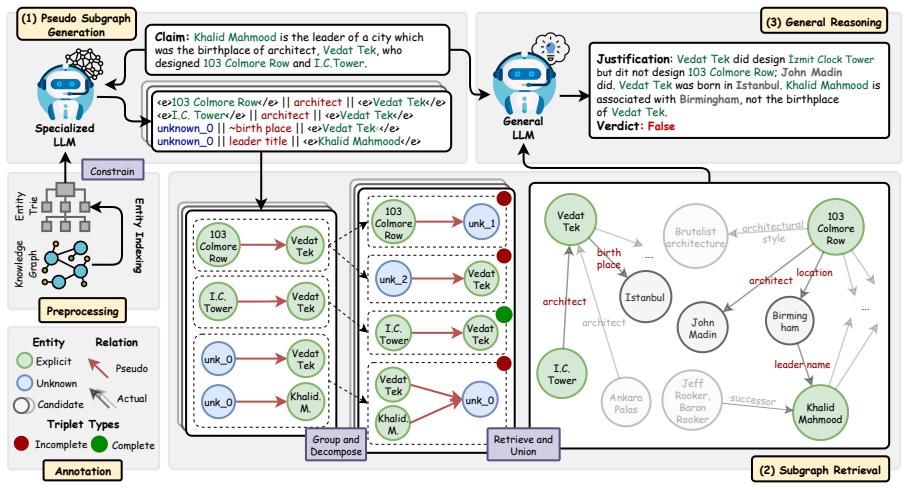
The load-bearing object is the pseudo-subgraph, a small graph of triplets generated from the claim by a fine-tuned LLM, with 'unknown_i' placeholders marking entities to be resolved during retrieval, and an Entity Trie constraining decoding so every emitted entity is a node in the knowledge graph. This representation bridges text and graph so that retrieval can be done with structured matching rather than free-text search, and it is what lets a 1B–3B model outperform a 70B general LLM at generating usable query structures.
What would settle it
Recompute GEAR and KG-GPT accuracies on the exact 2,000-claim sample of the FactKG test set that ClaimPKG was evaluated on, or on the full 9,041-claim test set, with the same entity pre-identification given to baselines; if the gap against ClaimPKG shrinks below the reported 9–12 points, the state-of-the-art claim is not supported.
Extended reading notes
Core claim
ClaimPKG's central claim is that claim verification over knowledge graphs improves when the claim is first translated into graph structure by a lightweight, task-specialized LLM, rather than left to a general LLM to segment and retrieve against the KG directly. The mechanism is a pseudo-subgraph: triplets of the form head_entity||relation||tail_entity, with an 'unknown_i' placeholder for entities the claim references indirectly or through multi-hop relations. Trie-constrained decoding forces every named entity to be a real KG node, beam search yields multiple structural views of the claim, and the retrieval stage scores candidate entities by how many pseudo-relations they satisfy. The paper claims this yields 84.64% average accuracy on FactKG, versus 76.65% for GEAR and 74.70% for KG-GPT, and that the method generalizes zero-shot to HoVer and FEVEROUS across Llama- and Qwen-based backbones.
Load-bearing premise
The 9–12 point margin over GEAR and KG-GPT assumes those baselines were evaluated on the same 2,000-claim random sample of the FactKG test set that ClaimPKG uses; the paper does not report the sample seed or release the sample, so the comparison may not be apples-to-apples.
Editorial extensions
If this is right
- If the reported gains hold, the default way to combine LLMs with knowledge graphs for verification shifts from prompting a general LLM to reason over the KG toward training a small model to act as a structure-builder front end.
- The trie-constrained decoding result—entity correctness at 100% with the constraint and 87.5% without—indicates that guaranteeing entity validity is a cheap and effective way to cut retrieval noise.
- The ablation showing a 20-point drop when incomplete-triplet retrieval is removed implies that explicit handling of unresolved, multi-hop entities is the main source of the accuracy gain on claims like existence and multi-hop categories.
- Zero-shot transfer to HoVer and FEVEROUS, even only on the subset the system predicts as supported, suggests the pseudo-subgraph representation carries patterns that generalize beyond the KG it was trained on.
Reading between the lines
- A testable extension: apply ClaimPKG to other KG-based verification benchmarks to see whether the 9–12 point margin is specific to FactKG or a general property of the pseudo-subgraph bridge.
- The paper's own error analysis attributes 71.5% of errors to the general reasoning LLM, so the next bottleneck is not structure generation but reasoning; pairing the pipeline with a stronger reasoning model or self-consistency could push accuracy further without changing retrieval.
- Because the trained specialized LLM is decoupled from the KG and only the Entity Trie is graph-specific, the framework has a natural adaptation path for updatable knowledge bases—updating the trie may suffice for new entities.
Editorial analysis
A structured set of objections, weighed in public.
Referee Report
Summary. ClaimPKG proposes an end-to-end framework for claim verification over knowledge graphs. A lightweight fine-tuned LLM with trie-constrained decoding converts a claim into one or more pseudo-subgraphs, possibly containing unknown_i placeholder entities; a retrieval module scores candidate entities and relations to assemble a relevant KG subgraph; and a general-purpose LLM then produces a verdict and justification. On FactKG the paper reports an average accuracy of 84.64% with Llama-3B* plus Llama-70B, claiming 9-12 point improvements over GEAR and KG-GPT, and it presents ablations, training-data-size experiments, and zero-shot transfer to HoVer and FEVEROUS.
Significance. If the headline results are valid, ClaimPKG would be a practically valuable demonstration that a small specialized LLM with constrained decoding can replace heavier entity-linking and multi-hop reasoning components in KG-based claim verification. The paper is thorough in several respects: Algorithms 1 and 2 give concrete pseudocode, all prompt templates are included, hyperparameters are tuned on the dev set, the supervised setup on FactKG train/dev/test is standard, and the 200-case error analysis helps interpret failure modes. The manuscript also reports a training-data-size curve with as few as 100 samples, which is useful for practitioners. The main obstacle is that the central performance comparison and the zero-shot generalization claim rest on evaluation protocols that are not currently established as comparable, which is a load-bearing issue for the paper's central claims.
major comments (2)
- [§5.1, Table 1] The central state-of-the-art claim is not verifiable as reported. The manuscript states that "for evaluation, we randomly sample 2K claims from the test set" (§5.1) but does not provide the random seed or release the sample, and Table 1 marks the Entity Correctness of GEAR and KG-GPT as "Known in Prior," indicating that those rows may be taken from prior publications rather than computed on the same 2K claims. If the GEAR and KG-GPT accuracies are full-test-set results while ClaimPKG is evaluated on a stratified 2K subset, the reported 9-12 point gap could be caused by sample composition rather than method quality. In addition, the "Average" column appears to be an unweighted mean over the five categories, which is not the same as overall accuracy on the test set, and no confidence intervals or multiple-sample results are reported. Please release the exact sample and seed, rerun GEAR and KG-GPT on that sample under the same protocol, and report both the unweighted category-mean and the overall accuracy with variance.
- [§5.2 (RQ3), Table 3] The zero-shot generalization claim is not supported by the reported evaluation. The manuscript analyzes only ClaimPKG's Support-Predicted samples, which constitute 12.5%-15.7% of the HoVer/FEVEROUS test sets, and compares these numbers against "Zero-shot CoT" baselines that appear to be evaluated on the full test sets. This is not an apples-to-apples comparison: the subset on which ClaimPKG predicts Supported may have a different difficulty distribution than the full set, and a baseline evaluated on the full set cannot be used to claim a 4% accuracy improvement on the subset. Moreover, the paper does not describe how FEVEROUS's NEI labels are handled, so the FEVEROUS accuracy figures (83.8 and 83.6) are uninterpretable as reported. Please evaluate the baselines on exactly the same support-predicted subset, or report full-set results with a defined treatment for claims outside DBpedia coverage and for NEI labels.
minor comments (6)
- [Appendix A, Table 4] The dev-set total for FactKG is printed as 132666; the row entries (6426 + 6840) sum to 13266, so the total should be corrected.
- [References] The two Glockner et al. entries (2022a and 2022b) are the same paper; one should be removed and the in-text citation updated accordingly.
- [§5.1, Table 1] The implementation section says baselines were evaluated on Llama 3, Qwen 2.5, and GPT-4o-mini, but Table 1 shows only GEAR (Fine-tuned BERT) and two KG-GPT rows; the manuscript should clarify which baselines were actually rerun and which are cited from prior work.
- [Appendix C.5, Table 11] The table reports Rerank Based accuracy as 84.73, while the surrounding text says the reranking score is 84.56; one of these is a typo and should be fixed.
- [§4.3, Algorithm 2] Equation (5) defines the candidate score as a sum over all relations connecting a candidate to explicit entities, but Algorithm 2's GetCandidatesAndScores uses MaxRelatedRelationScores, and AggregateGlobalScore sums those per-set maxima; the equation and the pseudocode are inconsistent and should be reconciled.
- [Table 3] The caption does not define "Support-Predicted" or the meaning of the percentage in parentheses, even though the main text explains them; the caption should be self-contained.
Circularity Check
No load-bearing circularity: the central SOTA claim rests on a standard supervised train/test setup with an independent retrieval and reasoning pipeline. The only definitional shortcut is the reported 100% Entity Correctness, which is guaranteed by the Trie-constrained decoder rather than measured.
-
self definitional
[Section 4.2 (Trie-Constrained Decoding), Table 1, and Appendix C.1 (Entity Correctness metric)]
"Entity correctness quantifies the correctness of a claim's extracted entities, i.e., whether these entities exist in the KG. Specifically, ... correctness(P, G) = #(P.enities ∩ G.entities) / #(P.entities). ... When ⟨e⟩ is generated, the decoding process restricts token selection based on T until ⟨/e⟩ is produced, ensuring all generated entities exist in the KG."
Entity Correctness is defined as the fraction of generated entities that belong to the KG. The Entity-Trie constraint forces every entity generated inside ⟨e⟩...⟨/e⟩ to be a valid Trie path, i.e., a KG entity, so P.entities ⊆ G.entities by construction. Therefore the reported 100.0% Entity Correctness is a logical tautology of the decoder, not an empirical finding. The comparison against 87.5% without the Trie still has empirical content, and this metric is not the paper's central SOTA claim, so the circularity is minor and not load-bearing.
full rationale
ClaimPKG's derivation chain is self-contained. The specialized LLM is trained on FactKG's training split using pseudo-subgraph labels derived from the provided evidence annotations, and it is evaluated on the held-out test split; this is standard supervised learning, not a fitted-input-called-prediction loop. The final verdict is produced by a separate general-purpose LLM that reasons over subgraphs retrieved by a deterministic algorithm, so the target label is not encoded in any trained parameter. Hyperparameters such as beam size, k1, and k2 are tuned on the dev set and reported in the appendix, which is normal model selection. There are no load-bearing self-citations, no imported uniqueness theorems, and no ansatz smuggled in via the authors' prior work; the external citations (FactKG, KG-GPT, constrained decoding, relation extraction) are independent and not from the present authors. The one definitional shortcut is the 100% Entity Correctness figure, which follows directly from the Trie-constrained decoding definition and is therefore true by construction; however, it is not the basis of the state-of-the-art accuracy claim. The reader's concern about baseline comparability (GEAR and KG-GPT rows marked 'Known in Prior' versus ClaimPKG's 2K sampled test set) is a valid evaluation-rigor issue, but it is not circularity: it concerns whether the comparison is apples-to-apples, not whether the method's output reduces to its inputs. Overall, the paper's central result is not circular, and the only circular element is a minor, non-load-bearing metric.
Assumptions & free parameters
free parameters (5)
- beam_size =
5
- k1 =
3
- k2 =
1
- relation_scoring_model =
BGE-Large-EN-v1.5
- specialized_LLM_training_data_size =
not explicitly stated (Figure 3 suggests 5K)
assumptions (4)
- domain assumption The FactKG test set claims are all grounded in DBpedia, so the required evidence exists in the KG.
- ad hoc to paper A candidate unknown entity connected to more explicit entities is more likely to be correct, and every candidate set should contribute at least k1 triplets.
- domain assumption Using only the most relevant subgraph S_c* and treating each sampled pseudo-subgraph as reasonable is a sufficient approximation of the true posterior.
- domain assumption Any entity that matters for verification is either present in the KG or can be represented as an unknown_i placeholder.
invented entities (2)
-
unknown_i placeholder entities
-
pseudo-subgraph P_c
Cite this review
Pith. "Pith review of ClaimPKG: Enhancing Claim Verification via Pseudo-Subgraph Generation with Lightweight Specialized LLM." pith.science (2026). https://pith.science/paper/JMKKXFD7
@misc{pith2026250522552,
  author       = {Pith},
  title        = {Pith review of: ClaimPKG: Enhancing Claim Verification via Pseudo-Subgraph Generation with Lightweight Specialized LLM},
  year         = {2026},
  howpublished = {\url{https://pith.science/paper/JMKKXFD7}},
  note         = {Machine review of arXiv:2505.22552}
}
read the original abstract
Integrating knowledge graphs (KGs) to enhance the reasoning capabilities of large language models (LLMs) is an emerging research challenge in claim verification. While KGs provide structured, semantically rich representations well-suited for reasoning, most existing verification methods rely on unstructured text corpora, limiting their ability to effectively leverage KGs. Additionally, despite possessing strong reasoning abilities, modern LLMs struggle with multi-step modular pipelines and reasoning over KGs without adaptation. To address these challenges, we propose ClaimPKG, an end-to-end framework that seamlessly integrates LLM reasoning with structured knowledge from KGs. Specifically, the main idea of ClaimPKG is to employ a lightweight, specialized LLM to represent the input claim as pseudo-subgraphs, guiding a dedicated subgraph retrieval module to identify relevant KG subgraphs. These retrieved subgraphs are then processed by a general-purpose LLM to produce the final verdict and justification. Extensive experiments on the FactKG dataset demonstrate that ClaimPKG achieves state-of-the-art performance, outperforming strong baselines in this research field by 9%-12% accuracy points across multiple categories. Furthermore, ClaimPKG exhibits zero-shot generalizability to unstructured datasets such as HoVer and FEVEROUS, effectively combining structured knowledge from KGs with LLM reasoning across various LLM backbones.
Figures


Figures from the paper (4 more)


Reference graph
Works this paper leans on
-
[1]
online" 'onlinestring :=
ENTRY address archivePrefix author booktitle chapter edition editor eid eprint eprinttype howpublished institution journal key month note number organization pages publisher school series title type volume year doi pubmed url lastchecked label extra.label sort.label short.list INTEGERS output.state before.all mid.sentence after.sentence after.block STRING...
-
[2]
write newline
" write newline "" before.all 'output.state := FUNCTION n.dashify 't := "" t empty not t #1 #1 substring "-" = t #1 #2 substring "--" = not "--" * t #2 global.max substring 't := t #1 #1 substring "-" = "-" * t #2 global.max substring 't := while if t #1 #1 substring * t #2 global.max substring 't := if while FUNCTION word.in bbl.in capitalize " " * FUNCT...
-
[3]
Rami Aly, Zhijiang Guo, Michael Sejr Schlichtkrull, James Thorne, Andreas Vlachos, Christos Christodoulopoulos, Oana Cocarascu, and Arpit Mittal. 2021. https://datasets-benchmarks-proceedings.neurips.cc/paper/2021/hash/68d30a9594728bc39aa24be94b319d21-Abstract-round1.html FEVEROUS: fact extraction and verification over unstructured and structured informat...
work page 2021
-
[4]
Nicola De Cao, Gautier Izacard, Sebastian Riedel, and Fabio Petroni. 2021. https://openreview.net/forum?id=5k8F6UU39V Autoregressive entity retrieval . In 9th International Conference on Learning Representations, ICLR 2021, Virtual Event, Austria, May 3-7, 2021 . OpenReview.net
work page 2021
-
[5]
Darren Edge, Ha Trinh, Newman Cheng, Joshua Bradley, Alex Chao, Apurva Mody, Steven Truitt, and Jonathan Larson. 2024. https://doi.org/10.48550/ARXIV.2404.16130 From local to global: A graph RAG approach to query-focused summarization . CoRR, abs/2404.16130
-
[7]
Max Glockner, Yufang Hou, and Iryna Gurevych. 2022 b . https://doi.org/10.18653/V1/2022.EMNLP-MAIN.397 Missing counter-evidence renders NLP fact-checking unrealistic for misinformation . In Proceedings of the 2022 Conference on Empirical Methods in Natural Language Processing, EMNLP 2022, Abu Dhabi, United Arab Emirates, December 7-11, 2022 , pages 5916--...
-
[8]
Jonathan Herzig, Pawel Krzysztof Nowak, Thomas M \"u ller, Francesco Piccinno, and Julian Eisenschlos. 2020. https://doi.org/10.18653/v1/2020.acl-main.398 T a P as: Weakly supervised table parsing via pre-training . In Proceedings of the 58th Annual Meeting of the Association for Computational Linguistics, pages 4320--4333, Online. Association for Computa...
-
[9]
Jinhao Jiang, Kun Zhou, Zican Dong, Keming Ye, Xin Zhao, and Ji-Rong Wen. 2023. https://doi.org/10.18653/v1/2023.emnlp-main.574 S truct GPT : A general framework for large language model to reason over structured data . In Proceedings of the 2023 Conference on Empirical Methods in Natural Language Processing, pages 9237--9251, Singapore. Association for C...
Show all 35 references
-
[10]
Yichen Jiang, Shikha Bordia, Zheng Zhong, Charles Dognin, Maneesh Kumar Singh, and Mohit Bansal. 2020. https://doi.org/10.18653/V1/2020.FINDINGS-EMNLP.309 Hover: A dataset for many-hop fact extraction and claim verification . In Findings of the Association for Computational Li...
2020 doi
-
[11]
Jiho Kim, Yeonsu Kwon, Yohan Jo, and Edward Choi. 2023 a . https://doi.org/10.18653/V1/2023.FINDINGS-EMNLP.631 KG-GPT: A general framework for reasoning on knowledge graphs using large language models . In Findings of the Association for Computational Linguistics: EMNLP 2023, ...
2023 doi
-
[12]
Jiho Kim, Sungjin Park, Yeonsu Kwon, Yohan Jo, James Thorne, and Edward Choi. 2023 b . https://doi.org/10.18653/V1/2023.ACL-LONG.895 Factkg: Fact verification via reasoning on knowledge graphs . In Proceedings of the 61st Annual Meeting of the Association for Computational Lin...
2023 doi
-
[13]
Gonzalez, Hao Zhang, and Ion Stoica
Woosuk Kwon, Zhuohan Li, Siyuan Zhuang, Ying Sheng, Lianmin Zheng, Cody Hao Yu, Joseph E. Gonzalez, Hao Zhang, and Ion Stoica. 2023. Efficient memory management for large language model serving with pagedattention. In Proceedings of the ACM SIGOPS 29th Symposium on Operating S...
2023
-
[14]
Mendes, Sebastian Hellmann, Mohamed Morsey, Patrick van Kleef, S \" o ren Auer, and Christian Bizer
Jens Lehmann, Robert Isele, Max Jakob, Anja Jentzsch, Dimitris Kontokostas, Pablo N. Mendes, Sebastian Hellmann, Mohamed Morsey, Patrick van Kleef, S \" o ren Auer, and Christian Bizer. 2015. https://doi.org/10.3233/SW-140134 Dbpedia - A large-scale, multilingual knowledge bas...
2015 doi
-
[15]
Qi Li, Heng Ji, and Liang Huang. 2013. https://aclanthology.org/P13-1008/ Joint event extraction via structured prediction with global features . In Proceedings of the 51st Annual Meeting of the Association for Computational Linguistics, ACL 2013, 4-9 August 2013, Sofia, Bulga...
2013
-
[16]
Ilya Loshchilov and Frank Hutter. 2019. https://openreview.net/forum?id=Bkg6RiCqY7 Decoupled weight decay regularization . In 7th International Conference on Learning Representations, ICLR 2019, New Orleans, LA, USA, May 6-9, 2019 . OpenReview.net
2019
-
[17]
Linhao Luo, Yuan - Fang Li, Gholamreza Haffari, and Shirui Pan. 2024. https://openreview.net/forum?id=ZGNWW7xZ6Q Reasoning on graphs: Faithful and interpretable large language model reasoning . In The Twelfth International Conference on Learning Representations, ICLR 2024, Vie...
2024
-
[18]
Meta. 2024. https://llama.meta.com/llama3/ Build the future of ai with meta llama 3, 2024
2024
-
[19]
Makoto Miwa and Mohit Bansal. 2016. https://doi.org/10.18653/v1/P16-1105 End-to-end relation extraction using LSTM s on sequences and tree structures . In Proceedings of the 54th Annual Meeting of the Association for Computational Linguistics (Volume 1: Long Papers), pages 110...
2016 doi
-
[20]
OpenAI. 2024. https://openai.com/index/hello-gpt-4o/ Hello gpt-4o, 2024a
2024
-
[21]
Liangming Pan, Xiaobao Wu, Xinyuan Lu, Anh Tuan Luu, William Yang Wang, Min - Yen Kan, and Preslav Nakov. 2023. https://doi.org/10.18653/V1/2023.ACL-LONG.386 Fact-checking complex claims with program-guided reasoning . In Proceedings of the 61st Annual Meeting of the Associati...
2023 doi
-
[22]
Jungsoo Park, Sewon Min, Jaewoo Kang, Luke Zettlemoyer, and Hannaneh Hajishirzi. 2022. https://doi.org/10.18653/v1/2022.acl-long.354 F a VIQ : FA ct verification from information-seeking questions . In Proceedings of the 60th Annual Meeting of the Association for Computational...
2022 doi
-
[23]
Qwen . 2024. https://qwenlm.github.io/blog/qwen2.5/ Qwen2.5: A party of foundation models
2024
-
[24]
Tal Schuster, Adam Fisch, and Regina Barzilay. 2021. https://doi.org/10.18653/v1/2021.naacl-main.52 Get your vitamin C ! robust fact verification with contrastive evidence . In Proceedings of the 2021 Conference of the North American Chapter of the Association for Computationa...
2021 doi
-
[25]
Ni, Heung - Yeung Shum, and Jian Guo
Jiashuo Sun, Chengjin Xu, Lumingyuan Tang, Saizhuo Wang, Chen Lin, Yeyun Gong, Lionel M. Ni, Heung - Yeung Shum, and Jian Guo. 2024. https://openreview.net/forum?id=nnVO1PvbTv Think-on-graph: Deep and responsible reasoning of large language model on knowledge graph . In The Tw...
2024
-
[26]
James Thorne and Andreas Vlachos. 2018. https://aclanthology.org/C18-1283/ Automated fact checking: Task formulations, methods and future directions . In Proceedings of the 27th International Conference on Computational Linguistics, COLING 2018, Santa Fe, New Mexico, USA, Augu...
2018
-
[27]
James Thorne, Andreas Vlachos, Christos Christodoulopoulos, and Arpit Mittal. 2018. https://doi.org/10.18653/V1/N18-1074 FEVER: a large-scale dataset for fact extraction and verification . In Proceedings of the 2018 Conference of the North American Chapter of the Association f...
2018 doi
-
[28]
Bailin Wang, Richard Shin, Xiaodong Liu, Oleksandr Polozov, and Matthew Richardson. 2020. https://doi.org/10.18653/v1/2020.acl-main.677 RAT-SQL : Relation-aware schema encoding and linking for text-to- SQL parsers . In Proceedings of the 58th Annual Meeting of the Association ...
2020 doi
-
[29]
Haoran Wang and Kai Shu. 2023. https://doi.org/10.18653/V1/2023.FINDINGS-EMNLP.416 Explainable claim verification via knowledge-grounded reasoning with large language models . In Findings of the Association for Computational Linguistics: EMNLP 2023, Singapore, December 6-10, 2...
2023 doi
-
[30]
Le, Ed H
Xuezhi Wang, Jason Wei, Dale Schuurmans, Quoc V. Le, Ed H. Chi, Sharan Narang, Aakanksha Chowdhery, and Denny Zhou. 2023. https://openreview.net/forum?id=1PL1NIMMrw Self-consistency improves chain of thought reasoning in language models . In The Eleventh International Conferen...
2023
-
[31]
Chi, Quoc V
Jason Wei, Xuezhi Wang, Dale Schuurmans, Maarten Bosma, Brian Ichter, Fei Xia, Ed H. Chi, Quoc V. Le, and Denny Zhou. 2022. http://papers.nips.cc/paper\_files/paper/2022/hash/9d5609613524ecf4f15af0f7b31abca4-Abstract-Conference.html Chain-of-thought prompting elicits reasoning...
2022
-
[32]
Wikipedia . 2025 a . https://en.wikipedia.org/wiki/Levenshtein_distance Levenshtein distance --- Wikipedia, The Free Encyclopedia . Accessed: 14-February-2025
2025
-
[33]
Wikipedia . 2025 b . https://en.wikipedia.org/wiki/Trie Trie --- Wikipedia , The Free Encyclopedia . [Online; accessed 9-February-2025]
2025
-
[34]
Shitao Xiao, Zheng Liu, Peitian Zhang, and Niklas Muennighoff. 2023. https://arxiv.org/abs/2309.07597 C-pack: Packaged resources to advance general chinese embedding . Preprint, arXiv:2309.07597
2023 arXiv
-
[35]
Jie Zhou, Ganqu Cui, Shengding Hu, Zhengyan Zhang, Cheng Yang, Zhiyuan Liu, Lifeng Wang, Changcheng Li, and Maosong Sun. 2020. https://doi.org/10.1016/J.AIOPEN.2021.01.001 Graph neural networks: A review of methods and applications . AI Open , 1:57--81
2020 doi
-
[36]
Jie Zhou, Xu Han, Cheng Yang, Zhiyuan Liu, Lifeng Wang, Changcheng Li, and Maosong Sun. 2019. https://doi.org/10.18653/V1/P19-1085 GEAR: graph-based evidence aggregating and reasoning for fact verification . In Proceedings of the 57th Conference of the Association for Computat...
2019 doi
Reviewed August 7, 2026 · model on record in the stance chip above.
Discussion (0). Sign in to comment.