REVIEW 3 major objections 4 minor 69 references
Characterizing Bias: Benchmarking Large Language Models in Simplified versus Traditional Chinese
T0 review · 3 major / 4 minor · reviewed 2026-08-07 · deepseek-v4-flash
Pith's one-line read Prompting a large language model in Simplified versus Traditional Chinese changes both whether it answers correctly and which job candidate it would hire, and the two biases point in opposite directions.
desk verdict Solid empirical audit of LLM biases across Simplified/Traditional Chinese, but the name-task headline overstates a script effect that the paper's own control experiments undercut. read the letter →
The pith
A machine-rendered reading of the paper's core claim, the machinery that carries it, and where it could break.
The reading
What carries the argument
The carrying object is SC-TC-Bench, a paired benchmark holding 110 regional terms with definitions in both scripts and 352 regionally popular three-character names with population counts and gender labels. The primary metrics are the correct, misaligned, and incorrect response shares for the term task, and the Mainland Chinese Name Rate for the name task, with 50% defined as the regionally unbiased reference. Three controlled experiments do the causal work: conditioning on population-based name popularity, balancing gender distributions in the candidate lists, and a same-name-different-script comparison restricted to six names identical except for being written in Simplified or Traditional characters, which flips the majority preference from Taiwanese to Mainland names. Token-generation probabilities for surname characters and per-name token counts round out the mechanism analysis.
What would settle it
Replicate the name-choice task with gender-balanced Mainland and Taiwanese candidate lists of equal size and matched character structure; if the Mainland Chinese Name Rate moves to 50%, the claimed preference for Taiwanese names is an artifact of gender composition rather than a script or regional bias.
Extended reading notes
Core claim
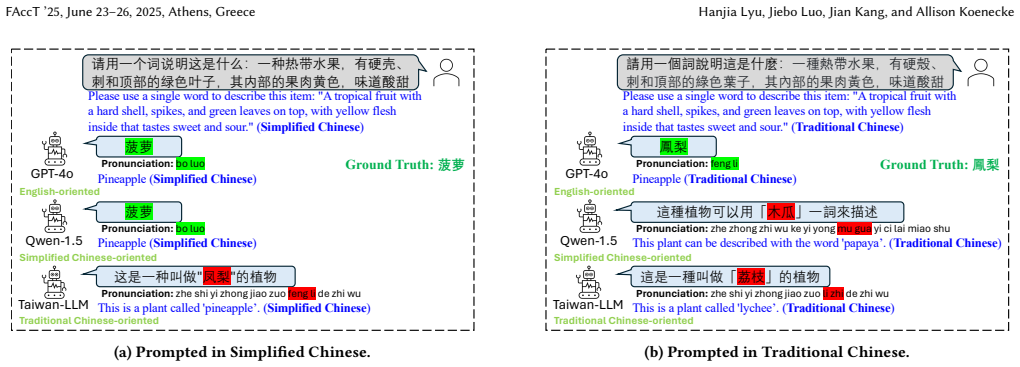
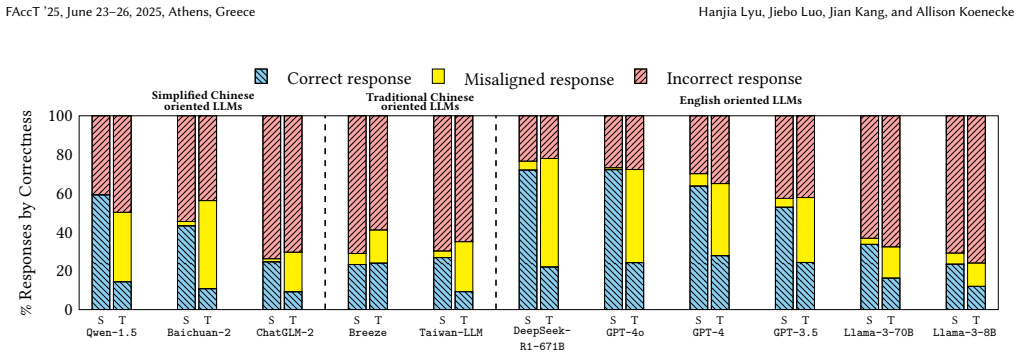
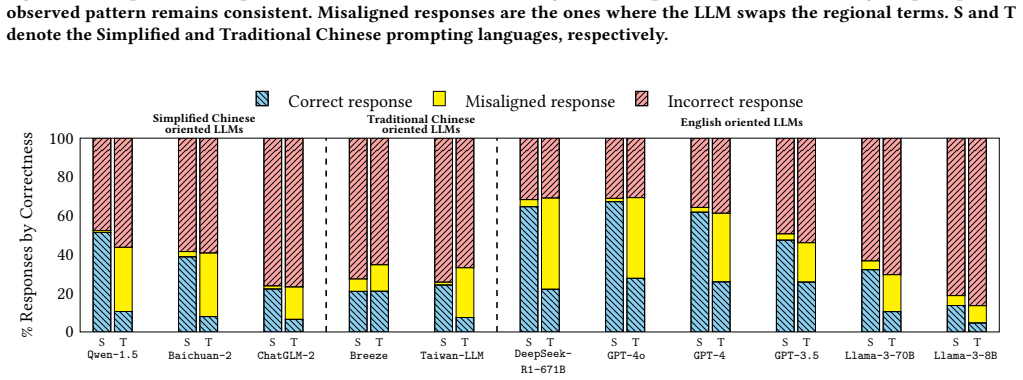
The discovery, on the paper's own terms, is that LLM behavior is not neutral across Simplified and Traditional Chinese, and the direction of the bias depends on the task rather than on the model's training language. Across 11 models spanning English-, Simplified Chinese-, and Traditional Chinese-oriented training, correct response rates on the regional term task are significantly higher when prompts are in Simplified Chinese, while “misaligned” responses—returning the Mainland term when asked in Traditional Chinese—are significantly more likely under Traditional prompts. On the regional name choice task the pattern reverses: most models select Taiwanese names at rates significantly below the 50% Mainland-share benchmark that an unbiased model would meet. The paper attributes the term bias to overrepresentation of Simplified Chinese regional terms in large text corpora, and the name bias to model preferences for particular characters and to tokenization differences between the two scripts.
Load-bearing premise
The headline Taiwanese-name preference assumes that, after the reported controls, the Mainland and Taiwanese name lists are regionally comparable, so the measured Mainland Chinese name rate isolates script or region rather than gender imbalance—yet the Mainland corpus is heavily female-skewed (134 female against 18 male names) and the direct script-only test uses just six all-female names.
Editorial extensions
If this is right
- Correct-response gaps on regional terms persist when prompts are rephrased, so the Simplified-Chinese advantage is robust to wording.
- Terms that models systematically misalign under Traditional prompts appear more often in Simplified form even inside Traditional Chinese-oriented corpora, implicating training-data imbalance as a cause.
- Holding the name constant and changing only the script flips the majority selection from Taiwanese to Mainland names, isolating script and tokenization as drivers of the name bias.
- Small single-character edits, such as a surname written 陈 versus 陳, can elicit large swings in which region's names get chosen.
- A regionally unbiased model should refuse to hire on the basis of a name alone; most tested models instead comply with the prompt and pick a candidate.
Reading between the lines
- A gender-balanced replication of the name task, with matched male and female names in both regions, is the natural next audit: the paper's own Mainland corpus is 134 female against 18 male names, and the script-only experiment uses only female names.
- If tokenization is the mechanism, retraining or re-fragmenting Chinese tokenizers could reduce the name bias more directly than curating additional training data.
- The matched-prompt design transfers to other Chinese-using regions such as Hong Kong, Macau, and Malaysia, and to other script or dialect pairs, where the bias direction could differ.
- The finding that English prompts often yield the highest valid-response rates hints that using English as a 'neutral' fallback can import a third, English-flavored bias into Chinese-language decisions.
Editorial analysis
A structured set of objections, weighed in public.
Referee Report
Summary. The paper introduces SC-TC-Bench, a new benchmark for auditing large language models (LLMs) when prompted in Simplified versus Traditional Chinese, and applies it to 11 commercial and open-source LLMs. Two tasks are designed: regional term choice, where the model must name an item using the regionally appropriate term (Mainland China versus Taiwan), and regional name choice, where the model must select a job candidate from a mixed list of Mainland Chinese and Taiwanese names. The study reports that most LLMs are significantly more correct in Simplified Chinese on the term task, and that most LLMs select Taiwanese names at a higher rate than Mainland Chinese names across prompt languages. The paper further attempts to explain the name-task bias through name popularity, gender composition, character-level token generation probabilities, a same-name/different-script control, and tokenization analysis. The benchmark dataset is publicly released.
Significance. The term-task result is a solid, well-controlled contribution: the authors use power analysis, Benjamini-Hochberg correction, multiple prompt variants, and corpus-frequency evidence to show a reproducible Simplified-Chinese advantage, and they release the benchmark for future audits. The name-task investigation is also valuable as a real-world hiring audit, particularly the character-preference experiments and the same-name script-control design. However, the headline interpretation of the name task as showing a bias toward Traditional Chinese script is not supported by the paper's own control experiment, which flips the preference toward Simplified forms when name identity is held constant. With a careful reinterpretation that separates regional name content from script effects, and with attention to the gender imbalance in the name corpus, the paper can make a meaningful and publishable contribution to fairness auditing of LLMs across Chinese script variants.
major comments (3)
- [§4.6.1, Figure 4; Abstract] The same-name/different-script experiment shows that when only the script differs, the majority of LLMs prefer the Mainland (Simplified) rendering—the opposite of the main result reported in §4.1. This directly contradicts the abstract's claim that LLMs 'surprisingly favored Traditional Chinese names' in the regional name choice task. The observed preference in the main name task is a preference for Taiwanese name content (e.g., given-name characters such as 俊 and 宇, which do not appear in the Mainland corpus), not for Traditional Chinese script. The script effect is real but operates in the opposite direction, so the abstract and the Section 5 statement that 'specific characters and tokenization of written scripts could be a driver of biases favoring Traditional Chinese' conflate two distinct mechanisms. The headline and discussion should be reframed to distinguish regional name identity from script effect.
- [§2.2.2, Figure 3, §4.4] The Mainland Chinese name corpus is heavily female-skewed (134 female versus 18 male names) while the Taiwanese corpus is balanced (100 male versus 100 female). Since prior work (Nghiem et al., ref [38]) demonstrates that LLMs exhibit name-based gender bias in employment recommendations, the raw Mainland Chinese name rates in Figure 3 may undercount Mainland names for reasons of gender rather than region. The gender-matched analyses in §4.4 and Tables 24–26 are presented as robustness checks, but the primary experiment is never re-run with balanced gender sampling, and the main-text discussion still reports the unbalanced result as the headline. The authors should either re-run the main name task with gender-balanced candidate lists or report the gender-matched rates as the primary outcome, with the unbalanced result relegated to an auxiliary analysis.
- [§4.6.2, Table 37] The tokenization analysis shows that Traditional Chinese names are typically split into more tokens than their Simplified equivalents for most LLMs, a pattern that prior work (Ahia et al., ref [3]) associates with over-fragmentation and degraded processing. This predicts a preference for Simplified forms, and indeed the same-name experiment in §4.6.1 observes exactly that preference. The paper's assertion that tokenization 'likely contributes to the observed name selection biases' favoring Traditional Chinese is therefore internally inconsistent: the tokenization evidence works against the main name-task result and cannot be cited as a partial explanation of it without a more nuanced argument that specifies how fragmentation could produce a preference for the higher-token variant. The authors should either revise this explanatory claim or present the tokenization result as evidence that script-based processing actually counteracts the name-content bias.
minor comments (4)
- [Appendix A.2] There is a typo in the description of hyperparameters: 'temprature' should be 'temperature'.
- [Figure 4 and Figure 11 captions] The arrow labels 'MC Name Rate Up' and 'MC Name Rate Down' are not self-explanatory; please clarify in the caption that red arrows denote an increase in the selection rate of Mainland Chinese names relative to the corresponding baseline figure.
- [Table 37] The rows for GPT-3.5 and Llama-3-8B are numerically identical to those for GPT-4 and Llama-3-70B, respectively; please check whether this duplication is intentional or a reporting error.
- [Appendix B.2, Tables 14–17] The full term-level tables are very large and difficult to parse in print; consider supplementing them with a compact visualization or an electronic spreadsheet link in the main text.
Circularity Check
No significant circularity: the benchmark claims are measured outcomes against external definitions and official name statistics; explanations are post hoc but not fitted to the target.
full rationale
The paper's central claims are empirical measurements, not derivations from fitted inputs. Regional term correctness is scored against region-specific vocabulary sourced from prior published Cross-Strait vocabulary work and independently reviewed by native speakers (Sections 2.2.1, A.7), and name regional labels come from separate official government reports for Mainland China and Taiwan (Section 2.2.2, Appendix C.3). The headline asymmetry—Simplified-favoring term responses but Traditional-favoring name selections—is read off actual LLM outputs (Figures 2 and 3), so the task-dependence claim does not reduce to the benchmark construction. The explanatory mechanisms (training-data imbalance, character preference, tokenization) are tested with independent measurements: corpus frequencies (Section 3.2.2, Table 18), token-generation probabilities (Sections 4.5.1, Tables 35-36), and tokenizer token counts (Section 4.6.2, Table 37). None of these are fitted to the observed selection rates; they are separate observations that the paper offers as partial, post hoc explanations. The same-name/different-script experiment (Section 4.6.1) is an explicit control that qualifies the name-task claim, and the paper discloses the female-only limitation of that control in Appendix C.6. The only self-citation is [43] in the introduction as background on political sample simulation; it is not load-bearing. The paper is self-contained against external benchmarks and official statistics. The skeptic's concern about the name task conflating name content with script is an interpretation or correctness issue, not circularity: the observed flip under the script-only control weakens the 'favor Traditional Chinese names' headline but does not make any claimed result equivalent to its inputs by construction. No circular step meets the evidentiary bar of quoting a derivation that reduces to its own inputs.
Assumptions & free parameters
free parameters (3)
- Misalignment threshold =
3 out of 15 trials
- Number of permutations for name lists =
180
- Number of trials for term task =
15
assumptions (6)
- domain assumption Simplified Chinese maps to Mainland China and Traditional Chinese maps to Taiwan
- domain assumption The official name reports provide representative samples of names in each region
- domain assumption Publicly available text corpora are valid proxies for LLM training data
- domain assumption Token generation probabilities reflect character preferences
- standard math Independence of repeated trials from the same LLM for statistical testing
- domain assumption Manual verification by native speakers ensures correctness of definitions and translations
Cite this review
Pith. "Pith review of Characterizing Bias: Benchmarking Large Language Models in Simplified versus Traditional Chinese." pith.science (2026). https://pith.science/paper/2HEU377Y
@misc{pith2026250522645,
  author       = {Pith},
  title        = {Pith review of: Characterizing Bias: Benchmarking Large Language Models in Simplified versus Traditional Chinese},
  year         = {2026},
  howpublished = {\url{https://pith.science/paper/2HEU377Y}},
  note         = {Machine review of arXiv:2505.22645}
}
read the original abstract
While the capabilities of Large Language Models (LLMs) have been studied in both Simplified and Traditional Chinese, it is yet unclear whether LLMs exhibit differential performance when prompted in these two variants of written Chinese. This understanding is critical, as disparities in the quality of LLM responses can perpetuate representational harms by ignoring the different cultural contexts underlying Simplified versus Traditional Chinese, and can exacerbate downstream harms in LLM-facilitated decision-making in domains such as education or hiring. To investigate potential LLM performance disparities, we design two benchmark tasks that reflect real-world scenarios: regional term choice (prompting the LLM to name a described item which is referred to differently in Mainland China and Taiwan), and regional name choice (prompting the LLM to choose who to hire from a list of names in both Simplified and Traditional Chinese). For both tasks, we audit the performance of 11 leading commercial LLM services and open-sourced models -- spanning those primarily trained on English, Simplified Chinese, or Traditional Chinese. Our analyses indicate that biases in LLM responses are dependent on both the task and prompting language: while most LLMs disproportionately favored Simplified Chinese responses in the regional term choice task, they surprisingly favored Traditional Chinese names in the regional name choice task. We find that these disparities may arise from differences in training data representation, written character preferences, and tokenization of Simplified and Traditional Chinese. These findings highlight the need for further analysis of LLM biases; as such, we provide an open-sourced benchmark dataset to foster reproducible evaluations of future LLM behavior across Chinese language variants (https://github.com/brucelyu17/SC-TC-Bench).
Figures


Figures from the paper (9 more)






Reference graph
Works this paper leans on
-
[38]
Huy Nghiem, John Prindle, Jieyu Zhao, and Hal Daumé Iii. 2024. “You Gotta be a Doctor, Lin” : An Investigation of Name-Based Bias of Large Language Models in Employment Recommendations. InProceedings of the 2024 Conference on Empirical Methods in Natural Language Processing, Yaser Al-Onaizan, Mohit Bansal, and Yun-Nung Chen (Eds.). Association for Computa...
-
[3]
Orevaoghene Ahia, Sachin Kumar, Hila Gonen, Jungo Kasai, David Mortensen, Noah Smith, and Yulia Tsvetkov. 2023. Do All Languages Cost the Same? To- kenization in the Era of Commercial Language Models. InProceedings of the 2023 Conference on Empirical Methods in Natural Language Processing, Houda Bouamor, Juan Pino, and Kalika Bali (Eds.). Association for ...
-
[1]
2018. Name Statistics. https://www.ris.gov.tw/documents/data/5/2/107namestat. pdf Accessed: 04-09-2024. Characterizing Bias: Benchmarking Large Language Models in Simplified versus Traditional Chinese FAccT ’25, June 23–26, 2025, Athens, Greece
work page 2018
-
[2]
Anurag Acharya, Kartik Talamadupula, and Mark A Finlayson. 2021. An atlas of cultural commonsense for machine reasoning. InAAAI Conference on Artificial Intelligence
work page 2021
-
[4]
Ai2. 2021. c4. https://huggingface.co/datasets/allenai/c4. Accessed: 2025-04-28
work page 2021
-
[5]
Mohammad Atari, Mona J Xue, Peter S Park, Damián Blasi, and Joseph Henrich
-
[6]
Jinze Bai, Shuai Bai, Yunfei Chu, Zeyu Cui, Kai Dang, Xiaodong Deng, Yang Fan, Wenbin Ge, Yu Han, Fei Huang, et al. 2023. Qwen technical report.arXiv preprint arXiv:2309.16609(2023)
arXiv 2023
-
[7]
2023.Fairness and Machine Learning: Limitations and Opportunities
Solon Barocas, Moritz Hardt, and Arvind Narayanan. 2023.Fairness and Machine Learning: Limitations and Opportunities. MIT Press
2023
Show all 69 references
-
[8]
Kaj Bostrom and Greg Durrett. 2020. Byte Pair Encoding is Suboptimal for Language Model Pretraining. InFindings of the Association for Computational Linguistics: EMNLP 2020, Trevor Cohn, Yulan He, and Yang Liu (Eds.). Association for Computational Linguistics, Online, 4617–462...
2020 doi
-
[9]
Tom Brown, Benjamin Mann, Nick Ryder, Melanie Subbiah, Jared D Kaplan, Prafulla Dhariwal, Arvind Neelakantan, Pranav Shyam, Girish Sastry, Amanda Askell, et al. 2020. Language models are few-shot learners.Advances in neural information processing systems33 (2020), 1877–1901
2020
-
[10]
Jianbin Chang. 2023. chinese-c4. https://huggingface.co/datasets/shjwudp/chin ese-c4. Accessed: 2025-04-28
2023
-
[11]
Pokai Chang. 2023. zh-tw-wikipedia. https://huggingface.co/datasets/zetavg/zh- tw-wikipedia. Accessed: 2025-04-28
2023
-
[12]
Jacob Cohen. 1992. Statistical power analysis.Current directions in psychological science1(3) (1992)
1992
-
[13]
Zhengxiao Du, Yujie Qian, Xiao Liu, Ming Ding, Jiezhong Qiu, Zhilin Yang, and Jie Tang. 2022. GLM: General Language Model Pretraining with Autoregressive Blank Infilling. (2022), 320–335
2022
-
[14]
Philipp Ennen, Po-Chun Hsu, Chan-Jan Hsu, Chang-Le Liu, Yen-Chen Wu, Yin- Hsiang Liao, Chin-Tung Lin, Da-Shan Shiu, and Wei-Yun Ma. 2023. Extending the pre-training of bloom for improved support of traditional chinese: Models, methods and results.arXiv preprint arXiv:2303.04715(2023)
2023 arXiv
-
[15]
Chengguang Gan, Qinghao Zhang, and Tatsunori Mori. 2024. Application of llm agents in recruitment: A novel framework for resume screening.arXiv preprint arXiv:2401.08315(2024)
2024 arXiv
-
[16]
Daya Guo, Dejian Yang, Haowei Zhang, Junxiao Song, Ruoyu Zhang, Runxin Xu, Qihao Zhu, Shirong Ma, Peiyi Wang, Xiao Bi, et al . 2025. Deepseek-r1: Incentivizing reasoning capability in llms via reinforcement learning.arXiv preprint arXiv:2501.12948(2025)
2025 arXiv
-
[17]
Daniil Gurgurov, Mareike Hartmann, and Simon Ostermann. 2024. Adapting Mul- tilingual LLMs to Low-Resource Languages with Knowledge Graphs via Adapters. InProceedings of the 1st Workshop on Knowledge Graphs and Large Language Mod- els (KaLLM 2024), Russa Biswas, Lucie-Aimée Ka...
2024 doi
-
[18]
Valentin Hofmann, Pratyusha Ria Kalluri, Dan Jurafsky, and Sharese King. 2024. Dialect prejudice predicts AI decisions about people’s character, employability, and criminality.arXiv preprint arXiv:2403.00742(2024)
2024 arXiv
-
[19]
Chan-Jan Hsu, Chang-Le Liu, Feng-Ting Liao, Po-Chun Hsu, Yi-Chang Chen, and Da-shan Shiu. 2023. Advancing the Evaluation of Traditional Chinese Lan- guage Models: Towards a Comprehensive Benchmark Suite.arXiv preprint arXiv:2309.08448(2023)
2023 arXiv
-
[20]
Chan-Jan Hsu, Chang-Le Liu, Feng-Ting Liao, Po-Chun Hsu, Yi-Chang Chen, and Da-Shan Shiu. 2024. Breeze-7B Technical Report. (2024). arXiv:2403.02712 [cs.CL]
2024 arXiv
-
[21]
Yuzhen Huang, Yuzhuo Bai, Zhihao Zhu, Junlei Zhang, Jinghan Zhang, Tangjun Su, Junteng Liu, Chuancheng Lv, Yikai Zhang, Yao Fu, et al. 2024. C-eval: A multi- level multi-discipline chinese evaluation suite for foundation models.Advances in Neural Information Processing Systems...
2024
-
[22]
Lee Chak Kei. 2023. OpenOrca-Traditional-Chinese. https://huggingface.co/dat asets/lchakkei/OpenOrca-Traditional-Chinese. Accessed: 2025-04-28
2023
-
[23]
Haonan Li, Yixuan Zhang, Fajri Koto, Yifei Yang, Hai Zhao, Yeyun Gong, Nan Duan, and Timothy Baldwin. 2023. Cmmlu: Measuring massive multitask lan- guage understanding in chinese.arXiv preprint arXiv:2306.09212(2023)
2023 arXiv
-
[24]
Sheng-Wei Li. 2024. c4-zhtw. https://huggingface.co/datasets/liswei/c4-zhtw. Accessed: 2025-04-28
2024
-
[25]
Sheng-Wei Li. 2024. common-crawl-zhtw. https://huggingface.co/datasets/liswei /common-crawl-zhtw. Accessed: 2025-04-28
2024
-
[26]
2014.Cross-Strait Common Vocabulary
Xingjian Li, Zhiqun Qiu, and Fuling Xu. 2014.Cross-Strait Common Vocabulary. Fujian People’s Publishing House
2014
-
[27]
Yizhi Li. 2024. MAP-CC. https://huggingface.co/datasets/m-a-p/MAP-CC. Accessed: 2025-04-28
2024
-
[28]
Yen-Ting Lin. 2024. TaiwanChat. https://huggingface.co/datasets/yentinglin/Tai wanChat. Accessed: 2025-04-28
2024
-
[29]
Yen-Ting Lin and Yun-Nung Chen. 2023. Taiwan llm: Bridging the linguistic divide with a culturally aligned language model.arXiv preprint arXiv:2311.17487 (2023)
2023 arXiv
-
[30]
Chuang Liu, Renren Jin, Yuqi Ren, Linhao Yu, Tianyu Dong, Xiaohan Peng, Shuting Zhang, Jianxiang Peng, Peiyi Zhang, Qingqing Lyu, et al. 2023. M3ke: A massive multi-level multi-subject knowledge evaluation benchmark for chinese large language models.arXiv preprint arXiv:2305.1...
2023 arXiv
-
[31]
Tianyin Liu and Janet Hsiao. 2012. The perception of simplified and traditional Chinese characters in the eye of simplified and traditional Chinese readers. In Proceedings of the Annual Meeting of the Cognitive Science Society, Vol. 34
2012
-
[32]
Xiao Liu, Xuanyu Lei, Shengyuan Wang, Yue Huang, Zhuoer Feng, Bosi Wen, Jiale Cheng, Pei Ke, Yifan Xu, Weng Lam Tam, et al. 2023. Alignbench: Benchmarking chinese alignment of large language models.arXiv preprint arXiv:2311.18743 (2023)
2023 arXiv
-
[33]
Mapull. 2022. Chinese Pinyin Dictionary. https://github.com/mapull/chinese- dictionary Accessed: 04-09-2024
2022
-
[34]
AI Meta. 2024. Introducing meta llama 3: The most capable openly available llm to date.Meta AI.(2024)
2024
-
[35]
Marco Monroy. 2024. Simplified vs. Traditional Chinese: What’s the difference? A guide. https://www.berlitz.com/blog/traditional-vs-simplified-chinese Accessed: 06-15-2024
2024
-
[36]
Moin Nadeem, Anna Bethke, and Siva Reddy. 2021. StereoSet: Measuring stereo- typical bias in pretrained language models. InProceedings of the 59th Annual Meeting of the Association for Computational Linguistics and the 11th Interna- tional Joint Conference on Natural Language ...
2021 doi
-
[37]
New York City Council. 2021. Local Law 144 of 2021. https://www.nyc.gov/asse ts/dca/downloads/pdf/about/Local-Law-144.pdf
2021
-
[39]
Ministry of Public Security (China). 2013. Moat Popular Names. https://web.ar chive.org/web/20160920191749/http://zhaoren.idtag.cn/samename/searchName !pmbyrepeatlist.htm Accessed: 04-09-2024
2013
-
[40]
OpenAI. 2023. GPT-4 Technical Report.CoRRabs/2303.08774 (2023). doi:10.485 50/ARXIV.2303.08774 arXiv:2303.08774
2023 arXiv
-
[41]
OpenAI. 2024. Hello GPT-4o. https://openai.com/index/hello-gpt-4o/ Accessed: 06-12-2024
2024
-
[42]
Anaelia Ovalle, Ninareh Mehrabi, Palash Goyal, Jwala Dhamala, Kai-Wei Chang, Richard Zemel, Aram Galstyan, Yuval Pinter, and Rahul Gupta. 2024. Tokenization Matters: Navigating Data-Scarce Tokenization for Gender Inclusive Language Technologies. InFindings of the Association f...
2024 doi
-
[43]
Weihong Qi, Hanjia Lyu, and Jiebo Luo. 2024. Representation bias in political sample simulations with large language models.arXiv preprint arXiv:2407.11409 (2024)
2024 arXiv
-
[44]
Science & Technology Policy Research and Information Center. 2020. Formosa Language Understanding Dataset. https://scidm.nchc.org.tw/dataset/grandchall enge2020 Accessed: 06-12-2024
2020
-
[45]
M Rithani, R Venkatakrishnan, et al. 2024. Empirical Evaluation of Large Language Models in Resume Classification. In2024 Fourth International Conference on Advances in Electrical, Computing, Communication and Sustainable Technologies (ICAECT). IEEE, 1–4
2024
-
[46]
Chih Chieh Shao, Trois Liu, Yuting Lai, Yiying Tseng, and Sam Tsai. 2018. DRCD: A Chinese machine reading comprehension dataset.arXiv preprint arXiv:1806.00920(2018)
2018 arXiv
-
[47]
Siqi Shen, Lajanugen Logeswaran, Moontae Lee, Honglak Lee, Soujanya Poria, and Rada Mihalcea. 2024. Understanding the Capabilities and Limitations of Large Language Models for Cultural Commonsense.arXiv preprint arXiv:2405.04655 (2024)
2024 arXiv
-
[48]
Chenglei Si, Zhengyan Zhang, Yingfa Chen, Fanchao Qi, Xiaozhi Wang, Zhiyuan Liu, Yasheng Wang, Qun Liu, and Maosong Sun. 2023. Sub-Character Tokeniza- tion for Chinese Pretrained Language Models.Transactions of the Association for Computational Linguistics11 (2023), 469–487. d...
2023 doi
-
[49]
Zhi-Rui Tam, Ya-Ting Pai, Yen-Wei Lee, Jun-Da Chen, Wei-Min Chu, Sega Cheng, and Hong-Han Shuai. 2024. An improved traditional chinese evaluation suite for foundation model.arXiv preprint arXiv:2403.01858(2024)
2024 arXiv
-
[50]
David Thissen, Lynne Steinberg, and Daniel Kuang. 2002. Quick and easy imple- mentation of the Benjamini-Hochberg procedure for controlling the false positive rate in multiple comparisons.Journal of educational and behavioral statistics27, FAccT ’25, June 23–26, 2025, Athens, ...
2002
-
[51]
Thanh Tung Tran, Truong Giang Nguyen, Thai Hoa Dang, and Yuta Yoshinaga
-
[52]
Dixuan Wang, Yanda Li, Junyuan Jiang, Zepeng Ding, Guochao Jiang, Jiaqing Liang, and Deqing Yang. 2024. Tokenization Matters! Degrading Large Language Models through Challenging Their Tokenization.arXiv preprint arXiv:2405.17067 (2024)
2024 arXiv
-
[53]
InInternational Conference on Future Data and Security Engineering
Improving Human Resources’ Efficiency with a Generative AI-Based Resume Analysis Solution. InInternational Conference on Future Data and Security Engineering. Springer, 352–365
-
[54]
Liang Xu, Anqi Li, Lei Zhu, Hang Xue, Changtai Zhu, Kangkang Zhao, Hao- nan He, Xuanwei Zhang, Qiyue Kang, and Zhenzhong Lan. 2023. Superclue: A comprehensive chinese large language model benchmark.arXiv preprint arXiv:2307.15020(2023)
2023 arXiv
-
[55]
Jason Wei, Yi Tay, Rishi Bommasani, Colin Raffel, Barret Zoph, Sebastian Borgeaud, Dani Yogatama, Maarten Bosma, Denny Zhou, Donald Metzler, et al
-
[56]
Aiyuan Yang, Bin Xiao, Bingning Wang, Borong Zhang, Ce Bian, Chao Yin, Chenxu Lv, Da Pan, Dian Wang, Dong Yan, et al. 2023. Baichuan 2: Open large- scale language models.arXiv preprint arXiv:2309.10305(2023)
2023 arXiv
-
[57]
Ruoxiao Yang and William Shi Yuan Wang. 2018. Categorical perception of Chinese characters by simplified and traditional Chinese readers.Reading and Writing31 (2018), 1133–1154
2018
-
[58]
Qinyang Xu. 2023. BaiduBaike-5.63M. https://huggingface.co/datasets/xuqinyan g/BaiduBaike-5.63M. Accessed: 2025-04-28
2023
-
[59]
Aohan Zeng, Xiao Liu, Zhengxiao Du, Zihan Wang, Hanyu Lai, Ming Ding, Zhuoyi Yang, Yifan Xu, Wendi Zheng, Xiao Xia, et al. 2023. GLM-130B: An Open Bilingual Pre-trained Model. InThe Eleventh International Conference on Learning Representations
2023
-
[60]
Hui Zeng. 2023. Measuring massive multitask chinese understanding.arXiv preprint arXiv:2304.12986(2023)
2023 arXiv
-
[61]
Da Yin, Hritik Bansal, Masoud Monajatipoor, Liunian Harold Li, and Kai-Wei Chang. 2022. GeoMLAMA: Geo-Diverse Commonsense Probing on Multilingual Pre-Trained Language Models. InProceedings of the 2022 Conference on Empirical Methods in Natural Language Processing, Yoav Goldber...
2022 doi
-
[62]
Yixuan Zhang and Haonan Li. 2023. Can Large Language Model Comprehend Ancient Chinese? A Preliminary Test on ACLUE. InProceedings of the Ancient Language Processing Workshop, Adam Anderson, Shai Gordin, Bin Li, Yudong Liu, and Marco C. Passarotti (Eds.). INCOMA Ltd., Shoumen, ...
2023
-
[63]
Jieyu Zhao, Tianlu Wang, Mark Yatskar, Vicente Ordonez, and Kai-Wei Chang
-
[64]
Xiang Zhang, Senyu Li, Bradley Hauer, Ning Shi, and Grzegorz Kondrak. 2023. Don‘t Trust ChatGPT when your Question is not in English: A Study of Mul- tilingual Abilities and Types of LLMs. InProceedings of the 2023 Conference on Empirical Methods in Natural Language Processing...
2023 doi
-
[65]
MC” refers to “Mainland Chinese
Wanjun Zhong, Ruixiang Cui, Yiduo Guo, Yaobo Liang, Shuai Lu, Yanlin Wang, Amin Saied, Weizhu Chen, and Nan Duan. 2023. Agieval: A human-centric benchmark for evaluating foundation models.arXiv preprint arXiv:2304.06364 (2023). A Additional Details of Methods A.1 Review of Pre...
2023 arXiv
-
[68]
Wayne Xin Zhao, Kun Zhou, Junyi Li, Tianyi Tang, Xiaolei Wang, Yupeng Hou, Yingqian Min, Beichen Zhang, Junjie Zhang, Zican Dong, et al. 2023. A survey of large language models.arXiv preprint arXiv:2303.18223(2023)
2023 arXiv
-
[2018]
Gender Bias in Coreference Resolution: Evaluation and Debiasing Methods. InProceedings of the 2018 Conference of the North American Chapter of the Associa- tion for Computational Linguistics: Human Language Technologies, Volume 2 (Short Papers), Marilyn Walker, Heng Ji, and Am...
2018 doi
-
[2022]
Emergent abilities of large language models.arXiv preprint arXiv:2206.07682 (2022)
2022 arXiv
-
[2023]
Which humans? (2023)
2023
Reviewed August 7, 2026 · model on record in the stance chip above.
Discussion (0). Sign in to comment.