REVIEW 2 major objections 5 minor 60 references
Private Rate-Constrained Optimization with Applications to Fair Learning
T0 review · 2 major / 5 minor · reviewed 2026-08-07 · deepseek-v4-flash
Pith's one-line read The paper introduces RaCO-DP, a differentially private training method that enforces arbitrary rate constraints—group fairness, false-negative limits, and more—by reducing their cost to a private histogram per mini-batch.
desk verdict New rate-constrained DP formulation with solid theory for the unclipped case, but the main theorem does not cover the clipped algorithm actually evaluated. read the letter →
The pith
A machine-rendered reading of the paper's core claim, the machinery that carries it, and where it could break.
The reading
What carries the argument
The machinery is the generalized rate constraint form Gamma_j($\theta$) = sum_{I in I_j} sum_{k in [K]} alpha_{j,I,k} P_k(union_{i in I} D_i; $\theta$), where {D_1,...,D_Q} is a single public partition of the dataset and each constraint recombines these parts. This form guarantees that the only non-decomposable statistics are the counts used to normalize each rate, and those counts are exactly the entries of a private histogram H-$hat^{{(t)}}$ with L1-sensitivity 1. The optimization engine is SGDA on the Lagrangian: a projected gradient-ascent update on the dual variable $\lambda$ whose gradient is the private constraint violation, and a per-sample clipped-and-noised gradient descent update on $\theta$ that uses the same private histogram through post-processing. The proof machinery that carries the convergence argument is the linear structure of the dual update, which lets the analysis rely on an L-infinity bound on the dual gradient error instead of L2, and which yields a 1/$T^{{1/4}}$ rate rather than the 1/$T^{{1/6}}$ rate of the standard nonconvex-concave GDA analysis.
What would settle it
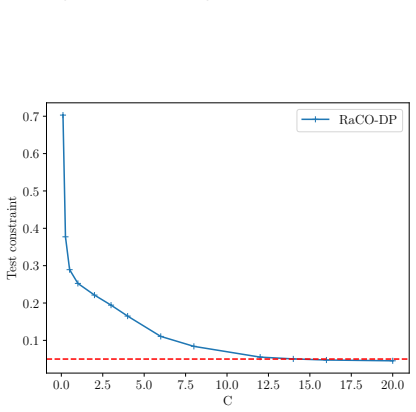
Run Algorithm 1 exactly as written—with the Line 8 gradient clipping and with the parameter choices of Theorem D.1—on a logistic-regression task with the strict false-negative constraint FNR=0 used in the paper's Figure 6, in the noise-free setting (sigma=0, b=infinity). If for a small clipping norm such as C=2 the iterates never approach the feasible set, as the paper's own figure shows, then the claimed convergence to an (alpha,alpha)-stationary point of Phi does not hold for the actual (clipped) algorithm; a complete argument would need a bound on the clipping bias.
Extended reading notes
Core claim
The paper's central claim is that arbitrary rate constraints can be folded into differentially private optimization without weakening the privacy guarantee. It defines generalized rate constraints as weighted sums of prediction rates over unions of parts of a fixed partition of the dataset, and observes that all quantities needed for both the primal and dual updates—constraint values and their per-sample gradients—can be read off a single histogram of softmax predictions over that partition. Because each data point touches exactly one part and its class probabilities sum to one, the histogram has L1-sensitivity at most one, so Laplace noise suffices to privatize it. The primal update then applies DP-SGD-style clipping and Gaussian noise to per-sample Lagrangian gradients, while the dual update uses the private histogram's post-processed values and therefore costs no additional privacy budget. The mathematical payload is a convergence analysis of SGDA with biased gradients: exploiting the linearity of the Lagrangian in the dual parameter, the analysis shows that with suitable parameters some iterate is an ($\alpha$, $\alpha$)-stationary point of the value function Phi($\theta$) = max_{$\lambda$ in Lambda} L($\theta$, $\lambda$), with $\alpha$ scaling like (d log(JKn/rho) log(n/delta)/(n eps))^{1/3} plus $K^{{1/4}}$-dependent terms, and with a faster rate in T than previously known for nonconvex-concave SGDA. The paper presents this as the first general differentially private treatment of rate-constrained optimization, with group fairness as a prominent application.
Load-bearing premise
The convergence guarantee is proved for the algorithm run without gradient clipping, whereas the algorithm as stated and as run clips every per-sample gradient; if the bias introduced by clipping is not controlled, the advertised guarantee does not cover the method actually used.
Editorial extensions
If this is right
- Group fairness constraints such as demographic parity and equalized odds become compatible with standard (epsilon,delta)-differential privacy, with the fairness-related cost reduced to a private histogram per step rather than per-example decomposition.
- Practitioners can specify the maximum allowed disparity or false-negative rate directly through the slack gamma and obtain it, instead of tuning an indirect penalty coefficient as in prior fairness methods.
- The improved SGDA analysis—1/T^{1/4} convergence using the linear structure of the dual and an L-infinity dual-gradient error—applies to any nonconvex-linear min-max problem with bounded gradient errors, beyond rate constraints.
- For a privacy budget (epsilon,delta), the optimal number of iterations balances optimization progress against noise, yielding the stated error scale alpha = O((d log(JKn/rho) log(n/delta)/(n eps))^{1/3} + K^{1/4}(log(n/delta) log(JKn/rho))^{1/4}/(n eps)^{1/4}).
Reading between the lines
- If the clipping-norm bias shown in the paper's Figure 6 is the dominant obstacle, a natural testable extension is to let the clipping norm grow during training, which might reconcile the implemented algorithm with the no-clipping theory while preserving privacy accounting.
- The histogram route suggests that other aggregate statistics that are bounded per example—such as calibration or coverage constraints—could be brought into DP optimization by the same mechanism, since their evaluation reduces to a low-sensitivity histogram.
- Once clipping is included in the analysis as a fixed bias term, the effective stationarity error alpha would degrade by roughly the bias magnitude, implying a three-way trade-off between privacy, feasibility, and utility that the current bound does not display explicitly.
Editorial analysis
A structured set of objections, weighed in public.
Referee Report
Summary. The paper introduces RaCO-DP, a differentially private stochastic gradient descent-ascent method for minimizing an empirical loss subject to rate constraints, with group fairness constraints as the main application. The method reformulates the constrained problem through a Lagrangian, uses a generalized rate-constraint structure based on a global partition of the dataset, and privately estimates a per-mini-batch histogram at each step; the histogram is then post-processed to compute both the primal per-sample gradients and the dual constraint gradients. The paper states a privacy guarantee (Theorem 4.1), a formal convergence analysis for non-convex objectives under bias in the gradient estimates (Appendix D, Theorem D.1 and Theorem D.5), and experiments on demographic parity and false-negative-rate constraints across several tabular benchmarks, reporting Pareto improvements over DP-FERMI and near-non-private performance.
Significance. If the claimed convergence result were established for the actual algorithm, this would be a meaningful contribution: RaCO-DP would be the first general DP framework for arbitrary rate constraints, not just fairness, with formal privacy and convergence guarantees and a favorable empirical privacy-utility-fairness trade-off. The paper also has several genuine strengths: the histogram-based mechanism is a clean way to avoid per-constraint privacy composition; the convergence analysis is self-contained, does not rely on fitted constants, and explicitly attempts to handle biased gradient estimates; and the limitations discussion is unusually honest, including a direct demonstration that clipping bias can break constraint satisfaction. The main reason the paper cannot be accepted in its current form is that the central convergence theorem is proven only for a no-clipping variant of the algorithm, while Algorithm 1, the experiments, and the abstract all refer to the clipping-based method.
major comments (2)
- [Appendix D.5, Lemma D.4; Section 4.2, Eq. (10)] The main-text convergence claim is stated for Algorithm 1, but the formal theorem in Appendix D.2, Theorem D.1, is explicitly for 'Algorithm 1 run without clipping,' while Algorithm 1 as defined clips every per-sample gradient at Line 8 and all reported experiments use clipping. The gradient-error bound in Lemma D.4 does not model the clipping operation at all, so the proof does not establish convergence to an approximate stationary point for the algorithm whose results are actually reported. This is not a purely cosmetic mismatch: Figure 6 and the Limitations section show that clipping bias alone, with sigma=0 and b=infinity, pushes the FNR constraint violation above 0.6 for C<=2 on Adult, i.e., far outside the feasible set, and the cited work of Koloskova et al. indicates that such bias does not vanish with vanishing step sizes. The paper should either prove convergence with clipping, explicitly bound the clipping bias and its effect on the stationarity and feasibility guarantees, or formally restrict the main theorem to the no-clipping variant and correspondingly qualify the abstract, the informal Theorem 5.2, and the experimental claims.
- [Appendix D.5, Lemma D.4; Section 4.2, Eq. (10)] The notation H in Lemma D.4 needs clarification. In Section 4, H^{(t)} is defined as the mini-batch histogram (Eq. (8)), and the per-sample gradient in Eq. (10) uses H^{(t)} as the mini-batch histogram, with sum over k of H_{i,k} equal to |B∩I|. In the proof of the primal gradient error, the first term in the regularizer difference sums over x in D while normalizing by sum_{i in I, k} H_{i,k}; if H is the mini-batch histogram, this term is not the full-batch gradient ∇θR(θ,λ). If H is instead intended to be a full-batch histogram for the purposes of the proof, that should be stated explicitly and consistently. As written, the proof does not transparently derive the claimed bound relating the full-batch gradient to the private mini-batch estimator, and this gap is load-bearing for Theorem D.1.
minor comments (5)
- [Section 5, before Theorem 5.2] The sentence 'This leads to the following result for Algorithm 1 run without clipping' should be incorporated into the theorem statement itself, so that the informal Theorem 5.2 cannot be read as applying to the clipping-based Algorithm 1 defined in Section 4.
- [Appendix D.5, Lemma D.4] Please define all symbols (H versus \widehat H, full-batch versus mini-batch histograms) before the proof, and make the decomposition of the primal regularizer error explicit: sampling error, private-histogram denominator error, and loss sampling error should be separated.
- [Section 6, Experimental setup] The statement 'we do not account for privacy loss from hyperparameter tuning' means that the reported ε values are not end-to-end privacy guarantees for the models selected via validation on the training data. This is standard in parts of the literature, but it should be stated more prominently and preferably discussed in the Limitations section.
- [Section 6, Baselines and experimental setup] The comparison with DP-FERMI uses results reported in prior work while reserving 15% of the training set for validation in the current setup. Please clarify how this difference in training-set size affects comparability, since the baseline numbers were generated under a different pipeline.
- [Throughout] There are several typos and notation inconsistencies, including 'Langrangian' in Section 4.1, inconsistent use of ε versus ϵ, and the informal theorem statement referring to 'Algorithm 1' rather than 'Algorithm 1 run without clipping.' These should be corrected in a revision.
Circularity Check
No circularity: the convergence and privacy analyses are derived from stated assumptions and noise-calibration bounds, with the acknowledged no-clipping caveat constituting a correctness gap rather than a circular step.
full rationale
RaCO-DP's central claim (Theorem 5.2 and its formal version, Theorem D.1) is a convergence and privacy statement derived from explicit assumptions: Lipschitzness and smoothness of h and ℓ, a compact dual set Λ, Poisson sampling, and calibrated Laplace/Gaussian noise scales. The proof chain is self-contained: Lemma D.4 bounds primal and dual gradient estimation errors using concentration inequalities (Lemmas C.1 and C.2), and Theorem D.5 converts these bounds into an approximate-stationarity guarantee for SGDA. No fitted constant, experiment, or empirical curve is used as an input to the proof, and the stated rate is parameter-free up to problem constants. The 'generalized rate constraints' formulation is an explicit generalization of the existing rate-constraint form (Eq. 5), not a renaming that presupposes the privacy or convergence result. Self-citations in the paper (e.g., [7], [8], [48]) appear in related-work or privacy-accounting contexts and are not load-bearing for the main theorem. The authors' own limitation section and Figure 6 document that the formal convergence theorem assumes Algorithm 1 is run without clipping, while the implemented algorithm clips per-sample gradients in Line 8; this is a scope/correctness gap between theory and practice, not circular reasoning, because Theorem D.1 does not assume its own conclusion and the gap is explicitly disclosed. No circular step satisfies the required standard of exhibiting a specific reduction of a claimed prediction to its inputs.
Assumptions & free parameters
free parameters (6)
- clipping norm C
- Gaussian noise standard deviation σ
- Laplace noise scale b
- Primal and dual learning rates ηθ, ηλ
- softmax temperature τ
- mini-batch size B and sampling rate r
assumptions (7)
- ad hoc to paper Convergence is proven only for Algorithm 1 run without clipping
- domain assumption Loss ℓ and classifier h are Lipschitz and smooth in θ
- domain assumption The dual feasible set Λ is compact with bounded diameter and the Lagrangian is linear in λ
- standard math Poisson subsampling and the composition theorems give privacy amplification
- domain assumption A known global partition of the dataset exists and the constraint weights α are public
- domain assumption Mini-batch intersection sizes |B∩I| stay bounded away from zero with high probability
- ad hoc to paper Privacy loss from hyperparameter tuning is not counted in the reported ε budget
Cite this review
Pith. "Pith review of Private Rate-Constrained Optimization with Applications to Fair Learning." pith.science (2026). https://pith.science/paper/BCBRXTMS
@misc{pith2026250522703,
  author       = {Pith},
  title        = {Pith review of: Private Rate-Constrained Optimization with Applications to Fair Learning},
  year         = {2026},
  howpublished = {\url{https://pith.science/paper/BCBRXTMS}},
  note         = {Machine review of arXiv:2505.22703}
}
read the original abstract
Many problems in trustworthy ML can be expressed as constraints on prediction rates across subpopulations, including group fairness constraints (demographic parity, equalized odds, etc.). In this work, we study such constrained minimization problems under differential privacy (DP). Standard DP optimization techniques like DP-SGD rely on objectives that decompose over individual examples, enabling per-example gradient clipping and noise addition. Rate constraints, however, depend on aggregate statistics across groups, creating inter-sample dependencies that violate this decomposability. To address this, we develop RaCO-DP, a DP variant of Stochastic Gradient Descent-Ascent (SGDA) that solves the Lagrangian formulation of rate constraint problems. Through careful design, the extra privacy cost incurred by incorporating these constraints in our approach is limited to that of privately estimating a histogram over each mini-batch at every step. We prove the convergence of our algorithm through a novel analysis of SGDA that leverages the linear structure of the dual parameter. Empirical results show that our method Pareto-dominates existing private learning approaches under group fairness constraints and also achieves strong privacy-utility-fairness performance on neural networks.
Figures


Figures from the paper (4 more)



Reference graph
Works this paper leans on
-
[1]
Deep Learning with Differential Privacy
Martin Abadi et al. “Deep Learning with Differential Privacy”. In:Proceedings of the 2016 ACM SIGSAC Conference on Computer and Communications Security (CCS). 2016
work page 2016
-
[2]
A Reductions Approach to Fair Classification
Alekh Agarwal et al. “A Reductions Approach to Fair Classification”. In:Proceedings of the 35th International Conference on Machine Learning. Proceedings of Machine Learning Research. PMLR, 2018
work page 2018
-
[3]
Alex Teboul.Heart Disease Health Indicators Dataset. 2022.url: https://www.kaggle.com/datasets/ alexteboul/heart-disease-health-indicators-dataset (visited on 05/16/2025)
work page 2022
-
[4]
Differential Privacy Has Disparate Impact on Model Accuracy
Eugene Bagdasaryan, Omid Poursaeed, and Vitaly Shmatikov. “Differential Privacy Has Disparate Impact on Model Accuracy”. In:Advances in Neural Information Processing Systems. 2019
work page 2019
-
[5]
Privacy amplification by subsampling: Tight analyses via couplings and divergences
Borja Balle, Gilles Barthe, and Marco Gaboardi. “Privacy amplification by subsampling: Tight analyses via couplings and divergences”. In:Advances in neural information processing systems31 (2018)
work page 2018
-
[6]
MIT Press, 2023
Solon Barocas, Moritz Hardt, and Arvind Narayanan.Fairness and Machine Learning: Limitations and Opportunities. MIT Press, 2023
2023
-
[7]
Raef Bassily, Cristóbal Guzmán, and Michael Menart. “Differentially Private Algorithms for the Stochastic Saddle Point Problem with Optimal Rates for the Strong Gap”. In:Proceedings of Thirty Sixth Conference on Learning Theory. Proceedings of Machine Learning Research. 2023
work page 2023
-
[8]
Raef Bassily, CristóbalA Guzmán, andMichael Menart. “Private Algorithmsfor Stochastic SaddlePoints and Variational Inequalities: Beyond Euclidean Geometry”. In:The Thirty-eighth Annual Conference on Neural Information Processing Systems. 2024
work page 2024
Show all 60 references
-
[9]
Private Empirical Risk Minimization: Efficient Algorithms and Tight Error Bounds
Raef Bassily, Adam D. Smith, and Abhradeep Thakurta. “Private Empirical Risk Minimization: Efficient Algorithms and Tight Error Bounds”. In:FOCS. 2014
2014
-
[10]
UCI Machine Learning Repository
Barry Becker and Ronny Kohavi.Adult. UCI Machine Learning Repository. 1996
1996
-
[11]
Leonard Berrada et al.Unlocking Accuracy and Fairness in Differentially Private Image Classification. 2023
2023
-
[12]
Optimal algorithms for differentially private stochastic monotone variational inequalities and saddle-point problems
Digvijay Boob and Cristóbal Guzmán. “Optimal algorithms for differentially private stochastic monotone variational inequalities and saddle-point problems”. In:Mathematical Programming(2023)
2023
-
[13]
Robust Optimization for Non-Convex Objectives
Robert S. Chen et al. “Robust Optimization for Non-Convex Objectives”. In:NIPS. 2017
2017
-
[14]
ScalableDP-SGD:Shufflingvs.poissonsubsampling
LynnChuaetal.“ScalableDP-SGD:Shufflingvs.poissonsubsampling”.In: arXiv preprint arXiv:2411.04205 (2024)
2024 arXiv
-
[15]
Optimization with Non-Differentiable Constraints with Applications to Fairness, Recall, Churn, and Other Goals
Andrew Cotter et al. “Optimization with Non-Differentiable Constraints with Applications to Fairness, Recall, Churn, and Other Goals”. In:Journal of Machine Learning Research(2019)
2019
-
[16]
Training Well-Generalizing Classifiers for Fairness Metrics and Other Data- Dependent Constraints
Andrew Cotter et al. “Training Well-Generalizing Classifiers for Fairness Metrics and Other Data- Dependent Constraints”. In:Proceedings of the 36th International Conference on Machine Learning. International Conference on Machine Learning. PMLR, 2019
2019
-
[17]
On the compatibility of privacy and fairness
Rachel Cummings et al. “On the compatibility of privacy and fairness”. In:Adjunct publication of the 27th conference on user modeling, adaptation and personalization. 2019
2019
-
[18]
Stochastic Model-Based Minimization of Weakly Convex Functions
Damek Davis and Dmitriy Drusvyatskiy. “Stochastic Model-Based Minimization of Weakly Convex Functions”. In:SIAM Journal on Optimization29 (2019)
2019
-
[19]
Retiring Adult: New Datasets for Fair Machine Learning
Frances Ding et al. “Retiring Adult: New Datasets for Fair Machine Learning”. In:Advances in Neural Information Processing Systems34 (2021)
2021
-
[20]
Connectthedots:Tighterdiscreteapproximationsofprivacylossdistributions
VadymDoroshenkoetal.“Connectthedots:Tighterdiscreteapproximationsofprivacylossdistributions”. In: arXiv preprint arXiv:2207.04380(2022)
2022 arXiv
-
[21]
The Algorithmic Foundations of Differential Privacy
Cynthia Dwork and Aaron Roth. “The Algorithmic Foundations of Differential Privacy”. In:Foundations and Trends® in Theoretical Computer Science(2014)
2014
-
[22]
Calibrating Noise to Sensitivity in Private Data Analysis
Cynthia Dwork et al. “Calibrating Noise to Sensitivity in Private Data Analysis”. In:Theory of Cryptography. 2006. 11
2006
-
[23]
Fairness through awareness
Cynthia Dwork et al. “Fairness through awareness”. In:Proceedings of the 3rd innovations in theoretical computer science conference. 2012
2012
-
[24]
Disparate Impact in Differential Privacy from Gradient Misalignment
Maria S Esipova et al. “Disparate Impact in Differential Privacy from Gradient Misalignment”. In:The Eleventh International Conference on Learning Representations. 2022
2022
-
[25]
Neither private nor fair: Impact of data imbalance on utility and fairness in differential privacy
Tom Farrand et al. “Neither private nor fair: Impact of data imbalance on utility and fairness in differential privacy”. In:Proceedings of the 2020 Workshop on Privacy-Preserving Machine Learning in Practice. 2020
2020
-
[26]
Deep Learning with Label Differential Privacy
Badih Ghazi et al. “Deep Learning with Label Differential Privacy”. In:Advances in Neural Information Processing Systems. Vol. 34. 2021
2021
-
[27]
Non-Discriminatory Machine Learning through Convex Fairness Criteria
Naman Goel, Mohammad Yaghini, and Boi Faltings. “Non-Discriminatory Machine Learning through Convex Fairness Criteria”. In:Proceedings of the 2018 AAAI/ACM Conference on AI, Ethics, and Society. 2018
2018
-
[28]
Satisfying real-world goals with dataset constraints
Gabriel Goh et al. “Satisfying real-world goals with dataset constraints”. In:Advances in neural information processing systems29 (2016)
2016
-
[29]
Mirror Descent Algorithms with Nearly Dimension-Independent Rates for Differentially-Private Stochastic Saddle-Point Problems extended abstract
Tomas Gonzalez, Cristobal Guzman, and Courtney Paquette. “Mirror Descent Algorithms with Nearly Dimension-Independent Rates for Differentially-Private Stochastic Saddle-Point Problems extended abstract”. In:Proceedings of Thirty Seventh Conference on Learning Theory. Proceedin...
2024
-
[30]
Numerical Composition of Differential Privacy
Sivakanth Gopi, Yin Tat Lee, and Lukas Wutschitz. “Numerical Composition of Differential Privacy”. In: Advances in Neural Information Processing Systems. Vol. 34. 2021
2021
-
[31]
Stochastic-Differentially-Private-and-Fair-Learning
Devansh Gupta. Stochastic-Differentially-Private-and-Fair-Learning. May 6, 2023. url: https : / / github.com/devanshgupta160/Stochastic- Differentially- Private- and- Fair- Learning (vis- ited on 09/27/2023)
2023
-
[32]
Equality of opportunity in supervised learning
Moritz Hardt, Eric Price, and Nati Srebro. “Equality of opportunity in supervised learning”. In:Advances in neural information processing systems29 (2016)
2016
-
[33]
GANs Trained by a Two Time-Scale Update Rule Converge to a Local Nash Equilibrium
Martin Heusel et al. “GANs Trained by a Two Time-Scale Update Rule Converge to a Local Nash Equilibrium”. In:Advances in Neural Information Processing Systems. Vol. 30. Curran Associates, Inc., 2017
2017
-
[34]
Statlog (German Credit Data)
Hans Hofmann. Statlog (German Credit Data). UCI Machine Learning Repository. 1994
1994
-
[35]
Differentially private fair learning
Matthew Jagielski et al. “Differentially private fair learning”. In:International Conference on Machine Learning. PMLR. 2019
2019
-
[36]
The composition theorem for differential privacy
Peter Kairouz, Sewoong Oh, and Pramod Viswanath. “The composition theorem for differential privacy”. In: International conference on machine learning. PMLR. 2015
2015
-
[37]
What can we learn privately?
Shiva Prasad Kasiviswanathan et al. “What can we learn privately?” In:SIAM Journal on Computing 40 (2011)
2011
-
[38]
RevisitingGradientClipping:Stochastic bias and tight convergence guarantees
AnastasiaKoloskova,HadrienHendrikx,andSebastianUStich.“RevisitingGradientClipping:Stochastic bias and tight convergence guarantees”. In:International Conference on Machine Learning. PMLR. 2023
2023
-
[39]
What You See is What You Get: Principled Deep Learning via Distributional Generalization
Bogdan Kulynych et al. “What You See is What You Get: Principled Deep Learning via Distributional Generalization”. In:Advances in Neural Information Processing Systems. 2022
2022
-
[40]
Avoiding Pitfalls for Privacy Accounting of Subsampled Mechanisms under Composition
Christian Janos Lebeda et al. “Avoiding Pitfalls for Privacy Accounting of Subsampled Mechanisms under Composition”. In:arXiv preprint arXiv:2405.20769(2024)
2024 arXiv
-
[41]
On Gradient Descent Ascent for Nonconvex-Concave Minimax Problems
Tianyi Lin, Chi Jin, and Michael Jordan. “On Gradient Descent Ascent for Nonconvex-Concave Minimax Problems”. In:Proceedings of the 37th International Conference on Machine Learning. International Conference on Machine Learning. PMLR, Nov. 21, 2020
2020
-
[42]
Parkinsons
Max Little. Parkinsons. UCI Machine Learning Repository. 2007
2007
-
[43]
Stochastic Differentially Private and Fair Learning
Andrew Lowy, Devansh Gupta, and Meisam Razaviyayn. “Stochastic Differentially Private and Fair Learning”. In:The Eleventh International Conference on Learning Representations. 2023. 12
2023
-
[44]
Differential Privacy has Bounded Impact on Fairness in Classification
Paul Mangold et al. “Differential Privacy has Bounded Impact on Fairness in Classification”. In:ICML. 2023
2023
-
[45]
Performance analysis of cost-sensitive learning methods with application to imbalanced medical data
Ibomoiye Domor Mienye and Yanxia Sun. “Performance analysis of cost-sensitive learning methods with application to imbalanced medical data”. In:Informatics in Medicine Unlocked(2021)
2021
-
[46]
Fair learning with private demographic data
Hussein Mozannar, Mesrob Ohannessian, and Nathan Srebro. “Fair learning with private demographic data”. In:International Conference on Machine Learning. PMLR. 2020
2020
-
[47]
Robust Stochastic Approximation Approach to Stochastic Programming
A. Nemirovski et al. “Robust Stochastic Approximation Approach to Stochastic Programming”. In: (2009)
2009
-
[48]
Hyperparameter Tuning with Renyi Differential Privacy
Nicolas Papernot and Thomas Steinke. “Hyperparameter Tuning with Renyi Differential Privacy”. In: International Conference on Learning Representations. 2022
2022
-
[49]
Membership Inference Attacks against Machine Learning Models
Reza Shokri et al. “Membership Inference Attacks against Machine Learning Models”. In:2017 IEEE Symposium on Security and Privacy (SP). 2017
2017
-
[50]
Stochastic gradient descent with differ- entially private updates
Shuang Song, Kamalika Chaudhuri, and Anand D. Sarwate. “Stochastic gradient descent with differ- entially private updates”. In:2013 IEEE Global Conference on Signal and Information Processing. 2013
2013
-
[51]
Chasing Your Long Tails: Differentially Private Prediction in Health Care Settings
Vinith M. Suriyakumar et al. “Chasing Your Long Tails: Differentially Private Prediction in Health Care Settings”. In:Proceedings of the 2021 ACM Conference on Fairness, Accountability, and Transparency. 2021
2021
-
[52]
K-Anonymity: A Model for Protecting Privacy
Latanya Sweeney. “K-Anonymity: A Model for Protecting Privacy”. In:Int. J. Uncertain. Fuzziness Knowl.-Based Syst.(Oct. 1, 2002)
2002
-
[53]
Differentially Private Empirical Risk Minimization under the Fairness Lens
Cuong Tran, My Dinh, and Ferdinando Fioretto. “Differentially Private Empirical Risk Minimization under the Fairness Lens”. In:Advances in Neural Information Processing Systems. Vol. 34. 2021
2021
-
[54]
On the Fairness Impacts of Private Ensembles Models
Cuong Tran and Ferdinando Fioretto. “On the Fairness Impacts of Private Ensembles Models”. In: Proceedings of the Thirty-Second International Joint Conference on Artificial Intelligence. 2023
2023
-
[55]
SF-PATE: Scalable, Fair, and Private Aggregation of Teacher Ensembles
Cuong Tran et al. “SF-PATE: Scalable, Fair, and Private Aggregation of Teacher Ensembles”. In: Proceedings of the Thirty-Second International Joint Conference on Artificial Intelligence, IJCAI-23. International Joint Conferences on Artificial Intelligence Organization, 2023
2023
-
[56]
Exact Privacy Analysis of the Gaussian Sparse Histogram Mechanism
Arjun Wilkins et al. “Exact Privacy Analysis of the Gaussian Sparse Histogram Mechanism”. In:Journal of Privacy and Confidentiality14.1 (2024)
2024
-
[57]
Differentially Private SGDA for Minimax Problems
Zhenhuan Yang et al. “Differentially Private SGDA for Minimax Problems”. In:The 38th Conference on Uncertainty in Artificial Intelligence. 2022
2022
-
[58]
Default of Credit Card Clients
I-Cheng Yeh. Default of Credit Card Clients. UCI Machine Learning Repository. 2009
2009
-
[59]
Fairness Constraints: Mechanisms for Fair Classification
Muhammad Bilal Zafar et al. “Fairness Constraints: Mechanisms for Fair Classification”. In:Proceedings of the 20th International Conference on Artificial Intelligence and Statistics. 2017
2017
-
[60]
Bring Your Own Algorithm for Optimal Differentially Private Stochastic Minimax Optimization
Liang Zhang et al. “Bring Your Own Algorithm for Optimal Differentially Private Stochastic Minimax Optimization”. In:Advances in Neural Information Processing Systems. Vol. 35. Curran Associates, Inc., 2022. 13 A Application to Other Rate Constraints A.1 Fairness Constraints F...
2021
Reviewed August 7, 2026 · model on record in the stance chip above.
Discussion (0). Sign in to comment.