REVIEW 3 major objections 6 minor 99 references
Finite-Sample Convergence Bounds for Trust Region Policy Optimization in Mean-Field Games
T0 review · 3 major / 6 minor · reviewed 2026-08-07 · deepseek-v4-flash
Pith's one-line read This paper proves that a trust-region policy optimization algorithm, alternating an entropy-regularized TRPO policy update with a mean-field population update, reaches an ε-approximate mean-field Nash equilibrium in finite ergodic games…
desk verdict Genuinely new TRPO-for-MFG analysis with clean exact proofs, but the 'model-free' label overstates the oracle: the step rule takes µ as a query argument, so the Õ(1/ε^6) guarantee is really for a mean-field simulator. read the letter →
The pith
A machine-rendered reading of the paper's core claim, the machinery that carries it, and where it could break.
The reading
What carries the argument
The load-bearing object is the two-loop iteration: an inner entropy-regularized TRPO loop whose policy update is a closed-form softmax mirror-descent step π_{ℓ+1}(a|s) ∝ π_ℓ(a|s) exp(α_ℓ(Q(s,a) − η log π_ℓ(a|s))), and an outer mean-field update that moves μ toward the M-step forward population μ($P^{{π}}$_μ)^M. The proof hinges on the exploitability decomposition φ(π,μ) ≤ [max_{π'} J(π',μ,μ) − J(π,μ,μ)] + C_φ‖$λ^{{π,μ}}$ − μ‖₂, which separates how wrong the policy is from how far the population is from its own stationary distribution. Assumptions A-1 to A-4, namely Lipschitzness, a monotone contraction of the M-step update, unichain ergodicity, and a finite concentrability coefficient, are what make the two errors contract at geometric and O(log L/L) rates.
What would settle it
Implement the algorithm on a small finite mean-field game satisfying Assumptions A-1 to A-4 whose equilibrium is computable by policy iteration; with the ν-restart oracle, record the number of environment calls needed to make the exploitability of the output uniform-mixture policy first fall below ε. If this count grows faster than Õ(1/$ε^{6}$), or never falls, the central sample-complexity claim is wrong.
Extended reading notes
Core claim
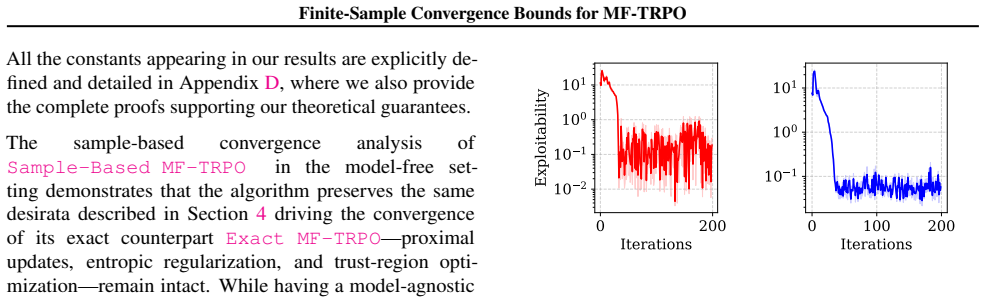
The central claim is that alternating a TRPO best-response step for a fixed population μ with an M-step population update μ_{k+1} = μ_k + β_k(μ_k($P^{{π_k}}$_{μ_k})^M − μ_k) drives the pair to the unique ε-MFNE. Exact MF-TRPO attains exploitability ε_K ≤ C exp(−(τ/4)Σ_{j=1}^K β_j) + C√(log L/L), and Sample-Based MF-TRPO attains a matching high-probability bound with extra sampling-error terms, as stated in Corollary D.5. The key point is that the equilibrium error decomposes into a policy-value gap and a population-stationarity gap, each controlled by a different loop, yielding a total sample complexity of Õ(1/$ε^{6}$) without requiring policies to be uniformly bounded away from zero.
Load-bearing premise
The sample-based algorithm assumes the environment oracle lets the learner reset and query transitions under any chosen population distribution μ, whereas in a genuinely multi-agent system the population distribution is an emerging statistic the learner cannot simply dial in.
Editorial extensions
If this is right
- A model-free learner can find an ε-MFNE in a finite ergodic mean-field game with Õ(1/ε^6) calls to a ν-restart environment, matching the sample rate of single-agent TRPO.
- Previous assumptions forcing policies to be uniformly bounded away from zero, or forcing the induced Markov chain to be absolutely continuous with respect to the uniform distribution, are relaxed; unichain ergodicity plus the monotonicity condition A-2 suffice.
- The sample-based guarantee applies to the uniform mixture of the inner TRPO iterates, not the last iterate, so averaging over iterates is what the theory protects.
- To reach an ε-MFNE, the paper sets the inner horizon L = Õ(1/ε²), the outer iteration count K = Õ(log(1/ε)), and the per-iteration episode counts P and I_ℓ = Õ(1/ε⁴), giving the total Õ(1/ε^6) call complexity.
Reading between the lines
- The two-error decomposition suggests that any policy-optimization method with a decaying value gap and a contractive population update would inherit the same Õ(1/ε^6) complexity, so the specific TRPO update may not be essential to the rate.
- If the environment oracle cannot accept μ as an input, because the population distribution only emerges from play, the algorithm's inner rollouts cannot be generated as written; an online variant that uses the realized μ_t would be a natural extension whose rate the paper leaves open.
- Since the theorem protects the uniform mixture of inner policies, a practical implementation should sample from that mixture via the paper's Uniform-Mixture subroutine; comparing last-iterate versus mixture exploitability in the grid experiments would test how conservative the averaging guarantee is.
- The Õ(1/ε^6) result is an upper bound, and the paper provides no matching lower bound, so it is plausible that a tighter analysis or a different algorithm could reach ε^4 or ε^5 in this mean-field setting.
Editorial analysis
A structured set of objections, weighed in public.
Referee Report
Summary. This paper proposes MF-TRPO, an entropy-regularized trust-region policy optimization algorithm for finite state-action mean-field games, and analyzes both an exact version (Algorithms 1–2) and a sample-based version (Algorithms 6–8). The exact version combines an inner TRPO loop, whose convergence is imported from Shani et al. (2020), with an outer mean-field population update; under Assumptions A-1–A-3 the authors prove an exploitability bound of the form O(exp(-τ∑β_j/4) + sqrt(log L / L)). The sample-based version adds sampling error from inner Q-estimation and outer population rollouts and claims, under Assumptions A-1–A-4 and a ν-restart oracle, a high-probability exploitability bound with total Õ(1/ε^6) environment interactions to reach an ε-MFNE. The main text presents the algorithms and informal statements; the appendices contain the proofs and the sample-complexity accounting.
Significance. If the claims hold, this would be the first finite-sample high-probability guarantee for TRPO-type methods in mean-field games with explicit population updates, under assumptions weaker than uniform exploration, and the rate Õ(1/ε^6) would align with single-agent regularized TRPO. The paper is generally careful with constants, clearly separates the inner-loop bound (Shani et al.) from the outer contraction argument, and the exact version's analysis is plausible. However, the sample-based claim's applicability to model-free mean-field games depends on an environment oracle that accepts the mean-field distribution as an input; this is a substantive gap, along with a missing union bound over the outer iterations and an apparent arithmetic error in the complexity statement.
major comments (3)
- [Section 2 (Interactions with the environment) and Algorithm 8] The environment oracle is defined so that the step operation takes the mean-field distribution profile µ as an input and samples from P(·|s,a,µ). Algorithm 6 lines 8-9 and Algorithm 8 line 15 both generate rollouts under a user-specified \hatµ_{k-1}. In a model-free mean-field game, µ is an emergent population statistic rather than a queryable control; resetting the initial state to ν does not reset the population. Therefore the finite-sample guarantee in Corollary D.5 and the Õ(1/ε^6) complexity in Remark D.7 do not apply to the claimed model-free setting unless the authors either reframe the result as requiring a mean-field simulator (a generative-model-strength assumption at the population level) or modify the algorithm to use only transitions under the realized µ. This is load-bearing because it determines whether the algorithm can be executed at all outside the oracle.
- [Theorem D.4 and Corollary D.5] The high-probability statements are not union-bounded over the K outer iterations. Theorem D.2 and Proposition D.3 each hold with probability at least 1-δ for a fixed call (a fixed µ, a fixed k), but the recursion in Theorem D.4 requires all K outer iterations and all L inner iterations to be simultaneously good. As written, one needs to replace δ by δ/(K L) (or an equivalent schedule) in the trajectory counts, and while this only changes polylogarithmic factors, the stated 'with probability at least 1-δ' bound is not justified without that step. This affects the main high-probability exploitability guarantee.
- [Remark D.7] The sample-complexity accounting is internally inconsistent. With P and I_ℓ both declared to be Õ(1/ε^4), the claimed mean-field update cost Õ(P × I_ℓ × K) is Õ(1/ε^8), not Õ(1/ε^2), and the subsequent overall Õ(1/ε^6) total does not follow from the stated component costs. Moreover, the mean-field update in Algorithm 8 uses P rollouts per outer iteration, not P × I_ℓ rollouts, so the displayed product conflates the inner policy-estimation budget with the population-estimation budget. The authors should provide a corrected end-to-end count of environment calls over K outer iterations.
minor comments (6)
- [Assumption A-2] The displayed inequality in Assumption A-2 is missing the universal quantifier over µ and µ′; it currently reads 'for µ ∈ P(S)' even though both µ and µ′ appear. Also, the condition is an upper bound on an inner product and is used in the proofs as a one-sided Lipschitz bound, so calling it 'monotonicity' without further explanation is confusing.
- [Section 5, paragraph after Proposition 5.2] The sentence 'as explicit knowledge of the environment's transition dynamics or reward structure is required' should read 'is not required'; as written it contradicts the stated model-free motivation of Sample-Based MF-TRPO.
- [Algorithm 8, line 15] The notation 'P_{a∈A} P(·|s_{m-1,p,k}, a, \hatµ_{k-1}) \hatπ_k(a|s_{m-1,p,k})' should be written as an explicit sum over a; as displayed it could be misread as a product or a set-valued transition.
- [Appendix D.4, equation (28)] In the recursion displayed before equation (28), the term '∥\hatµ_{k−1} + µ⋆∥²' appears where the minus sign is clearly intended; this is a typo in an otherwise detailed proof.
- [Proposition D.3] The proof applies Hoeffding's inequality to an ℓ1-type deviation and then concludes a bound on the Euclidean norm ∥ϵ_k∥₂ ≤ ε; the intermediate display 'P(1/P ∑ ... ≥ ε/4)' and the final constant 64 should be reconciled, since the displayed argument appears to give an ℓ1 bound with a slightly different constant.
- [Remark D.1 and Corollary D.5] The notation for the uniform mixture policy is inconsistent: Remark D.1 and Algorithm 6 use \hatπ^{Unif,µ}_L, while Corollary D.5 writes \hatπ^{Unif,\hatµ_k}_L. The two should be harmonized to avoid confusion about which mean-field parameter the mixture is evaluated under.
Circularity Check
No material circularity: the MF-TRPO guarantees are derived from explicit assumptions plus the external Shani et al. TRPO bound; the only self-citations are definitional and non-load-bearing.
full rationale
The derivation chain is self-contained relative to its stated assumptions. Exact MF-TRPO convergence (Theorem C.5) follows from Assumptions A-1, A-2, A-3 and Theorem C.1, which is Theorem 16 of Shani et al. (2020), an external bound with no fitted target conclusion. The supporting lemmas on Lipschitzness of optimal policies, value gaps, and exploitability (Propositions E.2-E.5, Corollary E.4) are proved from the assumptions. The sample-based analysis (Theorem D.2, Theorem D.4, Corollary D.5) adds high-probability estimation lemmas (Proposition D.3) and the external Theorem 5 of Shani et al.; no fitted parameter is renamed as a prediction, and the õ(1/ε^6) complexity is obtained by multiplying the explicitly stated L, Iℓ, P, and K scalings. Assumption A-2 is stated as an assumption rather than derived as a conclusion, and a sufficient primitive condition for it is proved in Lemma E.6 from A-1 and A-3, so the monotonicity assumption is not circularly imported. The only self-citations are to Laurière et al. (2022) for the discounted-stationary MFG formulation and the exploitability definition; these frame the problem but are not load-bearing for the convergence rates. A genuine scope caveat, not a circularity, is that the interaction oracle in Section 2 lets the algorithm query transitions under a user-supplied population profile μ; this is a modeling-assumption concern about whether the algorithm is truly model-free, not a circular reuse of the target result. Some typographical and notational inconsistencies (e.g., k versus K in Corollary 5.3, and the garbled sentence in Section 5 about explicit knowledge being required) do not constitute circularity. Overall the circularity burden is very low.
Assumptions & free parameters
free parameters (4)
- entropy regularization weight η =
0.05 and 0.3 in experiments
- mean-field update horizon M =
100 in experiments
- outer step size βk =
0.01 (exact), 0.1 (sample-based) in experiments
- discount factor γ =
0.9 in experiments
assumptions (6)
- domain assumption Assumption A-1: r and P are Lipschitz in µ (Lr_µ, LP_µ)
- domain assumption Assumption A-2: M-step mean-field operator is strongly monotone with Cop,MFG<1
- domain assumption Assumption A-3: unichain plus uniform mixing with rate CErg ρ^t
- domain assumption Assumption A-4: concentrability of discounted occupation measure d^{πµ}_{µ,µ}/ν is bounded
- domain assumption Environment oracle: reset to ν and step with a user-specified µ
- standard math Shani et al. (2020), Theorem 16 (exact TRPO value-gap bound) and Theorem 5 (sample-based TRPO bound)
Cite this review
Pith. "Pith review of Finite-Sample Convergence Bounds for Trust Region Policy Optimization in Mean-Field Games." pith.science (2026). https://pith.science/paper/HFQM5I4M
@misc{pith2026250522781,
  author       = {Pith},
  title        = {Pith review of: Finite-Sample Convergence Bounds for Trust Region Policy Optimization in Mean-Field Games},
  year         = {2026},
  howpublished = {\url{https://pith.science/paper/HFQM5I4M}},
  note         = {Machine review of arXiv:2505.22781}
}
read the original abstract
We introduce Mean-Field Trust Region Policy Optimization (MF-TRPO), a novel algorithm designed to compute approximate Nash equilibria for ergodic Mean-Field Games (MFG) in finite state-action spaces. Building on the well-established performance of TRPO in the reinforcement learning (RL) setting, we extend its methodology to the MFG framework, leveraging its stability and robustness in policy optimization. Under standard assumptions in the MFG literature, we provide a rigorous analysis of MF-TRPO, establishing theoretical guarantees on its convergence. Our results cover both the exact formulation of the algorithm and its sample-based counterpart, where we derive high-probability guarantees and finite sample complexity. This work advances MFG optimization by bridging RL techniques with mean-field decision-making, offering a theoretically grounded approach to solving complex multi-agent problems.
Figures


Figures from the paper (3 more)


Reference graph
Works this paper leans on
-
[1]
and Capuzzo-Dolcetta, I
Achdou, Y. and Capuzzo-Dolcetta, I. Mean field games: numerical methods. SIAM Journal on Numerical Analysis, 48 0 (3): 0 1136--1162, 2010
2010
-
[2]
and Porretta, A
Achdou, Y. and Porretta, A. Convergence of a finite difference scheme to weak solutions of the system of partial differential equations arising in mean field games. SIAM Journal on Numerical Analysis, 54 0 (1): 0 161--186, 2016
2016
-
[3]
Mean field games: numerical methods for the planning problem
Achdou, Y., Camilli, F., and Capuzzo-Dolcetta, I. Mean field games: numerical methods for the planning problem. SIAM Journal on Control and Optimization, 50 0 (1): 0 77--109, 2012
2012
-
[4]
Mean field games and applications: Numerical aspects
Achdou, Y., Cardaliaguet, P., Delarue, F., Porretta, A., Santambrogio, F., Achdou, Y., and Lauri \`e re, M. Mean field games and applications: Numerical aspects. Mean Field Games: Cetraro, Italy 2019, pp.\ 249--307, 2020
2019
-
[5]
Agarwal, A., Kakade, S., and Yang, L. F. Model-based reinforcement learning with a generative model is minimax optimal. In Conference on Learning Theory, pp.\ 67--83. PMLR, 2020
2020
-
[6]
An extended mean field game for storage in smart grids
Alasseur, C., Ben Taher, I., and Matoussi, A. An extended mean field game for storage in smart grids. Journal of Optimization Theory and Applications, 184: 0 644--670, 2020
2020
-
[7]
Regularization of the policy updates for stabilizing mean field games
Algumaei, T., Solozabal, R., Alami, R., Hacid, H., Debbah, M., and Tak \'a c , M. Regularization of the policy updates for stabilizing mean field games. In Pacific-Asia Conference on Knowledge Discovery and Data Mining, pp.\ 361--372. Springer, 2023
2023
-
[8]
D., and Saldi, N
Anahtarci, B., Kariksiz, C. D., and Saldi, N. Learning mean-field games with discounted and average costs. Journal of Machine Learning Research, 24 0 (17): 0 1--59, 2023 a
2023
Show all 99 references
-
[9]
D., and Saldi, N
Anahtarci, B., Kariksiz, C. D., and Saldi, N. Q-learning in regularized mean-field games. Dynamic Games and Applications, 13 0 (1): 0 89--117, 2023 b
2023
-
[10]
Mean-field sampling for cooperative multi-agent reinforcement learning
Anand, E., Karmarkar, I., and Qu, G. Mean-field sampling for cooperative multi-agent reinforcement learning. arXiv preprint arXiv:2412.00661, 2024
2024
-
[11]
Unified reinforcement q-learning for mean field game and control problems
Angiuli, A., Fouque, J.-P., and Laurière, M. Unified reinforcement q-learning for mean field game and control problems. arXiv preprint arXiv:2006.13912, 2021
2006 arXiv
-
[12]
Convergence of multi-scale reinforcement Q learning algorithms for mean field game and control problems
Angiuli, A., Fouque, J.-P., Lauri \`e re, M., and Zhang, M. Convergence of multi-scale reinforcement Q learning algorithms for mean field game and control problems. arXiv preprint arXiv:2312.06659, 2023
2023 arXiv
-
[13]
On solutions of mean field games with ergodic cost
Arapostathis, A., Biswas, A., and Carroll, J. On solutions of mean field games with ergodic cost. Journal de Math \'e matiques Pures et Appliqu \'e es , 107 0 (2): 0 205--251, 2017
2017
-
[14]
Lipschitz continuity in model-based reinforcement learning
Asadi, K., Misra, D., and Littman, M. Lipschitz continuity in model-based reinforcement learning. In International Conference on Machine Learning, pp.\ 264--273. PMLR, 2018
2018
-
[15]
Inapproximability of np-complete variants of nash equilibrium
Austrin, P., Braverman, M., and Chlamt \'a c , E. Inapproximability of np-complete variants of nash equilibrium. In International Workshop on Approximation Algorithms for Combinatorial Optimization, pp.\ 13--25. Springer, 2011
2011
-
[16]
M., Munos, R., and Kappen, H
Azar, G. M., Munos, R., and Kappen, H. J. Minimax pac bounds on the sample complexity of reinforcement learning with a generative model. Machine learning, 91: 0 325--349, 2013
2013
-
[17]
and Priuli, F
Bardi, M. and Priuli, F. S. Linear-quadratic n-person and mean-field games with ergodic cost. SIAM Journal on Control and Optimization, 52 0 (5): 0 3022--3052, 2014
2014
-
[18]
A mean-field game model of electricity market dynamics
Bassi \`e re, A., Dumitrescu, R., and Tankov, P. A mean-field game model of electricity market dynamics. In Quantitative Energy Finance: Recent Trends and Developments, pp.\ 181--219. Springer, 2024
2024
-
[19]
and Hesse, S
Becherer, D. and Hesse, S. Common noise by random measures: Mean-field equilibria for competitive investment and hedging. arXiv preprint arXiv:2408.01175, 2024
2024
-
[20]
First-order methods in optimization
Beck, A. First-order methods in optimization. SIAM, 2017
2017
-
[21]
and Russo, D
Bhandari, J. and Russo, D. Global optimality guarantees for policy gradient methods. Operations Research, 2024
2024
-
[22]
A., Ortega, P
Braun, D. A., Ortega, P. A., Theodorou, E., and Schaal, S. Path integral control and bounded rationality. In 2011 IEEE symposium on adaptive dynamic programming and reinforcement learning (ADPRL), pp.\ 202--209. IEEE, 2011
2011
-
[23]
The master equation and the convergence problem in mean field games:(ams-201)
Cardaliaguet, P., Delarue, F., Lasry, J.-M., and Lions, P.-L. The master equation and the convergence problem in mean field games:(ams-201). Princeton University Press, 2019
2019
-
[24]
and Lauri \`e re, M
Carmona, R. and Lauri \`e re, M. Convergence analysis of machine learning algorithms for the numerical solution of mean field control and games i: The ergodic case. SIAM Journal on Numerical Analysis, 59 0 (3): 0 1455--1485, 2021
2021
-
[25]
Mean field games and systemic risk
Carmona, R., Fouque, J.-P., and Sun, L.-H. Mean field games and systemic risk. arXiv preprint arXiv:1308.2172, 2013
2013 arXiv
-
[26]
Probabilistic theory of mean field games with applications I-II
Carmona, R., Delarue, F., et al. Probabilistic theory of mean field games with applications I-II. Springer, 2018
2018
-
[27]
Numerical method for fbsdes of mckean--vlasov type
Chassagneux, J.-F., Crisan, D., and Delarue, F. Numerical method for fbsdes of mckean--vlasov type. The Annals of Applied Probability, 29 0 (3): 0 1640--1684, 2019
2019
-
[28]
Cover, T. M. Elements of information theory. John Wiley & Sons, 1999
1999
-
[29]
and Koeppl, H
Cui, K. and Koeppl, H. Approximately solving mean field games via entropy-regularized deep reinforcement learning. In International Conference on Artificial Intelligence and Statistics, pp.\ 1909--1917. PMLR, 2021
1909
-
[30]
and Koeppl, H
Cui, K. and Koeppl, H. Learning graphon mean field games and approximate nash equilibria. In International Conference on Learning Representations, 2022
2022
-
[31]
A mean field game analysis of sir dynamics with vaccination
Doncel, J., Gast, N., and Gaujal, B. A mean field game analysis of sir dynamics with vaccination. Probability in the Engineering and Informational Sciences, 36 0 (2): 0 482--499, 2022
2022
-
[32]
and Touzi, N
Espinosa, G.-E. and Touzi, N. Optimal investment under relative performance concerns. Mathematical Finance, 25 0 (2): 0 221--257, 2015
2015
-
[33]
and Silva, F
Fischer, M. and Silva, F. J. On the asymptotic nature of first order mean field games. Applied Mathematics & Optimization, 84: 0 2327--2357, 2021
2021
-
[34]
N-player games and mean field games of moderate interactions
Flandoli, F., Ghio, M., and Livieri, G. N-player games and mean field games of moderate interactions. Applied Mathematics & Optimization, 85 0 (3): 0 38, 2022
2022
-
[35]
Counterfactual multi-agent policy gradients
Foerster, J., Farquhar, G., Afouras, T., Nardelli, N., and Whiteson, S. Counterfactual multi-agent policy gradients. Proceedings of the AAAI conference on artificial intelligence, 32 0 (1), 2018
2018
-
[36]
Convergence of adaptive and interacting markov chain monte carlo algorithms
Fort, G., Moulines, E., and Priouret, P. Convergence of adaptive and interacting markov chain monte carlo algorithms. The Annals of Statistics, 39 0 (6): 0 3262--3289, 2011
2011
-
[37]
Taming the noise in reinforcement learning via soft updates
Fox, R., Pakman, A., and Tishby, N. Taming the noise in reinforcement learning via soft updates. Proceedings of the Thirty-Second Conference on Uncertainty in Artificial Intelligence, 2016
2016
-
[38]
A theory of regularized markov decision processes
Geist, M., Scherrer, B., and Pietquin, O. A theory of regularized markov decision processes. In International Conference on Machine Learning, pp.\ 2160--2169. PMLR, 2019
2019
-
[39]
Concave utility reinforcement learning: the mean-field game viewpoint, 2022
Geist, M., Pérolat, J., Laurière, M., Elie, R., Perrin, S., Bachem, O., Munos, R., and Pietquin, O. Concave utility reinforcement learning: the mean-field game viewpoint, 2022. URL https://arxiv.org/abs/2106.03787
2022 arXiv
-
[40]
Numerical resolution of mckean-vlasov fbsdes using neural networks
Germain, M., Mikael, J., and Warin, X. Numerical resolution of mckean-vlasov fbsdes using neural networks. Methodology and Computing in Applied Probability, 24 0 (4): 0 2557--2586, 2022
2022
-
[41]
and Diepold, K
Gronauer, S. and Diepold, K. Multi-agent deep reinforcement learning: a survey. Artificial Intelligence Review, 55 0 (2): 0 895--943, 2022
2022
-
[42]
Learning mean-field games
Guo, X., Hu, A., Xu, R., and Zhang, J. Learning mean-field games. Advances in neural information processing systems, 32, 2019
2019
-
[43]
A general framework for learning mean-field games
Guo, X., Hu, A., Xu, R., and Zhang, J. A general framework for learning mean-field games. Mathematics of Operations Research, 48 0 (2): 0 656--686, 2023
2023
-
[44]
Reinforcement learning with deep energy-based policies
Haarnoja, T., Tang, H., Abbeel, P., and Levine, S. Reinforcement learning with deep energy-based policies. In International conference on machine learning, pp.\ 1352--1361. PMLR, 2017
2017
-
[45]
J., Liaw, C., Plan, Y., and Randhawa, S
Harvey, N. J., Liaw, C., Plan, Y., and Randhawa, S. Tight analyses for non-smooth stochastic gradient descent. In Conference on Learning Theory, pp.\ 1579--1613. PMLR, 2019
2019
-
[46]
Howard, R. A. Dynamic programming and markov processes. John Wiley, 1960
1960
-
[47]
Howard, R. A. and Matheson, J. E. Risk-sensitive markov decision processes. Management science, 18 0 (7): 0 356--369, 1972
1972
-
[48]
E., and Malham \'e , R
Huang, M., Caines, P. E., and Malham \'e , R. P. Individual and mass behaviour in large population stochastic wireless power control problems: centralized and nash equilibrium solutions. In 42nd IEEE international conference on decision and control (IEEE cat. No. 03CH37475), v...
2003
-
[49]
P., and Caines, P
Huang, M., Malham \'e , R. P., and Caines, P. E. Nash equilibria for large-population linear stochastic systems of weakly coupled agents. In Analysis, control and optimization of complex dynamic systems, pp.\ 215--252. Springer, 2005
2005
-
[50]
P., and Caines, P
Huang, M., Malham \'e , R. P., and Caines, P. E. Large population stochastic dynamic games: closed-loop mckean-vlasov systems and the nash certainty equivalence principle. Commun. Inf. Syst., 6 0 (1): 0 221--252, 2006 a
2006
-
[51]
P., and Caines, P
Huang, M., Malham \'e , R. P., and Caines, P. E. Nash certainty equivalence in large population stochastic dynamic games: Connections with the physics of interacting particle systems. In Proceedings of the 45th IEEE Conference on Decision and Control, pp.\ 4921--4926. IEEE, 2006 b
2006
-
[52]
and Sha, F
Iqbal, S. and Sha, F. Actor-attention-critic for multi-agent reinforcement learning. In International conference on machine learning, pp.\ 2961--2970. PMLR, 2019
2019
-
[53]
and Langford, J
Kakade, S. and Langford, J. Approximately optimal approximate reinforcement learning. In Proceedings of the Nineteenth International Conference on Machine Learning, pp.\ 267--274, 2002
2002
-
[54]
Kakade, S. M. On the sample complexity of reinforcement learning. University of London, University College London (United Kingdom), 2003
2003
-
[55]
and Singh, S
Kearns, M. and Singh, S. Finite-sample convergence rates for q-learning and indirect algorithms. Advances in neural information processing systems, 11, 1998
1998
-
[56]
A., and Peters, J
Kober, J., Bagnell, J. A., and Peters, J. Reinforcement learning in robotics: A survey. The International Journal of Robotics Research, 32 0 (11): 0 1238--1274, 2013
2013
-
[57]
and Zariphopoulou, T
Lacker, D. and Zariphopoulou, T. Mean field and n-agent games for optimal investment under relative performance criteria. Mathematical Finance, 29 0 (4): 0 1003--1038, 2019
2019
-
[58]
and Lions, P.-L
Lasry, J.-M. and Lions, P.-L. Jeux \`a champ moyen. i--le cas stationnaire. Comptes Rendus Math \'e matique , 343 0 (9): 0 619--625, 2006 a
2006
-
[59]
and Lions, P.-L
Lasry, J.-M. and Lions, P.-L. Jeux \`a champ moyen. ii--horizon fini et contr \^o le optimal. Comptes Rendus. Math \'e matique , 343 0 (10): 0 679--684, 2006 b
2006
-
[60]
and Lions, P.-L
Lasry, J.-M. and Lions, P.-L. Mean field games. Japanese journal of mathematics, 2 0 (1): 0 229--260, 2007
2007
-
[61]
Learning mean field games: A survey
Lauri \`e re, M., Perrin, S., Geist, M., and Pietquin, O. Learning mean field games: A survey. arXiv preprint arXiv:2205.12944, pp.\ 19--49, 2022
2022 arXiv
-
[62]
and Tankov, P
Lavigne, P. and Tankov, P. Decarbonization of financial markets: a mean-field game approach. arXiv preprint arXiv:2301.09163, 2023
2023
-
[63]
G., and Castro, P
Le Lan, C., Bellemare, M. G., and Castro, P. S. Metrics and continuity in reinforcement learning. Proceedings of the AAAI Conference on Artificial Intelligence, 35 0 (9): 0 8261--8269, 2021
2021
-
[64]
A mean-field game approach to cloud resource management with function approximation
Mao, W., Qiu, H., Wang, C., Franke, H., Kalbarczyk, Z., Iyer, R., and Basar, T. A mean-field game approach to cloud resource management with function approximation. Advances in Neural Information Processing Systems, 35: 0 36243--36258, 2022
2022
-
[65]
I., Fern \'a ndez-Gaucherand, E., Hern \'a ndez-Hernandez, D., Coraluppi, S., and Fard, P
Marcus, S. I., Fern \'a ndez-Gaucherand, E., Hern \'a ndez-Hernandez, D., Coraluppi, S., and Fard, P. Risk sensitive markov decision processes. In Systems and control in the twenty-first century, pp.\ 263--279. Springer, 1997
1997
-
[66]
J., and Le Fort-Piat, N
Matignon, L., Laurent, G. J., and Le Fort-Piat, N. Hysteretic q-learning: an algorithm for decentralized reinforcement learning in cooperative multi-agent teams. In 2007 IEEE/RSJ International Conference on Intelligent Robots and Systems, pp.\ 64--69. IEEE, 2007
2007
-
[67]
On the global convergence rates of softmax policy gradient methods
Mei, J., Xiao, C., Szepesvari, C., and Schuurmans, D. On the global convergence rates of softmax policy gradient methods. In International conference on machine learning, pp.\ 6820--6829. PMLR, 2020
2020
-
[68]
Asynchronous methods for deep reinforcement learning
Mnih, V. Asynchronous methods for deep reinforcement learning. International Conference on Machine Learning, pp.\ 1928--1937, 2016
1928
-
[69]
Equilibrium points in n-person games
Nash, J. Equilibrium points in n-person games. Proceedings of the national academy of sciences, 36 0 (1): 0 48--49, 1950
1950
-
[70]
Non-cooperative games
Nash, J. Non-cooperative games. Annals of Mathematics, 54 0 (2): 0 286--295, 1951
1951
-
[71]
A unified view of entropy-regularized markov decision processes
Neu, G., Jonsson, A., and G \'o mez, V. A unified view of entropy-regularized markov decision processes. arXiv preprint arXiv:1705.07798, 2017
2017 arXiv
-
[72]
Combining policy gradient and q-learning
O'Donoghue, B., Munos, R., Kavukcuoglu, K., and Mnih, V. Combining policy gradient and q-learning. 5th International Conference on Learning Representations, 2017
2017
-
[73]
Scaling mean field games by online mirror descent
P \'e rolat, J., Perrin, S., Elie, R., Lauri \`e re, M., Piliouras, G., Geist, M., Tuyls, K., and Pietquin, O. Scaling mean field games by online mirror descent. In Proceedings of the 21st International Conference on Autonomous Agents and Multiagent Systems, pp.\ 1028--1037, 2022
2022
-
[74]
Fictitious play for mean field games: C ontinuous time analysis and applications
Perrin, S., P \'e rolat, J., Lauri \`e re, M., Geist, M., Elie, R., and Pietquin, O. Fictitious play for mean field games: C ontinuous time analysis and applications. Advances in neural information processing systems, 33: 0 13199--13213, 2020
2020
-
[75]
Mean field games flock! the reinforcement learning way
Perrin, S., Lauri \`e re, M., P \'e rolat, J., Geist, M., \'E lie, R., and Pietquin, O. Mean field games flock! the reinforcement learning way. arXiv preprint arXiv:2105.07933, 2021
2021 arXiv
-
[76]
Generalization in mean field games by learning master policies
Perrin, S., Lauri \`e re, M., P \'e rolat, J., \'E lie, R., Geist, M., and Pietquin, O. Generalization in mean field games by learning master policies. Proceedings of the AAAI Conference on Artificial Intelligence, 36 0 (9): 0 9413--9421, 2022
2022
-
[77]
Relative entropy policy search
Peters, J., Mulling, K., and Altun, Y. Relative entropy policy search. Proceedings of the AAAI Conference on Artificial Intelligence, 24 0 (1): 0 1607--1612, 2010
2010
-
[78]
Puterman, M. L. and Shin, M. C. Modified policy iteration algorithms for discounted markov decision problems. Management Science, 24 0 (11): 0 1127--1137, 1978
1978
-
[79]
Risk-averse dynamic programming for markov decision processes
Ruszczy \'n ski, A. Risk-averse dynamic programming for markov decision processes. Mathematical programming, 125: 0 235--261, 2010
2010
-
[80]
Discrete-time average-cost mean-field games on polish spaces
Saldi, N. Discrete-time average-cost mean-field games on polish spaces. Turkish Journal of Mathematics, 44 0 (2): 0 463--480, 2020
2020
-
[81]
S., Farquhar, G., Nardelli, N., Rudner, T
Samvelyan, M., Rashid, T., De Witt, C. S., Farquhar, G., Nardelli, N., Rudner, T. G., Hung, C.-M., Torr, P. H., Foerster, J., and Whiteson, S. The starcraft multi-agent challenge. arXiv preprint arXiv:1902.04043, 2019
1902 arXiv
-
[82]
and Geist, M
Scherrer, B. and Geist, M. Local policy search in a convex space and conservative policy iteration as boosted policy search. In Machine Learning and Knowledge Discovery in Databases: European Conference, ECML PKDD 2014, Nancy, France, September 15-19, 2014. Proceedings, Part I...
2014
-
[83]
Trust region policy optimization
Schulman, J., Levine, S., Moritz, P., Jordan, M., and Abbeel, P. Trust region policy optimization. In Proceedings of the 32nd International Conference on International Conference on Machine Learning-Volume 37, pp.\ 1889--1897, 2015
2015
-
[84]
Safe, multi-agent, reinforcement learning for autonomous driving
Shalev-Shwartz, S., Shammah, S., and Shashua, A. Safe, multi-agent, reinforcement learning for autonomous driving. arXiv preprint arXiv:1610.03295, 2016
2016 arXiv
-
[85]
Adaptive trust region policy optimization: Global convergence and faster rates for regularized mdps
Shani, L., Efroni, Y., and Mannor, S. Adaptive trust region policy optimization: Global convergence and faster rates for regularized mdps. Proceedings of the AAAI Conference on Artificial Intelligence, 34 0 (04): 0 5668--5675, 2020
2020
-
[86]
Near-optimal time and sample complexities for solving markov decision processes with a generative model
Sidford, A., Wang, M., Wu, X., Yang, L., and Ye, Y. Near-optimal time and sample complexities for solving markov decision processes with a generative model. Advances in Neural Information Processing Systems, 31, 2018
2018
-
[87]
and Barto, A
Sutton, R. and Barto, A. G. Reinforcement learning: An introduction. SIAM Rev, 6 0 (2): 0 423, 2018 a
2018
-
[88]
Sutton, R. S. and Barto, A. G. Reinforcement learning: An introduction. MIT press, 2018 b
2018
-
[89]
Algorithms for reinforcement learning
Szepesv \'a ri, C. Algorithms for reinforcement learning. Springer nature, 2022
2022
-
[90]
and Zhou, X
Tangpi, L. and Zhou, X. Optimal investment in a large population of competitive and heterogeneous agents. Finance and Stochastics, 28 0 (2): 0 497--551, 2024
2024
-
[91]
Deep learning-based numerical methods for high-dimensional parabolic partial differential equations and backward stochastic differential equations
Weinan, E., Han, J., and Jentzen, A. Deep learning-based numerical methods for high-dimensional parabolic partial differential equations and backward stochastic differential equations. Communications in Mathematics and Statistics, 4 0 (5): 0 349--380, 2017
2017
-
[92]
Wiering, M. A. et al. Multi-agent reinforcement learning for traffic light control. In Machine Learning: Proceedings of the Seventeenth International Conference (ICML'2000), pp.\ 1151--1158, 2000
2000
-
[93]
Williams, R. J. and Peng, J. Function optimization using connectionist reinforcement learning algorithms. Connection Science, 3 0 (3): 0 241--268, 1991
1991
-
[94]
Policy mirror ascent for efficient and independent learning in mean field games
Yardim, B., Cayci, S., Geist, M., and He, N. Policy mirror ascent for efficient and independent learning in mean field games. In International Conference on Machine Learning, pp.\ 39722--39754. PMLR, 2023
2023
-
[95]
Zaman, M. A. U., Koppel, A., Bhatt, S., and Basar, T. Oracle-free reinforcement learning in mean-field games along a single sample path. In International Conference on Artificial Intelligence and Statistics, pp.\ 10178--10206. PMLR, 2023
2023
-
[96]
Multi-agent reinforcement learning: A selective overview of theories and algorithms
Zhang, K., Yang, Z., and Ba s ar, T. Multi-agent reinforcement learning: A selective overview of theories and algorithms. Handbook of reinforcement learning and control, pp.\ 321--384, 2021
2021
-
[97]
Ziebart, B. D. Modeling purposeful adaptive behavior with the principle of maximum causal entropy. Carnegie Mellon University, 2010
2010
-
[98]
D., Bagnell, J
Ziebart, B. D., Bagnell, J. A., and Dey, A. K. Modeling interaction via the principle of maximum causal entropy. International Conference on Machine Learning (ICML), pp.\ 1255–--1262, 2010
2010
-
[99]
write newline
" write newline "" before.all 'output.state := FUNCTION n.dashify 't := "" t empty not t #1 #1 substring "-" = t #1 #2 substring "--" = not "--" * t #2 global.max substring 't := t #1 #1 substring "-" = "-" * t #2 global.max substring 't := while if t #1 #1 substring * t #2 gl...
Reviewed August 7, 2026 · model on record in the stance chip above.
Discussion (0). Sign in to comment.