REVIEW 3 major objections 5 minor 1 cited by
Dynamic Task Adaptation for Multi-Robot Manufacturing Systems with Large Language Models
T0 review · 3 major / 5 minor · reviewed 2026-08-07 · deepseek-v4-flash
Pith's one-line read A large language model, embedded in a central controller agent, generated a valid task reassignment after every simulated robot failure in a 20-trial physical testbed.
desk verdict A genuinely nice proof-of-concept for LLM-guided task reassignment on physical robots, but Table I's impossible summary statistics undercut the headline quantitative claim until raw logs surface. read the letter →
The pith
A machine-rendered reading of the paper's core claim, the machinery that carries it, and where it could break.
The reading
What carries the argument
The load-bearing mechanism is the Central Controller Agent (CCA), a software layer that turns a robot failure into a structured prompt for the LLM, receives a proposed configuration $K'_{r_e}$, and sends the proposal through a validation gate. The gate is the formal condition $\forall\phi_l \in C_{\tau_d} : \phi_l(K'_{r_e}) = \mathrm{valid}$, which checks reachability, sensory compatibility, and tool capability before any task is reassigned. When the gate rejects a proposal, the CCA appends a structured error message to the next prompt, creating the closed feedback loop that produced the observed retries and 19.36 s average adaptation time.
What would settle it
Run the same 20-trial protocol after deleting one constraint from $C_{\tau_d}$, for example the reachability limit that excludes station M3, and check whether the CCA approves an unreachable assignment that the physical arm cannot complete; if it does, the reported success rate is an artifact of validator completeness rather than of LLM reasoning.
Extended reading notes
Core claim
The paper's central claim is that an LLM-enabled Central Controller Agent can reassign tasks after a robot disruption without predefined failure-handling rules. Formally, when the disrupted robot $r_d$ was on task $\tau_d$, the CCA picks an exploration robot $r_e$, prompts the LLM for an updated capability configuration $K'_{r_e}$, and accepts the reassignment only if $\forall\phi_l \in C_{\tau_d},\ \phi_l(K'_{r_e}) = \mathrm{valid}$ — every reachability, sensor, and tool constraint in the task's constraint set is satisfied. The reported physical experiment achieves a 100 percent success rate over 20 trials, with 60 percent on the first attempt and a maximum of four retries, and the paper presents this as evidence that an LLM can infer feasibility constraints from structured configuration data while still relying on subject-matter-expert validation to guarantee safety.
Load-bearing premise
The system depends on the human-written validation checks covering every physical requirement of every reassigned task; if a requirement such as a reach limit is missing from the constraint set, the controller can approve an assignment the robot cannot actually perform.
Editorial extensions
If this is right
- A manufacturing cell can recover from a robot failure by reinterpreting its existing configuration files, so new layouts or robot models may require updated data rather than new reprogrammed logic.
- First-attempt success of 60 percent means the LLM alone is not a sufficient safety check; independent validation must remain in the loop before a reassignment reaches physical execution.
- Recovery times on the order of 20 seconds are plausible for small cells, but the prompt grows with the number of robots, buffers, and sensors, so larger deployments will need the same validation discipline at higher scale.
- The experiment is designed around tasks whose feasibility must be inferred from configuration data, and the LLM's first-attempt successes on those tasks indicate that implicit constraints can be read by the model without explicit instructions.
Reading between the lines
- The 100 percent success rate is best read as a property of the full controller-plus-validator system, not of the LLM by itself: an incomplete constraint set would likely let invalid assignments through even though all 20 trials passed.
- A natural stress test is to inject two simultaneous failures or to add a third robot; the retry count and adaptation time would probably rise as the prompt and candidate set grow, which would show where the reasoning bottleneck lies.
- If the constraint set could be generated automatically from a digital twin or an ontology, the same architecture would no longer need a human expert to author validation rules for every task, turning the proof-of-concept into a route to deployment.
- The measured 19.36 s average includes LLM inference and retries; swapping the model for a lighter one could speed recovery but likely lower first-attempt accuracy, so the reported speed and success are tied to the specific model used.
Editorial analysis
A structured set of objections, weighed in public.
Referee Report
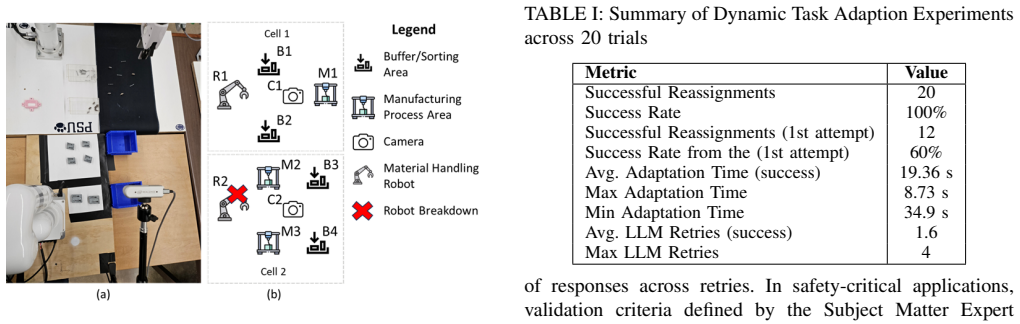
Summary. The paper presents an LLM-enabled Central Controller Agent (CCA) for dynamic task reassignment in a multi-robot manufacturing system. The formal problem is stated in terms of robots, capability configurations, task constraints, and a validity condition on reassignment. The implementation uses structured prompts, a validation step, and feedback-based retries. A physical dual-robot experiment with a simulated R2 failure after two sorting tasks reports 20 trials, a 100% final success rate, a 60% first-attempt success rate, and up to 4 retries. The authors position the work as an initial exploratory proof-of-concept.
Significance. If the empirical claims hold, the paper offers a useful proof-of-concept that an LLM can interpret structured configuration data and, with closed-loop validation feedback, recover from a robot disruption in a manufacturing setting. The strengths are the physical testbed, the explicit formulation of validity through constraint functions, and the clear separation between first-attempt and retry-based success. The study is preliminary: one scenario, one LLM, no baseline, and no statistical variation. The significance is therefore as a feasibility demonstration rather than as a general result.
major comments (3)
- [Section IV.B, Table I] The reported time statistics are internally inconsistent: Avg. Adaptation Time (success) = 19.36 s, Max Adaptation Time = 8.73 s, Min Adaptation Time = 34.9 s. Since a maximum cannot be less than an average, and a minimum cannot be greater than an average, at least two of these three entries must be erroneous. This is not a stylistic issue: Table I is the only quantitative support for the paper's headline 100% success claim. The authors must correct the table and provide per-trial raw data or a detailed explanation of the discrepancy before the central claim can be evaluated.
- [Section IV.B] The 100% success rate includes trials in which the first LLM response failed validation and the CCA applied structured feedback over up to 4 retries. The metric therefore measures the closed-loop system, not the LLM's unaided reasoning capability. The paper should state this explicitly in the abstract and results summary, and should consistently distinguish 'final system success' from 'first-attempt LLM success'. In addition, because validity is defined relative to the constraint set Cτd and the SME-defined validation criteria, an omitted constraint could allow a reassignment that is formally valid but physically infeasible. The manuscript acknowledges this dependency, but the claim that 'valid reassignment configurations were eventually found' should be qualified as 'valid with respect to the modeled constraints and validation criteria.'
- [Section IV.A-B] The experimental evaluation uses a single repeated scenario (R2 fails after two sorting tasks, two cells, one candidate replacement robot) with 20 trials and no baseline comparison. There is no variation in failure type, task set, or robot configuration, and no error bars or confidence intervals are reported. As an exploratory proof-of-concept this is acceptable, but the abstract's statement that the experiments 'demonstrate high task success rates' overstates the generality. The conclusions should be explicitly restricted to the tested scenario, and the paper should note that broader adaptability claims require experiments over diverse disruptions and configurations.
minor comments (5)
- [Section III.B.2] The word 'inlcude' should be 'include' in the sentence 'the prompt is composed to inlcude both high-level task objectives and system-level constraints.'
- [Section III.B.1] The sentence 'which the exploration robot re uses to identify relevant objects originally assigned to the disrupted robots re' appears to contain typographical errors: 'robots re' should likely be 'robot rd', and the plural is inconsistent. Please correct the notation.
- [Table I caption] The caption reads 'Summary of Dynamic Task Adaption Experiments'; 'Adaption' should be 'Adaptation'.
- [Section V] The phrase 'enhancing the LLM’s reasoning with ability under uncertainty' should be reworded, for example to 'enhancing the LLM's reasoning ability under uncertainty'.
- [Section III.B.2, Figure 3] The prompt structure is described at a high level but the actual prompt template is not reproduced. Providing the full prompt (or a representative example) in an appendix would substantially improve reproducibility, since the results depend heavily on prompt construction and feedback formatting.
Circularity Check
No circular derivation: the reported success is an empirical measurement against a defined validity predicate, with no fitted inputs and no load-bearing self-citations.
full rationale
The paper's central claim is an experimental result: across 20 trials the LLM-enabled Central Controller Agent eventually produced reassignments that the CCA's own constraint checks marked valid. This is a measured outcome, not a derived quantity, and the validity predicate is explicitly defined in Section II as the satisfaction of all constraint functions in C_tau_d. No parameter is fitted to the data and then renamed as a prediction, and no analytic result is reduced to its own assumptions. The only self-citations are contextual: Kovalenko et al. [9] is cited for the general central-controller architecture and Lim et al. [14] is mentioned as future work; neither carries the empirical claim. The acknowledged reliance on SME-defined validation criteria is a completeness assumption about physical constraints, not a logical circle. The apparent impossibility of Table I's min/max/average adaptation times (Avg. 19.36 s, Max 8.73 s, Min 34.9 s) is a data-consistency or reporting problem, not a circularity problem, because it concerns the trustworthiness of the measurement rather than the logical relationship between inputs and conclusions.
Assumptions & free parameters
free parameters (1)
- max_retry_limit =
4
assumptions (5)
- domain assumption Robot capabilities can be represented as structured key-value configurations K_ri.
- domain assumption Each task constraint φ_l is a boolean-valued function that can be evaluated exactly by the CCA.
- ad hoc to paper GPT-4o, prompted with structured context and validation feedback, can generate configurations satisfying these constraints within 4 retries.
- ad hoc to paper The tested scenario (R2 failure after two sorting tasks, two cells) is representative enough to support the stated conclusions about adaptability.
- domain assumption SME-defined validation criteria are complete and correct.
Cite this review
Pith. "Pith review of Dynamic Task Adaptation for Multi-Robot Manufacturing Systems with Large Language Models." pith.science (2026). https://pith.science/paper/MSRE3AL2
@misc{pith2026250522804,
  author       = {Pith},
  title        = {Pith review of: Dynamic Task Adaptation for Multi-Robot Manufacturing Systems with Large Language Models},
  year         = {2026},
  howpublished = {\url{https://pith.science/paper/MSRE3AL2}},
  note         = {Machine review of arXiv:2505.22804}
}
read the original abstract
Recent manufacturing systems are increasingly adopting multi-robot collaboration to handle complex and dynamic environments. While multi-agent architectures support decentralized coordination among robot agents, they often face challenges in enabling real-time adaptability for unexpected disruptions without predefined rules. Recent advances in large language models offer new opportunities for context-aware decision-making to enable adaptive responses to unexpected changes. This paper presents an initial exploratory implementation of a large language model-enabled control framework for dynamic task reassignment in multi-robot manufacturing systems. A central controller agent leverages the large language model's ability to interpret structured robot configuration data and generate valid reassignments in response to robot failures. Experiments in a real-world setup demonstrate high task success rates in recovering from failures, highlighting the potential of this approach to improve adaptability in multi-robot manufacturing systems.
Figures


Forward citations
Cited by 1 Pith paper
-
IndoorR2X: Indoor Robot-to-Everything Coordination with LLM-Driven Planning
Fusing IoT/CCTV into a shared semantic state lets LLM multi-robot planners keep high success while cutting path length, actions, and tokens versus robot-only sharing under partial observability.
Reference graph
Works this paper leans on
-
[1]
Multi-robot assembly strategies and metrics,
J. A. Marvel, R. Bostelman, and J. Falco, “Multi-robot assembly strategies and metrics,” ACM Computing Surveys (CSUR) , vol. 51, no. 1, pp. 1–32, 2018
work page 2018
-
[2]
Research on large-scale additive man- ufacturing based on multi-robot collaboration technology,
H. Shen, L. Pan, and J. Qian, “Research on large-scale additive man- ufacturing based on multi-robot collaboration technology,” Additive Manufacturing, vol. 30, p. 100906, 2019
work page 2019
-
[3]
Digital twin and virtual reality based methodology for multi-robot manufacturing cell commissioning,
L. Pérez, S. Rodríguez-Jiménez, N. Rodríguez, R. Usamentiaga, and D. F. García, “Digital twin and virtual reality based methodology for multi-robot manufacturing cell commissioning,” Applied sciences, vol. 10, no. 10, p. 3633, 2020
work page 2020
-
[4]
Agent-based Distributed Manufacturing Control: A State- of-the-art Survey,
P. Leitão, “Agent-based Distributed Manufacturing Control: A State- of-the-art Survey,” Engineering applications of artificial intelligence , vol. 22, no. 7, pp. 979–991, 2009
work page 2009
-
[5]
Past, Present, and Future of Industrial Agent Applications,
P. Leitão, V . Ma ˇrík, and P. Vrba, “Past, Present, and Future of Industrial Agent Applications,” IEEE Transactions on Industrial In- formatics, vol. 9, no. 4, pp. 2360–2372, 2012
work page 2012
-
[6]
Decentralized and centralized planning for multi-robot additive manufacturing,
L. Poudel, S. Elagandula, W. Zhou, and Z. Sha, “Decentralized and centralized planning for multi-robot additive manufacturing,” Journal of Mechanical Design , vol. 145, no. 1, p. 012003, 2023
work page 2023
-
[7]
Smart-llm: Smart multi-agent robot task planning using large language models,
S. S. Kannan, V . L. Venkatesh, and B.-C. Min, “Smart-llm: Smart multi-agent robot task planning using large language models,” in 2024 IEEE/RSJ International Conference on Intelligent Robots and Systems (IROS). IEEE, 2024, pp. 12 140–12 147
work page 2024
-
[8]
Y . Wang, R. Xiao, J. Y . L. Kasahara, R. Yajima, K. Nagatani, A. Yamashita, and H. Asama, “Dart-llm: Dependency-aware multi- robot task decomposition and execution using large language models,” arXiv preprint arXiv:2411.09022 , 2024
arXiv 2024
Show all 14 references
-
[9]
Toward an Automated Learning Control Architecture for Cyber-Physical Man- ufacturing Systems,
I. Kovalenko, J. Moyne, M. Bi, E. C. Balta, W. Ma, Y . Qamsane, X. Zhu, Z. M. Mao, D. M. Tilbury, and K. Barton, “Toward an Automated Learning Control Architecture for Cyber-Physical Man- ufacturing Systems,” IEEE Access, vol. 10, pp. 38 755–38 773, 2022
2022
-
[10]
[Online]
UFACTORY , Nov 2023. [Online]. Available: https://www.ufactory.cc/
2023
-
[11]
GPT-4o System Card,
A. Hurst, A. Lerer, A. P. Goucher, A. Perelman, A. Ramesh, A. Clark, A. Ostrow, A. Welihinda, A. Hayes, A. Radford et al. , “GPT-4o System Card,” arXiv preprint arXiv:2410.21276 , 2024
2024 arXiv
-
[12]
Mitigating spatial hal- lucination in large language models for path planning via prompt engineering,
H. Zhang, H. Deng, J. Ou, and C. Feng, “Mitigating spatial hal- lucination in large language models for path planning via prompt engineering,” Scientific Reports, vol. 15, no. 1, p. 8881, 2025
2025
-
[13]
Make your llm fully utilize the context,
S. An, Z. Ma, Z. Lin, N. Zheng, J.-G. Lou, and W. Chen, “Make your llm fully utilize the context,” Advances in Neural Information Processing Systems, vol. 37, pp. 62 160–62 188, 2024
2024
-
[14]
Ontology-Based Feedback to Improve Runtime Control for Multi- Agent Manufacturing Systems,
J. Lim, L. Pfeiffer, F. Ocker, B. V ogel-Heuser, and I. Kovalenko, “Ontology-Based Feedback to Improve Runtime Control for Multi- Agent Manufacturing Systems,” pp. 1–7, 2023
2023
Reviewed August 7, 2026 · model on record in the stance chip above.
Discussion (0). Sign in to comment.