REVIEW 3 major objections 6 minor 67 references
4DTAM: Non-Rigid Tracking and Mapping via Dynamic Surface Gaussians
T0 review · 3 major / 6 minor · reviewed 2026-08-07 · deepseek-v4-flash
Pith's one-line read 4DTAM is the first SLAM system to jointly solve camera localization and non-rigid surface reconstruction through differentiable rendering.
desk verdict A coherent non-rigid SLAM system with a real analytic Jacobian contribution, but the Sim4D test-view protocol appears to make the headline comparisons invalid; the paper deserves review but needs major revision. read the letter →
The pith
A machine-rendered reading of the paper's core claim, the machinery that carries it, and where it could break.
The reading
What carries the argument
The load-bearing object is the canonical 2D Gaussian map: a set of flat, oriented Gaussian surfels (each defined by a mean point, a rotation whose third column is the surface normal, and a 2D scale) that can be rendered by ray-splat intersection and differentiated analytically. A compact MLP warp-field $f_\theta(\gamma(\mathbf{x}), \gamma(t)) \to (\delta\mathbf{x}, \delta\mathbf{r}, \delta\mathbf{s})$ maps canonical positions and time to deformation offsets, giving an implicit smoothness prior on motion. The other pieces that make the loop close are an analytic SE(3) camera-pose Jacobian for 2DGS, normal initialization computed by finite differences of back-projected depth, an as-rigid-as-possible loss on Gaussian means, and a novel normal-rigidity loss that penalizes changes in the dot products between neighbouring surface normals across time. The Sim4D dataset provides the first quantitative test bed with ground-truth trajectories, depth, normals, and masks for non-rigid RGB-D SLAM.
What would settle it
Render or record a sequence where a soft object is torn into two pieces or two blobs merge into one (the water-effect sequence is a candidate), run 4DTAM, and check whether the canonical Gaussian surface stays a single connected sheet. If the reconstruction cannot split or merge, or if trajectory and depth errors jump sharply at the topological event while a per-primitive trajectory method succeeds, the smooth-warp central claim is falsified.
Extended reading notes
Core claim
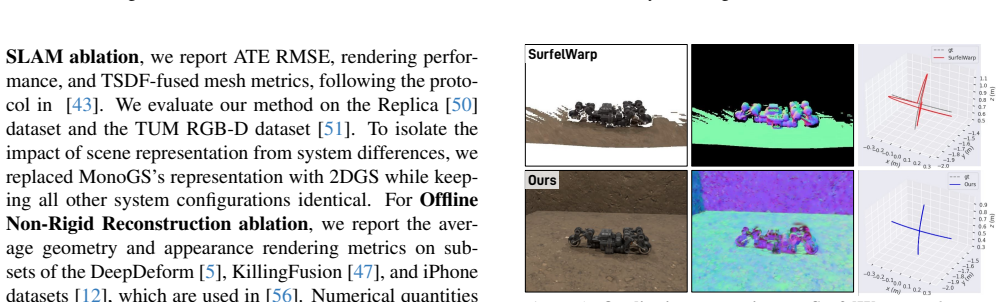
On its own terms, the paper's central result is that the high-dimensional problem of 4D tracking and mapping—estimating the camera trajectory, the static canonical scene, and a time-dependent deformation together from a single RGB-D stream—is solvable online without semantic priors. The scene is represented by 2D Gaussian splatting primitives, each a flat oriented surfel with a position, rotation, scale, opacity, and color; the deformation from canonical time to observation time is produced by an 8-layer MLP warp field that takes position and time and outputs offsets in position, rotation, and scale. The system's contributions are an analytic Jacobian for camera poses in 2DGS, surface normal initialization from sensor depth, a normal-rigidity loss that keeps local surface orientation consistent across time, and ARAP regularization on Gaussian means, all optimized in a sliding-window tracking-and-mapping loop. Alongside the method, the paper introduces Sim4D, a synthetic benchmark of fifty animated everyday objects with ground-truth depth, normals, masks, and camera trajectories, and reports that with known or predicted depth the pipeline reconstructs deforming scenes with lower trajectory error and more accurate geometry than the SurfelWarp baseline.
Load-bearing premise
The whole system rests on the assumption that a single smooth warp field can express whatever deformation actually happens; if the scene tears, merges, or moves too fast for the MLP, the canonical map cannot represent it and joint pose estimation will drift.
Editorial extensions
If this is right
- A single RGB-D camera can map scenes whose objects bend, slide, or deform continuously, without templates, segmentation, or static-scene assumptions.
- Because normals are explicit and supervised from depth, the same surface-Gaussian representation also improves static SLAM geometry, cutting depth rendering error and raising mesh F1 versus a solid-Gaussian baseline.
- Combining the warp field with a learned monocular depth predictor extends the pipeline to ordinary color cameras, at reduced accuracy.
- The analytic pose Jacobian for 2D Gaussian Splatting is a reusable building block for pose estimation in surface-based Gaussian rendering beyond SLAM.
- Sim4D gives future 4D-SLAM work a common benchmark with ground-truth camera trajectories and object meshes, enabling quantitative comparisons where earlier work relied on qualitative demos.
Reading between the lines
- Editorial inference: because the warp field is a smooth function of position and time, it can only represent topological changes through continuous stretching; scenes that tear, merge, or splash would likely break the canonical map, and a testable extension is to add per-primitive split-and-merge or a piecewise motion basis.
- Editorial inference: the reported 1.5 fps tracking rate and one-minute global optimization place the method at interactive rather than true real-time operation; pruning the MLP or using a smaller warp could close the gap, at some cost in deformation quality.
- Editorial inference: the synthetic Sim4D benchmark uses object-centred arc trajectories of about 20 degrees, so it evaluates moderate viewpoint change; a harder test with larger excursions or occlusions would reveal how much of the improvement comes from the smooth-motion prior.
- Editorial inference: the normal-rigidity loss is representation-agnostic and could improve other dynamic surface Gaussian or mesh trackers, since it enforces local rigidity without knowing the object's shape class.
Editorial analysis
A structured set of objections, weighed in public.
Referee Report
Summary. The paper presents 4DTAM, a non-rigid RGB-D SLAM system that jointly estimates camera ego-motion, scene geometry, appearance, and dynamics by combining 2D Gaussian Splatting surface primitives with an MLP warp-field. The authors derive an analytic camera-pose Jacobian for 2DGS, introduce surface normal and rigidity regularizers, and release a synthetic dataset (Sim4D) with an evaluation protocol. The central claim is that 4DTAM is the first 4D tracking-and-mapping method via differentiable rendering and that it outperforms existing non-rigid SLAM (SurfelWarp). The analytic derivation in Section 3.2 is sound, but the main quantitative claims are undermined by an internal inconsistency in the dataset protocol and by a direct counterexample in Table 1.
Significance. If the claims are corrected and re-established, the paper would make a useful contribution: the analytic pose Jacobian for 2D Gaussian Splatting (Eqs. 11 and 13) is a reusable technical result; the surface-Gaussian SLAM formulation with normal initialization and rigidity losses is a reasonable step toward non-rigid RGB-D SLAM; and the open Sim4D dataset with ground-truth depth, normals, masks, and camera trajectories, plus the released rendering script, is a valuable resource. The paper also includes a monocular-depth-prior experiment and offline reconstruction ablations. However, the current evaluation does not support the headline claims: the test-view protocol is internally inconsistent, and one appearance metric directly contradicts the 'outperforms across all metrics' statement.
major comments (3)
- [Section 4.2, Table 1] The sentence 'Our method outperforms SurfelWarp across all metrics' is false as written. In Table 1, the LPIPS value on the 'water effect' sequence is 0.908 for 4DTAM and 0.587 for SurfelWarp, and lower LPIPS is better. This is a direct counterexample to the stated claim. The claim should be corrected to a per-metric comparison, and the failure case should be analyzed, for example whether the water's non-smooth or topologically changing motion exceeds the capacity of the smooth MLP warp-field.
- [Section 3.5 vs. Supplementary Section 9] The evaluation protocol is internally inconsistent and this undermines the quantitative comparison. Main text Section 3.5 states that 'test viewpoints are defined outside of these arcs,' but Supplementary Section 9 defines training views by θ∈[−10°,10°] and φ∈[−10°,10°] and defines test views as a circle through (θ,φ)=(±5°,0°) and (0°,±5°). That circle lies entirely inside the training ranges, so the reported test views are interpolated rather than extrapolated. The claim of novel-view synthesis and the comparison with SurfelWarp on these test views need to be re-run with test viewpoints actually outside the training arcs, or the claims must be revised to describe interpolation performance.
- [Section 4.1] The SurfelWarp comparison is asymmetric. The text states that because SurfelWarp requires explicit foreground segmentation, 'we collect its results only on pixels with valid reconstruction,' while 4DTAM is evaluated on the rendered image more generally. Since PSNR, SSIM, LPIPS, and depth L1 all depend on the pixel mask used for evaluation, this asymmetry can favor 4DTAM. Please report results for both methods on the same evaluation mask, state exactly how the mask is constructed, and quantify how the comparison changes when both methods are evaluated on the same pixels.
minor comments (6)
- [Section 1] The term 'multi-layer perception' should be 'multi-layer perceptron'.
- [Section 3.4.2] There is a typo: 'Gaussianss' should be 'Gaussians'. Also, the text around Eqs. (15) and (16) writes 'cannonical Gaussians' and should read 'canonical Gaussians'.
- [Table 6] In the TUM ablation table, the MonoGS LPIPS row reads '0.26 1 0.201 0.200'; this appears to be a formatting artifact and should be corrected to a consistent numeric value.
- [Table 9] In the SSIM row of the monocular-depth-prior table, the entry '0253' should be '0.253'.
- [Supplementary Section 9] The claim in the caption of Figure 9 that the views maintain 'a clear separation between the training and test views' is contradicted by the coordinate definitions; this should be corrected together with the protocol described in the major comment.
- [Equation (20)] The total loss in Eq. (20) lists L_ARAP and L_{ARAP_n} without explicit weighting coefficients, while the other terms carry λ weights; please state whether the ARAP terms are intentionally given weight 1 or whether the coefficients were omitted.
Circularity Check
No significant circularity: the tracking/mapping derivation is self-contained; the noted benchmark concerns are correctness risks, not circular derivation steps.
full rationale
The method's derivation chain is not circular. The analytic camera-pose Jacobian (Section 3.2 and Supplementary Section 8) is obtained from standard SE(3) Lie algebra, and the warp-field MLP (Section 3.3) together with the Gaussian surface primitives is optimized directly against the RGB-D observations through the photometric, depth, normal, and ARAP losses (Section 3.4). The ARAP and normal-rigidity terms are regularizers, not fitted predictions of unseen constants, and the reported 'predictions' are renderings of the optimized model. The only author self-citation is MonoGS [29], used for keyframing, pruning, brightness parameters, and the isotropic loss; these are published, independently evaluated building blocks and are not the load-bearing claim of 4DTAM, so this self-citation does not constitute circularity. I also weighed the evaluation concerns raised by the reviewer: Section 4.2's claim that the method 'outperforms SurfelWarp across all metrics' is contradicted by Table 1 for LPIPS on the water-effect sequence (0.908 vs 0.587), and Supplementary Section 9 defines test views on a circle through (5°,0°), (0°,5°), (-5°,0°), and (0°,-5°), which lie inside the training ranges stated in the same section and conflict with Section 3.5's statement that test viewpoints are 'outside of these arcs.' These are benchmark-validity and internal-consistency problems that weaken the quantitative comparison, but they are not cases where a prediction reduces to a fitted input by construction; the core derivation remains self-contained.
Assumptions & free parameters
free parameters (5)
- Loss weights for non-rigid SLAM (λp, λg, λiso, λn) =
0.9, 0.1, 10.0, 0.002
- ARAP neighbor count, radius, exponential decay =
20, 0.05, 500
- MLP architecture sizes (layers, hidden units, frequency encodings) =
8 layers, 256 units; time=1, position=4
- Keyframe interval N =
1
- Static SLAM λn and λg =
0.01 and 0.5
assumptions (5)
- domain assumption 2D Gaussian Splatting provides a differentiable surface representation with explicit normals.
- domain assumption A compact MLP warp-field can represent general scene dynamics.
- domain assumption ARAP and normal-rigidity regularizers prevent drift in unobserved regions.
- domain assumption RGB-D depth measurements are metric and accurate enough for back-projection and normal computation.
- domain assumption Quantitative evaluation on the synthetic Sim4D generalizes to real-world scenes.
Cite this review
Pith. "Pith review of 4DTAM: Non-Rigid Tracking and Mapping via Dynamic Surface Gaussians." pith.science (2026). https://pith.science/paper/DVF7R4SC
@misc{pith2026250522859,
  author       = {Pith},
  title        = {Pith review of: 4DTAM: Non-Rigid Tracking and Mapping via Dynamic Surface Gaussians},
  year         = {2026},
  howpublished = {\url{https://pith.science/paper/DVF7R4SC}},
  note         = {Machine review of arXiv:2505.22859}
}
read the original abstract
We propose the first 4D tracking and mapping method that jointly performs camera localization and non-rigid surface reconstruction via differentiable rendering. Our approach captures 4D scenes from an online stream of color images with depth measurements or predictions by jointly optimizing scene geometry, appearance, dynamics, and camera ego-motion. Although natural environments exhibit complex non-rigid motions, 4D-SLAM remains relatively underexplored due to its inherent challenges; even with 2.5D signals, the problem is ill-posed because of the high dimensionality of the optimization space. To overcome these challenges, we first introduce a SLAM method based on Gaussian surface primitives that leverages depth signals more effectively than 3D Gaussians, thereby achieving accurate surface reconstruction. To further model non-rigid deformations, we employ a warp-field represented by a multi-layer perceptron (MLP) and introduce a novel camera pose estimation technique along with surface regularization terms that facilitate spatio-temporal reconstruction. In addition to these algorithmic challenges, a significant hurdle in 4D SLAM research is the lack of reliable ground truth and evaluation protocols, primarily due to the difficulty of 4D capture using commodity sensors. To address this, we present a novel open synthetic dataset of everyday objects with diverse motions, leveraging large-scale object models and animation modeling. In summary, we open up the modern 4D-SLAM research by introducing a novel method and evaluation protocols grounded in modern vision and rendering techniques.
Figures


Figures from the paper (5 more)



Reference graph
Works this paper leans on
-
[1]
https://polyhaven.com/textures/ fabric
Poly haven. https://polyhaven.com/textures/ fabric. Accessed: 2024-11-01. 6
work page 2024
- [2]
-
[3]
Oliver Boyne. Blendersynth. https://ollieboyne. github.io/BlenderSynth, 2023. 6
work page 2023
-
[4]
Neural Deformation Graphs for Globally-consistent Non-rigid Reconstruction
Alja ˇz Boˇziˇc, Pablo Palafox, Michael Zollh¨ofer, Justus Thies, Angela Dai, and Matthias Nießner. Neural deforma- tion graphs for globally-consistent non-rigid reconstruction. arXiv preprint arXiv:2012.01451, 2020. 3
work page Pith review arXiv 2012
-
[5]
Deepdeform: Learning non-rigid rgb-d reconstruction with semi-supervised data
Alja ˇz Bo ˇziˇc, Michael Zollh ¨ofer, Christian Theobalt, and Matthias Nießner. Deepdeform: Learning non-rigid rgb-d reconstruction with semi-supervised data. 2020. 3, 7
work page 2020
-
[6]
D. J. Butler, J. Wulff, G. B. Stanley, and M. J. Black. A nat- uralistic open source movie for optical flow evaluation. In Proceedings of the European Conference on Computer Vi- sion (ECCV), 2012. 3
work page 2012
-
[7]
Neural surface reconstruction of dynamic scenes with monocular rgb-d camera
Hongrui Cai, Wanquan Feng, Xuetao Feng, Yan Wang, and Juyong Zhang. Neural surface reconstruction of dynamic scenes with monocular rgb-d camera. InThirty-sixth Confer- ence on Neural Information Processing Systems (NeurIPS) ,
-
[8]
Blender - a 3d modelling and rendering package, 2018
Blender Online Community. Blender - a 3d modelling and rendering package, 2018. 3, 6
work page 2018
Show all 67 references
-
[9]
Objaverse: A universe of annotated 3d objects
Matt Deitke, Dustin Schwenk, Jordi Salvador, Luca Weihs, Oscar Michel, Eli VanderBilt, Ludwig Schmidt, Kiana Ehsani, Aniruddha Kembhavi, and Ali Farhadi. Objaverse: A universe of annotated 3d objects. In Proceedings of the IEEE/CVF Conference on Computer Vision and Pattern Rec...
2023
-
[10]
DeformGS: Scene flow in highly deformable scenes for deformable object manipulation
Bardienus P Duisterhof, Zhao Mandi, Yunchao Yao, Jia- Wei Liu, Jenny Seidenschwarz, Mike Zheng Shou, Ramanan Deva, Shuran Song, Stan Birchfield, Bowen Wen, and Jef- frey Ichnowski. DeformGS: Scene flow in highly deformable scenes for deformable object manipulation. WAFR, 2024. 3
2024
-
[11]
Engel, V
J. Engel, V . Koltun, and D. Cremers. Direct sparse odom- etry. IEEE Transactions on Pattern Analysis and Machine Intelligence (PAMI), 2017. 6
2017
-
[12]
Monocular dynamic view synthesis: A reality check
Hang Gao, Ruilong Li, Shubham Tulsiani, Bryan Russell, and Angjoo Kanazawa. Monocular dynamic view synthesis: A reality check. In NeurIPS, 2022. 3, 7
2022
-
[13]
Surfelwarp: Efficient non- volumetric single view dynamic reconstruction
Wei Gao and Russ Tedrake. Surfelwarp: Efficient non- volumetric single view dynamic reconstruction. In Proceed- ings of Robotics: Science and Systems (RSS) , 2018. 3, 6, 7, 8
2018
-
[14]
R. Garg, A. Roussos, and L. Agapito. Dense variational reconstruction of non-rigid surfaces from monocular video. In Proceedings of the IEEE Conference on Computer Vision and Pattern Recognition (CVPR), 2013. 2
2013
-
[15]
Sugar: Surface- aligned gaussian splatting for efficient 3d mesh reconstruc- tion and high-quality mesh rendering
Antoine Gu ´edon and Vincent Lepetit. Sugar: Surface- aligned gaussian splatting for efficient 3d mesh reconstruc- tion and high-quality mesh rendering. 2024. 2
2024
-
[16]
Deepcap: Monocular human performance capture using weak supervision
Marc Habermann, Weipeng Xu, Michael Zollhofer, Gerard Pons-Moll, and Christian Theobalt. Deepcap: Monocular human performance capture using weak supervision. In Pro- ceedings of the IEEE/CVF Conference on Computer Vision and Pattern Recognition, pages 5052–5063, 2020. 3
2020
-
[17]
2d gaussian splatting for geometrically ac- curate radiance fields
Binbin Huang, Zehao Yu, Anpei Chen, Andreas Geiger, and Shenghua Gao. 2d gaussian splatting for geometrically ac- curate radiance fields. In Proceedings of SIGGRAPH, 2024. 2, 3
2024
-
[18]
Sc-gs: Sparse-controlled gaussian splatting for editable dynamic scenes
Yi-Hua Huang, Yang-Tian Sun, Ziyi Yang, Xiaoyang Lyu, Yan-Pei Cao, and Xiaojuan Qi. Sc-gs: Sparse-controlled gaussian splatting for editable dynamic scenes. Proceed- ings of the IEEE Conference on Computer Vision and Pattern Recognition (CVPR), 2024. 3
2024
-
[19]
V olumeDeform: Real-time V olumetric Non-rigid Reconstruction
Matthias Innmann, Michael Zollh ¨ofer, Matthias Nießner, Christian Theobalt, and Marc Stamminger. V olumeDeform: Real-time V olumetric Non-rigid Reconstruction. In Pro- ceedings of the European Conference on Computer Vision (ECCV), 2016. 3
2016
-
[20]
Catalin Ionescu, Dragos Papava, Vlad Olaru, and Cristian Sminchisescu. Human3. 6m: Large scale datasets and pre- dictive methods for 3d human sensing in natural environ- ments. IEEE transactions on pattern analysis and machine intelligence, 36(7):1325–1339, 2013. 3
2013
-
[21]
M. M. Johari, C. Carta, and F. Fleuret. ESLAM: Efficient dense slam system based on hybrid representation of signed distance fields. In Proceedings of the IEEE Conference on Computer Vision and Pattern Recognition (CVPR), 2023. 2
2023
-
[22]
Olaf K ¨ahler, Victor Adrian Prisacariu, and David W. Murray. Real-time large-scale dense 3d reconstruction with loop clo- sure. In Proceedings of the European Conference on Com- puter Vision (ECCV), 2016. 2
2016
-
[23]
Neu- ral 3D mesh renderer
Hiroharu Kato, Yoshitaka Ushiku, and Tatsuya Harada. Neu- ral 3D mesh renderer. In Proceedings of the IEEE Confer- ence on Computer Vision and Pattern Recognition (CVPR) , pages 3907–3916, 2018. 2
2018
-
[24]
Splatam: Splat, track and map 3d gaussians for dense rgb-d slam
Nikhil Keetha, Jay Karhade, Krishna Murthy Jatavallabhula, Gengshan Yang, Sebastian Scherer, Deva Ramanan, and Jonathon Luiten. Splatam: Splat, track and map 3d gaussians for dense rgb-d slam. In Proceedings of the IEEE/CVF Con- ference on Computer Vision and Pattern Recogniti...
2024
-
[25]
3D gaussian splatting for real-time radiance field rendering
Bernhard Kerbl, Georgios Kopanas, Thomas Leimk ¨uhler, and George Drettakis. 3D gaussian splatting for real-time radiance field rendering. ACM Transactions on Graphics (TOG), 2023. 2
2023
-
[26]
Matthew Loper, Naureen Mahmood, Javier Romero, Ger- ard Pons-Moll, and Michael J. Black. SMPL: A skinned multi-person linear model. ACM Trans. Graphics (Proc. SIGGRAPH Asia), 34(6):248:1–248:16, 2015. 3
2015
-
[27]
Dynamic 3d gaussians: Tracking by per- sistent dynamic view synthesis
Jonathon Luiten, Georgios Kopanas, Bastian Leibe, and Deva Ramanan. Dynamic 3d gaussians: Tracking by per- sistent dynamic view synthesis. 3DV, 2024. 3, 6, 1
2024
-
[28]
Rnnslam: Reconstructing the 3d colon to visualize missing regions during a colonoscopy
Ruibin Ma, Rui Wang, Yubo Zhang, Stephen Pizer, Sarah K McGill, Julian Rosenman, and Jan-Michael Frahm. Rnnslam: Reconstructing the 3d colon to visualize missing regions during a colonoscopy. Medical image analysis, 72: 102100, 2021. 3
2021
-
[29]
Hidenobu Matsuki, Riku Murai, Paul H. J. Kelly, and An- drew J. Davison. Gaussian Splatting SLAM. 2024. 2, 5, 6, 7, 1 4
2024
-
[30]
McCormac, A
J. McCormac, A. Handa, A. J. Davison, and S. Leutenegger. SemanticFusion: Dense 3D semantic mapping with convo- lutional neural networks. In Proceedings of the IEEE In- ternational Conference on Robotics and Automation (ICRA),
-
[31]
Nerf: Representing scenes as neural radiance fields for view syn- thesis
Ben Mildenhall, Pratul P Srinivasan, Matthew Tancik, Jonathan T Barron, Ravi Ramamoorthi, and Ren Ng. Nerf: Representing scenes as neural radiance fields for view syn- thesis. In Proceedings of the European Conference on Com- puter Vision (ECCV), 2020. 2, 5
2020
-
[32]
tiny-cuda-nn, 2021
Thomas M ¨uller. tiny-cuda-nn, 2021. 1
2021
-
[33]
Instant neural graphics primitives with a mul- tiresolution hash encoding
Thomas M ¨uller, Alex Evans, Christoph Schied, and Alexan- der Keller. Instant neural graphics primitives with a mul- tiresolution hash encoding. ACM Transactions on Graphics (TOG), 2022. 2, 5
2022
-
[34]
R. A. Newcombe, S. Izadi, O. Hilliges, D. Molyneaux, D. Kim, A. J. Davison, P. Kohli, J. Shotton, S. Hodges, and A. Fitzgibbon. KinectFusion: Real-Time Dense Surface Map- ping and Tracking. In Proceedings of the International Sym- posium on Mixed and Augmented Reality (ISMAR), 2011. 2
2011
-
[35]
R. A. Newcombe, S. Lovegrove, and A. J. Davison. DTAM: Dense Tracking and Mapping in Real-Time. In Proceedings of the International Conference on Computer Vision (ICCV),
-
[36]
Dynamicfusion: Reconstruction and tracking of non-rigid scenes in real-time
Richard A Newcombe, Dieter Fox, and Steven M Seitz. Dynamicfusion: Reconstruction and tracking of non-rigid scenes in real-time. In Proceedings of the IEEE Conference on Computer Vision and Pattern Recognition (CVPR), 2015. 3
2015
-
[37]
Differentiable volumetric rendering: Learn- ing implicit 3d representations without 3d supervision
Michael Niemeyer, Lars Mescheder, Michael Oechsle, and Andreas Geiger. Differentiable volumetric rendering: Learn- ing implicit 3d representations without 3d supervision. In Proceedings of the IEEE Conference on Computer Vision and Pattern Recognition (CVPR), 2020. 2
2020
-
[38]
Barron, Sofien Bouaziz, Dan B Goldman, Steven M
Keunhong Park, Utkarsh Sinha, Jonathan T. Barron, Sofien Bouaziz, Dan B Goldman, Steven M. Seitz, and Ricardo Martin-Brualla. Nerfies: Deformable neural radiance fields. ICCV, 2021. 3
2021
-
[39]
Neural body: Implicit neural representations with structured latent codes for novel view synthesis of dynamic humans
Sida Peng, Yuanqing Zhang, Yinghao Xu, Qianqian Wang, Qing Shuai, Hujun Bao, and Xiaowei Zhou. Neural body: Implicit neural representations with structured latent codes for novel view synthesis of dynamic humans. In Proceed- ings of the IEEE/CVF Conference on Computer Vision a...
2021
-
[40]
D-NeRF: Neural Radiance Fields for Dynamic Scenes
Albert Pumarola, Enric Corona, Gerard Pons-Moll, and Francesc Moreno-Noguer. D-NeRF: Neural Radiance Fields for Dynamic Scenes. 3
-
[41]
Gomez Rodriguez, J
Juan J. Gomez Rodriguez, J. M. M Montiel, and Juan D. Tardos. Nr-slam: Non-rigid monocular slam. IEEE Transac- tions on Robotics (T-RO), 2023. 3
2023
-
[42]
Co-fusion: Real- time segmentation, tracking and fusion of multiple objects
Martin R ¨unz and Lourdes Agapito. Co-fusion: Real- time segmentation, tracking and fusion of multiple objects. In Proceedings of the IEEE International Conference on Robotics and Automation (ICRA), 2017. 3
2017
-
[43]
Os- wald
Erik Sandstr ¨om, Yue Li, Luc Van Gool, and Martin R. Os- wald. Point-slam: Dense neural point cloud-based slam. In Proceedings of the International Conference on Computer Vision (ICCV), 2023. 2, 7, 1, 3
2023
-
[44]
Bad slam: Bundle adjusted direct rgb-d slam
Thomas Sch ¨ops, Torsten Sattler, and Marc Pollefeys. Bad slam: Bundle adjusted direct rgb-d slam. In Proceedings of the IEEE Conference on Computer Vision and Pattern Recognition (CVPR), 2019. 2
2019
-
[45]
StaticFusion: Background re- construction for dense rgb-d slam in dynamic environments
Raluca Scona, Mariano Jaimez, Yvan R Petillot, Maurice Fallon, and Daniel Cremers. StaticFusion: Background re- construction for dense rgb-d slam in dynamic environments. In Proceedings of the IEEE International Conference on Robotics and Automation (ICRA), 2018. 3
2018
-
[46]
Dynomo: Online point tracking by dynamic online monocular gaussian recon- struction, 2024
Jenny Seidenschwarz, Qunjie Zhou, Bardienus Duisterhof, Deva Ramanan, and Laura Leal-Taix ´e. Dynomo: Online point tracking by dynamic online monocular gaussian recon- struction, 2024. 3
2024
-
[47]
Killingfusion: Non-rigid 3d reconstruc- tion without correspondences
Miroslava Slavcheva, Maximilian Baust, Daniel Cremers, and Slobodan Ilic. Killingfusion: Non-rigid 3d reconstruc- tion without correspondences. In Proceedings of the IEEE Conference on Computer Vision and Pattern Recognition (CVPR), 2017. 3, 7
2017
-
[48]
Sobolevfusion: 3d reconstruction of scenes undergoing free non-rigid motion
Miroslava Slavcheva, Maximilian Baust, and Slobodan Ilic. Sobolevfusion: 3d reconstruction of scenes undergoing free non-rigid motion. In Proceedings of the IEEE Conference on Computer Vision and Pattern Recognition (CVPR), 2018. 3
2018
-
[49]
Sol `a, J
J. Sol `a, J. Deray, and D. Atchuthan. A micro Lie theory for state estimation in robotics. arXiv:1812.01537, 2018. 5, 1
2018 arXiv
-
[50]
Julian Straub, Thomas Whelan, Lingni Ma, Yufan Chen, Erik Wijmans, Simon Green, Jakob J. Engel, Raul Mur-Artal, Carl Ren, Shobhit Verma, Anton Clarkson, Mingfei Yan, Brian Budge, Yajie Yan, Xiaqing Pan, June Yon, Yuyang Zou, Kimberly Leon, Nigel Carter, Jesus Briales, Tyler Gi...
1906 arXiv
-
[51]
Sturm, N
J. Sturm, N. Engelhard, F. Endres, W. Burgard, and D. Cre- mers. A Benchmark for the Evaluation of RGB-D SLAM Systems. In Proceedings of the IEEE/RSJ Conference on In- telligent Robots and Systems (IROS), 2012. 7
2012
-
[52]
Sucar, S
E. Sucar, S. Liu, J. Ortiz, and A. J. Davison. iMAP: Implicit mapping and positioning in real-time. In Proceedings of the International Conference on Computer Vision (ICCV), 2021. 2
2021
-
[53]
Torresani, A
L. Torresani, A. Hertzmann, and C. Chris Bregler. Nonrigid structure-from-motion: Estimating shape and motion with hierarchical priors. IEEE Transactions on Pattern Analysis and Machine Intelligence (PAMI), 30(5), 2008. 2
2008
-
[54]
Non- rigid neural radiance fields: Reconstruction and novel view synthesis of a dynamic scene from monocular video
Edgar Tretschk, Ayush Tewari, Vladislav Golyanik, Michael Zollh¨ofer, Christoph Lassner, and Christian Theobalt. Non- rigid neural radiance fields: Reconstruction and novel view synthesis of a dynamic scene from monocular video. 2021. 3
2021
-
[55]
Co- slam: Joint coordinate and sparse parametric encodings for neural real-time slam
Hengyi Wang, Jingwen Wang, and Lourdes Agapito. Co- slam: Joint coordinate and sparse parametric encodings for neural real-time slam. Proceedings of the IEEE Conference on Computer Vision and Pattern Recognition (CVPR), 2023. 2
2023
-
[56]
Mor- pheus: Neural dynamic 360deg surface reconstruction from 5 monocular rgb-d video
Hengyi Wang, Jingwen Wang, and Lourdes Agapito. Mor- pheus: Neural dynamic 360deg surface reconstruction from 5 monocular rgb-d video. In Proceedings of the IEEE/CVF Conference on Computer Vision and Pattern Recognition , pages 20965–20976, 2024. 3, 7, 8, 1
2024
-
[57]
Shape of motion: 4d reconstruc- tion from a single video
Qianqian Wang, Vickie Ye, Hang Gao, Jake Austin, Zhengqi Li, and Angjoo Kanazawa. Shape of motion: 4d reconstruc- tion from a single video. 2024. 3
2024
-
[58]
Moge: Unlocking accurate monocular geometry estimation for open-domain images with optimal training supervision, 2024
Ruicheng Wang, Sicheng Xu, Cassie Dai, Jianfeng Xiang, Yu Deng, Xin Tong, and Jiaolong Yang. Moge: Unlocking accurate monocular geometry estimation for open-domain images with optimal training supervision, 2024. 2
2024
-
[59]
Tartanair: A dataset to push the limits of visual slam
Wenshan Wang, Delong Zhu, Xiangwei Wang, Yaoyu Hu, Yuheng Qiu, Chen Wang, Yafei Hu, Ashish Kapoor, and Se- bastian Scherer. Tartanair: A dataset to push the limits of visual slam. In 2020 IEEE/RSJ International Conference on Intelligent Robots and Systems (IROS), pages 4909–49...
2020
-
[60]
Whelan, M
T. Whelan, M. Kaess, H. Johannsson, M. F. Fallon, J. J. Leonard, and J. B. McDonald. Real-time large scale dense RGB-D SLAM with volumetric fusion. International Jour- nal of Robotics Research (IJRR), 34(4-5):598–626, 2015. 2
2015
-
[61]
Whelan, S
T. Whelan, S. Leutenegger, R. F. Salas-Moreno, B. Glocker, and A. J. Davison. ElasticFusion: Dense SLAM without a pose graph. In Proceedings of Robotics: Science and Sys- tems (RSS), 2015. 2
2015
-
[62]
Gs-slam: Dense visual slam with 3d gaussian splatting
Chi Yan, Delin Qu, Dan Xu, Bin Zhao, Zhigang Wang, Dong Wang, and Xuelong Li. Gs-slam: Dense visual slam with 3d gaussian splatting. In CVPR, 2024. 2
2024
-
[63]
V ox-fusion: Dense tracking and mapping with voxel-based neural implicit representation
Xingrui Yang, Hai Li, Hongjia Zhai, Yuhang Ming, Yuqian Liu, and Guofeng Zhang. V ox-fusion: Dense tracking and mapping with voxel-based neural implicit representation. In Proceedings of the International Symposium on Mixed and Augmented Reality (ISMAR), 2022. 2
2022
-
[64]
Deformable 3d gaussians for high- fidelity monocular dynamic scene reconstruction
Ziyi Yang, Xinyu Gao, Wen Zhou, Shaohui Jiao, Yuqing Zhang, and Xiaogang Jin. Deformable 3d gaussians for high- fidelity monocular dynamic scene reconstruction. 2024. 3, 5, 1
2024
-
[65]
Real-time photorealistic dynamic scene representa- tion and rendering with 4d gaussian splatting
Zeyu Yang, Hongye Yang, Zijie Pan, Xiatian Zhu, and Li Zhang. Real-time photorealistic dynamic scene representa- tion and rendering with 4d gaussian splatting. Proceedings of the International Conference on Learning Representations (ICLR), 2024. 3, 5
2024
-
[66]
Gaussian opacity fields: Efficient adaptive surface reconstruction in unbounded scenes
Zehao Yu, Torsten Sattler, and Andreas Geiger. Gaussian opacity fields: Efficient adaptive surface reconstruction in unbounded scenes. ACM Transactions on Graphics (TOG),
-
[67]
Oswald, and Marc Polle- feys
Zihan Zhu, Songyou Peng, Viktor Larsson, Weiwei Xu, Hu- jun Bao, Zhaopeng Cui, Martin R. Oswald, and Marc Polle- feys. Nice-slam: Neural implicit scalable encoding for slam. In Proceedings of the IEEE Conference on Computer Vision and Pattern Recognition (CVPR), 2022. 2 6
2022
Reviewed August 7, 2026 · model on record in the stance chip above.
Discussion (0). Sign in to comment.