REVIEW 4 major objections 4 minor 37 references
iHDR: Iterative HDR Imaging with Arbitrary Number of Exposures
T0 review · 4 major / 4 minor · reviewed 2026-08-07 · deepseek-v4-flash
Pith's one-line read A single two-frame fusion network, iterated with a physics-based tonemapping step, can merge any number of exposures without retraining.
desk verdict The two-input fusion results are strong and the iterative-pairwise idea is genuinely new, but the arbitrary-K claim rests on ten unreleased scenes and omits the flexible-input baselines it cites, so the headline should be treated as promising rather than proven. read the letter →
The pith
A machine-rendered reading of the paper's core claim, the machinery that carries it, and where it could break.
The reading
What carries the argument
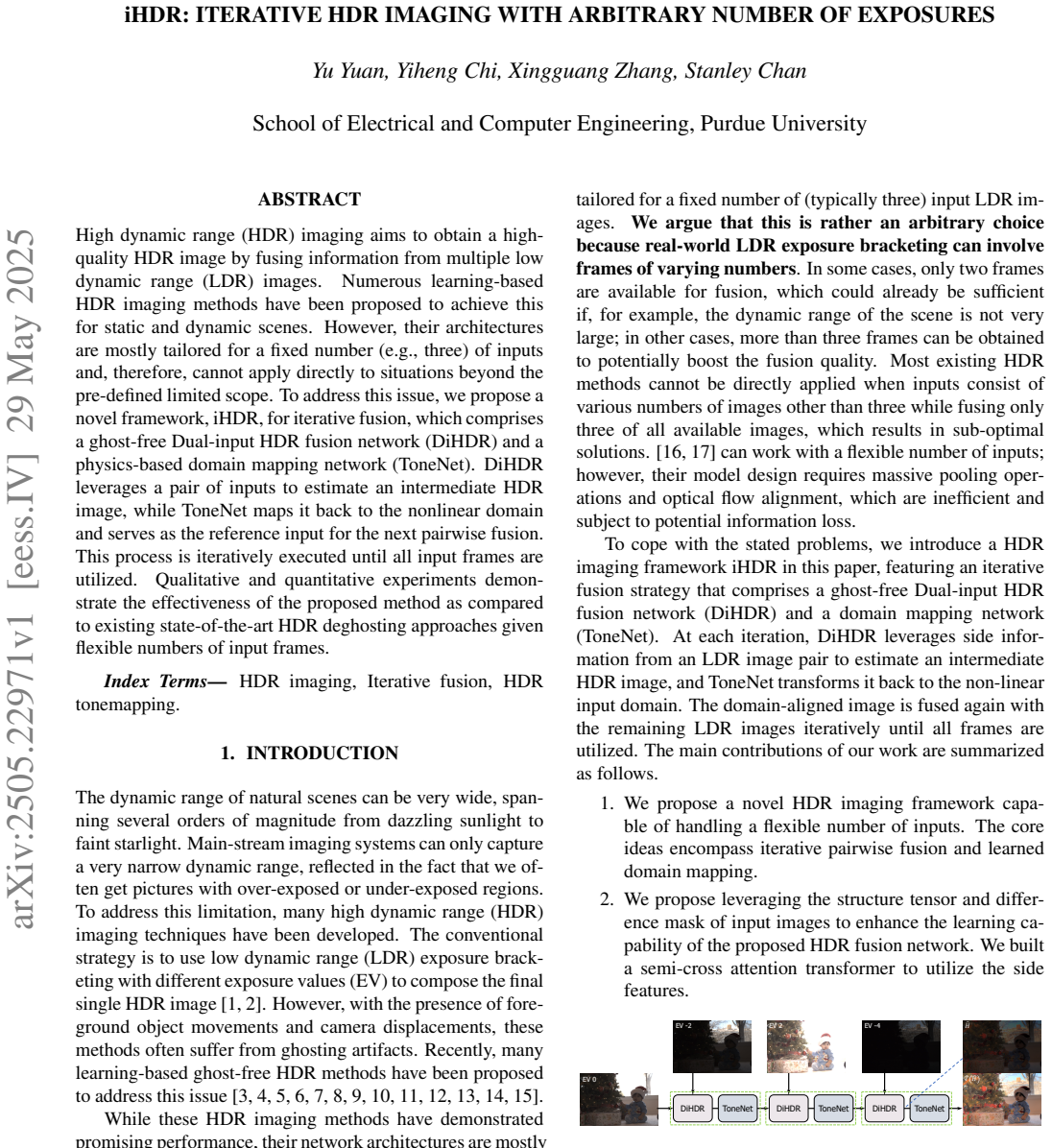
The machine that carries the claim is the closed loop formed by DiHDR and ToneNet. DiHDR is a U-shaped transformer that takes six inputs—reference LDR and its pseudo-HDR, non-reference LDR and its pseudo-HDR, a structure tensor of the reference, and a difference mask—and outputs a linear HDR estimate. Its semi-cross attention transformer (SCAT) blocks modify the MDTA attention so a prior feature projects onto both key and value, letting structure and mask information steer attention. ToneNet's task is to invert the imaging pipeline: it uses the sensor relation $L = (cH)^{1/\gamma}$ as a physically motivated starting point and learns residuals, producing a tone-mapped image that is then treated as the new reference LDR in the next iteration. The iteration orders non-reference frames by average-luminance difference from the true reference, so each successive fusion adds the most compatible remaining exposure.
What would settle it
Take a static scene, capture a burst with $K=9$, and after each DiHDR step compare ToneNet's output $\hat{T}$ against the ground-truth HDR tone-mapped by the same physical model; if the mean absolute error of $\hat{T}$ grows from iteration to iteration, or if a small injected tone shift at iteration one produces a larger final error than the same shift applied directly to the final ground truth, the no-accumulation assumption is violated.
Extended reading notes
Core claim
On the paper's own terms, the central discovery is that iterative pairwise fusion with physics-based domain mapping makes the number of input frames a free parameter of inference rather than of architecture. DiHDR fuses a reference and one non-reference LDR frame with the help of handcrafted side information—pseudo-HDR images, a structure-tensor flat map, and a difference mask—attended through a semi-cross attention transformer; ToneNet then converts the estimated linear HDR into the nonlinear domain using a sensor model $L = (cH)^{1/\gamma}$, so the next pair shares a consistent reference. The paper reports that this single model, trained only on two-input SIG17 samples, outperforms seven fixed-three-input methods on the two-input test set and produces increasing PSNR-$\mu$ and SSIM-$\mu$ as it consumes 2, 3, 5, or 9 frames of its collected dynamic-scene bursts. The load-bearing mechanism is that ToneNet's mapping is accurate enough that domain-conversion biases do not accumulate across iterations.
Load-bearing premise
The iterative chain can reuse a ToneNet-mapped intermediate as a reference without accumulating errors, so if ToneNet's mapping drifts even slightly, each subsequent fusion step ingests a biased reference and the error could compound over more frames.
Editorial extensions
If this is right
- One trained model covers any burst length $K \ge 2$, so there is no need to retrain or fine-tune a new network for each possible number of exposures.
- Additional input frames improve quality: on the paper's collected dataset, PSNR-$\mu$ and SSIM-$\mu$ increase monotonically as iHDR consumes 2, 3, 5, or 9 frames.
- Two-frame bursts, which are awkward for three-input models, are handled directly and the paper reports that this approach outperforms seven fixed-three-input methods that were adapted to two inputs.
- ToneNet's physics-based mapping is what makes iteration viable, preserving color and contrast better than mu-law or a learned tone mapper, so domain-conversion bias does not visibly accumulate.
- Computational cost stays comparable to or lower than transformer-based fixed-input alternatives: the paper lists 374.76 GMACs and roughly 6.93 seconds on an A100 for three 1500x1000 inputs.
Reading between the lines
- If confirmed on broader benchmarks, burst-length flexibility would let capture pipelines adapt to scene dynamic range with a single checkpoint: two frames for easy scenes, nine for hard ones, without re-training.
- The framework suggests a general recipe: any pairwise fusion network plus a learned domain-inversion module yields an arbitrary-length fusion, a trick that might transfer to other multi-frame tasks such as burst denoising or burst super-resolution where the intermediate estimate can be mapped back to the input domain.
- A testable prediction is that the performance-versus-K curve should rise and then saturate; if ToneNet bias accumulates, the curve should eventually turn downward, and the paper's evidence only goes up to $K=9$, so the saturation point is still open.
- Because ToneNet's training labels come from manually adjusting a simplified sensor model, the method's flexibility may inherit that model's accuracy; extreme cameras with different noise, color filter arrays, or nonlinear response would stress the assumption.
Editorial analysis
A structured set of objections, weighed in public.
Referee Report
Summary. The paper proposes iHDR, an iterative HDR imaging framework designed to fuse an arbitrary number K≥2 of LDR exposures with a single trained model. The method combines a two-input HDR fusion network (DiHDR) with a physics-based tonemapping network (ToneNet); at each iteration DiHDR fuses the current reference and the next LDR frame, and ToneNet maps the intermediate HDR estimate back into the LDR domain to serve as the reference for the next iteration. The authors report strong two-input results on SIG17 (Table 1), a collected 10-scene 9-frame dataset for flexible-K evaluation (Table 2, Fig. 8), tonemapping comparisons (Fig. 5), and ablations for the structure tensor, difference mask, and semi-cross attention transformer (Table 3). The central claim is that one two-input-trained model outperforms existing fixed-three-input HDR deghosting methods for K=2,3,5,9 without retraining per burst length.
Significance. If the flexible-K claim holds, iHDR would be a practically valuable contribution: it removes the need to retrain per burst length and offers a principled pairwise-fusion strategy for exposure brackets of varying size. The two-input SIG17 results are strong and internally consistent, with large margins over all seven baselines in Table 1 (e.g., PSNR-µ 41.63 vs 36.48 for SCTNet). The paper also provides useful ablations showing the contribution of structure tensor guidance and the semi-cross attention prior injection. However, the paper's headline claim—arbitrary-K generalization—is supported only by ten self-collected scenes with no per-iteration drift analysis, no statistical significance, and an evaluation that omits the strongest baselines from Table 1 as well as the flexible-input methods cited in the introduction. The central idea is plausible, but the current evidence is not yet sufficient to establish the flexible-number claim at the level the paper states.
major comments (4)
- [§3.4, Supplementary §6] The arbitrary-K claim rests on the stability of the iterative ToneNet chain, but Supplementary §6 explicitly states that tonemapping biases 'can accumulate and be exacerbated across fusion iterations.' The only supporting evidence is Table 2 and Fig. 8 on 10 self-collected brackets, with no per-iteration drift analysis, no oracle experiment, and no error bars or significance tests. Add an oracle-chain comparison that reconstructs the sequence using ground-truth LDR/domain references at each iteration instead of the ToneNet-mapped reference, and report per-iteration PSNR/SSIM/HDR-VDP2 curves; also report results on more than 10 scenes.
- [Table 2, §1] Table 2 omits SCTNet, which is the strongest or second-strongest baseline in Table 1 on two-input SIG17, and it also omits the flexible-input methods (Prabhakar et al. [16] and FlexHDR [17]) that are cited in Section 1 as being inefficient or lossy. Without these comparisons, the claim that iHDR outperforms state-of-the-art for arbitrary K is not established. Include SCTNet on the same 9-frame dataset, and include flexible-input baselines at matching input counts (K=5,9) or explain why they cannot be adapted.
- [§3.4, Table 2] The comparison in Table 2 is confounded by input count: Ours(5) and Ours(9) receive 5 and 9 frames, while AHDR, NHDRRNet, HDR-GAN, and HDR-Transformer receive only 3. Improved scores at larger K may reflect extra input information rather than the iterative fusion design. This is not merely a formal concern: at K=3, Ours(3) has PSNR-l 14.71, below HDR-GAN (15.28) and HDR-Transformer (16.27), so the paper's claim of 'superior performance to other three-input frameworks' is not supported at the equal-input comparison. Report a controlled comparison at fixed K for all methods, and for larger K compare against flexible-input baselines or fixed-K adaptations that ingest the same frames.
- [§2.4, Eq. (5), Supplementary §6] The ToneNet supervision uses a single exposure-related scalar c=4.5, described as chosen by 'manually adjusting' the physical model in Section 3.1 and Supplementary §6. Since ToneNet is the linchpin of the iterative chain, this manual choice is load-bearing: if the mapping is biased for a different camera or scene distribution, the paper itself warns that errors accumulate. Provide a sensitivity analysis over c (and over the Eq. (3) difference-mask threshold and Gaussian blur radius), and justify the chosen value independently of the test set, ideally by reporting robustness across scenes and cameras.
minor comments (4)
- [Fig. 5 caption] The caption lists pairs such as '13.63/0.8001' without explaining which metric is the numerator and denominator; specify that these are PSNR/SSIM values and which domain each number refers to.
- [§3.1, Supplementary §7] The 10-scene 9-frame dataset is the only evidence for the flexible-K claim, but it is not released and no code link is provided; for reproducibility and for the community to verify the central claim, please release the dataset and code.
- [§2.1] The reference frame is described as 'mid-exposed and sharp,' but no objective criterion for sharpness is given; specify how sharpness is measured or state that it is selected manually.
- [§2.5, Eq. (7)] The loss weight λ is set to 0.1 without an ablation; since ToneNet quality directly affects iterative stability, a small ablation study for λ would strengthen the paper.
Circularity Check
Minor circularity: ToneNet's tonemapping validation uses labels from the same c=4.5 model it is claimed to learn; main HDR fusion benchmarks are independent.
-
self definitional
[Sec. 2.4 (Eq. 5), Sec. 2.5 (loss), Sec. 3.1 (ToneNet labels), Sec. 3.2, Supplementary Sec. 6 (c=4.5)]
"Sec. 3.1: 'For the tonemapping labels required by ToneNet, we obtain them by manually adjusting the parameters of the physical model in Sec. 2.4.' Sec. 2.5: 'T denotes the physics-based tonemapping results of ground truth HDR.' Eq. (5): 'L= (c·H) 1/γ'; supplementary: 'we simplify the parameters ξ,t, and QE by absorbing them into one exposure-related scalar c=4.5'."
ToneNet's training target T is generated by the same simplified relation L=(c·H)^{1/γ} with a manually chosen scalar c=4.5 that ToneNet is claimed to implement. The Sec. 3.2 comparison of ToneNet against 'GT (Non-linear)' therefore measures how well ToneNet reproduces its own label generator, not an independent tonemapping ground truth. The 'physics-based' claim and the assertion that mapping bias will not accumulate in iterative fusion are fitted to this self-generated target rather than independently established. This bears on the stability of the arbitrary-K chain, though the main HDR deghosting results on SIG17 and the collected dataset are evaluated against external HDR labels and remain independent.
full rationale
The central HDR deghosting and flexible-K results are not circular: DiHDR is trained on two-input SIG17 pairs and evaluated against external HDR ground truth (SIG17 test set and the paper's collected 9-frame bracketed scenes with labels), and the gains in Table 2/Fig. 8 are empirical outcomes of the iterative algorithm, not quantities forced by the training objective. The paper's own supplementary admits the load-bearing assumption that ToneNet biases 'can accumulate and be exacerbated across fusion iterations,' which is a stated limitation and a correctness risk rather than a circular derivation. The one genuine circular sub-step is the ToneNet tonemapping comparison in Sec. 3.2: its labels are produced by manually adjusting the very physical model (c=4.5) that ToneNet is said to learn, so the claim that ToneNet 'preserves the inherent HDR essence' reduces to self-consistency with a fitted scalar. Because that sub-claim supports the iterative-chain stability argument but the main fusion accuracy is independently benchmarked, the overall circularity is minor rather than load-bearing for the central result.
Assumptions & free parameters
free parameters (3)
- Exposure scalar c in ToneNet model =
4.5
- Difference mask threshold =
0.2
- Difference mask Gaussian blur radius =
7
assumptions (4)
- domain assumption LDR image formation follows L=(cH)^(1/gamma) after simplification of the full imaging model (Eq. 9 in the supplement).
- domain assumption Gamma 2.2 validly converts between LDR and linear HDR in pseudo-HDR construction (Eq. 1) and tone mapping.
- domain assumption Structure tensor and difference mask provide useful ghost-free side information.
- domain assumption Ground-truth HDR labels in SIG17 and the collected 9-frame dataset are accurate and consistent.
Cite this review
Pith. "Pith review of iHDR: Iterative HDR Imaging with Arbitrary Number of Exposures." pith.science (2026). https://pith.science/paper/HCNZAUX6
@misc{pith2026250522971,
  author       = {Pith},
  title        = {Pith review of: iHDR: Iterative HDR Imaging with Arbitrary Number of Exposures},
  year         = {2026},
  howpublished = {\url{https://pith.science/paper/HCNZAUX6}},
  note         = {Machine review of arXiv:2505.22971}
}
read the original abstract
High dynamic range (HDR) imaging aims to obtain a high-quality HDR image by fusing information from multiple low dynamic range (LDR) images. Numerous learning-based HDR imaging methods have been proposed to achieve this for static and dynamic scenes. However, their architectures are mostly tailored for a fixed number (e.g., three) of inputs and, therefore, cannot apply directly to situations beyond the pre-defined limited scope. To address this issue, we propose a novel framework, iHDR, for iterative fusion, which comprises a ghost-free Dual-input HDR fusion network (DiHDR) and a physics-based domain mapping network (ToneNet). DiHDR leverages a pair of inputs to estimate an intermediate HDR image, while ToneNet maps it back to the nonlinear domain and serves as the reference input for the next pairwise fusion. This process is iteratively executed until all input frames are utilized. Qualitative and quantitative experiments demonstrate the effectiveness of the proposed method as compared to existing state-of-the-art HDR deghosting approaches given flexible numbers of input frames.
Figures


Figures from the paper (7 more)


Reference graph
Works this paper leans on
-
[16]
Attention-guided progressive neural texture fu- sion for high dynamic range image restoration,
J. Chen, Z. Yang, T. N. Chan, H. Li, J. Hou, and L.-P. Chau, “Attention-guided progressive neural texture fu- sion for high dynamic range image restoration,”IEEE Transactions on Image Processing, 2022
work page 2022
-
[17]
Ghost-free high dynamic range imaging with context-aware Trans- former,
Z. Liu, Y . Wang, B. Zeng, and S. Liu, “Ghost-free high dynamic range imaging with context-aware Trans- former,” inEuropean Conference on Computer Vision, 2022, pp. 344–360
work page 2022
-
[1]
INTRODUCTION The dynamic range of natural scenes can be very wide, span- ning several orders of magnitude from dazzling sunlight to faint starlight. Main-stream imaging systems can only capture a very narrow dynamic range, reflected in the fact that we of- ten get pictures with over-exposed or under-exposed regions. To address this limitation, many high d...
-
[2]
The core ideas encompass iterative pairwise fusion and learned domain mapping
We propose a novel HDR imaging framework capa- ble of handling a flexible number of inputs. The core ideas encompass iterative pairwise fusion and learned domain mapping
-
[3]
iHDR: Iterative HDR Imaging with Arbitrary Number of Exposures
We propose leveraging the structure tensor and differ- ence mask of input images to enhance the learning ca- pability of the proposed HDR fusion network. We built a semi-cross attention transformer to utilize the side features. EV 0 EV -2 EV 2 EV -4 %𝑇#𝐻 #𝐻 To n e N e tTo n e N e tTo n e N e tDiHDRDiHDRDiHDR Figure 1: The proposed iHDR framework. ToneNet ...
work page Pith review arXiv 2025
-
[4]
THE PROPOSED FRAMEWORK 2.1. Problem Statement and Solution Overview Consider an HDR imaging problem where we want to convert a collection of LDR images{L 1,L 2, . . . ,LK}into a single HDR imageH. Existing HDR methods often assumeK= 3. As a result, if the method is learning-based, it will train a neural network with a fixedK= 3. The question we want to as...
-
[5]
EXPERIMENTS 3.1. Implementation Details Datasets.In this section, we perform extensive experiments to validate the effectiveness of the proposed approach. We use the dataset of SIG17 [3], where we split one set of three LDR images into two sets that share the same reference image. We generate 148 samples of training and 30 samples for testing dual-input f...
-
[6]
Method AHDR NHDRRNet HDR-GAN HDR-Transf
[4] [5] [7] [14] [9] [11] PSNR-l31.26 32.68 35.44 34.12 29.66 36.64 34.16 38.75 PSNR-µ29.53 30.28 31.75 30.89 29.36 35.59 36.48 41.63 SSIM-l0.8649 0.9407 0.9579 0.9573 0.8874 0.9543 0.9669 0.9819 SSIM-µ0.9055 0.9203 0.9180 0.9673 0.9584 0.9818 0.9774 0.9878 HDR-VDP2 56.95 57.73 59.45 51.19 59.87 59.91 59.27 62.84 Table 2: Quantitative comparison with diff...
Show all 37 references
-
[7]
(a) PSNR-µcurves (b) SSIM-µcurves Figure 8: Performance with varying input frame numbers
[7] [14] [9] 2 frames 3 frames 5 frames 9 frames PSNR-l13.06 11.03 15.28 16.27 13.92 14.71 16.99 18.05 PSNR-µ13.84 14.13 17.58 15.54 15.84 16.71 19.06 19.92 SSIM-l0.4261 0.4752 0.4969 0.6218 0.6777 0.6806 0.6823 0.6814 SSIM-µ0.4954 0.5174 0.6538 0.4606 0.5983 0.6577 0.7765 0.7...
-
[8]
In this framework, we design the DiHDR for pairwise fusion and the ToneNet for inter-domain transforma- tion
CONCLUSION In this paper, we propose an iterative HDR imaging frame- work iHDR that can flexibly handle arbitrary number of in- put frames. In this framework, we design the DiHDR for pairwise fusion and the ToneNet for inter-domain transforma- tion. We introduce SCAT, which ef...
-
[9]
Recovering high dynamic range radiance maps from photographs,
P. E. Debevec and J. Malik, “Recovering high dynamic range radiance maps from photographs,” inProceedings of the 24th Annual Conference on Computer Graphics and Interactive Techniques, 1997, p. 369–378
1997
-
[10]
Exposure fu- sion,
T. Mertens, J. Kautz, and F. Van Reeth, “Exposure fu- sion,” in15th Pacific Conference on Computer Graphics and Applications, 2007, pp. 382–390
2007
-
[11]
Deep high dy- namic range imaging of dynamic scenes,
N. K. Kalantari and R. Ramamoorthi, “Deep high dy- namic range imaging of dynamic scenes,”ACM Trans- actions on Graphics, vol. 36, no. 4, 2017
2017
-
[12]
Deep high dynamic range imaging with large foreground motions,
S. Wu, J. Xu, Y .-W. Tai, and C.-K. Tang, “Deep high dynamic range imaging with large foreground motions,” inEuropean Conference on Computer Vision, 2018
2018
-
[13]
Attention-guided network for ghost-free high dynamic range imaging,
Q. Yan, D. Gong, Q. Shi, A. van den Hengel, C. Shen, I. Reid, and Y . Zhang, “Attention-guided network for ghost-free high dynamic range imaging,” inIEEE/CVF Conference on Computer Vision and Pattern Recogni- tion, 2019, pp. 1751–1760
2019
-
[14]
Ghost removal via chan- nel attention in exposure fusion,
Q. Yan, B. Wang, P. Li, X. Li, A. Zhang, Q. Shi, Z. You, Y . Zhu, J. Sun, and Y . Zhang, “Ghost removal via chan- nel attention in exposure fusion,”Computer Vision and Image Understanding, vol. 201, p. 103079, 2020
2020
-
[15]
Deep HDR imaging via a non-local net- work,
Q. Yan, L. Zhang, Y . Liu, Y . Zhu, J. Sun, Q. Shi, and Y . Zhang, “Deep HDR imaging via a non-local net- work,”IEEE Transactions on Image Processing, 2020
2020
-
[18]
Selective TransHDR: Transformer-based se- lective HDR imaging using ghost region mask,
J. W. Song, Y .-I. Park, K. Kong, J. Kwak, and S.- J. Kang, “Selective TransHDR: Transformer-based se- lective HDR imaging using ghost region mask,” in European Conference on Computer Vision, 2022, p. 288–304
2022
-
[19]
Alignment-free HDR deghosting with semantics consistent Transformer,
S. Tel, Z. Wu, Y . Zhang, B. Heyrman, C. Demonceaux, R. Timofte, and D. Ginhac, “Alignment-free HDR deghosting with semantics consistent Transformer,” in International Conference on Computer Vision, 2023
2023
-
[20]
HDR imaging with spatially varying signal-to-noise ratios,
Y . Chi, X. Zhang, and S. H. Chan, “HDR imaging with spatially varying signal-to-noise ratios,” inIEEE/CVF Conference on Computer Vision and Pattern Recogni- tion, 2023, pp. 5724–5734
2023
-
[21]
A unified HDR imaging method with pixel and patch level,
Q. Yan, W. Chen, S. Zhang, Y . Zhu, J. Sun, and Y . Zhang, “A unified HDR imaging method with pixel and patch level,” inIEEE/CVF Conference on Computer Vision and Pattern Recognition, 2023
2023
-
[22]
HDR-GAN: HDR image reconstruction from multi- exposed LDR images with large motions,
Y . Niu, J. Wu, W. Liu, W. Guo, and R. W. H. Lau, “HDR-GAN: HDR image reconstruction from multi- exposed LDR images with large motions,”IEEE Trans- actions on Image Processing, vol. 30, 2021
2021
-
[23]
Towards high-quality HDR deghosting with conditional diffusion models,
Q. Yan, T. Hu, Y . Sun, H. Tang, Y . Zhu, W. Dong, L. Van Gool, and Y . Zhang, “Towards high-quality HDR deghosting with conditional diffusion models,”IEEE Transactions on Circuits and Systems for Video Tech- nology, 2023
2023
-
[24]
A fast, scalable, and reliable deghosting method for extreme exposure fusion,
K. R. Prabhakar, R. Arora, A. Swaminathan, K. P. Singh, and R. V . Babu, “A fast, scalable, and reliable deghosting method for extreme exposure fusion,” inIn- ternational Conference on Computational Photography, 2019, pp. 1–8
2019
-
[25]
FlexHDR: Modeling alignment and exposure uncer- tainties for flexible HDR imaging,
S. Catley-Chandar, T. Tanay, L. Vandroux, A. Leonardis, G. Slabaugh, and E. P ´erez-Pellitero, “FlexHDR: Modeling alignment and exposure uncer- tainties for flexible HDR imaging,”IEEE Transactions on Image Processing, vol. 31, pp. 5923–5935, 2022
2022
-
[26]
High dynamic range imaging via gradient-aware context aggregation network,
Q. Yan, D. Gong, J. Q. Shi, A. v. den Hengel, J. Sun, Y . Zhu, and Y . Zhang, “High dynamic range imaging via gradient-aware context aggregation network,”Pat- tern Recognition, vol. 122, p. 108342, 2022
2022
-
[27]
Ghosting-free multi- exposure image fusion in gradient domain,
K. R. Prabhakar and R. V . Babu, “Ghosting-free multi- exposure image fusion in gradient domain,” inInterna- tional Conference on Acoustics, Speech, and Signal Pro- cessing, 2016, pp. 1766–1770
2016
-
[28]
Un- supervised deep image fusion with structure tensor rep- resentations,
H. Jung, Y . Kim, H. Jang, N. Ha, and K. Sohn, “Un- supervised deep image fusion with structure tensor rep- resentations,”IEEE Transactions on Image Processing, vol. 29, pp. 3845–3858, 2020
2020
-
[29]
Restormer: Efficient Transformer for high-resolution image restoration,
S. W. Zamir, A. Arora, S. Khan, M. Hayat, F. S. Khan, and M.-H. Yang, “Restormer: Efficient Transformer for high-resolution image restoration,” inIEEE/CVF Con- ference on Computer Vision and Pattern Recognition, 2022
2022
-
[30]
HDR-VDP-2: a calibrated visual metric for visibility and quality predictions in all luminance conditions,
R. Mantiuk, K. J. Kim, A. G. Rempel, and W. Heidrich, “HDR-VDP-2: a calibrated visual metric for visibility and quality predictions in all luminance conditions,” in ACM SIGGRAPH, 2011
2011
-
[31]
Deep tone mapping operator for high dynamic range images,
A. Rana, P. Singh, G. Valenzise, F. Dufaux, N. Ko- modakis, and A. Smolic, “Deep tone mapping operator for high dynamic range images,”IEEE Transactions on Image Processing, vol. 29, pp. 1285–1298, 2020
2020
-
[32]
Spatially varying expo- sure with 2-by-2 multiplexing: Optimality and univer- sality,
X. Qu, Y . Chi, and S. H. Chan, “Spatially varying expo- sure with 2-by-2 multiplexing: Optimality and univer- sality,”IEEE Transactions on Computational Imaging, vol. 10, pp. 261–276, 2024. Supplementary Material for iHDR: Iterative HDR Imaging with Arbitrary Number of Inputs
2024
-
[33]
Consequently, the tone-mapped results can serve as inputs for subsequent fusion steps
PHYSICS-BASED TONEMAPPING The goal of the physics-based tonemapping network is to enable the iterative fusion scheme by converting the HDR output of DiHDR from the linear domain back to the non- linear domain of the LDR input images. Consequently, the tone-mapped results can s...
-
[34]
We capture the data using a Sonyα6400 camera mounted on a tripod
DA TASETS Our 9-input LDR Dataset.This paper collects 10 exposure brackets with labels, each containing 9 frames of dynamic scenes with EV values of±4,±3,±2,±1, and 0. We capture the data using a Sonyα6400 camera mounted on a tripod. The resolution of all images is downsampled...
-
[35]
4 presents a comparison of computational cost for var- ious methods
COMPUTA TIONAL COST Table. 4 presents a comparison of computational cost for var- ious methods. The penultimate column lists the parameters of DiHDR, along with the wall time for processing two in- puts. The last column provides the total time for DiHDR and ToneNet to process ...
-
[36]
We observe that the computational time and complexity of iHDR is lower than or comparable to HDR- Transformer and SCTNet on 3 inputs of1500×1000images
[5] [14] [9] [11] GMACs 1453.70 2166.69 778.81 981.81 293.77 374.76 Time (s) 0.29 0.35 4.85 6.86 7.12 6.93 1 ToneNet pass) Additionally, we compare GMACs for dif- ferent methods. We observe that the computational time and complexity of iHDR is lower than or comparable to HDR- ...
-
[37]
Experiments on HDR Deghosting
ADDITIONAL VISUAL RESULTS 9.1. Experiments on HDR Deghosting. Results on 2-input SIG17 Dataset.Fig. 10 show the results of HDR deghosting experiments. Our method outperforms other methods in suppressing ghosting artifacts. Results of Generalization Performance.Since all (2- in...
Reviewed August 7, 2026 · model on record in the stance chip above.
Discussion (0). Sign in to comment.