REVIEW 4 major objections 5 minor 1 cited by
Scalable Complexity Control Facilitates Reasoning Ability of LLMs
T0 review · 4 major / 5 minor · reviewed 2026-08-07 · deepseek-v4-flash
Pith's one-line read The paper argues that controlling model complexity during pretraining, through the initialization rate and weight decay, improves scaling laws and reasoning benchmarks across model and data sizes.
desk verdict Plausible and valuable direction, but the scaling-law claim is not backed by the data as presented—send to review, demand better evidence. read the letter →
The pith
A machine-rendered reading of the paper's core claim, the machinery that carries it, and where it could break.
The reading
What carries the argument
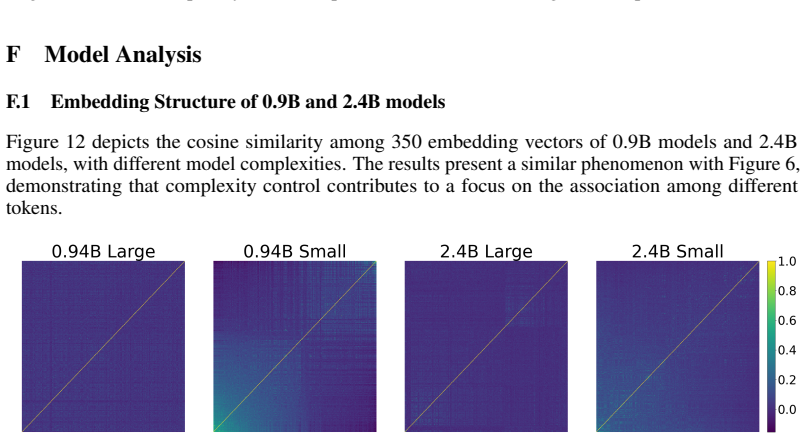
The mechanism is a pair of hyperparameters: the initialization rate, defined by sampling each weight from a normal distribution with scale $d_{\mathrm{in}}^{-\gamma}$, and the weight decay coefficient $\lambda$ in the optimizer update. A rate above $\gamma = 0.5$ counts as small-complexity initialization, while $\gamma = 0.5$ is the standard He/LeCun-style choice. The theoretical engine is an interpolated function norm $\|f\|_\gamma$ that connects the kernel-regime norm at $\gamma = -1/2$ with the Barron norm at $\gamma = -1$; under the paper's idealization, minimizing this norm makes training prefer sparse deep circuits over dense shallow circuits. In the trained network this preference shows up as condensation (neurons collapsing into few groups), higher cosine similarity among embeddings, and larger condensation and low-rank metrics in attention projections.
What would settle it
Measure the test-loss gap between the small- and large-complexity configurations on a 2.4B model trained on 10B or more tokens: if the gap closes as data grows, the leftward shift in the paper's scaling-law figure is not a durable scaling-law improvement.
Extended reading notes
Core claim
The paper's central claim is that model complexity, set by the initialization rate and weight decay, is a controllable proxy for whether a pretrained LLM learns compressed, generalizable rules or memorizes surface patterns. In the language of the paper, small-complexity pretraining steers training toward a circuit ensemble with few, deep circuits rather than many shallow ones, which is why it improves reasoning while also improving the scaling-law exponent. The empirical evidence has three parts: test-loss curves for 0.8B models shift left when complexity is reduced, in both the data-size and model-size directions; at scale, the small-complexity 0.9B/600B model beats the large-complexity model on 14 of 15 benchmarks and the 2.4B/1T model on 13 of 15, with average gains of +4.6 and +3.4 points; and mechanistic analyses show small complexity increases embedding similarity and condensation/low-rank structure in attention projections. The paper also argues, via a norm-interpolation calculation, that lower initialization rate favors exactly the sparse-deep solutions that generalize.
Load-bearing premise
The argument depends on the assumption that test-loss rankings seen on small 0.8B models trained on at most 1.4B tokens still hold at 600B and 1T token scales, and that the 2.4B small-complexity gain is not caused by the extra normalization used only in that run.
Editorial extensions
If this is right
- Higher initialization rate and weight decay improve sample efficiency: the same test loss is reached with fewer tokens or fewer parameters.
- A constant initialization rate, rather than a fixed initialization standard deviation, is the right scaling prescription, so the recipe can transfer across model widths.
- Complexity control stacks with supervised fine-tuning: the reported SFT gains are larger on small-complexity base models.
- The gains concentrate on reasoning-heavy tasks such as GSM8K, MATH, and CommonsenseQA, so complexity control can be treated as a reasoning-oriented pretraining intervention.
- Realizing the gains at scale requires stabilizing training with a moderate rate and additional normalization, so the recipe must be adapted as model size grows.
Reading between the lines
- If the scaling-law ordering from 0.8B models holds beyond 10B parameters, choosing the initialization rate and weight decay may become standard pretraining practice, but that extrapolation goes beyond what the paper's single large runs can confirm.
- The sparse-deep-circuits account predicts that small-complexity models should show measurable phase-transition or grokking-like behavior on small algorithmic tasks; this is testable with existing circuit-probing experiments.
- Because the 2.4B small run used extra embedding and sandwich normalization, the cleanest reading is that complexity control plus stability engineering jointly produced the gain; the paper does not isolate the two components.
- The authors point to post-training complexity control as future work; if it transfers, the same reasoning gains could be obtained after pretraining at even lower cost.
Editorial analysis
A structured set of objections, weighed in public.
Referee Report
Summary. This paper proposes that controlling model complexity during pretraining, implemented through the initialization rate γ and the weight decay coefficient λ, improves the scaling laws of large language models and enhances their reasoning ability. The authors train Llama-style models at several scales: 180M models on 40B tokens for analysis, 0.8B models on 0.2–1.4B tokens for scaling-law curves, 0.9B models on 600B tokens, and 2.4B models on 1T tokens. They report that small-complexity configurations (larger γ, larger λ) shift test-loss curves leftward and produce higher benchmark scores, with average gains of +4.6% and +3.4% over 15 tasks for the 0.9B and 2.4B comparisons, respectively. The paper also includes mechanistic analyses of embedding similarity and attention-matrix condensation, and a heuristic theoretical argument based on interpolated function norms and circuit-ensemble representations.
Significance. If the claims are substantiated, the paper offers a simple and computationally free intervention for improving LLM reasoning by tuning two hyperparameters, with no additional data or architecture changes. The reported gains on math and commonsense benchmarks are practically meaningful, and the focus on complexity control as a design principle is a useful complement to data- and scale-centric approaches. The authors have provided substantial experimental effort, including training a 2.4B model on 1T tokens, and the auxiliary analyses (embedding similarity, attention condensation) suggest a mechanism consistent with the condensation literature. However, as detailed below, the headline scaling-law conclusion currently rests on evidence that is too weak to fully support the paper's claims.
major comments (4)
- [4.1, Figure 2] The scaling-law conclusion is extrapolated from a heavily undertrained regime: the 0.8B models are trained on at most 1.4B tokens, which gives a token-to-parameter ratio below 2:1, while the headline benchmark comparisons use roughly 600B tokens per 0.9B model and 1T tokens per 2.4B model. The figure shows single runs with no error bars, and the claimed difference in scaling slopes is assessed visually rather than fitted. Without intermediate-scale points or multiple seeds, the data do not establish that the ordering of test losses persists across two orders of magnitude in data, which is the basis for the abstract's claim of consistent improvement in scaling laws.
- [4.2, Table 1, and Appendix B] The 2.4B small-complexity model is not a clean comparison for complexity control: it uses gamma equal to 0.58 instead of the gamma equal to 1 used in Figure 2, and it additionally employs embedding normalization and sandwich normalization (stated in Appendix B and Section 6.1). These architectural changes were introduced to mitigate loss spikes, but they confound the attribution of the plus 3.4 average gain to complexity control alone. The authors should either isolate the effect of gamma while holding normalization fixed, or present a matched 2.4B model without the extra normalization.
- [Table 1 and Appendix C] All reported benchmark differences are based on a single training run per configuration, with no standard errors or significance tests. Several deltas are small (for example, MMLU-Pro minus 0.5, OpenBookQA plus 0.8, GPQA plus 0.9, and IFEval plus 0.7 for the 2.4B comparison) and could be within evaluation noise. The assertion that complexity control improves performance consistently across tasks needs either multiple seeds or a paired statistical analysis across the 15 benchmarks.
- [6.3] The theoretical analysis rests on two very strong assumptions: convergence to the minimum-gamma-norm minimizer, and decomposition of the parameter distribution into product measures with per-layer masses epsilon or 0.9. These assumptions are not validated empirically and are not shown to be necessary for the reported benchmark gains. As a heuristic the discussion is illustrative, but as written it may be misread as a mechanistic explanation. Please clarify that this is a plausibility argument rather than a derivation of the scaling-law results.
minor comments (5)
- [3, Eq. (1)] The displayed weight-decay update rule appears to have a sign typo: it reads theta_{t+1} = -hat_theta_t - lambda * C * theta_t, but the standard AdamW update would be theta_{t+1} = hat_theta_t - lambda * C * theta_t. Please correct the sign.
- [6.3] The derivation of the minimized function norm is hard to follow because several intermediate displays are truncated or ambiguous, including the final expression for the norm with the factor 0.9 and epsilon. Please expand the calculation and define the norm notation precisely.
- [Table 1 caption] The table caption does not state that the 2.4B Small model uses gamma equal to 0.58 while the 0.9B Small model uses gamma equal to 1. Adding this information would prevent conflating the two configurations.
- [Figure 2 right] In the right panel, all models are trained on 1B tokens, so the token-to-parameter ratio varies from 20 for the 50M model to 1.25 for the 0.8B model. This confounds model-size scaling with data-to-model ratio and should be discussed.
- [Abstract and Section 4.1] The phrase that the initialization rate turns out to be the right invariant for the scaling laws is stronger than the evidence provided, since only a few discrete gamma values are tested. Please consider qualifying this claim.
Circularity Check
No load-bearing circularity: the scaling-law and benchmark gains are direct controlled comparisons against external benchmarks; self-citations are background, and the heuristic circuit-depth analysis is explicitly assumption-based rather than a fitted prediction.
full rationale
The central empirical claim—smaller initialization rate and larger weight decay improve test loss and downstream benchmarks—is established by direct controlled experiments (Figures 2, 4, 5; Tables 1, 4, 6) using external benchmarks (MMLU, GSM8K, etc.). No parameter is fitted to the target benchmark gains: the small-complexity configuration (γ=1, λ=1) is defined before the comparison, and the 2.4B γ=0.58 choice is a stability-motivated hyperparameter, not selected by the reported benchmark deltas. The scaling-law extrapolation from 0.2–1.4B-token runs and single-run large-scale comparisons is a substantive correctness risk, but it is not circularity because the curve ordering is observed, not derived from the conclusion. The paper's self-citations to condensation work [39, 69, 88] are heavy but background; the experiments in this paper stand independently of those citations. The theoretical analysis in Section 6.3 is explicitly labeled 'heuristic calculations'; it constructs an interpolation between RKHS and Barron norms and assumes (Assumption 1) that training with rate γ selects the minimum of that norm. The circuit-depth conclusion follows from that stated assumption and the constructed norm, but the paper does not use this calculation to generate the benchmark numbers, so it is an explanatory model rather than a circular prediction. No equation is shown to be equivalent to its own inputs by construction. Overall, the empirical contribution is self-contained against external benchmarks, so circularity is minimal.
Assumptions & free parameters
free parameters (3)
- initialization rate gamma =
0.1, 0.3, 0.5, 0.8, 1 for 180M; 0.5 vs 1 and 0.58 for 0.9B/2.4B
- weight decay coefficient lambda =
0, 0.1, 1
- epsilon in Assumption 2 =
unspecified, stated as 0 < epsilon << 1, with 0.9 used in the norm formula
assumptions (4)
- ad hoc to paper Training initialized with rate gamma converges to a global minimizer with minimum ||f||_gamma norm (Section 6.3, Assumption 1).
- ad hoc to paper Every minimizer's parameter distribution decomposes into weighted product measures with per-layer masses epsilon or 0.9 (Section 6.3, Assumption 2).
- domain assumption Deep residual networks with 2-layer blocks are a valid proxy for Transformer circuits (Section 6.3).
- standard math RKHS and Barron norm characterizations of 2-layer networks are standard background (Section 6.3).
invented entities (1)
-
circuit ensemble representation {(c_i, L_i)}
Cite this review
Pith. "Pith review of Scalable Complexity Control Facilitates Reasoning Ability of LLMs." pith.science (2026). https://pith.science/paper/SL3RUARY
@misc{pith2026250523013,
  author       = {Pith},
  title        = {Pith review of: Scalable Complexity Control Facilitates Reasoning Ability of LLMs},
  year         = {2026},
  howpublished = {\url{https://pith.science/paper/SL3RUARY}},
  note         = {Machine review of arXiv:2505.23013}
}
read the original abstract
The reasoning ability of large language models (LLMs) has been rapidly advancing in recent years, attracting interest in more fundamental approaches that can reliably enhance their generalizability. This work demonstrates that model complexity control, conveniently implementable by adjusting the initialization rate and weight decay coefficient, improves the scaling law of LLMs consistently over varying model sizes and data sizes. This gain is further illustrated by comparing the benchmark performance of 2.4B models pretrained on 1T tokens with different complexity hyperparameters. Instead of fixing the initialization std, we found that a constant initialization rate (the exponent of std) enables the scaling law to descend faster in both model and data sizes. These results indicate that complexity control is a promising direction for the continual advancement of LLMs.
Figures


Figures from the paper (13 more)




Forward citations
Cited by 1 Pith paper
-
Unveiling the Mechanisms of Multi-Hop Reasoning in Transformers via Identity Bridge
Adding identity supervision on bridge tokens enables out-of-distribution two-hop reasoning in simple transformers, with a nuclear-norm theory explaining the benefit.
Reference graph
Works this paper leans on
-
[1]
https://github.com/microsoft/Megatron-DeepSpeed, 2022
Megatron-deepspeed. https://github.com/microsoft/Megatron-DeepSpeed, 2022
2022
-
[2]
Josh Achiam, Steven Adler, Sandhini Agarwal, Lama Ahmad, Ilge Akkaya, Florencia Leoni Aleman, Diogo Almeida, Janko Altenschmidt, Sam Altman, Shyamal Anadkat, et al. GPT-4 technical report. arXiv preprint arXiv:2303.08774, 2023
arXiv 2023
-
[3]
Physics of language models: Part 3.2, knowledge manipula- tion
Zeyuan Allen-Zhu and Yuanzhi Li. Physics of language models: Part 3.2, knowledge manipula- tion. In arXiv preprint: abs/2309.14402, 2023
arXiv 2023
-
[4]
On exact computation with an infinitely wide neural net
Sanjeev Arora, Simon S Du, Wei Hu, Zhiyuan Li, Russ R Salakhutdinov, and Ruosong Wang. On exact computation with an infinitely wide neural net. In Advances in Neural Information Processing Systems, pages 8141–8150, 2019
2019
-
[5]
Stronger generalization bounds for deep nets via a compression approach
Sanjeev Arora, Rong Ge, Behnam Neyshabur, and Yi Zhang. Stronger generalization bounds for deep nets via a compression approach. In International conference on machine learning, pages 254–263. PMLR, 2018
2018
-
[6]
Program synthesis with large language models
Jacob Austin, Augustus Odena, Maxwell Nye, Maarten Bosma, Henryk Michalewski, David Dohan, Ellen Jiang, Carrie Cai, Michael Terry, Quoc Le, et al. Program synthesis with large language models. arXiv preprint arXiv:2108.07732, 2021
arXiv 2021
-
[7]
Spectrally-normalized margin bounds for neural networks
Peter L Bartlett, Dylan J Foster, and Matus J Telgarsky. Spectrally-normalized margin bounds for neural networks. Advances in neural information processing systems, 30, 2017
2017
-
[8]
Rademacher and gaussian complexities: Risk bounds and structural results
Peter L Bartlett and Shahar Mendelson. Rademacher and gaussian complexities: Risk bounds and structural results. Journal of Machine Learning Research, 3(Nov):463–482, 2002
2002
Show all 91 references
-
[9]
Phase dia- gram of initial condensation for two-layer neural networks
Zheng-An Chen, Yuqing Li, Tao Luo, Zhangchen Zhou, and Zhi-Qin John Xu. Phase dia- gram of initial condensation for two-layer neural networks. CSIAM Transactions on Applied Mathematics, 5(3):448–514, 2024
2024
-
[10]
On the global convergence of gradient descent for over- parameterized models using optimal transport
Lenaic Chizat and Francis Bach. On the global convergence of gradient descent for over- parameterized models using optimal transport. Advances in neural information processing systems, 31, 2018
2018
-
[11]
Think you have solved question answering? try arc, the ai2 reasoning challenge
Peter Clark, Isaac Cowhey, Oren Etzioni, Tushar Khot, Ashish Sabharwal, Carissa Schoenick, and Oyvind Tafjord. Think you have solved question answering? try arc, the ai2 reasoning challenge. arXiv:1803.05457v1, 2018
2018 arXiv
-
[12]
Training verifiers to solve math word problems
Karl Cobbe, Vineet Kosaraju, Mohammad Bavarian, Mark Chen, Heewoo Jun, Lukasz Kaiser, Matthias Plappert, Jerry Tworek, Jacob Hilton, Reiichiro Nakano, Christopher Hesse, and John Schulman. Training verifiers to solve math word problems. arXiv preprint arXiv:2110.14168, 2021
-
[13]
Hwang, Soumya Sanyal, Xiang Ren, Allyson Ettinger, Zaid Harchaoui, and Yejin Choi
Nouha Dziri, Ximing Lu, Melanie Sclar, Xiang Lorraine Li, Liwei Jiang, Bill Yuchen Lin, Sean Welleck, Peter West, Chandra Bhagavatula, Ronan Le Bras, Jena D. Hwang, Soumya Sanyal, Xiang Ren, Allyson Ettinger, Zaid Harchaoui, and Yejin Choi. Faith and fate: Limits of transforme...
2023
-
[14]
A comparative analysis of optimization and generalization properties of two-layer neural network and random feature models under gradient descent dynamics
Weinan E, Chao Ma, and Lei Wu. A comparative analysis of optimization and generalization properties of two-layer neural network and random feature models under gradient descent dynamics. Sci. China Math., 63, 2020
2020
-
[15]
Machine learning from a continuous viewpoint, I
Weinan E, Chao Ma, and Lei Wu. Machine learning from a continuous viewpoint, I. Science China Mathematics, 63(11):2233–2266, 2020
2020
-
[16]
The Barron space and the flow-induced function spaces for neural network models
Weinan E, Chao Ma, and Lei Wu. The Barron space and the flow-induced function spaces for neural network models. Constructive Approximation, 55(1):369–406, 2022
2022
-
[17]
Representation formulas and pointwise properties for Barron functions
Weinan E and Stephan Wojtowytsch. Representation formulas and pointwise properties for Barron functions. Calculus of Variations and Partial Differential Equations, 61(2):1–37, 2022
2022
-
[18]
Towards revealing the mystery behind chain of thought: A theoretical perspective
Guhao Feng, Bohang Zhang, Yuntian Gu, Haotian Ye, Di He, and Liwei Wang. Towards revealing the mystery behind chain of thought: A theoretical perspective. In Thirty-seventh Conference on Neural Information Processing Systems, 2023
2023
-
[19]
The language model evaluation harness, 07 2024
Leo Gao, Jonathan Tow, Baber Abbasi, Stella Biderman, Sid Black, Anthony DiPofi, Charles Foster, Laurence Golding, Jeffrey Hsu, Alain Le Noac’h, Haonan Li, Kyle McDonell, Niklas Muennighoff, Chris Ociepa, Jason Phang, Laria Reynolds, Hailey Schoelkopf, Aviya Skowron, Lintang S...
2024
-
[20]
Size-independent sample complexity of neural networks
Noah Golowich, Alexander Rakhlin, and Ohad Shamir. Size-independent sample complexity of neural networks. In Conference On Learning Theory, pages 297–299. PMLR, 2018
2018
-
[21]
Deepseek-r1: Incentivizing reasoning capability in llms via reinforcement learning
Daya Guo, Dejian Yang, Haowei Zhang, Junxiao Song, Ruoyu Zhang, Runxin Xu, Qihao Zhu, Shirong Ma, Peiyi Wang, Xiao Bi, et al. Deepseek-r1: Incentivizing reasoning capability in llms via reinforcement learning. arXiv preprint arXiv:2501.12948, 2025
2025 arXiv
-
[22]
Delving deep into rectifiers: Surpassing human-level performance on imagenet classification
Kaiming He, Xiangyu Zhang, Shaoqing Ren, and Jian Sun. Delving deep into rectifiers: Surpassing human-level performance on imagenet classification. In Proceedings of the IEEE international conference on computer vision, pages 1026–1034, 2015
2015
-
[23]
Measuring massive multitask language understanding
Dan Hendrycks, Collin Burns, Steven Basart, Andy Zou, Mantas Mazeika, Dawn Song, and Jacob Steinhardt. Measuring massive multitask language understanding. arXiv preprint arXiv:2009.03300, 2020
2009 arXiv
-
[24]
Measuring mathematical problem solving with the math dataset
Dan Hendrycks, Collin Burns, Saurav Kadavath, Akul Arora, Steven Basart, Eric Tang, Dawn Song, and Jacob Steinhardt. Measuring mathematical problem solving with the math dataset. arXiv preprint arXiv:2103.03874, 2021
2021 arXiv
-
[25]
Improving transformer optimization through better initialization
Xiao Shi Huang, Felipe Perez, Jimmy Ba, and Maksims V olkovs. Improving transformer optimization through better initialization. In International Conference on Machine Learning, pages 4475–4483. PMLR, 2020
2020
-
[26]
C-eval: A multi-level multi-discipline chinese evaluation suite for foundation models
Yuzhen Huang, Yuzhuo Bai, Zhihao Zhu, Junlei Zhang, Jinghan Zhang, Tangjun Su, Junteng Liu, Chuancheng Lv, Yikai Zhang, Jiayi Lei, Yao Fu, Maosong Sun, and Junxian He. C-eval: A multi-level multi-discipline chinese evaluation suite for foundation models. arXiv preprint arXiv:2...
2023 arXiv
-
[27]
Neural tangent kernel: Convergence and generalization in neural networks
Arthur Jacot, Franck Gabriel, and Clément Hongler. Neural tangent kernel: Convergence and generalization in neural networks. Advances in neural information processing systems , 31, 2018
2018
-
[28]
Nora Kassner, Benno Krojer, and Hinrich Schütze. Are pretrained language models symbolic reasoners over knowledge? In Proceedings of the 24th Conference on Computational Natural Language Learning, pages 552–564, Online, November 2020. Association for Computational Linguistics
2020
-
[29]
A simple weight decay can improve generalization
Anders Krogh and John Hertz. A simple weight decay can improve generalization. Advances in neural information processing systems, 4, 1991. 11
1991
-
[30]
Training language models to self-correct via reinforcement learning
Aviral Kumar, Vincent Zhuang, Rishabh Agarwal, Yi Su, John D Co-Reyes, Avi Singh, Kate Baumli, Shariq Iqbal, Colton Bishop, Rebecca Roelofs, et al. Training language models to self-correct via reinforcement learning. arXiv preprint arXiv:2409.12917, 2024
2024 arXiv
-
[31]
Orr, and Klaus Robert Müller
Yann LeCun, Leon Bottou, Genevieve B. Orr, and Klaus Robert Müller. Efficient BackProp, pages 9–50. Springer Berlin Heidelberg, Berlin, Heidelberg, 1998
1998
-
[32]
Cmmlu: Measuring massive multitask language understanding in chinese, 2023
Haonan Li, Yixuan Zhang, Fajri Koto, Yifei Yang, Hai Zhao, Yeyun Gong, Nan Duan, and Timothy Baldwin. Cmmlu: Measuring massive multitask language understanding in chinese, 2023
2023
-
[33]
Chain of thought empowers transformers to solve inherently serial problems
Zhiyuan Li, Hong Liu, Denny Zhou, and Tengyu Ma. Chain of thought empowers transformers to solve inherently serial problems. In The Twelfth International Conference on Learning Representations, 2024
2024
-
[34]
Truthfulqa: Measuring how models mimic human falsehoods, 2021
Stephanie Lin, Jacob Hilton, and Owain Evans. Truthfulqa: Measuring how models mimic human falsehoods, 2021
2021
-
[35]
Jack Lindsey, Wes Gurnee, Emmanuel Ameisen, Brian Chen, Adam Pearce, Nicholas L. Turner, Craig Citro, David Abrahams, Shan Carter, Basil Hosmer, Jonathan Marcus, Michael Sklar, Adly Templeton, Trenton Bricken, Callum McDougall, Hoagy Cunningham, Thomas Henighan, Adam Jermyn, A...
2025
-
[36]
Deepseek-v3 technical report
Aixin Liu, Bei Feng, Bing Xue, Bingxuan Wang, Bochao Wu, Chengda Lu, Chenggang Zhao, Chengqi Deng, Chenyu Zhang, Chong Ruan, et al. Deepseek-v3 technical report. arXiv preprint arXiv:2412.19437, 2024
2024 arXiv
-
[37]
Crystal: Introspective reasoners reinforced with self-feedback
Jiacheng Liu, Ramakanth Pasunuru, Hannaneh Hajishirzi, Yejin Choi, and Asli Celikyilmaz. Crystal: Introspective reasoners reinforced with self-feedback. In Houda Bouamor, Juan Pino, and Kalika Bali, editors, Proceedings of the 2023 Conference on Empirical Methods in Natural La...
2023
-
[38]
Understanding the difficulty of training transformers
Liyuan Liu, Xiaodong Liu, Jianfeng Gao, Weizhu Chen, and Jiawei Han. Understanding the difficulty of training transformers. arXiv preprint arXiv:2004.08249, 2020
2004 arXiv
-
[39]
Phase diagram for two-layer relu neural networks at infinite-width limit
Tao Luo, Zhi-Qin John Xu, Zheng Ma, and Yaoyu Zhang. Phase diagram for two-layer relu neural networks at infinite-width limit. Journal of Machine Learning Research, 22(71):1–47, 2021
2021
-
[40]
A mean field view of the landscape of two-layer neural networks
Song Mei, Andrea Montanari, and Phan-Minh Nguyen. A mean field view of the landscape of two-layer neural networks. Proceedings of the National Academy of Sciences, 115(33):E7665– E7671, 2018
2018
-
[41]
Can a suit of armor conduct electricity? a new dataset for open book question answering
Todor Mihaylov, Peter Clark, Tushar Khot, and Ashish Sabharwal. Can a suit of armor conduct electricity? a new dataset for open book question answering. In EMNLP, 2018
2018
-
[42]
Norm-based capacity control in neural networks
Behnam Neyshabur, Ryota Tomioka, and Nathan Srebro. Norm-based capacity control in neural networks. In Conference on learning theory, pages 1376–1401. PMLR, 2015
2015
-
[43]
In-context learning and induction heads, 2022
Catherine Olsson, Nelson Elhage, Neel Nanda, Nicholas Joseph, Nova DasSarma, Tom Henighan, Ben Mann, Amanda Askell, Yuntao Bai, Anna Chen, Tom Conerly, Dawn Drain, Deep Ganguli, Zac Hatfield-Dodds, Danny Hernandez, Scott Johnston, Andy Jones, Jackson Kernion, Liane Lovitt, Kam...
2022
-
[44]
Grokking: Gen- eralization beyond overfitting on small algorithmic datasets
Alethea Power, Yuri Burda, Harri Edwards, Igor Babuschkin, and Vedant Misra. Grokking: Gen- eralization beyond overfitting on small algorithmic datasets. In arXiv preprint: abs/2201.02177, 2022. 12
2022 arXiv
-
[45]
Measuring and narrowing the compositionality gap in language models
Ofir Press, Muru Zhang, Sewon Min, Ludwig Schmidt, Noah Smith, and Mike Lewis. Measuring and narrowing the compositionality gap in language models. In Houda Bouamor, Juan Pino, and Kalika Bali, editors, Findings of the Association for Computational Linguistics: EMNLP 2023, pag...
2023
-
[46]
Li, and Noah Goodman
Ben Prystawski, Michael Y . Li, and Noah Goodman. Why think step by step? reasoning emerges from the locality of experience. In Thirty-seventh Conference on Neural Information Processing Systems, 2023
2023
-
[47]
Scaling language models: Methods, analysis & insights from training gopher
Jack W Rae, Sebastian Borgeaud, Trevor Cai, Katie Millican, Jordan Hoffmann, Francis Song, John Aslanides, Sarah Henderson, Roman Ring, Susannah Young, et al. Scaling language models: Methods, analysis & insights from training gopher. arXiv preprint arXiv:2112.11446, 2021
2021 arXiv
-
[48]
Uniform approximation of functions with random bases
Ali Rahimi and Benjamin Recht. Uniform approximation of functions with random bases. In 2008 46th annual allerton conference on communication, control, and computing , pages 555–561. IEEE, 2008
2008
-
[49]
Gpqa: A graduate-level google-proof q&a benchmark
David Rein, Betty Li Hou, Asa Cooper Stickland, Jackson Petty, Richard Yuanzhe Pang, Julien Dirani, Julian Michael, and Samuel R Bowman. Gpqa: A graduate-level google-proof q&a benchmark. In First Conference on Language Modeling, 2024
2024
-
[50]
Parameters as interacting particles: long time convergence and asymptotic error scaling of neural networks
Grant Rotskoff and Eric Vanden-Eijnden. Parameters as interacting particles: long time convergence and asymptotic error scaling of neural networks. Advances in neural information processing systems, 31, 2018
2018
-
[51]
Winogrande: An adversarial winograd schema challenge at scale
Keisuke Sakaguchi, Ronan Le Bras, Chandra Bhagavatula, and Yejin Choi. Winogrande: An adversarial winograd schema challenge at scale. Communications of the ACM, 64(9):99–106, 2021
2021
-
[52]
Mean field analysis of neural networks: A central limit theorem
Justin Sirignano and Konstantinos Spiliopoulos. Mean field analysis of neural networks: A central limit theorem. Stochastic Processes and their Applications, 130(3):1820–1852, 2020
2020
-
[53]
SlimPajama: A 627B token cleaned and deduplicated version of RedPajama
Daria Soboleva, Faisal Al-Khateeb, Robert Myers, Jacob R Steeves, Joel Hestness, and Nolan Dey. SlimPajama: A 627B token cleaned and deduplicated version of RedPajama. https://www.cerebras.net/blog/ slimpajama-a-627b-token-cleaned-and-deduplicated-version-of-redpajama , June 2023
2023
-
[54]
Recitation-augmented language models
Zhiqing Sun, Xuezhi Wang, Yi Tay, Yiming Yang, and Denny Zhou. Recitation-augmented language models. In The Eleventh International Conference on Learning Representations, 2023
2023
-
[55]
Challenging big-bench tasks and whether chain-of-thought can solve them
Mirac Suzgun, Nathan Scales, Nathanael Schärli, Sebastian Gehrmann, Yi Tay, Hyung Won Chung, Aakanksha Chowdhery, Quoc V Le, Ed H Chi, Denny Zhou, , and Jason Wei. Challenging big-bench tasks and whether chain-of-thought can solve them. arXiv preprint arXiv:2210.09261, 2022
-
[56]
olmpics-on what language model pre-training captures
Alon Talmor, Yanai Elazar, Yoav Goldberg, and Jonathan Berant. olmpics-on what language model pre-training captures. Transactions of the Association for Computational Linguistics, 8:743–758, 2020
2020
-
[57]
CommonsenseQA: A question answering challenge targeting commonsense knowledge
Alon Talmor, Jonathan Herzig, Nicholas Lourie, and Jonathan Berant. CommonsenseQA: A question answering challenge targeting commonsense knowledge. In Proceedings of the 2019 Conference of the North American Chapter of the Association for Computational Linguis- tics: Human Lang...
2019
-
[58]
Llama 2: Open foundation and fine-tuned chat models
Hugo Touvron, Louis Martin, Kevin Stone, Peter Albert, Amjad Almahairi, Yasmine Babaei, Nikolay Bashlykov, Soumya Batra, Prajjwal Bhargava, Shruti Bhosale, Dan Bikel, Lukas Blecher, Cristian Canton Ferrer, Moya Chen, Guillem Cucurull, David Esiobu, Jude Fernandes, Jeremy Fu, W...
2023 arXiv
-
[59]
Mimetic initialization of self-attention layers
Asher Trockman and J Zico Kolter. Mimetic initialization of self-attention layers. In Interna- tional Conference on Machine Learning, pages 34456–34468. PMLR, 2023
2023
-
[60]
Explaining grokking through circuit efficiency
Vikrant Varma, Rohin Shah, Zachary Kenton, János Kramár, and Ramana Kumar. Explaining grokking through circuit efficiency. In arXiv preprint: abs/2309.02390, 2023
2023 arXiv
-
[61]
Deepnet: Scaling transformers to 1,000 layers
Hongyu Wang, Shuming Ma, Li Dong, Shaohan Huang, Dongdong Zhang, and Furu Wei. Deepnet: Scaling transformers to 1,000 layers. IEEE Transactions on Pattern Analysis and Machine Intelligence, 2024
2024
-
[62]
Interpretability in the wild: a circuit for indirect object identification in GPT-2 small
Kevin Ro Wang, Alexandre Variengien, Arthur Conmy, Buck Shlegeris, and Jacob Steinhardt. Interpretability in the wild: a circuit for indirect object identification in GPT-2 small. In The Eleventh International Conference on Learning Representations, 2023
2023
-
[63]
Understanding the reasoning ability of language models from the perspec- tive of reasoning paths aggregation
Xinyi Wang, Alfonso Amayuelas, Kexun Zhang, Liangming Pan, Wenhu Chen, and William Yang Wang. Understanding the reasoning ability of language models from the perspec- tive of reasoning paths aggregation. In arXiv preprint: abs/2402.03268, 2024
2024 arXiv
-
[64]
Mmlu-pro: A more robust and challenging multi-task language understanding benchmark
Yubo Wang, Xueguang Ma, Ge Zhang, Yuansheng Ni, Abhranil Chandra, Shiguang Guo, Weiming Ren, Aaran Arulraj, Xuan He, Ziyan Jiang, et al. Mmlu-pro: A more robust and challenging multi-task language understanding benchmark. In The Thirty-eight Conference on Neural Information Pr...
2024
-
[65]
Data-dependent sample complexity of deep neural networks via lipschitz augmentation
Colin Wei and Tengyu Ma. Data-dependent sample complexity of deep neural networks via lipschitz augmentation. Advances in neural information processing systems, 32, 2019
2019
-
[66]
Chi, Tatsunori Hashimoto, Oriol Vinyals, Percy Liang, Jeff Dean, and William Fedus
Jason Wei, Yi Tay, Rishi Bommasani, Colin Raffel, Barret Zoph, Sebastian Borgeaud, Dani Yogatama, Maarten Bosma, Denny Zhou, Donald Metzler, Ed H. Chi, Tatsunori Hashimoto, Oriol Vinyals, Percy Liang, Jeff Dean, and William Fedus. Emergent abilities of large language models. T...
2022
-
[67]
Chain-of-thought prompting elicits reasoning in large language models
Jason Wei, Xuezhi Wang, Dale Schuurmans, Maarten Bosma, Fei Xia, Ed Chi, Quoc V Le, Denny Zhou, et al. Chain-of-thought prompting elicits reasoning in large language models. Advances in neural information processing systems, 35:24824–24837, 2022
2022
-
[68]
Silva, Daniele Panozzo, Denis Zorin, and Joan Bruna
Francis Williams, Matthew Trager, Cláudio T. Silva, Daniele Panozzo, Denis Zorin, and Joan Bruna. Gradient dynamics of shallow univariate relu networks. CoRR, abs/1906.07842, 2019
1906 arXiv
-
[69]
An overview of condensation phe- nomenon in deep learning
Zhi-Qin John Xu, Yaoyu Zhang, and Zhangchen Zhou. An overview of condensation phe- nomenon in deep learning. In arXiv preprint arXiv:2504.09484, 2025
2025 arXiv
-
[70]
An Yang, Baosong Yang, Beichen Zhang, Binyuan Hui, Bo Zheng, Bowen Yu, Chengyuan Li, Dayiheng Liu, Fei Huang, Haoran Wei, et al. Qwen2. 5 technical report. arXiv preprint arXiv:2412.15115, 2024
2024 arXiv
-
[71]
Memory 3: Language modeling with explicit memory
Hongkang Yang, Zehao Lin, Wenjin Wang, Hao Wu, Zhiyu Li, Bo Tang, Wenqiang Wei, Jinbo Wang, Zeyun Tang, Shichao Song, Chenyang Xi, Yu Yu, Kai Chen, Feiyu Xiong, Linpeng Tang, and Weinan E. Memory 3: Language modeling with explicit memory. Journal of Machine Learning, 3(3):300–...
2024
-
[72]
Do large language models latently perform multi-hop reasoning? In arXiv preprint: abs/2402.16837, 2024
Sohee Yang, Elena Gribovskaya, Nora Kassner, Mor Geva, and Sebastian Riedel. Do large language models latently perform multi-hop reasoning? In arXiv preprint: abs/2402.16837, 2024
2024 arXiv
-
[73]
An analysis for reasoning bias of language models with small initialization
Junjie Yao, Zhongwang Zhang, and Zhi-Qin John Xu. An analysis for reasoning bias of language models with small initialization. arXiv preprint arXiv:2502.04375, 2025. 14
2025 arXiv
-
[74]
Eric Zelikman, Georges Harik, Yijia Shao, Varuna Jayasiri, Nick Haber, and Noah D. Goodman. Quiet-star: Language models can teach themselves to think before speaking. In arXiv preprint: abs/2403.09629, 2024
2024 arXiv
-
[75]
STar: Bootstrapping reasoning with reasoning
Eric Zelikman, Yuhuai Wu, Jesse Mu, and Noah Goodman. STar: Bootstrapping reasoning with reasoning. In Alice H. Oh, Alekh Agarwal, Danielle Belgrave, and Kyunghyun Cho, editors, Advances in Neural Information Processing Systems, 2022
2022
-
[76]
Hellaswag: Can a machine really finish your sentence? In Proceedings of the 57th Annual Meeting of the Association for Computational Linguistics, 2019
Rowan Zellers, Ari Holtzman, Yonatan Bisk, Ali Farhadi, and Yejin Choi. Hellaswag: Can a machine really finish your sentence? In Proceedings of the 57th Annual Meeting of the Association for Computational Linguistics, 2019
2019
-
[77]
PanGu-α: Large-scale autoregressive pretrained chinese language models with auto-parallel computation
Wei Zeng, Xiaozhe Ren, Teng Su, Hui Wang, Yi Liao, Zhiwei Wang, Xin Jiang, ZhenZhang Yang, Kaisheng Wang, Xiaoda Zhang, et al. PanGu-α: Large-scale autoregressive pretrained chinese language models with auto-parallel computation. arXiv preprint arXiv:2104.12369, 2021
2021 arXiv
-
[78]
Improving deep transformer with depth-scaled initialization and merged attention
Biao Zhang, Ivan Titov, and Rico Sennrich. Improving deep transformer with depth-scaled initialization and merged attention. arXiv preprint arXiv:1908.11365, 2019
1908 arXiv
-
[79]
Understanding deep learning (still) requires rethinking generalization
Chiyuan Zhang, Samy Bengio, Moritz Hardt, Benjamin Recht, and Oriol Vinyals. Understanding deep learning (still) requires rethinking generalization. Communications of the ACM, 64(3):107– 115, 2021
2021
-
[80]
A type of generalization error induced by initialization in deep neural networks
Yaoyu Zhang, Zhi-Qin John Xu, Tao Luo, and Zheng Ma. A type of generalization error induced by initialization in deep neural networks. arXiv:1905.07777 [cs, stat], 2019
1905 arXiv
-
[81]
Linear stability hypothesis and rank stratification for nonlinear models
Yaoyu Zhang, Zhongwang Zhang, Leyang Zhang, Zhiwei Bai, Tao Luo, and Zhi-Qin John Xu. Linear stability hypothesis and rank stratification for nonlinear models. arXiv preprint arXiv:2211.11623, 2022
2022 arXiv
-
[82]
Stochastic modified equations and dynamics of dropout algorithm
Zhongwang Zhang, Yuqing Li, Tao Luo, and Zhi-Qin John Xu. Stochastic modified equations and dynamics of dropout algorithm. arXiv preprint arXiv:2305.15850, 2023
2023 arXiv
-
[83]
Initial- ization is critical to whether transformers fit composite functions by reasoning or memorizing
Zhongwang Zhang, Pengxiao Lin, Zhiwei Wang, Yaoyu Zhang, and Zhi-Qin John Xu. Initial- ization is critical to whether transformers fit composite functions by reasoning or memorizing. In The Thirty-eighth Annual Conference on Neural Information Processing Systems, 2024
2024
-
[84]
Com- plexity control facilitates reasoning-based compositional generalization in transformers
Zhongwang Zhang, Pengxiao Lin, Zhiwei Wang, Yaoyu Zhang, and Zhi-Qin John Xu. Com- plexity control facilitates reasoning-based compositional generalization in transformers. arXiv preprint arXiv:2501.08537, 2025
2025 arXiv
-
[85]
Loss spike in training neural networks
Zhongwang Zhang and Zhi-Qin John Xu. Loss spike in training neural networks. arXiv preprint arXiv:2305.12133, 2023
2023 arXiv
-
[86]
Implicit regularization of dropout
Zhongwang Zhang and Zhi-Qin John Xu. Implicit regularization of dropout. IEEE Transactions on Pattern Analysis and Machine Intelligence, 2024
2024
-
[87]
Agieval: A human-centric benchmark for evaluating foundation models
Wanjun Zhong, Ruixiang Cui, Yiduo Guo, Yaobo Liang, Shuai Lu, Yanlin Wang, Amin Saied, Weizhu Chen, and Nan Duan. Agieval: A human-centric benchmark for evaluating foundation models. arXiv preprint arXiv:2304.06364, 2023
2023 arXiv
-
[88]
Empirical phase diagram for three-layer neural networks with infinite width
Hanxu Zhou, Qixuan Zhou, Zhenyuan Jin, Tao Luo, Yaoyu Zhang, and Zhi-Qin John Xu. Empirical phase diagram for three-layer neural networks with infinite width. Advances in Neural Information Processing Systems, 2022
2022
-
[89]
Towards understand- ing the condensation of neural networks at initial training
Hanxu Zhou, Qixuan Zhou, Tao Luo, Yaoyu Zhang, and Zhi-Qin John Xu. Towards understand- ing the condensation of neural networks at initial training. Advances in Neural Information Processing Systems, 2022
2022
-
[90]
Instruction-following evaluation for large language models, 2023
Jeffrey Zhou, Tianjian Lu, Swaroop Mishra, Siddhartha Brahma, Sujoy Basu, Yi Luan, Denny Zhou, and Le Hou. Instruction-following evaluation for large language models, 2023
2023
-
[91]
0.9B Large
Chen Zhu, Renkun Ni, Zheng Xu, Kezhi Kong, W Ronny Huang, and Tom Goldstein. Gradinit: Learning to initialize neural networks for stable and efficient training. Advances in Neural Information Processing Systems, 34:16410–16422, 2021. 15 A Limitation and Future Work While our m...
2021
Reviewed August 7, 2026 · model on record in the stance chip above.
Discussion (0). Sign in to comment.