REVIEW 4 major objections 5 minor 47 references
Generating discrete time crystals through optimal control
T0 review · 4 major / 5 minor · reviewed 2026-08-07 · deepseek-v4-flash
Pith's one-line read Optimization over pulse shapes yields discrete time crystals in generic many-body quantum systems.
desk verdict A plausible proof-of-concept that optimal control can find DTC-generating pulses, but the cost functions encode the target response and the universality claim outruns the evidence. read the letter →
The pith
A machine-rendered reading of the paper's core claim, the machinery that carries it, and where it could break.
The reading
What carries the argument
The machinery is the CRAB (chopped random basis) optimal-control scheme: the time-dependent modulation $\lambda(t)$ is expanded as a truncated Fourier series with coefficients $\{A_n, B_n\}$, and these coefficients are numerically minimized against a cost function built to detect DTC order. For the Dicke model the cost function $F_1$ rewards $2T$-periodicity of the collective spin $j_x(t)$ while penalizing $T$-periodicity; for the spin chain $F_2$ rewards a Fourier peak at half the driving frequency $\Omega_0/2$, suppresses all other peaks, and enforces a minimum peak height. The optimization is constrained by coefficient bounds $|A_n|, |B_n| \leq \chi$, which encode experimental limitations on pulse shapes. The method works because a DTC's defining observable signature—period-doubling under a periodic drive—can be written directly as a target for an optimizer.
What would settle it
Measure, numerically or experimentally, the subharmonic peak height at $\Omega_0/2$ in the optimized spin-chain pulse averaged over at least 100 disorder realizations for system sizes $L = 8, 12, 16$: if the peak height decreases with $L$, the optimized pulse does not produce a genuine many-body DTC.
Extended reading notes
Core claim
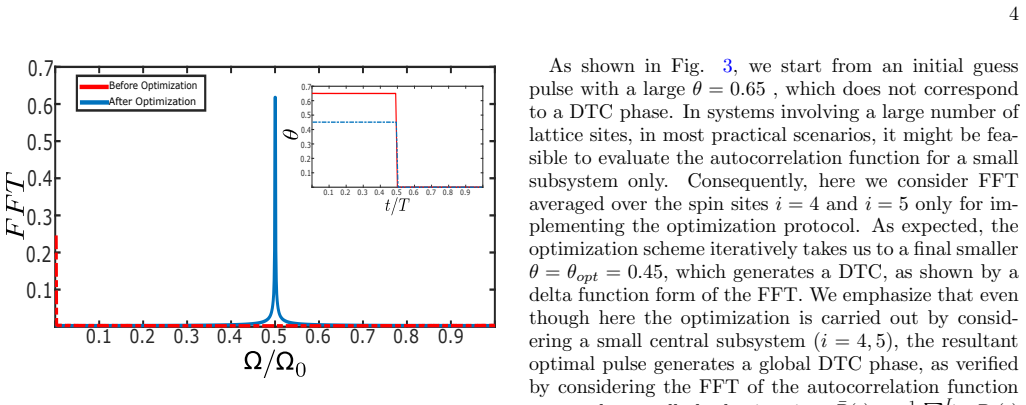
The central discovery is that spontaneous breaking of discrete time-translational symmetry can be engineered by numerically optimizing the Fourier coefficients of a periodic drive against a cost function that encodes the DTC signature: a $2T$-periodic response to a $T$-periodic drive, equivalently a single Fourier peak at half the driving frequency. In the open Dicke model, minimizing $F_1 = |j_x(sT) - j_x(sT+2T)| + 1/|j_x(sT) - j_x(sT+T)|$ takes an initial non-DTC guess pulse to an optimized pulse that produces period-doubled oscillation, robust to detuning variations (persisting for a range of $\epsilon$). In a many-body-localized spin chain, minimizing $F_2$, which pins the autocorrelation FFT peak at $\Omega_0/2$ with a threshold height and suppresses other peaks, yields a smaller optimized $\theta$ that produces a global DTC; optimizing over just two central sites (4 and 5) of an 8-site chain suffices for the whole chain. The paper presents this as a universal protocol for generating DTCs in arbitrary many-body quantum systems.
Load-bearing premise
The entire protocol rests on the assumption that the cost functions $F_1$ and $F_2$ correctly encode genuine DTC order, so that minimizing them on a single trajectory (Dicke model) or on two sites of one disorder realization (spin chain) yields a pulse whose period doubling is stable and system-wide; if the cost functions are merely fitting the target response, the central claim fails.
Editorial extensions
If this is right
- DTC generation no longer requires analytically designed on-off or sinusoidal pulse shapes; a generic numerical search over pulse coefficients suffices.
- The same optimization protocol produces DTCs in both an open dissipative system and a closed disordered system, supporting the claim of universality across many-body platforms.
- In the spin chain, optimizing the autocorrelation over only two central lattice sites yields a pulse that produces a DTC over the entire 8-site chain, suggesting the protocol is practical for larger systems where global measurements are infeasible.
- The optimized value of $\theta$ sets a characteristic scale such that the DTC phase persists for $|\theta| \lesssim |\theta_{\rm opt}|$, giving an efficient route to reconstruct dynamical phase diagrams.
- Constraint bounds on the Fourier coefficients allow the search to respect experimental limitations, so the pulses found are realistic to implement.
Reading between the lines
- The same cost-function logic could be applied to target other Floquet phases, such as period-$3T$ responses or fractional subharmonics, by changing the target frequency and threshold in the spectral cost function.
- Because $F_1$ requires only stroboscopic knowledge of a collective observable, the scheme could be run as a closed-loop experiment that finds a DTC drive without a Hamiltonian model, by feeding measured subharmonic amplitudes back into the optimizer.
- A single-trajectory cost in the open Dicke model may not detect multi-partite entanglement signatures of genuine time-crystalline order; a stricter test would optimize against a cost built from the quantum Fisher information or entanglement entropy.
- If DTC phases prove to be typical attractors of this optimization landscape rather than fine-tuned solutions, that would strengthen the universality claim and suggest many models host hidden DTC regimes.
Editorial analysis
A structured set of objections, weighed in public.
Referee Report
Summary. The paper proposes using Chopped RAndom Basis (CRAB) optimal control to generate discrete time crystals (DTCs) in generic many-body quantum systems. The method defines cost functions whose minimization yields periodic driving pulses that produce period-doubled stroboscopic dynamics. The authors demonstrate the protocol in two settings: an open Dicke model in the thermodynamic mean-field limit, with a cost function F1 (Eq. 6) that penalizes T-periodic j_x and rewards 2T-periodic j_x at a fixed late time sT; and a disordered spin chain of length L=8, with a cost function F2 (Eq. 9) that directly rewards an FFT peak at half the driving frequency and suppresses other spectral weight, evaluated using only sites 4 and 5 of one disorder realization. They report optimized pulses that yield period-doubled response, claim robustness to parameter changes (ε for the Dicke model, and a global DTC for the spin chain), and discuss experimental implementations in BEC-cavity and trapped-ion platforms. The central claim is that this constitutes a 'universal protocol for generating DTCs in arbitrary many-body quantum systems.'
Significance. If the universality and robustness claims were properly substantiated, the work would introduce a valuable inverse-design tool: instead of manually constructing DTC-generating pulses, one could optimize over a control landscape to discover non-trivial drives. The numerical demonstrations are plausible and the experimental discussion is reasonable. However, the current evidence does not establish that the optimized pulses produce a genuine DTC phase rather than a fine-tuned response. The cost functions explicitly encode the DTC signature, so the demonstrations are to some extent expected outcomes of fitting. The paper would be significantly strengthened by tests of persistence, rigidity, disorder averaging, and finite-size scaling. As it stands, the central 'universal protocol' claim is not supported by the presented numerics.
major comments (4)
- [Eq. (6) and Fig. 2] The cost function F1 in Eq. (6) is evaluated at three stroboscopic times only (sT, sT+T, sT+2T) and directly rewards 2T periodicity while penalizing T periodicity. This means the optimization is fitting the DTC signature by construction, not discovering it. To support the claim that the optimized pulse generates a robust DTC phase, the authors should demonstrate persistence of the period-doubled response over many periods (e.g., 10^4 or more), not just the short window shown in Fig. 2 (t from 4970 to 5000). They should also test stability under small perturbations of the optimized pulse coefficients and the Hamiltonian parameters, and show that the response is not fine-tuned to the specific initial steady state used in the optimization.
- [Eq. (9) and Fig. 3] The cost function F2 directly rewards an FFT peak at half the drive frequency, suppresses all other spectral peaks, and includes an ad hoc amplitude threshold (x = FFT(Ω0/2) − 0.05 in Eq. (9)). Optimizing such a cost can produce a pulse that yields the desired Fourier peak without necessarily producing a rigid, many-body DTC. The spin-chain demonstration uses a single disorder realization of L=8 and evaluates the cost only on sites 4 and 5. The claim that the optimized pulse yields a 'global DTC' is based on one full-chain FFT for that single realization. To establish a DTC phase, the authors need to average over many disorder realizations, perform finite-size scaling (L=8, 10, 12, ...), and verify that the optimized pulse parameters (e.g., θ_opt) are stable across realizations. Without this, the result could be a fine-tuned response for one particular sample.
- [Appendix A and Fig. 2] The robustness evidence for the Dicke model is too limited to justify the statement that the DTC phase 'persists for a finite range of ε' (page 3). The optimization is performed at ε=0.05, and the only additional DTC check is ε=0.06 in Appendix A. Fig. 2 shows a limit cycle at ε=0.04 and a thermal phase at ε=0.1, but this does not map out a finite DTC region. The authors should systematically scan ε (and ideally κ and the pulse amplitude bound χ) to identify the extent of the DTC phase, and also test sensitivity to the initial condition, since the cost function starts from a specific symmetry-broken steady state of Eq. (4).
- [Conceptual distinction in Introduction/Conclusion] A discrete time crystal is a phase of matter characterized by spontaneous breaking of time-translational symmetry, which implies rigidity of the subharmonic response against generic perturbations. Here, the drive is explicitly optimized to produce subharmonic response, so the protocol is closer to entrainment or direct subharmonic driving unless additional rigidity tests are provided. To support the claim of spontaneous symmetry breaking and a 'universal protocol', the authors should show that the optimized pulse produces period doubling from a variety of initial states (not only the symmetry-broken steady state or the specific product-state ensemble) and that the response survives weak local perturbations to the Hamiltonian or the drive. These tests are standard in the DTC literature (e.g., Ref. [8]) and would distinguish a true DTC from a fine-tuned response.
minor comments (5)
- [Eq. (8)] The definition of f(t) is incomplete in the manuscript; the sine term is cut off after 'A_n cos(ν_n t)+'. Please complete the expression.
- [Fig. 3 caption] The caption states the cost function is 'averaging over the lattice sites i=4,5 and all possible initial product states.' For L=8 this is 2^8=256 product states; please specify whether the FFT is computed for each state and then averaged, and over what time window the FFT is taken.
- [Page 4, spin-chain parameter text] The statement 'we start from an initial guess pulse with a large θ=0.65' is ambiguous because θ is time-dependent in Eq. (8). It would be clearer to specify the initial Fourier coefficients (e.g., A_0=0.65, other coefficients zero) and the corresponding optimized coefficients that yield θ_opt.
- [Eq. (9)] The penalty function Θ(x) is discontinuous at x=0, which may complicate the numerical optimization. Please comment on how CRAB handles this non-smoothness, or whether a smooth approximation was used.
- [Throughout] The phrase 'spontaneous breaking of time-translational symmetry' is used repeatedly, but the paper does not discuss the distinction between a symmetry-broken phase and a response that is explicitly imposed by the drive. A short discussion of this distinction, and how the optimized pulse relates to the Floquet eigenstate order, would help place the results in context.
Circularity Check
Cost functions F1 and F2 encode the DTC signature itself, so the optimized pulses reproduce the objective by construction; the universality claim rests on an unverified proxy.
-
self definitional
[DTC in the modulated open Dicke model, Eq. (6) and surrounding text]
"F1({An, Bn}) = |j_x(sT) - j_x(sT + 2T)| + 1/|j_x(sT) - j_x(sT + T)| ... In the above equation (6), the first term on the r.h.s. ensures that as a result of the optimization, j_x(t) becomes 2T periodic, whereas the second term on the r.h.s. denotes a penalty for pulses which result in T periodic j_x's."
The minimized function is exactly the stroboscopic DTC criterion for j_x: making the first term small is 2T periodicity, and the reciprocal penalty forbids T-periodic stroboscopic response. Thus the optimized pulse necessarily produces the reported period-doubled j_x (Figs. 1-2), because that is what the optimizer was asked to do. The only 'robustness' test is one additional detuning value (epsilon=0.06, Fig. 4); no term in F1 requires persistence over long times, stability under perturbation, or generic initial conditions. Calling this a robust DTC generated by optimal control is therefore restating the fitted objective rather than an independent prediction.
-
fitted input called prediction
[DTC in a many-body-localized spin chain system, Eq. (9)]
"F2({An, Bn}) = F2^(1) + F2^(2) + F2^(3), F2^(1) = |F_CMA - 0.5Ω0|, F2^(2) = Σ_{ω≠0.5Ω0} |FFT(ω)|, F2^(3) = Θ(x)/|x|; x = FFT(Ω0/2) - 0.05 ... The first ... and second ... ensure that the peak occurs at half of the driving frequency and no other peaks exist at any other frequencies, respectively, whereas, the third part ... defines a lower threshold value (=0.05) for the FFT peak at Ω=Ω0/2, for the phase to be considered as a DTC."
The optimization variable θ(t) is fitted by minimizing F2, whose components directly reward an FFT maximum at Ω0/2, penalize every other frequency component, and impose the 0.05 threshold. Consequently, the post-optimization FFT shown in Fig. 3 is the objective function value, not an independent measurement of DTC order. Moreover, F2 is evaluated only on sites 4 and 5 of one L=8 disorder realization (no disorder averaging or finite-size scaling is reported); the subsequent 'global DTC' check is the FFT of the same realization. Thus the protocol's universality claim is supported by a fit to the target signature, not by a prediction that could have failed independently.
full rationale
The central reduction is by construction: the cost functions are not independent probes of a DTC phase but direct encodings of the reported signatures. F1 minimizes the stroboscopic 2T-periodicity condition plus a penalty for T-periodicity, so the optimized Dicke pulse is guaranteed to show period-doubled j_x at the sampled times. F2 rewards an FFT peak at half the drive frequency, suppresses all other peaks, and enforces a threshold, so the optimized spin-chain pulse is likewise guaranteed to produce that FFT peak at the sites used for optimization. The additional checks—one neighboring detuning value in the Dicke model and a global-site FFT on the same single disorder realization in the spin chain—do not supply the missing rigidity, persistence, or disorder-averaged evidence that would turn a fitted pulse into a robust DTC phase. There is no load-bearing self-citation chain here; the paper's own equations exhibit the circularity. However, the optimizer genuinely searches a constrained pulse space and could have failed to satisfy the constraints, so the numerical demonstrations retain some nontrivial content. The score is therefore 7 rather than 8: the advertised universal protocol reduces substantially to the chosen cost functions, though not every step is purely tautological.
Assumptions & free parameters
free parameters (4)
- Control pulse Fourier coefficients {A_0, A_n, B_n} for open Dicke model =
not reported
- Control pulse Fourier coefficients for spin chain =
theta_opt = 0.45 (reported)
- FFT peak threshold in cost function F2^(3) =
0.05
- Penalty magnitude Theta(x) =
10^4 for x <= 0, 1 for x > 0
assumptions (4)
- domain assumption Mean-field approximation in the thermodynamic limit N -> infinity accurately describes the open Dicke model dynamics used to evaluate the cost function in Eq. (6).
- domain assumption Lindblad master equation with Markovian photon loss (Eq. (3)) captures the dissipative dynamics.
- ad hoc to paper The truncated Fourier basis in Eq. (1) with finite N_c is sufficient to represent an experimentally realizable, DTC-generating control pulse.
- ad hoc to paper For the spin chain, a single disorder realization and a cost function evaluated only on sites 4 and 5 are representative enough to yield a global DTC phase for L=8.
Cite this review
Pith. "Pith review of Generating discrete time crystals through optimal control." pith.science (2026). https://pith.science/paper/EKS7L4CL
@misc{pith2026250523021,
  author       = {Pith},
  title        = {Pith review of: Generating discrete time crystals through optimal control},
  year         = {2026},
  howpublished = {\url{https://pith.science/paper/EKS7L4CL}},
  note         = {Machine review of arXiv:2505.23021}
}
read the original abstract
In this work we use optimal control to generate Discrete Time Crystals (DTC) in generic many-body quantum systems. We define appropriate cost functions, which, when optimized, result in the formation of DTCs. This hitherto unexplored method represents DTCs as an optimization problem, and allows us to find non-trivial realistic periodic control pulses and parameter regimes which result in spontaneous breaking of time-translational symmetry in quantum systems. We exemplify our approach using many-body quantum systems in the presence, as well as absence of dissipation. We also discuss possible experimental realization of the control protocol for generating DTCs.
Figures


Figures from the paper (1 more)

Reference graph
Works this paper leans on
-
[8]
In such systems time translation symmetry can be spontaneously broken when the system is in a non- equilibrium state such as many body localization. The spins can be encoded in the 6 2S1/2 |F= 0, mF = 0>and |F= 1, m F = 0>hyperfine clock states of an electro- statically trapped and laser cooled 171Yb+ ions [21]. The many body localization hamiltonian can ...
work page 2021
-
[1]
Time crystals: a review.Reports on Progress in Physics, 81(1):016401, nov 2017
Krzysztof Sacha and Jakub Zakrzewski. Time crystals: a review.Reports on Progress in Physics, 81(1):016401, nov 2017. 6
work page 2017
-
[2]
Else, Christopher Monroe, Chetan Nayak, and Norman Y
Dominic V. Else, Christopher Monroe, Chetan Nayak, and Norman Y. Yao. Discrete time crystals.Annual Review of Condensed Matter Physics, 11(Volume 11, 2020):467–499, 2020
2020
-
[3]
Krzysztof Sacha.Springer Series on Atomic, Optical, and Plasma Physics, 2020
work page 2020
-
[4]
Zaletel, Mikhail Lukin, Christopher Monroe, Chetan Nayak, Frank Wilczek, and Norman Y
Michael P. Zaletel, Mikhail Lukin, Christopher Monroe, Chetan Nayak, Frank Wilczek, and Norman Y. Yao. Col- loquium: Quantum and classical discrete time crystals. Rev. Mod. Phys., 95:031001, Jul 2023
2023
-
[5]
Else, Bela Bauer, and Chetan Nayak
Dominic V. Else, Bela Bauer, and Chetan Nayak. Flo- quet time crystals.Phys. Rev. Lett., 117:090402, Aug 2016
work page 2016
-
[6]
Iemini, A
F. Iemini, A. Russomanno, J. Keeling, M. Schir` o, M. Dal- monte, and R. Fazio. Boundary time crystals.Phys. Rev. Lett., 121:035301, Jul 2018
2018
-
[7]
Federico Carollo, Igor Lesanovsky, Mauro Antezza, and Gabriele De Chiara. Quantum thermodynamics of boundary time-crystals.Quantum Science and Technol- ogy, 9(3):035024, may 2024
work page 2024
Show all 47 references
-
[9]
N. Y. Yao, A. C. Potter, I.-D. Potirniche, and A. Vish- wanath. Discrete time crystals: Rigidity, criticality, and realizations.Phys. Rev. Lett., 118:030401, Jan 2017
2017
-
[10]
Yao and Chetan Nayak
Norman Y. Yao and Chetan Nayak. Time crystals in periodically driven systems.Physics Today, 71(9):40–47, 09 2018
2018
-
[11]
Kshetrimayum, J
A. Kshetrimayum, J. Eisert, and D. M. Kennes. Stark time crystals: Symmetry breaking in space and time. Phys. Rev. B, 102:195116, Nov 2020
2020
-
[12]
Discrete time crystal enabled by stark many-body localization.Phys
Shuo Liu, Shi-Xin Zhang, Chang-Yu Hsieh, Shengyu Zhang, and Hong Yao. Discrete time crystal enabled by stark many-body localization.Phys. Rev. Lett., 130:120403, Mar 2023
2023
-
[13]
Vincent Liu
Biao Huang, Ying-Hai Wu, and W. Vincent Liu. Clean floquet time crystals: Models and realizations in cold atoms.Phys. Rev. Lett., 120:110603, Mar 2018
2018
-
[14]
Discrete time crystals in unbounded potentials.Phys
Yevgeny Bar Lev and Achilleas Lazarides. Discrete time crystals in unbounded potentials.Phys. Rev. Lett., 133:200401, Nov 2024
2024
-
[15]
Floquet time crystal in the lipkin-meshkov-glick model.Phys
Angelo Russomanno, Fernando Iemini, Marcello Dal- monte, and Rosario Fazio. Floquet time crystal in the lipkin-meshkov-glick model.Phys. Rev. B, 95:214307, Jun 2017
2017
-
[16]
Lukin, and Dmitry A
Wen Wei Ho, Soonwon Choi, Mikhail D. Lukin, and Dmitry A. Abanin. Critical time crystals in dipolar sys- tems.Phys. Rev. Lett., 119:010602, Jul 2017
2017
-
[17]
Higher-order and fractional discrete time crys- tals in clean long-range interacting systems.Nature Com- munications, 12(1):2341, Apr 2021
Andrea Pizzi, Johannes Knolle, and Andreas Nun- nenkamp. Higher-order and fractional discrete time crys- tals in clean long-range interacting systems.Nature Com- munications, 12(1):2341, Apr 2021
2021
-
[18]
Discrete time-crystalline order in cavity and circuit qed systems.Phys
Zongping Gong, Ryusuke Hamazaki, and Masahito Ueda. Discrete time-crystalline order in cavity and circuit qed systems.Phys. Rev. Lett., 120:040404, Jan 2018
2018
-
[19]
Time crystallinity in dissipative floquet systems.Phys
Achilleas Lazarides, Sthitadhi Roy, Francesco Piazza, and Roderich Moessner. Time crystallinity in dissipative floquet systems.Phys. Rev. Res., 2:022002, Apr 2020
2020
-
[20]
Dis- crete time crystals in the presence of non-markovian dy- namics.Phys
Bandita Das, Noufal Jaseem, and Victor Mukherjee. Dis- crete time crystals in the presence of non-markovian dy- namics.Phys. Rev. A, 110:012208, Jul 2024
2024
-
[21]
Non-hermitian discrete time crystals.Phys
Rozhin Yousefjani, Angelo Carollo, Krzysztof Sacha, Saif Al-Kuwari, and Abolfazl Bayat. Non-hermitian discrete time crystals.Phys. Rev. B, 111:165117, Apr 2025
2025
-
[22]
Zhang, P
J. Zhang, P. W. Hess, A. Kyprianidis, P. Becker, A. Lee, J. Smith, G. Pagano, I.-D. Potirniche, A. C. Potter, A. Vishwanath, N. Y. Yao, and C. Monroe. Observation of a discrete time crystal.Nature, 543(7644):217–220, Mar 2017
2017
-
[24]
Matsko, Lute Maleki, and Krzysztof Sacha
Hossein Taheri, Andrey B. Matsko, Lute Maleki, and Krzysztof Sacha. All-optical dissipative discrete time crystals.Nature Communications, 13(1):848, Feb 2022
2022
-
[25]
Mondal, Rajan Singh, Aamir A
Arnab Sarkar, Anurag, Javed A. Mondal, Rajan Singh, Aamir A. Makki, Ateesh K. Rathi, Ryan J.T. Nicholl, Sagar Chakraborty, Kirill I. Bolotin, and Saikat Ghosh. Observation of tunable discrete time crystalline phases. arXiv, page 2302.13318, 2025
2025
-
[26]
Jara, Dennis F
Roy D. Jara, Dennis F. Salinel, and Jayson G. Cosme. Theory of parametric resonance for discrete time crystals in fully connected spin-cavity systems.Phys. Rev. A, 109:042212, Apr 2024
2024
-
[27]
J¨ ager, Jan Mathis Giesen, Imke Schneider, and Sebastian Eggert
Simon B. J¨ ager, Jan Mathis Giesen, Imke Schneider, and Sebastian Eggert. Dissipative dicke time crystals: An atom’s point of view.Phys. Rev. A, 110:L010202, Jul 2024
2024
-
[28]
Chopped random-basis quantum optimization
Tommaso Caneva, Tommaso Calarco, and Simone Mon- tangero. Chopped random-basis quantum optimization. Physical Review A - PHYS REV A, 84, 03 2011
2011
-
[29]
Optimal control technique for many-body quan- tum dynamics.Phys
Patrick Doria, Tommaso Calarco, and Simone Mon- tangero. Optimal control technique for many-body quan- tum dynamics.Phys. Rev. Lett., 106:190501, May 2011
2011
-
[30]
Caneva, M
T. Caneva, M. Murphy, T. Calarco, R. Fazio, S. Mon- tangero, V. Giovannetti, and G. E. Santoro. Optimal control at the quantum speed limit.Phys. Rev. Lett., 103:240501, Dec 2009
2009
-
[31]
Santoro, and Simone Montangero
Tommaso Caneva, Tommaso Calarco, Rosario Fazio, Giuseppe E. Santoro, and Simone Montangero. Speeding up critical system dynamics through optimized evolution. Phys. Rev. A, 84:012312, Jul 2011
2011
-
[32]
Precision bound and optimal con- trol in periodically modulated continuous quantum ther- mal machines.Phys
Arpan Das, Shishira Mahunta, Bijay Kumar Agarwalla, and Victor Mukherjee. Precision bound and optimal con- trol in periodically modulated continuous quantum ther- mal machines.Phys. Rev. E, 108:014137, Jul 2023
2023
-
[33]
Optimal control strategies for parameter estimation of quantum systems.SciPost Phys., 16:013, 2024
Quentin Ansel, Etienne Dionis, and Dominique Sugny. Optimal control strategies for parameter estimation of quantum systems.SciPost Phys., 16:013, 2024
2024
-
[34]
Lloyd and S
S. Lloyd and S. Montangero. Information theoretical analysis of quantum optimal control.Phys. Rev. Lett., 113:010502, Jul 2014
2014
-
[35]
Quantum speed limits: from heisenberg’s uncertainty principle to optimal quantum control.Journal of Physics A: Mathematical and Theoretical, 50(45):453001, oct 2017
Sebastian Deffner and Steve Campbell. Quantum speed limits: from heisenberg’s uncertainty principle to optimal quantum control.Journal of Physics A: Mathematical and Theoretical, 50(45):453001, oct 2017
2017
-
[36]
Borselli, M
F. Borselli, M. Maiw¨ oger, T. Zhang, P. Haslinger, V. Mukherjee, A. Negretti, S. Montangero, T. Calarco, I. Mazets, M. Bonneau, and J. Schmiedmayer. Two- particle interference with double twin-atom beams.Phys. Rev. Lett., 126:083603, Feb 2021
2021
-
[37]
van Frank, M
S. van Frank, M. Bonneau, J. Schmiedmayer, S. Hild, C. Gross, M. Cheneau, I. Bloch, T. Pichler, A. Ne- gretti, T. Calarco, and S. Montangero. Optimal control of complex atomic quantum systems.Scientific Reports, 6(1):34187, Oct 2016
2016
-
[38]
One decade of quantum optimal control in the chopped random basis
Matthias M M¨ uller, Ressa S Said, Fedor Jelezko, Tom- maso Calarco, and Simone Montangero. One decade of quantum optimal control in the chopped random basis. 7 Reports on Progress in Physics, 85(7):076001, jun 2022
2022
-
[39]
Inouye, A
S. Inouye, A. P. Chikkatur, D. M. Stamper-Kurn, J. Stenger, D. E. Pritchard, and W. Ketterle. Superradi- ant rayleigh scattering from a bose-einstein condensate. Science, 285(5427):571–574, 1999
1999
-
[40]
Dicke quantum phase tran- sition with a superfluid gas in an optical cavity.Nature, 464:1301, 2010
Kristian Baumann, Christine Guerlin, Ferdinand Bren- necke, and Tilman Esslinger. Dicke quantum phase tran- sition with a superfluid gas in an optical cavity.Nature, 464:1301, 2010
2010
-
[41]
Cosme, and Andreas Hemmerich
Hans Keßler, Phatthamon Kongkhambut, Christoph Georges, Ludwig Mathey, Jayson G. Cosme, and Andreas Hemmerich. Observation of a dissipative time crystal. Phys. Rev. Lett., 127:043602, Jul 2021
2021
-
[42]
Dynamical phase transition in the open dicke model.Proceedings of the National Academy of Sciences, 112(11):3290–3295, 2015
Jens Klinder, Hans Kessler, Matthias Wolke, Ludwig Mathey, and Andreas Hemmerich. Dynamical phase transition in the open dicke model.Proceedings of the National Academy of Sciences, 112(11):3290–3295, 2015
2015
-
[43]
A. C. Lee, J. Smith, P. Richerme, B. Neyenhuis, P. W. Hess, J. Zhang, and C. Monroe. Engineering large stark shifts for control of individual clock state qubits.Phys. Rev. A, 94:042308, Oct 2016
2016
-
[44]
Smith, A
J. Smith, A. Lee, P. Richerme, B. Neyenhuis, P. W. Hess, P. Hauke, M. Heyl, D. A. Huse, and C. Mon- roe. Many-body localization in a quantum simulator with programmable random disorder.Nature Physics, 12(10):907–911, Oct 2016
2016
-
[45]
Realization of a dis- crete time crystal on 57 qubits of a quantum computer
Philipp Frey and Stephan Rachel. Realization of a dis- crete time crystal on 57 qubits of a quantum computer. Science Advances, 8(9):eabm7652, 2022
2022
-
[46]
S. Rosi, A. Bernard, N. Fabbri, L. Fallani, C. Fort, M. In- guscio, T. Calarco, and S. Montangero. Fast closed-loop optimal control of ultracold atoms in an optical lattice. Phys. Rev. A, 88:021601, Aug 2013
2013
-
[47]
Cataliotti, and Filippo Caruso
Ivana Mastroserio, Stefano Gherardini, Cosimo Lovecchio, Tommaso Calarco, Simone Montangero, Francesco S. Cataliotti, and Filippo Caruso. Experi- mental realization of optimal time-reversal on an atom chip for quantum undo operations.Advanced Quantum Technologies, 5(12):2200057, 2022
2022
-
[48]
Lovecchio, F
C. Lovecchio, F. Sch¨ afer, S. Cherukattil, M. Al ` ı Khan, I. Herrera, F. S. Cataliotti, T. Calarco, S. Montangero, and F. Caruso. Optimal preparation of quantum states on an atom-chip device.Phys. Rev. A, 93:010304, Jan 2016
2016
Reviewed August 7, 2026 · model on record in the stance chip above.
Discussion (0). Sign in to comment.