REVIEW 3 major objections 6 minor 30 references
Multi-Sourced Compositional Generalization in Visual Question Answering
T0 review · 3 major / 6 minor · reviewed 2026-08-07 · deepseek-v4-flash
Pith's one-line read VQA models fail on novel compositions whose parts come from different modalities; retrieval-augmented training that aligns cross-modal primitive representations improves this ability without sacrificing standard accuracy.
desk verdict A useful new benchmark and a plausible method, undercut by test-set hyperparameter selection and no error bars; the headline gain needs a cleaner evaluation. read the letter →
The pith
A machine-rendered reading of the paper's core claim, the machinery that carries it, and where it could break.
The reading
What carries the argument
The central mechanism is the retrieval-aggregation equation: for a primitive feature $p$, the aggregated feature is $p_a = p + \frac{w_q}{K_q}\sum_{i=1}^{K_q}\cos(p,p_i^{(q)}) + \frac{w_v}{K_v}\sum_{i=1}^{K_v}\cos(p,p_i^{(v)})$, where $p_i^{(q)}$ and $p_i^{(v)}$ are the top-$K$ retrieved features from the linguistic and visual primitive databases $\mathcal{D}_q$ and $\mathcal{D}_v$, and $w_q, w_v$ control each modality's contribution. The aggregated feature replaces the original primitive feature during training, so the feature extractor is continuously refined to produce context-invariant, modality-consistent primitive representations. The benchmark machinery pairs every primitive in a sample, labels a pair as novel if that pair never occurs in the training set, and classifies novel pairs into LL, VV, or LV depending on whether the two primitives come from language, vision, or one of each.
What would settle it
Hold out a random portion of GQA-MSCG as validation, select $w_q$ and $w_v$ using only that validation accuracy, then report accuracy on the remaining test samples; if the retrieval-augmented model no longer beats its baseline across all seven splits under this protocol, or if the gains become small or negative, the central claim is falsified.
Extended reading notes
Core claim
The paper's central claim is that VQA models can be made to generalize to novel compositions of primitives drawn from different modalities by aligning primitive representations at training time through retrieval. Concretely, for each word-level or object-level primitive in a training sample, the framework retrieves the top-K most cosine-similar primitive features from a linguistic primitive database and a visual primitive database, both built solely from the training set, and replaces the original feature with a weighted sum of itself and the two retrieval aggregates. Because each database stores the same primitive in many contexts, the aggregated feature pulls together representations of semantically equivalent primitives across modalities and contexts. On the constructed GQA-MSCG benchmark, the framework improves overall accuracy from 72.41 to 74.21 for the CFR baseline and from 68.49 to 71.53 for Qwen-VL across all seven test splits, and it slightly improves IID accuracy on GQA test-dev and VQA v2 val. The paper also claims that difficulty grows with the number of novel-composition types co-occurring in a sample (Level-1 to Level-3), and that existing models degrade accordingly.
Load-bearing premise
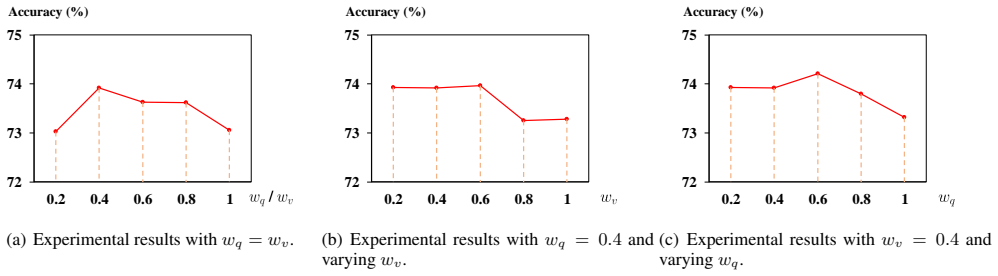
The reported gains depend on the mixture weights $w_q=0.6$ and $w_v=0.4$ used to combine retrieved linguistic and visual features, and those weights were chosen by inspecting GQA-MSCG test accuracy; if that choice carries hidden information about the test set, the improvement would not transfer to new data.
Editorial extensions
If this is right
- Across the seven GQA-MSCG splits, the framework raises accuracy for both tested baselines on every split, with Level-1 gains from roughly +1.5 to +3.4 points and Level-3 gains from roughly +1.4 to +3.6 points.
- Because the method adds no auxiliary loss and builds its databases from the training split, it can be inserted into existing VQA models without changing the training objective or introducing external data.
- The framework preserves or slightly improves IID generalization, with CFR gaining +1.43 points and Qwen-VL gaining +1.13 points on GQA test-dev, so the compositional improvement is not bought by sacrificing ordinary accuracy.
- Linguistic-only and visual-only retrieval each help most on their own modality's novel compositions, while joint retrieval gives the best overall accuracy, indicating the two databases are complementary.
- Existing VQA models show inconsistent abilities across LL, VV, and LV splits, so a model that is strong on one type of novel composition is not necessarily strong on another; the framework pushes all three in the same direction.
Reading between the lines
- The retrieval-aggregation step acts as a form of train-time feature smoothing; if the reported gains replicate, it suggests that representation alignment across modalities, rather than model capacity, is a primary bottleneck for multi-sourced compositional generalization in VQA.
- Because novelty is defined as an unseen pair of recorded primitives, the benchmark does not control for synonyms or paraphrases; a harder variant that swaps synonyms for seen words would test whether the framework aligns semantics or merely surface forms.
- The visual primitive database relies on GQA's scene-graph annotations, so an extension worth testing is whether the same retrieval scheme works with detector-free or caption-derived visual primitives, which would determine if the gains survive without oracle object labels.
Editorial analysis
A structured set of objections, weighed in public.
Referee Report
Summary. The paper introduces the task of multi-sourced compositional generalization (MSCG) for VQA, constructs a new benchmark GQA-MSCG with seven test splits corresponding to different combinations of novel composition types (LL, VV, LV and their co-occurrences), and proposes a retrieval-augmented training framework (RAG) that aggregates each primitive feature with retrieved features of semantically equivalent primitives from linguistic and visual databases built from the training set. Experiments on CFR and Qwen-VL report accuracy gains on GQA-MSCG as well as on IID splits of GQA and VQA v2.
Significance. If the empirical claims were validated, the paper would make a useful contribution: the GQA-MSCG benchmark is well-motivated and carefully constructed (primitives are required to be seen while compositions are novel, and the multi-level splits are a nice design), and the framework is simple, model-agnostic, and does not add training losses. The release of the dataset is a concrete positive. However, the core empirical claim is currently compromised by the evaluation protocol: hyperparameters are selected on the test set, and no uncertainty estimates are provided. The significance of the contribution therefore depends on a corrected evaluation.
major comments (3)
- [Section 5.5 and Section 5.1 (Implementation Details)] The aggregation weights w_q=0.6 and w_v=0.4 are selected by maximizing accuracy on the GQA-MSCG dataset itself, as shown in Figure 5, and the final results in Table 1 are reported on the same set. This constitutes test-set model selection, so the reported improvements (e.g., +1.8 points for CFR+RAG on Overall) are optimistically biased. Please select hyperparameters on a held-out validation split of GQA-MSCG (or via cross-validation) and report final results on a separate test split, or explicitly justify why this selection does not bias the conclusion.
- [Tables 1–3] No standard deviations, confidence intervals, or multiple-seed runs are reported. Given that Figure 5 shows accuracy fluctuations of roughly 1–2 points across neighboring hyperparameter values, the reported gains of about 1–2 points cannot be distinguished from selection noise. Please report mean and standard deviation over at least three independent runs with different seeds for all main tables.
- [Section 3.3, Eq. (1)] The aggregation formula is dimensionally inconsistent: p_a is a feature vector, while the terms (1/K_q)Σ cos(p, p_q^(i)) and (1/K_v)Σ cos(p, p_v^(i)) are scalars. As written, the equation adds scalars to a vector, which is not a valid operation. The intended aggregation (e.g., a weighted sum of feature vectors with cosine-similarity weights, or a gated combination) must be specified precisely, because this operation is the core of the framework.
minor comments (6)
- [Figures 3 and 4] The figures use the labels 'QQ' and 'QV' for what the text calls 'LL' and 'LV' (e.g., Figure 3(a) 'QQ split' vs. Section 4 'LL'). Please unify the notation.
- [Section 5.3] The citations for LLaVA-1.5 and LLaVA-1.6 are swapped relative to the reference list; LLaVA-1.5 is [Liu et al., 2023] and LLaVA-1.6 is [Liu et al., 2024a].
- [Section 5.5] There are two occurrences of the typo 'CFG+RAG' that should read 'CFR+RAG'.
- [Abstract and Section 4] The term 'multi-sourced' is used to describe all three novel composition types, but LL and VV compositions are composed of primitives from a single modality; consider clarifying that the framework addresses compositions whose primitives can originate from either modality, not that each composition must be cross-modal.
- [Section 3.3] It is not specified how visual primitives are localized in the image when the visual encoder produces patch-level features (as in Qwen-VL); please clarify the procedure used for matching a primitive to its corresponding feature.
- [Section 4] The dataset construction samples 5,000 samples per category, yielding 35,000 test samples; it would be helpful to report the number of candidate samples in D_c before sampling to inform the reader of the sampling ratio.
Circularity Check
GQA-MSCG headline gain is partially a fitted result: aggregation weights w_q/w_v are selected on the target test set (Fig. 5) and then used to report the final Table 1 accuracies on that same test set.
-
fitted input called prediction
[Section 5.5 Parameter Analysis; Implementation Details; Eq. (1); Table 1]
"CFR+RAG performs best with setting w_q = 0.6 and w_v = 0.4 simultaneously. Based on the above experimental results, we set w_q to 0.6 and w_v to 0.4 for all experiments."
The aggregation weights w_q and w_v are hyperparameters in Eq. (1) that control how much retrieved linguistic and visual primitive features contribute to training. Section 5.5 chooses these weights by sweeping them on the GQA-MSCG dataset (Figure 5) and taking the configuration that maximizes accuracy on that dataset. The final results in Table 1, which are used to claim that the framework 'significantly improves' multi-sourced compositional generalization, are then reported on the very same GQA-MSCG test splits. This is not an unbiased evaluation: the reported MSCG accuracy is partly an output of test-set model selection.
full rationale
The paper's core retrieval-augmented training idea is not circular in the sense of being defined in terms of its own output, and there is no load-bearing self-citation chain or imported uniqueness theorem. However, the primary empirical claim about MSCG generalization is weakened by a fitted-input problem: the hyperparameters w_q and w_v are explicitly tuned on the GQA-MSCG test set (Figure 5) and then the same test set is used to produce the headline numbers in Table 1. Because the paper reports no error bars or held-out validation for these weights, the reported improvements are partly a consequence of test-set selection rather than a genuine prediction of generalization. The IID results on GQA test-dev and VQA v2 val provide some independent evidence that the framework does not hurt IID performance, which keeps the paper from collapsing entirely into circularity. But the main contribution as evaluated on GQA-MSCG does not support the strong 'significantly improves' claim without a proper validation protocol, so a moderate circularity score is warranted.
Assumptions & free parameters
free parameters (6)
- w_q =
0.6
- w_v =
0.4
- T_q =
8 (1 for VQA v2)
- T_v =
32
- K_q =
4
- K_v =
16 (4 for VQA v2)
assumptions (5)
- domain assumption GQA scene graph annotations accurately identify object categories and attributes for visual primitives.
- domain assumption NLTK lemmatization and part-of-speech tagging reliably extract linguistic primitives from questions.
- domain assumption Cosine similarity between feature vectors is a valid measure of semantic similarity between primitives.
- domain assumption The retrieval databases built from the GQA train split do not leak test-set information.
- domain assumption The reimplemented baseline models (CFR, Qwen-VL) match the official code behavior.
Cite this review
Pith. "Pith review of Multi-Sourced Compositional Generalization in Visual Question Answering." pith.science (2026). https://pith.science/paper/7IHO7F3G
@misc{pith2026250523045,
  author       = {Pith},
  title        = {Pith review of: Multi-Sourced Compositional Generalization in Visual Question Answering},
  year         = {2026},
  howpublished = {\url{https://pith.science/paper/7IHO7F3G}},
  note         = {Machine review of arXiv:2505.23045}
}
read the original abstract
Compositional generalization is the ability of generalizing novel compositions from seen primitives, and has received much attention in vision-and-language (V\&L) recently. Due to the multi-modal nature of V\&L tasks, the primitives composing compositions source from different modalities, resulting in multi-sourced novel compositions. However, the generalization ability over multi-sourced novel compositions, \textit{i.e.}, multi-sourced compositional generalization (MSCG) remains unexplored. In this paper, we explore MSCG in the context of visual question answering (VQA), and propose a retrieval-augmented training framework to enhance the MSCG ability of VQA models by learning unified representations for primitives from different modalities. Specifically, semantically equivalent primitives are retrieved for each primitive in the training samples, and the retrieved features are aggregated with the original primitive to refine the model. This process helps the model learn consistent representations for the same semantic primitives across different modalities. To evaluate the MSCG ability of VQA models, we construct a new GQA-MSCG dataset based on the GQA dataset, in which samples include three types of novel compositions composed of primitives from different modalities. Experimental results demonstrate the effectiveness of the proposed framework. We release GQA-MSCG at https://github.com/NeverMoreLCH/MSCG.
Figures


Figures from the paper (3 more)


Reference graph
Works this paper leans on
-
[1]
Robust visual rea- soning via language guided neural module networks
[Akulaet al., 2021 ] Arjun Akula, Varun Jampani, Soravit Changpinyo, and Song-Chun Zhu. Robust visual rea- soning via language guided neural module networks. InAdvances in Neural Information Processing Systems (NeurIPS), pages 11041–11053,
work page 2021
-
[5]
[Baiet al., 2023 ] Jinze Bai, Shuai Bai, Shusheng Yang, Shi- jie Wang, Sinan Tan, Peng Wang, Junyang Lin, Chang Zhou, and Jingren Zhou. Qwen-vl: A frontier large vision- language model with versatile abilities.arXiv preprint arXiv:2308.12966,
arXiv 2023
-
[9]
The paradox of the compositionality of natural language: A neural machine translation case study
[Dankerset al., 2022 ] Verna Dankers, Elia Bruni, and Dieuwke Hupkes. The paradox of the compositionality of natural language: A neural machine translation case study. InProceedings of the Annual Meeting of the Association for Computational Linguistics (ACL), pages 4154–4175,
work page 2022
-
[13]
Compositional attention networks for machine reasoning
[Hudson and Manning, 2018] Drew A Hudson and Christo- pher D Manning. Compositional attention networks for machine reasoning. InProceedings of the International Conference on Learning Representations (ICLR),
work page 2018
-
[14]
Gqa: A new dataset for real-world vi- sual reasoning and compositional question answering
[Hudson and Manning, 2019] Drew A Hudson and Christo- pher D Manning. Gqa: A new dataset for real-world vi- sual reasoning and compositional question answering. In Proceedings of IEEE/CVF Conference on Computer Vi- sion and Pattern Recognition (CVPR), pages 6700–6709,
work page 2019
-
[15]
Overcoming language pri- ors in vqa via decomposed linguistic representations
[Jinget al., 2020 ] Chenchen Jing, Yuwei Wu, Xiaoxun Zhang, Yunde Jia, and Qi Wu. Overcoming language pri- ors in vqa via decomposed linguistic representations. In Proceedings of the AAAI Conference on Artificial Intelli- gence (AAAI), volume 34, pages 11181–11188,
work page 2020
-
[17]
On compositional generalization of neural ma- chine translation
[Liet al., 2021 ] Yafu Li, Yongjing Yin, Yulong Chen, and Yue Zhang. On compositional generalization of neural ma- chine translation. InProceedings of the Annual Meeting of the Association for Computational Linguistics (ACL), pages 4767–4780,
work page 2021
-
[18]
Compositional temporal ground- ing with structured variational cross-graph correspondence learning
[Liet al., 2022 ] Juncheng Li, Junlin Xie, Long Qian, Lin- chao Zhu, Siliang Tang, Fei Wu, Yi Yang, Yueting Zhuang, and Xin Eric Wang. Compositional temporal ground- ing with structured variational cross-graph correspondence learning. InProceedings of IEEE/CVF Conference on Computer Vision and Pattern Recognition (CVPR), pages 3032–3041,
work page 2022
Show all 30 references
-
[19]
Blip-2: Bootstrapping language-image pre- training with frozen image encoders and large language models.arXiv preprint arXiv:2301.12597,
[Liet al., 2023c ] Junnan Li, Dongxu Li, Silvio Savarese, and Steven Hoi. Blip-2: Bootstrapping language-image pre- training with frozen image encoders and large language models.arXiv preprint arXiv:2301.12597,
-
[20]
Improved baselines with visual instruction tuning,
[Liuet al., 2023 ] Haotian Liu, Chunyuan Li, Yuheng Li, and Yong Jae Lee. Improved baselines with visual instruction tuning,
2023
-
[21]
Overcoming language priors in visual question answering with cumulative learning strategy.Neurocom- puting, 608:128419,
[Maoet al., 2024 ] Aihua Mao, Feng Chen, Ziying Ma, and Ken Lin. Overcoming language priors in visual question answering with cumulative learning strategy.Neurocom- puting, 608:128419,
2024
-
[22]
Learning graph embeddings for compositional zero-shot learning
[Naeemet al., 2021 ] Muhammad Ferjad Naeem, Yongqin Xian, Federico Tombari, and Zeynep Akata. Learning graph embeddings for compositional zero-shot learning. InProceedings of IEEE/CVF Conference on Computer Vision and Pattern Recognition (CVPR), pages 953–962,
2021
-
[23]
Coarse- to-fine reasoning for visual question answering
[Nguyenet al., 2022 ] Binh X Nguyen, Tuong Do, Huy Tran, Erman Tjiputra, Quang D Tran, and Anh Nguyen. Coarse- to-fine reasoning for visual question answering. pages 4557–4565,
2022
-
[24]
Counter- factual vqa: A cause-effect look at language bias
[Niuet al., 2021 ] Yulei Niu, Kaihua Tang, Hanwang Zhang, Zhiwu Lu, Xian-Sheng Hua, and Ji-Rong Wen. Counter- factual vqa: A cause-effect look at language bias. InPro- ceedings of IEEE/CVF Conference on Computer Vision and Pattern Recognition (CVPR), pages 12700–12710,
2021
-
[25]
Combine to describe: Evaluating compositional generalization in image captioning
[Pantazopouloset al., 2022 ] George Pantazopoulos, Alessandro Suglia, and Arash Eshghi. Combine to describe: Evaluating compositional generalization in image captioning. InProceedings of the Association for Computational Linguistics: Student Research Workshop (ACLSRW), pages 115–131,
2022
-
[26]
Overcom- ing language priors for visual question answering based on knowledge distillation
[Peng and Wei, 2024] Daowan Peng and Wei Wei. Overcom- ing language priors for visual question answering based on knowledge distillation. InProceedings of the IEEE In- ternational Conference on Multimedia and Expo (ICME), pages 1–6. IEEE,
2024
-
[27]
Faster r-cnn: Towards real-time ob- ject detection with region proposal networks.IEEE Trans- actions on Pattern Analysis and Machine Intelligence (T- PAMI), 39(6):1137–1149,
[Renet al., 2016 ] Shaoqing Ren, Kaiming He, Ross Gir- shick, and Jian Sun. Faster r-cnn: Towards real-time ob- ject detection with region proposal networks.IEEE Trans- actions on Pattern Analysis and Machine Intelligence (T- PAMI), 39(6):1137–1149,
2016
-
[29]
Transformer module networks for systematic generaliza- tion in visual question answering.IEEE Transactions on Pattern Analysis and Machine Intelligence,
[Yamadaet al., 2024 ] Moyuru Yamada, Vanessa D’Amario, Kentaro Takemoto, Xavier Boix, and Tomotake Sasaki. Transformer module networks for systematic generaliza- tion in visual question answering.IEEE Transactions on Pattern Analysis and Machine Intelligence,
2024
-
[30]
Minigpt-4: Enhancing vision-language understanding with advanced large lan- guage models.arXiv preprint arXiv:2304.10592, 2023
[Zhuet al., 2023 ] Deyao Zhu, Jun Chen, Xiaoqian Shen, Xi- ang Li, and Mohamed Elhoseiny. Minigpt-4: Enhancing vision-language understanding with advanced large lan- guage models.arXiv preprint arXiv:2304.10592, 2023
2023 arXiv
-
[2009]
Composi- tional generalization for multi-label text classification: A data-augmentation approach
[Chaiet al., 2024 ] Yuyang Chai, Zhuang Li, Jiahui Liu, Lei Chen, Fei Li, Donghong Ji, and Chong Teng. Composi- tional generalization for multi-label text classification: A data-augmentation approach. InProceedings of the AAAI Conference on Artificial Intelligence (AAAI), volu...
2024
-
[2015]
Systematic generalization: what is required and can it be learned?arXiv preprint arXiv:1811.12889,
[Bahdanauet al., 2018 ] Dzmitry Bahdanau, Shikhar Murty, Michael Noukhovitch, Thien Huu Nguyen, Harm de Vries, and Aaron Courville. Systematic generalization: what is required and can it be learned?arXiv preprint arXiv:1811.12889,
2018 arXiv
-
[2016]
Plug-and- play vqa: Zero-shot vqa by conjoining large pretrained models with zero training
[Tionget al., 2022 ] Anthony Meng Huat Tiong, Junnan Li, Boyang Li, Silvio Savarese, and Steven CH Hoi. Plug-and- play vqa: Zero-shot vqa by conjoining large pretrained models with zero training. InFindings of the Association for Computational Linguistics: EMNLP 2022, pages 951– 967,
2022
-
[2017]
Language-conditioned graph networks for relational reasoning
[Huet al., 2019 ] Ronghang Hu, Anna Rohrbach, Trevor Darrell, and Kate Saenko. Language-conditioned graph networks for relational reasoning. InProceedings of the IEEE/CVF International Conference on Computer Vision (ICCV), pages 10294–10303,
2019
-
[2018]
Vqa: Visual question answering
[Antolet al., 2015 ] Stanislaw Antol, Aishwarya Agrawal, Ji- asen Lu, Margaret Mitchell, Dhruv Batra, C Lawrence Zit- nick, and Devi Parikh. Vqa: Visual question answering. InProceedings of the IEEE/CVF International Conference on Computer Vision (ICCV), pages 2425–2433,
2015
-
[2019]
LoRA: Low-rank adaptation of large language models
[Huet al., 2022 ] Edward J Hu, Yelong Shen, Phillip Wallis, Zeyuan Allen-Zhu, Yuanzhi Li, Shean Wang, Lu Wang, and Weizhu Chen. LoRA: Low-rank adaptation of large language models. InProceedings of the International Con- ference on Learning Representations (ICLR),
2022
-
[2020]
Retrieval-augmented primitive representa- tions for compositional zero-shot learning
[Jinget al., 2024 ] Chenchen Jing, Yukun Li, Hao Chen, and Chunhua Shen. Retrieval-augmented primitive representa- tions for compositional zero-shot learning. InProceedings of the AAAI Conference on Artificial Intelligence (AAAI), volume 38, pages 2652–2660,
2024
-
[2021]
Bottom-up and top-down attention for im- age captioning and visual question answering
[Andersonet al., 2018 ] Peter Anderson, Xiaodong He, Chris Buehler, Damien Teney, Mark Johnson, Stephen Gould, and Lei Zhang. Bottom-up and top-down attention for im- age captioning and visual question answering. InProceed- ings of IEEE/CVF Conference on Computer Vision and Pa...
2018
-
[2022]
Making the v in vqa matter: Elevating the role of image understanding in visual question answering
[Goyalet al., 2017 ] Yash Goyal, Tejas Khot, Douglas Summers-Stay, Dhruv Batra, and Devi Parikh. Making the v in vqa matter: Elevating the role of image understanding in visual question answering. InProceedings of IEEE/CVF Conference on Computer Vision and Pattern Recognition ...
2017
-
[2023]
” O’Reilly Media, Inc.”,
[Birdet al., 2009 ] Steven Bird, Ewan Klein, and Edward Loper.Natural language processing with Python: ana- lyzing text with the natural language toolkit. ” O’Reilly Media, Inc.”,
2009
-
[2024]
Meta module network for compositional visual reasoning
[Chenet al., 2021 ] Wenhu Chen, Zhe Gan, Linjie Li, Yu Cheng, William Wang, and Jingjing Liu. Meta module network for compositional visual reasoning. InProceed- ings of the IEEE/CVF Winter Conference on Applications of Computer Vision (WACV), pages 655–664,
2021
Reviewed August 7, 2026 · model on record in the stance chip above.
Discussion (0). Sign in to comment.