REVIEW 4 major objections 5 minor 1 cited by
Second Opinion Matters: Towards Adaptive Clinical AI via the Consensus of Expert Model Ensemble
T0 review · 4 major / 5 minor · reviewed 2026-08-07 · deepseek-v4-flash
Pith's one-line read A modular ensemble of specialist medical LLMs, combined through weighted probability pooling and a final consensus step, claims to outperform every single state-of-the-art model tested on medical benchmarks.
desk verdict A plausible ensemble framework for medical QA, but the headline accuracy gains are not yet established: they rest on 500-question subsets, undisclosed tunable weights, and a few inconsistent numbers. read the letter →
The pith
A machine-rendered reading of the paper's core claim, the machinery that carries it, and where it could break.
The reading
What carries the argument
The Consensus Mechanism: a triage LLM classifies the task and selects a set of specialist expert models; each expert returns an answer with a full probability distribution; a Weighted Log Opinion Pool (WLOP) combines the distributions as the weighted geometric mean in log-space, followed by cascade boosting that adds rank-frequency bonuses with geometrically decaying weights ($\theta_r = [1.0, 0.5, 0.25, \dots]$); a final consensus LLM then synthesizes the experts' rationales and reweighted distribution into the output. The design claim is that this pipeline distributes reasoning across domain perspectives and explicitly models uncertainty rather than relying on a single model's internal reasoning.
What would settle it
Re-run the full evaluation on the complete MedXpertQA, MedQA, MedMCQA, and DDX+ test splits (or across many random seeds) and compute confidence intervals for the accuracy differences; if the Consensus Mechanism's advantage over O3-high and Gemini 2.5 Pro disappears or falls within sampling error, the central claim fails. A second check is to measure whether the GPT-4.1 judge's equivalence decisions systematically favor the ensemble over single models.
Extended reading notes
Core claim
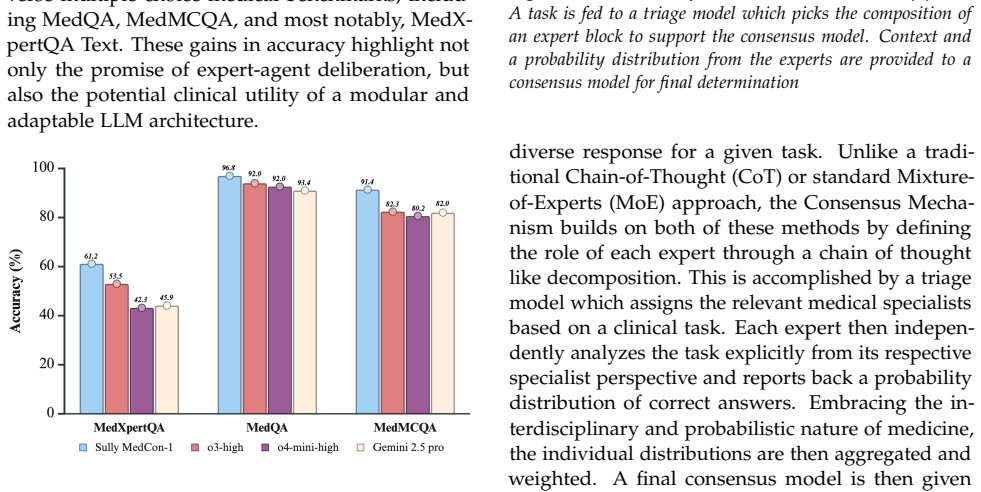
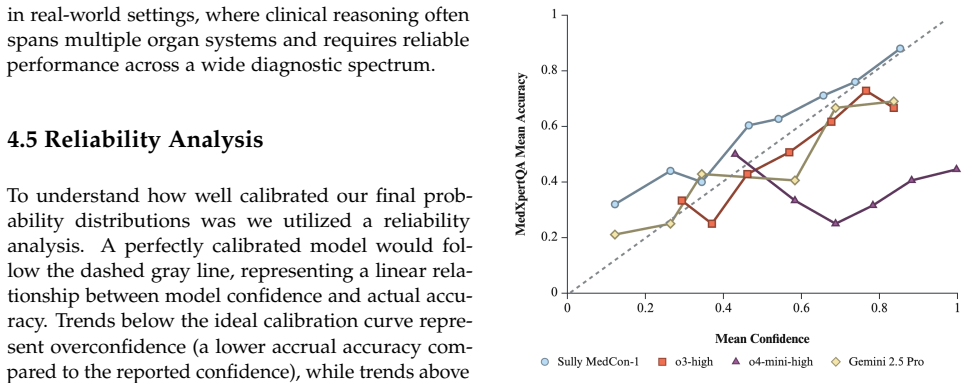
The central claim is that the Consensus Mechanism, which routes each clinical query through a triage agent to a panel of specialist LLMs and then combines their probability distributions via a weighted log opinion pool, cascade boosting, and a final consensus LLM, achieves higher accuracy than any single state-of-the-art model evaluated: 61.2% versus 53.0% for O3-high and 44.1% for Gemini 2.5 Pro on MedXpertQA; 96.8% versus 92.2% on MedQA; 94.2% versus 91.5% on MedMCQA; and superior F1 (0.326 versus 0.287) and top-1 accuracy (52.0% versus 45.2%) on DDX+. The paper further claims that this architecture improves probability calibration and reduces overconfidence relative to single models, and that its modularity allows substituting newer or cheaper models without redesign.
Load-bearing premise
The evaluation rests on a 500-question random sample (seed=5) of each test split being representative of the full benchmark, with no confidence intervals or significance tests reported; if the sample is not representative or the accuracy gaps are within sampling noise, the claimed superiority over single models collapses.
Editorial extensions
If this is right
- If the accuracy gaps replicate on full benchmarks, ensembles of publicly available models could reach or exceed closed-source top models in medical question answering.
- Better calibration and explicit probability distributions could make AI suggestions more safely actionable as clinical decision support.
- The modular design means newer or cheaper models can be swapped into the expert block without retraining, mitigating model obsolescence and vendor lock-in.
- The reported top-4 accuracy near 90% on MedXpertQA suggests that even when the top answer is wrong, the correct answer tends to lie within a small candidate set, which is useful for clinician review.
- The architecture's advantages come with added cost and latency from querying multiple experts, so deployment would balance those factors against accuracy gains.
Reading between the lines
- The 500-question seed-5 samples and the GPT-4.1 judge used for DDX+ equivalence mean the headline gaps could shrink on full-test evaluation; an obvious test is running the same pipeline on complete test splits or across several seeds.
- Because the method's gains come from aggregation, it should degrade gracefully rather than catastrophically as individual models are swapped, which is testable by ablating the consensus layer and by replacing experts with weaker open-weight models.
- The same architecture could transfer to other high-stakes multi-option tasks beyond medicine, such as legal or technical diagnosis, where multiple perspectives and calibrated confidence are valued.
- Cost and latency optimization is claimed but not measured; an explicit Pareto analysis of accuracy versus cost would determine deployment feasibility.
Editorial analysis
A structured set of objections, weighed in public.
Referee Report
Summary. The paper proposes MedCon-1, a 'Consensus Mechanism' that routes a medical query through a triage model to a panel of specialty-specific LLM experts, aggregates their probability distributions via a weighted log opinion pool with cascade boosting, and then asks a final consensus LLM to produce the answer. The authors claim that this ensemble outperforms state-of-the-art single models on MedXpertQA, MedQA, MedMCQA, and DDX+, while also improving calibration. The central evidence is based on 500-question subsets (seed=5) of each benchmark, with tunable aggregation parameters that are not reported.
Significance. If the headline accuracy gains are reproducible, the paper would make a useful contribution to clinically oriented LLM systems: the modular design is clearly described, the use of full probability distributions from each expert is a sensible way to capture uncertainty, and the worked example in Appendix D.0 illustrates the intended behavior. The paper also deserves credit for disclosing the fixed-seed subsetting protocol and the judge-based DDX+ evaluation. However, the current evidence does not establish the claimed superiority over SoTA models because the evaluation rests on single small subsets without significance testing, the tuned parameters are undisclosed, and there are unresolved numerical inconsistencies. The significance of the result therefore remains conditional on a stronger evaluation protocol.
major comments (4)
- [§3.3, Appendix A.0, Tables 1–2] All headline accuracy comparisons are computed on a single random 500-question subset (seed=5) of each test split. No confidence intervals, significance tests, or additional seeds are reported. For binary accuracy with n=500, the standard error is roughly 2 percentage points, and some reported gaps, e.g., MedMCQA 94.2% vs. 91.5%, are not significant at the 5% level under a simple two-proportion comparison. The paper's Limitations section does not acknowledge this as a residual risk. I recommend either evaluating on the full test splits or reporting multi-seed bootstrap intervals with a pre-specified number of seeds.
- [§2.3–2.4, §3.1] The configuration is described as 'optimized for accuracy,' but the values of the adjustable expert weights w_i and the boost scaler λboost are not reported, and no validation split or search procedure is described. If these parameters were chosen using the same 500-question subsets that produce the headline numbers, the reported gains may be inflated by selection. Please disclose the final parameter values and separate model selection from testing, e.g., by using a development set or nested cross-validation.
- [Tables 1 and 7; §4.1] There are unresolved numerical inconsistencies across tables. MedQA accuracy for O3-high is 92.2% in Table 1 but 94.0% in Table 7, and Gemini 2.5 Pro is 93.4% in Table 1 but 91.0% in Table 7. MedXpertQA consensus accuracy is 61.0% in the abstract, 61.2% in Section 4.1, and 61.17% in Appendix C.0. These discrepancies need to be reconciled; as written, a reader cannot determine which numbers are the definitive reported results.
- [§3.4, Appendix B.2] The DDX+ evaluation depends on a GPT-4.1 judge to equate model diagnoses with ground truth. While the judge prompt is specified and all models are judged by the same procedure, there is no human validation of judge decisions or analysis of whether judge leniency interacts with model output style. Because the DDX+ F1 and top-1 claims appear in the abstract, the reliability of the judge should be quantified, e.g., by a human-annotated sample or a sensitivity analysis.
minor comments (5)
- [Abstract] The abstract contains a typo: "expert'" should be "experts."
- [§2.3] The weighted log opinion pool formula uses log pi(X); if any expert assigns zero probability to an outcome, the expression is undefined. Please state how zero probabilities are handled.
- [§4.2] The section is titled 'Top-K Performance in MedXpert' but the benchmark is MedXpertQA; please use consistent naming throughout.
- [§4.5] The calibration claim would be stronger with a quantitative metric such as expected calibration error (ECE) or a reliability diagram with confidence intervals; Figure 8 alone is not sufficient to support the claim of improved calibration.
- [Throughout] Model names are inconsistent: 'O3-high' and 'o3-high' are used interchangeably, and 'DDx' appears alongside 'DDX+'. Please standardize these terms.
Circularity Check
No circularity demonstrated: the headline improvements are evaluated against external benchmarks rather than derived from the model's own definitions or from self-cited results.
full rationale
The paper's central claim is empirical: a weighted ensemble of expert LLMs plus a final consensus model outperforms single models on MedXpertQA, MedQA, MedMCQA, and DDX+. These benchmarks are external, fixed datasets, not quantities defined by the model, so the reported accuracies are not equivalent to the paper's own equations or inputs by construction. The WLOP aggregation in Section 2.3 and cascade boosting in Section 2.4 are arithmetic operations on expert probability outputs and do not smuggle in the benchmark outcomes. No load-bearing argument is justified by a self-citation: the reference list contains no prior work by the present authors, and the system is not defended by a 'uniqueness theorem.' The main evidentiary weakness is not circularity. Section 3.1 states the configuration was 'explicitly optimized for accuracy,' while Sections 2.3 and 2.4 define adjustable weights w_i and tunable lambda_boost whose chosen values and validation procedure are not reported, and Appendix A.0 restricts evaluation to a single 500-question subset per benchmark with seed 5. If the tunables had been optimized on those same subsets, the gains would be fitted rather than predicted; but the paper does not state that, and the evaluation otherwise derives from external benchmark data. That is an overfitting/selection-evidence concern, not a construction-level circularity. Accordingly, the circularity score is 0.
Assumptions & free parameters
free parameters (5)
- Cascade boost scaler λboost =
not reported
- Expert weights w_i in WLOP =
not reported
- Cascade rank weights θ_r =
[1.0, 0.5, 0.25, 0.125, 0.0625, 0.03125]
- Expert model configuration =
not specified
- Evaluation subset (n=500, seed=5) =
seed=5
assumptions (4)
- ad hoc to paper The 500-question subsets with seed 5 represent the full MedXpertQA, MedQA, MedMCQA, and DDX+ test splits.
- domain assumption The GPT-4.1 judge accurately identifies semantically equivalent diagnoses without introducing bias.
- domain assumption The probability distributions returned by each expert LLM are meaningful and comparable across models.
- domain assumption The triage model correctly routes tasks to relevant specialties.
Cite this review
Pith. "Pith review of Second Opinion Matters: Towards Adaptive Clinical AI via the Consensus of Expert Model Ensemble." pith.science (2026). https://pith.science/paper/XCNYG3TS
@misc{pith2026250523075,
  author       = {Pith},
  title        = {Pith review of: Second Opinion Matters: Towards Adaptive Clinical AI via the Consensus of Expert Model Ensemble},
  year         = {2026},
  howpublished = {\url{https://pith.science/paper/XCNYG3TS}},
  note         = {Machine review of arXiv:2505.23075}
}
abstract
Despite the growing clinical adoption of large language models (LLMs), current approaches heavily rely on single model architectures. To overcome risks of obsolescence and rigid dependence on single model systems, we present a novel framework, termed the Consensus Mechanism. Mimicking clinical triage and multidisciplinary clinical decision-making, the Consensus Mechanism implements an ensemble of specialized medical expert agents enabling improved clinical decision making while maintaining robust adaptability. This architecture enables the Consensus Mechanism to be optimized for cost, latency, or performance, purely based on its interior model configuration. To rigorously evaluate the Consensus Mechanism, we employed three medical evaluation benchmarks: MedMCQA, MedQA, and MedXpertQA Text, and the differential diagnosis dataset, DDX+. On MedXpertQA, the Consensus Mechanism achieved an accuracy of 61.0% compared to 53.5% and 45.9% for OpenAI's O3 and Google's Gemini 2.5 Pro. Improvement was consistent across benchmarks with an increase in accuracy on MedQA ($\Delta\mathrm{Accuracy}_{\mathrm{consensus\text{-}O3}} = 3.4\%$) and MedMCQA ($\Delta\mathrm{Accuracy}_{\mathrm{consensus\text{-}O3}} = 9.1\%$). These accuracy gains extended to differential diagnosis generation, where our system demonstrated improved recall and precision (F1$_\mathrm{consensus}$ = 0.326 vs. F1$_{\mathrm{O3\text{-}high}}$ = 0.2886) and a higher top-1 accuracy for DDX (Top1$_\mathrm{consensus}$ = 52.0% vs. Top1$_{\mathrm{O3\text{-}high}}$ = 45.2%).
Figures


Figures from the paper (8 more)




Forward citations
Cited by 1 Pith paper
-
AI-Generated Content in Cross-Domain Applications: Research Trends, Challenges and Propositions
A cross-domain vision paper that surveys AI-generated content and proposes research directions, without introducing new empirical results.
Reference graph
Works this paper leans on
-
[1]
The appli- cation of large language models in medicine: A scoping review
Meng X, Yan X, Zhang K, et al. The appli- cation of large language models in medicine: A scoping review. iScience. 2024;27(5):109713. doi:10.1016/j.isci.2024.109713
arXiv 2024
-
[2]
Dennstädt F, Hastings J, Putora PM, Schmerder M, Cihoric N. Implementing large language models in healthcare while balancing control, collaboration, costs and security. Npj Digi- tal Medicine. 2025;8(1). doi:10.1038/s41746-025- 01476-7
-
[3]
The rise of small language models in Healthcare: A Comprehensive survey
Garg M, Raza S, Rayana S, Liu X, Sohn S. The rise of small language models in Healthcare: A Comprehensive survey. arXiv. doi:10.48550/arXiv.2504.17119
-
[4]
Large lan- guage models in healthcare
Al-Garadi M, Mungle T, Ahmed A, Sarker A, Miao Z, Matheny ME. Large lan- guage models in healthcare. arXiv. 2025. doi:10.48550/arXiv.2503.04748
-
[5]
Reddy S. Evaluating large language mod- els for use in healthcare: A framework for translational value assessment. Infor- matics in Medicine Unlocked . 2023;41:101304. doi:10.1016/j.imu.2023.101304
-
[6]
Eval- uation and mitigation of the limitations of large language models in clinical decision- making
Hager P , Jungmann F, Holland R, et al. Eval- uation and mitigation of the limitations of large language models in clinical decision- making. Nature Medicine. 2024;30(9):2613-2622. doi:10.1038/s41591-024-03097-1 10
-
[7]
Towards accurate differential diagnosis with large language models
McDuff D, Schaekermann M, Tu T, et al. Towards accurate differential diagnosis with large language models. Nature. 2025. doi:10.1038/s41586-025-08869-4
-
[8]
Large Language Mod- els—Misdiagnosing diagnostic excellence? JAMA Network Open
Ranji SR. Large Language Mod- els—Misdiagnosing diagnostic excellence? JAMA Network Open . 2024;7(10):e2440901. doi:10.1001/jamanetworkopen.2024.40901
Show all 36 references
- [9]
-
[10]
A comprehensive survey of Mixture- of-Experts: Algorithms, theory, and applications
Mu S, Lin S. A comprehensive survey of Mixture- of-Experts: Algorithms, theory, and applications. arXiv. 2025. doi:10.48550/arXiv.2503.07137
2025 doi
- [11]
-
[12]
Extent of diagnostic agreement among medical referrals
Van Such M, Lohr R, Beckman T, Naessens JM. Extent of diagnostic agreement among medical referrals. Journal of Evaluation in Clinical Practice . 2017;23(4):870-874. doi:10.1111/jep.12747
2017 doi
- [13]
- [14]
-
[15]
Accurate differential diagno- sis with large language models
Du Y, et al. Accurate differential diagno- sis with large language models. In: Pro- ceedings of the 39th International Conference on Machine Learning . 2022;162:1234–1245. https://proceedings.mlr.press/v162/du22c.html
2022
-
[16]
Com- bining Probability Distributions: A Critique and an Annotated Bibliography
Genest, Christian, and James V . Zidek. "Com- bining Probability Distributions: A Critique and an Annotated Bibliography." Statistical Sci- ence, vol. 1, no. 1, 1986, pp. 114–35. JSTOR, http://www.jstor.org/stable/2245510
1986
-
[17]
Aggregating expert opin- ions in support of medical diagnostic decision- making
Gangl, Clemens, et al. "Aggregating expert opin- ions in support of medical diagnostic decision- making." Knowledge representation for health care/prohealth (KR4HC) (2019): 56-62
2019
- [18]
-
[19]
What Disease does this Patient Have? A Large-scale Open Domain Question Answering Dataset from Medical Exams
Jin D, Pan E, Oufattole N, Weng WH, Fang H, Szolovits P . What Disease does this Patient Have? A Large-scale Open Domain Question Answering Dataset from Medical Exams. arXiv
- [20]
-
[21]
I know what I don’t know: improving model cascades through confidence tuning
Rabanser S, Rauschmayr N, Kulshrestha A, et al. I know what I don’t know: improving model cascades through confidence tuning. arXiv. 2025. doi:10.48550/arXiv.2502.19335
2025 doi
-
[22]
diagnosis1
Sagona M, Dai T, Macis M, Darden M. Trust in AI-assisted health systems and AI’s trust in humans. Npj Health Systems . 2(1). doi:10.1038/s44401-025-00016-5 11 Appendix Methodologies Supplemental Information A.0 MCQ Evaluation Question Sets: Due to time and resource constraints...
-
[24]
Heart Attack
ONLY rename a student’s diagnosis if there is a CLEAR and DIRECT match to a ground truth diagnosis (e.g., "Heart Attack" → "Myocardial Infarction")
-
[25]
Tension Headache
DO NOT standardize terms that are medically distinct conditions (e.g., don’t change "Tension Headache" to "Cluster Headache")
-
[26]
Iron Deficiency Anemia
DO NOT change a term just because it falls in the same general category (e.g., don’t change "Iron Deficiency Anemia" to "Anemia" unless the ground truth specifically lists "Iron Deficiency Anemia")
-
[27]
If unsure about a match, KEEP the student’s original term
-
[28]
Preserve the student’s original probability values
-
[29]
MI" → "Myocardial Infarction
Preserve all diagnoses from the student that don’t have exact matches in the ground truth. Examples of CORRECT standardization: • "MI" → "Myocardial Infarction" • "Pulmonary Embolus" → "Pulmonary Embolism" • "Upper Respiratory Tract Infection" → "URTI" Examples of INCORRECT st...
-
[30]
Patient Profile: |- Age: 56 |- Comorbidities: DM2, CKD on HD ⊥- Recent Event: Craniotomy for SDH (Day 4)
-
[31]
Presentation: |- Right calf swelling, erythema, warmth |- Dorsiflexion pain (Homan’s sign) |- Fever, leukocytosis ⊥- No cardiopulmonary findings
-
[32]
Differential: |- DVT |- Cellulitis ⊥- Superficial thrombophlebitis
-
[33]
Diagnosis: Presumed proximal DVT (duplex US pending/high clinical suspicion)
-
[34]
Management Constraints: |- High bleeding risk (post-craniotomy) |- CKD: LMWH/DOAC accumulation ⊥- Need to prevent PE
-
[35]
Treatment Options: |- Anticoagulation (UFH, LMWH, DOACs, warfarin) |- IVC filter |- Thrombolysis |- Surgical options ⊥- Conservative care
-
[36]
Best Choice: IVC filter (prevents PE, no systemic bleed risk) 8) Second Best: UFH (reversible, titratable) Unknowns Considered: - Duplex ultrasound confirmation - Extent of thrombus (proximal vs distal) - Neurological stability and neurosurgical input - Hematology consultation...
- [2020]
Reviewed August 7, 2026 · model on record in the stance chip above.
Discussion (0). Sign in to comment.