REVIEW 1 major objections 5 minor 1 cited by
Gradient Methods with Online Scaling Part I. Theoretical Foundations
T0 review · 1 major / 5 minor · reviewed 2026-08-07 · deepseek-v4-flash
Pith's one-line read This paper claims that by learning its matrix stepsize online, a simple gradient method provably converges no slower than gradient descent, asymptotically matches the best fixed preconditioner, and converges superlinearly near the optimum.
desk verdict A genuinely new online-learning preconditioning framework with convincing proofs and real superlinear convergence, but the paper's claim to explain hypergradient descent's empirical success is not backed by its own analysis. read the letter →
The pith
A machine-rendered reading of the paper's core claim, the machinery that carries it, and where it could break.
The reading
What carries the argument
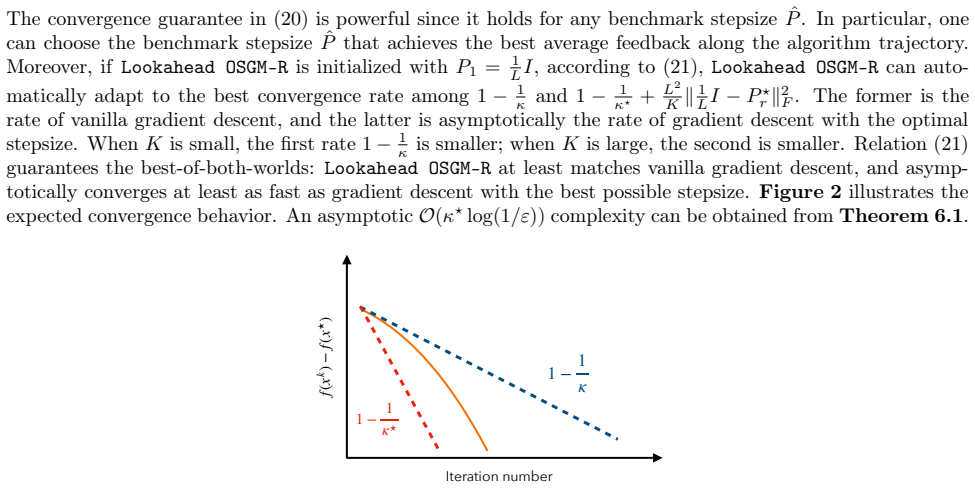
The load-bearing object is the pair (feedback function, landscape action): OSGM — online scaled gradient methods, a family of first-order methods that adapt a matrix stepsize by online learning — measures each stepsize $P_k$ by a feedback function $\ell_{x^k}(P_k)$ and updates $P_k$ by online gradient descent. The central object within that is the ratio feedback $r_x(P)$, the contraction ratio of suboptimality produced by a preconditioned gradient step, together with the reduction inequality that bounds the $K$-step error by the $K$-th power of the average contraction ratio, an AM-GM product bound that needs no convexity. The argument is carried by a cancellation identity: under the lookahead landscape action $x^{k+1} = x^{k+1/2} - (1/L)\nabla f(x^{k+1/2})$, the descent lemma gives $r_k \le r_{x^k}(P_k) - (1/(4L^2))\|\nabla r_{x^k}(P_k)\|_F^2$, while online gradient descent's regret bound carries a matching positive term $(\eta/2)\|\nabla r_{x^k}(P_k)\|_F^2$; setting $\eta = 1/(2L^2)$ makes the two cancel, leaving only constant regret $L^2\|P_1 - \hat P\|_F^2$. For trajectory adaptivity the machinery is dynamic regret with a path-length cost; for local superlinearity it is the fact that the ratio feedback of the Hessian inverse at the optimum is $O(\|x - x^\star\|^2)$ when the Hessian is $H$-Lipschitz, so the constant-regret bound with benchmark $[\nabla^2 f(x^\star)]^{-1}$ yields $(C/K)^K$.
What would settle it
On a strongly convex quadratic with Hessian $H$ (so the Hessian-Lipschitz constant is zero), known optimum $f^\star = 0$ and $L = \|H\|_2$, run Lookahead OSGM-R (Algorithm 2) with $P_1 = (1/L)I$ and $\eta = 1/(2L^2)$ for $K = 10^4$ iterations. Theorem 6.4 predicts $f(x^{K+1}) \le f(x^1)(C/K)^K$ with $C = L^2\|(1/L)I - H^{-1}\|_F^2$; if the observed error exceeds that bound at any $K$, the theorem's constants or the cancellation at Eqs. (18)--(19) fail. A second check targets the mechanism: with $\eta$ doubled, Eq. (18) predicts the compensation term no longer cancels and the superlinear phase should disappear or be substantially delayed; if it does not, the claimed cancellation is not the operative mechanism.
Extended reading notes
Core claim
On the paper's own terms, the discovery is that a first-order method can be accelerated by letting the stepsize itself be learned online, and that a single extra gradient step — the 'lookahead' — absorbs the error of that learning. The stepsize $P_k$ is updated by online gradient descent against the ratio feedback $r_x(P) = (f(x - P\nabla f(x)) - f^\star)/(f(x) - f^\star)$, and the iterate is advanced from the proposal $x^{k+1/2} = x^k - P_k\nabla f(x^k)$ by one more gradient step of length $1/L$. Because the extra step shrinks the function value by an amount proportional to the squared gradient of the feedback, choosing the online learning rate $\eta = 1/(2L^2)$ cancels the gradient-norm error term that online gradient descent would otherwise leave in its regret bound; the cumulative progress of the method is then bounded by that of any fixed benchmark stepsize plus a constant, $L^2\|P_1 - \hat P\|_F^2$. Feeding this into the arithmetic-mean--geometric-mean reduction $f(x^{K+1}) - f^\star \le [f(x^1) - f^\star]((1/K)\sum_k r_k)^K$ gives the headline rate $\min\{(1 - 1/\kappa)^K,\ (1 - 1/\kappa^\star + L^2\|(1/L)I - P^\star_r\|_F^2/K)^K\}$, and, with the Hessian inverse at the optimum as benchmark, the local superlinear rate $(C/K)^K$. The same machinery, with hypergradient feedback $h_x(P) = (f(x - P\nabla f(x)) - f(x))/\|\nabla f(x)\|^2$ and a monotone lookahead action, reproduces hypergradient descent as a special case ($\eta = 1/L$), which the paper reads as an explanation of why that heuristic works.
Load-bearing premise
The load-bearing premise is that the optimal value $f^\star$ and the smoothness constant $L$ are known exactly — ratio feedback requires $f^\star$ (Section 3.1), and both the online learning rate $\eta = 1/(2L^2)$ and the $1/L$ lookahead step need $L$ — and that gradients are exact, with the stochastic and practical regime deferred to Part II (Section 8); if any of these is missing, the compensation of the online learner's error term fails and the stated acceleration is not guaranteed.
Editorial extensions
If this is right
- On smooth strongly convex problems, Lookahead OSGM-R reaches accuracy $\varepsilon$ in at most $\min\{\kappa^\star L^2\|P_1 - P^\star_r\|_F^2 + \kappa^\star \log((f(x^1) - f^\star)/\varepsilon),\ \kappa \log((f(x^1) - f^\star)/\varepsilon)\}$ iterations, so it is never asymptotically slower than gradient descent and eventually matches the best fixed preconditioner.
- When a preconditioner substantially improves conditioning ($\kappa^\star < \sqrt{\kappa}$), the asymptotic complexity $O(\kappa^\star \log(1/\varepsilon))$ beats the classical accelerated rate $O(\sqrt{\kappa} \log(1/\varepsilon))$; the paper reads this as implicit preconditioning, consistent with the known lower bound.
- On problems with $H$-Lipschitz Hessian, the method converges locally at the non-asymptotic superlinear rate $(C/K)^K$, matching or surpassing the analyzed rates of quasi-Newton methods.
- A one-line equivalence in Section 9 shows that hypergradient descent with learning rate $1/L$ is exactly Lookahead OSGM-H, so the framework provides a rigorous global convergence analysis of that popular heuristic.
- Through dynamic regret, OSGM competes with the best stepsize sequence along the actual trajectory up to a path-length cost, so it can track a locally optimal preconditioner that switches between regions of different curvature.
Reading between the lines
- The compensation mechanism at $\eta = 1/(2L^2)$ suggests a general design rule: pair any online learner in stepsize space with a lookahead safeguard whose descent cancels the learner's error term; the paper proves this only for online gradient descent, but Section 7.4's suggestion of more sophisticated online learning algorithms hints that the constant-regret structure may extend beyond OGD.
- The superlinear bound needs exact $L$ and exact gradients; a testable extension is whether $(C/K)^K$ survives under backtracking estimation of $L$ (sketched in Section 7.4) or under stochastic gradients — the theory here covers neither, and the paper defers the practical regime to Part II.
- The equivalence between hypergradient descent at $\eta = 1/L$ and Lookahead OSGM-H implies that practitioners running hypergradient descent with a small fixed $\eta$ are in effect using a damped lookahead; decoupling the lookahead stepsize from the online learning rate, as OSGM does, is a modification the theory suggests could restore the full effect.
Editorial analysis
A structured set of objections, weighed in public.
Referee Report
Summary. The paper introduces Online Scaled Gradient Methods (OSGM), a framework that treats preconditioner/stepsize selection as an online convex optimization problem over the matrix stepsize, using either ratio feedback r_x(P) or hypergradient feedback h_x(P) and a landscape action that can accept, filter, or look ahead. The main theoretical results are for Lookahead OSGM-R and Monotone Lookahead OSGM-H: global convergence rates that compete with any fixed benchmark stepsize and, in the strongly convex case, are asymptotically as good as gradient descent with the best preconditioner; potential-function complexity bounds; local adaptivity bounds via dynamic regret; and non-asymptotic superlinear convergence of the form (C/K)^K. The paper also claims that this framework explains the empirical success of hypergradient descent. The appendix contains complete proofs for the stated theorems.
Significance. If the central OSGM-R results are correct, they are a substantial contribution: a gradient-only method with global rate matching the optimal fixed preconditioner asymptotically and with non-asymptotic superlinear convergence, proved through a transparent online-learning cancellation argument. The proofs are unusually complete, and the comparisons are made against arbitrary benchmark stepsizes in for-all bounds rather than against quantities fitted to the algorithm's own trajectory. However, the paper's secondary claim that OSGM explains the empirical behavior of the original hypergradient-descent heuristic is not supported by the analyzed monotone variant, and this weakness affects one of the three headline contributions in the abstract.
major comments (1)
- [Section 9 and Section 6.2] The claim that OSGM "explains the empirical success of the popular hypergradient-descent heuristic" (Abstract; also Section 1.1 and Section 9) is not supported by the analyzed variant. The convergence theorems for the hypergradient instantiation, Theorems 6.6, 6.7, and 6.9, are stated for "Monotone Lookahead OSGM-H" (Algorithm 3), whose landscape action enforces f(x^{k+1}) <= min{f(x^{k+1/2} - (1/L) grad f(x^{k+1/2})), f(x^k)}. The reduction used for these results, Theorem 4.2, explicitly requires f(x^{k+1}) <= f(x^k) for every k. Section 9 shows that HDM with eta = 1/L and P = R^{n x n} reduces to the non-monotone lookahead update x^{k+1} = x^{k+1/2} - eta grad f(x^{k+1/2}), and the HDM literature contains no monotone filter. The difference is consequential: for f(x) = 0.5 x^2 on x >= 0 and f(x) = 0.25 x^2 on x < 0 (L = 1, mu = 0.5), HDM with eta = 1/L, P_1 = 20, x_1 = 1 gives P_2 = 10.5 and x_2 = -9.5, so f(x_2) = 22.56 > 0.5 = f(x_1), violating the monotonicity required by Theorem 4.2. The abstract and Section 9 should either restrict the explanatory claim to the monotone lookahead variant or supply a separate convergence analysis for the original non-monotone HDM update.
minor comments (5)
- [Theorems 6.5 and 6.10] The statements of Theorems 6.5 and 6.10 write the superlinear bound as f(x^{K+1}) - f(x^1) <= ..., but the quantity f(x^{K+1}) - f(x^1) is not the suboptimality; the proofs establish the bound for f(x^{K+1}) - f^*. The displayed inequality is implied by the proof, but the wording should be corrected to avoid confusion.
- [Section 6.1.1 and Section 7.4] The headline rates for OSGM-R in Theorem 6.1 and Theorem 6.4 require the ratio feedback, which uses the optimal value f^*, as well as exact knowledge of L to set eta = 1/(2L^2) and the lookahead step 1/L. The paper mentions this in Section 6.1.1 and Section 7.4, but the abstract and Section 1.1 present the results as unconditional; the assumptions should be stated in the theorem statements themselves.
- [Section 7.4] The text suggests replacing OGD with parameter-free online algorithms such as [52], but those algorithms typically require a bounded feasible set, whereas the main theorems use P = R^{n x n} with no boundedness assumption. The paper should reconcile this practical recommendation with the unbounded candidate set used in the theory.
- [Section 9] The sentence "HDM and Lookahead OSGM are equivalent if the stepsize of online gradient descent is set to eta = 1/L" is imprecise: the equivalence is with the vanilla (non-monotone) lookahead landscape, not with the Monotone Lookahead OSGM-H of Algorithm 3. This wording is part of the overreach identified in the major comment.
- [Section 8] Section 8 contains no experiments and refers to Part II; the paper is honest about this, but readers should not interpret the abstract's "empirical success" phrasing as evidence presented in this manuscript.
Circularity Check
No circularity: the OSGM rates follow from self-contained reductions, standard OGD regret lemmas, and for-all benchmark stepsizes; self-citations are contextual pointers, not load-bearing evidence.
full rationale
The derivation chain is self-contained. The key reductions (Theorems 4.1 and 4.2) are algebraic identities, and the lookahead progress improvement (Lemma 4.1) follows from the standard descent lemma. The online-gradient-descent regret bounds (Lemmas 5.1 and 5.2) are textbook inequalities and are applied to an arbitrary benchmark stepsize P_hat that is not fitted to the data or to the trajectory. The cancellation in Eqs. (18)-(19) is an explicit algebraic choice of eta = 1/(2L^2), not a fitted constant disguised as a prediction. The benchmark stepsizes used to obtain the final rates, including P*_r and the Hessian inverse [∇²f(x*)]^{-1}, appear inside for-all bounds; the bound with P*_r uses the minimax definition and Proposition 3.2, and the superlinear bound uses the Lipschitz-Hessian estimate in Lemma 6.1 together with the already-proved linear convergence of Theorem 6.1. No central claim reduces to an input by construction. The self-citations to the authors' preprints [15] and [9] are contextual (noting that the paper extends those works, pointing to additional feedback functions, and deferring practical details to Part II); they are not used as the proof of any theorem here. The claimed explanation of hypergradient descent's empirical success is a scope/applicability concern because the analyzed Monotone Lookahead OSGM-H enforces a descent filter that standard HDM lacks, but this is an overreach beyond the proven setting rather than a circular derivation. Therefore the circularity score is 0.
Assumptions & free parameters
free parameters (1)
- Online gradient stepsize η =
1/(2L^2) for OSGM-R, 1/L for OSGM-H
assumptions (6)
- domain assumption f is L-smooth and µ-strongly convex (used throughout Sections 3-6)
- domain assumption f has H-Lipschitz Hessian (Lemma 6.1, Theorems 6.4, 6.9)
- domain assumption Exact gradient evaluations at every iteration
- domain assumption The smoothness constant L is known to the algorithm (or a valid upper bound)
- standard math Standard online gradient descent regret bounds (Lemmas 5.1 and 5.2)
- standard math Descent lemma and AM-GM inequality
invented entities (2)
-
Scheduler-Landscape abstraction
-
Ratio and hypergradient feedback functions r_x(P) and h_x(P)
Cite this review
Pith. "Pith review of Gradient Methods with Online Scaling Part I. Theoretical Foundations." pith.science (2026). https://pith.science/paper/Z3N5ETRB
@misc{pith2026250523081,
  author       = {Pith},
  title        = {Pith review of: Gradient Methods with Online Scaling Part I. Theoretical Foundations},
  year         = {2026},
  howpublished = {\url{https://pith.science/paper/Z3N5ETRB}},
  note         = {Machine review of arXiv:2505.23081}
}
read the original abstract
This paper establishes the theoretical foundations of the online scaled gradient methods (OSGM), a framework that utilizes online learning to adapt stepsizes and provably accelerate first-order methods. OSGM quantifies the effectiveness of a stepsize by a feedback function motivated from a convergence measure and uses the feedback to adjust the stepsize through an online learning algorithm. Consequently, instantiations of OSGM achieve convergence rates that are asymptotically no worse than the optimal stepsize. OSGM yields desirable convergence guarantees on smooth convex problems, including 1) trajectory-dependent global convergence on smooth convex objectives; 2) an improved complexity result on smooth strongly convex problems, and 3) local superlinear convergence. Notably, OSGM constitutes a new family of first-order methods with non-asymptotic superlinear convergence, joining the celebrated quasi-Newton methods. Finally, OSGM explains the empirical success of the popular hypergradient-descent heuristic in optimization for machine learning.
Figures

Forward citations
Cited by 1 Pith paper
-
Enhanced PDHG for Linear Programming with Online Preconditioning
Online preconditioning for a GPU LP solver cuts iteration counts by roughly 10-30% on Netlib and MIPLIB benchmarks, with the learning rate tuned per instance.
Reference graph
Works this paper leans on
-
[1]
Disentangling adaptive gradient methods from learning rates.CoRR, abs/2002.11803, 2020
Naman Agarwal, Rohan Anil, Elad Hazan, Tomer Koren, and Cyril Zhang. Disentangling adaptive gradient methods from learning rates.CoRR, abs/2002.11803, 2020. (cited on 17)
arXiv 2002
-
[2]
Parameter adaptation in stochastic optimization
Luís B Almeida, Thibault Langlois, José D Amaral, and Alexander Plakhov. Parameter adaptation in stochastic optimization. InOn-line learning in neural networks, pages 111–134. 1999. (cited on 18)
work page 1999
-
[3]
Jason M Altschuler and Pablo A Parrilo. Acceleration by stepsize hedging: Silver stepsize schedule for smooth convex optimization.Mathematical Programming, pages 1–14, 2024. (cited on 17)
work page 2024
-
[4]
Jason M Altschuler and Pablo A Parrilo. Acceleration by stepsize hedging: Multi-step descent and the silver stepsize schedule.Journal of the ACM, 72(2):1–38, 2025. (cited on 17)
work page 2025
-
[5]
David Applegate, Mateo Diaz, Oliver Hinder, Haihao Lu, Miles Lubin, Brendan O’Donoghue, and Warren Schudy. Practical large-scale linear programming using primal-dual hybrid gradient.Advances in Neural Information Processing Systems, 34:20243–20257, 2021. (cited on 17)
work page 2021
-
[6]
Two-point step size gradient methods.IMA journal of numerical analysis, 8(1):141–148, 1988
Jonathan Barzilai and Jonathan M Borwein. Two-point step size gradient methods.IMA journal of numerical analysis, 8(1):141–148, 1988. (cited on 17)
work page 1988
-
[7]
Online learning rate adaptation with hypergradient descent
Atilim Gunes Baydin, Robert Cornish, David Martinez Rubio, Mark Schmidt, and Frank Wood. Online learning rate adaptation with hypergradient descent. InInternational Conference on Learning Represen- tations, 2018. (cited on 2, 18)
work page 2018
-
[8]
Kartik Chandra, Audrey Xie, Jonathan Ragan-Kelley, and Erik Meijer. Gradient descent: The ultimate optimizer.Advances in Neural Information Processing Systems, 35:8214–8225, 2022. (cited on 18) 19
work page 2022
Show all 72 references
-
[9]
Provable and practical online learning rate adaptation with hypergradient descent.arXiv preprint arXiv:2502.11229, 2025
Ya-Chi Chu, Wenzhi Gao, Yinyu Ye, and Madeleine Udell. Provable and practical online learning rate adaptation with hypergradient descent.arXiv preprint arXiv:2502.11229, 2025. (cited on 1, 3, 4, 17, 18)
2025 arXiv
-
[10]
Non-monotonebehavioroftheheavyballmethod
MarinaDanilova, AnastasiiaKulakova, andBorisPolyak. Non-monotonebehavioroftheheavyballmethod. InDifference Equations and Discrete Dynamical Systems with Applications: 24th ICDEA, Dresden, Ger- many, May 21–25, 2018 24, pages 213–230. Springer, 2020. (cited on 17)
2018
-
[11]
An enhanced alternating direction method of multipliers-based interior point method for linear and conic optimization.INFORMS Journal on Computing, 2024
Qi Deng, Qing Feng, Wenzhi Gao, Dongdong Ge, Bo Jiang, Yuntian Jiang, Jingsong Liu, Tianhao Liu, Chenyu Xue, Yinyu Ye, et al. An enhanced alternating direction method of multipliers-based interior point method for linear and conic optimization.INFORMS Journal on Computing, 202...
2024
-
[12]
Uniformly optimal and parameter-free first-order methods for convex and function-constrained optimization.arXiv preprint arXiv:2412.06319, 2024
Qi Deng, Guanghui Lan, and Zhenwei Lin. Uniformly optimal and parameter-free first-order methods for convex and function-constrained optimization.arXiv preprint arXiv:2412.06319, 2024. (cited on 17)
2024 arXiv
-
[13]
Adaptive subgradient methods for online learning and stochas- tic optimization.Journal of machine learning research, 12(7), 2011
John Duchi, Elad Hazan, and Yoram Singer. Adaptive subgradient methods for online learning and stochas- tic optimization.Journal of machine learning research, 12(7), 2011. (cited on 3, 16, 17)
2011
-
[14]
John Wiley & Sons, 2000
Roger Fletcher.Practical methods of optimization. John Wiley & Sons, 2000. (cited on 2)
2000
-
[15]
Gradient methods with online scaling.arXiv preprint arXiv:2411.01803, 2024
Wenzhi Gao, Ya-Chi Chu, Yinyu Ye, and Madeleine Udell. Gradient methods with online scaling.arXiv preprint arXiv:2411.01803, 2024. (cited on 1, 4, 6, 13, 18)
2024 arXiv
-
[16]
Scalable approximate optimal diagonal pre- conditioning.arXiv preprint arXiv:2312.15594, 2023
Wenzhi Gao, Zhaonan Qu, Madeleine Udell, and Yinyu Ye. Scalable approximate optimal diagonal pre- conditioning.arXiv preprint arXiv:2312.15594, 2023. (cited on 6, 17)
2023 arXiv
-
[17]
Clarabel: An interior-point solver for conic programs with quadratic objectives.arXiv preprint arXiv:2405.12762, 2024
Paul J Goulart and Yuwen Chen. Clarabel: An interior-point solver for conic programs with quadratic objectives.arXiv preprint arXiv:2405.12762, 2024. (cited on 17)
2024 arXiv
-
[18]
Shampoo: Preconditioned stochastic tensor optimization
Vineet Gupta, Tomer Koren, and Yoram Singer. Shampoo: Preconditioned stochastic tensor optimization. InInternational Conference on Machine Learning, pages 1842–1850. PMLR, 2018. (cited on 17)
2018
-
[19]
Introduction to online convex optimization.Foundations and Trends®in Optimization, 2(3-4):157–325, 2016
Elad Hazan et al. Introduction to online convex optimization.Foundations and Trends®in Optimization, 2(3-4):157–325, 2016. (cited on 8)
2016
-
[20]
Revisiting the polyak step size.arXiv preprint arXiv:1905.00313, 2019
Elad Hazan and Sham Kakade. Revisiting the polyak step size.arXiv preprint arXiv:1905.00313, 2019. (cited on 17)
1905 arXiv
-
[21]
Adaptive online gradient descent.Advances in neural information processing systems, 20, 2007
Elad Hazan, Alexander Rakhlin, and Peter Bartlett. Adaptive online gradient descent.Advances in neural information processing systems, 20, 2007. (cited on 3)
2007
-
[22]
Neural networks for machine learning lecture 6a overview of mini-batch gradient descent.Cited on, 14(8):2, 2012
Geoffrey Hinton, Nitish Srivastava, and Kevin Swersky. Neural networks for machine learning lecture 6a overview of mini-batch gradient descent.Cited on, 14(8):2, 2012. (cited on 3, 17)
2012
-
[23]
Restarted primal-dual hybrid conjugate gradient method for large-scale quadratic programming.arXiv preprint arXiv:2405.16160, 2024
Yicheng Huang, Wanyu Zhang, Hongpei Li, Dongdong Ge, Huikang Liu, and Yinyu Ye. Restarted primal-dual hybrid conjugate gradient method for large-scale quadratic programming.arXiv preprint arXiv:2405.16160, 2024. (cited on 17)
2024 arXiv
-
[24]
Increased rates of convergence through learning rate adaptation.Neural networks, 1(4):295–307, 1988
Robert A Jacobs. Increased rates of convergence through learning rate adaptation.Neural networks, 1(4):295–307, 1988. (cited on 18)
1988
-
[25]
Unconstrained online learning with unbounded losses
Andrew Jacobsen and Ashok Cutkosky. Unconstrained online learning with unbounded losses. InInterna- tional Conference on Machine Learning, pages 14590–14630. PMLR, 2023. (cited on 16)
2023
-
[26]
Online learning guided curvature approximation: A quasi-newton method with global non-asymptotic superlinear convergence
Ruichen Jiang, Qiujiang Jin, and Aryan Mokhtari. Online learning guided curvature approximation: A quasi-newton method with global non-asymptotic superlinear convergence. InThe Thirty Sixth Annual Conference on Learning Theory, pages 1962–1992. PMLR, 2023. (cited on 2, 17, 18)
1962
-
[27]
Online learning guided quasi-newton methods with global non- asymptotic convergence.arXiv preprint arXiv:2410.02626, 2024
Ruichen Jiang and Aryan Mokhtari. Online learning guided quasi-newton methods with global non- asymptotic convergence.arXiv preprint arXiv:2410.02626, 2024. (cited on 2, 18) 20
2024 arXiv
-
[28]
Adaptive hierarchical hyper-gradient descent.International Journal of Machine Learning and Cybernetics, 13(12):3785–3805, 2022
Renlong Jie, Junbin Gao, Andrey Vasnev, and Minh-Ngoc Tran. Adaptive hierarchical hyper-gradient descent.International Journal of Machine Learning and Cybernetics, 13(12):3785–3805, 2022. (cited on 18)
2022
-
[29]
Non-asymptotic global convergence analysis of bfgs with the armijo-wolfe line search.arXiv preprint arXiv:2404.16731, 2024
Qiujiang Jin, Ruichen Jiang, and Aryan Mokhtari. Non-asymptotic global convergence analysis of bfgs with the armijo-wolfe line search.arXiv preprint arXiv:2404.16731, 2024. (cited on 17)
2024 arXiv
-
[30]
Non-asymptotic global convergence rates of bfgs with exact line search.arXiv preprint arXiv:2404.01267, 2024
Qiujiang Jin, Ruichen Jiang, and Aryan Mokhtari. Non-asymptotic global convergence rates of bfgs with exact line search.arXiv preprint arXiv:2404.01267, 2024. (cited on 2, 17)
2024 arXiv
-
[31]
Non-asymptotic superlinear convergence of standard quasi-newton methods.Mathematical Programming, 200(1):425–473, 2023
Qiujiang Jin and Aryan Mokhtari. Non-asymptotic superlinear convergence of standard quasi-newton methods.Mathematical Programming, 200(1):425–473, 2023. (cited on 2)
2023
-
[32]
Adam: A method for stochastic optimization.arXiv preprint arXiv:1412.6980, 2014
Diederik P Kingma. Adam: A method for stochastic optimization.arXiv preprint arXiv:1412.6980, 2014. (cited on 3)
2014 arXiv
-
[33]
Searching for optimal per-coordinate step-sizes with multidimensional backtracking.Advances in Neural Information Processing Systems, 36, 2024
Frederik Kunstner, Victor Sanches Portella, Mark Schmidt, and Nicholas Harvey. Searching for optimal per-coordinate step-sizes with multidimensional backtracking.Advances in Neural Information Processing Systems, 36, 2024. (cited on 2, 6, 18)
2024
-
[34]
Optimal and parameter-free gradient minimization methods for smooth optimization.arXiv preprint arXiv:2310.12139, 2023
Guanghui Lan, Yuyuan Ouyang, and Zhe Zhang. Optimal and parameter-free gradient minimization methods for smooth optimization.arXiv preprint arXiv:2310.12139, 2023. (cited on 3)
2023 arXiv
-
[35]
A simple uniformly optimal method without line search for convex opti- mization.arXiv preprint arXiv:2310.10082, 2023
Tianjiao Li and Guanghui Lan. A simple uniformly optimal method without line search for convex opti- mization.arXiv preprint arXiv:2310.10082, 2023. (cited on 3, 17)
2023 arXiv
-
[36]
A second look at exponential and cosine step sizes: Simplicity, adaptivity, and performance
Xiaoyu Li, Zhenxun Zhuang, and Francesco Orabona. A second look at exponential and cosine step sizes: Simplicity, adaptivity, and performance. InInternational Conference on Machine Learning, pages 6553–
-
[37]
An admm-based interior-point method for large-scale linear programming.Optimization Methods and Software, 36(2-3):389–424, 2021
Tianyi Lin, Shiqian Ma, Yinyu Ye, and Shuzhong Zhang. An admm-based interior-point method for large-scale linear programming.Optimization Methods and Software, 36(2-3):389–424, 2021. (cited on 17)
2021
-
[38]
Pdcs: A primal-dual large-scale conic programming solver with gpu enhancements.arXiv preprint arXiv:2505.00311, 2025
Zhenwei Lin, Zikai Xiong, Dongdong Ge, and Yinyu Ye. Pdcs: A primal-dual large-scale conic programming solver with gpu enhancements.arXiv preprint arXiv:2505.00311, 2025. (cited on 17)
2025
-
[39]
Haihao Lu and Jinwen Yang. cupdlp. jl: A gpu implementation of restarted primal-dual hybrid gradient for linear programming in julia.arXiv preprint arXiv:2311.12180, 2023. (cited on 17)
2023 arXiv
-
[40]
cupdlp-c: A strengthened implementation of cupdlp for linear programming by c language.arXiv preprint arXiv:2312.14832, 2023
Haihao Lu, Jinwen Yang, Haodong Hu, Qi Huangfu, Jinsong Liu, Tianhao Liu, Yinyu Ye, Chuwen Zhang, and Dongdong Ge. cupdlp-c: A strengthened implementation of cupdlp for linear programming by c language.arXiv preprint arXiv:2312.14832, 2023. (cited on 17)
2023 arXiv
-
[41]
Tuning-freestep-size adaptation
AshiqueRupamMahmood, RichardSSutton, ThomasDegris, andPatrickMPilarski. Tuning-freestep-size adaptation. In2012 IEEE international conference on acoustics, speech and signal processing (ICASSP), pages 2121–2124. IEEE, 2012. (cited on 18)
2012
-
[42]
Adaptive gradient descent without descent
Yura Malitsky and Konstantin Mishchenko. Adaptive gradient descent without descent. InInternational Conference on Machine Learning, pages 6702–6712. PMLR, 2020. (cited on 17)
2020
-
[43]
Adaptive proximal gradient method for convex optimization
Yura Malitsky and Konstantin Mishchenko. Adaptive proximal gradient method for convex optimization. Advances in Neural Information Processing Systems, 37:100670–100697, 2024. (cited on 17)
2024
-
[44]
Adaptive bound optimization for online convex optimization
H Brendan McMahan and Matthew Streeter. Adaptive bound optimization for online convex optimization. arXiv preprint arXiv:1002.4908, 2010. (cited on 3) 21
2010 arXiv
-
[45]
Renato D. C. Monteiro, Jerome W. O’Neal, and Arkadi Nemirovski. A new conjugate gradient algorithm in- corporating adaptive ellipsoid preconditioning. Technical Report Optimization Online e-print 2004-10-973, School of Industrial and Systems Engineering, Georgia Institute of T...
2004
-
[46]
Linear convergence of first order methods for non-strongly convex optimization.Mathematical Programming, 175:69–107, 2019
Ion Necoara, Yu Nesterov, and Francois Glineur. Linear convergence of first order methods for non-strongly convex optimization.Mathematical Programming, 175:69–107, 2019. (cited on 2)
2019
-
[47]
A method for solving the convex programming problem with convergence rate o (1/k2)
Yurii Nesterov. A method for solving the convex programming problem with convergence rate o (1/k2). In Dokl akad nauk Sssr, volume 269, page 543, 1983. (cited on 2, 17)
1983
-
[48]
Springer Science & Business Media, 2013
Yurii Nesterov.Introductory lectures on convex optimization: A basic course, volume 87. Springer Science & Business Media, 2013. (cited on 2, 19)
2013
-
[49]
Springer, 1999
Jorge Nocedal and Stephen J Wright.Numerical optimization. Springer, 1999. (cited on 2)
1999
-
[50]
Conic optimization via operator splitting and homogeneous self-dual embedding.Journal of Optimization Theory and Applications, 169:1042–1068,
Brendan O’donoghue, Eric Chu, Neal Parikh, and Stephen Boyd. Conic optimization via operator splitting and homogeneous self-dual embedding.Journal of Optimization Theory and Applications, 169:1042–1068,
-
[51]
A modern introduction to online learning.arXiv preprint arXiv:1912.13213, 2019
Francesco Orabona. A modern introduction to online learning.arXiv preprint arXiv:1912.13213, 2019. (cited on 2, 3, 8, 17, 18)
1912 arXiv
-
[52]
Coin betting and parameter-free online learning.Advances in Neural Information Processing Systems, 29, 2016
Francesco Orabona and Dávid Pál. Coin betting and parameter-free online learning.Advances in Neural Information Processing Systems, 29, 2016. (cited on 3, 16)
2016
-
[53]
MADA: Meta-adaptive optimizers through hyper-gradient descent
Kaan Ozkara, Can Karakus, Parameswaran Raman, Mingyi Hong, Shoham Sabach, Branislav Kveton, and Volkan Cevher. MADA: Meta-adaptive optimizers through hyper-gradient descent. InForty-first International Conference on Machine Learning, 2024. (cited on 18)
2024
-
[54]
Introduction to optimization
Boris T Polyak. Introduction to optimization. 1987. (cited on 17)
1987
-
[55]
Optimal diagonal precondi- tioning.Operations Research, 2024
Zhaonan Qu, Wenzhi Gao, Oliver Hinder, Yinyu Ye, and Zhengyuan Zhou. Optimal diagonal precondi- tioning.Operations Research, 2024. (cited on 6, 17)
2024
-
[56]
Lecture notes on online learning draft, 2009
Alexander Rakhlin, J Abernethy, A Agarwal, P Bartlett, E Hazan, and A Tewari. Lecture notes on online learning draft, 2009. (cited on 18)
2009
-
[57]
On the convergence of adam and beyond.arXiv preprint arXiv:1904.09237, 2019
Sashank J Reddi, Satyen Kale, and Sanjiv Kumar. On the convergence of adam and beyond.arXiv preprint arXiv:1904.09237, 2019. (cited on 17)
1904 arXiv
-
[58]
Greedy quasi-newton methods with explicit superlinear conver- gence.SIAM Journal on Optimization, 31(1):785–811, 2021
Anton Rodomanov and Yurii Nesterov. Greedy quasi-newton methods with explicit superlinear conver- gence.SIAM Journal on Optimization, 31(1):785–811, 2021. (cited on 2, 17)
2021
-
[59]
New results on superlinear convergence of classical quasi-newton methods.Journal of optimization theory and applications, 188:744–769, 2021
Anton Rodomanov and Yurii Nesterov. New results on superlinear convergence of classical quasi-newton methods.Journal of optimization theory and applications, 188:744–769, 2021. (cited on 2, 17)
2021
-
[60]
Ratesofsuperlinearconvergenceforclassicalquasi-newtonmethods
AntonRodomanovandYuriiNesterov. Ratesofsuperlinearconvergenceforclassicalquasi-newtonmethods. Mathematical Programming, pages 1–32, 2022. (cited on 2, 17)
2022
-
[61]
Convergence analysis of an adaptive method of gradient descent.University of Oxford, Oxford, M
David Martinez Rubio. Convergence analysis of an adaptive method of gradient descent.University of Oxford, Oxford, M. Sc. thesis, 2017. (cited on 18)
2017
-
[62]
Local gain adaptation in stochastic gradient descent
Nicol N Schraudolph. Local gain adaptation in stochastic gradient descent. 1999. (cited on 2, 18)
1999
-
[63]
Adapting bias by gradient descent: An incremental version of delta-bar-delta
Richard S Sutton. Adapting bias by gradient descent: An incremental version of delta-bar-delta. InAAAI, volume 92, pages 171–176. Citeseer, 1992. (cited on 18) 22
1992
-
[64]
No-regret dynamics in the fenchel game: A unified framework for algorithmic convex optimization.Mathematical Programming, 205(1):203–268, 2024
Jun-Kun Wang, Jacob Abernethy, and Kfir Y Levy. No-regret dynamics in the fenchel game: A unified framework for algorithmic convex optimization.Mathematical Programming, 205(1):203–268, 2024. (cited on 18)
2024
-
[65]
On the convergence of stochastic gradient descent with bandwidth-based step size.Journal of Machine Learning Research, 24(48):1–49, 2023
Xiaoyu Wang and Ya-xiang Yuan. On the convergence of stochastic gradient descent with bandwidth-based step size.Journal of Machine Learning Research, 24(48):1–49, 2023. (cited on 17)
2023
-
[66]
The role of level-set geometry on the performance of pdhg for conic linear optimization.arXiv preprint arXiv:2406.01942, 2024
Zikai Xiong and Robert M Freund. The role of level-set geometry on the performance of pdhg for conic linear optimization.arXiv preprint arXiv:2406.01942, 2024. (cited on 17)
2024 arXiv
-
[67]
Adaptive powerball stochastic conjugate gradient for large-scale learning.IEEE Transactions on Big Data, 9(6):1598–1606, 2023
Zhuang Yang. Adaptive powerball stochastic conjugate gradient for large-scale learning.IEEE Transactions on Big Data, 9(6):1598–1606, 2023. (cited on 18)
2023
-
[68]
Adam-mini: Use fewer learning rates to gain more.arXiv preprint arXiv:2406.16793, 2024
Yushun Zhang, Congliang Chen, Ziniu Li, Tian Ding, Chenwei Wu, Yinyu Ye, Zhi-Quan Luo, and Ruoyu Sun. Adam-mini: Use fewer learning rates to gain more.arXiv preprint arXiv:2406.16793, 2024. (cited on 17)
2024 arXiv
-
[69]
Algorithm 778: L-bfgs-b: Fortran sub- routines for large-scale bound-constrained optimization.ACM Transactions on mathematical software (TOMS), 23(4):550–560, 1997
Ciyou Zhu, Richard H Byrd, Peihuang Lu, and Jorge Nocedal. Algorithm 778: L-bfgs-b: Fortran sub- routines for large-scale bound-constrained optimization.ACM Transactions on mathematical software (TOMS), 23(4):550–560, 1997
1997
-
[70]
Adabelief optimizer: Adapting stepsizes by the belief in observed gradients.Advances in neural information processing systems, 33:18795–18806, 2020
Juntang Zhuang, Tommy Tang, Yifan Ding, Sekhar C Tatikonda, Nicha Dvornek, Xenophon Papademetris, and James Duncan. Adabelief optimizer: Adapting stepsizes by the belief in observed gradients.Advances in neural information processing systems, 33:18795–18806, 2020. (cited on 17)
2020
-
[71]
Surrogate losses for online learning of stepsizes in stochastic non-convex optimization
Zhenxun Zhuang, Ashok Cutkosky, and Francesco Orabona. Surrogate losses for online learning of stepsizes in stochastic non-convex optimization. InInternational Conference on Machine Learning, pages 7664–7672. PMLR, 2019. (cited on 3) 23 Appendix Table of Contents A Proof of re...
2019
-
[6564]
(cited on 17)
PMLR, 2021. (cited on 17)
2021
Reviewed August 7, 2026 · model on record in the stance chip above.
Discussion (0). Sign in to comment.