REVIEW 4 major objections 5 minor 80 references
A Constructed Response: Designing and Choreographing Robot Arm Movements in Collaborative Dance Improvisation
T0 review · 4 major / 5 minor · reviewed 2026-08-07 · deepseek-v4-flash
Pith's one-line read In solo duets with a robot arm, dancers move more fluidly than they do in groups
desk verdict The 1-1 vs 3-1 comparison is a genuine qualitative contribution, but the headline movement-contrast is perception, not measured kinematics. read the letter →
The pith
A machine-rendered reading of the paper's core claim, the machinery that carries it, and where it could break.
The reading
What carries the argument
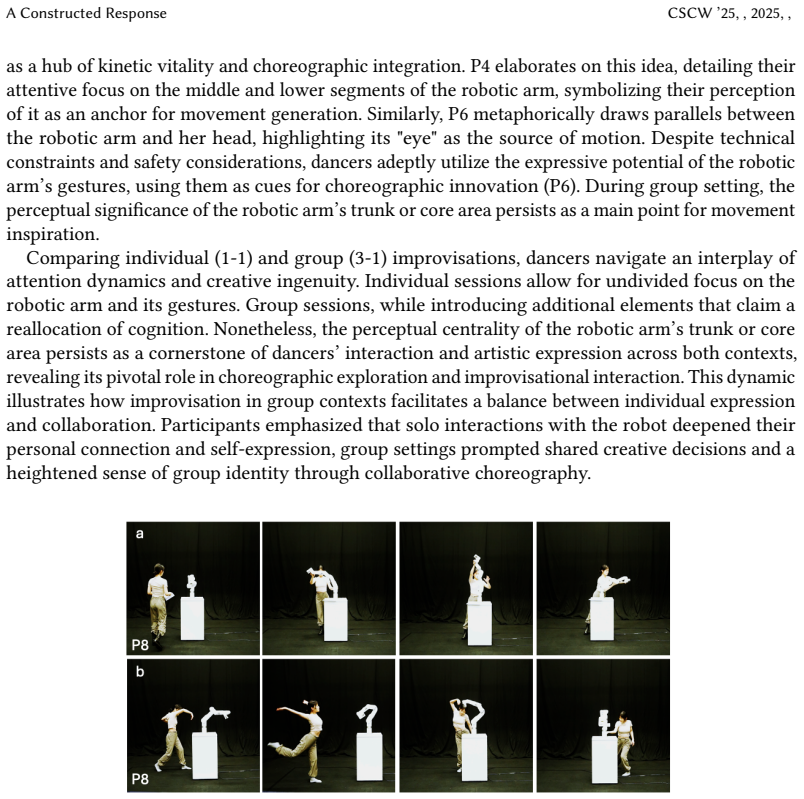
The carrying mechanism is a three-workshop procedure built around a stationary UFactory xArm 6 robotic arm placed at the center of a white platform on the floor. Dancers first physically manipulated the arm to record their own movement designs (programming through demonstration), then improvised with the played-back sequences alone (1-1) and in groups of three (3-1), and finally choreographed solo and duet performances with the same sequences. The comparison that carries the argument is the 1-1 versus 3-1 contrast in improvisation, analyzed through semi-structured interviews, video coding of space use, attention, and movement quality, and participant sketches synthesized with affinity diagrams.
What would settle it
Repeat the same 1-1 and 3-1 improvisations with identical recorded robot sequences, but capture each dancer's body with motion capture or inertial sensors and compute objective movement-continuity metrics (for example, stops per minute, mean jerk, or speed variability), while two independent coders blind to condition rate the videos; if the fluidity gap between conditions disappears or the coders disagree substantially, the central claim does not hold.
Extended reading notes
Core claim
The central claim is that the human-to-robot ratio itself shapes the choreographic and social outcome of improvisation with a non-humanoid robot. In the one-to-one condition, dancers reported leading the robot, felt a closer and more intimate relationship, and produced continuous, fluid movement; the robot functioned as a dance partner. In the three-to-one condition, dancers divided attention between human partners and the robot, reported exploring the space more, moved in more discontinuous, stop-and-restart ways, and perceived the robot as part of the stage background or as a prop. The paper also documents a context-dependent shift in perception: the same robot is viewed as a tool during movement design, as a partner during solo improvisation, and again as a tool or set piece in group settings. Choreographers additionally reported that programming the robot shifted their creative focus from theme-setting to form-setting.
Load-bearing premise
The central contrast between fluid solo and stop-and-go group movement rests solely on qualitative video coding and dancer self-reports, with no quantitative kinematic measurement and no inter-coder reliability check; biased coding or leading interview questions would overturn the main finding.
Editorial extensions
If this is right
- If the 1-1 versus 3-1 contrast is real, robot designers should treat the number of human collaborators as a first-class parameter, because the same robot movement evokes different movement quality and social role in different group sizes.
- The workshop format demonstrates end-user programming through demonstration: dancers without robotics training can author the robot's full movement vocabulary by guiding its joints, which supports creative ownership and reduces the need for technical intermediaries.
- The robot's consistent, repeatable playback was reported as a structural anchor for improvisation, implying that predictable non-humanoid movement can scaffold spontaneity once performers know the sequence by heart.
- In group settings the robot's salience drops so sharply that it becomes background; future systems may need active measures such as mobility, variable timing, sound, or repositioning to keep a non-humanoid agent in a shared attentional loop.
- Choreographing for the robot pushed choreographers from theme-driven to form-driven composition, which has implications for how creative tools shape the types of artistic decisions users make.
Reading between the lines
- Beyond the paper's qualitative evidence, the fluid-versus-stop-and-go contrast could be quantified with motion capture (for example, jerk-based smoothness, stop frequency, and spatial range), giving an objective test of the ratio effect independent of coding bias.
- A plausible mechanism the paper leaves implicit is attention allocation: when human partners provide live responsiveness and the robot does not, dancers rationally shift attention to humans; this predicts that a robot with stronger real-time feedback would retain partner status in group settings.
- Because participants were all professional dancers with no prior robot-arm experience, the tool-to-partner shift observed in solo improvisation may strengthen over repeated sessions; a longitudinal version of the workshops could test whether familiarity keeps the robot salient in group contexts.
- The 'robot as background' result suggests a cheap design fix: a mobile base or periodic repositioning may be sufficient to hold a non-humanoid agent's share of group attention, which is testable with the same workshop protocol on a mobile robot.
Editorial analysis
A structured set of objections, weighed in public.
Referee Report
Summary. This paper reports a qualitative workshop study in which nine professional dancers improvised and choreographed with a non-humanoid xArm 6 robot arm in one-human-to-one-robot (1-1) and three-human-to-one-robot (3-1) configurations. The authors claim that 1-1 improvisation produced more fluid, intimate, and continuous movement and a stronger sense of connection with the robot, while 3-1 improvisation led to divided attention, increased perceived use of space, more stop-and-go movements, and perception of the robot as stage background. The evidence consists of semi-structured interviews, video coding, sketches, and researcher observation, analyzed thematically. The paper also derives design implications for human-robot creative collaboration and discusses limitations including small sample size and mechanical constraints of the robot.
Significance. If the central contrast were methodologically secure, this would be a valuable contribution to CSCW and HRI research on co-creative movement with non-humanoid robots, complementing prior work on dance technology, motion capture, and virtual performance. The study's strengths include the use of professional dancers, a realistic robotic platform, multi-modal qualitative data, and the inclusion of a substantial limitations section. However, the headline claims that dancers 'produced more fluid movements' and 'more stop-and-go movements' are currently supported only by self-report and researcher coding without kinematic measurement, inter-coder reliability, or control for workshop order and leading interview prompts. The significance is therefore conditional on reframing the claims as perceived or exploratory, or on adding quantitative movement analysis.
major comments (4)
- [§3.5–§3.6, §4.1.1] The central 1-1 versus 3-1 contrast is fully confounded with workshop order. Every participant completed Workshop 1 (one dancer with one robot) before Workshop 2 (three dancers with one robot), so order, practice with the robot, familiarity among group members, and the specific movement designs chosen in Workshop 2 are all entangled with the number of human partners. The abstract and conclusion attribute observed differences in movement fluidity and connection to the 1-1 versus 3-1 manipulation, but the design cannot support that attribution. At minimum, the paper should explicitly acknowledge this confound in the Limitations section and reframe the findings as perceptions or experiences within a fixed sequence rather than as effects of group size.
- [§3.4] The Workshop 2 interview guide contains explicitly comparative and leading questions, including 'What are the major differences between 1-1 and 3-1 settings?', 'When do you explore space more, 1-1 or 3-1? Why?', and 'Which case makes you feel more connected to the robotic arm?'. These prompts presuppose that the participants experienced systematic differences and direct them to produce exactly the contrast reported in Section 4.1.1. Since Workshop 1 interviews did not use the same comparative frame, the asymmetry further weakens the comparison. The analysis should either treat the resulting themes as co-constructed responses to the interview framing, or the authors should provide evidence that the same themes emerged spontaneously from non-leading discussion.
- [§3.8, §4.1.1] The supporting evidence for 'more fluid movements' and 'more stop-and-go movements' is not sufficient to support these as movement-production claims. The video coding described in §3.8 reportedly captured 'movement quality' and 'use of space,' but no codebook, operational definitions, code frequencies, or inter-coder reliability are reported, and the terms 'fluid/continuous' versus 'stop-and-go' are never defined quantitatively. The participant quotes in §4.1.1 are consistent with perceived differences, but they cannot establish that dancers actually moved differently in the two conditions. The authors should either add kinematic measures, such as motion-capture or video-derived metrics of velocity, jerk, pause frequency, and spatial spread, or revise the abstract and conclusions to say that dancers perceived and described their movements as more fluid or more stop-and-go in the respective settings.
- [Abstract, §6] The abstract and conclusion state that dancers 'produced more fluid movements' and 'more stop-and-go movements' as though these were measured properties of the dancing. Given the evidence base described above, these statements overstate what the data can show. The claims should be explicitly qualified as perceived or reported movement qualities, or supported with quantitative analysis.
minor comments (5)
- [§4.1.4] Typo: 'saptial awareness' should be 'spatial awareness'.
- [§4.1.5] Typo: 'camea’s perspective' should be 'camera’s perspective'.
- [§4.2.4] Typos: 'repeatablity' should be 'repeatability' and 'expressiveenss' should be 'expressiveness'; 'Enhaving' should be 'Enhancing'.
- [§3.2] The sentence 'with 2 had prior experience with drones' is grammatically incomplete; consider revising to 'and two had prior experience with drones'.
- [§2.1] The phrase 'co-improvement in the dance-making process' is unclear; it may be intended as 'co-improvisation' or 'collaborative improvement'.
Circularity Check
No significant circularity: the qualitative findings are empirical and do not reduce to their inputs by definition, by fitted parameters, or by a load-bearing self-citation chain.
full rationale
This paper is a qualitative workshop study rather than a formal derivation: there are no equations, no fitted parameters, and no uniqueness theorem used to force a conclusion. The central claims about 1-1 versus 3-1 improvisation are presented as themes observed in interviews and video coding, and the evidence consists of participants' reported perceptions and researcher-described movement qualities. The workshop questions in Section 3.4 do directly solicit comparative answers along the outcome dimensions, and the fixed order of Workshop 1 before Workshop 2 confounds partner count with familiarity and practice; these are real threats to construct and internal validity that the Limitations section does not acknowledge. But a leading interview prompt is not the same as a circular derivation: the paper does not define 'connection' or 'fluidity' as whatever participants answer and then report that answer as a prediction. Similarly, the self-citations, notably [22] for the demonstration-based programming method and [49] for the 'Born' stimulus sequence, provide methodological precedents and a movement stimulus, but the paper's findings do not logically reduce to those citations. The main weaknesses are missing kinematic measurement, absent inter-coder reliability, and an unoperationalized 'fluid versus stop-and-go' distinction, all of which undermine confidence in the findings but do not constitute circularity under the standards applied here.
Assumptions & free parameters
assumptions (2)
- domain assumption Dancers' self-reported experiences during semi-structured interviews are valid evidence of movement quality and social presence.
- domain assumption The nine recruited professional dancers, mostly female and from one local university, are representative enough to support generalizable claims about dancers.
Cite this review
Pith. "Pith review of A Constructed Response: Designing and Choreographing Robot Arm Movements in Collaborative Dance Improvisation." pith.science (2026). https://pith.science/paper/LN4HBDGD
@misc{pith2026250523090,
  author       = {Pith},
  title        = {Pith review of: A Constructed Response: Designing and Choreographing Robot Arm Movements in Collaborative Dance Improvisation},
  year         = {2026},
  howpublished = {\url{https://pith.science/paper/LN4HBDGD}},
  note         = {Machine review of arXiv:2505.23090}
}
read the original abstract
Dancers often prototype movements themselves or with each other during improvisation and choreography. How are these interactions altered when physically manipulable technologies are introduced into the creative process? To understand how dancers design and improvise movements while working with instruments capable of non-humanoid movements, we engaged dancers in workshops to co-create movements with a robot arm in one-human-to-one-robot and three-human-to-one-robot settings. We found that dancers produced more fluid movements in one-to-one scenarios, experiencing a stronger sense of connection and presence with the robot as a co-dancer. In three-to-one scenarios, the dancers divided their attention between the human dancers and the robot, resulting in increased perceived use of space and more stop-and-go movements, perceiving the robot as part of the stage background. This work highlights how technologies can drive creativity in movement artists adapting to new ways of working with physical instruments, contributing design insights supporting artistic collaborations with non-humanoid agents.
Figures


Figures from the paper (12 more)




Reference graph
Works this paper leans on
-
[1]
Naoko Abe. 2022. Beyond anthropomorphising robot motion and towards robot-specific motion: consideration of the potential of artist—dancers in research on robotic motion. Artificial Life and Robotics 27, 4 (2022), 777–785
work page 2022
-
[2]
Sarah Fdili Alaoui and Jean-Marc Matos. 2021. RCO: Investigating social and technological constraints through interactive dance. In Proceedings of the 2021 CHI Conference on Human Factors in Computing Systems . 1–13
work page 2021
-
[3]
Sarah Alexander, Jeffrey D Boehm, and Neil Glen. 2023. Using mobile technologies to enhance learning and improve student engagement in the dance studio. Research in Dance Education 24, 2 (2023), 154–172
work page 2023
-
[4]
Anjali Awasthi and Satyaveer S Chauhan. 2012. A hybrid approach integrating Affinity Diagram, AHP and fuzzy TOPSIS for sustainable city logistics planning. Applied Mathematical Modelling 36, 2 (2012), 573–584
work page 2012
-
[5]
Carlos Augusto Bautista Isaza, Daniel Enriquez, Hayoun Moon, Myounghoon Jeon, and Sang Won Lee. 2024. Under- standing Multi-user, Handheld Mixed Reality for Group-based MR Games.Proceedings of the ACM on Human-Computer Interaction 8, CSCW1 (2024), 1–28
work page 2024
-
[6]
Mara Patricia Mandradjieff Bennett. 2020. Dancing dolls and extended bodies: A posthuman exploration of lively objects in twentieth and twenty-first century ballets . Ph. D. Dissertation
work page 2020
- [7]
-
[8]
F. Berthaut, M. T. Marshall, and S. Subramanian. 2019. Co-Creating with Robots: Human-Robot Interaction in Contemporary Dance. In Proceedings of the 2019 ACM Designing Interactive Systems Conference (DIS ’19) . https: //doi.org/10.1145/3322276.3322355
arXiv 2019
Show all 80 references
-
[9]
Mark Billinghurst and Hirokazu Kato. 2001. Seamless Transition between Reality and Virtuality. In Proceedings of the 2001 ACM Symposium on Virtual Reality Software and Technology . 129–136
2001
-
[11]
Virginia Braun and Victoria Clarke. 2006. Using thematic analysis in qualitative research. Qualitative Research in Psychology 3, 2 (2006), 77–101
2006
-
[12]
Melinda Buckwalter. 2010. Composing While Dancing. An Improviser’s Companion . The University of Wisconsin Press, Madison, WI, USA. https://uwpress.wisc.edu/books/4705.htm
2010
-
[13]
Jo Butterworth *. 2004. Teaching choreography in higher education: a process continuum model. Research in Dance Education 5, 1 (April 2004), 45–67. https://doi.org/10.1080/1464789042000190870 Publisher: Routledge _eprint: https://doi.org/10.1080/1464789042000190870
2004 doi
-
[14]
Calvo-Merino, D
B. Calvo-Merino, D. E. Glaser, J. Grèzes, R. E. Passingham, and P. Haggard. 2005. Action observation and acquired motor skills: An FMRI study with expert dancers. Cerebral Cortex 15, 8 (2005), 1243–1249
2005
-
[15]
Jiaxun Cao, Qingyang He, Zhuo Wang, RAY LC, and Xin Tong. 2023. DreamVR: Curating an Interactive Exhibition in Social VR Through an Autobiographical Design Study. In Proceedings of the 2023 CHI Conference on Human Factors in Computing Systems (CHI ’23) . Association for Comput...
2023
-
[16]
Carlson, R
K. Carlson, R. W. Lindeman, and M. McGill. 2021. MoCap in Motion: Enhancing Dance Choreography through Real- Time Motion Capture Feedback. In Proceedings of the 2021 ACM Symposium on User Interface Software and Technology (UIST ’21). https://doi.org/10.1145/3472749.3474787 27 ...
2021
-
[17]
Carroll, Danielle Lottridge, Celine Latulipe, Vikash Singh, and Melissa Word
Erin A. Carroll, Danielle Lottridge, Celine Latulipe, Vikash Singh, and Melissa Word. 2012. Bodies in critique: a technological intervention in the dance production process. In Proceedings of the ACM 2012 conference on Computer Supported Cooperative Work. ACM, Seattle Washingt...
2012
-
[18]
Francisco Enrique Vicente Castro, shuang cai, Vera Liqian Zhong, and Kayla DesPortes. 2024. Body and Code: A Distributed Cognition Exploration Into Dance and Computing Learning. In Proceedings of the 16th Conference on Creativity & Cognition. 196–210
2024
-
[19]
Sorry to Keep You Waiting
Xiaoyu Chang, Yanheng Li, Sijia Liu, Ling Ma, and Ray Lc. 2024. " Sorry to Keep You Waiting": Recovering from Negative Consequences Resulting from Service Robot Unintended Rejection. In Proceedings of the 2024 ACM/IEEE International Conference on Human-Robot Interaction . 96–105
2024
-
[20]
Steve DiPaola, Sara Salevati, Kristin Carlson, and Thecla Schiphorst. 2016. Movement awareness through emotion based aesthetic visualisation. In Electronic Visualisation and the Arts . BCS Learning & Development
2016
-
[21]
Steve Dixon. 2007. Digital Performance: A History of New Media in Theater, Dance, Performance Art, and Installation . MIT Press
2007
-
[22]
Kaixu Dong, Zhiyuan Zhang, Xiaoyu Chang, Pakpong Chirarattananon, and RAY LC. 2024. Dances with Drones: Spatial Matching and Perceived Agency in Improvised Movements with Drone and Human Partners. In Proceedings of the CHI Conference on Human Factors in Computing Systems . 1–16
2024
-
[23]
Paul Dourish. 2001. Where the Action Is: The Foundations of Embodied Interaction . MIT Press
2001
-
[24]
A. D. Dragan and S. S. Srinivasa. 2012. Generating Legible Motion. In Proceedings of the 7th ACM/IEEE International Conference on Human-Robot Interaction (HRI ’12) . https://doi.org/10.1145/2157689.2157798
2012
-
[25]
Brian R. Duffy. 2003. Anthropomorphism and the social robot.Robotics and Autonomous Systems 42, 3-4 (2003), 177–190. https://doi.org/10.1016/S0921-8890(02)00374-3
2003 doi
-
[27]
Parry, Kari Love, and Wendy Ju
Natalie Friedman, Alexandra Bremers, Bolor Amgalan, RAY LC, A.J. Parry, Kari Love, and Wendy Ju. 2024. Clothing for Robot Identity. In In Human-Robot Interaction â €™24: Robo-Identity Workshop. Boulder CO USA, 3. https://drive. google.com/file/d/1tpCvo8AGi8EO2C63Z-DIEfwpcpZL41bS/view
2024
-
[28]
Parry, Ray LC, Bolor Amgalan, Jen Liu, and Wendy Ju
Natalie Friedman, Kari Love, Alexandra Bremers, A.J. Parry, Ray LC, Bolor Amgalan, Jen Liu, and Wendy Ju. 2021. Designing Functional Clothing for Human-robot Interaction. In Companion of the 2021 ACM/IEEE International Conference on Human-Robot Interaction (HRI ’21 Companion) ...
2021
-
[29]
Natalie Friedman, Kari Love, RAY LC, Jenny E Sabin, Guy Hoffman, and Wendy Ju. 2021. What Robots Need From Clothing. In Designing Interactive Systems Conference 2021 (DIS ’21) . Association for Computing Machinery, New York, NY, USA, 1345–1355. https://doi.org/10.1145/3461778.3462045
2021
-
[30]
I Am a Mirror Dweller
Kexue Fu, Yixin Chen, Jiaxun Cao, Xin Tong, and RAY LC. 2023. "I Am a Mirror Dweller": Probing the Unique Strategies Users Take to Communicate in the Context of Mirrors in Social Virtual Reality. InProceedings of the 2023 CHI Conference on Human Factors in Computing Systems (C...
2023
-
[31]
Sara Gibbons. 2015. Co-Authorship in Action: Curation & Collaboration in American post-Judson Dance. Honors Theses (Jan. 2015). https://digitalcommons.colby.edu/honorstheses/771
2015
-
[32]
Carlos Gomez Cubero, Maros Pekarik, Valeria Rizzo, and Elizabeth Jochum. 2021. The robot is present: Creative approaches for artistic expression with robots. Frontiers in Robotics and AI 8 (2021), 662249
2021
-
[33]
Björn Hartmann, Meredith Ringel Morris, and Justine Cassell. 2006. Design as Exploration: Creating Interface Alternatives through Empirical Analysis. In Proceedings of the 2006 ACM Conference on Computer Supported Cooperative Work. 165–174
2006
-
[34]
Hui-Ting Hong, Chu-Yin Chen, Arnaud Tanguy, and Abderrahmane Kheddar. 2024. A Dance Performance with a Humanoid Robot using a Real-time Gesture Responsive Framework. In 2024 33rd IEEE International Conference on Robot and Human Interactive Communication (ROMAN) . IEEE, 1550–1555
2024
-
[35]
Lu-Ho Hsia and Gwo-Jen Hwang. 2021. Enhancing students’ choreography and reflection in university dance courses: A mobile technology-assisted peer assessment approach. British Journal of Educational Technology 52, 1 (2021), 266–287
2021
-
[36]
Stacy Hsueh, Sarah Fdili Alaoui, and Wendy E. Mackay. 2019. Understanding Kinaesthetic Creativity in Dance. In Proceedings of the 2019 CHI Conference on Human Factors in Computing Systems (CHI ’19) . Association for Computing Machinery, New York, NY, USA, 1–12. https://doi.org...
2019
-
[37]
Sandy Huang, Björn Hartmann, and Maneesh Agrawala. 2018. Robotic Arm as a Partner in Dance: Movement Improvisation with Robotic Assistance. ACM Transactions on Human-Robot Interaction 7, 1 (2018), 1–19
2018
-
[38]
Shahzaf Iqbal, Tahir Ashfaq, and Che Azlan Bin Taib. 2022. A systematic literature review on organizational performance in global higher education: an affinity diagram approach. Pakistan Journal of Social Research 4, 1 (2022), 688–701. 28 A Constructed Response CSCW ’25, , 2025, ,
2022
-
[39]
So-Yeon Kim, Hyojin Park, Myeongul Jung, and Kwanguk (Kenny) Kim. 2020. Impact of Body Size Match to an Avatar on the Body Ownership Illusion and User’s Subjective Experience. Cyberpsychology, Behavior, and Social Networking 23, 4 (April 2020), 234–241. https://doi.org/10.1089...
2020
-
[40]
Michael Kimmel, Dayana Hristova, and Kerstin Kussmaul. 2018. Sources of Embodied Creativity: Interactivity and Ideation in Contact Improvisation. Behavioral Sciences 8, 6 (June 2018), 52. https://doi.org/10.3390/bs8060052 Number: 6 Publisher: Multidisciplinary Digital Publishi...
2018 doi
-
[41]
Michael Klien. 2007. Choreography: a pattern language. Kybernetes 36, 7/8 (Aug. 2007), 1081–1088. https://doi.org/10. 1108/03684920710777856
2007
-
[42]
Susan Kozel. 2010. Cloth and Skin: Touching and Feeling the Fabric of Dance.Performance Research 15, 4 (2010), 37–43
2010
-
[43]
Liva Kupca, Kasper Spring Ehlers, Elizabeth Jochum, and Simona Orinska. 2022. Creating the Bridges: A Mixed Method Pilot Study on Dance and Movement Therapy to Reduce Loneliness for Family Members of Children with Disabilities. Nordic Journal of Arts, Culture and Health (2022)
2022
-
[44]
RAY LC. 2021. Now You See Me, Now You Don’t: revealing personality and narratives from playful interactions with machines being watched. In Proceedings of the 15th International Conference on Tangible, Embedded, and Embodied Interaction (TEI ’21). ACM, New York, NY, USA, 1–7. ...
2021
-
[45]
RAY LC, Aaliyah Alcibar, Alejandro Baez, and Stefanie Torossian. 2020. Machine Gaze: Self-Identification Through Play With a computer Vision-Based Projection and Robotics System. Frontiers in Robotics and AI 7 (2020). https: //doi.org/10.3389/frobt.2020.580835
2020
-
[46]
RAY LC, Maurice Benayoun, Permagnus Lindborg, Hongshen Xu, Hin Chung Chan, Ka Man Yip, and Tianyi Zhang
-
[47]
RAY LC and Mizuho Kappa. 2022. Presentation of Self in Machine Life : A human-machine performance. In 2022 IEEE VIS Arts Program (VISAP). 12–13. https://doi.org/10.1109/VISAP57411.2022.00009 ISSN: 2767-7028
2022
-
[48]
RAY LC, Sijia Liu, and Qiaosheng Lyu. 2023. IN/ACTive: A Distance-Technology-Mediated Stage for Performer- Audience Telepresence and Environmental Control. In Proceedings of the 31st ACM International Conference on Mul- timedia (MM ’23). Association for Computing Machinery, Ne...
2023
-
[49]
Contradiction pushes me to improvise
Ray LC, Sihuang Man, Xiying Bao, Jinhan Wan, Bo Wen, and Zijing Song. 2023. " Contradiction pushes me to improvise": Performer Expressivity and Engagement in Distanced Movement Performance Paradigms. Proceedings of the ACM on Human-Computer Interaction 7, CSCW2 (2023), 1–26
2023
-
[50]
Sit on me please
RAY LC, J.D. Zamfirescu-Pereira, Natalie Friedman, Kexue Fu, Yanheng Li, and Wendy Ju. 2024. "Sit on me please": Investigating Perception of Furniture Robotic Movements Using Video Prototyping. In Extended Abstracts of the CHI Conference on Human Factors in Computing Systems (...
2024
-
[51]
J. Lee, M. Kim, and S. Yoon. 2022. Synchronizing Haptic Feedback and Interactive Lighting in Robotic Dance Performances. In Proceedings of the 2022 ACM Conference on Human Factors in Computing Systems (CHI ’22) . https://doi.org/10.1145/3491102.3502005
2022
-
[52]
Nice to meet you!
Yanheng Li, Lin Luoying, Xinyan Li, Yaxuan Mao, and Ray LC. 2023. "Nice to meet you!": Expressing Emotions with Movement Gestures and Textual Content in Automatic Handwriting Robots. In Companion of the 2023 ACM/IEEE International Conference on Human-Robot Interaction (HRI ’23...
2023
-
[53]
Todd Lubart, Dario Esposito, Alla Gubenko, and Claude Houssemand. 2021. Creativity in humans, robots, humbots. Creativity: Theories-Research-Applications 8, 1 (2021)
2021
-
[54]
Masahiro Mori. 2012. The uncanny valley. IEEE Robotics & Automation Magazine 19, 2 (2012), 98–100. https: //doi.org/10.1109/MRA.2012.2192811
2012
-
[55]
Donald A Norman. 2004. Emotional Design: Why We Love (or Hate) Everyday Things. In Proceedings of the 2004 ACM Conference on Computer Supported Cooperative Work . 89–96
2004
-
[56]
Robin Otterbein, Elizabeth Jochum, Daniel Overholt, Shaoping Bai, and Alex Dalsgaard. 2022. Dance and movement-led research for designing and evaluating wearable human-computer interfaces. In Proceedings of the 8th International Conference on Movement and Computing . 1–9
2022
-
[57]
Solip Park, Perttu Hämäläinen, Annakaisa Kultima, Laia Turmo Vidal, Elena MáRquez Segura, and Dennis Reidsma
-
[58]
Pedro Passos, Keith Davids, and Jia Yi Chow. 2016. Interpersonal Coordination and Performance in Social Systems . Routledge. Google-Books-ID: uggzDAAAQBAJ. 29 CSCW ’25, , 2025, , Chang et al
2016
-
[59]
In Proceedings of the 17th International Conference on the Foundations of Digital Games
Move to Design: Tactics and challenges of playful movement-based interaction designers’ experiences during the Covid-19 pandemic. In Proceedings of the 17th International Conference on the Foundations of Digital Games . 1–8
-
[60]
Jean-Philippe Rivière, Sarah Fdili Alaoui, Baptiste Caramiaux, and Wendy E Mackay. 2018. How Do Dancers Learn To Dance? A first-person perspective of dance acquisition by expert contemporary dancers. In Proceedings of the 5th International Conference on Movement and Computing . 1–7
2018
-
[61]
Jonas E Pedersen, Kristoffer W Christensen, Damith Herath, and Elizabeth Jochum. 2020. I like the way you move: A mixed-methods approach for studying the effects of robot motion on collaborative human robot interaction. In Social Robotics: 12th International Conference, ICSR 2...
2020
-
[62]
Jean-Philippe Rivière, Sarah Fdili Alaoui, Baptiste Caramiaux, and Wendy E Mackay. 2021. Exploring the role of artifacts in collective dance re-staging. Proceedings of the ACM on Human-Computer Interaction 5, CSCW1 (2021), 1–22
2021
-
[63]
Jean-Philippe Rivière, Sarah Fdili Alaoui, Baptiste Caramiaux, and Wendy E Mackay. 2019. Capturing movement decomposition to support learning and teaching in contemporary dance. Proceedings of the ACM on Human-Computer Interaction 3, CSCW (2019), 1–22
2019
-
[64]
Amit Rogel, Richard Savery, Ning Yang, and Gil Weinberg. 2022. Robogroove: Creating fluid motion for dancing robotic arms. In Proceedings of the 8th International Conference on Movement and Computing . 1–9
2022
-
[65]
Amit Rogel. 2022. Music and Movement Based Dancing for a Non-Anthropomorphic Robot. In 2022 17th ACM/IEEE International Conference on Human-Robot Interaction (HRI) . IEEE, 1173–1175
2022
-
[66]
Eleanor Sandry. 2017. Creative collaborations with machines. Philosophy & Technology 30, 3 (2017), 305–319
2017
-
[67]
Bonnie Rowell. 2000. United Kingdom: An expanding map. In Europe Dancing: Perspectives on Theatre, Dance, and Cultural Identity. Routledge, London, 188–212. https://doi.org/10.4324/9780203448717
2000 doi
-
[68]
Maxine Sheets-Johnstone. 1979. On movement and objects in motion: The phenomenology of the visible in dance. Journal of Aesthetic Education 13, 2 (1979), 33–46
1979
-
[69]
Kjeld Schmidt. 2002. Practice for Technology: Choreographic Movement in the Making. In Proceedings of the 2002 ACM Conference on Computer Supported Cooperative Work . 282–291
2002
-
[70]
Vikash Singh, Celine Latulipe, Erin Carroll, and Danielle Lottridge. 2011. The choreographer’s notebook: a video annotation system for dancers and choreographers. InProceedings of the 8th ACM conference on Creativity and cognition (C&C ’11). Association for Computing Machi...
2011 doi
-
[72]
Lucy Suchman. 2007. Human-Machine Reconfigurations: Plans and Situated Actions . Cambridge University Press
2007
-
[73]
Daniel Strutt. 2022. Motion capture and the digital dance aesthetic: Using inertial sensor motion tracking for devising and producing contemporary dance performance. In Dance data, cognition, and multimodal communication . Routledge, 131–147
2022
-
[74]
Takayama, D
L. Takayama, D. Dooley, and W. Ju. 2011. Expressing Thought: Improving Robot Readability with Animation Principles. In Proceedings of the 6th International Conference on Human-Robot Interaction (HRI ’11) . https://doi.org/10.1145/1957656. 1957786
2011 doi
-
[75]
John D Sullivan, Sarah Fdili Alaoui, Pierre Godard, and Liz Santoro. 2023. Embracing the messy and situated practice of dance technology design. In Proceedings of the 2023 ACM Designing Interactive Systems Conference . 1383–1397
2023
-
[76]
Katie Winkle, Praminda Caleb-Solly, Ailie Turton, and Paul Bremner. 2018. Social Robots for Engagement in Rehabili- tative Therapies: Design Implications from a Study with Therapists. In Proceedings of the 2018 ACM/IEEE International Conference on Human-Robot Interaction (Chic...
2018
-
[77]
Milka Trajkova, Duri Long, Manoj Deshpande, Andrea Knowlton, and Brian Magerko. 2024. Exploring Collaborative Movement Improvisation Towards the Design of LuminAI—a Co-Creative AI Dance Partner. In Proceedings of the CHI Conference on Human Factors in Computing Systems . 1–22
2024
-
[78]
Fan Yang and Yong Li. 2024. Solo Dance or Pas de Deux? The Sector Stereotype Matters in Coproduction. Public Performance & Management Review 47, 2 (2024), 323–348
2024
-
[79]
Hongshen Xu and Ray LC. 2022. Cohesiveness of Robots in Groups Affects the Perception of Social Rejection by Human Observers. In Proceedings of the 2022 ACM/IEEE International Conference on Human-Robot Interaction (HRI ’22) . IEEE Press, Sapporo, Hokkaido, Japan, 1100–1104
2022
-
[80]
Zhang, Y
X. Zhang, Y. Wang, and J. Chen. 2023. AI-Driven Collaborative Creativity in Dance: Enhancing Human-Robot Interaction. In Proceedings of the 2023 ACM Conference on Computer-Supported Cooperative Work and Social Computing (CSCW ’23). https://doi.org/10.1145/3479406.3482034
2023
-
[81]
Becoming My Own Audience
Fan Zhang, Molin Li, Xiaoyu Chang, Kexue Fu, Richard William Allen, and RAY LC. 2025. "Becoming My Own Audience": How Dancers React to Avatars Unlike Themselves in Motion Capture-Supported Live Improvisational Performance. In Proceedings of the CHI Conference on Human Factors ...
2025
-
[83]
Qiushi Zhou, Cheng Cheng Chua, Jarrod Knibbe, Jorge Goncalves, and Eduardo Velloso. 2021. Dance and choreography in HCI: a two-decade retrospective. In Proceedings of the 2021 CHI conference on human factors in computing systems . 1–14. 31
2021
-
[2022]
In Proceedings of the 10th International Conference on Digital and Interactive Arts (ARTECH ’21)
Power Chess: Robot-to-Robot Nonverbal Emotional Expression Applied to Competitive Play. In Proceedings of the 10th International Conference on Digital and Interactive Arts (ARTECH ’21) . Association for Computing Machinery, New York, NY, USA, 1–11. https://doi.org/10.1145/3483...
Reviewed August 7, 2026 · model on record in the stance chip above.
Discussion (0). Sign in to comment.