REVIEW 3 major objections 5 minor 35 references
Two Is Better Than One: Rotations Scale LoRAs
T0 review · 3 major / 5 minor · reviewed 2026-08-07 · deepseek-v4-flash
Pith's one-line read Adding an input-dependent rotation to each LoRA output before the usual weighted-sum gating, RadarGate claims, enlarges what LoRA-MoE can express and lets it keep improving as the number of experts grows.
desk verdict Plausible incremental LoRA-MoE gating with a broken theory claim and mixed but interesting scaling evidence. read the letter →
The pith
A machine-rendered reading of the paper's core claim, the machinery that carries it, and where it could break.
The reading
What carries the argument
The load-bearing object is the block-diagonal rotation matrix $R_i \in \mathbb{R}^{d_{\text{out}}\times d_{\text{out}}}$ whose $2\times2$ blocks $R_i^{(m)} = \begin{pmatrix}\cos\alpha_{ri}^{(m)} & -\sin\alpha_{ri}^{(m)} \\ \sin\alpha_{ri}^{(m)} & \cos\alpha_{ri}^{(m)}\end{pmatrix}$ rotate pairs of coordinates of the $i$-th LoRA output. The angles $\alpha_{ri}$ are not free constants: they are generated per input as $\alpha_{ri} = \big((x A_i B_i) \odot (x \sum_{A_jB_j \in S_i} A_jB_j)\big)\theta_r$, a learnable, input-dependent function of the Hadamard product between the LoRA output and the sum of the other LoRA outputs, so the rotation encodes pairwise relative relations between LoRA representations. This rotation is what changes the basis vectors themselves before the StretchGate applies the conventional weighted sum; the paper's Lemma 2 relies on the union of these rotated cones being strictly larger than the fixed cone to argue that targets outside the fixed cone become reachable.
What would settle it
For a trained RadarGate, measure on held-out inputs whether each target output $\Delta y_{\text{target}}(x)$ falls inside that input's cone $H'(x)$ spanned by the rotated LoRA outputs; if the typical distance to $H'(x)$ is no smaller than the distance to the unrotated cone $H$, the claimed rotation-driven expansion is not what produces the reported gains.
Extended reading notes
Core claim
The paper's central claim is that the well-documented performance collapse of LoRA-based mixture-of-experts as expert count grows is caused by the gating mechanism's weighted-sum form, not by the LoRA modules themselves. Because existing gates compute $\Delta y = \sum_i g_i v_i$ with $g_i \ge 0$ and $\sum_i g_i = 1$, the combined output is confined to the convex cone $H = \operatorname{conv}\{v_1,\dots,v_n\}$ of the LoRA outputs, which only allows magnitude scaling along fixed directions. RadarGate replaces this with a two-step transform: a RotationGate multiplies each LoRA output $v_i$ by an input-dependent block-diagonal rotation matrix $R_i(x;\theta_r)$, producing rotated vectors $\tilde v_i$, and a StretchGate then applies the usual non-negative, sum-to-one weights. The paper argues (Lemma 1) that this enlarges the hypothesis space from $K_{\text{gate}}$ to $K_{\text{ours}}$, and (Lemma 2) that the union over inputs of the rotated cones $\bigcup_x H'(x)$ strictly contains the original fixed cone $H$, so outputs outside $H$ become reachable. On this basis it claims better fitting, better generalization, and sustained performance when LoRA count grows from 5 to 40.
Load-bearing premise
RadarGate's theoretical case for better generalization depends on the assumption that, for each individual input, the target output lies inside that input's own rotated cone—the paper only proves that the union of such cones over all inputs is larger, not that each input's own cone reaches its own target.
Editorial extensions
If this is right
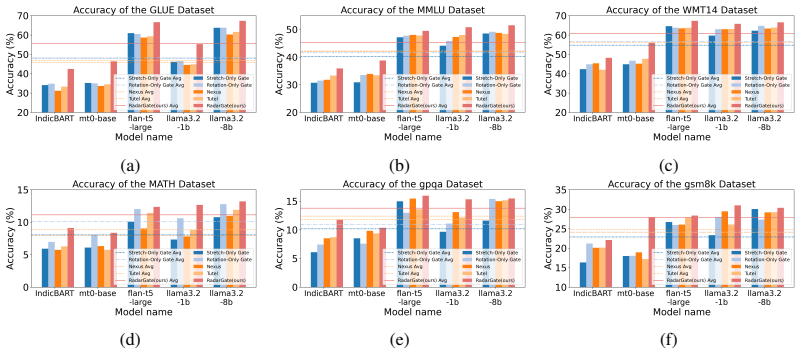
- Scaling LoRA-MoE to 40 experts no longer follows the inverted-U pattern of baseline gates: RadarGate reports near-monotonic improvement with up to an 8% accuracy gain over the best baselines.
- The rotation gate adds asymptotically negligible overhead—computational and memory complexity stay at the same order as existing gating methods—so the scalability gain does not come at a cost in efficiency.
- The rotation behavior is contrastive: semantically similar LoRA representations are pulled together while distant ones are pushed apart, which the paper links to faster and more stable convergence of the gating network.
- RadarGate also sustains a 5–10% advantage over baselines as the base model grows from 110M to 8B parameters, and in low-sample regimes (50 training samples).
Reading between the lines
- The same geometric degree-of-freedom argument could apply to any weighted-sum ensemble of vectors—task-vector merging, adapter stacking, or multi-modal adapter fusion—so a natural extension is testing whether input-dependent rotations before combination give comparable scaling benefits there.
- A control experiment that swaps the rotation matrices for equal-parameter input-dependent linear maps (without orthogonality) would separate the 'rotation as geometry' explanation from mere added capacity; the paper does not run this control.
- The contrastive alignment the authors observe suggests a regularizer on the rotation angles could explicitly encourage semantic separation between LoRA experts, making the gate's routing decisions more interpretable.
- The per-input reachability gap (union vs. own cone) is testable: recording achieved vs. required outputs per held-out input would show whether the generalization gain actually comes from rotation-expanded reachability or from the extra parameters acting as a more flexible interaction layer.
Editorial analysis
A structured set of objections, weighed in public.
Referee Report
Summary. The paper proposes RadarGate, a gating mechanism for LoRA-MoE that rotates LoRA output vectors through input-dependent relative angles (RotationGate) before weighting them (StretchGate). The motivation is that standard convex-combination gating restricts outputs to a fixed convex cone, causing underfitting and poor generalization when LoRA experts scale. The authors prove two lemmas: nested hypothesis spaces reduce fitting error, and the union of rotated dynamic cones strictly contains the fixed cone. They evaluate on GLUE, MMLU, WMT14, MATH, GSM8K, and GPQA across HydraLoRA, MoLE, and OMoE architectures, and report improvements in fitting, generalization, scaling, convergence, and low-sample settings.
Significance. The idea of adding rotational degrees of freedom to LoRA-MoE gating is original and easy to implement, and the complexity analysis suggests low overhead. If the theoretical claim were established and the empirical results robust, this would be a modest but useful contribution to parameter-efficient fine-tuning. The paper ships no code yet, and the main theoretical argument currently has a quantifier gap; the empirical tables are not as uniformly favorable as the text claims. With repair of the theory and more careful evaluation, the work could become a solid contribution.
major comments (3)
- [§4.2 and Appendix C.3] Lemma 2 proves only that the union over all inputs of the dynamic cones H′(x) strictly contains the fixed cone H. For a fixed test input x, however, the model's output is confined to the single dynamic cone H′(x), not to the union over other inputs, so the sentence “Thus Δytarget ∈ ∪x H′(x)\H can still be fitted” does not follow. Appendix C.3 repeats the same union quantifier and relies on a “core idea” transfer instead of a proof. Since rotations preserve norms, every H′(x) lies in the ball of radius max_i ‖v_i‖; targets outside that ball are unreachable at every input, so “outside H” is not sufficient for fitting. Please either prove per-input reachability or substantially temper the theoretical generalization claim.
- [Table 1 and §5.3 Obs.❷] The claim of 5–10% improvements over learnable baselines is contradicted by the reported numbers. On SST-2 under the first learnable-architecture block, Nexus achieves 70.67% while RadarGate reports 48.69%, and under the second block RadarGate's 56.30% trails Nexus's 57.33%; similar non-improvements appear on QNLI, RTE, and several MMLU rows. The text says RadarGate is best on 'over 90% of tasks,' but Table 1 does not support this. Please provide per-architecture aggregate win rates and clarify which columns belong to which architecture.
- [§5.1 and §5.3] All results are single point estimates with no standard deviations, number of seeds, or significance tests. Many reported differences are only 1–2 percentage points, so the load-bearing empirical claim that RadarGate sustains performance at larger scales needs uncertainty quantification before it can be accepted.
minor comments (5)
- [§5.3] Figure 3 references in Section 5.3 appear as unresolved '(??)' placeholders; all figure citations need to be corrected.
- [§4.3 and Appendix C.4] Equation (10) uses 'O r' and 'O s' while Equation (40) defines Or and Os with subscript notation; please make the notation consistent and state explicitly which complexity is for RadarGate.
- [§4.1] The statement that 'the absolute value of the angle is meaningless, and only the relative value of the rotation angle matters' is an unproved axiom; please either formalize the relative-angle invariance or report an experiment that tests it.
- [Table 1] Table 1's merged-column layout makes it difficult to determine which gating method is evaluated under which LoRA architecture; please reformat with clear column spans.
- [§5.4] The case study reports angle and weight values from what appears to be a single run; it should be labeled as illustrative rather than as statistical evidence.
Circularity Check
No significant circularity: the theoretical lemmas are tautological or geometric but not used as fitted predictions, and no self-citation chain is load-bearing; the generalization argument's quantifier gap is a correctness issue, not circularity.
full rationale
The paper's derivation chain contains no step that reduces to its own inputs. Lemma 1 (Section 4.2, proof in Appendix C.1) restates that a larger hypothesis space cannot have a larger optimal fitting error; this is a definitional property, but the paper independently establishes K_gate ⊆ K_ours by the explicit θ_r=0 construction in Appendix C.2, so the containment is not assumed from the lemma. Lemma 2 is a geometric statement about unions of rotated convex hulls; its proof is self-contained and does not presuppose the fitting claim. The load-bearing use of Lemma 2 in Section 4.2 ('Thus Δytarget ∈ ∪_x H′(x)\H can still be fitted') is logically too strong: for a fixed test input x the model output lies in H′(x), not in the union over all inputs, so membership in the union does not by itself establish reachability at x. This is a non-circular logical gap in the generalization argument, and Appendix C.3 partially acknowledges it ('Although the original statement of the lemma is for fixed vi, the core idea...'). The empirical evaluation is independent: the gating methods are trained on FLAN subsets and evaluated on held-out GLUE, MMLU, WMT14, MATH, GSM8K, and GPQA benchmarks, with no test-set fitting or relabeled prediction. There are no load-bearing self-citations, no imported uniqueness theorem, and no ansatz smuggled in by citation. Accordingly, the circularity score is 0; any concern about the generalization proof belongs to correctness risk rather than circularity.
Assumptions & free parameters
free parameters (6)
- θr (rotation angle projection) =
learned from data
- θs (gate weight projection) =
learned from data
- top-k =
2 in main results (Table 1)
- temperature τ =
not specified
- LoRA rank r and α =
r=8, α=32
- low-rank factorization dim r_a for θr =
not specified
assumptions (5)
- standard math Rotation matrices are orthogonal and norm-preserving (Eq. 7 and Eq. 19).
- standard math Convex hull properties: non-negative weights summing to 1 confine outputs to the convex cone (Eq. 3).
- domain assumption The ideal target modification Δy_target can be expressed as a convex combination of LoRA outputs (Eq. 2).
- domain assumption Pretrained weights and LoRA matrices are frozen; only gating parameters are trained.
- ad hoc to paper The absolute value of the angle is meaningless, and only the relative value of the rotation angle matters.
Cite this review
Pith. "Pith review of Two Is Better Than One: Rotations Scale LoRAs." pith.science (2026). https://pith.science/paper/DFRKANLC
@misc{pith2026250523184,
  author       = {Pith},
  title        = {Pith review of: Two Is Better Than One: Rotations Scale LoRAs},
  year         = {2026},
  howpublished = {\url{https://pith.science/paper/DFRKANLC}},
  note         = {Machine review of arXiv:2505.23184}
}
read the original abstract
Scaling Low-Rank Adaptation (LoRA)-based Mixture-of-Experts (MoE) facilitates large language models (LLMs) to efficiently adapt to diverse tasks. However, traditional gating mechanisms that route inputs to the best experts may fundamentally hinder LLMs' scalability, leading to poor generalization and underfitting issues. We identify that the root cause lies in the restricted expressiveness of existing weighted-sum mechanisms, both within and outside the convex cone of LoRA representations. This motivates us to propose RadarGate, a novel geometrically inspired gating method that introduces rotational operations of LoRAs representations to boost the expressiveness and facilitate richer feature interactions among multiple LoRAs for scalable LLMs. Specifically, we first fuse each LoRA representation to other LoRAs using a learnable component and then feed the output to a rotation matrix. This matrix involves learnable parameters that define the relative angular relationship between LoRA representations. Such a simple yet effective mechanism provides an extra degree of freedom, facilitating the learning of cross-LoRA synergies and properly tracking the challenging poor generalization and underfitting issues as the number of LoRA grows. Extensive experiments on 6 public benchmarks across 21 tasks show the effectiveness of our RadarGate for scaling LoRAs. We also provide valuable insights, revealing that the rotations to each pair of representations are contrastive, encouraging closer alignment of semantically similar representations during geometrical transformation while pushing distance ones further apart. We will release our code to the community.
Figures


Figures from the paper (13 more)




Reference graph
Works this paper leans on
-
[1]
Mtlora: Low-rank adaptation approach for efficient multi-task learning
Agiza, A., Neseem, M., and Reda, S. Mtlora: Low-rank adaptation approach for efficient multi-task learning. InProceedings of the IEEE/CVF Conference on Computer Vision and Pattern Recognition (CVPR), 2024
work page 2024
-
[2]
Aminabadi, R. Y ., Rajbhandari, S., Awan, A. A., Li, C., Li, D., Zheng, E., Ruwase, O., Smith, S., Zhang, M., Rasley, J., et al. Deepspeed-inference: enabling efficient inference of transformer models at unprecedented scale. InSC22: International Conference for High Performance Computing, Networking, Storage and Analysis, 2022
work page 2022
-
[3]
B, G. and Purwar, A. Evaluating the efficacy of open-source llms in enterprise-specific RAG systems: A comparative study of performance and scalability.CoRR, 2024
work page 2024
-
[4]
Bojar, O., Buck, C., Federmann, C., Haddow, B., Koehn, P., Leveling, J., Monz, C., Pecina, P., Post, M., Saint-Amand, H., Soricut, R., Specia, L., and Tamchyna, A. s. Findings of the 2014 workshop on statistical machine translation. InProceedings of the Ninth Workshop on Statistical Machine Translation, 2014
work page 2014
-
[5]
Deepseek-r1: Incentivizing reasoning capability in llms via reinforcement learning, 2025
DeepSeek-AI. Deepseek-r1: Incentivizing reasoning capability in llms via reinforcement learning, 2025
2025
-
[6]
Omoe: Diversifying mixture of low-rank adaptation by orthogonal finetuning
Feng, J., Pu, Z., Hu, T., Li, D., Ai, X., and Wang, H. Omoe: Diversifying mixture of low-rank adaptation by orthogonal finetuning. 2025
work page 2025
-
[7]
Nexus: Specialization meets adaptability for efficiently training mixture of experts.CoRR, 2024
Gritsch, N., Zhang, Q., Locatelli, A., Hooker, S., and ¨Ust¨un, A. Nexus: Specialization meets adaptability for efficiently training mixture of experts.CoRR, 2024
work page 2024
-
[8]
Fusemoe: Mixture-of- experts transformers for fleximodal fusion
Han, X., Nguyen, H., Harris, C., Ho, N., and Saria, S. Fusemoe: Mixture-of- experts transformers for fleximodal fusion. In Globersons, A., Mackey, L., Bel- grave, D., Fan, A., Paquet, U., Tomczak, J. M., and Zhang, C. (eds.),Advances in Neural Information Processing Systems 38: Annual Conference on Neural Informa- tion Processing Systems 2024, NeurIPS 202...
work page 2024
Show all 35 references
-
[9]
Fastmoe: A fast mixture-of-expert training system.arXiv preprint arXiv:2103.13262, 2021
He, J., Qiu, J., Zeng, A., Yang, Z., Zhai, J., and Tang, J. Fastmoe: A fast mixture-of-expert training system.arXiv preprint arXiv:2103.13262, 2021
2021 arXiv
-
[10]
Mea- suring massive multitask language understanding.Proceedings of the International Conference on Learning Representations (ICLR), 2021
Hendrycks, D., Burns, C., Basart, S., Zou, A., Mazeika, M., Song, D., and Steinhardt, J. Mea- suring massive multitask language understanding.Proceedings of the International Conference on Learning Representations (ICLR), 2021
2021
-
[11]
J., yelong shen, Wallis, P., Allen-Zhu, Z., Li, Y ., Wang, S., Wang, L., and Chen, W
Hu, E. J., yelong shen, Wallis, P., Allen-Zhu, Z., Li, Y ., Wang, S., Wang, L., and Chen, W. LoRA: Low-Rank Adaptation of Large Language Models. InInternational Conference on Learning Representations, 2022
2022
-
[12]
Y ., Pang, T., Du, C., and Lin, M
Huang, C., Liu, Q., Lin, B. Y ., Pang, T., Du, C., and Lin, M. Lorahub: Efficient cross-task generalization via dynamic loRA composition. InFirst Conference on Language Modeling, 2024. 10
2024
-
[13]
Tutel: Adaptive mixture-of-experts at scale.Proceedings of Machine Learning and Systems, 2023
Hwang, C., Cui, W., Xiong, Y ., Yang, Z., Liu, Z., Hu, H., Wang, Z., Salas, R., Jose, J., Ram, P., et al. Tutel: Adaptive mixture-of-experts at scale.Proceedings of Machine Learning and Systems, 2023
2023
-
[14]
Pre-gated MoE: An Algorithm-System Co-Design for Fast and Scalable Mixture-of-Expert Inference
Hwang, R., Wei, J., Cao, S., Hwang, C., Tang, X., Cao, T., Yang, M., and Rhu, M. Pre-gated MoE: An Algorithm-System Co-Design for Fast and Scalable Mixture-of-Expert Inference. 2024 ACM/IEEE 51st Annual International Symposium on Computer Architecture (ISCA), 2023
2024
-
[15]
T., Wortsman, M., Schmidt, L., Hajishirzi, H., and Farhadi, A
Ilharco, G., Ribeiro, M. T., Wortsman, M., Schmidt, L., Hajishirzi, H., and Farhadi, A. Editing models with task arithmetic. InThe Eleventh International Conference on Learning Representa- tions, ICLR 2023, Kigali, Rwanda, May 1-5, 2023, 2023
2023
-
[16]
A., Jordan, M
Jacobs, R. A., Jordan, M. I., Nowlan, S. J., and Hinton, G. E. Adaptive mixtures of local experts. Neural computation, 1991
1991
-
[17]
Matrix-transformation based low-rank adapta- tion (mtlora): A brain-inspired method for parameter-efficient fine-tuning.arXiv preprint arXiv:2403.07440, 2024
Liang, Y ., Wang, Y ., Li, Y ., and Zeng, Y . Matrix-transformation based low-rank adapta- tion (mtlora): A brain-inspired method for parameter-efficient fine-tuning.arXiv preprint arXiv:2403.07440, 2024
2024 arXiv
-
[18]
Let’s verify step by step.arXiv preprint arXiv:2305.20050, 2023
Lightman, H., Kosaraju, V ., Burda, Y ., Edwards, H., Baker, B., Lee, T., Leike, J., Schulman, J., Sutskever, I., and Cobbe, K. Let’s verify step by step.arXiv preprint arXiv:2305.20050, 2023
2023 arXiv
-
[19]
Scaling laws for fine-grained mixture of experts
Ludziejewski, J., Krajewski, J., Adamczewski, K., Pi´oro, M., Krutul, M., Antoniak, S., Ciebiera, K., Kr ´ol, K., Odrzyg ´o´zd´z, T., Sankowski, P., Cygan, M., and Jaszczur, S. Scaling laws for fine-grained mixture of experts. InICLR 2024 Workshop on Mathematical and Empirical...
2024
-
[20]
Lsh-moe: Communication-efficient moe training via locality-sensitive hashing
Nie, X., Liu, Q., Fu, F., Zhu, S., Miao, X., Li, X., Zhang, Y ., Liu, S., and Cui, B. Lsh-moe: Communication-efficient moe training via locality-sensitive hashing. InAd- vances in Neural Information Processing Systems 38: Annual Conference on Neural In- formation Processing Sy...
2024
-
[21]
Mode: Effective multi-task parameter efficient fine-tuning with a mixture of dyadic experts.arXiv preprint arXiv:2408.01505, 2024
Ning, L., Lara, H., Guo, M., and Rastogi, A. Mode: Effective multi-task parameter efficient fine-tuning with a mixture of dyadic experts.arXiv preprint arXiv:2408.01505, 2024
2024 arXiv
-
[22]
M., Charlin, L., Roux, N
Ostapenko, O., Su, Z., Ponti, E. M., Charlin, L., Roux, N. L., Caccia, L., and Sordoni, A. Towards modular llms by building and reusing a library of loras. InForty-first International Conference on Machine Learning, ICML 2024, Vienna, Austria, July 21-27, 2024, 2024
2024
-
[23]
L., Stickland, A
Rein, D., Hou, B. L., Stickland, A. C., Petty, J., Pang, R. Y ., Dirani, J., Michael, J., and Bowman, S. R. GPQA: A graduate-level google-proof q&a benchmark. InFirst Conference on Language Modeling, 2024
2024
-
[24]
V ., Hinton, G
Shazeer, N., Mirhoseini, A., Maziarz, K., Davis, A., Le, Q. V ., Hinton, G. E., and Dean, J. Outrageously large neural networks: The sparsely-gated mixture-of-experts layer. In5th International Conference on Learning Representations, ICLR 2017, Toulon, France, April 24-26, 201...
2017
-
[25]
D., Ng, A., and Potts, C
Socher, R., Perelygin, A., Wu, J., Chuang, J., Manning, C. D., Ng, A., and Potts, C. Recursive deep models for semantic compositionality over a sentiment treebank. InProceedings of EMNLP, 2013
2013
-
[26]
Hydralora: An asymmetric lora architecture for efficient fine-tuning.arXiv preprint arXiv:2404.19245, 2024
Tian, C., Shi, Z., Guo, Z., Li, L., and Xu, C. Hydralora: An asymmetric lora architecture for efficient fine-tuning.arXiv preprint arXiv:2404.19245, 2024
2024 arXiv
-
[27]
W., Lester, B., Du, N., Dai, A
Wei, J., Bosma, M., Zhao, V ., Guu, K., Yu, A. W., Lester, B., Du, N., Dai, A. M., and Le, Q. V . Finetuned language models are zero-shot learners. InInternational Conference on Learning Representations, 2022
2022
-
[28]
Mixture of lora experts
Wu, X., Huang, S., and Wei, F. Mixture of lora experts. InThe Twelfth International Conference on Learning Representations, ICLR 2024, Vienna, Austria, May 7-11, 2024, 2024. 11
2024
-
[29]
Flex-moe: Modeling arbitrary modality combination via the flexible mixture- of-experts
Yun, S., Choi, I., Peng, J., Wu, Y ., Bao, J., Zhang, Q., Xin, J., Long, Q., and Chen, T. Flex-moe: Modeling arbitrary modality combination via the flexible mixture- of-experts. 2024. URL http://papers.nips.cc/paper_files/paper/2024/hash/ b2f2af5403042b1344f4e93b35fb67d9-Abstr...
2024
-
[30]
Composing parameter-efficient modules with arithmetic operations.ArXiv, 2023
Zhang, J., Chen, S., Liu, J., and He, J. Composing parameter-efficient modules with arithmetic operations.ArXiv, 2023
2023
-
[31]
Galore: Memory- efficient LLM training by gradient low-rank projection
Zhao, J., Zhang, Z., Chen, B., Wang, Z., Anandkumar, A., and Tian, Y . Galore: Memory- efficient LLM training by gradient low-rank projection. InForty-first International Conference on Machine Learning, ICML 2024, Vienna, Austria, July 21-27, 2024, 2024
2024
-
[32]
Multi-lora composition for image generation.CoRR, 2024
Zhong, M., Shen, Y ., Wang, S., Lu, Y ., Jiao, Y ., Ouyang, S., Yu, D., Han, J., and Chen, W. Multi-lora composition for image generation.CoRR, 2024
2024
-
[33]
M., Le, Q
Zhou, Y ., Lei, T., Liu, H., Du, N., Huang, Y ., Zhao, V ., Dai, A. M., Le, Q. V ., Laudon, J., et al. Mixture-of-experts with expert choice routing.Advances in Neural Information Processing Systems, 2022
2022
-
[34]
Y ., Dai, A
Zhou, Y ., Lei, T., Liu, H., Du, N., Huang, Y ., Zhao, V . Y ., Dai, A. M., Chen, Z., Le, Q. V ., and Laudon, J. Mixture-of-experts with expert choice routing. In Koyejo, S., Mohamed, S., Agarwal, A., Belgrave, D., Cho, K., and Oh, A. (eds.),Advances in Neural Information Proc...
2022
-
[35]
Uni-perceiver-moe: Learning sparse generalist models with conditional moes
Zhu, J., Zhu, X., Wang, W., Wang, X., Li, H., Wang, X., and Dai, J. Uni-perceiver-moe: Learning sparse generalist models with conditional moes. In Koyejo, S., Mohamed, S., Agarwal, A., Belgrave, D., Cho, K., and Oh, A. (eds.),Advances in Neural Information Processing Systems 3...
2022
Reviewed August 7, 2026 · model on record in the stance chip above.
Discussion (0). Sign in to comment.