REVIEW 4 major objections 4 minor 47 references
SAMamba: Adaptive State Space Modeling with Hierarchical Vision for Infrared Small Target Detection
T0 review · 4 major / 4 minor · reviewed 2026-08-07 · deepseek-v4-flash
Pith's one-line read SAMamba claims state-of-the-art infrared small-target detection on three public benchmarks by pairing SAM2's frozen hierarchical encoder with Mamba's selective state-space modeling.
desk verdict Plausible new SOTA for infrared small target detection, but the comparison protocol against baselines is underspecified and must be checked. read the letter →
The pith
A machine-rendered reading of the paper's core claim, the machinery that carries it, and where it could break.
The reading
What carries the argument
The load-bearing machinery is a three-part adaptation of a frozen SAM2 encoder. The FS-Adapter re-weights tokens by cosine similarity to a learnable task embedding and then mixes channels through a learned matrix, inserted before each Hiera block to close the natural-to-infrared gap. The CSI module splits skip-connection features into four channel groups, runs each through a Vision Mamba state-space block, recombines same-index channels across groups, and applies channel and spatial attention, giving global context at linear cost. The DPCF module upsamples deep features and uses a single learnable scalar expanded into spatial-channel gates to fuse high- and low-resolution segments, so the network can choose detail versus context per location.
What would settle it
Retrain ISNet, HCFNet, and UIUNet with SAMamba's exact training recipe, including 1024x1024 dynamic crops, Adam, and SoftIoU plus Dice plus Focal loss for 300 epochs, then compare on NUAA-SIRST; if their IoU climbs to within about one point of SAMamba's 81.08, the claimed architectural advantage is a protocol artifact, whereas a persistent gap of several points would support the central claim.
Extended reading notes
Core claim
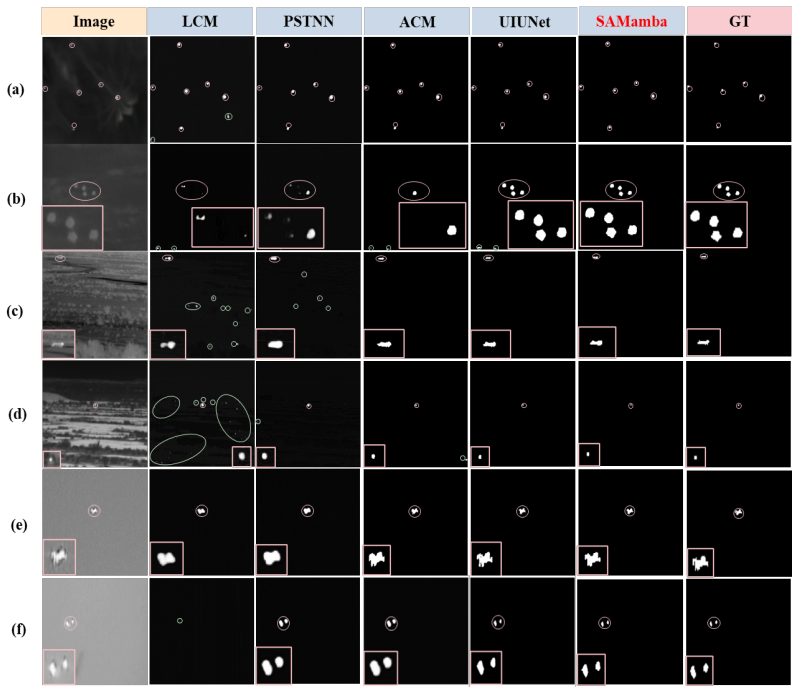
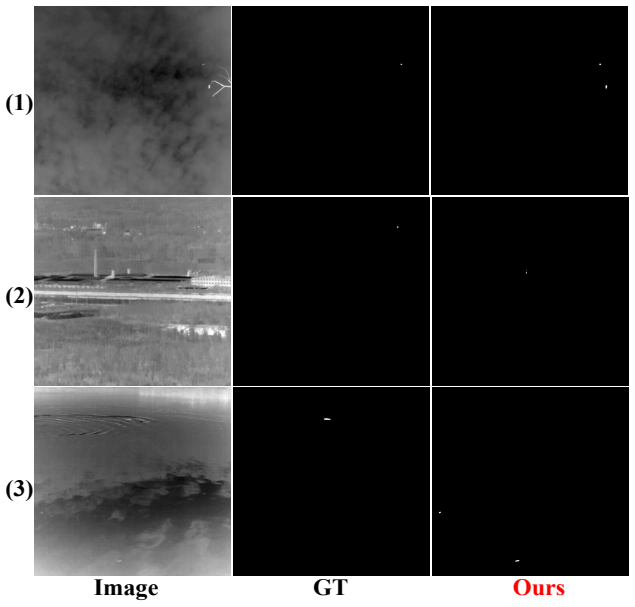
The paper's central claim is that SAMamba, a U-Net with a frozen SAM2 Hiera-S encoder and three lightweight modules, achieves the best published results on NUAA-SIRST, IRSTD-1k, and NUDT-SIRST across IoU, nIoU, and F1. On NUAA-SIRST it reports 81.08% IoU, 79.17% nIoU, and 89.55% F1; on IRSTD-1k 73.53% IoU, 68.99% nIoU, and 84.75% F1; on NUDT-SIRST 93.13% IoU, 93.15% nIoU, and 96.44% F1. The authors attribute the gains to domain adaptation via the FS-Adapter, long-range context via the CSI module's Mamba-based state-space interaction, and detail preservation via DPCF's adaptive gating fusion.
Load-bearing premise
The load-bearing premise is that the baseline methods in Table 1 were trained and evaluated under the same protocol as SAMamba, including 1024x1024 resolution, dynamic cropping, Adam optimization, and the combined SoftIoU plus Dice plus Focal loss; if the published baseline numbers used a different protocol, the reported margins could reflect training conditions rather than the architecture.
Editorial extensions
If this is right
- A frozen SAM2 Hiera-S encoder, adapted by lightweight modules, is sufficient to beat fully trained CNN detectors on three ISTD benchmarks.
- The Mamba-based CSI module's linear-complexity global context modeling is a practical alternative to attention for high-resolution infrared inputs.
- The component ablations attribute the improvement to each module: +0.89 IoU from FS-Adapter, +2.47 from CSI, and +2.28 from DPCF over the Hiera-based baseline.
- At 1024x1024 input, SAMamba's 37.18M-parameter Hiera-S variant runs at 6.39 FPS on an RTX 3090, comparable to ISNet and HCFNet while reporting higher accuracy.
- Domain adaptation through token-level selection plus channel mixing can be reused in other tasks that use a frozen foundation-model encoder on a different imaging modality.
Reading between the lines
- Editorial inference: if the protocol-matched comparison confirms the margins, the FS-Adapter design could transfer directly to other low-contrast or non-visible-spectrum tasks, such as radar or hyperspectral segmentation, where only small labeled sets exist.
- Editorial inference: the paper's own limitation analysis suggests the next testable extension is video, where feeding temporal frames through the same CSI state-space blocks could exploit motion cues, a direction the authors mention as future work.
- Editorial inference: because DPCF uses a single scalar expanded to gates, replacing it with per-channel learned gates might further improve fusion on heterogeneous backgrounds; this is a cheap experiment the paper does not run.
- Editorial inference: the large gain on NUDT-SIRST (93.13 IoU) relative to CNN baselines may reflect the synthetic dataset's clean target shapes, so a real-world low-SCR benchmark would clarify whether the architecture's advantage persists under sensor noise.
Editorial analysis
A structured set of objections, weighed in public.
Referee Report
Summary. The paper proposes SAMamba, an infrared small target detection (ISTD) architecture that combines a frozen SAM2 Hiera-S backbone with a new Feature Selection Adapter (FS-Adapter), a Cross-Channel State-Space Interaction (CSI) module based on Vision Mamba in the skip connections, and a Detail-Preserving Contextual Fusion (DPCF) module in the decoder. The method is evaluated on three ISTD benchmarks (NUAA-SIRST, IRSTD-1k, NUDT-SIRST) with IoU, nIoU, and F1 metrics. The authors report state-of-the-art results on all three datasets, together with component ablations, hyperparameter sensitivity studies, and a computational analysis. The central empirical claim is that SAMamba consistently outperforms prior methods, with margins of roughly 1 IoU point over ISNet and HCFNet on NUAA-SIRST and larger margins on IRSTD-1k and NUDT-SIRST.
Significance. If the reported comparisons are fair, SAMamba would be a credible new state of the art for ISTD on the three chosen benchmarks. The paper has several concrete strengths: it releases code, performs systematic ablations that isolate each module's contribution with monotonic gains, includes sensitivity analyses for internal hyperparameters, and provides an explicit computational analysis. The architectural combination of SAM2's hierarchical features with Mamba-based sequence modeling is sensible and timely. However, the significance of the central claim is currently weakened by incomplete evidence about the fairness of the baseline comparisons, by a formal inconsistency in the description of the DPCF gating mechanism, and by the absence of any statistical validation. These issues do not invalidate the general approach, but they need to be resolved before the state-of-the-art claim can be accepted.
major comments (4)
- [§4.1 and Table 1] The central claim in §4.3 that SAMamba 'consistently achieves state-of-the-art performance across all three datasets and all three evaluation metrics' rests on Table 1. SAMamba is trained at 1024×1024 resolution with dynamic scaling/cropping, Adam (lr 1e-4), 300 epochs, batch size 2, and a combined SoftIoU+Dice+Focal loss. The paper does not state whether any baseline was retrained under this protocol, and the original ISNet, UIUNet, and HCFNet papers use different resolutions (commonly 512×512) and different training recipes. Figure 6(a) shows that resolution alone can change IoU by several points, so the ~1-point margins on NUAA-SIRST (+1.06 over ISNet, +0.99 over HCFNet) may reflect protocol differences rather than architectural superiority. Please specify the exact source of every baseline number in Table 1 (original publication vs. reimplementation), and if numbers are copied, retrain the main baselines under the same protocol or report both original and matched-protocol results. The same concern applies to Table 4, where baseline FLOPs are reported for a 1024×1024 input without evidence that the baselines were configured and run at that resolution.
- [§3.5, Eqs. (13)-(14)] The DPCF module is described as a 'learnable, spatially-adaptive gating mechanism,' but the formal description does not support that claim. A single learnable parameter α' ∈ R^{1×1×1} is introduced and then expanded spatially and channel-wise to α ∈ R^{H×W×C/4}. Expanding a scalar produces a tensor in which all entries are identical, so β = sigmoid(α) is a single scalar value, not a per-location per-channel gate. This contradicts the subsequent statement that the network learns weights 'for each spatial location and channel group.' Please clarify the actual parameterization: either α is a learned tensor with spatial and channel dimensions, in which case the text should say so and Table 4's parameter counts should be updated accordingly, or the gating is a scalar fusion weight, in which case the 'spatially-adaptive' language and the ablation claims in Table 3(c) need to be revised.
- [§3.3, Eqs. (6)-(7)] The dimensions in the FS-Adapter token-selection step are inconsistent. F'_t ∈ R^{HW×C} and ξ ∈ R^C, but t_i is written as belonging to R^{HW} while the index i is ranged to C. If t_i is a token vector of length C, the index should run over HW and the notation should be changed accordingly; if t_i is a per-channel spatial map, the cosine similarity sim(t_i, ξ) is undefined because the two arguments have different dimensions. The intended mechanism is recoverable, but the formal description is not self-consistent and should be corrected before the module can be implemented or evaluated from the paper alone.
- [§4.4 and Table 1] All main results and ablations are reported as point estimates with no error bars, multiple seeds, or statistical significance tests. The headline margins over ISNet and HCFNet on NUAA-SIRST are only about 1 IoU point, and Figure 6(a) shows that experimental conditions such as input resolution can shift performance by several points. Please report the mean and standard deviation over at least three seeds for the main comparison in Table 1 and for the component ablation in Table 2, and state whether the observed component-wise gains are stable across seeds. This is necessary to support the word 'consistent' in the central claim.
minor comments (4)
- [§3.6, Eq. (16)] The variable names in Eq. (16) are reversed relative to standard convention: the text says 'ŷ represents the ground truth, y is the predicted mask,' but the usual notation is that y is the ground truth and ŷ is the prediction. Please swap the definitions or the symbols for clarity.
- [References] The UIUNet reference appears twice, once as Wu et al. (2022) and once as Wu et al. (2023), for what appears to be the same paper. Please consolidate the duplicate entry.
- [Table 4] The dagger symbol (†) next to ISNet in Table 4 is not explained in the table caption or the text. Please add a footnote describing what it indicates.
- [§4.4, Figure 6(c)] The sentence explaining why Hiera-L degrades performance says this is 'likely due to overfitting on the relatively small ISTD datasets,' but no evidence such as training/validation curves or regularization settings is provided. Please either qualify this as a hypothesis or support it with data.
Circularity Check
No derivation-level circularity; the SOTA claim is an external empirical comparison, with only a minor non-load-bearing self-citation and a mild NUAA-SIRST hyperparameter selection loop.
full rationale
Walking the claimed derivation chain, SAMamba's three components are specified as explicit forward computations (Eqs. 6-15) and are evaluated against external ground-truth benchmarks (NUAA-SIRST, IRSTD-1k, NUDT-SIRST) with standard metrics and a standard combined SoftIoU+Dice+Focal loss; the central SOTA claim in Section 4.3 is an empirical comparison, not a quantity derived by construction from the model's own definitions. The self-citation to HCFNet (Xu et al., 2024) appears only as related-work context and as a Table 1 baseline; no load-bearing argument, uniqueness theorem, or ansatz is imported from it, so this is not circular. One in-scope concern is that Section 4.4 selects the default CSI head count (4) and DPCF segment count (4) by maximizing IoU on the same NUAA-SIRST dataset whose 81.08% IoU is then reported as the headline in Table 1; this is a mild evaluation-selection loop that should be disclosed, and it makes the NUAA-SIRST margin optimistic rather than out-of-sample. It is not, however, a construction-level circularity, because the reported number is a measured outcome of training a fixed architecture, not the selection criterion itself, and the IRSTD-1k and NUDT-SIRST results are not part of that selection. Baseline comparability at 1024x1024 resolution (Section 4.1 vs Table 1) is a protocol-fairness question rather than a circularity question. Overall, the derivation is self-contained against external benchmarks, and the only circularity-adjacent issues are minor.
Assumptions & free parameters
free parameters (4)
- CSI heads =
4
- DPCF segments =
4
- DPCF gating scalar alpha' =
learned per fusion stage
- Input resolution =
1024x1024
assumptions (4)
- domain assumption Pre-trained SAM2 Hiera features trained on natural images transfer to infrared small targets via lightweight adapters.
- domain assumption The U-Net encoder-decoder with skip connections is an appropriate base architecture for ISTD.
- standard math The Mamba/ViM state-space formulation (Eq. 2-4) is correct and stable as used in the CSI module.
- domain assumption The reported benchmark splits are respected and the test sets are not used for model selection.
Cite this review
Pith. "Pith review of SAMamba: Adaptive State Space Modeling with Hierarchical Vision for Infrared Small Target Detection." pith.science (2026). https://pith.science/paper/ZPRMNEBS
@misc{pith2026250523214,
  author       = {Pith},
  title        = {Pith review of: SAMamba: Adaptive State Space Modeling with Hierarchical Vision for Infrared Small Target Detection},
  year         = {2026},
  howpublished = {\url{https://pith.science/paper/ZPRMNEBS}},
  note         = {Machine review of arXiv:2505.23214}
}
read the original abstract
Infrared small target detection (ISTD) is vital for long-range surveillance in military, maritime, and early warning applications. ISTD is challenged by targets occupying less than 0.15% of the image and low distinguishability from complex backgrounds. Existing deep learning methods often suffer from information loss during downsampling and inefficient global context modeling. This paper presents SAMamba, a novel framework integrating SAM2's hierarchical feature learning with Mamba's selective sequence modeling. Key innovations include: (1) A Feature Selection Adapter (FS-Adapter) for efficient natural-to-infrared domain adaptation via dual-stage selection (token-level with a learnable task embedding and channel-wise adaptive transformations); (2) A Cross-Channel State-Space Interaction (CSI) module for efficient global context modeling with linear complexity using selective state space modeling; and (3) A Detail-Preserving Contextual Fusion (DPCF) module that adaptively combines multi-scale features with a gating mechanism to balance high-resolution and low-resolution feature contributions. SAMamba addresses core ISTD challenges by bridging the domain gap, maintaining fine-grained details, and efficiently modeling long-range dependencies. Experiments on NUAA-SIRST, IRSTD-1k, and NUDT-SIRST datasets show SAMamba significantly outperforms state-of-the-art methods, especially in challenging scenarios with heterogeneous backgrounds and varying target scales. Code: https://github.com/zhengshuchen/SAMamba.
Figures


Figures from the paper (4 more)


Reference graph
Works this paper leans on
-
[1]
write newline
" write newline "" before.all 'output.state := FUNCTION n.dashify 't := "" t empty not t #1 #1 substring "-" = t #1 #2 substring "--" = not "--" * t #2 global.max substring 't := t #1 #1 substring "-" = "-" * t #2 global.max substring 't := while if t #1 #1 substring * t #2 global.max substring 't := if while FUNCTION word.in bbl.in ":" * " " * FUNCTION f...
-
[2]
write newline
" write newline "" before.all 'output.state := FUNCTION n.dashify 't := "" t empty not t #1 #1 substring "-" = t #1 #2 substring "--" = not "--" * t #2 global.max substring 't := t #1 #1 substring "-" = "-" * t #2 global.max substring 't := while if t #1 #1 substring * t #2 global.max substring 't := if while FUNCTION word.in bbl.in ":" * " " * FUNCTION f...
-
[3]
write newline
" write newline "" before.all 'output.state := FUNCTION n.dashify 't := "" t empty not t #1 #1 substring "-" = t #1 #2 substring "--" = not "--" * t #2 global.max substring 't := t #1 #1 substring "-" = "-" * t #2 global.max substring 't := while if t #1 #1 substring * t #2 global.max substring 't := if while FUNCTION word.in bbl.in ":" * " " * FUNCTION f...
-
[4]
author Alqaraghuli, S.M. , author Karan, O. , year 2024 . title Using deep learning technology based energy-saving for software defined wireless sensor networks (sdwsn) framework . journal Babylonian Journal of Artificial Intelligence volume 2024 , pages 34--45
work page 2024
-
[5]
author An, G. , author He, A. , author Wang, Y. , author Guo, J. , year 2024 . title Uwmamba: Underwater image enhancement with state space model . journal IEEE Signal Processing Letters
work page 2024
-
[6]
author Chen, C.P. , author Li, H. , author Wei, Y. , author Xia, T. , author Tang, Y.Y. , year 2013 . title A local contrast method for small infrared target detection . journal IEEE transactions on geoscience and remote sensing volume 52 , pages 574--581
work page 2013
-
[7]
author Chen, T. , author Lu, A. , author Zhu, L. , author Ding, C. , author Yu, C. , author Ji, D. , author Li, Z. , author Sun, L. , author Mao, P. , author Zang, Y. , year 2024 . title Sam2-adapter: Evaluating & adapting segment anything 2 in downstream tasks: Camouflage, shadow, medical image segmentation, and more . journal arXiv preprint arXiv:2408.04579
arXiv 2024
-
[8]
author Chen, T. , author Zhu, L. , author Ding, C. , author Cao, R. , author Wang, Y. , author Zhang, S. , author Li, Z. , author Sun, L. , author Zang, Y. , author Mao, P. , year 2023 . title Sam-adapter: Adapting segment anything in underperformed scenes , in: booktitle 2023 IEEE/CVF International Conference on Computer Vision Workshops (ICCVW) , pp. pa...
arXiv 2023
Show all 47 references
-
[9]
, author Wei, Q
author Cheng, Z. , author Wei, Q. , author Zhu, H. , author Wang, Y. , author Qu, L. , author Shao, W. , author Zhou, Y. , year 2024 . title Unleashing the potential of sam for medical adaptation via hierarchical decoding , in: booktitle Proceedings of the IEEE/CVF Conference ...
2024
-
[10]
, author Wu, Y
author Dai, Y. , author Wu, Y. , year 2017 . title Reweighted infrared patch-tensor model with both nonlocal and local priors for single-frame small target detection . journal IEEE journal of selected topics in applied earth observations and remote sensing volume 10 , pages 3752--3767
2017
-
[11]
, author Wu, Y
author Dai, Y. , author Wu, Y. , author Song, Y. , year 2016 . title Infrared small target and background separation via column-wise weighted robust principal component analysis . journal Infrared Physics & Technology volume 77 , pages 421--430
2016
-
[12]
, author Wu, Y
author Dai, Y. , author Wu, Y. , author Zhou, F. , author Barnard, K. , year 2021 a. title Asymmetric contextual modulation for infrared small target detection , in: booktitle Proceedings of the IEEE/CVF Winter Conference on Applications of Computer Vision , pp. pages 950--959
2021
-
[13]
, author Wu, Y
author Dai, Y. , author Wu, Y. , author Zhou, F. , author Barnard, K. , year 2021 b. title Attentional local contrast networks for infrared small target detection . journal IEEE Transactions on Geoscience and Remote Sensing volume 59 , pages 9813--9824 . :10.1109/TGRS.2020.3044958
2021
-
[14]
, author Meng, D
author Gao, C. , author Meng, D. , author Yang, Y. , author Wang, Y. , author Zhou, X. , author Hauptmann, A. , year 2013 . title Infrared patch-image model for small target detection in a single image . journal IEEE Transactions on Image Processing volume 22 , pages 4996--5009
2013
-
[15]
, author Chen, C
author Gao, D. , author Chen, C. , author Zhou, Y. , author Zhang, H. , author Hu, X. , year 2024 . title Ts-sam: Two small steps for sam, one giant leap for abnormal detections , in: booktitle 2024 IEEE International Conference on Multimedia and Expo (ICME) , organization IEE...
2024
-
[16]
, author Dao, T
author Gu, A. , author Dao, T. , year 2023 . title Mamba: Linear-time sequence modeling with selective state spaces . journal arXiv preprint arXiv:2312.00752
2023 arXiv
-
[17]
, author Zhu, Z
author Hui, W. , author Zhu, Z. , author Zheng, S. , author Zhao, Y. , year 2024 . title Endow sam with keen eyes: Temporal-spatial prompt learning for video camouflaged object detection , in: booktitle Proceedings of the IEEE/CVF Conference on Computer Vision and Pattern Reco...
2024
-
[18]
, author Ba, J
author Kingma, D.P. , author Ba, J. , year 2014 . title Adam: A method for stochastic optimization . journal arXiv preprint arXiv:1412.6980
2014 arXiv
-
[19]
, author Mintun, E
author Kirillov, A. , author Mintun, E. , author Ravi, N. , author Mao, H. , author Rolland, C. , author Gustafson, L. , author Xiao, T. , author Whitehead, S. , author Berg, A.C. , author Lo, W.Y. , et al., year 2023 . title Segment anything , in: booktitle Proceedings of the...
2023
-
[20]
, author Xiao, C
author Li, B. , author Xiao, C. , author Wang, L. , author Wang, Y. , author Lin, Z. , author Li, M. , author An, W. , author Guo, Y. , year 2022 . title Dense nested attention network for infrared small target detection . journal IEEE Transactions on Image Processing volume 3...
2022
-
[21]
, author Bao, K
author Lin, F. , author Bao, K. , author Li, Y. , author Zeng, D. , author Ge, S. , year 2024 . title Learning contrast-enhanced shape-biased representations for infrared small target detection . journal IEEE Transactions on Image Processing volume 33 , pages 3047--3058 . :10....
2024
-
[22]
, author He, Z
author Liu, J. , author He, Z. , author Chen, Z. , author Shao, L. , year 2018 . title Tiny and dim infrared target detection based on weighted local contrast . journal IEEE Geoscience and Remote Sensing Letters volume 15 , pages 1780--1784
2018
-
[23]
, author Yang, H
author Liu, J. , author Yang, H. , author Zhou, H.Y. , author Yu, L. , author Liang, Y. , author Yu, Y. , author Zhang, S. , author Zheng, H. , author Wang, S. , year 2024 . title Swin-umamba†: Adapting mamba-based vision foundation models for medical image segmentation . jour...
2024
-
[24]
, author Zhang, T
author Luo, M. , author Zhang, T. , author Wei, S. , author Ji, S. , year 2024 . title Sam-rsis: Progressively adapting sam with box prompting to remote sensing image instance segmentation . journal IEEE Transactions on Geoscience and Remote Sensing
2024
-
[25]
, author Li, F
author Ma, J. , author Li, F. , author Wang, B. , year 2024 . title U-mamba: Enhancing long-range dependency for biomedical image segmentation . journal arXiv preprint arXiv:2401.04722
2024 arXiv
-
[26]
, author Navab, N
author Milletari, F. , author Navab, N. , author Ahmadi, S.A. , year 2016 . title V-net: Fully convolutional neural networks for volumetric medical image segmentation , in: booktitle 2016 fourth international conference on 3D vision (3DV) , organization Ieee . pp. pages 565--571
2016
-
[27]
, author Wang, Y
author Rahman, M.A. , author Wang, Y. , year 2016 . title Optimizing intersection-over-union in deep neural networks for image segmentation , in: booktitle International symposium on visual computing , organization Springer . pp. pages 234--244
2016
-
[28]
, author Gabeur, V
author Ravi, N. , author Gabeur, V. , author Hu, Y.T. , author Hu, R. , author Ryali, C. , author Ma, T. , author Khedr, H. , author R \"a dle, R. , author Rolland, C. , author Gustafson, L. , et al., year 2024 . title Sam 2: Segment anything in images and videos . journal arX...
2024 arXiv
-
[29]
, author Fischer, P
author Ronneberger, O. , author Fischer, P. , author Brox, T. , year 2015 . title U-net: Convolutional networks for biomedical image segmentation , in: booktitle Medical image computing and computer-assisted intervention--MICCAI 2015: 18th international conference, Munich, Ger...
2015
-
[30]
, author Doll \'a r, G
author Ross, T.Y. , author Doll \'a r, G. , year 2017 . title Focal loss for dense object detection , in: booktitle proceedings of the IEEE conference on computer vision and pattern recognition , pp. pages 2980--2988
2017
-
[31]
, author Hu, Y.T
author Ryali, C. , author Hu, Y.T. , author Bolya, D. , author Wei, C. , author Fan, H. , author Huang, P.Y. , author Aggarwal, V. , author Chowdhury, A. , author Poursaeed, O. , author Hoffman, J. , et al., year 2023 . title Hiera: A hierarchical vision transformer without th...
2023
-
[32]
, author Zhou, L
author Wang, H. , author Zhou, L. , author Wang, L. , year 2019 . title Miss detection vs. false alarm: Adversarial learning for small object segmentation in infrared images , in: booktitle Proceedings of the IEEE/CVF International Conference on Computer Vision , pp. pages 8509--8518
2019
-
[33]
, author Wang, C
author Wang, S. , author Wang, C. , author Shi, C. , author Liu, Y. , author Lu, M. , year 2024 . title Mask-guided mamba fusion for drone-based visible-infrared vehicle detection . journal IEEE Transactions on Geoscience and Remote Sensing
2024
-
[34]
, author Park, J
author Woo, S. , author Park, J. , author Lee, J.Y. , author Kweon, I.S. , year 2018 . title Cbam: Convolutional block attention module , in: booktitle Proceedings of the European conference on computer vision (ECCV) , pp. pages 3--19
2018
-
[35]
, author Liu, Y
author Wu, R. , author Liu, Y. , author Liang, P. , author Chang, Q. , year 2024 . title Ultralight vm-unet: Parallel vision mamba significantly reduces parameters for skin lesion segmentation . journal arXiv preprint arXiv:2403.20035
2024 arXiv
-
[36]
, author Hong, D
author Wu, X. , author Hong, D. , author Chanussot, J. , year 2022 . title Uiu-net: U-net in u-net for infrared small object detection . journal IEEE Transactions on Image Processing volume 32 , pages 364--376
2022
-
[37]
, author Hong, D
author Wu, X. , author Hong, D. , author Chanussot, J. , year 2023 . title Uiu-net: U-net in u-net for infrared small object detection . journal IEEE Transactions on Image Processing volume 32 , pages 364--376 . :10.1109/TIP.2022.3228497
2023
-
[38]
, author Wu, Z
author Xiong, X. , author Wu, Z. , author Tan, S. , author Li, W. , author Tang, F. , author Chen, Y. , author Li, S. , author Ma, J. , author Li, G. , year 2024 . title Sam2-unet: Segment anything 2 makes strong encoder for natural and medical image segmentation . journal arX...
2024
-
[39]
, author Zheng, S
author Xu, S. , author Zheng, S. , author Xu, W. , author Xu, R. , author Wang, C. , author Zhang, J. , author Teng, X. , author Li, A. , author Guo, L. , year 2024 . title Hcf-net: Hierarchical context fusion network for infrared small object detection . journal arXiv preprin...
2024 arXiv
-
[40]
, author xun Li, J
author Zeng, M. , author xun Li, J. , author xiao Peng, Z. , year 2006 . title The design of top-hat morphological filter and application to infrared target detection . journal Infrared Physics & Technology volume 48 , pages 67--76
2006
-
[41]
, author Peng, L
author Zhang, L. , author Peng, L. , author Zhang, T. , author Cao, S. , author Peng, Z. , year 2018 . title Infrared small target detection via non-convex rank approximation minimization joint l 2, 1 norm . journal Remote Sensing volume 10 , pages 1821
2018
-
[42]
, author Peng, Z
author Zhang, L. , author Peng, Z. , year 2019 . title Infrared small target detection based on partial sum of the tensor nuclear norm . journal Remote Sensing volume 11 , pages 382
2019
-
[43]
, author Yue, K
author Zhang, M. , author Yue, K. , author Zhang, J. , author Li, Y. , author Gao, X. , year 2022 a. title Exploring feature compensation and cross-level correlation for infrared small target detection , in: booktitle Proceedings of the 30th ACM International Conference on Mul...
2022
-
[44]
, author Zhang, R
author Zhang, M. , author Zhang, R. , author Yang, Y. , author Bai, H. , author Zhang, J. , author Guo, J. , year 2022 b. title Isnet: Shape matters for infrared small target detection , in: booktitle 2022 IEEE/CVF Conference on Computer Vision and Pattern Recognition (CVPR) ,...
2022
-
[45]
, author Zhang, R
author Zhang, M. , author Zhang, R. , author Yang, Y. , author Bai, H. , author Zhang, J. , author Guo, J. , year 2022 c. title Isnet: Shape matters for infrared small target detection , in: booktitle Proceedings of the IEEE/CVF Conference on Computer Vision and Pattern Recogn...
2022
-
[46]
, author Chen, H
author Zhao, S. , author Chen, H. , author Zhang, X. , author Xiao, P. , author Bai, L. , author Ouyang, W. , year 2024 . title Rs-mamba for large remote sensing image dense prediction . journal arXiv preprint arXiv:2404.02668
2024 arXiv
-
[47]
, author Liao, B
author Zhu, L. , author Liao, B. , author Zhang, Q. , author Wang, X. , author Liu, W. , author Wang, X. , year 2024 . title Vision mamba: Efficient visual representation learning with bidirectional state space model . journal arXiv preprint arXiv:2401.09417
2024 arXiv
Reviewed August 7, 2026 · model on record in the stance chip above.
Discussion (0). Sign in to comment.