REVIEW 4 major objections 6 minor 71 references
Synthetic Generation and Latent Projection Denoising of Rim Lesions in Multiple Sclerosis
T0 review · 4 major / 6 minor · reviewed 2026-08-07 · deepseek-v4-flash
Pith's one-line read The paper claims that latent projection denoising of ambiguous rim lesions—projecting disputed samples onto a GAN's manifold of agreed rims—recovers 177 additional rim lesions and improves a rim/non-rim classifier to 0.87 accuracy and…
desk verdict Promising denoising idea, but the current evidence is too thin to support the claim that it recovers true rim lesions. read the letter →
The pith
A machine-rendered reading of the paper's core claim, the machinery that carries it, and where it could break.
The reading
What carries the argument
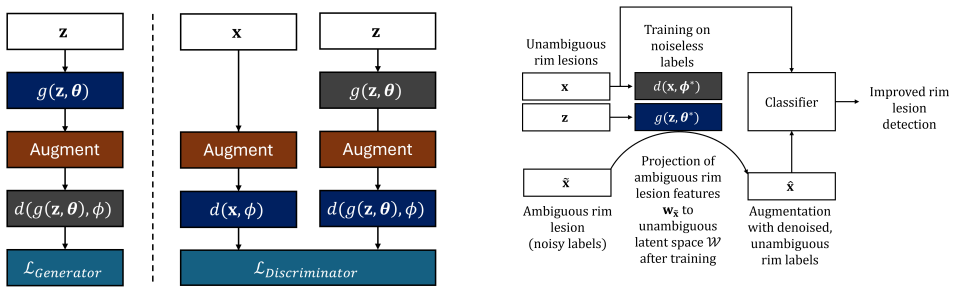
The load-bearing object is the StyleGAN2-ADA generator, a generative adversarial network architecture designed for limited data, trained on unambiguous rim lesions, together with its latent projection (GAN inversion). The generator has mapping and synthesis modules; for projection, an ambiguous image's features are extracted, and an optimization seeks the intermediate latent vector $w^*$ that minimizes perceptual loss plus a noise-regularization term, so that decoding $s(w^*)$ yields the closest unambiguous rim image. The paper uses Frechet Inception Distance (FID) between each augmented training set and the unseen test rim distribution as the distribution-quality measure, and a six-layer convolutional classifier whose accuracy, precision, and sensitivity compare augmentations. A multi-contrast extension adds T2FLAIR and probabilistic rim-mask channels, broadening the same mechanism to generation and segmentation.
What would settle it
Show the 100 denoised ambiguous lesions to a panel of fresh expert readers, or compare their rim status to longitudinal clinical endpoints; if the denoised lesions are not rated as rims substantially more often than the original ambiguous patches, the label-noise-removal claim fails. A second control is to retrain the classifier with the same number of unconditioned GAN samples: if it matches the 0.87 accuracy and 0.95 sensitivity, denoising is not doing the work.
Extended reading notes
Core claim
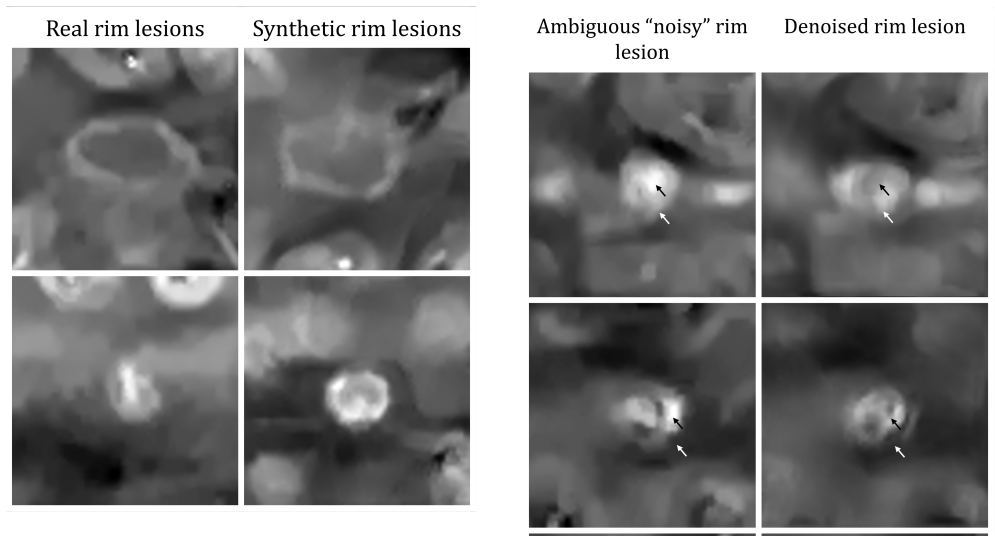
The paper claims that ambiguous rim lesions—those flagged as rims by only one of two expert readers—can be denoised rather than discarded. After training a StyleGAN2-ADA generator exclusively on unambiguous rim-lesion patches from QSM, the authors project each ambiguous patch onto the generator's latent space by minimizing a perceptual loss with noise regularization, then decode the closest unambiguous latent vector into a denoised rim image. Adding 100 such denoised lesions to the training set expands the minority rim class from 260 to 437 lesions and yields the best classifier results among all compared augmentations: accuracy 0.87, precision 0.91, sensitivity 0.95, and the lowest FID (34.17) to the held-out test rim distribution. The paper also shows that an expert radiologist judged about 40% of uncurated synthetic rims as true rims, and that a multi-contrast extension can generate QSM, T2FLAIR, and probabilistic rim-mask channels jointly.
Load-bearing premise
The method assumes that a lesion called a rim by only one reader really is a rim lesion, and that projecting it onto the manifold of agreed rim lesions removes confusing features rather than manufacturing a rim appearance that was not actually present; no ground truth exists for ambiguous cases, so the paper does not verify this premise.
Editorial extensions
If this is right
- The proposed latent-projection denoising augmentation reaches 0.87 accuracy and 0.95 sensitivity with comparable precision (0.91), meaning more true rim lesions are caught without a precision drop.
- The denoised data makes the training distribution closer to the unseen test rim distribution (FID 34.17) than any other augmentation, including real rims alone.
- Including ambiguous rims without denoising slightly degrades the classifier, while including their denoised versions improves it, so the projection step, not merely the extra data, drives the improvement.
- The heat maps showing which image regions drive the classifier (class activation maps) shift toward the lesion rim when denoised data is added, indicating the detector is focusing on the clinically relevant structure.
- The multi-contrast extension can generate susceptibility maps, T2FLAIR images, and probabilistic rim segmentations jointly, so the same approach can supply training targets for segmentation models.
Reading between the lines
- A direct test of the label-recovery assumption would be to have a fresh panel of readers grade the denoised ambiguous lesions; the paper's evidence is indirect (FID and classifier gain), so the method could in principle work as high-quality synthetic augmentation even if some ambiguous lesions were not true rims.
- The same projection-denoising recipe could be applied to other disputed labels in medical imaging—single-reader annotations or segmentations with low inter-rater agreement—whenever a clean subset is available to define the target manifold.
- The paper notes the conditional GAN converges to a lower FID during training; denoising into the conditional latent space rather than the rim-only space is a natural next step that might improve the recovered samples further.
- Because FID is the paper's quality proxy, an independent check would be lesion-level: verify whether denoised patches retain patient-specific geometry or only generic rim texture, since the latter may not transfer to per-patient longitudinal monitoring.
Editorial analysis
A structured set of objections, weighed in public.
Referee Report
Summary. The paper presents a StyleGAN2-ADA based method for generating synthetic paramagnetic rim lesions on quantitative susceptibility maps (QSM), and a 'latent projection denoising' approach (ADA-GAN-LD) where ambiguous rim lesions (flagged by only one of two readers) are projected into the latent space of a GAN trained only on unambiguous rims; the reconstructed images are then used to augment the minority rim-lesion class for classifier training. The authors report that this denoised augmentation yields the lowest FID (34.17) to the unseen test rim distribution and improves classifier accuracy to 0.87 and sensitivity to 0.95 on a held-out set, and they provide a multi-contrast extension generating QSM, T2FLAIR, and probabilistic rim masks. The code and generated data are promised to be released.
Significance. If the central premise holds—that ambiguous lesions are true rims whose confounding features can be removed by latent projection—the method would offer a clinically useful way to leverage noisy labels for rare-class medical imaging, and the public code/data release is a strength. The paper includes a radiologist assessment, comparisons to DeepSMOTE and affine augmentation, and an ablation with a conditional GAN. However, the evaluation rests on a single train/test split with no confidence intervals; the reported differences between the proposed method and standard synthetic augmentation are small, and the key premise is not directly validated. The significance is therefore conditional on additional validation.
major comments (4)
- [Section 4.3 vs Sections 3.6 and 5.2] The claim in Section 4.3 that the denoising method 'allowed us to recover 177 additional rim lesions to expand the minority class from 260 to 437 cases' is inconsistent with Section 3.6, which states that 100 ambiguous rim lesions were projected, and with Section 5.2, which states that training datasets were supplemented with 100 additional lesions for each augmentation method. The reported 68% class expansion is therefore not the setting actually evaluated; the experiments used 100 added samples. This discrepancy undermines the quantitative claim of label recovery and must be corrected or clarified.
- [Section 3.1, data labeling protocol] The labeling protocol is internally contradictory: Section 3.1 says lesions were classified as 'rim' only if both readers agreed and 'otherwise they were classified as non-rim', but then defines an 'ambiguous rim lesion' as one where only one reader said rim. Section 4.1 treats the 177 ambiguous lesions as a separate category, and Table 3 includes them as a distinct augmentation setting. The manuscript does not explain how these ambiguous lesions were handled in the baseline classifier labels or in the construction of the training/test sets, which is load-bearing for the comparison and for the interpretation of the 'Ambiguous rims' row in Table 3.
- [Section 3.5/3.6, Eq. (1)] The load-bearing premise that an ambiguous lesion is a true rim lesion whose confusing features can be removed by projection onto the unambiguous rim manifold is not validated. The paper does not include a negative control—for example, projecting known non-rim lesions and checking whether they are not recovered as rims—so it is possible that the projection maps any input onto the rim-like manifold, in which case the 'denoised' samples are simply synthetic rims and the improvement reflects generic augmentation rather than label recovery. Provide such a control and report how often denoised projections of non-rims are classified as rims by the trained classifier.
- [Sections 4.4 and 4.5, Tables 3 and 4] The classifier performance differences supporting the denoising claim are small (accuracy 0.87 vs 0.85; sensitivity 0.95 vs 0.93) and are reported from a single split with no confidence intervals, error bars, or significance tests. The FID differences (34.17 vs 34.36 vs 34.24) are also on the order of differences that could arise from sampling variability given the small test set (60 rim lesions). The specific benefit of latent projection denoising over plain synthetic augmentation is therefore not statistically established; multiple cross-validation splits or bootstrap confidence intervals are needed.
minor comments (6)
- [Section 5.1] The word 'snythesized' is a typo and should be 'synthesized'.
- [Section 4.6] The word 'demylinated' is a typo and should be 'demyelinated'.
- [Equation (1)] Please specify the exact layers used for the perceptual loss LP and the precise form of the noise regularization term LN, since the current notation relies on references [51] and [67] without making the implementation fully self-contained.
- [Section 3.1] The acquisition parameters are presented as 'T E1 dT E = 6.28/4.06 ms'; this should be written more clearly (e.g., TE1 = 6.28 ms, ΔTE = 4.06 ms).
- [Table 1 caption] The caption sentence 'In a separate experiment, and nearly a third (0.29) of the uncurated synthetic lesions...' is grammatically awkward and should be rephrased for clarity.
- [Section 4.3] Figure 7 shows a single denoised example; showing additional examples would help the reader assess the variability of the denoising operation.
Circularity Check
No significant circularity: the central performance claims are evaluated on held-out real rim lesions, and the denoising step is a standard GAN-inversion projection rather than a self-citation or fitted-label reduction.
full rationale
The paper's main claims—that synthetic rim lesions and latent-projection-denoised ambiguous lesions improve rim classification—are tested against a held-out test set of 60 real rim lesions and 120 non-rim lesions (Section 3.4, Tables 3 and 4). The classifier improvement is therefore an external benchmark, not a quantity forced by the training procedure. The denoising operation (Eq. 1) is a standard GAN-inversion latent projection using perceptual loss and noise regularization, cited to external works [8, 27, 29], and the 'ambiguous rim' definition is an input label, not an output derived from the method's own success. The statement that the method 'allowed us to recover 177 additional rim lesions' is a labeling choice—outputs of a generator trained only on unambiguous rims are rim-like by construction—but the paper does not use that count as evidence of correctness; instead, it validates the augmentation by held-out classifier accuracy, sensitivity, and FID to the unseen test rim distribution. The unvalidated premise that ambiguous single-reader lesions are true rims is a correctness/validity concern, not a circular reduction: even if the premise fails, the comparison remains a well-defined external benchmark. The discrepancy between '177 additional rim lesions' (Section 4.3) and 'projected 100 noisy rim lesions' (Sections 3.6 and 5.2) is an internal inconsistency, not circularity. No fitted parameter is renamed as a prediction, and no load-bearing argument reduces to a self-citation chain. Thus the derivation is self-contained with respect to circularity.
Assumptions & free parameters
free parameters (3)
- Augmentation count =
100 lesions per augmentation method
- Noise regularization weight alpha in Eq. 1 =
1e5
- GAN training hyperparameters =
lr=2.5e-3, beta1=0.9, beta2=0.99, ada rt=0.6
assumptions (5)
- domain assumption Unambiguous rim lesions (two-reader agreement) are correctly labeled and representative of the true rim lesion distribution.
- ad hoc to paper Ambiguous rim lesions (one-reader positive) are true rim lesions whose label noise can be removed by projection.
- domain assumption The GAN trained on unambiguous rims captures the full variability of the real rim lesion distribution.
- ad hoc to paper Perceptual loss (VGG features) plus noise regularization is a valid distance for lesion identity in latent projection.
- domain assumption FID computed between augmented training sets and held-out test rims is a meaningful proxy for detection performance.
Cite this review
Pith. "Pith review of Synthetic Generation and Latent Projection Denoising of Rim Lesions in Multiple Sclerosis." pith.science (2026). https://pith.science/paper/7JVZ7HUS
@misc{pith2026250523353,
  author       = {Pith},
  title        = {Pith review of: Synthetic Generation and Latent Projection Denoising of Rim Lesions in Multiple Sclerosis},
  year         = {2026},
  howpublished = {\url{https://pith.science/paper/7JVZ7HUS}},
  note         = {Machine review of arXiv:2505.23353}
}
read the original abstract
Quantitative susceptibility maps from magnetic resonance images can provide both prognostic and diagnostic information in multiple sclerosis, a neurodegenerative disease characterized by the formation of lesions in white matter brain tissue. In particular, susceptibility maps provide adequate contrast to distinguish between "rim" lesions, surrounded by deposited paramagnetic iron, and "non-rim" lesion types. These paramagnetic rim lesions (PRLs) are an emerging biomarker in multiple sclerosis. Much effort has been devoted to both detection and segmentation of such lesions to monitor longitudinal change. As paramagnetic rim lesions are rare, addressing this problem requires confronting the class imbalance between rim and non-rim lesions. We produce synthetic quantitative susceptibility maps of paramagnetic rim lesions and show that inclusion of such synthetic data improves classifier performance and provide a multi-channel extension to generate accompanying contrasts and probabilistic segmentation maps. We exploit the projection capability of our trained generative network to demonstrate a novel denoising approach that allows us to train on ambiguous rim cases and substantially increase the minority class. We show that both synthetic lesion synthesis and our proposed rim lesion label denoising method best approximate the unseen rim lesion distribution and improve detection in a clinically interpretable manner. We release our code and generated data at https://github.com/agr78/PRLx-GAN upon publication.
Figures


Figures from the paper (5 more)



Reference graph
Works this paper leans on
-
[1]
Bilal Ahmad, Jun Sun, Qi You, Vasile Palade, and Zhongjie Mao. Brain tumor classification using a combination of vari- ational autoencoders and generative adversarial networks. Biomedicines, 10(2):223, 2022. 2
work page 2022
-
[2]
Synthetic mri for stroke: a qualitative and quantitative pilot study
Joachim Andr ´e, Sami Barrit, and Patrice Jissendi. Synthetic mri for stroke: a qualitative and quantitative pilot study. Sci- entific Reports, 12(1), 2022. 2
work page 2022
-
[3]
From noisy predic- 8 tion to true label: Noisy prediction calibration via generative model, 2022
HeeSun Bae, Seungjae Shin, Byeonghu Na, JoonHo Jang, Kyungwoo Song, and Il-Chul Moon. From noisy predic- 8 tion to true label: Noisy prediction calibration via generative model, 2022. 3
work page 2022
-
[4]
F. Bagnato, P. Sati, C. C. Hemond, C. Elliott, S. A. Gau- thier, D. M. Harrison, C. Mainero, J. Oh, D. Pitt, R. T. Shinohara, S. A. Smith, B. Trapp, C. J. Azevedo, P. A. Calabresi, R. G. Henry, C. Laule, D. Ontaneda, W. D. Rooney, N. L. Sicotte, D. S. Reich, and M. Absinta. Imaging chronic active lesions in multiple sclerosis: a consensus statement. Brain...
work page 2024
-
[5]
Callaghan, Siawoosh Mohammadi, and Nikolaus Weiskopf
Martina F. Callaghan, Siawoosh Mohammadi, and Nikolaus Weiskopf. Synthetic quantitative mri through relaxometry modelling. NMR in Biomedicine, 29(12):1729–1738, 2016. 2
work page 2016
-
[6]
Eric R. Chan, Connor Z. Lin, Matthew A. Chan, Koki Nagano, Boxiao Pan, Shalini De Mello, Orazio Gallo, Leonidas Guibas, Jonathan Tremblay, Sameh Khamis, Tero Karras, and Gordon Wetzstein. Efficient geometry-aware 3d generative adversarial networks, 2022. 8
work page 2022
-
[7]
W. Chen, S. A. Gauthier, A. Gupta, J. Comunale, T. Liu, S. Wang, M. Pei, D. Pitt, and Y . Wang. Quantitative sus- ceptibility mapping of multiple sclerosis lesions at vari- ous ages. Radiology, 271(1):183–92, 2014. 1527-1315 Chen, Weiwei Gauthier, Susan A Gupta, Ajay Comunale, Joseph Liu, Tian Wang, Shuai Pei, Mengchao Pitt, David Wang, Yi R01 EB013443/EB...
work page 2014
-
[8]
Inverting the generator of a generative adversarial network
Antonia Creswell and Anil Anthony Bharath. Inverting the generator of a generative adversarial network. IEEE Trans- actions on Neural Networks and Learning Systems , 30(7): 1967–1974, 2019. 2
work page 1967
Show all 71 references
-
[9]
Damien Dablain, Bartosz Krawczyk, and Nitesh V . Chawla. Deepsmote: Fusing deep learning and smote for imbalanced data, 2021. 2, 4
2021
-
[10]
Consensus of algorithms for lesion segmentation in brain mri studies of multiple scle- rosis
Alessandro Pasquale De Rosa, Marco Benedetto, Stefano Tagliaferri, Francesco Bardozzo, Alessandro D’Ambrosio, Alvino Bisecco, Antonio Gallo, Mario Cirillo, Roberto Tagliaferri, and Fabrizio Esposito. Consensus of algorithms for lesion segmentation in brain mri studies of multi...
2024
-
[11]
3d-aware conditional image synthesis, 2023
Kangle Deng, Gengshan Yang, Deva Ramanan, and Jun-Yan Zhu. 3d-aware conditional image synthesis, 2023. 8
2023
-
[12]
Dimov, Thanh D
Alexey V . Dimov, Thanh D. Nguyen, Kelly M. Gillen, Melanie Marcille, Pascal Spincemaille, David Pitt, Susan A. Gauthier, and Yi Wang. Susceptibility source separation from gradient echo data using magnitude decay modeling. Journal of Neuroimaging, 32(5):852–859, 2022. 8
2022
-
[13]
Mri criteria for the diagnosis of multiple sclerosis: Magnims consensus guidelines
Massimo Filippi, Maria A Rocca, Olga Ciccarelli, Nicola De Stefano, Nikos Evangelou, Ludwig Kappos, Alex Rovira, Jaume Sastre-Garriga, Mar Tintor`e, Jette L Frederiksen, and et al. Mri criteria for the diagnosis of multiple sclerosis: Magnims consensus guidelines. The Lancet N...
2016
-
[14]
Assessing ro- bustness of quantitative susceptibility-based mri radiomic features in patients with multiple sclerosis
Cristiana Fiscone, Leonardo Rundo, Alessandra Lugaresi, David Neil Manners, Kieren Allinson, Elisa Baldin, Gi- anfranco V ornetti, Raffaele Lodi, Caterina Tonon, Claudia Testa, Mauro Castelli, and Fulvio Zaccagna. Assessing ro- bustness of quantitative susceptibility-based mri...
2023
-
[15]
K. Gohil. Multiple sclerosis: Progress, but no cure. P t, 40 (9):604–5, 2015. Gohil, Kunj Journal Article United States 2015/09/30 P T. 2015 Sep;40(9):604-5. 1
2015
-
[16]
Goodfellow, Jean Pouget-Abadie, Mehdi Mirza, Bing Xu, David Warde-Farley, Sherjil Ozair, Aaron Courville, and Yoshua Bengio
Ian J. Goodfellow, Jean Pouget-Abadie, Mehdi Mirza, Bing Xu, David Warde-Farley, Sherjil Ozair, Aaron Courville, and Yoshua Bengio. Generative adversarial networks, 2014. 3
2014
-
[17]
Alexander, Steven E
Karthik Gopinath, Andrew Hoopes, Daniel C. Alexander, Steven E. Arnold, Yael Balbastre, Benjamin Billot, Adri `a Casamitjana, You Cheng, Russ Yue Zhi Chua, Brian L. Ed- low, Bruce Fischl, Harshvardhan Gazula, Malte Hoffmann, C. Dirk Keene, Seunghoi Kim, W. Taylor Kimberly, So-...
2024
-
[18]
Syn- thetic data in ai: Challenges, applications, and ethical impli- cations, 2024
Shuang Hao, Wenfeng Han, Tao Jiang, Yiping Li, Haonan Wu, Chunlin Zhong, Zhangjun Zhou, and He Tang. Syn- thetic data in ai: Challenges, applications, and ethical impli- cations, 2024. 8
2024
-
[19]
C. C. Hemond and R. Bakshi. Magnetic resonance imag- ing in multiple sclerosis. Cold Spring Harb Perspect Med, 8 (5), 2018. 2157-1422 Hemond, Christopher C Bakshi, Ro- hit Journal Article Review United States 2018/01/24 Cold Spring Harb Perspect Med. 2018 May 1;8(5):a028969. d...
2018 doi
-
[20]
Gans trained by a two time-scale update rule converge to a local nash equilib- rium, 2018
Martin Heusel, Hubert Ramsauer, Thomas Unterthiner, Bernhard Nessler, and Sepp Hochreiter. Gans trained by a two time-scale update rule converge to a local nash equilib- rium, 2018. 3
2018
-
[21]
Riedl, Tobias Zrzavy, Celia Lerma-Martin, Gregor Kasprian, Claudia E
Annika Hofmann, Nik Krajnc, Assunta Dal-Bianco, Chris- tian J. Riedl, Tobias Zrzavy, Celia Lerma-Martin, Gregor Kasprian, Claudia E. Weber, Francesco Pezzini, Fritz Leut- mezer, and et al. Myeloid cell iron uptake pathways and paramagnetic rim formation in multiple sclerosis. ...
2023
-
[22]
Huang, E
W. Huang, E. M. Sweeney, U. W. Kaunzner, Y . Wang, S. A. Gauthier, and T. D. Nguyen. Quantitative suscep- tibility mapping versus phase imaging to identify multiple sclerosis iron rim lesions with demyelination. J Neuroimag- ing, 32(4):667–675, 2022. 1552-6569 Huang, Weiyuan S...
2022
-
[23]
Hurley, and Guangyuan Piao
Weipeng Huang, Qin Li, Yang Xiao, Cheng Qiao, Tie Cai, Junwei Liao, Neil J. Hurley, and Guangyuan Piao. Cor- recting noisy multilabel predictions: Modeling label noise through latent space shifts, 2025. 3
2025
-
[24]
Iglesias, Benjamin Billot, Ya ¨el Balbastre, Colin Magdamo, Steven E
Juan E. Iglesias, Benjamin Billot, Ya ¨el Balbastre, Colin Magdamo, Steven E. Arnold, Sudeshna Das, Brian L. Ed- low, Daniel C. Alexander, Polina Golland, and Bruce Fischl. Synthsr: A public ai tool to turn heterogeneous clinical brain scans into high-resolution t1-weighted im...
2023
-
[25]
Paramagnetic rims in multiple scle- rosis and neuromyelitis optica spectrum disorder: A quanti- tative susceptibility mapping study with 3-t mri
Jinhee Jang, Yoonho Nam, Yangsean Choi, Na-Young Shin, Jae Young An, Kook-Jin Ahn, Bum-Soo Kim, Kwang-Soo Lee, and Woojun Kim. Paramagnetic rims in multiple scle- rosis and neuromyelitis optica spectrum disorder: A quanti- tative susceptibility mapping study with 3-t mri. Jour...
2020
-
[26]
L. Ju, X. Wang, L. Wang, D. Mahapatra, X. Zhao, Q. Zhou, T. Liu, and Z. Ge. Improving medical images classifi- cation with label noise using dual-uncertainty estimation. IEEE Trans Med Imaging , 41(6):1533–1546, 2022. 1558- 254x Ju, Lie Wang, Xin Wang, Lin Mahapatra, Dwarikana...
2022
-
[27]
A style-based generator architecture for generative adversarial networks,
Tero Karras, Samuli Laine, and Timo Aila. A style-based generator architecture for generative adversarial networks,
-
[28]
Training generative adver- sarial networks with limited data, 2020
Tero Karras, Miika Aittala, Janne Hellsten, Samuli Laine, Jaakko Lehtinen, and Timo Aila. Training generative adver- sarial networks with limited data, 2020. 3, 4
2020
-
[29]
Analyzing and improving the image quality of stylegan, 2020
Tero Karras, Samuli Laine, Miika Aittala, Janne Hellsten, Jaakko Lehtinen, and Timo Aila. Analyzing and improving the image quality of stylegan, 2020. 4
2020
-
[30]
Kaunzner and Susan A
Ulrike W. Kaunzner and Susan A. Gauthier. Mri in the as- sessment and monitoring of multiple sclerosis: an update on best practice. Therapeutic Advances in Neurological Disor- ders, 10(6):247–261, 2017. 1
2017
-
[31]
Prior image- constrained reconstruction using style-based generative models
Varun A Kelkar and Mark Anastasio. Prior image- constrained reconstruction using style-based generative models. In Proceedings of the 38th International Confer- ence on Machine Learning, pages 5367–5377. PMLR, 2021. 3
2021
-
[32]
Convolutional networks for images, speech, and time series , page 255–258
Yann LeCun and Yoshua Bengio. Convolutional networks for images, speech, and time series , page 255–258. MIT Press, Cambridge, MA, USA, 1998. 3
1998
-
[33]
Detecting alzheimer’s disease on small dataset: A knowledge transfer perspective
Wei Li, Yifei Zhao, Xi Chen, Yang Xiao, and Yuanyuan Qin. Detecting alzheimer’s disease on small dataset: A knowledge transfer perspective. IEEE Journal of Biomedical and Health Informatics, 23(3):1234–1242, 2019. 2
2019
-
[34]
Morphology enabled dipole inversion (medi) from a single- angle acquisition: Comparison with cosmos in human brain imaging
Tian Liu, Jing Liu, Ludovic De Rochefort, Pascal Spince- maille, Ildar Khalidov, James Robert Ledoux, and Yi Wang. Morphology enabled dipole inversion (medi) from a single- angle acquisition: Comparison with cosmos in human brain imaging. Magnetic Resonance in Medicine, 66(3):777–783,
-
[35]
Medi+0: Morphology enabled dipole inversion with automatic uniform cerebrospinal fluid zero reference for quantitative susceptibility mapping
Zhe Liu, Pascal Spincemaille, Yihao Yao, Yan Zhang, and Yi Wang. Medi+0: Morphology enabled dipole inversion with automatic uniform cerebrospinal fluid zero reference for quantitative susceptibility mapping. Magnetic Resonance in Medicine, 79(5):2795–2803, 2018. 3
2018
-
[36]
C. Lou, P. Sati, M. Absinta, K. Clark, J. D. Dworkin, A. M. Valcarcel, M. K. Schindler, D. S. Reich, E. M. Sweeney, and R. T. Shinohara. Fully automated detection of paramagnetic rims in multiple sclerosis lesions on 3t susceptibility- based mr imaging. Neuroimage Clin , 32:10...
2021
-
[37]
Qsm-rimds: A detection and segmenta- tion tool for paramagnetic rim lesions in multiple sclerosis,
Ha Luu, Mert Sisman, Ilhami Kovanlikaya, Tam Vu, Pascal Spincemaille, Yi Wang, Francesca Bagnato, Susan Gauthier, and Thanh Nguyen. Qsm-rimds: A detection and segmenta- tion tool for paramagnetic rim lesions in multiple sclerosis,
-
[38]
Maggi, P
P. Maggi, P. Sati, G. Nair, I. C. M. Cortese, S. Jacobson, B. R. Smith, A. Nath, J. Ohayon, V . van Pesch, G. Perrotta, C. Pot, M. Th´eaudin, V . Martinelli, R. Scotti, T. Wu, R. Du Pasquier, P. A. Calabresi, M. Filippi, D. S. Reich, and M. Absinta. Paramagnetic rim lesions ar...
2020
-
[39]
Employing deep learning and transfer learning for accurate brain tumor detection
Sandeep Kumar Mathivanan, Sridevi Sonaimuthu, Sankar Murugesan, Hariharan Rajadurai, Basu Dev Shivahare, and Mohd Asif Shah. Employing deep learning and transfer learning for accurate brain tumor detection. Scientific Re- ports, 14(1), 2024. 2
2024
-
[40]
Mey, Kedar R
Gabrielle M. Mey, Kedar R. Mahajan, and Tara M. Desilva. Neurodegeneration in multiple sclerosis. WIREs Mecha- nisms of Disease, 15(1), 2023. 1
2023
-
[41]
Conditional generative adversarial nets
Mehdi Mirza and Simon Osindero. Conditional generative adversarial nets. CoRR, abs/1411.1784, 2014. 3
2014 arXiv
-
[42]
A deep learning ap- proach for synthetic mri based on two routine sequences and training with synthetic data
Elisa Moya-S ´aez, ´Oscar Pe ˜na-Nogales, Rodrigo de Luis- Garc´ıa, and Carlos Alberola-L ´opez. A deep learning ap- proach for synthetic mri based on two routine sequences and training with synthetic data. Computer Methods and Pro- grams in Biomedicine, 210:106371, 2021. 2
2021
-
[43]
K. C. Ng Kee Kwong, D. Mollison, R. Meijboom, E. N. York, A. Kampaite, M. J. Thrippleton, S. Chandran, and A. D. Waldman. The prevalence of paramagnetic rim lesions in multiple sclerosis: A systematic review and meta-analysis. PLoS One, 16(9):e0256845, 2021. 2
2021
-
[44]
Do 2d gans know 3d shape? unsupervised 3d shape reconstruction from 2d image gans
Xingang Pan, Bo Dai, Ziwei Liu, Chen Change Loy, and Ping Luo. Do 2d gans know 3d shape? unsupervised 3d shape reconstruction from 2d image gans. In International Conference on Learning Representations, 2021. 8
2021
-
[45]
J. A. Reeves, M. Mohebbi, R. Zivadinov, N. Bergsland, M. G. Dwyer, F. Salman, F. Schweser, and D. Jakimovski. Reliability of paramagnetic rim lesion classification on quan- titative susceptibility mapping (qsm) in people with mul- tiple sclerosis: Single-site experience and sy...
2023
-
[46]
Roberts, Dominick J
Alexandra G. Roberts, Dominick J. Romano, Mert S ¸is ¸man, Alexey V . Dimov, Thanh D. Nguyen, Ilhami Kovanlikaya, Susan A. Gauthier, Yi Wang, and Pascal Spincemaille. Max- imum spherical mean value filtering for whole-brain qsm. Magnetic Resonance in Medicine , 91(4):1586–1597...
2024
-
[47]
Quantitative susceptibility mapping radiomics with label noise compensation for predicting deep brain stimulation outcomes in parkinson’s disease
Alexandra Grace Roberts, Jinwei Zhang, Ceren Tozlu, Do- minick Romano, Sema Akkus, Heejong Kim, Mert Rory Sabuncu, Pascal Spincemaille, Jianqi Li, Yi Wang, Xi Wu, and Brian Harris Kopell. Quantitative susceptibility mapping radiomics with label noise compensation for predictin...
-
[48]
Robertson and N
D. Robertson and N. Moreo. Disease-modifying therapies in multiple sclerosis: Overview and treatment considerations. Fed Pract, 33(6):28–34, 2016. 1945-337x Robertson, Der- rick Moreo, Natalie Journal Article United States 2016/06/01 Fed Pract. 2016 Jun;33(6):28-34. 1
2016
-
[49]
Multiple sclerosis lesion synthesis in mri us- ing an encoder-decoder u-net.IEEE Access, 7:25171–25184,
Mostafa Salem, Sergi Valverde, Mariano Cabezas, Debo- rah Pareto, Arnau Oliver, Joaquim Salvi, `Alex Rovira, and Xavier Llad´o. Multiple sclerosis lesion synthesis in mri us- ing an encoder-decoder u-net.IEEE Access, 7:25171–25184,
-
[50]
Selvaraju, Abhishek Das, Ramakrishna Vedantam, Michael Cogswell, Devi Parikh, and Dhruv Ba- tra
Ramprasaath R. Selvaraju, Abhishek Das, Ramakrishna Vedantam, Michael Cogswell, Devi Parikh, and Dhruv Ba- tra. Grad-cam: Why did you say that? visual explanations from deep networks via gradient-based localization. CoRR, abs/1610.02391, 2016. 4
-
[51]
Very deep convo- lutional networks for large-scale image recognition, 2015
Karen Simonyan and Andrew Zisserman. Very deep convo- lutional networks for large-scale image recognition, 2015. 4
2015
-
[52]
Simulating brain gradient-echo mag- netic resonance images through microstructural modeling
Mert S ¸is ¸man, Alexandra Roberts, Hangwei Zhuang, Renjiu Hu, Junghun Cho, Shun Zhang, Pascal Spincemaille, Thanh Nguyen, and Yi Wang. Simulating brain gradient-echo mag- netic resonance images through microstructural modeling. In 13th International Workshop on Innovative Sim...
2024
-
[53]
Hicks, Hugo L
Vajira Thambawita, Pegah Salehi, Sajad Amouei Sheshkal, Steven A. Hicks, Hugo L. Hammer, Sravanthi Parasa, Thomas de Lange, P ˚al Halvorsen, and Michael A. Riegler. Singan-seg: Synthetic training data generation for medical image segmentation. PLOS ONE, 17(5):1–24, 2022. 2
2022
-
[54]
Robustness of conditional gans to noisy labels, 2018
Kiran Koshy Thekumparampil, Ashish Khetan, Zinan Lin, and Sewoong Oh. Robustness of conditional gans to noisy labels, 2018. 3 11
2018
-
[55]
Clarke, Nikos Evangelou, Sandy Pa- tel, Andrew Dwyer, Marc Agzarian, Stephen Bacchi, and Mark Slee
Adon Toru Asahina, Joe Lu, Pooja Chugh, Srishti Sharma, Prakriti Sharma, Sheryn Tan, Joshua Kovoor, Brandon Stret- ton, Aashray Gupta, Annabel Sorby-Adams, Rudy Goh, Adil Harroud, Margareta A. Clarke, Nikos Evangelou, Sandy Pa- tel, Andrew Dwyer, Marc Agzarian, Stephen Bacchi,...
2024
-
[56]
A mixed- supervision multilevel gan framework for image quality en- hancement, 2021
Uddeshya Upadhyay and Suyash Awate. A mixed- supervision multilevel gan framework for image quality en- hancement, 2021. 8
2021
-
[57]
Transfer learning in magnetic resonance brain imaging: A systematic review
Juan Miguel Valverde, Vandad Imani, Ali Abdollahzadeh, Riccardo De Feo, Mithilesh Prakash, Robert Ciszek, and Jussi Tohka. Transfer learning in magnetic resonance brain imaging: A systematic review. Journal of Imaging, 7(4):66,
-
[58]
C. C. V oon, T. Wiltgen, B. Wiestler, S. Schlaeger, and M. M¨uhlau. Quantitative susceptibility mapping in multiple sclerosis: A systematic review and meta-analysis. Neuroim- age Clin, 42:103598, 2024. 2213-1582 V oon, Cui Ci Wilt- gen, Tun Wiestler, Benedikt Schlaeger, Sarah ...
2024
-
[59]
Covidgan: Data augmentation using auxiliary classifier gan for improved covid-19 detection
Abdul Waheed, Muskan Goyal, Deepak Gupta, Ashish Khanna, Fadi Al-Turjman, and Pl ´acido Rogerio Pinheiro. Covidgan: Data augmentation using auxiliary classifier gan for improved covid-19 detection. IEEE Access , 8:91916– 91923, 2020. 2
2020
-
[60]
Rising prevalence of multiple sclero- sis worldwide: Insights from the atlas of ms, third edition
Clare Walton, Rachel King, Lindsay Rechtman, Wendy Kaye, Emmanuelle Leray, Ruth Ann Marrie, Neil Robertson, Nicholas La Rocca, Bernard Uitdehaag, Ingrid van der Mei, Mitchell Wallin, Anne Helme, Ceri Angood Napier, Nick Ri- jke, and Peer Baneke. Rising prevalence of multiple s...
2020
-
[61]
R. J. Ward, D. T. Dexter, and R. R. Crichton. Iron, neu- roinflammation and neurodegeneration. Int J Mol Sci , 23 (13), 2022. 1422-0067 Ward, Roberta J Dexter, David T Crichton, Robert R Journal Article Review Switzerland 2022/07/10 Int J Mol Sci. 2022 Jun 30;23(13):7267. doi:...
2022 doi
-
[62]
Differential diagnosis of multiple sclerosis and other inflam- matory cns diseases
Paula Wildner, Mariusz Stasiołek, and Mariola Matysiak. Differential diagnosis of multiple sclerosis and other inflam- matory cns diseases. Multiple Sclerosis and Related Disor- ders, 37:101452, 2020. 1
2020
-
[63]
Montanez
Jake Williams, Abel Tadesse, Tyler Sam, Huey Sun, and George D. Montanez. Limits of transfer learning, 2020. 2
2020
-
[64]
Gan inversion: A survey,
Weihao Xia, Yulun Zhang, Yujiu Yang, Jing-Hao Xue, Bolei Zhou, and Ming-Hsuan Yang. Gan inversion: A survey,
-
[65]
Synaug: Exploiting synthetic data for data imbalance problems, 2024
Moon Ye-Bin, Nam Hyeon-Woo, Wonseok Choi, Nayeong Kim, Suha Kwak, and Tae-Hyun Oh. Synaug: Exploiting synthetic data for data imbalance problems, 2024. 8
2024
-
[66]
Nguyen, Jinwei Zhang, Melanie Marcille, Pascal Spincemaille, Yi Wang, Susan A
Hang Zhang, Thanh D. Nguyen, Jinwei Zhang, Melanie Marcille, Pascal Spincemaille, Yi Wang, Susan A. Gauthier, and Elizabeth M. Sweeney. Qsmrim-net: Imbalance-aware learning for identification of chronic active multiple sclero- sis lesions on quantitative susceptibility maps. N...
2022
-
[67]
Efros, Eli Shecht- man, and Oliver Wang
Richard Zhang, Phillip Isola, Alexei A. Efros, Eli Shecht- man, and Oliver Wang. The unreasonable effectiveness of deep features as a perceptual metric, 2018. 4
2018
-
[68]
Zhang, T.D
S. Zhang, T.D. Nguyen, S.M. Hurtado R ´ua, U.W. Kaun- zner, S. Pandya, I. Kovanlikaya, P. Spincemaille, Y . Wang, and S.A. Gauthier. Quantitative susceptibility mapping of time-dependent susceptibility changes in multiple sclerosis lesions. American Journal of Neuroradiology, 2019. 2
2019
-
[69]
Learning deep features for discrimi- native localization
Bolei Zhou, Aditya Khosla, `Agata Lapedriza, Aude Oliva, and Antonio Torralba. Learning deep features for discrimi- native localization. CoRR, abs/1512.04150, 2015. 4
2015 arXiv
-
[70]
S ¸is ¸man, T
M. S ¸is ¸man, T. D. Nguyen, A. G. Roberts, D. J. Romano, A. V . Dimov, I. Kovanlikaya, P. Spincemaille, and Y . Wang. Microstructure-informed myelin mapping (mimm) from routine multi-echo gradient echo data using multiscale physics modeling of iron and myelin effects and qsm....
2025
-
[1546]
Epub 2022 Jun 1
doi: 10.1109/TMI.2022.3141425. Epub 2022 Jun 1. 8
2022
Reviewed August 7, 2026 · model on record in the stance chip above.
Discussion (0). Sign in to comment.