REVIEW 3 major objections 6 minor 36 references
TimePoint: Accelerated Time Series Alignment via Self-Supervised Keypoint and Descriptor Learning
T0 review · 3 major / 6 minor · reviewed 2026-08-07 · deepseek-v4-flash
Pith's one-line read TimePoint claims that dynamic time warping can be run on a sparse set of learned keypoints and descriptors, cutting alignment cost from quadratic to very small while improving DTW-based classification accuracy on standard benchmarks.
desk verdict TimePoint delivers a real speedup by running DTW on learned sparse keypoints, but the paper's 'higher alignment accuracy' claim is supported only by 1-NN accuracy, not by any direct measure of alignment error. read the letter →
The pith
A machine-rendered reading of the paper's core claim, the machinery that carries it, and where it could break.
The reading
What carries the argument
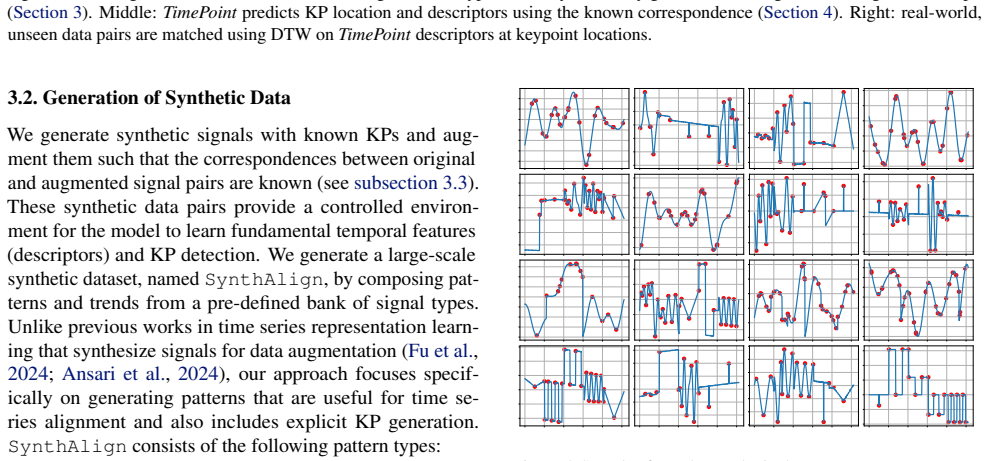
The central objects are the learned keypoint probability map and per-step descriptor field produced by a shared wavelet-convolutional encoder and two decoder heads. The mechanism that makes these trainable without human labels is SynthAlign: synthetic signals composed from sine, block, sawtooth, and radial-basis patterns, with keypoints defined at peaks, boundaries, and zero crossings, warped by a CPAB transformation, a smooth, invertible, monotonically increasing time warp obtained by integrating a continuous piecewise-affine velocity field, so every point in the warped signal has a known ground-truth correspondence. Those correspondences drive a binary cross-entropy keypoint loss and a margin-based contrastive descriptor loss over matched and unmatched keypoint pairs. The load-bearing step at inference is applying DTW to the sparse descriptor sequences with the cosine cost $1-\cos(D[t],D'[t'])$, which is what reduces the complexity from $\mathcal{O}(L\cdot L')$ to $\mathcal{O}(\tilde{L}\cdot\tilde{L}')$.
What would settle it
On the paper's own per-dataset results, a dataset where the 20 percent-keypoint accuracy is substantially below full-signal DTW is a direct counterinstance to the claim of typically improving accuracy; collecting such cases across the 102-dataset benchmark and checking whether they share a common pattern type would test the transfer assumption. For a sharper test, train only on SynthAlign and evaluate on a held-out domain built from waveforms absent from the training bank (for example, exponential decays or clipped impulses) with warps outside the CPAB prior; if TP+DTW at 20 percent keypoints loses to full-signal DTW there, the claim fails exactly where the paper's limitation warning predicts.
Extended reading notes
Core claim
The paper's central claim is that temporal alignment between two time series does not require every time point: a model can learn, from synthetic data alone, where the informative locations are and what descriptors capture their local context, and DTW run on those sparse points can be both faster and more accurate than DTW run on the raw signals. TimePoint trains a wavelet-convolutional encoder with two heads, one producing a per-time-step keypoint probability map and one producing a 256-dimensional $\ell^2$-normalized descriptor per step, using synthetic signals with known keypoints and known correspondences created by CPAB warps. A binary cross-entropy loss supervises keypoint detection and a margin-based contrastive loss supervises descriptor matching only at keypoint locations. At inference, the top $K\%$ of detected keypoints and their descriptors are aligned by DTW with cost $1-\cos(D[t],D'[t'])$, replacing the full $\mathcal{O}(L\cdot L')$ dynamic program with $\mathcal{O}(\tilde{L}\cdot\tilde{L}')$. Across 102 datasets from the standard time-series benchmark, TP+DTW attains the highest average rank with statistical significance at both 100 percent and 20 percent keypoint usage; at 20 percent keypoints, 1-NN accuracy rises from 0.706 for plain DTW to 0.721, and fine-tuning on real data further raises it to 0.790 while leaving runtime unchanged.
Load-bearing premise
The load-bearing premise is that the synthetic training signals, built from sine, block, sawtooth, and Gaussian-blob patterns warped by smooth, monotone time distortions sampled from one fixed prior, are representative enough of real-world time series that keypoints and descriptors learned on them transfer to new domains; the paper itself notes that performance may be sub-optimal when real signals deviate substantially from that synthetic distribution.
Editorial extensions
If this is right
- At 20 percent keypoint usage, TimePoint cuts the measured GPU runtime of 1-NN DTW on the 102-dataset suite from 192 hours to 2.88 hours, a roughly 65-fold speedup, while improving mean 1-NN accuracy from 0.706 to 0.721.
- The same training recipe generalizes zero-shot from purely synthetic signals to real-world benchmark data, and fine-tuning on unlabeled real data gains about 7 to 8 accuracy points with no change in inference runtime.
- Because the cost is quadratic in the number of keypoints rather than the signal length, the relative speedup grows with sequence length; the paper reports near-linear scaling for long signals at low keypoint ratios.
- TP+DTW remains more accurate than full-signal DTW under additive Gaussian noise and Gaussian blur at two intensity levels, so the sparse representation also buys noise tolerance.
Reading between the lines
- One testable extension: at a fixed keypoint fraction the speedup should grow quadratically with signal length, so a wall-clock benchmark on very long sequences (tens of thousands of samples) would show whether TimePoint opens regimes where dense DTW is infeasible.
- The learned descriptors carry local shape information over a large receptive field, which suggests they could serve as general time-series embeddings for retrieval, clustering, or anomaly detection, uses the paper does not evaluate.
- Because sparse inputs also change the accuracy-runtime trade-off of SoftDTW, combining TimePoint's keypoints with approximate or differentiable DTW variants could compound the speedup; the paper notes a similar possibility for FastDTW but does not test it.
- The paper leaves multivariate inputs to future work; a channel-shared or channel-fused extension of the same encoder and contrastive loss is a natural next step, though TimePoint does not claim it.
Editorial analysis
A structured set of objections, weighed in public.
Referee Report
Summary. TimePoint proposes a self-supervised framework that learns 1D keypoints and descriptors for time series, trained on a synthetic dataset (SynthAlign) whose pairs are related by CPAB diffeomorphic warps with known correspondences. At inference, DTW is applied only to the learned sparse keypoint descriptors, reducing the dynamic-programming complexity from O(L*L') to O(tilde-L*tilde-L'). The paper reports 1-NN classification accuracy on 102 UCR datasets, showing that TimePoint+DTW achieves the highest average rank among several DTW variants, with a 65x runtime speedup at 20% keypoints (Table 1), plus noise-robustness experiments and ablations showing that the WTConv encoder and cosine-similarity cost contribute to the gains.
Significance. If the claims hold, TimePoint is a practically useful contribution: it provides a learned sparse representation that accelerates DTW-based alignment by one to two orders of magnitude while maintaining or slightly improving downstream classification accuracy. The paper is strong on empirical breadth: it includes extensive UCR experiments, ablations, runtime and GPU-memory measurements, a noise-robustness study, and code release. The zero-shot transfer from synthetic CPAB-warped training data to real UCR signals is an interesting result, and the use of ground-truth correspondences during training avoids fitting any parameter to the test labels. The main weakness is that the central accuracy claim is supported only by an indirect proxy (1-NN classification accuracy), not by any direct measure of alignment quality, which limits the internal validity of the claimed alignment improvement.
major comments (3)
- [Section 6.2, Table 1; Section 4.5; Eq. (2)] The claim that TimePoint+DTW yields 'typically higher alignment accuracy than standard DTW' is not directly tested. The only evidence is 1-NN classification accuracy on UCR, which is an indirect proxy: the descriptor contrastive loss in Eq. (2) explicitly makes descriptors class-discriminative, so classification can improve even if the resulting DTW alignment paths are no more accurate than those of standard DTW. Because SynthAlign (Section 3.3) generates pairs with known CPAB ground-truth warps, the authors should report a direct alignment-quality metric on held-out synthetic pairs, e.g., correspondence error between predicted and ground-truth warp paths, or alignment-path accuracy. Without such an evaluation, the accuracy component of the central claim is under-supported.
- [Section 4.6, Section 6.2] The fine-tuning protocol is not fully specified with respect to data splits. Section 4.6 says TimePoint is fine-tuned on 'real data from the UCR archive', and Section 6.2 says the archive's original train-test splits are used, but it is not stated explicitly that fine-tuning uses only the training portions of the ~100 UCR datasets. If test signals are used in the self-supervised CPAB fine-tuning before 1-NN evaluation, the fine-tuned rows of Table 1 would be optimistically biased. The authors should clarify that fine-tuning is restricted to training splits, or rerun the fine-tuned evaluation accordingly.
- [Section 3.3, Section 5, Appendix B] The external validity of the claims rests on a fixed synthetic prior: the CPAB smoothness prior with sigma_var=0.5, sigma_smooth=1, and a 16-segment partition, over a pattern bank of sines, blocks, sawtooths, and RBFs. The paper acknowledges this in Section 5, but no experiment characterizes how performance degrades as the test-time distortions deviate from this prior, or when the pattern bank is mismatched. A simple test would be to evaluate a model trained with the default prior on SynthAlign data generated with substantially larger or smaller sigma_var, or with held-out pattern types, and to report both alignment error and 1-NN accuracy. This would substantiate the claimed generality beyond the specific synthetic distribution.
minor comments (6)
- [Abstract; Section 4.5] The abstract states that TimePoint 'typically improves alignment accuracy', but no direct alignment metric is ever defined or measured; the phrase should be qualified as '1-NN classification accuracy' when used in the abstract and conclusion.
- [Figure 2] The caption claims that the blue and black boxes highlight areas where sparse DTW 'results in better matching', but no quantitative matching score is shown; either add a quantitative alignment-error comparison for this illustrative pair or soften the caption.
- [Section 3.2; Appendix B] The keypoint definition is described somewhat loosely ('peaks, derivative zero crossings', 'start and end points'); Appendix B gives more detail, but a precise formal definition of the keypoint labeling rule for each waveform family would improve reproducibility.
- [Eq. (2)] The descriptor loss treats every non-corresponding pair as a negative pair, including keypoints that may be temporally close under the CPAB warp. This is a design choice that could suppress useful local structure; a brief discussion or ablation on the negative-pair sampling would be helpful.
- [Appendix A.3] The GPU memory analysis correctly explains why the DTW cost matrix does not depend on descriptor dimensionality, but the statement 'identical memory footprint' should account for the memory of the descriptor tensors and the forward pass, which are not part of the DP matrix.
- [Throughout] There are minor grammatical issues, e.g., 'yields major speedups' and 'a 65x speedup' in Section 6.3; a light copyedit would improve readability.
Circularity Check
No significant circularity: training on synthetic CPAB-warped data with held-out UCR evaluation; speedup is definitional but the accuracy claim rests on an external benchmark.
full rationale
The paper's central derivation is self-contained. TimePoint is trained on SynthAlign pairs with ground-truth CPAB correspondences using Equations (1)-(3); no test labels, test warps, or test-set parameters are used to fit the model. At inference, KPs are selected by confidence and DTW is run on the descriptor sequences, so the O(L*L') to O(~L*~L') reduction in Section 4.5 is a direct complexity statement, not a hidden fit. The claimed accuracy improvement is evaluated on the UCR archive using the original train/test splits (Section 6.2); even the fine-tuning protocol in Section 4.6 uses only unlabeled training signals with self-generated CPAB warps, so the comparison to standard DTW is externally falsifiable. The self-citations to CPAB (Freifeld et al., 2017) and WTConv (Finder et al., 2024) are tool citations with stated assumptions and code-reproduced implementations; they are used as components and do not smuggle in the target result or forbid alternatives. Section 5's limitation about deviation from the synthetic distribution is an acknowledged external-validity caveat, not a circular step. One evidentiary gap exists: alignment quality is only measured indirectly through 1-NN classification accuracy, and the paper never reports direct alignment error on its own synthetic ground-truth warps; this weakens internal validation but does not reduce the claimed result to its inputs.
Assumptions & free parameters
free parameters (6)
- CPAB prior sigma_var =
0.5
- CPAB prior sigma_smooth =
1
- CPAB partition segments =
16
- Keypoint selection ratio =
0.1 to 1.0 (e.g., 0.2 as a main trade-off)
- Contrastive margins mp and mn =
mp=1, mn=0.1
- NMS window size =
5
assumptions (5)
- domain assumption CPAB transformations provide a realistic model of nonlinear time warping.
- domain assumption The SynthAlign pattern bank (sine, block, sawtooth, RBF plus linear trends, flips, Gaussian noise) is representative of real-world time series.
- domain assumption 1-NN classification accuracy on UCR is a valid proxy for alignment quality.
- domain assumption Keypoints defined by local extrema, zero-crossings, and boundaries are the right salient structure for alignment.
- standard math Standard mathematical background: DTW dynamic programming, binary cross-entropy, contrastive loss, and wavelet transforms are correct and applicable.
Cite this review
Pith. "Pith review of TimePoint: Accelerated Time Series Alignment via Self-Supervised Keypoint and Descriptor Learning." pith.science (2026). https://pith.science/paper/BZEOIYNC
@misc{pith2026250523475,
  author       = {Pith},
  title        = {Pith review of: TimePoint: Accelerated Time Series Alignment via Self-Supervised Keypoint and Descriptor Learning},
  year         = {2026},
  howpublished = {\url{https://pith.science/paper/BZEOIYNC}},
  note         = {Machine review of arXiv:2505.23475}
}
read the original abstract
Fast and scalable alignment of time series is a fundamental challenge in many domains. The standard solution, Dynamic Time Warping (DTW), struggles with poor scalability and sensitivity to noise. We introduce TimePoint, a self-supervised method that dramatically accelerates DTW-based alignment while typically improving alignment accuracy by learning keypoints and descriptors from synthetic data. Inspired by 2D keypoint detection but carefully adapted to the unique challenges of 1D signals, TimePoint leverages efficient 1D diffeomorphisms, which effectively model nonlinear time warping, to generate realistic training data. This approach, along with fully convolutional and wavelet convolutional architectures, enables the extraction of informative keypoints and descriptors. Applying DTW to these sparse representations yield major speedups and typically higher alignment accuracy than standard DTW applied to the full signals. TimePoint demonstrates strong generalization to real-world time series when trained solely on synthetic data, and further improves with fine-tuning on real data. Extensive experiments demonstrate that TimePoint consistently achieves faster and more accurate alignments than standard DTW, making it a scalable solution for time-series analysis. Our code is available at https://github.com/BGU-CS-VIL/TimePoint
Figures


Figures from the paper (5 more)


Reference graph
Works this paper leans on
-
[1]
write newline
" write newline "" before.all 'output.state := FUNCTION n.dashify 't := "" t empty not t #1 #1 substring "-" = t #1 #2 substring "--" = not "--" * t #2 global.max substring 't := t #1 #1 substring "-" = "-" * t #2 global.max substring 't := while if t #1 #1 substring * t #2 global.max substring 't := if while FUNCTION format.date year duplicate empty "emp...
-
[2]
F., Stella, L., Turkmen, C., Zhang, X., Mercado, P., Shen, H., Shchur, O., Rangapuram, S
Ansari, A. F., Stella, L., Turkmen, C., Zhang, X., Mercado, P., Shen, H., Shchur, O., Rangapuram, S. S., Arango, S. P., Kapoor, S., et al. Chronos: Learning the language of time series. arXiv preprint arXiv:2403.07815, 2024
arXiv 2024
-
[3]
Cao, K., Ji, J., Cao, Z., Chang, C.-Y., and Niebles, J. C. Few-shot video classification via temporal alignment. In Proceedings of the IEEE/CVF conference on computer vision and pattern recognition, pp.\ 10618--10627, 2020
work page 2020
-
[4]
E., Ifergane, S., and Freifeld, O
Chelly, I., Finder, S. E., Ifergane, S., and Freifeld, O. Trainable highly-expressive activation functions. In European Conference on Computer Vision, pp.\ 200--217. Springer, 2024
work page 2024
-
[5]
Cuturi, M. and Blondel, M. Soft-dtw: a differentiable loss function for time-series. In International conference on machine learning, pp.\ 894--903. PMLR, 2017
work page 2017
-
[6]
A., Bagnall, A., Kamgar, K., Yeh, C.-C
Dau, H. A., Bagnall, A., Kamgar, K., Yeh, C.-C. M., Zhu, Y., Gharghabi, S., Ratanamahatana, C. A., and Keogh, E. The ucr time series archive. IEEE/CAA Journal of Automatica Sinica, 6 0 (6): 0 1293--1305, 2019
work page 2019
-
[7]
Statistical comparisons of classifiers over multiple data sets
Dem s ar, J. Statistical comparisons of classifiers over multiple data sets. The Journal of Machine learning research, 7: 0 1--30, 2006
work page 2006
-
[8]
Superpoint: Self-supervised interest point detection and description
DeTone, D., Malisiewicz, T., and Rabinovich, A. Superpoint: Self-supervised interest point detection and description. In Proceedings of the IEEE conference on computer vision and pattern recognition workshops, pp.\ 224--236, 2018
work page 2018
Show all 36 references
-
[9]
Temporal cycle-consistency learning
Dwibedi, D., Aytar, Y., Tompson, J., Sermanet, P., and Zisserman, A. Temporal cycle-consistency learning. In Proceedings of the IEEE/CVF conference on computer vision and pattern recognition, pp.\ 1801--1810, 2019
2019
-
[10]
E., Amoyal, R., Treister, E., and Freifeld, O
Finder, S. E., Amoyal, R., Treister, E., and Freifeld, O. Wavelet convolutions for large receptive fields. In European Conference on Computer Vision, pp.\ 363--380. Springer, 2024
2024
-
[11]
Freifeld, O., Hauberg, S., Batmanghelich, K., and Fisher III, J. W. Highly-expressive spaces of well-behaved transformations: Keeping it simple. In ICCV, 2015
2015
-
[12]
Freifeld, O., Hauberg, S., Batmanghelich, K., and Fisher III, J. W. Transformations based on continuous piecewise-affine velocity fields. IEEE TPAMI, 2017
2017
-
[13]
Are synthetic time-series data really not as good as real data? arXiv preprint arXiv:2402.00607, 2024
Fu, F., Chen, J., Zhang, J., Yang, C., Ma, L., and Yang, Y. Are synthetic time-series data really not as good as real data? arXiv preprint arXiv:2402.00607, 2024
2024 arXiv
-
[14]
S., and Freifeld, O
Kaufman, I., Weber, R. S., and Freifeld, O. Cyclic diffeomorphic transformer nets for contour alignment. In 2021 IEEE International Conference on Image Processing (ICIP), pp.\ 349--353. IEEE, 2021
2021
-
[15]
Ta2n: Two-stage action alignment network for few-shot action recognition
Li, S., Liu, H., Qian, R., Li, Y., See, J., Fei, M., Yu, X., and Lin, W. Ta2n: Two-stage action alignment network for few-shot action recognition. In Proceedings of the AAAI Conference on Artificial Intelligence, volume 36, pp.\ 1404--1411, 2022
2022
-
[16]
L \"o ning, M., Bagnall, A., Ganesh, S., Kazakov, V., Lines, J., and Kir \'a ly, F. J. sktime: A unified interface for machine learning with time series. arXiv preprint arXiv:1909.07872, 2019
1909 arXiv
-
[17]
Decoupled weight decay regularization
Loshchilov, I. Decoupled weight decay regularization. arXiv preprint arXiv:1711.05101, 2017
2017 arXiv
-
[18]
Lowe, D. G. Object recognition from local scale-invariant features. In Proceedings of the seventh IEEE international conference on computer vision, volume 2, pp.\ 1150--1157. Ieee, 1999
1999
-
[19]
Mantri, K. S. I., Wang, X., Sch \"o nlieb, C.-B., Ribeiro, B., Bevilacqua, B., and Eliasof, M. Digraf: Diffeomorphic graph-adaptive activation function. In Advances in Neural Information Processing Systems (NeurIPS), 2024
2024
-
[20]
Mantri, K. S. I., Sch \"o nlieb, C.-B., Ribeiro, B., Baskin, C., and Eliasof, M. Ditask: Multi-task fine-tuning with diffeomorphic transformations. In Proceedings of the IEEE/CVF Conference on Computer Vision and Pattern Recognition (CVPR), 2025
2025
-
[21]
Martinez, I., Viles, E., and Olaizola, I. G. Closed-form diffeomorphic transformations for time series alignment. In International Conference on Machine Learning, pp.\ 15122--15158. PMLR, 2022
2022
-
[22]
Bake off redux: a review and experimental evaluation of recent time series classification algorithms
Middlehurst, M., Sch \"a fer, P., and Bagnall, A. Bake off redux: a review and experimental evaluation of recent time series classification algorithms. Data Mining and Knowledge Discovery, pp.\ 1--74, 2024
2024
-
[23]
and Desolneux, A
Mumford, D. and Desolneux, A. Pattern theory: the stochastic analysis of real-world signals. AK Peters/CRC Press, 2010
2010
-
[24]
Dynamic-programming approach to continuous speech recognition
Sakoe, H. Dynamic-programming approach to continuous speech recognition. 1971 Proc. the International Congress of Acoustics, Budapest, 1971
1971
-
[25]
and Chiba, S
Sakoe, H. and Chiba, S. Dynamic programming algorithm optimization for spoken word recognition. IEEE Transactions on Acoustics, Speech, and Signal Processing, 26 0 (1): 0 43--49, 1978. ISSN 0096-3518. doi:10.1109/TASSP.1978.1163055
1978
-
[26]
and Chan, P
Salvador, S. and Chan, P. Toward accurate dynamic time warping in linear time and space. Intelligent Data Analysis, 11 0 (5): 0 561--580, 2007
2007
-
[27]
and Wen, J.-R
Su, B. and Wen, J.-R. Temporal alignment prediction for supervised representation learning and few-shot sequence classification. In International Conference on Learning Representations, 2022
2022
-
[28]
A., Zafeiriou, S., and Schuller, B
Trigeorgis, G., Nicolaou, M. A., Zafeiriou, S., and Schuller, B. W. Deep canonical time warping. In Proceedings of the IEEE Conference on Computer Vision and Pattern Recognition, pp.\ 5110--5118, 2016
2016
-
[29]
Time series alignment with global invariances
Vayer, T., Chapel, L., Courty, N., Flamary, R., Soullard, Y., and Tavenard, R. Time series alignment with global invariances. arXiv preprint arXiv:2002.03848, 2020
2002 arXiv
-
[30]
Weber, R. S. and Freifeld, O. Regularization-free diffeomorphic temporal alignment nets. In International Conference on Machine Learning, pp.\ 30794--30826. PMLR, 2023
2023
-
[31]
Weber, R. S. and Freifeld, O. Diffeomorphic temporal alignment nets for time-series joint alignment and averaging. arXiv preprint arXiv:2502.06591, 2025
2025 arXiv
-
[32]
S., Eyal, M., Skafte Detlefsen, N., Shriki, O., and Freifeld, O
Weber, R. S., Eyal, M., Skafte Detlefsen, N., Shriki, O., and Freifeld, O. Diffeomorphic temporal alignment nets. In Advances in neural information processing systems, volume 32, 2019
2019
-
[33]
and Keogh, E
Wu, R. and Keogh, E. J. Fastdtw is approximate and generally slower than the algorithm it approximates. IEEE Transactions on Knowledge and Data Engineering, 34 0 (8): 0 3779--3785, 2020
2020
-
[34]
Deep declarative dynamic time warping for end-to-end learning of alignment paths
Xu, M., Garg, S., Milford, M., and Gould, S. Deep declarative dynamic time warping for end-to-end learning of alignment paths. arXiv preprint arXiv:2303.10778, 2023
2023 arXiv
-
[35]
Warpformer: A multi-scale modeling approach for irregular clinical time series
Zhang, J., Zheng, S., Cao, W., Bian, J., and Li, J. Warpformer: A multi-scale modeling approach for irregular clinical time series. In Proceedings of the 29th ACM SIGKDD Conference on Knowledge Discovery and Data Mining, pp.\ 3273--3285, 2023
2023
-
[36]
and Itti, L
Zhao, J. and Itti, L. shapedtw: Shape dynamic time warping. Pattern Recognition, 74: 0 171--184, 2018
2018
Reviewed August 7, 2026 · model on record in the stance chip above.
Discussion (0). Sign in to comment.