REVIEW 3 major objections 4 minor 33 references
Evaluating AI capabilities in detecting conspiracy theories on YouTube
T0 review · 3 major / 4 minor · reviewed 2026-08-07 · deepseek-v4-flash
Pith's one-line read Zero-shot text LLMs catch conspiracy YouTube videos with high recall but low precision, and a fine-tuned RoBERTa remains the best detector.
desk verdict Useful applied benchmark, but the central LLM-vs-RoBERTa comparison likely rests on mismatched test splits and the paper overstates RoBERTa's superiority. read the letter →
The pith
A machine-rendered reading of the paper's core claim, the machinery that carries it, and where it could break.
The reading
What carries the argument
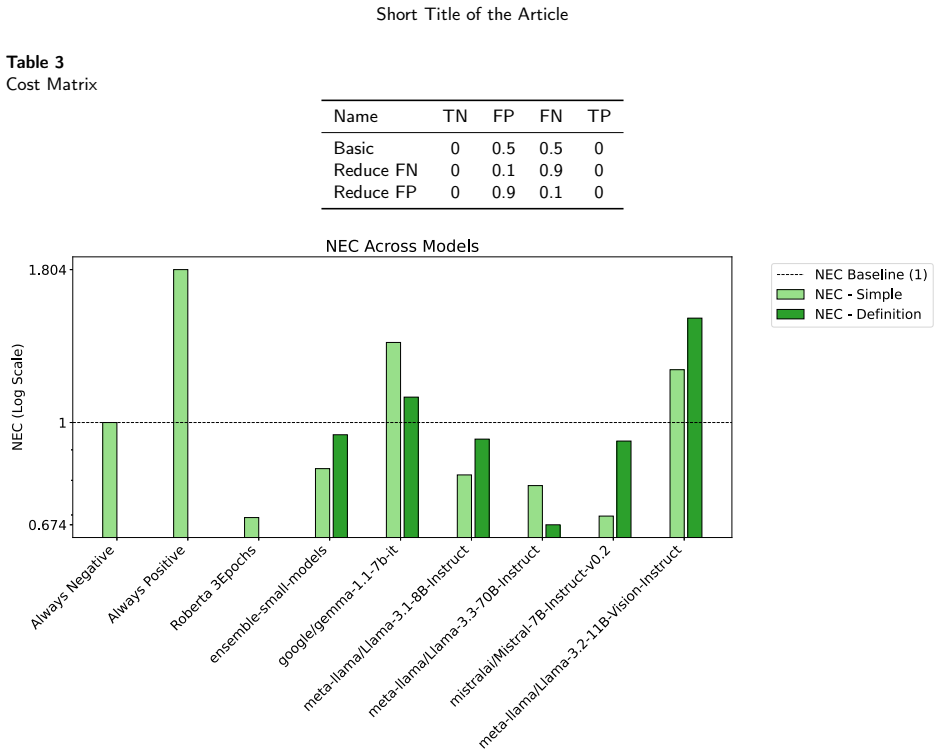
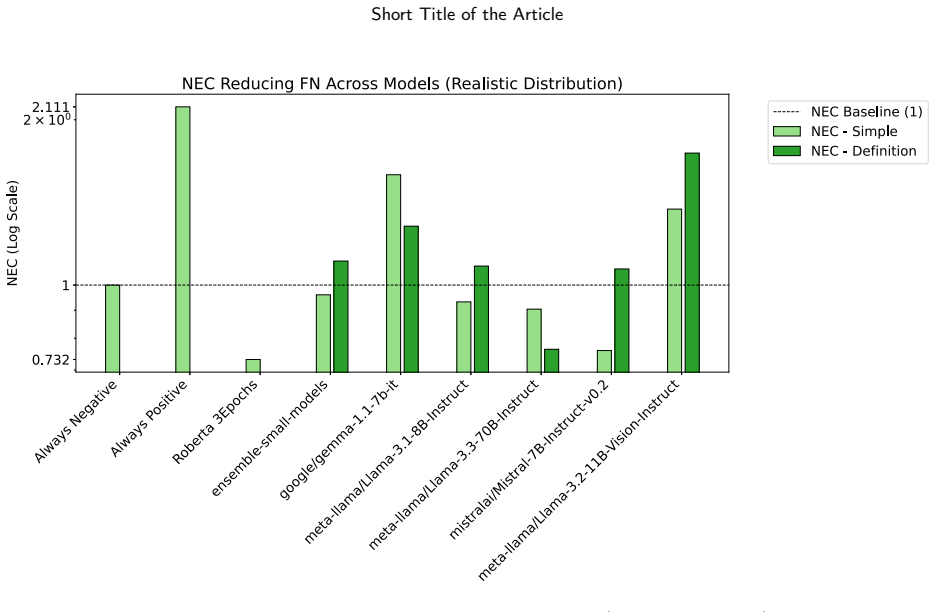
The machinery is the enriched YouNICon benchmark: 2,515 YouTube videos with transcripts, descriptions, comments, channel metadata, and thumbnails, scored by text-only and vision-language models under two zero-shot prompts, plus a fine-tuned RoBERTa baseline and a cost-sensitive Normalized Expected Cost (NEC) metric that reweights false-positive and false-negative penalties and simulates realistic rare-class distributions.
What would settle it
Re-annotate a random sample of the 2,515 videos with expert coders using a written codebook and recompute every model's precision, recall, and NEC; if the ranking changes so that a multimodal model or a different LLM surpasses RoBERTa, or if the high-recall/low-precision pattern disappears, the central claim is contradicted.
Extended reading notes
Core claim
The central claim is that, on a curated set of 2,515 conspiracy-labeled YouTube videos, zero-shot open-weight LLMs achieve high recall at the expense of precision, multimodal models with thumbnail input lag behind their text-only counterparts, and a fine-tuned RoBERTa baseline achieves the best overall performance, particularly when evaluation penalizes false positives. The paper demonstrates this through precision-recall comparisons, cost-sensitive Normalized Expected Cost (NEC) analyses under different cost matrices and simulated rare-class priors, and an in-the-wild experiment on 6,943 English videos sampled from YouTube-Commons.
Load-bearing premise
The crowd-sourced binary labels in YouNICon are treated as ground truth for precision, recall, and NEC comparisons, yet the paper itself reports many mislabeled or ambiguous cases and only fair inter-rater agreement (Cohen's kappa 0.33) on the in-the-wild subset.
Editorial extensions
If this is right
- Text-only zero-shot LLMs can be used as high-recall first-pass screens for conspiracy content, but a deployed system would need a precision filter or threshold tuning to avoid overwhelming moderators with false positives.
- Adding video thumbnails to an 11B vision-language model does not improve and can worsen conspiracy detection, so multimodal investment is better directed at other signals.
- A small fine-tuned model (RoBERTa) can match or beat models up to 70B parameters when false positives are costly, making task-specific fine-tuning a viable low-cost alternative to large LLMs.
- Model rankings depend strongly on whether the evaluator prioritizes avoiding false negatives or false positives; the NEC results show no single model dominates in every cost regime.
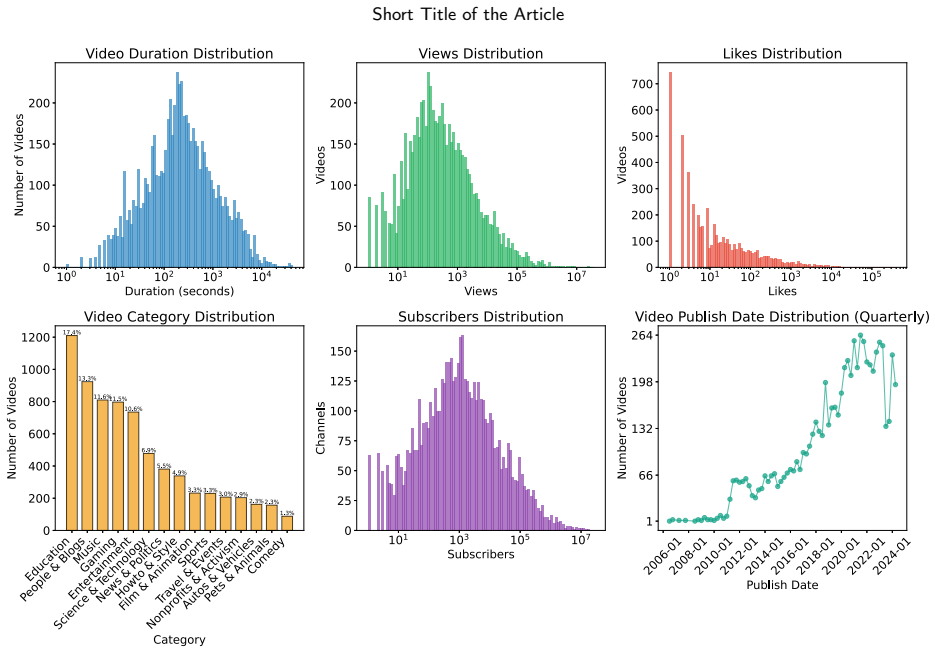
- In an in-the-wild sample of 6,943 English YouTube videos, the best models label about 1.6% of videos as conspiracy-related, with such videos concentrated in News & Politics and showing higher engagement.
Reading between the lines
- The paper's evidence is consistent with the possibility that LLM training or safety alignment creates a systematic bias toward classifying ambiguous content as conspiratorial; this could be tested by measuring model calibration on a balanced, expert-labeled set.
- The negative thumbnail result may not generalize to richer visual inputs: the paper notes some conspiracy videos rely on on-screen text, so OCR or full-frame analysis could still add signal even though thumbnails alone do not.
- Since the ground-truth labels themselves are noisy (the paper's Appendix A reports many mislabeled instances), the absolute performance numbers are less trustworthy than the relative patterns; an expert relabeling effort could either sharpen or overturn the comparison.
- A practical extension suggested by the results is a two-stage pipeline: a high-recall LLM screener followed by a high-precision fine-tuned reranker, trading the strengths of both model families against moderation cost.
Editorial analysis
A structured set of objections, weighed in public.
Referee Report
Summary. The paper evaluates open-weight large language models (LLMs), both text-only and multimodal, for detecting conspiracy-theory YouTube videos. Using the YouNICon dataset enriched with transcripts, metadata, comments, and thumbnails, the authors compare zero-shot LLMs (7B-70B) and a multimodal 11B model against a fine-tuned RoBERTa baseline. They report precision/recall, normalized expected cost (NEC) under several cost scenarios, and an in-the-wild experiment on 9,218 sampled videos with manual annotation of 87 disagreement cases. The main claims are that text-only LLMs achieve high recall but lower precision, multimodal models underperform their text-only counterparts, and fine-tuned RoBERTa remains competitive with or superior to the larger LLMs, depending on the evaluation setting.
Significance. If the central comparison is confirmed, the paper offers a practically useful benchmark for conspiracy content detection on YouTube: open-weight LLMs can act as high-recall screening tools, static thumbnails provide little signal, and a compact fine-tuned model is a cost-effective alternative to 70B models. The authors provide a reproducible hydration pipeline on GitHub, use cost-sensitive evaluation with multiple priors, and include a qualitative error analysis that candidly documents label noise. These are notable strengths for an applied NLP evaluation paper.
major comments (3)
- [§3.2, §4.1, §5.1] The central comparison between the fine-tuned RoBERTa and the zero-shot LLMs is not shown to be controlled. Section 3.2 defines a 75/7.5/17.5 train/validation/test split only for RoBERTa, while the zero-shot LLM evaluation is described (Section 4.1) as being on 'the YouNICon dataset' with 35% positives, which matches the full 2,515-video distribution rather than a 17.5% held-out subset. If the LLM numbers in Tables 1-2 are computed on the full dataset and RoBERTa's on roughly 440 held-out videos, then the headline claim that 'fine-tuned models still achieve the best performance' rests on a mismatched evaluation. The authors must either state explicitly that all models shared the exact same held-out test split or rerun the zero-shot models on the RoBERTa test split and report those results.
- [§4.3.4, Table 2] The claim that 'the RoBERTa model was the best-performing model' is not supported by the reported NEC values in the basic setting: RoBERTa has NEC 0.693, while Llama-3.3-70B-Instruct with the definition prompt has NEC 0.674. The 'best overall' judgment appears to depend on an unstated aggregation across cost scenarios and class priors. Please specify the aggregation criterion (e.g., median rank) and reconcile the narrative with the table, or the conclusion should be revised to say that RoBERTa is best in the reduce-FP scenario but not universally.
- [§4.4, §5.1] The in-the-wild evaluation is based on only 87 disagreement cases with Cohen's kappa of 0.33, and the paper itself acknowledges that these numbers only compare relative accuracy in ambiguous cases. This is a reasonable pilot, but the abstract and Section 5.1 present 'RoBERTa achieves performance close to LLMs' as a broad real-world finding. Please soften the generalization or provide additional evidence (e.g., evaluation on a larger random sample) to support the claim.
minor comments (4)
- [§4.3.4] There is a missing citation: the sentence 'as demonstrated in other works in the literature [?]' contains a placeholder that should be replaced with an actual reference.
- [Table 4] Table 4 lists 'Llama' and 'Mistral' without specifying the prompt variant; the text says the selected models were Llama 3.3 70B with the definition prompt and Mistral 7B with the simple prompt. Please include this information in the table or caption.
- [§4.1, Figure 4, Table 6] The balanced-setting results are introduced with 'we observe an improved precision... across all models,' but RoBERTa is absent from Table 6 and Figure 4. This should be noted in the text or caption to avoid implying that RoBERTa was included.
- [§1 and throughout] The dataset name is spelled inconsistently as both 'YouNiCon' and 'YouNICon'; please standardize.
Circularity Check
No significant circularity: the paper is an empirical benchmark against the external YouNICon dataset, and its central comparison is a measured outcome rather than a construction from its inputs.
full rationale
The paper's derivation chain is an empirical evaluation, not a mathematical derivation. Zero-shot LLMs are scored on the externally annotated YouNICon dataset, and the RoBERTa baseline is fine-tuned on a train split and evaluated on an unseen test split, as described in Section 3.2. The claim that fine-tuned models achieve the best performance is a reported measurement, and the paper itself notes that RoBERTa's advantage stems from being fine-tuned on the labeled dataset (Section 4.3.4). No equation equates an output to an input by construction, and no fitted parameter is renamed as a prediction. The prompts adapted from the authors' prior TikTok study [4] are an experimental design choice, not a load-bearing circular premise; they do not force the precision-recall or NEC outcomes. The paper also evaluates against an independent in-the-wild dataset with manual annotation, providing external evidence. Concerns about split mismatch or label noise are correctness and validity risks, not circularity, and therefore do not raise the circularity score.
Assumptions & free parameters
free parameters (2)
- NEC cost matrix weights =
basic: FP=0.5, FN=0.5; reduce FN: FP=0.1, FN=0.9; reduce FP: FP=0.9, FN=0.1
- Positive-class prior for realistic evaluation =
5%
assumptions (4)
- domain assumption YouNICon crowd-sourced labels are reliable enough to serve as ground truth for evaluation.
- domain assumption The Douglas and Sutton definition of conspiracy theory is a valid operationalization for the zero-shot definition prompt.
- domain assumption A single video thumbnail is sufficient visual input to draw conclusions about multimodal LLM performance.
- domain assumption YouTube-Commons random sample is adequate for in-the-wild evaluation despite category distribution differences.
Cite this review
Pith. "Pith review of Evaluating AI capabilities in detecting conspiracy theories on YouTube." pith.science (2026). https://pith.science/paper/LVDO64CN
@misc{pith2026250523570,
  author       = {Pith},
  title        = {Pith review of: Evaluating AI capabilities in detecting conspiracy theories on YouTube},
  year         = {2026},
  howpublished = {\url{https://pith.science/paper/LVDO64CN}},
  note         = {Machine review of arXiv:2505.23570}
}
read the original abstract
As a leading online platform with a vast global audience, YouTube's extensive reach also makes it susceptible to hosting harmful content, including disinformation and conspiracy theories. This study explores the use of open-weight Large Language Models (LLMs), both text-only and multimodal, for identifying conspiracy theory videos shared on YouTube. Leveraging a labeled dataset of thousands of videos, we evaluate a variety of LLMs in a zero-shot setting and compare their performance to a fine-tuned RoBERTa baseline. Results show that text-based LLMs achieve high recall but lower precision, leading to increased false positives. Multimodal models lag behind their text-only counterparts, indicating limited benefits from visual data integration. To assess real-world applicability, we evaluate the most accurate models on an unlabeled dataset, finding that RoBERTa achieves performance close to LLMs with a larger number of parameters. Our work highlights the strengths and limitations of current LLM-based approaches for online harmful content detection, emphasizing the need for more precise and robust systems.
Figures


Figures from the paper (12 more)






Reference graph
Works this paper leans on
-
[1]
How google fights misinformation, 2 2019. URLhttps://storage.googleapis.com/gweb-uniblog-publish-prod/documents/ How_Google_Fights_Disinformation.pdf
work page 2019
-
[2]
Finalreportoftheselectcommitteetoinvestigatethejanuary6thattackontheunitedstatescapitol,122022. URL https://www.govinfo. gov/app/details/GPO-J6-REPORT/summary
-
[3]
J. Cohen. A coefficient of agreement for nominal scales.Educ. Psychol. Meas., 20(1):37–46, Apr. 1960
work page 1960
-
[4]
Conspiracy theories and where to find them on TikTok
F. Corso, F. Pierri, and G. D. F. Morales. Conspiracy theories and where to find them on tiktok. (arXiv:2407.12545), July 2024. URL http://arxiv.org/abs/2407.12545. arXiv:2407.12545 [cs]
work page Pith review arXiv 2024
-
[5]
M. M. Danilak. langdetect. URLhttps://pypi.org/project/langdetect/
-
[6]
Whatareconspiracytheories?adefinitionalapproachtotheircorrelates,consequences,andcommunication
K.M.DouglasandR.M.Sutton. Whatareconspiracytheories?adefinitionalapproachtotheircorrelates,consequences,andcommunication. Annual review of psychology, 74(1):271–298, 2023
work page 2023
-
[7]
S. Edgerly, E. Vraga, T. Fung, T. Joon, M. Woo, H. Yoo, and A. Veenstra. Youtube as a public sphere: The proposition 8 debate. 10 2009
work page 2009
-
[8]
M. Faddoul, G. Chaslot, and H. Farid. A longitudinal analysis of youtube’s promotion of conspiracy videos. 2020. URL https: //arxiv.org/abs/2003.03318
arXiv 2020
Show all 33 references
-
[9]
Analysisandcomparisonofclassificationmetrics
L.Ferrer. Analysisandcomparisonofclassificationmetrics. (arXiv:2209.05355),Sept.2023. URL http://arxiv.org/abs/2209.05355. arXiv:2209.05355 [cs]
2023 arXiv
-
[10]
FFmpeg. Ffmpeg. URLhttps://www.ffmpeg.org/
-
[11]
V. U. Gongane, M. V. Munot, and A. D. Anuse. Detection and moderation of detrimental content on social media platforms: current status and future directions.Soc. Netw. Anal. Min., 12(1):129, Sept. 2022
2022
- [12]
-
[13]
Grusauskaite, J
K. Grusauskaite, J. Harambam, and S. Aupers. Picturing opaque power: How conspiracy theorists construct oppositional videos on youtube. Social Media + Society, 8(2), 2022. doi: 10.1177/20563051221089568. URLhttps://doi.org/10.1177/20563051221089568
2022 doi
-
[14]
Huggingface serverless inference api
Huggingface. Huggingface serverless inference api. URLhttps://huggingface.co/docs/api-inference/en/index. First Author et al.:Preprint submitted to Elsevier Page 22 of 27 Short Title of the Article
- [15]
-
[16]
C. W. Jo, M. Wesołowska, and M. Wojcieszak. Harmful youtube video detection: A taxonomy of online harm and mllms as alternative annotators, 2024. URLhttps://arxiv.org/abs/2411.05854
2024 arXiv
-
[17]
Joulin, E
A. Joulin, E. Grave, P. Bojanowski, and T. Mikolov. Bag of tricks for efficient text classification. In M. Lapata, P. Blunsom, and A. Koller, editors,Proceedingsofthe15thConferenceoftheEuropeanChapteroftheAssociationforComputationalLinguistics:Volume2,ShortPapers , pages 427–4...
2017
-
[18]
Langlais
P.-C. Langlais. Releasing youtube-commons: a massive open corpus for conversational and multimodal data
-
[19]
S. Liaw, F. Huang, F. Benevenuto, H. Kwak, and J. An. Younicon: Youtube’s community of conspiracy videos, 2023. URLhttps: //arxiv.org/abs/2304.05274
2023 arXiv
- [20]
-
[21]
McGrady, K
R. McGrady, K. Zheng, R. Curran, J. Baumgartner, and E. Zuckerman. Dialing for videos: A random sample of YouTube.J. Quant. Descr. Digit. Media, 3, Dec. 2023
2023
-
[22]
Llama 3.2: Revolutionizing edge ai and vision with open, customizable models,
Meta. Llama 3.2: Revolutionizing edge ai and vision with open, customizable models, . URL https://ai.meta.com/blog/ llama-3-2-connect-2024-vision-edge-mobile-devices/
2024
-
[23]
Llama 3.3,
Meta. Llama 3.3, . URLhttps://www.llama.com/docs/model-cards-and-prompt-formats/llama3_3/
-
[24]
Müller, M
M. Müller, M. Salathé, and P. E. Kummervold. COVID-Twitter-BERT: A natural language processing model to analyse COVID-19 content on twitter.Front. Artif. Intell., 6:1023281, Mar. 2023
2023
-
[25]
Nakatani
S. Nakatani. Language detection library for java, 2010. URLhttps://github.com/shuyo/language-detection
2010
-
[26]
Oppositional thinking analysis: Conspiracy theories vs critical thinking narratives
PAN. Oppositional thinking analysis: Conspiracy theories vs critical thinking narratives
-
[27]
it is just a flu
K. Papadamou, S. Zannettou, J. Blackburn, E. D. Cristofaro, G. Stringhini, and M. Sirivianos. "it is just a flu": Assessing the effect of watch history on youtube’s pseudoscientific video recommendations, 2021. URLhttps://arxiv.org/abs/2010.11638
2021 arXiv
-
[28]
Rep., 12(1):5966, Apr
F.Pierri,B.L.Perry,M.R.DeVerna,K.-C.Yang,A.Flammini,F.Menczer,andJ.Bryden.OnlinemisinformationislinkedtoearlyCOVID-19 vaccination hesitancy and refusal.Sci. Rep., 12(1):5966, Apr. 2022
2022
- [29]
- [30]
-
[31]
S. C. Team. How many videos are on youtube? statistics & facts (2025)
2025
-
[32]
yt-dlp: a feature-rich command-line audio/video downloader
yt dlp. yt-dlp: a feature-rich command-line audio/video downloader. URLhttps://github.com/yt-dlp/yt-dlp
-
[33]
in-the-wild
X.Zhou,A.Sharma,A.X.Zhang,andT.Althoff.Correctingmisinformationonsocialmediawithalargelanguagemodel.(arXiv:2403.11169), Sept. 2024. URLhttp://arxiv.org/abs/2403.11169. arXiv:2403.11169 [cs]. First Author et al.:Preprint submitted to Elsevier Page 23 of 27 Short Title of the Ar...
2024
Reviewed August 7, 2026 · model on record in the stance chip above.
Discussion (0). Sign in to comment.