REVIEW 3 major objections 6 minor 30 references
Unconventional Temperature Dependence of Exciton Diamagnetism in 2D Ruddlesden-Popper Lead Halide Perovskites
T0 review · 3 major / 6 minor · reviewed 2026-08-07 · deepseek-v4-flash
Pith's one-line read The diamagnetic shift of excitons in the layered perovskite (BA)₂(MA)₄Pb₅I₁₆ shrinks by a factor of 3.8 as temperature rises from 20 K to 286 K, implying a room-temperature exciton binding energy near 475 meV.
desk verdict Careful diamagnetic-shift data on an n=5 RPP show a real sigma(T) drop, but the headline binding-energy tripling conflicts with the stable zero-field exciton peak and is unsupported as presented. read the letter →
The pith
A machine-rendered reading of the paper's core claim, the machinery that carries it, and where it could break.
The reading
What carries the argument
The central object is the diamagnetic shift coefficient σ, obtained by fitting the magnetic-field dependence of the 1s exciton peak energy to ΔE(B) = ±g μ_B B + σB² in fields up to 40 T. This coefficient measures the quadratic energy shift caused by the magnetic confinement of the exciton's orbital wavefunction and is proportional to the square of the exciton radius, so a small σ means a compact exciton. In the ideal 2D and 3D hydrogen models with a fixed reduced effective mass, σ is inversely proportional to the exciton binding energy (σ_3D = ħ²e²/[8(μ*)²E_B]), which lets the authors convert the measured σ values into binding-energy ratios.
What would settle it
Measure the reduced effective mass of (BA)₂(MA)₄Pb₅I₁₆ directly as a function of temperature, for example by cyclotron resonance or temperature-dependent magneto-absorption of Landau levels; if μ* changes by roughly a factor of two between 20 K and 300 K, the inferred 3.8-fold increase in binding energy vanishes. Alternatively, determine the room-temperature binding energy directly through two-photon absorption or by resolving the 2s exciton state, and compare it with the 475 meV value.
Extended reading notes
Core claim
At magnetic fields up to 40 T, the authors measured the energy shift of the 1s exciton peak in (BA)₂(MA)₄Pb₅I₁₆ as a function of field and temperature, fitting each dataset to ΔE(B) = ±g μ_B B + σ B². The diamagnetic coefficient σ decreases monotonically from 1.37 ± 0.05 µeV/T² at 20 K to 0.36 ± 0.13 µeV/T² at 286 K, while the g-factor remains constant at about 2.0. Taking the reduced effective mass to be fixed at μ* = 0.104 m₀, the hydrogen-model relation σ = ħ²e²/[8(μ*)²E_B] yields a 3.8-fold increase in binding energy, from 125 ± 29 meV at cryogenic temperature to about 475 meV near room temperature. The authors interpret this as evidence for a smaller exciton radius at higher temperatures, in contrast to the quenching of binding energy observed in 3D perovskites.
Load-bearing premise
The reduced effective mass of the electron-hole pair is assumed to remain constant at 0.104 m0 at all temperatures and through the 280 K structural phase transition, even though that value was measured in the three-dimensional perovskite MAPbI3 rather than in this layered n=5 material.
Editorial extensions
If this is right
- The room-temperature exciton binding energy of (BA)₂(MA)₄Pb₅I₁₆ would be near 475 meV, far exceeding the thermal energy kBT at 300 K.
- Device models that use cryogenic binding energies for 2D Ruddlesden-Popper perovskites would underestimate the difficulty of dissociating excitons at operating temperatures.
- Efficient solar cells made from this material would need to rely on edge states or heterostructure engineering to separate these very strongly bound excitons.
- The measured constancy of the g-factor across the same temperature range indicates that the effect is tied to the exciton size rather than to a change in its spin structure.
Reading between the lines
- A direct test would be to measure the reduced effective mass of this n=5 material as a function of temperature; if μ* changes by roughly a factor of two, the inferred binding-energy increase is spurious.
- The sharp drop in the diamagnetic shift between 250 K and 286 K may be linked to the structural phase transition near 280 K seen in the exciton peak position, and temperature-resolved measurements across that transition could reveal the microscopic mechanism.
- Applying the same magneto-optical technique to other members of the (BA)₂(MA)ₙ₋₁PbₙI₃ₙ₊₁ family (n = 1–4) would show whether the inverse temperature trend is specific to n = 5 or a general feature of layered perovskites.
- Because the hydrogen-model prefactor used to convert σ to E_B may not hold exactly for a mixed-dimensional exciton, the magnitude (but not the sign) of the inferred 475 meV value is the most uncertain part of the claim.
Editorial analysis
A structured set of objections, weighed in public.
Referee Report
Summary. The manuscript reports temperature-dependent magneto-attenuance measurements of the n=5 Ruddlesden–Popper perovskite (BA)2(MA)4Pb5I16 in pulsed magnetic fields, extracting the exciton diamagnetic shift coefficient σ and the exciton g-factor from fits of the 1s exciton peak shift to ΔE(B)=±gμBB+σB^2. The authors find that σ decreases from 1.37±0.05 μeV/T^2 at 20 K to 0.36±0.13 μeV/T^2 at 286 K, while the g-factor is approximately constant. Assuming a hydrogen-like exciton with a temperature-independent reduced mass μ*=0.104 m0, they convert the measured σ into binding energies using E_B=ℏ^2e^2/[8(μ*)^2σ], obtaining a 3.8-fold increase in E_B, from ~125 meV at low temperature to ~475 meV near room temperature. The experimental description is detailed, and the paper explicitly acknowledges that the hydrogen-model conversion involves assumptions about dielectric screening, dimensionality, and effective mass.
Significance. If the quantitative binding-energy claim were correct, it would be a notable counterexample to the usual expectation that exciton binding energies decrease with temperature, with implications for carrier dissociation in layered perovskite optoelectronic devices. The paper's strengths are the direct high-field measurements, the simultaneous fitting of four polarization/field configurations, the reporting of fit parameters with uncertainties, and the transparency about model limitations. However, the central quantitative claim that the binding energy triples at room temperature is not supported by the data as presented, because it conflicts with the measured zero-field exciton peak position and rests on an unjustified constant-mass assumption. The robust empirical result is the temperature dependence of the diamagnetic shift coefficient itself.
major comments (3)
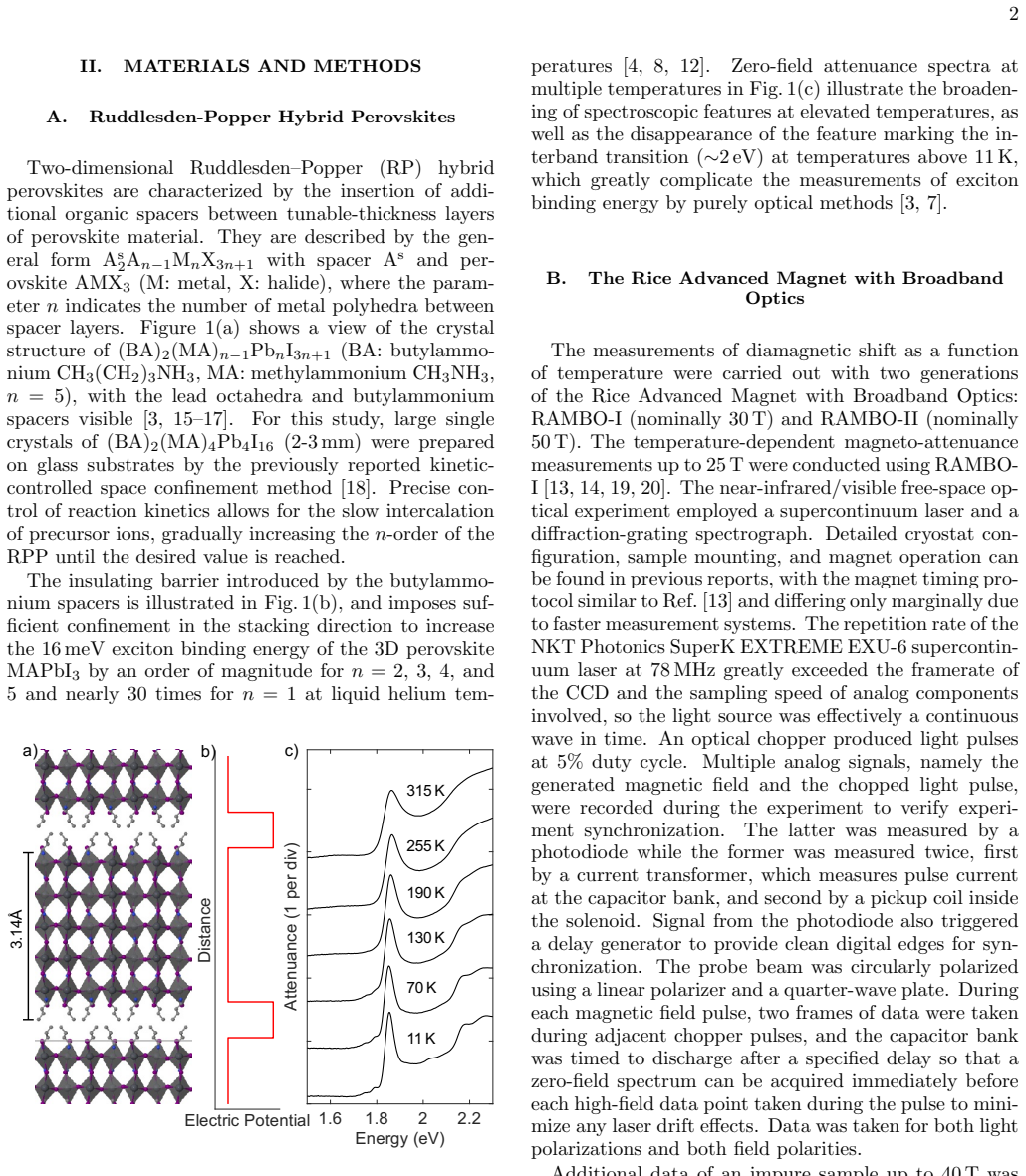
- [Section III and Fig. B.1] The inferred factor-of-3.8 increase in E_B is internally inconsistent with the zero-field 1s exciton peak position. Using the standard relation E_1s = E_g - E_B, an increase in E_B from ~125 meV to ~475 meV while the 1s peak remains fixed near 1.855 eV (Fig. B.1) requires E_g to increase by ~350 meV. No such band-edge shift is reported or discussed: the interband continuum is visible only at 11 K in Fig. 1(c), and Fig. B.1 explicitly plots the exciton peak, not the continuum edge. The paper therefore conflates the exciton peak with the optical band gap when it argues that the stable peak justifies a constant μ*. As presented, either μ* is strongly temperature dependent, or the hydrogen-model conversion is invalid; in either case the tripled-binding-energy claim is unsupported.
- [Section III, constant-μ* assumption] The quantitative conversion depends on μ*=0.104 m0, a value measured in 3D MAPbI3 at 2 K and 160 K, and on μ* remaining constant across the structural phase transition near 280 K shown in Appendix B. Because E_B scales as (μ*)^(-2) for fixed σ, a factor-of-two change in μ* between 20 K and 286 K would eliminate the claimed anomaly. The only in-sample justification offered is the stability of the feature in Fig. B.1, which, as noted above, is the exciton peak rather than the band edge. The paper provides no high-temperature effective-mass measurement and no argument that the layered n=5 material should have the same mass as 3D MAPbI3 at all temperatures.
- [Abstract, Section III, and Section IV] The Abstract and conclusion present the tripled room-temperature binding energy without the strong caveats that appear later in the paper. Section III states that mixed dimensionality may modify the hydrogen-model relation, and Section IV says that 'extrapolation from the diamagnetic shift coefficient to the binding energy is not direct.' If the quantitative E_B claim is to be retained, the paper needs either direct high-temperature evidence for the continuum edge and E_g, or a quantitative treatment of the temperature-dependent dielectric screening and effective mass. Otherwise the paper should be reframed around the measured σ(T) trend, with the binding-energy increase presented only as a conditional model-dependent inference.
minor comments (6)
- [Section II A and Fig. B.1 caption] The chemical formula for the n=5 compound is written as (BA)2(MA)4Pb4I16, but the correct formula for n=5 is (BA)2(MA)4Pb5I16; the same typo appears in the Fig. B.1 caption and should be corrected.
- [Section II B and Fig. 2(e)] The 40 T data are described as coming from an 'impure sample' and yield g=2.6 and σ=1.2 μeV/T^2, whereas the 20 K point in the temperature series gives g=1.98±0.03 and σ=1.37±0.05 μeV/T^2. The manuscript does not clarify whether these are the same sample or how the 40 T result relates to the σ(T) dataset, which makes the abstract claim of measurements 'up to 40 T' difficult to evaluate.
- [Fig. B.1] The vertical axis label 'Peak Energy' is clear, but the main text refers to this quantity as the 'optical band gap' in Section III; the terminology should be made consistent, since the figure shows the exciton peak rather than the continuum edge.
- [Fig. C.1 and Fig. 3(e)] The σ(T) series is not strictly monotonic (for example, σ at 120 K is 1.05±0.03 μeV/T^2, slightly above the 85 K value of 0.99±0.07 μeV/T^2), and the high-temperature points carry large relative uncertainties (0.36±0.13 μeV/T^2 at 286 K). A fit or trend line with a statistical assessment of monotonicity would strengthen the empirical claim of an inverse correlation.
- [Eq. (1) and Fig. 2(d)] The sign convention for the Zeeman term and the assignment of circular polarization states ('<' and '>') to positive and negative fields should be defined explicitly; the figures use these symbols without a textual explanation.
- [Reference [25]] Reference [25] lists the publisher city as 'New Pork, NY'; this should be 'New York, NY'.
Circularity Check
No circularity: sigma is measured from raw spectra and E_B follows from a standard published hydrogen-model formula with an externally measured reduced mass.
full rationale
The derivation chain is: Eq. (1) fits the field-dependent exciton peak shift to obtain the diamagnetic coefficient sigma at each temperature; the hydrogen-model relation sigma = hbar^2 e^2 / [8 (mu*)^2 E_B] (Section III, citing Refs. [21,22]) then converts sigma to E_B using a fixed reduced mass mu* = 0.104 m0 measured in MAPbI3 by independent groups (Refs. [8,12]). None of these steps defines sigma in terms of E_B or fits a parameter to the target binding-energy claim; sigma is an independently extracted observable. The only self-citation (Ref. [4]) supplies a comparison value (125 meV at 4 K) and background on deviations from hydrogen models; it is not used to derive the room-temperature binding energy, so it is not load-bearing. The paper candidly labels the conversion an 'extrapolation' and lists the dielectric function and hydrogen-model applicability as open questions. The assumption that mu* is temperature-independent is an external modeling assumption, not a circular one; whether it is correct is a scientific-risk concern rather than a circularity.
Assumptions & free parameters
free parameters (2)
- diamagnetic shift coefficient sigma(T) =
1.37+/-0.05 micro-eV/T^2 at 20 K; 0.36+/-0.13 micro-eV/T^2 at 286 K
- exciton g-factor =
1.82+/-0.10 to 2.04+/-0.03 across temperature
assumptions (4)
- domain assumption The reduced effective mass mu* is constant with temperature and equals 0.104 m0, the value measured in 3D MAPbI3.
- ad hoc to paper The exciton obeys hydrogen-like scaling in the 2D or 3D limit, with mixed dimensionality modifying only prefactors.
- domain assumption The spectral feature tracked is the 1s exciton and its magnetic-field shift contains only the Zeeman and diamagnetic terms of Eq. (1).
- ad hoc to paper The structural phase transition near 280 K does not alter the exciton character enough to change mu* or the hydrogen-model relation.
Cite this review
Pith. "Pith review of Unconventional Temperature Dependence of Exciton Diamagnetism in 2D Ruddlesden-Popper Lead Halide Perovskites." pith.science (2026). https://pith.science/paper/5T3GJ7CM
@misc{pith2026250523571,
  author       = {Pith},
  title        = {Pith review of: Unconventional Temperature Dependence of Exciton Diamagnetism in 2D Ruddlesden-Popper Lead Halide Perovskites},
  year         = {2026},
  howpublished = {\url{https://pith.science/paper/5T3GJ7CM}},
  note         = {Machine review of arXiv:2505.23571}
}
abstract
Layered hybrid perovskites containing larger organic cations have demonstrated superior environmental stability, but the presence of these insulating spacers also strengthens the exciton binding energy, which contributes to reduced carrier separation. The consequences of increased binding energy on device efficiency are still not fully documented, and binding energy measurements are often conducted at cryogenic temperatures where linewidths are decreased and a series of hydrogen-like bound states can be identified, but not under ambient conditions where devices are expected to operate. In contrast to the quenching observed in 3D perovskites such as methylammonium lead iodide, where exciton binding energies are thought to decrease at higher temperatures, we present evidence for a smaller excitonic radius at higher temperatures in the $n=5$ member of butylammonium-spaced methylammonium lead iodide, (BA)$_2$(MA)$_{n-1}$Pb$_n$I$_{3n+1}$. We measured the temperature-dependent diamagnetic shift coefficient in magnetic fields up to 40\,T, which is one-third as large at room temperature as those at cryogenic temperatures. In both the ideal 2D and 3D hydrogen models, this trend would indicate that the exciton binding energy more than triples at room temperature.
Figures


Reference graph
Works this paper leans on
-
[1]
K. Chen, A. J. Barker, F. L. C. Morgan, J. E. Halpert, and J. M. Hodgkiss, Effect of Carrier Thermaliza- tion Dynamics on Light Emission and Amplification in Organometal Halide Perovskites, The Journal of Physi- cal Chemistry Letters6, 153 (2015)
work page 2015
-
[2]
S. Sidhik, Y. Wang, M. De Siena, R. Asadpour, A. J. Torma, T. Terlier, K. Ho, W. Li, A. B. Puthirath, X. Shuai, A. Agrawal, B. Traore, M. Jones, R. Girid- haragopal, P. M. Ajayan, J. Strzalka, D. S. Ginger, C. Katan, M. A. Alam, J. Even, M. G. Kanatzidis, and A. D. Mohite, Deterministic fabrication of 3D/2D per- ovskite bilayer stacks for durable and effi...
work page 2022
-
[3]
J.-C. Blancon, H. Tsai, W. Nie, C. C. Stoumpos, L. Pedesseau, C. Katan, M. Kepenekian, C. M. M. Soe, K. Appavoo, M. Y. Sfeir, S. Tretiak, P. M. Ajayan, M. G. Kanatzidis, J. Even, J. J. Crochet, and A. D. Mohite, Extremely efficient internal exciton dissociation through edge states in layered 2D perovskites, Science355, 1288 (2017)
work page 2017
-
[4]
by a factor of 3.8 to reach 475 meV. Extrapolation from the diamagnetic shift coefficient to the binding energy is not direct, but future experiments of the dielectric function and more direct measurements of the binding energy would provide clarification. The presence of high-binding-energy excitons would require the exploitation of edge states [3] or th...
-
[5]
J.-C. Blancon, A. V. Stier, H. Tsai, W. Nie, C. C. Stoumpos, B. Traor´ e, L. Pedesseau, M. Kepenekian, F. Katsutani, G. T. Noe, J. Kono, S. Tretiak, S. A. Crooker, C. Katan, M. G. Kanatzidis, J. J. Crochet, J. Even, and A. D. Mohite, Scaling law for excitons in 2D perovskite quantum wells, Nature Communications 9, 2254 (2018)
work page 2018
- [6]
-
[7]
D. M. Niedzwiedzki, H. Zhou, and P. Biswas, Exciton Binding Energy of MAPbI3 Thin Film Elucidated via Analysis and Modeling of Perovskite Absorption and Photoluminescence Properties Using Various Methodolo- gies, The Journal of Physical Chemistry C126, 1046 (2022)
work page 2022
-
[8]
K. R. Hansen, J. S. Colton, and L. Whittaker-Brooks, Measuring the Exciton Binding Energy: Learning from a Decade of Measurements on Halide Perovskites and Tran- sition Metal Dichalcogenides, Advanced Optical Materi- als12, 2301659 (2024)
work page 2024
Show all 30 references
-
[9]
Miyata, A
A. Miyata, A. Mitioglu, P. Plochocka, O. Portugall, J. T.- W. Wang, S. D. Stranks, H. J. Snaith, and R. J. Nicholas, Direct measurement of the exciton binding energy and effective masses for charge carriers in organic–inorganic tri-halide perovskites, Nature Physics11, 582 (2015)
2015
-
[10]
Kazimierczuk, D
T. Kazimierczuk, D. Fr¨ ohlich, S. Scheel, H. Stolz, and M. Bayer, Giant Rydberg excitons in the copper oxide Cu2O, Nature514, 343 (2014)
2014
-
[11]
J. Even, L. Pedesseau, and C. Katan, Analysis of Multi- valley and Multibandgap Absorption and Enhancement of Free Carriers Related to Exciton Screening in Hybrid Perovskites, The Journal of Physical Chemistry C118, 11566 (2014)
2014
-
[12]
Sestu, M
N. Sestu, M. Cadelano, V. Sarritzu, F. Chen, D. Marongiu, R. Piras, M. Mainas, F. Quochi, M. Saba, A. Mura, and G. Bongiovanni, Absorption F-Sum Rule for the Exciton Binding Energy in Methylammonium Lead Halide Perovskites, The Journal of Physical Chem- istry Letters6, 4566 (2015)
2015
-
[13]
Z. Yang, A. Surrente, K. Galkowski, N. Bruyant, D. K. Maude, A. A. Haghighirad, H. J. Snaith, P. Plochocka, and R. J. Nicholas, Unraveling the Exciton Binding Energy and the Dielectric Constant in Single-Crystal Methylammonium Lead Triiodide Perovskite, The Jour- nal of Physic...
2017
-
[14]
G. T. Noe, II, H. Nojiri, J. Lee, G. L. Woods, J. L´ eotin, and J. Kono, A table-top, repetitive pulsed magnet for nonlinear and ultrafast spectroscopy in high magnetic fields up to 30 T, Review of Scientific Instruments84, 123906 (2013)
2013
-
[15]
F. Tay, A. Baydin, F. Katsutani, and J. Kono, Magneto- optical Spectroscopy with RAMBO: A Table-Top 30 T Magnet, Journal of the Physical Society of Japan91, 101006 (2022)
2022
-
[16]
S. N. Ruddlesden and P. Popper, New compounds of the K2NIF4 type, Acta Crystallographica10, 538 (1957)
1957
-
[17]
C. R. Kagan, D. B. Mitzi, and C. D. Dimitrakopoulos, Organic-Inorganic Hybrid Materials as Semiconducting Channels in Thin-Film Field-Effect Transistors, Science 286, 945 (1999)
1999
-
[18]
C. C. Stoumpos, C. M. M. Soe, H. Tsai, W. Nie, J.- C. Blancon, D. H. Cao, F. Liu, B. Traor´ e, C. Katan, J. Even, A. D. Mohite, and M. G. Kanatzidis, High Members of the 2D Ruddlesden-Popper Halide Per- ovskites: Synthesis, Optical Properties, and Solar Cells of (CH3(CH2)3NH3)...
2017
-
[19]
J. Hou, W. Li, H. Zhang, S. Sidhik, J. Fletcher, I. Met- calf, S. B. Anantharaman, X. Shuai, A. Mishra, J.- C. Blancon, C. Katan, D. Jariwala, J. Even, M. G. Kanatzidis, and A. D. Mohite, Synthesis of 2D perovskite crystals via progressive transformation of quantum well thickn...
2024
-
[20]
G. T. Noe, I. Katayama, F. Katsutani, J. J. Allred, J. A. Horowitz, D. M. Sullivan, Q. Zhang, F. Sekiguchi, G. L. Woods, M. C. Hoffmann, H. Nojiri, J. Takeda, and J. Kono, Single-shot terahertz time-domain spectroscopy in pulsed high magnetic fields, Optics Express24, 30328 (2016)
2016
-
[21]
Baydin, T
A. Baydin, T. Makihara, N. M. Peraca, and J. Kono, Time-domain terahertz spectroscopy in high magnetic fields, Frontiers of Optoelectronics14, 110 (2021)
2021
-
[22]
M. Dyksik, Using the Diamagnetic Coefficients to Es- timate the Reduced Effective Mass in 2D Layered Per- ovskites: New Insight from High Magnetic Field Spec- troscopy, International Journal of Molecular Sciences23, 12531 (2022)
2022
-
[23]
K. Cong, G. T. Noe II, and J. Kono, Excitons in Mag- netic Fields, inEncyclopedia of Modern Optics (Second Edition), edited by B. D. Guenther and D. G. Steel (El- sevier, Oxford, 2018) pp. 63–81
2018
-
[24]
Miura,Physics of Semiconductors in High Magnetic Fields, 1st ed., Series on Semiconductor Science and Technology Series, Vol
N. Miura,Physics of Semiconductors in High Magnetic Fields, 1st ed., Series on Semiconductor Science and Technology Series, Vol. 15 (Oxford University Press, Ox- ford, 2007)
2007
-
[25]
F. J. A. Solsona and J. M. Fornies-Marquina, Dielectric properties of ten primary amines at microwave frequen- cies as a function of temperature, Journal of Physics D: Applied Physics15, 1783 (1982). 9
1982
-
[26]
Knox,Theory of Excitons., edited by H
R. Knox,Theory of Excitons., edited by H. Ehrenreich and F. Spaepen, Solid State Physics; Advances in Re- search and Applications. Supplement, Vol. 5 (Academic Press, New Pork, NY, 1963)
1963
-
[27]
Umari, E
P. Umari, E. Mosconi, and F. De Angelis, Infrared Dielec- tric Screening Determines the Low Exciton Binding En- ergy of Metal-Halide Perovskites, The Journal of Physical Chemistry Letters9, 620 (2018)
2018
-
[28]
Feneberg, J
M. Feneberg, J. Nixdorf, C. Lidig, R. Goldhahn, Z. Galazka, O. Bierwagen, and J. S. Speck, Many-electron effects on the dielectric function of cubic In2O3: Effective electron mass, band nonparabolicity, band gap renormal- ization, and Burstein-Moss shift, Physical Review B93, ...
2016
-
[29]
B. Song, J. Hou, H. Wang, S. Sidhik, J. Miao, H. Gu, H. Zhang, S. Liu, Z. Fakhraai, J. Even, J.-C. Blancon, A. D. Mohite, and D. Jariwala, Determination of Dielec- tric Functions and Exciton Oscillator Strength of Two- Dimensional Hybrid Perovskites, ACS Materials Letters 3, 1...
2021
-
[30]
Han, J.-W
T.-H. Han, J.-W. Lee, Y. J. Choi, C. Choi, S. Tan, S.-J. Lee, Y. Zhao, Y. Huang, D. Kim, and Y. Yang, Surface- 2D/Bulk-3D Heterophased Perovskite Nanograins for Long-Term-Stable Light-Emitting Diodes, Advanced Ma- terials32, 1905674 (2020)
2020
Reviewed August 7, 2026 · model on record in the stance chip above.
Discussion (0). Sign in to comment.