REVIEW 4 major objections 5 minor 68 references
Multi-Group Proportional Representation for Text-to-Image Models
T0 review · 4 major / 5 minor · reviewed 2026-08-07 · deepseek-v4-flash
Pith's one-line read MPR measures worst-case representation gaps across intersectional groups in text-to-image models.
desk verdict A useful, honest application of a known metric to text-to-image fairness; the same noisy labeler feeds both measurement and training, and Proposition 2's proof is sketchy, but the package is worth refereeing. read the letter →
The pith
A machine-rendered reading of the paper's core claim, the machinery that carries it, and where it could break.
The reading
What carries the argument
The metric itself: $\mathrm{MPR}(C,G_q,R)=\sup_{c\in C}|\mathbb{E}_{G_q}[c(X_g)]-\mathbb{E}_R[c(X_r)]|$, the worst-case gap between a generated distribution and a reference distribution over a bounded function class $C$. Choosing $C$ as bounded linear functions gives an explicit norm computation; choosing $C$ as depth-$\ell$ decision trees gives the maximum total variation between marginal distributions over any $\ell$-attribute intersection. These closed forms allow MPR to be computed and used in gradient-based fine-tuning, with buffers of past generated images and worst-case functions stabilizing the supremum, and CLIP/DINO regularization preserving image quality.
What would settle it
Generate the same image set for a fixed prompt, then label the images twice: once with the paper's linear classifiers on CLIP embeddings and once with human annotators for gender, age, and race. If MPR computed on human labels ranks the models differently from MPR on classifier labels, or if the fine-tuned model no longer beats the vanilla model on human-labeled MPR, the measurement and optimization claims collapse. A cheaper version: re-run the Table 4 comparison with race labels replaced by a second, independently trained race classifier and check whether the MPR ordering of methods is stable.
Extended reading notes
Core claim
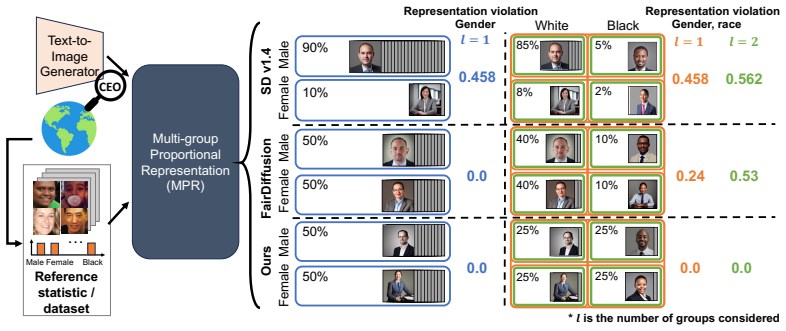
The central claim is that MPR, originally proposed for retrieval, transfers to text-to-image generation as a theoretically grounded measure of proportional representation across arbitrary intersectional groups. With attribute vectors as inputs and decision trees or linear classifiers as the function class, the MPR supremum has closed forms tied to total variation and linear projections, making it computable and interpretable: the splits of the worst-case tree name the intersectional groups driving the bias. Used as a fine-tuning objective with buffered samples and regularization, MPR guides a diffusion model toward more balanced intersectional generation without a large drop in semantic fidelity.
Load-bearing premise
The load-bearing premise is that the automated classifiers used to label gender, age, and race on generated faces are accurate enough that MPR values and gradients reflect true demographic membership; the paper's own race classifier is 77% accurate, and the authors note these estimators may carry their own biases.
Editorial extensions
If this is right
- MPR unifies earlier single-axis fairness metrics as special cases, so a single evaluation can replace separate gender, race, and age checks.
- Decision-tree MPR identifies which intersectional group is most over- or under-represented, turning a harm score into an interpretable audit.
- Contextual reference distributions let MPR reward historical accuracy, such as women-only ENIAC programmers, instead of always demanding uniform parity.
- Fine-tuning with MPR reduces intersectional representational harm while maintaining CLIP scores, outperforming baselines that only address gender.
- By trading function-class complexity for sample size, MPR scales to large attribute sets where enumerating all intersectional groups is impossible.
Reading between the lines
- Our inference: because MPR with decision trees returns interpretable split attributes, the same measurement could double as an audit report that tells developers which intersectional group is most underrepresented, not just that bias exists.
- Our inference: the buffer-based optimization recipe could generalize to other non-differentiable distributional metrics in generative models, since it converts the supremum into a finite set of cached worst-case functions.
- Our inference: pairing MPR with official statistics from sources like Census or labor data could make 'proportional' representation operational for deployment, but it would also inherit whatever historical biases those references contain; the paper flags this tension but does not resolve it.
- Our inference: Proposition 2 suggests MPR improvements should transfer to unseen prompts, so a cheap testable extension is to fine-tune on one set of occupations and evaluate on a held-out set; the paper's experiments average across professions but do not explicitly report held-out prompt generalization.
Editorial analysis
A structured set of objections, weighed in public.
Referee Report
Summary. The paper introduces Multi-Group Proportional Representation (MPR) for text-to-image models. MPR is defined in Definition 1 as the worst-case absolute difference, over a function class C, between the expectation of c under the generated distribution and under a reference distribution R. The authors give an empirical estimator (Eq. 2), generalization bounds (Propositions 1 and 2), closed-form expressions for bounded linear functions and decision trees (Propositions 3 and 4), and a fine-tuning algorithm (Algorithm 1) that optimizes the MPR objective with buffers and a CLIP/DINO regularization term. The experiments measure representational harm across professions, traits, and disabilities for several T2I models, and apply the fine-tuning method to Stable Diffusion v1.4, reporting improved intersectional representation relative to baseline debiasing methods while maintaining CLIP scores.
Significance. If the technical results are correct, MPR provides a flexible and principled framework that unifies existing fairness metrics for T2I models with IPM/MMD theory and multicalibration, while allowing context-dependent reference distributions and tunable function-class complexity. The closed-form computations for linear classifiers and decision trees, as well as the buffer-based fine-tuning scheme, are useful contributions, and the released code supports reproducibility. However, the central claims rest on the correctness of the generalization bounds and on the reliability of the automated attribute classifiers; both raise concerns that must be addressed before the measurement and mitigation conclusions can be accepted.
major comments (4)
- [Section 3.1, Eq. (4); Appendix B, Proof of Proposition 2] Proposition 2 as stated is not established by the supplied proof. The exponent in Eq. (4) is exp(-2(k+m)/B^2 * (epsilon/2 - 2*lambda)), which is linear in the margin, whereas the proof's own use of Proposition 1 would yield a squared term; Remark 2 in the appendix uses a squared term, confirming the inconsistency. Additionally, the proof applies a fixed-prompt deviation bound to each q_i and then asserts the same bound for the average without a union bound or uniform control of the Rademacher complexities, so the concentration over N prompts does not follow. The proof also contains indexing errors (e.g., 'n' in place of 'm' in the symmetrization step). This is load-bearing because Proposition 2 is cited as justification that MPR measured on finitely many prompts generalizes to the prompt distribution.
- [Section 4 and Appendix C; Algorithm 1] The empirical claims depend on automated attribute classifiers that are used both to measure MPR and as the training signal in Algorithm 1. The race classifier has only 77% test accuracy on FairFace, and the paper does not validate its behavior on synthetic images from Stable Diffusion, which are out-of-distribution for a CLIP linear probe. If the labeler makes systematic errors on generated images, the MPR reductions reported in Tables 1-4 and in the fine-tuning comparison could reflect exploitation of labeler bias rather than genuine demographic change. The authors acknowledge this risk in Appendix A, but no sensitivity analysis, confusion matrices, alternative labelers, or manually labeled subset validation is provided. I request such an analysis, or at minimum an explicit error model and a discussion of how label noise affects both the measurement and the optimization.
- [Table 4; Definition 1] The MPR values in Table 4 are inconsistent with the metric as defined. For decision-tree function classes, Proposition 4 implies MPR <= 1, yet Table 4 reports MPR(G)=1.18 and MPR(GAR)=1.89 for the Vanilla model. For a binary gender attribute with a balanced FairFace reference, even the linear function class of Proposition 3 (with one-hot encoding and ||w||<=1) would not allow MPR(G)=1.18: the maximum possible deviation with a balanced reference is at most sqrt(2)*0.5, about 0.71. The table does not specify which function class and which attribute encoding were used, nor whether the reported numbers are normalized. This makes the headline comparison in Table 4 difficult to interpret and potentially invalid. The authors must state the exact C used for each MPR column and reconcile the numerical range with Definition 1.
- [Appendix B, Proof of Proposition 1] The proof of Proposition 1 contains technical errors that prevent it from establishing the stated bound. The McDiarmid step bounds the martingale difference by B/min{m,k} in Eq. (11), but the exponent in the subsequent concentration inequality is written as exp(-2*epsilon^2*(m+k)/B^2), which would require a different range; the factor 1/min^2 is missing. The symmetrization argument also mixes the sample-size factors, with terms like 2*E sup (1/k) sum_{i=n+1}^{k+m} sigma*c(x_i) appearing instead of the reference-sample Rademacher average with 1/m. Since Proposition 1 is used to justify sample-size selection and to derive Proposition 2, the proof must be corrected before the theoretical claims can be accepted.
minor comments (5)
- [Section 5, Table 4] The caption states that results are averaged across seven professions, but only six are listed (chef, therapist, taxi driver, flight attendant, housekeeper, nurse); please correct the count or list all professions.
- [Section 3.2, Eq. (5)] The displayed formula for Proposition 3 is written as a fraction, but it should be read as the norm ||a^T X||; please clarify the notation and state explicitly that the supremum equals the Euclidean norm of X^T a.
- [Appendix D.2, Figure 4] The caption refers to the 'true MPR' as computed with 5,000 generated images; this is an approximation, and the caption should state that assumption explicitly to avoid overclaiming.
- [Appendix B, Eq. (20)] The index n is used without definition; the intended reference-sample size appears to be m, and the coefficient should be 1/m rather than 1/k for the second Rademacher term.
- [Appendix B, Remark 2, Eq. (24)] The Bernstein-style bound introduces sigma^2 and a second term exp(-2(k+m)(epsilon/4 - 2*lambda)^2/B^2), but the relationship between the two terms and the value of epsilon/4 versus epsilon/2 in Proposition 2 is not explained; please harmonize the notation.
Circularity Check
No significant circularity: the MPR metric is restated and its theoretical properties are proved in the paper; using the same attribute estimators in measurement and fine-tuning is a stated design choice, not a hidden reduction.
full rationale
The derivation chain is self-contained. Definition 1 states MPR as an IPM-type supremum over a function class, and the paper explicitly notes that MPR is also known as MMD and a special case of integral probability metrics. Propositions 1-4 are proved in the paper from Definition 1 using standard Rademacher/McDiarmid arguments and elementary linear-algebra and decision-tree optimizations; none of the proofs assumes the conclusion. For example, Proposition 3 reduces to the norm of the empirical mean difference, which follows directly from the supremum over a unit ball, and Proposition 4 follows from choosing optimal leaf signs in a decision tree. The citation to the earlier retrieval MPR paper is provenance, not load-bearing: the definition and proofs are reproduced here. The same reference distribution and the same CLIP-probe attribute classifiers feed both MPR evaluation and the fine-tuning objective in Algorithm 1; this is a deliberate optimization/evaluation loop, and the paper flags the classifier-bias risk in Appendix A: "These estimation methods may not only perpetuate harmful categorization practices but could also contain inherent biases themselves." That is a validity or robustness limitation, not a circular derivation: the claimed MPR reductions are reductions of the same quantity the method optimizes, which is what an optimization method should demonstrate, and the CLIP score check is an independent external benchmark. No fitted parameter is renamed as a prediction, and no uniqueness theorem or ansatz is imported from the authors' prior work to force the choice of C or R. Overall, no significant circularity.
Assumptions & free parameters
free parameters (2)
- lambda (regularization strength) =
0.5
- Buffer sizes B_MPR and B_C =
32
assumptions (3)
- standard math Rademacher complexity and McDiarmid/Hoeffding inequalities give valid high-probability bounds for the MPR generalization gap.
- ad hoc to paper Representational harm is adequately captured by the class of functions C (bounded linear or depth-limited decision trees) over the chosen demographic attributes.
- domain assumption The reference distribution R (FairFace test set, or Google Images for the ENIAC case) is the appropriate target for proportional representation.
Cite this review
Pith. "Pith review of Multi-Group Proportional Representation for Text-to-Image Models." pith.science (2026). https://pith.science/paper/LAYZFS44
@misc{pith2026250524023,
  author       = {Pith},
  title        = {Pith review of: Multi-Group Proportional Representation for Text-to-Image Models},
  year         = {2026},
  howpublished = {\url{https://pith.science/paper/LAYZFS44}},
  note         = {Machine review of arXiv:2505.24023}
}
read the original abstract
Text-to-image (T2I) generative models can create vivid, realistic images from textual descriptions. As these models proliferate, they expose new concerns about their ability to represent diverse demographic groups, propagate stereotypes, and efface minority populations. Despite growing attention to the "safe" and "responsible" design of artificial intelligence (AI), there is no established methodology to systematically measure and control representational harms in image generation. This paper introduces a novel framework to measure the representation of intersectional groups in images generated by T2I models by applying the Multi-Group Proportional Representation (MPR) metric. MPR evaluates the worst-case deviation of representation statistics across given population groups in images produced by a generative model, allowing for flexible and context-specific measurements based on user requirements. We also develop an algorithm to optimize T2I models for this metric. Through experiments, we demonstrate that MPR can effectively measure representation statistics across multiple intersectional groups and, when used as a training objective, can guide models toward a more balanced generation across demographic groups while maintaining generation quality.
Figures


Figures from the paper (7 more)


Reference graph
Works this paper leans on
-
[1]
https://population.un.org/ wpp/
United nations department of economic and social affairs: Population division. https://population.un.org/ wpp/. Accessed: 2024-11-14. 4
work page 2024
-
[2]
Centers for disease control and prevention.https://dhds. cdc.gov/SP. Accessed Sep 11, 2024. 7
work page 2024
-
[3]
Eurostats data. https://ec.europa.eu/eurostat/ web / population - demography / demography - population - stock - balance / database. Ac- cessed: 2024-11-14. 4
work page 2024
-
[4]
International labour organization statistics. https:// ilostat.ilo.org/. Accessed: 2024-11-14. 4
work page 2024
-
[5]
Oecd data. https : / / www . oecd . org / en / data . html. Accessed: 2024-11-14. 4
work page 2024
-
[6]
employed persons by detailed oc- cupation, sex, race, and hispanic or latino ethnicity
Us bureau of labor statistics. employed persons by detailed oc- cupation, sex, race, and hispanic or latino ethnicity. https: //www.bls.gov/cps/cpsaat11.htm . Accessed: 2024-11-09. 4
work page 2024
-
[7]
World bank open data. https://data.worldbank. org/. Accessed: 2024-11-14. 4
work page 2024
-
[8]
Adobe. Firefly, 2024. Accessed Sep 7, 2024. https:// www.adobe.com/products/firefly/features/ text-to-image.html. 1
work page 2024
Show all 68 references
-
[9]
How well can text-to-image generative models under- stand ethical natural language interventions? arXiv preprint arXiv:2210.15230, 2022
Hritik Bansal, Da Yin, Masoud Monajatipoor, and Kai-Wei Chang. How well can text-to-image generative models under- stand ethical natural language interventions? arXiv preprint arXiv:2210.15230, 2022. 3, 5, 8
2022 arXiv
-
[10]
Pioneer programmer: Jean Jennings Bartik and the computer that changed the world
Jean Jennings Bartik. Pioneer programmer: Jean Jennings Bartik and the computer that changed the world . Truman State University Press, 2013. 7
2013
-
[11]
Easily acces- sible text-to-image generation amplifies demographic stereo- types at large scale
Federico Bianchi, Pratyusha Kalluri, Esin Durmus, Faisal Ladhak, Myra Cheng, Debora Nozza, Tatsunori Hashimoto, Dan Jurafsky, James Zou, and Aylin Caliskan. Easily acces- sible text-to-image generation amplifies demographic stereo- types at large scale. In ACM Conference on Fa...
2023
-
[12]
Inte- grating structured biological data by kernel maximum mean discrepancy
Karsten M Borgwardt, Arthur Gretton, Malte J Rasch, Hans- Peter Kriegel, Bernhard Schölkopf, and Alex J Smola. Inte- grating structured biological data by kernel maximum mean discrepancy. Bioinformatics, 22(14):e49–e57, 2006. 3
2006
-
[13]
Con- centration inequalities: A nonasymptotic theory of indepen- dence
Stéphane Boucheron, Gábor Lugosi, and Pascal Massart. Con- centration inequalities: A nonasymptotic theory of indepen- dence. 2013. 2
2013
-
[14]
Pixart- σ: Weak-to-strong training of diffusion transformer for 4k text-to-image generation
Junsong Chen, Chongjian Ge, Enze Xie, Yue Wu, Lewei Yao, Xiaozhe Ren, Zhongdao Wang, Ping Luo, Huchuan Lu, and Zhenguo Li. Pixart- σ: Weak-to-strong training of diffusion transformer for 4k text-to-image generation. arXiv preprint arXiv:2403.04692, 2024. 7
2024 arXiv
-
[15]
Tibet: Identifying and evaluating biases in text-to-image generative models
Aditya Chinchure, Pushkar Shukla, Gaurav Bhatt, Kiri Salij, Kartik Hosanagar, Leonid Sigal, and Matthew Turk. Tibet: Identifying and evaluating biases in text-to-image generative models. In European Conference on Computer Vision, pages 429–446. Springer, 2024. 3
2024
-
[16]
Dall-eval: Prob- ing the reasoning skills and social biases of text-to-image generation models
Jaemin Cho, Abhay Zala, and Mohit Bansal. Dall-eval: Prob- ing the reasoning skills and social biases of text-to-image generation models. In European Conference on Computer Vision, pages 3043–3054, 2023. 1, 2, 3, 5
2023
-
[17]
Fair sampling in diffusion models through switching mechanism
Yujin Choi, Jinseong Park, Hoki Kim, Jaewook Lee, and Saerom Park. Fair sampling in diffusion models through switching mechanism. In AAAI Conference on Artificial In- telligence, pages 21995–22003, 2024. 3
2024
-
[18]
Debiasing vision-language models via biased prompts
Ching-Yao Chuang, Varun Jampani, Yuanzhen Li, Antonio Torralba, and Stefanie Jegelka. Debiasing vision-language models via biased prompts. arXiv preprint arXiv:2302.00070,
-
[19]
Openbias: Open-set bias detection in text-to-image generative models
Moreno D’Incà, Elia Peruzzo, Massimiliano Mancini, Dejia Xu, Vidit Goel, Xingqian Xu, Zhangyang Wang, Humphrey Shi, and Nicu Sebe. Openbias: Open-set bias detection in text-to-image generative models. In IEEE/CVF Conference on Computer Vision and Pattern Recognition, pages 122...
2024
-
[20]
Openbias: Open-set bias detection in text-to-image generative models
Moreno D’Incà, Elia Peruzzo, Massimiliano Mancini, Dejia Xu, Vidit Goel, Xingqian Xu, Zhangyang Wang, Humphrey Shi, and Nicu Sebe. Openbias: Open-set bias detection in text-to-image generative models. In IEEE/CVF Conference on Computer Vision and Pattern Recognition, pages 122...
2024
-
[21]
Diversity is not a one-way street: Pilot study on ethical inter- ventions for racial bias in text-to-image systems
Kathleen C Fraser, Svetlana Kiritchenko, and Isar Nejadgholi. Diversity is not a one-way street: Pilot study on ethical inter- ventions for racial bias in text-to-image systems. IEEE/CVF International Conference on Computer Vision, 2023. 1, 3
2023
-
[22]
A friendly face: Do text-to-image systems rely on stereotypes when the input is under-specified? In The AAAI-23 Workshop on Creative AI Across Modalities, 2023
Kathleen C Fraser, Isar Nejadgholi, and Svetlana Kiritchenko. A friendly face: Do text-to-image systems rely on stereotypes when the input is under-specified? In The AAAI-23 Workshop on Creative AI Across Modalities, 2023. 2
2023
-
[23]
Fair diffusion: Instructing text-to-image generation models on fairness
Felix Friedrich, Manuel Brack, Lukas Struppek, Dominik Hin- tersdorf, Patrick Schramowski, Sasha Luccioni, and Kristian Kersting. Fair diffusion: Instructing text-to-image generation models on fairness. arXiv preprint arXiv:2302.10893, 2023. 1, 2, 3, 5, 7, 8
2023 arXiv
-
[24]
Unified concept editing in diffusion models
Rohit Gandikota, Hadas Orgad, Yonatan Belinkov, Joanna Materzy´nska, and David Bau. Unified concept editing in diffusion models. In IEEE/CVF Winter Conference on Ap- plications of Computer Vision, pages 5111–5120, 2024. 3, 5, 8
2024
-
[25]
Introducing gemini: our largest and most capable ai model, 2023
Google. Introducing gemini: our largest and most capable ai model, 2023. Accessed Sep 7, 2024. https://blog. google/technology/ai/google-gemini-ai/. 1
2023
-
[26]
A kernel two-sample test
Arthur Gretton, Karsten M Borgwardt, Malte J Rasch, Bern- hard Schölkopf, and Alexander Smola. A kernel two-sample test. The Journal of Machine Learning Research, 13(1):723– 773, 2012. 3
2012
-
[27]
Gender recognition or gender reductionism? the social implications of embedded gender recognition systems
Foad Hamidi, Morgan Klaus Scheuerman, and Stacy M Bran- ham. Gender recognition or gender reductionism? the social implications of embedded gender recognition systems. In ACM Conference on Human Factors in Computing Systems, pages 1–13, 2018. 5
2018
-
[28]
Multicalibration: Calibration for the (computationally-identifiable) masses
Ursula Hébert-Johnson, Michael Kim, Omer Reingold, and Guy Rothblum. Multicalibration: Calibration for the (computationally-identifiable) masses. In International Con- ference on Machine Learning, pages 1939–1948, 2018. 3
1939
-
[29]
Lora: Low-rank adaptation of large language models
Edward J Hu, Yelong Shen, Phillip Wallis, Zeyuan Allen-Zhu, Yuanzhi Li, Shean Wang, Lu Wang, and Weizhu Chen. Lora: Low-rank adaptation of large language models. 2021. 8
2021
-
[30]
Fairface: Face at- tribute dataset for balanced race, gender, and age for bias measurement and mitigation
Kimmo Karkkainen and Jungseock Joo. Fairface: Face at- tribute dataset for balanced race, gender, and age for bias measurement and mitigation. In IEEE/CVF Winter Confer- ence on Applications of Computer Vision, pages 1548–1558,
-
[31]
De-stereotyping text-to-image models through prompt tuning
Eunji Kim, Siwon Kim, Chaehun Shin, and Sungroh Yoon. De-stereotyping text-to-image models through prompt tuning. Workshop on Challenges in Deployable Generative AI at Inter- national Conference on Machine Learning, 2023. 2, 3
2023
-
[32]
Multi- accuracy: Black-box post-processing for fairness in classifi- cation
Michael P Kim, Amirata Ghorbani, and James Zou. Multi- accuracy: Black-box post-processing for fairness in classifi- cation. In AAAI/ACM Conference on AI, Ethics, and Society, pages 247–254, 2019. 3
2019
-
[33]
Training unbiased diffusion models from biased dataset
Yeongmin Kim, Byeonghu Na, Minsang Park, JoonHo Jang, Dongjun Kim, Wanmo Kang, and Il-Chul Moon. Training unbiased diffusion models from biased dataset. International Conference on Learning Representations, 2024. 3
2024
-
[34]
Davis E. King. Dlib-ml: A machine learning toolkit. Journal of Machine Learning Research, 10:1755–1758, 2009. 6
2009
-
[35]
Proving ground: The untold story of the six women who programmed the world’s first modern computer
Kathy Kleiman. Proving ground: The untold story of the six women who programmed the world’s first modern computer. Hurst Publishers, 2022. 7
2022
-
[36]
Playground v2
Daiqing Li, Aleks Kamko, Ehsan Akhgari, Ali Sabet, Linmiao Xu, and Suhail Doshi. Playground v2. 5: Three insights to- wards enhancing aesthetic quality in text-to-image generation. arXiv preprint arXiv:2402.17245, 2024. 7
2024 arXiv
-
[37]
Fair text-to-image diffusion via fair mapping
Jia Li, Lijie Hu, Jingfeng Zhang, Tianhang Zheng, Hua Zhang, and Di Wang. Fair text-to-image diffusion via fair mapping. arXiv preprint arXiv:2311.17695, 2023. 3
2023 arXiv
-
[38]
Controlling the fidelity and diversity of deep generative models via pseudo density
Shuangqi Li, Chen Liu, Tong Zhang, Hieu Le, Sabine Süsstrunk, and Mathieu Salzmann. Controlling the fidelity and diversity of deep generative models via pseudo density. Transactions on Machine Learning Research, 2024. 3
2024
-
[39]
Stable bias: Evaluating societal representa- tions in diffusion models
Sasha Luccioni, Christopher Akiki, Margaret Mitchell, and Yacine Jernite. Stable bias: Evaluating societal representa- tions in diffusion models. Advances in Neural Information Processing Systems, 36, 2024. 2, 3
2024
-
[40]
Bigbench: A unified bench- mark for social bias in text-to-image generative models based on multi-modal llm
Hanjun Luo, Haoyu Huang, Ziye Deng, Xuecheng Liu, Ruizhe Chen, and Zuozhu Liu. Bigbench: A unified bench- mark for social bias in text-to-image generative models based on multi-modal llm. arXiv preprint arXiv:2407.15240, 2024. 1, 3
2024 arXiv
-
[41]
Latent consistency models: Synthesizing high- resolution images with few-step inference
Simian Luo, Yiqin Tan, Longbo Huang, Jian Li, and Hang Zhao. Latent consistency models: Synthesizing high- resolution images with few-step inference. arXiv preprint arXiv:2310.04378, 2023. 7
2023 arXiv
-
[42]
they only care to show us the wheelchair
Kelly Avery Mack, Rida Qadri, Remi Denton, Shaun K Kane, and Cynthia L Bennett. “they only care to show us the wheelchair”: disability representation in text-to-image ai mod- els. In CHI Conference on Human Factors in Computing Systems, pages 1–23, 2024. 1, 2, 4, 5, 7
2024
-
[43]
On the method of bounded differences
Colin McDiarmid et al. On the method of bounded differences. Surveys in combinatorics, 141(1):148–188, 1989. 2
1989
-
[44]
Training diffusion models towards diverse image generation with reinforcement learning
Zichen Miao, Jiang Wang, Ze Wang, Zhengyuan Yang, Lijuan Wang, Qiang Qiu, and Zicheng Liu. Training diffusion models towards diverse image generation with reinforcement learning. In IEEE/CVF Conference on Computer Vision and Pattern Recognition, pages 10844–10853, 2024. 3
2024
-
[45]
Midjourney.com, 2024
Midjourney. Midjourney.com, 2024. Accessed Sep 7, 2024. https://www.midjourney.com/home. 1
2024
-
[46]
On the epistemic limits of personalized prediction
Lucas Monteiro Paes, Carol Long, Berk Ustun, and Flavio Calmon. On the epistemic limits of personalized prediction. Advances in Neural Information Processing Systems, 35:1979– 1991, 2022. 4
1979
-
[47]
Integral probability metrics and their generat- ing classes of functions
Alfred Müller. Integral probability metrics and their generat- ing classes of functions. Advances in applied probability, 29 (2):429–443, 1997. 3
1997
-
[48]
Multi-group proportional representation in retrieval
Alex Oesterling, Claudio Mayrink Verdun, Alexander Glynn, Carol Xuan Long, Lucas Monteiro Paes, Sajani Vithana, Mar- tina Cardone, and Flavio Calmon. Multi-group proportional representation in retrieval. In Advances in Neural Information Processing Systems, 2024. 2, 3
2024
-
[49]
Editing implicit assumptions in text-to-image diffusion models
Hadas Orgad, Bahjat Kawar, and Yonatan Belinkov. Editing implicit assumptions in text-to-image diffusion models. In IEEE/CVF International Conference on Computer Vision , pages 7053–7061, 2023. 2, 3
2023
-
[50]
Factoring the matrix of domination: A critical review and reimagination of intersectionality in ai fairness
Anaelia Ovalle, Arjun Subramonian, Vagrant Gautam, Gilbert Gee, and Kai-Wei Chang. Factoring the matrix of domination: A critical review and reimagination of intersectionality in ai fairness. In AAAI/ACM Conference on AI, Ethics, and Society, pages 496–511, 2023. 3
2023
-
[51]
Bal- ancing act: Distribution-guided debiasing in diffusion models
Rishubh Parihar, Abhijnya Bhat, Abhipsa Basu, Saswat Mallick, Jogendra Nath Kundu, and R Venkatesh Babu. Bal- ancing act: Distribution-guided debiasing in diffusion models. In IEEE/CVF Conference on Computer Vision and Pattern Recognition, pages 6668–6678, 2024. 3
2024
-
[52]
Würstchen: An efficient architecture for large-scale text-to-image diffusion models
Pablo Pernias, Dominic Rampas, Mats L Richter, Christo- pher J Pal, and Marc Aubreville. Würstchen: An efficient architecture for large-scale text-to-image diffusion models. arXiv preprint arXiv:2306.00637, 2023. 7
2023 arXiv
-
[53]
Computational optimal transport: With applications to data science
Gabriel Peyré, Marco Cuturi, et al. Computational optimal transport: With applications to data science. Foundations and Trends® in Machine Learning, 11(5-6):355–607, 2019. 3
2019
-
[54]
Sdxl: Improving latent diffusion models for high-resolution image synthesis
Dustin Podell, Zion English, Kyle Lacey, Andreas Blattmann, Tim Dockhorn, Jonas Müller, Joe Penna, and Robin Rombach. Sdxl: Improving latent diffusion models for high-resolution image synthesis. In International Conference on Learning Representations, 2024. 5
2024
-
[55]
Gemini image generation got it wrong
Prabhakar Raghavan. Gemini image generation got it wrong. we’ll do better. https : / / blog . google / products/gemini/gemini-image-generation- issue/. Accessed: 2024-11-09. 1
2024
-
[56]
Zero-shot text-to-image generation
Aditya Ramesh, Mikhail Pavlov, Gabriel Goh, Scott Gray, Chelsea V oss, Alec Radford, Mark Chen, and Ilya Sutskever. Zero-shot text-to-image generation. In International confer- ence on machine learning, pages 8821–8831. PMLR, 2021. 1
2021
-
[57]
Google apologizes for ‘missing the mark’ after gemini generated racially diverse nazis
Adi Robertson. Google apologizes for ‘missing the mark’ after gemini generated racially diverse nazis. https : / / www . theverge . com / 2024 / 2 / 21 / 24079371 / google- ai- gemini- generative- inaccurate- historical. Accessed: 2024-11-09. 1, 3
2024
-
[58]
High-resolution image synthesis with latent diffusion models
Robin Rombach, Andreas Blattmann, Dominik Lorenz, Patrick Esser, and Björn Ommer. High-resolution image synthesis with latent diffusion models. In IEEE/CVF Con- ference on Computer Vision and Pattern Recognition, pages 10684–10695, 2022. 1, 5
2022
-
[59]
Finetuning text-to-image dif- fusion models for fairness
Xudong Shen, Chao Du, Tianyu Pang, Min Lin, Yongkang Wong, and Mohan Kankanhalli. Finetuning text-to-image dif- fusion models for fairness. arXiv preprint arXiv:2311.07604,
-
[60]
Generalized people diversity: Learning a human perception-aligned diversity representa- tion for people images
Hansa Srinivasan, Candice Schumann, Aradhana Sinha, David Madras, Gbolahan Oluwafemi Olanubi, Alex Beutel, Susanna Ricco, and Jilin Chen. Generalized people diversity: Learning a human perception-aligned diversity representa- tion for people images. In ACM Conference on Fairne...
2024
-
[61]
On the empirical estimation of integral probability metrics
Bharath K Sriperumbudur, Kenji Fukumizu, Arthur Gretton, Bernhard Schölkopf, and Gert RG Lanckriet. On the empirical estimation of integral probability metrics. Electronic Journal of Statistics, 6:1550–1599, 2012. 3
2012
-
[62]
Stable diffusion v2.1 and dream- studio updates 7-dec 22, 2022
Stabel Diffusion 2.1. Stable diffusion v2.1 and dream- studio updates 7-dec 22, 2022. Accessed Septem- ber 10, 2024. https : / / stability . ai / news / stablediffusion2-1-release7-dec-2022 . 5
2022
-
[63]
Survey of bias in text-to-image generation: Definition, evaluation, and mitigation
Yixin Wan, Arjun Subramonian, Anaelia Ovalle, Zongyu Lin, Ashima Suvarna, Christina Chance, Hritik Bansal, Rebecca Pattichis, and Kai-Wei Chang. Survey of bias in text-to-image generation: Definition, evaluation, and mitigation. arXiv preprint arXiv:2404.01030, 2024. 1
2024 arXiv
-
[64]
Concept algebra for (score-based) text-controlled generative models
Zihao Wang, Lin Gui, Jeffrey Negrea, and Victor Veitch. Concept algebra for (score-based) text-controlled generative models. Advances in Neural Information Processing Systems, 36, 2024. 1
2024
-
[65]
Mist: Mitigating intersectional bias with disentangled cross- attention editing in text-to-image diffusion models
Hidir Yesiltepe, Kiymet Akdemir, and Pinar Yanardag. Mist: Mitigating intersectional bias with disentangled cross- attention editing in text-to-image diffusion models. arXiv preprint arXiv:2403.19738, 2024. 1, 3
2024 arXiv
-
[66]
Iti- gen: Inclusive text-to-image generation
Cheng Zhang, Xuanbai Chen, Siqi Chai, Chen Henry Wu, Dmitry Lagun, Thabo Beeler, and Fernando De la Torre. Iti- gen: Inclusive text-to-image generation. In IEEE/CVF Inter- national Conference on Computer Vision, pages 3969–3980,
-
[67]
a photo of concept
Eric Zhao, De-An Huang, Hao Liu, Zhiding Yu, Anqi Liu, Olga Russakovsky, and Anima Anandkumar. Scaling fair learning to hundreds of intersectional groups. 2022. 3 Supplementary Material In this supplementary material, we provide detailed proofs, additional experimental results...
2022
-
[68]
Male”, “Old
to detect faces in the generated images and filtered to include only those images containing at least one detectable face. To estimate demographic attributes (gender, age, and race), we cropped the detected faces from the images. We applied our classifiers only to these croppe...
Reviewed August 7, 2026 · model on record in the stance chip above.
Discussion (0). Sign in to comment.