REVIEW 3 major objections 6 minor 37 references
LKD-KGC: Domain-Specific KG Construction via LLM-driven Knowledge Dependency Parsing
T0 review · 3 major / 6 minor · reviewed 2026-08-07 · deepseek-v4-flash
Pith's one-line read LKD-KGC claims that reading a domain corpus in dependency order, then generating an entity schema from the accumulated context and extracting triples under that schema, raises knowledge-graph precision and recall by 10–20% over…
desk verdict A useful pipeline idea with a solid Re-DocRED F1 edge, but the headline recall gains rest on a yield count mislabeled as recall, so the evaluation needs real revision. read the letter →
The pith
A machine-rendered reading of the paper's core claim, the machinery that carries it, and where it could break.
The reading
What carries the argument
The central mechanism is knowledge dependency parsing, implemented in a three-module pipeline. The Dependency Evaluation Module performs a bottom-up summarisation of the document tree and then a top-down LLM judgement of access order, producing summaries that carry context from earlier documents (with vector retrieval to bound the context length). The Schema Definition Module extracts entity types per document, embeds them, clusters with K-means choosing $k$ by the silhouette coefficient, and asks the LLM to merge duplicates and write one-sentence definitions. The Triple Extraction Module first recognises entities that fit the schema, then asks the LLM to propose relations only among those entities. The load-bearing idea is that both the schema and the extraction are guided by dependency-ordered global context, not by any external structure.
What would settle it
Run human domain experts on a random sample of triples from the Prometheus or IMS corpora and compare their correctness labels with those given by the LLM judge used in the paper, and also compare human coverage judgements with per-document true-triple counts; the claimed 10–20% recall advantage is unestablished if agreement is weak or if the count does not track coverage. Alternatively, ablate the dependency ordering by feeding the same corpus in reverse or shuffled order; the central mechanism predicts a clear drop in precision or recall.
Extended reading notes
Core claim
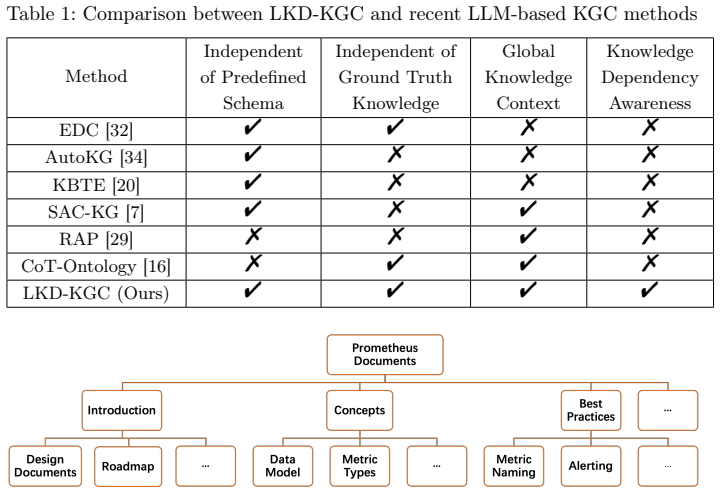
The central claim is that treating a domain corpus as an ordered, dependency-aware sequence and autoregressively building an entity schema from inter-document summaries yields higher-precision and higher-recall knowledge graphs than existing schema-guided or reference-integration LLM pipelines. Concretely, LKD-KGC first summarises each document and directory, ranks documents by LLM-judged comprehension priority, produces context-aware summaries that incorporate previously accessed documents, clusters deduplicated entity types into a schema, and finally extracts entities and then relations restricted to that schema. The paper asserts this is the first framework that simultaneously avoids manually predefined schemas and external ground-truth knowledge while exploiting global document context and knowledge dependency.
Load-bearing premise
The experiments measure recall as the number of triples an LLM judge labels true per document, and use that same LLM judge for precision, without a human-validated sample confirming the judge's correctness.
Editorial extensions
If this is right
- On private corpora with no public references, LKD-KGC still constructs a schema and extracts triples, removing the need for web retrieval or predefined ontologies.
- Because the entity schema is generated from the corpus rather than fixed, the same pipeline can be applied to a new domain without manual schema engineering.
- Ordering documents by dependency means later documents benefit from earlier context, which should reduce false positives caused by isolated reading of individual documents.
- The reported 10–20% gains appear across two base LLMs, suggesting the benefit comes from the pipeline design rather than from a single model's capability.
Reading between the lines
- If dependency ordering is the operative cause, similar ordered reading could improve other document-level LLM tasks, such as whole-manual summarisation or repository-grounded question answering, not just KG extraction.
- The schema built in one pass could be reused or incrementally updated when new documents arrive, offering a cheap route to maintain a living knowledge graph.
- A direct testable extension is to compare the LLM judge's verdicts against expert human labels on a few hundred sampled triples; if the judge is biased, the recall metric would need replacing with human-annotated coverage numbers.
- The clustering step's choice of $k$ via silhouette coefficients may be sensitive to the embedding model, and testing with different embedding models would reveal how much of the schema quality comes from clustering versus the LLM's entity definition.
Editorial analysis
A structured set of objections, weighed in public.
Referee Report
Summary. The paper proposes LKD-KGC, an unsupervised pipeline for domain-specific knowledge graph construction that combines three stages: dependency evaluation (ordering documents via LLM-derived priorities and context-aware summarization), schema definition (clustering and defining entity types), and triple extraction (schema-guided entity and relation extraction). The authors claim that LKD-KGC achieves 10–20% improvements in precision and recall over the EDC, AutoKG, and KBTE baselines on three corpora (Prometheus documentation, a 15-document Windows subset of Re-DocRED, and a private IMS documentation set), using two base LLMs. The manuscript includes an anonymous code repository and reports F1 gains on Re-DocRED in addition to precision and recall-number results on the other datasets.
Significance. If the reported results are sound, LKD-KGC is a useful contribution to LLM-based KGC for domain-specific corpora, particularly because it removes the need for predefined schemas and external knowledge while using cross-document context. The release of code is a concrete strength, and the Re-DocRED result (F1 29.7 vs. 23.8 for the best baseline under Llama-3.1-70B-Instruct) provides some external ground-truth evidence that the pipeline is competitive. However, the central recall claim currently rests on a non-standard metric (a raw count of LLM-judged triples) and on LLM-as-judge evaluations without human agreement, so the magnitude and even the direction of the claimed recall gains are not yet established. The paper's significance would increase substantially with human-validated recall on at least one dataset and with calibrated LLM judgments.
major comments (3)
- [Section 4.1, Tables 2 and 3] The 'Recall Number' and 'Average Recall Number' columns in Tables 2 and 3 are not recall rates: they count triples that an LLM judge deems true, with no denominator of relevant triples. Section 4.1 explicitly states that 'we instead compute the number of true triples per document as recall metric,' but a higher count can reflect higher extraction volume rather than better coverage. The paper itself notes that LKD-KGC extracts 6,580 valid entities on Prometheus, far more than the baselines, so the higher recall number may be a yield effect. The abstract's claim of '10%–20% improvements in both precision and recall rate' is therefore not supported for Prometheus and IMS. The authors should report recall against a human-annotated gold standard on at least one of these datasets, or clearly relabel the metric and soften the recall claim.
- [Section 4.1, Evaluation Metrics] The evaluation relies on Qwen2-VL-72B as judge for both triple correctness and semantic equivalence to Re-DocRED ground truth, without reporting human agreement, calibration, or inter-annotator reliability. Since the judge is an LLM and the systems under test are also LLM-based, the precision and recall numbers could reflect systematic judge biases (e.g., favoring verbose or schema-aligned outputs) rather than true quality differences. The authors cite prior work on LLM-as-judge, but this paper should report a human-validated sample of at least a few hundred triples across methods and datasets, along with agreement statistics, to establish that the judge is not driving the reported differences.
- [Table 2, Re-DocRED subset] The Re-DocRED experiment is conducted on only 15 documents, and no variance or significance testing is reported. The F1 advantage of LKD-KGC (29.7 vs. 23.8) is encouraging, but with 15 documents the difference could be driven by a few documents or by the LLM judge's handling of semantic equivalence. The authors should report per-document precision/recall/F1, standard deviations, and a paired significance test (e.g., bootstrap or Wilcoxon) to support the claim that LKD-KGC is systematically better than KBTE on this benchmark.
minor comments (6)
- [Abstract and Section 1] The phrase 'LLM-dirven' in the Introduction is a typo and should read 'LLM-driven'.
- [Table 2 header] The header 'F1 Score' is misspelled as 'F1 Socre'; please fix this typo.
- [Section 4.1, Baselines] The adaptation of KBTE, which originally builds its knowledge base from ground-truth tuples, is described only briefly; the paper should specify how the knowledge base is constructed from preceding documents and whether this adaptation was confirmed with the original authors or validated in any way.
- [Section 3.2, Schema Definition Module] The entity-type clustering uses K-means with k chosen by silhouette coefficient, but the paper does not report the resulting k values, the embedding dimensions, or the threshold for 'entity types that appear only once'; adding these details would improve reproducibility.
- [Section 1 and Section 5] The claim of '10%–20% improvements in both precision and recall rate' is stated as a general result, but the Re-DocRED F1 improvement is about 24.8% relative and the precision improvements vary; the authors should either qualify the claim or report the range precisely for each dataset and metric.
- [References] The paper cites the Qwen2 technical report for Qwen2-VL-72B, but a more specific reference for the vision-language model would help readers verify the judge model; please add the appropriate Qwen2-VL citation if available.
Circularity Check
No circular derivation: LKD-KGC is an empirical pipeline; the disclosed recall-number proxy is a validity concern, not a circular step.
full rationale
The paper contains no derived quantity that is re-imported as a prediction. Its workflow (documents to dependency-ordered summaries, clustered entity schema, schema-guided triple extraction) is a sequence of LLM prompts and K-means clustering with silhouette selection, not an equation chain, and no parameter is fitted to the reported precision or recall values. The evaluation uses two disclosed proxies on Prometheus/IMS: LLM-as-judge precision and a 'recall metric' defined as the number of judge-accepted triples per document, both attributed to prior work ([33] and [7]) rather than to the authors. Section 4.1 explicitly states that 'calculating recall rate is infeasible due the absence of ground-truth tuples,' so the abstract's 'recall rate' phrasing is an overstatement of an acknowledged proxy; this is an external-validity flaw, not a circularity, because the proxy is not defined in terms of the conclusion and is applied uniformly to all methods. On Re-DocRED, the paper computes precision, recall, and F1 against human-annotated ground truth (F1 29.7 vs. 23.8 for the best baseline), providing an independent anchor. There are no self-citations, no imported uniqueness theorem, and no ansatz smuggled in by citation; the dependency-ordering design is motivated by a domain observation and directly implemented in prompts. No step reduces by construction to its inputs.
Assumptions & free parameters
free parameters (3)
- vector retrieval top-k =
10
- LLM temperature =
0.1
- entity type frequency threshold =
1
assumptions (4)
- domain assumption Domain corpora have a latent optimal processing order from foundational to advanced documents.
- domain assumption LLM-as-judge can replace human evaluation of triple correctness.
- domain assumption Document summaries preserve the entity types needed for schema generation.
- domain assumption K-means with silhouette coefficient produces semantically valid entity type clusters.
Cite this review
Pith. "Pith review of LKD-KGC: Domain-Specific KG Construction via LLM-driven Knowledge Dependency Parsing." pith.science (2026). https://pith.science/paper/ST2GOKPS
@misc{pith2026250524163,
  author       = {Pith},
  title        = {Pith review of: LKD-KGC: Domain-Specific KG Construction via LLM-driven Knowledge Dependency Parsing},
  year         = {2026},
  howpublished = {\url{https://pith.science/paper/ST2GOKPS}},
  note         = {Machine review of arXiv:2505.24163}
}
read the original abstract
Knowledge Graphs (KGs) structure real-world entities and their relationships into triples, enhancing machine reasoning for various tasks. While domain-specific KGs offer substantial benefits, their manual construction is often inefficient and requires specialized knowledge. Recent approaches for knowledge graph construction (KGC) based on large language models (LLMs), such as schema-guided KGC and reference knowledge integration, have proven efficient. However, these methods are constrained by their reliance on manually defined schema, single-document processing, and public-domain references, making them less effective for domain-specific corpora that exhibit complex knowledge dependencies and specificity, as well as limited reference knowledge. To address these challenges, we propose LKD-KGC, a novel framework for unsupervised domain-specific KG construction. LKD-KGC autonomously analyzes document repositories to infer knowledge dependencies, determines optimal processing sequences via LLM driven prioritization, and autoregressively generates entity schema by integrating hierarchical inter-document contexts. This schema guides the unsupervised extraction of entities and relationships, eliminating reliance on predefined structures or external knowledge. Extensive experiments show that compared with state-of-the-art baselines, LKD-KGC generally achieves improvements of 10% to 20% in both precision and recall rate, demonstrating its potential in constructing high-quality domain-specific KGs.
Figures

Reference graph
Works this paper leans on
-
[1]
al.: The llama 3 herd of models (2024), https://arxiv.org/abs/2407.21783
Aaron Grattafiori et. al.: The llama 3 herd of models (2024), https://arxiv.org/abs/2407.21783
arXiv 2024
-
[2]
Abu-Salih, B.: Domain-specific knowledge graphs: A survey. J. Netw. Comput. Appl.185, 103076 (2021). https://doi.org/10.1016/J.JNCA.2021.103076
arXiv 2021
-
[3]
An Yang, Baosong Yang, et. al.: Qwen2 technical report. CoRRabs/2407.10671 (2024). https://doi.org/10.48550/ARXIV.2407.10671
-
[4]
In: Fifth Conference on Applied Natural Language Process- ing
Bikel, D.M., Miller, S., Schwartz, R., Weischedel, R.: Nymble: a high-performance learning name-finder. In: Fifth Conference on Applied Natural Language Process- ing. pp. 194–201. Association for Computational Linguistics, Washington, DC, USA (Mar 1997). https://doi.org/10.3115/974557.974586
-
[5]
In: Korhonen, A., Traum, D., Màrquez, L
Bosselut, A., Rashkin, H., Sap, M., Malaviya, C., Celikyilmaz, A., Choi, Y.: COMET: Commonsense transformers for automatic knowledge graph construc- tion. In: Korhonen, A., Traum, D., Màrquez, L. (eds.) Proceedings of the 57th Annual Meeting of the Association for Computational Linguistics. pp. 4762–
-
[6]
Brown, Tom B. et. al.: Language models are few-shot learners. In: Proceedings of the 34th International Conference on Neural Information Processing Systems. NIPS ’20, Curran Associates Inc., Red Hook, NY, USA (2020)
work page 2020
-
[7]
In: Ku, L.W., Martins, A., Srikumar, V
Chen, H., Shen, X., Lv, Q., Wang, J., Ni, X., Ye, J.: SAC-KG: Exploiting large language models as skilled automatic constructors for domain knowledge graph. In: Ku, L.W., Martins, A., Srikumar, V. (eds.) Proceedings of the 62nd Annual Meet- ing of the Association for Computational Linguistics (Volume 1: Long Papers). pp. 4345–4360. Association for Computa...
-
[8]
DeepSeek-AI, Daya Guo, et. al. : Deepseek-r1: Incentivizing reasoning ca- pability in llms via reinforcement learning. CoRRabs/2501.12948(2025). https://doi.org/10.48550/ARXIV.2501.12948
Show all 37 references
-
[9]
Ding, L., Zhou, S., Xiao, J., Han, J.: Automated construction of theme-specific knowledge graphs (2024), https://arxiv.org/abs/2404.19146
2024 arXiv
-
[10]
Edge, D., Trinh, H., Cheng, N., Bradley, J., Chao, A., Mody, A., Truitt, S., Metropolitansky, D., Ness, R.O., Larson, J.: From local to global: A graph rag ap- proach to query-focused summarization (2025), https://arxiv.org/abs/2404.16130
2025 arXiv
-
[11]
In: Moens, M.F., Huang, X., Specia, L., Yih, S.W.t
Huguet Cabot, P.L., Navigli, R.: REBEL: Relation extraction by end-to-end lan- guage generation. In: Moens, M.F., Huang, X., Specia, L., Yih, S.W.t. (eds.) Find- ings of the Association for Computational Linguistics: EMNLP 2021. pp. 2370–
2021
-
[12]
In: Jurafsky, D., Chai, J., Schluter, N., Tetreault, J
Lewis, M., Liu, Y., Goyal, N., Ghazvininejad, M., Mohamed, A., Levy, O., Stoyanov, V., Zettlemoyer, L.: BART: Denoising sequence-to-sequence pre- training for natural language generation, translation, and comprehension. In: Jurafsky, D., Chai, J., Schluter, N., Tetreault, J. (...
2020 doi
-
[13]
IEEE Trans
Lloyd, S.P.: Least squares quantization in PCM. IEEE Trans. Inf. Theory28(2), 129–136 (1982). https://doi.org/10.1109/TIT.1982.1056489
1982
-
[14]
In: Proceedings of the Seventh Conference on Natural Language Learning at HLT-NAACL 2003
McCallum, A., Li, W.: Early results for named entity recognition with conditional random fields, feature induction and web-enhanced lexicons. In: Proceedings of the Seventh Conference on Natural Language Learning at HLT-NAACL 2003. pp. 188–191 (2003), https://aclanthology.org/...
2003
-
[15]
In: Su, K.Y., Su, J., Wiebe, J., Li, H
Mintz, M., Bills, S., Snow, R., Jurafsky, D.: Distant supervision for relation ex- traction without labeled data. In: Su, K.Y., Su, J., Wiebe, J., Li, H. (eds.) Pro- ceedings of the Joint Conference of the 47th Annual Meeting of the ACL and the 4th International Joint Conferen...
2009
-
[16]
In: ProceedingsofWorkshopsatthe50thInternationalConferenceonVeryLargeData Bases, VLDB 2024, Guangzhou, China, August 26-30, 2024
Nie, J., Hou, X., Song, W., Wang, X., Jin, X., Zhang, X., Zhang, S., Shi, J.: Knowledge graph efficient construction: Embedding chain-of-thought into llms. In: ProceedingsofWorkshopsatthe50thInternationalConferenceonVeryLargeData Bases, VLDB 2024, Guangzhou, China, August 26-3...
2024
-
[17]
Noy, N., Gao, Y., Jain, A., Narayanan, A., Patterson, A., Taylor, J.: Industry-scale knowledge graphs: lessons and challenges. Commun. ACM62(8), 36–43 (Jul 2019). https://doi.org/10.1145/3331166
2019 doi
-
[18]
IEEE Trans
Pan, S., Luo, L., Wang, Y., Chen, C., Wang, J., Wu, X.: Unifying large language models and knowledge graphs: A roadmap. IEEE Trans. Knowl. Data Eng.36(7), 3580–3599 (2024). https://doi.org/10.1109/TKDE.2024.3352100
2024
-
[19]
In: Politzer-Ahles, S., Hsu, Y., Huang, C., Yao, Y
Panchendrarajan, R., Amaresan, A.: Bidirectional LSTM-CRF for named entity recognition. In: Politzer-Ahles, S., Hsu, Y., Huang, C., Yao, Y. (eds.) Proceedings of the 32nd Pacific Asia Conference on Language, Information and Computation, PACLIC 2018, Hong Kong, December 1-3, 20...
2018
-
[20]
In: Biswas, R., Kaffee, L.A., Agarwal, O., Minervini, P., Singh, S., de Melo, G
Papaluca, A., Krefl, D., Rodríguez Méndez, S., Lensky, A., Suominen, H.: Zero- and few-shots knowledge graph triplet extraction with large language models. In: Biswas, R., Kaffee, L.A., Agarwal, O., Minervini, P., Singh, S., de Melo, G. (eds.) Proceedings of the 1st Workshop o...
2024 doi
-
[21]
Prometheus Authors: prometheus (2025), https://prometheus.io/
2025
-
[22]
Prometheus Authors: prometheus documents (2025), https://prometheus.io/docs/introduction/overview/
2025
-
[23]
In: Proceedings of the 2019 Conference on Empirical Methods in Nat- ural Language Processing
Reimers, N., Gurevych, I.: Sentence-bert: Sentence embeddings using siamese bert- networks. In: Proceedings of the 2019 Conference on Empirical Methods in Nat- ural Language Processing. Association for Computational Linguistics (11 2019), http://arxiv.org/abs/1908.10084
2019 arXiv
-
[24]
Journal of Computational and Applied Mathematics20, 53–65 (1987)
Rousseeuw, P.J.: Silhouettes: A graphical aid to the interpretation and validation of cluster analysis. Journal of Computational and Applied Mathematics20, 53–65 (1987). https://doi.org/https://doi.org/10.1016/0377-0427(87)90125-7
1987 doi
-
[25]
In: Goldberg, Y., Kozareva, Z., Zhang, Y
Tan, Q., Xu, L., Bing, L., Ng, H.T., Aljunied, S.M.: Revisiting docred - addressing the false negative problem in relation extraction. In: Goldberg, Y., Kozareva, Z., Zhang, Y. (eds.) Proceedings of the 2022 Conference on Empirical Methods in Natural Language Processing, EMNLP...
2022 doi
-
[26]
Tang, J., Yang, Y., Wei, W., Shi, L., Su, L., Cheng, S., Yin, D., Huang, C.: Graphgpt: Graph instruction tuning for large language models (2024), https://arxiv.org/abs/2310.13023
2024 arXiv
-
[27]
Wikimedia Foundation: Wikipedia (2025), https://www.wikipedia.org/
2025
-
[28]
In: Korhonen, A., Traum, D., Màrquez, L
Yao, Y., Ye, D., Li, P., Han, X., Lin, Y., Liu, Z., Liu, Z., Huang, L., Zhou, J., Sun, M.: DocRED: A large-scale document-level relation extraction dataset. In: Korhonen, A., Traum, D., Màrquez, L. (eds.) Proceedings of the 57th Annual Meeting of the Association for Computatio...
2019 doi
-
[29]
In: Chen, H., Duh, W.E., Huang, H., Kato, M.P., Mothe, J., Poblete, B
Yao, Y., Mao, S., Zhang, N., Chen, X., Deng, S., Chen, X., Chen, H.: Schema- aware reference as prompt improves data-efficient knowledge graph construction. In: Chen, H., Duh, W.E., Huang, H., Kato, M.P., Mothe, J., Poblete, B. (eds.) Proceedings of the 46th International ACM ...
2023
-
[30]
Ye, H., Gui, H., Xu, X., Chen, X., Chen, H., Zhang, N.: Schema-adaptable knowl- edge graph construction (2023), https://arxiv.org/abs/2305.08703
2023 arXiv
-
[31]
In: Hajic, J., Tsujii, J
Zeng, D., Liu, K., Lai, S., Zhou, G., Zhao, J.: Relation classification via convo- lutional deep neural network. In: Hajic, J., Tsujii, J. (eds.) COLING 2014, 25th International Conference on Computational Linguistics, Proceedings of the Confer- ence: Technical Papers, August ...
2014
-
[32]
In: Al-Onaizan, Y., Bansal, M., Chen, Y
Zhang, B., Soh, H.: Extract, define, canonicalize: An llm-based framework for knowledge graph construction. In: Al-Onaizan, Y., Bansal, M., Chen, Y. (eds.) Proceedings of the 2024 Conference on Empirical Methods in Nat- ural Language Processing, EMNLP 2024, Miami, FL, USA, Nov...
2024
-
[33]
In: Oh, A., Naumann, T., Globerson, A., Saenko, K., Hardt, M., Levine, S
Zheng, L., Chiang, W., Sheng, Y., Zhuang, S., Wu, Z., Zhuang, Y., Lin, Z., Li, Z., Li, D., Xing, E.P., Zhang, H., Gonzalez, J.E., Stoica, I.: Judging llm-as-a-judge with mt-bench and chatbot arena. In: Oh, A., Naumann, T., Globerson, A., Saenko, K., Hardt, M., Levine, S. (eds....
2023
-
[34]
World Wide Web (WWW)27(5), 58 (2024)
Zhu, Y., Wang, X., Chen, J., Qiao, S., Ou, Y., Yao, Y., Deng, S., Chen, H., Zhang, N.: Llms for knowledge graph construction and reasoning: recent capa- bilities and future opportunities. World Wide Web (WWW)27(5), 58 (2024). https://doi.org/10.1007/S11280-024-01297-W
2024 doi
-
[2023]
pp. 911–921. ACM (2023). https://doi.org/10.1145/3539618.3591763
2023
-
[2381]
https://doi.org/10.18653/v1/2021.findings-emnlp.204
Association for Computational Linguistics, Punta Cana, Dominican Republic (Nov 2021). https://doi.org/10.18653/v1/2021.findings-emnlp.204
2021 doi
-
[4779]
https://doi.org/10.18653/v1/P19-1470
Association for Computational Linguistics, Florence, Italy (Jul 2019). https://doi.org/10.18653/v1/P19-1470
2019 doi
Reviewed August 7, 2026 · model on record in the stance chip above.
Discussion (0). Sign in to comment.