REVIEW 5 major objections 5 minor 1 cited by
Harnessing Foundation Models for Robust and Generalizable 6-DOF Bronchoscopy Localization
T0 review · 5 major / 5 minor · reviewed 2026-08-07 · deepseek-v4-flash
Pith's one-line read A vision-only tracker that recovers 6-DOF bronchoscope pose after blur and occlusion, with an 18.1-point SR-5 gain reported on 10 clinical cases.
desk verdict A solid engineering extension of PANS with a genuinely useful failure-recovery module, but the headline numbers rest on a self-generated ground truth that needs independent validation. read the letter →
The pith
A machine-rendered reading of the paper's core claim, the machinery that carries it, and where it could break.
The reading
What carries the argument
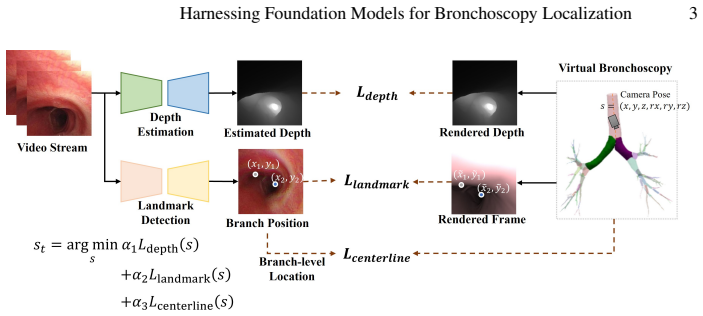
The load-bearing mechanism is a probabilistic pose cost $L(s)=\alpha_1 L_{\mathrm{depth}}(s)+\alpha_2 L_{\mathrm{landmark}}(s)+\alpha_3 L_{\mathrm{centerline}}(s)$, minimized by a Powell optimizer using the previous pose as initialization. Depth similarity is normalized cross-correlation between the EndoOmni-predicted depth and a depth render at pose $s$; landmark alignment is the visibility-weighted mean L2 distance between EndoMamba's detected branch landmarks and CT-projected landmarks; centerline cost penalizes distance and orientation deviation from the inferred branch centerline. A cost threshold flags tracking failure, and after clear views return, the detected branch's centerline point seeds re-initialization. The two foundation models supply transferable spatial-temporal representations so the system can work without patient-specific retraining.
What would settle it
Run PANSv2 on full-length clinical bronchoscopy videos while simultaneously recording an electromagnetic tracker or CT-fluoroscopy poses, and recompute SR-5 on blur and occlusion frames; if the 18.1-point gain does not reproduce against this independent ground truth, the robustness claim fails.
Extended reading notes
Core claim
The paper's central claim is that PANSv2 maintains accurate 6-DOF bronchoscope tracking on real clinical videos, including frames degraded by blur, fluid, and occlusion, by minimizing a weighted cost of depth similarity, landmark alignment, and centerline agreement, and by automatically re-initializing at a detected branch whenever the pose cost exceeds a threshold. Measured on 10,004 filtered frames, it reports SR-5 of 46.5% versus 28.4% for the previous PANS and 22.9% for DD-VNB; on 15,441 unfiltered frames, ablations show SR-5 of 41.8% with re-initialization versus 17.5% without it. The paper also acknowledges a slightly higher ATE than PANS, blamed on occasional landmark misidentification that places the pose in the wrong airway branch.
Load-bearing premise
Every reported gain inherits the ground-truth poses produced by the authors' manual OpenGL registration toolkit, whose accuracy was checked on only two cases with a 0.58 mm group variance.
Editorial extensions
If this is right
- If the central claim holds, vision-only bronchoscopy localization can keep tracking through real clinical artifacts without an external tracking system.
- A single initialization at the trachea is enough to navigate both sides of the airway, removing the two-step initialization prior methods require.
- The re-initialization module is the dominant robustness factor: removing it lowers SR-5 from 41.8% to 17.5% on unfiltered frames.
- Pre-trained endoscopic foundation models transfer across ten patient cases without per-case retraining, suggesting data-hungry pose learning can be avoided.
Reading between the lines
- Beyond the paper, the same three-cue cost could transfer to other tubular anatomies such as colonoscopy or ureteroscopy, where depth, lumen landmarks, and a centerline are equally available.
- The 200 ms per-frame runtime, dominated by rendering during optimization, implies the method would need a faster renderer or a learned pose prior to hit the 10-20 Hz video rate in real time.
- The re-initialization rule depends on EndoMamba detecting visible landmarks after the artifact clears; a prolonged occlusion covering every visible branch would leave the system unable to choose a restart branch, so a motion-prediction fallback would be needed.
- Because the paper reports slightly higher ATE than PANS, a temporal-consistency check on landmark identities could prevent the wrong-branch jumps that drive those large errors.
Editorial analysis
A structured set of objections, weighed in public.
Referee Report
Summary. The paper presents PANSv2, a vision-only 6-DOF bronchoscopy localization framework that combines a foundation-model depth estimate (EndoOmni), a video-based anatomical landmark detector (EndoMamba), and a CT-centerline constraint into a single pose cost minimized by Powell optimization. An automatic re-initialization module detects failures by thresholding the pose cost and restarts optimization from the centerline of the currently detected branch. Experiments on 10 patient procedures report comparisons against prior methods on 10,004 filtered frames (Table 1) and ablations on 15,441 unfiltered frames (Table 2), claiming an 18.1-percentage-point SR-5 improvement over prior methods and robust recovery after visual degradation.
Significance. If the reported results are reliable, PANSv2 would be a useful step toward practical bronchoscopy navigation: it integrates two foundation models for depth and landmarks, introduces a targeted re-initialization mechanism for a clinically important failure mode, and comes with an unusually large annotated dataset. The paper is also commendable for reporting unfiltered ablation results and for explicitly discussing the current runtime bottleneck. The main reservation is that all quantitative claims rest on self-generated manual ground-truth poses and on a filtered-frame comparison against prior methods, so the headline superiority over existing systems is not yet firmly established.
major comments (5)
- [Section 3.2, Tables 1 and 2] The headline comparison in Table 1 is computed on 10,004 filtered frames, and the unfiltered results in Table 2 report only PANSv2 ablations; no existing method is evaluated on the unfiltered frames. Because the central robustness claim is about performance under visual degradation, the paper should provide an unfiltered comparison against at least one prior method, or explicitly restrict the SOTA claim to the filtered setting.
- [Section 3.1] The annotation accuracy is characterized only by a 0.58 mm variance from two independently labeled cases; this is a precision estimate, not an accuracy bound, and it does not rule out a systematic bias in the manual registration on the ten test cases. Since SR-5 is defined at a 5 mm threshold, a label bias of a few millimeters could move many frames across the boundary and materially change the reported 18.1-point improvement. Independent validation—for example, phantom or electromagnetic tracking, or re-annotation of the test cases by a separate group—is needed to support the quantitative claims.
- [Section 2.5, Eq. (8)] The failure-detection threshold tau is never reported, and no sensitivity analysis is provided. Re-initialization is the main driver of the robustness gain in Table 2 (41.8% vs 17.5% SR-5), so the paper should state tau and show how SR-5 and SR-10 vary over a plausible range of this threshold.
- [Sections 2.4 and 3.1] EndoMamba is fine-tuned on branch labels that are generated from the same airway centerline used in the pose cost and in re-initialization. This shared geometric source couples landmark-detection errors into both the tracking cost and the recovery mechanism; the paper should discuss the resulting potential bias and, ideally, evaluate landmark detection against independently annotated branch labels.
- [Section 3.2] All SR and ATE numbers are reported as aggregate means over 10 cases without confidence intervals, per-case distributions, or significance tests. The 18.1-point SR-5 improvement is a single summary number; reporting paired per-case results would show whether the improvement is consistent across patients or driven by a few favorable cases.
minor comments (5)
- [Tables 1 and 2] The method is labeled 'Ours' in both tables; the tables should use 'PANSv2' consistently with the text.
- [Section 2.3] The number of anatomical landmarks n and the definition of the landmark set are not specified, which makes the landmark alignment cost and the branch-level voting procedure difficult to reproduce.
- [Section 2.3, Eq. (6)] The visibility score is continuous in [0,1], but the cost is computed only over landmarks with v_i = 1; the binarization threshold should be stated explicitly.
- [Section 3.1] The text says that frames without pose annotations are processed but do not contribute to metrics; the caption of Table 2 should clarify whether 'unfiltered' still excludes these unlabeled frames.
- [Section 3.1] The dataset description does not state whether patient data collection had ethics approval or how patient privacy was handled; this should be added for a clinical study.
Circularity Check
No significant circularity: PANSv2's pose estimates are evaluated against independent manual ground truth, and its landmark detector is a standard supervised component trained on training cases, not a fitted renaming of the output.
full rationale
The derivation chain is not circular in the sense defined by the review criteria. The final pose estimate is obtained by optimizing L(s)=α1L_depth+α2L_landmark+α3L_centerline with Powell, and the reported ATE/SR-5/SR-10 values are computed against poses manually annotated with an OpenGL-based toolkit, not against the method's own outputs or a quantity that the method is designed to reproduce by construction. The landmark detection labels are generated from ground-truth poses and the airway centerline, but this is standard supervised training: EndoMamba is fine-tuned on the 56 training cases and evaluated on 10 held-out cases. The centerline constraint and re-initialization module share the same branch definitions as the label-generation process, which creates a common representation but not an identity: the optimized pose is not set equal to the landmark or centerline inputs, and the paper explicitly notes that landmark misidentification can cause large errors (ATE increases relative to PANS in Table 1). The cited foundation models (EndoOmni, EndoMamba, PANS, BronchoTrack) are prior work by the same authors, but they are used as tools or baselines rather than as an imported uniqueness theorem that forbids alternatives; EndoMamba is additionally fine-tuned within this paper. The paper's own note that frames without pose annotations are processed but excluded from metrics is a scope limitation, not a circular step. The absence of external tracking validation for the manual ground truth and the unreported cost weights and re-initialization threshold τ are validity and reproducibility concerns, but they do not reduce the central claim to its inputs by construction.
Assumptions & free parameters
free parameters (3)
- cost weights alpha1, alpha2, alpha3 =
not reported
- re-initialization threshold tau =
not reported
- centerline variance scales sigma1 and sigma2 =
sigma1 = r/2, sigma2 = pi/6
assumptions (3)
- domain assumption The bronchoscope camera remains close to the airway centerline and its viewing direction aligns with the local airway orientation.
- domain assumption The manual CT-to-video registration used to create ground-truth poses is accurate and consistent.
- domain assumption EndoOmni and EndoMamba transfer to bronchoscopy well enough for pose optimization.
Cite this review
Pith. "Pith review of Harnessing Foundation Models for Robust and Generalizable 6-DOF Bronchoscopy Localization." pith.science (2026). https://pith.science/paper/YV7NJERS
@misc{pith2026250524249,
  author       = {Pith},
  title        = {Pith review of: Harnessing Foundation Models for Robust and Generalizable 6-DOF Bronchoscopy Localization},
  year         = {2026},
  howpublished = {\url{https://pith.science/paper/YV7NJERS}},
  note         = {Machine review of arXiv:2505.24249}
}
read the original abstract
Vision-based 6-DOF bronchoscopy localization offers a promising solution for accurate and cost-effective interventional guidance. However, existing methods struggle with 1) limited generalization across patient cases due to scarce labeled data, and 2) poor robustness under visual degradation, as bronchoscopy procedures frequently involve artifacts such as occlusions and motion blur that impair visual information. To address these challenges, we propose PANSv2, a generalizable and robust bronchoscopy localization framework. Motivated by PANS that leverages multiple visual cues for pose likelihood measurement, PANSv2 integrates depth estimation, landmark detection, and centerline constraints into a unified pose optimization framework that evaluates pose probability and solves for the optimal bronchoscope pose. To further enhance generalization capabilities, we leverage the endoscopic foundation model EndoOmni for depth estimation and the video foundation model EndoMamba for landmark detection, incorporating both spatial and temporal analyses. Pretrained on diverse endoscopic datasets, these models provide stable and transferable visual representations, enabling reliable performance across varied bronchoscopy scenarios. Additionally, to improve robustness to visual degradation, we introduce an automatic re-initialization module that detects tracking failures and re-establishes pose using landmark detections once clear views are available. Experimental results on bronchoscopy dataset encompassing 10 patient cases show that PANSv2 achieves the highest tracking success rate, with an 18.1% improvement in SR-5 (percentage of absolute trajectory error under 5 mm) compared to existing methods, showing potential towards real clinical usage.
Figures

Forward citations
Cited by 1 Pith paper
-
Geometry-Aware Visual Odometry for Bronchoscopic Navigation via High-Gain Observer Fusion
Vanishing-point lumen cues fused with noisy visual odometry via a high-gain observer cut absolute trajectory error by more than 50% versus SOTA VO on ex-vivo human lungs.
Reference graph
Works this paper leans on
-
[1]
Journal of thoracic disease 8(11), 3329 (2016)
Andolfi, M., Potenza, R., Capozzi, R., Liparulo, V ., Puma, F., Yasufuku, K.: The role of bronchoscopy in the diagnosis of early lung cancer: a review. Journal of thoracic disease 8(11), 3329 (2016)
work page 2016
-
[2]
Medical image analysis73, 1361–8415 (2021)
Banach, A., King, F., Masaki, F., Tsukada, H., Hata, N.: Visually navigated bronchoscopy using three cycle-consistent generative adversarial network for depth estimation. Medical image analysis73, 1361–8415 (2021)
work page 2021
-
[3]
Computer Methods and Programs in Biomedicine228, 107241 (2023)
Borrego-Carazo, J., Sanchez, C., Castells-Rufas, D., Carrabina, J., Gil, D.: Bronchopose: an analysis of data and model configuration for vision-based bronchoscopy pose estimation. Computer Methods and Programs in Biomedicine228, 107241 (2023)
work page 2023
-
[4]
Cold, K.M., Xie, S., Nielsen, A.O., Clementsen, P.F., Konge, L.: Artificial intelligence im- proves novices’ bronchoscopy performance: a randomized controlled trial in a simulated setting. Chest165(2), 405–413 (2024)
work page 2024
-
[5]
In: 2023 IEEE/RSJ International Conference on Intelligent Robots and Systems (IROS)
Deng, J., Li, P., Dhaliwal, K., Lu, C.X., Khadem, M.: Feature-based visual odometry for bronchoscopy: A dataset and benchmark. In: 2023 IEEE/RSJ International Conference on Intelligent Robots and Systems (IROS). pp. 6557–6564. IEEE (2023)
work page 2023
-
[6]
The com- puter journal6(2), 163–168 (1963)
Fletcher, R., Powell, M.J.: A rapidly convergent descent method for minimization. The com- puter journal6(2), 163–168 (1963)
work page 1963
-
[7]
IEEE Transactions on Medical Imaging41(12), 3600– 3610 (2022)
Gu, Y ., Gu, C., Yang, J., Sun, J., Yang, G.Z.: Vision–kinematics interaction for robotic- assisted bronchoscopy navigation. IEEE Transactions on Medical Imaging41(12), 3600– 3610 (2022)
work page 2022
-
[8]
Interna- tional Journal of Computer Assisted Radiology and Surgery19(4), 713–721 (2024)
Keuth, R., Heinrich, M., Eichenlaub, M., Himstedt, M.: Airway label prediction in video bronchoscopy: capturing temporal dependencies utilizing anatomical knowledge. Interna- tional Journal of Computer Assisted Radiology and Surgery19(4), 713–721 (2024)
work page 2024
Show all 18 references
-
[9]
Lung cancer180, 107196 (2023)
Kops, S.E., Heus, P., Korevaar, D.A., Damen, J.A., Idema, D.L., Verhoeven, R.L., Annema, J.T., Hooft, L., van der Heijden, E.H.: Diagnostic yield and safety of navigation bron- choscopy: a systematic review and meta-analysis. Lung cancer180, 107196 (2023)
2023
-
[10]
IEEE Robotics and Automation Letters6(4), 7225–7232 (2021) Harnessing Foundation Models for Bronchoscopy Localization 9
Recasens, D., Lamarca, J., Fácil, J.M., Montiel, J., Civera, J.: Endo-depth-and-motion: Re- construction and tracking in endoscopic videos using depth networks and photometric con- straints. IEEE Robotics and Automation Letters6(4), 7225–7232 (2021) Harnessing Foundation Model...
2021
-
[11]
arXiv preprint arXiv:1907.08136 (2019)
Sganga, J., Eng, D., Graetzel, C., Camarillo, D.B.: Autonomous driving in the lung using deep learning for localization. arXiv preprint arXiv:1907.08136 (2019)
2019 arXiv
-
[12]
IEEE Robotics and Automation Letters4(2), 732–739 (2019)
Shen, M., Gu, Y ., Liu, N., Yang, G.Z.: Context-aware depth and pose estimation for bron- choscopic navigation. IEEE Robotics and Automation Letters4(2), 732–739 (2019)
2019
-
[13]
arXiv preprint arXiv:2409.05442 (2024)
Tian, Q., Chen, Z., Liao, H., Huang, X., Li, L., Ourselin, S., Liu, H.: EndoOmni: Zero-shot cross-dataset depth estimation in endoscopy by robust self-learning from noisy labels. arXiv preprint arXiv:2409.05442 (2024)
2024 arXiv
-
[14]
In: MICCAI (2024)
Tian, Q., Chen, Z., Liao, H., Huang, X., Yang, B., Li, L., Liu, H.: PANS: Probabilistic airway navigation system for real-time robust bronchoscope localization. In: MICCAI (2024)
2024
-
[15]
In: IROS (2024)
Tian, Q., Liao, H., Huang, X., Chen, J., Zhang, Z., Yang, B., Ourselin, S., Liu, H.: DD-VNB: A depth-based dual-loop framework for real-time visually navigated bronchoscopy. In: IROS (2024)
2024
-
[16]
arXiv preprint arXiv:2502.19090 (2025)
Tian, Q., Liao, H., Huang, X., Yang, B., Lei, D., Ourselin, S., Liu, H.: EndoMamba: An efficient foundation model for endoscopic videos. arXiv preprint arXiv:2502.19090 (2025)
2025 arXiv
-
[17]
IEEE Transactions on Medical Imaging (2024)
Tian, Q., Liao, H., Huang, X., Yang, B., Wu, J., Chen, J., Li, L., Liu, H.: BronchoTrack: Airway lumen tracking for branch-level bronchoscopic localization. IEEE Transactions on Medical Imaging (2024)
2024
-
[18]
IEEE Robotics and Automation Letters5(1), 258–265 (2019)
Zhao, C., Shen, M., Sun, L., Yang, G.Z.: Generative localization with uncertainty estimation through video-ct data for bronchoscopic biopsy. IEEE Robotics and Automation Letters5(1), 258–265 (2019)
2019
Reviewed August 7, 2026 · model on record in the stance chip above.
Discussion (0). Sign in to comment.