REVIEW 2 major objections 5 minor 25 references
MagicGripper: A Multimodal Sensor-Integrated Gripper for Contact-Rich Robotic Manipulation
T0 review · 2 major / 5 minor · reviewed 2026-08-07 · deepseek-v4-flash
Pith's one-line read One printed grid gives robot grippers touch, sight, and proximity
desk verdict A well-engineered tactile gripper with strong hardware evaluation, but the proximity/contact detection algorithm rests on hand-set thresholds and the autonomous grasping demo is weaker than the abstract implies. read the letter →
The pith
A machine-rendered reading of the paper's core claim, the machinery that carries it, and where it could break.
The reading
What carries the argument
The central object is the multi-layer grid: a three-dimensional lattice of transparent Agilus30 Clear cells filled with translucent SUP706, printed in one piece by multi-material additive manufacturing. Mechanically it behaves as a lattice-spring system, deforming locally and isotropically in response to force magnitude, direction, and rotation. Optically it exhibits three coupled light-propagation modes — external reflection, internal reflection, and internal refraction — where internal reflection brightens deformed cells and internal refraction lets external visual and proximity features pass through to the camera. The algorithmic machinery built on this grid is temporal fusion ($N{=}30$ frames into $M{=}3$ background references plus one grid reference), proximity detection via channel entropy $E_{\text{total}}$ and inter-channel correlation $C_{\text{total}}$ with thresholds $\tau_E{=}0.5$ and $\tau_C{=}0.2$, and contact detection via grid similarity against the reference with threshold $\tau_G{=}0.6$.
What would settle it
Collect image streams from mini-MagicTac while a dark, glossy object approaches under flickering overhead light, compute $E_{\text{total}}$ and $C_{\text{total}}$ as in Algorithm 2, and check whether the approaching and noise conditions produce overlapping pairs that the $\tau_E{=}0.5$, $\tau_C{=}0.2$ decision rule cannot separate; if they overlap, the proximity detection claim fails for that condition.
Extended reading notes
Core claim
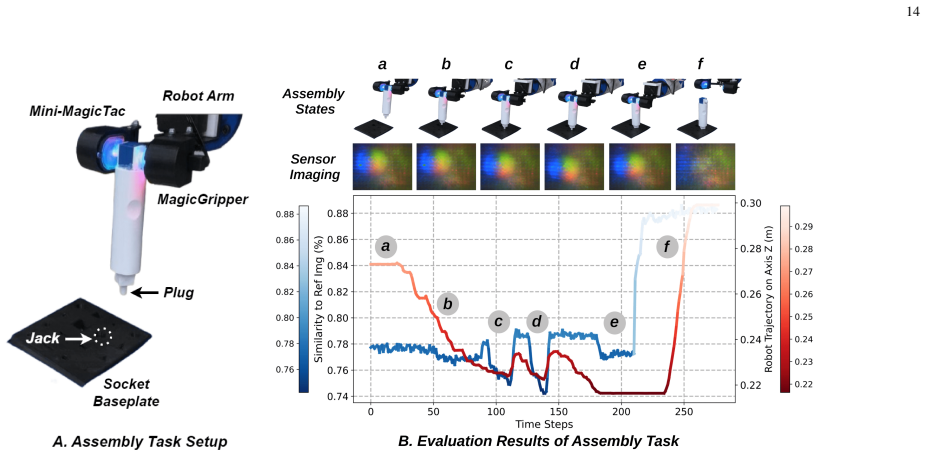
The paper's central claim is that the multi-layer grid structure is itself the multimodal sensor, so no additional hardware is needed for proximity, visual, or tactile perception. Before contact, light refracted through the grid cells carries the object's contour, color, and approximate distance to the camera. On light touch, only the outer skin deforms, and internal reflection makes nearby grid cells brighten, encoding static contact features such as texture and depth. Under stronger force, deformation spreads through multiple grid layers, and the resulting pattern maps force magnitude, direction, and torque. The paper pairs this physical mechanism with a detection framework: temporal fusion builds background and grid reference masks, channel entropy plus inter-channel correlation separates an approaching object from ambient light noise, and grid-similarity against the stored reference flags contact. In the reported experiments this framework supports 100% misalignment detection in teleoperated assembly versus 25% without the gripper, and an autonomous grasp task that ignores light noise and returns to base when slippage is detected.
Load-bearing premise
The load-bearing premise is that the fixed thresholds for entropy, correlation, and grid similarity will keep separating approaching objects from light noise and contact across different objects, lighting conditions, and individual sensor units, even though those thresholds were chosen from the reported experiments rather than derived from data or tested for sensitivity.
Editorial extensions
If this is right
- Compact grippers can achieve vision, proximity, and tactile sensing from a single camera and one printed elastomer, reducing size compared with stacked-sensor designs.
- The proximity-before-contact signal gives a control loop time to slow the gripper before physical touch, which should reduce impact forces in assembly and in-hand manipulation.
- The reported 5%-data fine-tuning result implies that additional gripper units of the same design can be brought online with very little per-unit calibration data.
- The wear test's stability up to roughly 32,000 interactions gives a practical maintenance limit for the elastomer before sensing performance degrades.
- The grid geometry and skin hardness can be re-tuned through the same printing process, so the sensor can be adapted to different task requirements without a hardware redesign.
Reading between the lines
- Editorial inference: because the multimodal encoding relies only on the grid's optical response, the same sensing principle could likely be ported to curved fingertips or other VBTS form factors by changing the printed geometry.
- Editorial inference: the hand-selected thresholds in Algorithms 2 and 3 are the most fragile part of the pipeline; a learned or adaptive threshold on the same entropy/correlation/similarity features would probably generalize better to unseen objects and lighting than the fixed values reported.
- Editorial inference: the reported force accuracy was measured on a fixed indenter setup with ResNet18; arbitrary contact geometries, rolling contacts, or soft object deformation may fall outside the demonstrated accuracy envelope.
- Editorial inference: connecting the proximity/contact state machine to an impedance controller would turn detection into closed-loop force control, a natural next step that the paper does not implement.
Editorial analysis
A structured set of objections, weighed in public.
Referee Report
Summary. The paper presents MagicGripper, a two-finger gripper whose sensing elements are two mini-MagicTac units, each a compact vision-based tactile sensor with a multi-layer grid embedded in a 3D-printed elastomer. The authors claim that the grid structure provides simultaneous visual, proximity, and tactile sensing within a single gripper-compatible unit. They evaluate mini-MagicTac with spatial-resolution tests against GelSight, contact localization and force regression against GelSight, manufacturing robustness against DIGIT, mechanical puncture tests, and wear-based performance robustness. They then report three robotic tasks: teleoperated assembly, contact-based alignment, and autonomous grasping. The autonomous grasping behavior is driven by a proposed sensing framework (Algorithms 1-3) that uses channel entropy, inter-channel correlation, and grid similarity to distinguish proximity, contact, and light-noise events.
Significance. If the quantitative claims hold, the work is useful: a compact, multi-modal tactile sensor integrated into a gripper, with manufacturing consistency and a low-cost fabrication route, would be a practical contribution to contact-rich manipulation. The paper has real strengths: it benchmarks against GelSight and DIGIT, provides extensive robustness experiments, reports model-transfer results with fine-tuning, and ships a complete hardware-integration story. The main algorithmic contribution, however, is the least supported part of the paper, and the headline quantitative claims lack uncertainty quantification. The significance of the result is therefore conditional on additional evaluation of the detection framework and on statistical support for the sensor metrics.
major comments (2)
- [§IV-E, Algorithms 2–3] The proximity/contact detection framework is the algorithmic core of the paper, but it rests on manually chosen thresholds (τE=0.5, τC=0.2, τG=0.6, τB=35, N=30, M=3) for which no sensitivity analysis, data-driven calibration, or labeled ground-truth evaluation is provided. In the autonomous grasping experiment the contact threshold is silently changed to 0.7 (Fig. 24D), and the combined detection test (Fig. 23) reports only qualitative trace behavior with no precision/recall or ROC numbers. The grasping demo also has no repeated-trial success rate: two of the three items are manually pulled away by design, so the only unmanipulated delivery is the biscuit. These omissions leave the claimed 'seamless transitions between pre-contact, contact, and post-contact phases' and the autonomous grasping result unverified beyond the particular demonstration.
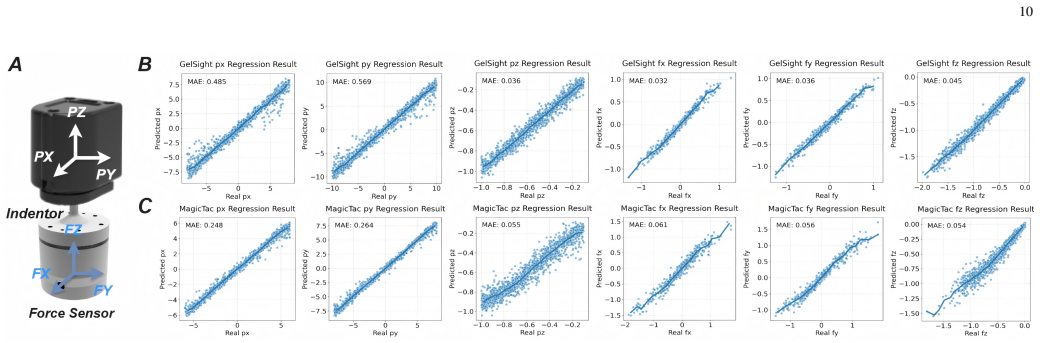
- [§IV-A, Table II and Fig. 10] The headline quantitative claims—0.15 mm spatial resolution, quarter-millimeter XY contact localization, and 0.05–0.06 N force error—are reported without uncertainty quantification. Table II gives accuracy percentages with no confidence intervals across the 100 repeated indentations; Fig. 10 reports XY/Z and force errors only as point values or ranges, with no error bars, trial counts, or statistical comparison against GelSight. Because these numbers are used to assert parity or superiority over GelSight, the manuscript should add confidence intervals, repeated-trial statistics, and significance tests; otherwise the comparison claims are not quantitatively established.
minor comments (5)
- [§III-A and Table I] The text says hardness can decrease from about 33A to 17A, but Table I lists 33.25A and 17.5/16.7A; please align the reported values and also fix the typo 'beetween'.
- [Algorithms 1 and 3] The Gaussian blur parameters and the exact similarity measure used in Algorithm 3 are not specified; please define the kernel size and the similarity formula for reproducibility.
- [§IV-B3] In the self-test description, 'stability maintained until test set 18' is inconsistent with the preceding statement that D3 was divided into 10 test sets; please correct this numerical inconsistency.
- [§VI] The conclusion says 'millinewton-level contact force prediction accuracy,' but §IV-A2 reports 0.05–0.06 N (50–60 mN); please rephrase to avoid implying sub-millinewton accuracy.
- [§V, Table VI] There is a typo 'two typies' and the notation 'Marker*' is unexplained; please clarify the table entries.
Circularity Check
No significant circularity: hardware inheritance is background, and the central performance claims are supported by external benchmarks and new experiments.
full rationale
MagicGripper's derivation chain is not circular. The sensor hardware inherits the multi-layer grid concept from the authors' prior MagicTac/CrystalTac papers, but the load-bearing claims in this paper—0.15 mm spatial resolution, roughly 0.3 mm XY localization, roughly 0.05–0.06 N force error, manufacturing consistency below 0.2 mm, and proximity/contact discrimination—are established by new experiments in Sections IV-A through IV-E against external baselines: spatial resolution is benchmarked against GelSight (Table II), manufacturing quality against DIGIT (Figs. 11–12), and force/localization against a physical force sensor and known robot poses (Fig. 10). The proximity/contact detection framework (Algorithms 1–3) uses hand-set thresholds (tau_E=0.5, tau_C=0.2, tau_G=0.6, and later 0.7 in Fig. 24), but these are operational control parameters, not fitted quantities renamed as predictions; the framework is tested on new object sets (Figs. 20–24), and the threshold inconsistency is a robustness limitation rather than a self-referential reduction. The self-citations [1] and [2] are used for fabrication background and physical properties, not as a uniqueness theorem or as proof of the new gripper's performance. No equation in the paper reduces to its own inputs, and no prediction is forced by construction.
Assumptions & free parameters
free parameters (6)
- τE =
0.5
- τC =
0.2
- τG =
0.6 (algorithm) / 0.7 (experiment)
- τB =
35
- N =
30
- M =
3
assumptions (3)
- domain assumption The optical behavior of the multi-layer grid can be described by external reflection, internal reflection, and internal refraction, and these effects map contact deformation to image brightness.
- domain assumption The DIGIT base unit's camera and LED illumination are sufficient to image the grid and external objects through the printed elastomer.
- domain assumption Channel entropy and inter-channel correlation are sufficient statistics to discriminate proximity, contact, and external light noise.
Cite this review
Pith. "Pith review of MagicGripper: A Multimodal Sensor-Integrated Gripper for Contact-Rich Robotic Manipulation." pith.science (2026). https://pith.science/paper/WVOBKUYX
@misc{pith2026250524382,
  author       = {Pith},
  title        = {Pith review of: MagicGripper: A Multimodal Sensor-Integrated Gripper for Contact-Rich Robotic Manipulation},
  year         = {2026},
  howpublished = {\url{https://pith.science/paper/WVOBKUYX}},
  note         = {Machine review of arXiv:2505.24382}
}
read the original abstract
Contact-rich manipulation in unstructured environments demands precise, multimodal perception to enable robust and adaptive control. Vision-based tactile sensors (VBTSs) have emerged as an effective solution; however, conventional VBTSs often face challenges in achieving compact, multi-modal functionality due to hardware constraints and algorithmic complexity. In this work, we present MagicGripper, a multimodal sensor-integrated gripper designed for contact-rich robotic manipulation. Building on our prior design, MagicTac, we develop a compact variant, mini-MagicTac, which features a three-dimensional, multi-layered grid embedded in a soft elastomer. MagicGripper integrates mini-MagicTac, enabling high-resolution tactile feedback alongside proximity and visual sensing within a compact, gripper-compatible form factor. We conduct a thorough evaluation of mini-MagicTac's performance, demonstrating its capabilities in spatial resolution, contact localization, and force regression. We also assess its robustness across manufacturing variability, mechanical deformation, and sensing performance under real-world conditions. Furthermore, we validate the effectiveness of MagicGripper through three representative robotic tasks: a teleoperated assembly task, a contact-based alignment task, and an autonomous robotic grasping task. Across these experiments, MagicGripper exhibits reliable multimodal perception, accurate force estimation, and high adaptability to challenging manipulation scenarios. Our results highlight the potential of MagicGripper as a practical and versatile tool for embodied intelligence in complex, contact-rich environments.
Figures


Figures from the paper (19 more)






Reference graph
Works this paper leans on
-
[1]
Magictac: A novel high-resolution 3d multi-layer grid-based tactile sensor,
W. Fan, H. Li, and D. Zhang, “Magictac: A novel high-resolution 3d multi-layer grid-based tactile sensor,”2024 IEEE International Confer- ence on Robotics and Automation (ICRA), 2024
work page 2024
-
[2]
Crystaltac: Vision-based tactile sensor family fabricated via rapid monolithic manufacturing,
——, “Crystaltac: Vision-based tactile sensor family fabricated via rapid monolithic manufacturing,”Cyborg and Bionic Systems, 2024
work page 2024
-
[3]
Gelsight: High-resolution robot tactile sensors for estimating geometry and force,
W. Yuan, S. Dong, and E. H. Adelson, “Gelsight: High-resolution robot tactile sensors for estimating geometry and force,”Sensors, vol. 17, no. 12, p. 2762, 2017
2017
-
[4]
Geltip: A finger-shaped optical tactile sensor for robotic manipulation,
D. F. Gomes, Z. Lin, and S. Luo, “Geltip: A finger-shaped optical tactile sensor for robotic manipulation,” in2020 IEEE/RSJ International Conference on Intelligent Robots and Systems (IROS). IEEE, 2020, pp. 9903–9909
work page 2020
-
[5]
Digit: A novel design for a low-cost compact high-resolution tactile sensor with application to in-hand manipulation,
M. Lambeta, P.-W. Chou, S. Tian, B. Yang, B. Maloon, V . R. Most, D. Stroud, R. Santos, A. Byagowi, G. Kammereret al., “Digit: A novel design for a low-cost compact high-resolution tactile sensor with application to in-hand manipulation,”IEEE Robotics and Automation Letters, vol. 5, no. 3, pp. 3838–3845, 2020
2020
-
[6]
Omnitact: A multi-directional high-resolution touch sensor,
A. Padmanabha, F. Ebert, S. Tian, R. Calandra, C. Finn, and S. Levine, “Omnitact: A multi-directional high-resolution touch sensor,” in2020 IEEE International Conference on Robotics and Automation (ICRA). IEEE, 2020, pp. 618–624
2020
-
[7]
Marker displacement method used in vision- based tactile sensors—from 2d to 3d-a review,
M. Li, T. Li, and Y . Jiang, “Marker displacement method used in vision- based tactile sensors—from 2d to 3d-a review,”IEEE Sensors Journal, 2023
work page 2023
-
[8]
An enhanced fingervision for contact spatial surface sensing,
Y . Yang, X. Wang, Z. Zhou, J. Zeng, and H. Liu, “An enhanced fingervision for contact spatial surface sensing,”IEEE Sensors Journal, vol. 21, no. 15, pp. 16 492–16 502, 2021
work page 2021
Show all 25 references
-
[9]
Digitac: A digit-tactip hybrid tactile sensor for comparing low-cost high-resolution robot touch,
N. F. Lepora, Y . Lin, B. Money-Coomes, and J. Lloyd, “Digitac: A digit-tactip hybrid tactile sensor for comparing low-cost high-resolution robot touch,”IEEE Robotics and Automation Letters, vol. 7, no. 4, pp. 9382–9388, 2022
2022
-
[10]
Finger-shaped gelforce: sensor for measuring surface traction fields for robotic hand,
K. Sato, K. Kamiyama, N. Kawakami, and S. Tachi, “Finger-shaped gelforce: sensor for measuring surface traction fields for robotic hand,” IEEE Transactions on Haptics, vol. 3, no. 1, pp. 37–47, 2009
2009
-
[11]
Sensing the frictional state of a robotic skin via subtractive color mixing,
X. Lin and M. Wiertlewski, “Sensing the frictional state of a robotic skin via subtractive color mixing,”IEEE Robotics and Automation Letters, vol. 4, no. 3, pp. 2386–2392, 2019
2019
-
[12]
Curvature sensing with a spherical tactile sensor using the color-interference of a marker array,
X. Lin, L. Willemet, A. Bailleul, and M. Wiertlewski, “Curvature sensing with a spherical tactile sensor using the color-interference of a marker array,” in2020 IEEE International Conference on Robotics and Automation (ICRA). IEEE, 2020, pp. 603–609
2020
-
[13]
Gelslim 3.0: High-resolution measurement of shape, force and slip in a compact tactile-sensing finger,
I. H. Taylor, S. Dong, and A. Rodriguez, “Gelslim 3.0: High-resolution measurement of shape, force and slip in a compact tactile-sensing finger,” in2022 International Conference on Robotics and Automation (ICRA). IEEE, 2022, pp. 10 781–10 787
2022
-
[14]
Densetact 2.0: Optical tactile sensor for shape and force reconstruction,
W. K. Do, B. Jurewicz, and M. Kennedy, “Densetact 2.0: Optical tactile sensor for shape and force reconstruction,” in2023 IEEE International Conference on Robotics and Automation (ICRA). IEEE, 2023, pp. 12 549–12 555
2023
-
[15]
Gel- stereo 2.0: An improved gelstereo sensor with multimedium refractive stereo calibration,
C. Zhang, S. Cui, S. Wang, J. Hu, Y . Cai, R. Wang, and Y . Wang, “Gel- stereo 2.0: An improved gelstereo sensor with multimedium refractive stereo calibration,”IEEE Transactions on Industrial Electronics, 2023
2023
-
[16]
Combining finger vision and optical tactile sensing: Reducing and handling errors while cutting vegetables,
A. Yamaguchi and C. G. Atkeson, “Combining finger vision and optical tactile sensing: Reducing and handling errors while cutting vegetables,” in2016 IEEE-RAS 16th International Conference on Humanoid Robots (Humanoids). IEEE, 2016, pp. 1045–1051
2016
-
[17]
Fingervision with whiskers: Light touch detection with vision-based tactile sensors,
A. Yamaguchi, “Fingervision with whiskers: Light touch detection with vision-based tactile sensors,” in2021 Fifth IEEE International Conference on Robotic Computing (IRC). IEEE, 2021, pp. 56–64
2021
-
[18]
Vitactip: Design and verification of a novel biomimetic physical vision-tactile fusion sensor,
W. Fan, H. Li, W. Si, S. Luo, N. Lepora, and D. Zhang, “Vitactip: Design and verification of a novel biomimetic physical vision-tactile fusion sensor,” in2024 IEEE International Conference on Robotics and Automation (ICRA). IEEE, 2024, pp. 1056–1062
2024
-
[19]
Uvtac: Switchable uv marker-based tactile sensing finger for effective force estimation and object localization,
W. Kim, W. D. Kim, J.-J. Kim, C.-H. Kim, and J. Kim, “Uvtac: Switchable uv marker-based tactile sensing finger for effective force estimation and object localization,”IEEE Robotics and Automation Letters, vol. 7, no. 3, pp. 6036–6043, 2022
2022
-
[20]
Spectac: A visual-tactile dual- modality sensor using uv illumination,
Q. Wang, Y . Du, and M. Y . Wang, “Spectac: A visual-tactile dual- modality sensor using uv illumination,” in2022 International Confer- ence on Robotics and Automation (ICRA). IEEE, 2022, pp. 10 844– 10 850
2022
-
[21]
Seeing through your skin: Recognizing objects with a novel visuotactile sensor,
F. R. Hogan, M. Jenkin, S. Rezaei-Shoshtari, Y . Girdhar, D. Meger, and G. Dudek, “Seeing through your skin: Recognizing objects with a novel visuotactile sensor,” inProceedings of the IEEE/CVF Winter Conference on Applications of Computer Vision, 2021, pp. 1218–1227
2021
-
[22]
Vistac toward a unified multimodal sensing finger for robotic manipulation,
S. Athar, G. Patel, Z. Xu, Q. Qiu, and Y . She, “Vistac toward a unified multimodal sensing finger for robotic manipulation,”IEEE Sensors Journal, vol. 23, no. 20, pp. 25 440–25 450, 2023
2023
-
[23]
Tirgel: A visuo-tactile sensor with total internal reflection mechanism for external observation and contact detection,
S. Zhang, Y . Sun, J. Shan, Z. Chen, F. Sun, Y . Yang, and B. Fang, “Tirgel: A visuo-tactile sensor with total internal reflection mechanism for external observation and contact detection,”IEEE Robotics and Automation Letters, 2023
2023
-
[24]
Satac: A thermoluminescence enabled tactile sensor for concurrent perception of temperature, pressure, and shear,
Z. Song, R. Yu, X. Zhang, K. W. Sou, S. Mu, D. Peng, X.-P. Zhang, and W. Ding, “Satac: A thermoluminescence enabled tactile sensor for concurrent perception of temperature, pressure, and shear,” in2024 IEEE International Conference on Robotics and Automation (ICRA), 2024, pp. ...
2024
-
[25]
M3tac: A multispectral multimodal visuotactile sensor with beyond- human sensory capabilities,
S. Li, H. Yu, G. Pan, H. Tang, J. Zhang, L. Ye, X.-P. Zhang, and W. Ding, “M3tac: A multispectral multimodal visuotactile sensor with beyond- human sensory capabilities,”IEEE Transactions on Robotics, vol. 40, pp. 4484–4503, 2024
2024
Reviewed August 7, 2026 · model on record in the stance chip above.
Discussion (0). Sign in to comment.