REVIEW 4 major objections 5 minor 51 references
CHIP: Chameleon Hash-based Irreversible Passport for Robust Deep Model Ownership Verification and Active Usage Control
T0 review · 4 major / 5 minor · reviewed 2026-08-07 · deepseek-v4-flash
Pith's one-line read Chameleon hash binds many user keys to one immutable model signature.
desk verdict The chameleon-hash trick is genuinely new and the fidelity work is solid, but offline active control rests on an untested adversary—fine-tuning the TLP to a forged passport—so the paper is a conditional at best. read the letter →
The pith
A machine-rendered reading of the paper's core claim, the machinery that carries it, and where it could break.
The reading
What carries the argument
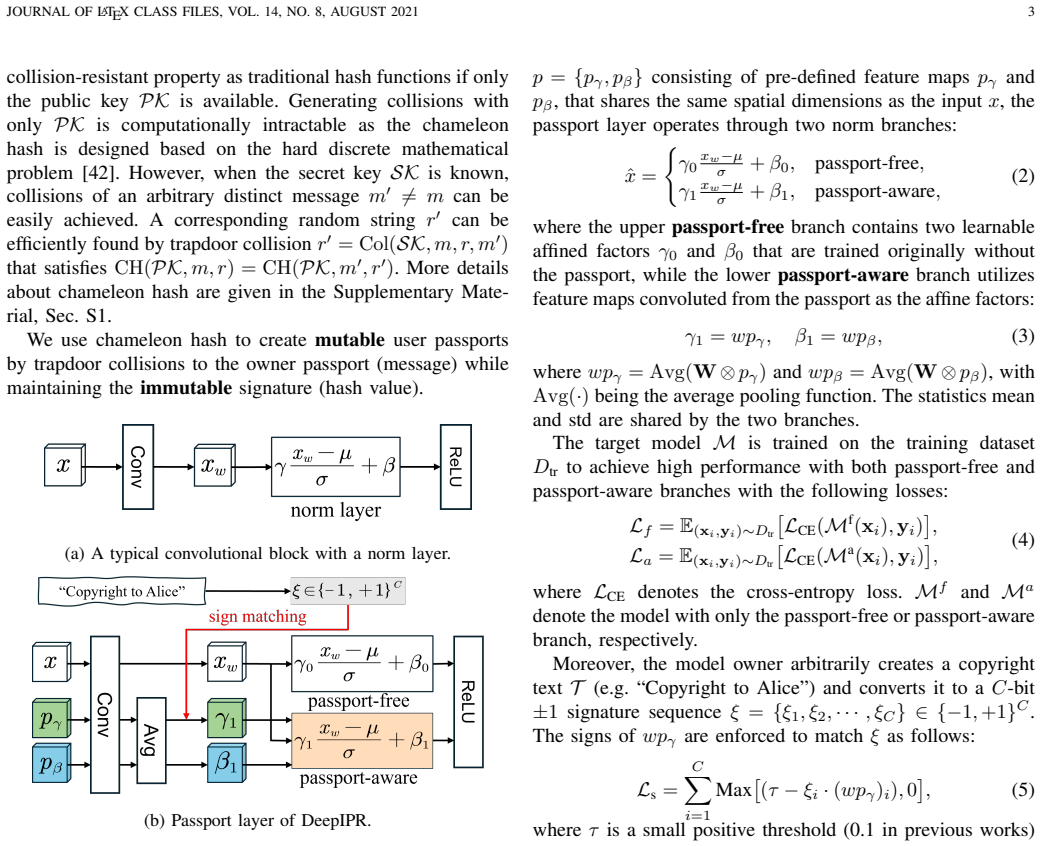
Chameleon hash: a trapdoor hash in which finding collisions is intractable using only the public key $PK$, but easy with the secret key $SK$ via a collision algorithm. In CHIP the hash binds the owner passport digest $m_o = \mathrm{Hash}(p_o^\gamma)$ and the licensor certificate $r_o$ to the immutable signature $\xi$, and the trapdoor property lets the owner mint user certificates that collide to the same $\xi$. The other load-bearing mechanism is the modified passport layer: a skip connection $\gamma_1 = \mathrm{Ada}(p_o^\gamma) + \mathrm{TLP}(w_{p_o^\gamma})$ together with a balance loss $L_{\mathrm{bal}}$ makes the affine factors depend sharply on the exact passport, so a mismatched passport destroys utility.
What would settle it
Run the oracle-passport ambiguity attack with the TLP layer free to be fine-tuned together with the forged passport on 30% of the training data, exactly as the owner does in Eq. (13); if the forged passport keeps accuracy near the clean model while both the signature detection and passport hashing accuracies exceed their thresholds, the central claim collapses.
Extended reading notes
Core claim
On its own terms, CHIP's discovery is that the chameleon hash's trapdoor-collision property lets many distinct user passports and licensee certificates hash to the same immutable signature $\xi = \mathrm{SGN}(\mathrm{CH}(PK, m_o, r_o))$, so the owner can generate $N$ user triplets $\{M_u^j, p_u^j, r_u^j\}$ from one master model without retraining. A user passport is created by perturbing the owner passport under a distance constraint, and the user certificate is a trapdoor collision $r_u^j = \mathrm{Col}(SK, m_o, r_o, m_u^j)$, so Eq. (14) holds for every user and the ownership signature stays fixed. The paper argues this yields strong ownership proof (only the licensor certificate decodes to meaningful text), active offline control (a model is unusable with any passport but its own, enforced by a skip connection that makes the affine factors sharply passport-dependent), and tracing (the culprit's passport passes the fidelity test), while a master model deployed as MLaaS admits only tuples that collide to $\xi$.
Load-bearing premise
The load-bearing premise is that a user who steals a distributed model cannot adapt its tiny TLP layer to a forged passport while keeping accuracy, so only the owner can mint a working passport-model pair.
Editorial extensions
If this is right
- Owners can distribute many individually traceable copies from one master model; minting a new user costs minutes of TLP fine-tuning instead of a full retraining.
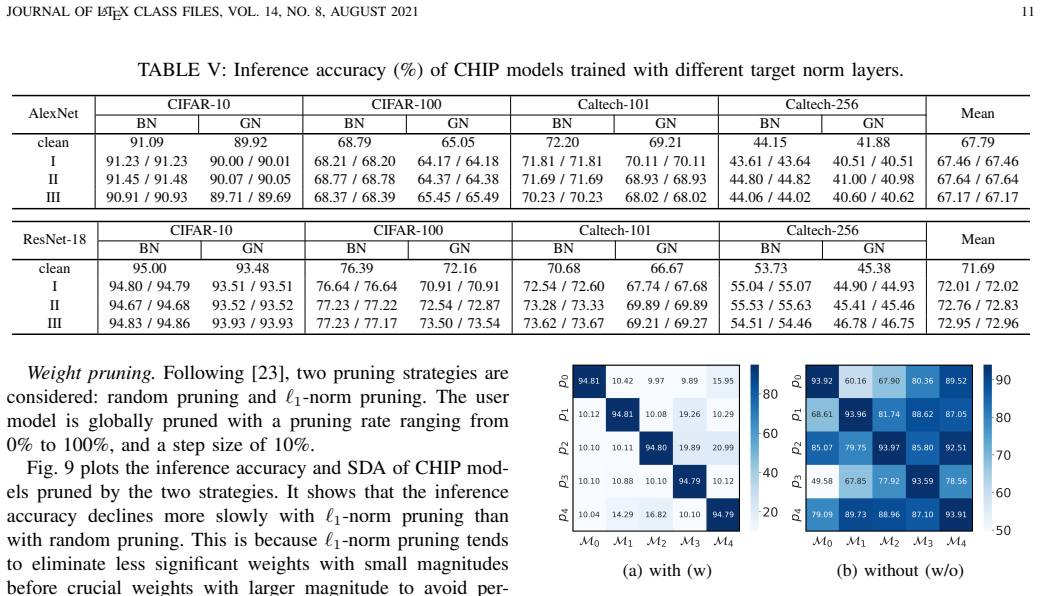
- An offline copy is useless to anyone except its registered user, because only the designated passport keeps accuracy near the clean model.
- An ownership claim must pass four tests — fidelity, signature detection, passport hashing, and licensor decoding — and a legitimate user's triplet passes the first three but not the licensor test.
- In MLaaS, issuing or revoking a user's passport is an efficient chameleon hash computation, so ad hoc subscription and withdrawal need no model change.
- The reported removal experiments show the signature surviving fine-tuning, transfer learning, and pruning, with accuracy degrading before the signature disappears.
Reading between the lines
- Editorial inference: the decisive un-tested attack is to run the paper's own user-triplet optimization from the attacker's side, jointly fine-tuning the TLP and forging a passport on a stolen model; if that preserves accuracy and lifts the passport hashing accuracy, offline active control and tracing both break.
- Editorial inference: since user models differ only in the small TLP and the passport, an attacker with two legitimately purchased copies could compare them to separate shared master weights from user-specific ones, which may ease watermark removal or passport synthesis.
- Editorial inference: the entire scheme leans on the chameleon hash secret key staying secret; if an attacker obtains it, they can mint unlimited colliding passports and pass the verification tests.
Editorial analysis
A structured set of objections, weighed in public.
Referee Report
Summary. The paper proposes CHIP, a DNN IP protection framework that combines passport-based watermarking with the Krawczyk-Rabin chameleon hash. The owner trains a master model whose passport-aware layers embed an immutable chameleon-hash signature derived from an owner passport and a licensor certificate; user-specific models are then produced by optimizing the small TLP layers and copies of the owner passport so that each user passport and licensee certificate collide to the same signature. This is claimed to deliver joint ownership verification, multi-user active usage control in both offline and online deployment, and traitor tracing without per-user retraining. The authors evaluate fidelity, active-control confusion matrices, robustness against ambiguity and removal attacks, cloud-token authentication, and graph-classification generalization. The cryptographic construction is plausible, but the offline active-control guarantee rests on an unverified assumption about whether an attacker can adapt the TLP to a forged passport while preserving utility.
Significance. If the central claim holds, CHIP is a meaningful step beyond prior passport-based methods: it is the first scheme in this line to combine passive ownership proof with offline multi-user active control and user tracing in a single model, and it does so using an independent cryptographic primitive rather than relying on the authors' earlier SteP construction. Concrete strengths include released code, extensive experiments across four image datasets, two architectures, two normalization types, and graph classification, as well as a data-free user-triplet generation procedure that is orders of magnitude cheaper than retraining. The main caveat is that the load-bearing active-control claim is currently demonstrated only against a restricted adversary; the experiments do not test the natural adaptation attack that the paper's own Definition 2 suggests.
major comments (4)
- [Sec. V-D, Definition 2 (Eq. 13)] The robustness evaluation does not exercise the adversary who fine-tunes the TLP to a forged passport. Equation (13) shows that the owner's own user-triplet generation optimizes exactly the TLP and a passport copy to maintain utility, and a malicious registered user holding a stolen user model can run the same data-free or low-data optimization to fit a forged passport p^f without needing to satisfy the diversification constraint. The attacks reported in Sec. V-D (Definition 1, Eq. 7, and Table III) keep the TLP fixed and only optimize the passport, and Fig. 7 likewise varies the signature while leaving the TLP unchanged. If TLP adaptation restores accuracy for p^f, the owner cannot restrict usage to the designated user and p^f will not appear in the owner's repository, breaking both offline active control and traitor tracing. Please add an experiment in which an attacker with white-box access to a user model optimizes the TLP (and any other passport-aware parameters) toward a forged passport, with and without a small amount of training data, and report accuracy, SDA, and PHA; the central claim should be revised depending on the outcome.
- [Sec. IV-D, Eq. (15)] The fidelity threshold tau_fidelity is never defined, yet it is the threshold that decides whether V_F passes and therefore whether a forged passport is rejected. The text in Sec. V-D says that forged passports cause false claims to "fail V_F in certain cases," but without a concrete threshold and without reporting accuracy distributions around it, the reader cannot tell whether the rejection is robust or tuned to the specific results. Please define tau_fidelity, state the value used, and report the accuracy distributions (e.g., over random and oracle passports, and over TLP-adaptation attacks) relative to that threshold.
- [Sec. V-D, Table IV] The transfer-learning comparison is made on different attack surfaces: for the four baselines the optimized model is the passport-free branch, while for CHIP it is the passport-aware model, as the note under Table IV states. Higher SDA for CHIP may therefore reflect a different starting point rather than stronger watermark persistence. Please run transfer learning on the same branch type for all methods, or report both branches, and discuss how the choice affects the comparison.
- [Sec. V-C, Fig. 5] The active-control confusion matrix in Fig. 5(a) tests only cross-user passport swaps on fixed user models. It does not test whether the underlying model can be re-optimized toward a new passport, which is the attack most directly suggested by Eq. (13). The claimed property that "a user model can only be normally used by the unique user who holds the designated paired passport" is therefore stronger than what the current experiments establish; please either add the TLP-adaptation experiment or weaken the claim accordingly.
minor comments (5)
- [Sec. IV-D, Eq. (18)] The licensor test is written as "V D ⇐ ⇒ Dec(r)"; this should be "V L ⇐ ⇒ Dec(r)" to match the test labels.
- [Sec. V-B and Sec. V-D] There are typos in the prose: "which which" in the second paragraph of Sec. V-B and "dose not imply" in Sec. V-D should be corrected.
- [Sec. V, Tables II and III] The main accuracy and robustness tables report single runs without standard deviations or multiple seeds. Given that several fidelity differences are smaller than 1%, error bars or multiple-seed averages would materially strengthen the claims.
- [Sec. IV-D, Eqs. (16) and (17)] The notation "ξ∗ ∧ ξ" is not defined; if it denotes a bitwise XNOR or equiparison on ±1 strings, please state this explicitly to avoid confusion with a logical AND.
- [Sec. V-A] Please state explicitly how many random seeds are used for the training of the master models and for the user-triplet generation, since the claimed stability of the approach would be better supported by reporting variance across seeds.
Circularity Check
No significant circularity: Eq. (14) follows from the external chameleon-hash trapdoor property, and active control is empirically established; the untested TLP-adaptation adversary is a robustness gap, not a circular reduction.
full rationale
The derivation core of CHIP is Eq. (14): every user pair (p_u^j, r_u^j) maps to the same chameleon-hash signature as the owner pair because r_u^j = Col(SK, m_o, r_o, m_u^j) (Sec. IV-C). This is a genuine theorem of the external Krawczyk-Rabin chameleon hash [41], not a redescription of the paper's own outputs: the owner signature xi is not fitted to the user models, and the user models are not fitted to xi. The active-control claim (a user model works only with its designated passport) is argued from the skip connection (Eq. 10) and established empirically with a negative control (without the skip connection control fails, Fig. 10(b)); it is not defined into existence. Near-misses that are not circularity: (1) the 100% SDA and matched-triplet PHA figures are largely enforced by the signature loss Ls and by the hash-collision equality themselves, but the paper transparently states V_D can be trivially bypassed (Sec. V-D) and uses the figures as implementation sanity checks; (2) Table III tests only the Definition 1 passport-only adversary with a fixed TLP, so the summary 'CHIP is verified to be robust against various ambiguity attacks' (Sec. V-D) is overbroad - a coverage/correctness gap, not a circular reduction, since the owner's own user-triplet procedure (Eq. 13) fine-tunes the TLP exactly as an adaptive adversary would; the threat model even admits a malicious user may 'counterfeit the passport' (Sec. III-A), yet that adversary is never evaluated. Self-citations: [23] SteP (co-authored) defines the offline-control gap and serves as a baseline, and [29]/[10] appear in related work; none carries the chameleon-hash derivation, which rests on an external 1998 primitive and on comparisons against four independently re-implemented baselines with released code. No fitted parameter is renamed as a prediction, and no uniqueness theorem is imported from the authors' prior work. Overall, the central claims have independent cryptographic and empirical content; score 2 reflects only the framing role of the co-authored SteP baseline and the construction-enforced verification metrics.
Assumptions & free parameters
free parameters (4)
- τfidelity
- τerror =
5%
- τ =
0.1
- Balance loss weight =
implied 1.0
assumptions (7)
- standard math Chameleon hash schemes provide collision resistance without the secret key and efficient trapdoor collisions with it.
- standard math SHA-512 is one-way and collision-resistant.
- domain assumption Signs of wpγ can carry a C-bit signature that survives inference.
- ad hoc to paper The skip connection makes affine factors so passport-dependent that a mismatched passport collapses accuracy.
- ad hoc to paper Minimizing Lbal on affine factors without data preserves user model accuracy.
- domain assumption The attacker does not or cannot fine-tune the TLP layer to a new passport.
- domain assumption The owner keeps the chameleon secret key and the master model private.
Cite this review
Pith. "Pith review of CHIP: Chameleon Hash-based Irreversible Passport for Robust Deep Model Ownership Verification and Active Usage Control." pith.science (2026). https://pith.science/paper/VUFEGOFR
@misc{pith2026250524536,
  author       = {Pith},
  title        = {Pith review of: CHIP: Chameleon Hash-based Irreversible Passport for Robust Deep Model Ownership Verification and Active Usage Control},
  year         = {2026},
  howpublished = {\url{https://pith.science/paper/VUFEGOFR}},
  note         = {Machine review of arXiv:2505.24536}
}
read the original abstract
The pervasion of large-scale Deep Neural Networks (DNNs) and their enormous training costs make their intellectual property (IP) protection of paramount importance. Recently introduced passport-based methods attempt to steer DNN watermarking towards strengthening ownership verification against ambiguity attacks by modulating the affine parameters of normalization layers. Unfortunately, neither watermarking nor passport-based methods provide a holistic protection with robust ownership proof, high fidelity, active usage authorization and user traceability for offline access distributed models and multi-user Machine-Learning as a Service (MLaaS) cloud model. In this paper, we propose a Chameleon Hash-based Irreversible Passport (CHIP) protection framework that utilizes the cryptographic chameleon hash function to achieve all these goals. The collision-resistant property of chameleon hash allows for strong model ownership claim upon IP infringement and liable user traceability, while the trapdoor-collision property enables hashing of multiple user passports and licensee certificates to the same immutable signature to realize active usage control. Using the owner passport as an oracle, multiple user-specific triplets, each contains a passport-aware user model, a user passport, and a licensee certificate can be created for secure offline distribution. The watermarked master model can also be deployed for MLaaS with usage permission verifiable by the provision of any trapdoor-colliding user passports. CHIP is extensively evaluated on four datasets and two architectures to demonstrate its protection versatility and robustness. Our code is released at https://github.com/Dshm212/CHIP.
Figures


Figures from the paper (6 more)


Reference graph
Works this paper leans on
-
[1]
J. Achiam, S. Adler, S. Agarwal, L. Ahmad, I. Akkaya, F. L. Aleman, D. Almeida, J. Altenschmidt, S. Altman, S. Anadkat et al. , “Gpt-4 technical report,” arXiv preprint arXiv:2303.08774 , 2023. JOURNAL OF LATEX CLASS FILES, VOL. 14, NO. 8, AUGUST 2021 13
arXiv 2023
-
[2]
J. Bai, S. Bai, Y . Chu, Z. Cui, K. Dang, X. Deng, Y . Fan, W. Ge, Y . Han, F. Huang et al. , “Qwen technical report,” arXiv preprint arXiv:2309.16609, 2023
arXiv 2023
-
[3]
Llama: Open and efficient foundation language models,
H. Touvron, T. Lavril, G. Izacard, X. Martinet, M.-A. Lachaux, T. Lacroix, B. Rozi `ere, N. Goyal, E. Hambro, F. Azhar et al. , “Llama: Open and efficient foundation language models,” arXiv preprint arXiv:2302.13971, 2023
arXiv 2023
-
[4]
Stealing machine learning models via prediction apis,
F. Tram `er et al., “Stealing machine learning models via prediction apis,” in Proc. USENIX Secur. Symp. , 2016, pp. 601–618
work page 2016
-
[5]
Deepem: Deep neural networks model recovery through em side-channel information leakage,
H. Yu, H. Ma, K. Yang, Y . Zhao, and Y . Jin, “Deepem: Deep neural networks model recovery through em side-channel information leakage,” in Proc. IEEE Int. Symp. Hardw. Oriented Secur. Trust . IEEE, 2020, pp. 209–218
work page 2020
-
[6]
Generative adversarial networks for black-box api attacks with limited training data,
Y . Shi, Y . E. Sagduyu, K. Davaslioglu, and J. H. Li, “Generative adversarial networks for black-box api attacks with limited training data,” in Proc. IEEE Int. Symp. Signal Process. Inf. Technol. IEEE, 2018, pp. 453–458
work page 2018
-
[7]
Knockoff nets: Stealing func- tionality of black-box models,
T. Orekondy, B. Schiele, and M. Fritz, “Knockoff nets: Stealing func- tionality of black-box models,” in Proc. IEEE/CVF Conf. Comput. Vis. Pattern Recognit., 2019, pp. 4954–4963
work page 2019
-
[8]
Maze: Data-free model stealing attack using zeroth-order gradient estimation,
S. Kariyappa, A. Prakash, and M. K. Qureshi, “Maze: Data-free model stealing attack using zeroth-order gradient estimation,” in Proc. IEEE/CVF Conf. Comput. Vis. Pattern Recognit. , 2021, pp. 13 814– 13 823
work page 2021
Show all 51 references
-
[9]
Too hot to handle: Novel thermal side-channel in power attack- protected intel processors,
N. Mishra, T. L. Dutta, S. Shukla, A. Chakraborty, and D. Mukhopad- hyay, “Too hot to handle: Novel thermal side-channel in power attack- protected intel processors,” in Proc. IEEE Int. Symp. Hardw. Oriented Secur. Trust. IEEE, 2024, pp. 378–382
2024
-
[10]
An overview of trustworthy ai: Advances in ip protection, privacy-preserving federated learning, security verification, and gai safety alignment,
Y . Zheng, C.-H. Chang, S.-H. Huang, P.-Y . Chen, and S. Picek, “An overview of trustworthy ai: Advances in ip protection, privacy-preserving federated learning, security verification, and gai safety alignment,” IEEE J. Emerg. Sel. Topics Circuit Syst. , 2024
2024
-
[11]
Embedding water- marks into deep neural networks,
Y . Uchida, Y . Nagai, S. Sakazawa, and S. Satoh, “Embedding water- marks into deep neural networks,” in Proc. ACM Int. Conf. Multimedia Retrieval, 2017, pp. 269–277
2017
-
[12]
Deepmarks: A secure fingerprinting framework for digital rights management of deep learning models,
H. Chen et al. , “Deepmarks: A secure fingerprinting framework for digital rights management of deep learning models,” in Proc. ACM Int. Conf. Multimedia Retrieval , 2019, pp. 105–113
2019
-
[13]
Deep model intellectual prop- erty protection with compression-resistant model watermarking,
H. Nie, S. Lu, J. Wu, and J. Zhu, “Deep model intellectual prop- erty protection with compression-resistant model watermarking,” IEEE Transactions Artif. Intell., vol. 5, no. 7, pp. 3362–3373, 2024
2024
-
[14]
A robustness-assured white-box watermark in neural networks,
P. Lv, P. Li, S. Zhang, K. Chen, R. Liang, H. Ma, Y . Zhao, and Y . Li, “A robustness-assured white-box watermark in neural networks,” IEEE Trans. Dependable Secure Comput., vol. 20, no. 6, pp. 5214–5229, 2023
2023
-
[15]
Riga: Covert and robust white-box watermarking of deep neural networks,
T. Wang and F. Kerschbaum, “Riga: Covert and robust white-box watermarking of deep neural networks,” in Proc. Web Conf., 2021, pp. 993–1004
2021
-
[16]
Free fine-tuning: A plug-and-play watermarking scheme for deep neural networks,
R. Wang et al., “Free fine-tuning: A plug-and-play watermarking scheme for deep neural networks,” in Proc. ACM Int Conf. Multimedia , 2023, pp. 8463–8474
2023
-
[17]
Turning your weakness into a strength: Watermarking deep neural networks by backdooring,
Y . Adi et al. , “Turning your weakness into a strength: Watermarking deep neural networks by backdooring,” in Proc. USENIX Secur. Symp., 2018, pp. 1615–1631
2018
-
[18]
Protecting intellectual property of deep neural networks with watermarking,
J. Zhang et al., “Protecting intellectual property of deep neural networks with watermarking,” in Proc. ACM Asia Conf. Comput. Commun. Secur., 2018, pp. 159–172
2018
-
[19]
Rethinking deep neural network ownership verification: Embedding passports to defeat ambiguity at- tacks,
L. Fan, K. W. Ng, and C. S. Chan, “Rethinking deep neural network ownership verification: Embedding passports to defeat ambiguity at- tacks,” Proc. Adv. Neural Inform. Process. Syst. , vol. 32, 2019
2019
-
[20]
Deepipr: Deep neural network ownership verification with passports,
L. Fan, K. W. Ng, C. S. Chan, and Q. Yang, “Deepipr: Deep neural network ownership verification with passports,” IEEE Trans. Pattern Anal. Mach. Intell. , vol. 44, no. 10, pp. 6122–6139, 2021
2021
-
[21]
Passport- aware normalization for deep model protection,
J. Zhang, D. Chen, J. Liao, W. Zhang, G. Hua, and N. Yu, “Passport- aware normalization for deep model protection,” Proc. Adv. Neural Inform. Process. Syst. , vol. 33, pp. 22 619–22 628, 2020
2020
-
[22]
Trapdoor normalization with irreversible ownership verification,
H. Liu, Z. Weng, Y . Zhu, and Y . Mu, “Trapdoor normalization with irreversible ownership verification,” in Proc. Int. Conf. Mach. Learn. PMLR, 2023, pp. 22 177–22 187
2023
-
[23]
Steganographic passport: An owner and user verifiable credential for deep model ip protection without retraining,
Q. Cui, R. Meng, C. Xu, and C.-H. Chang, “Steganographic passport: An owner and user verifiable credential for deep model ip protection without retraining,” in Proc. IEEE/CVF Conf. Comput. Vis. Pattern Recognit. , 2024, pp. 12 302–12 311
2024
-
[24]
Proof-of-learning: Definitions and practice,
H. Jia et al., “Proof-of-learning: Definitions and practice,” in Proc. IEEE Symp. Secur. Privacy. IEEE, 2021, pp. 1039–1056
2021
-
[25]
Ipguard: Protecting intellectual property of deep neural networks via fingerprinting the classification boundary,
X. Cao, J. Jia, and N. Z. Gong, “Ipguard: Protecting intellectual property of deep neural networks via fingerprinting the classification boundary,” in Proc. ACM Asia Conf. Comput. Commun. Secur. , 2021, pp. 14–25
2021
-
[26]
Metav: A meta-verifier approach to task-agnostic model fingerprinting,
X. Pan, Y . Yan, M. Zhang, and M. Yang, “Metav: A meta-verifier approach to task-agnostic model fingerprinting,” in Proc. ACM SIGKDD Conference Knowl. Discovery Data Mining , 2022, pp. 1327–1336
2022
-
[27]
Ganfinger: Gan-based fingerprint generation for deep neural network ownership verification,
H. Ren, A. Yan, X. Ren, P.-G. Ye, C.-z. Gao, Z. Zhou, and J. Li, “Ganfinger: Gan-based fingerprint generation for deep neural network ownership verification,” arXiv preprint arXiv:2312.15617 , 2023
2023 arXiv
-
[28]
Deepreg: A trustworthy and privacy-friendly ownership regulatory framework for deep learning models,
X. Zhuang, L. Zhang, C. Tang, and Y . Li, “Deepreg: A trustworthy and privacy-friendly ownership regulatory framework for deep learning models,” IEEE Trans. Inform. Forensics Secur., 2024
2024
-
[29]
A dnn fingerprint for non- repudiable model ownership identification and piracy detection,
Y . Zheng, S. Wang, and C.-H. Chang, “A dnn fingerprint for non- repudiable model ownership identification and piracy detection,” IEEE Trans. Inform. Forensics Secur., vol. 17, pp. 2977–2989, 2022
2022
-
[30]
Hardware-assisted intellectual property protection of deep learning models,
A. Chakraborty, A. Mondai, and A. Srivastava, “Hardware-assisted intellectual property protection of deep learning models,” in Proc. ACM/IEEE Des. Automat. Conf. IEEE, 2020, pp. 1–6
2020
-
[31]
Older and wiser: The marriage of device aging and intellectual property protection of deep neural networks,
N. Lin, S. Wang, Y . Zhang, Y . He, K. Wong, A. Basu, D. Shang, X. Chen, and Z. Wang, “Older and wiser: The marriage of device aging and intellectual property protection of deep neural networks,” arXiv preprint arXiv:2406.14863, 2024
2024 arXiv
-
[32]
Chaotic weights: A novel approach to protect intellectual property of deep neural networks,
N. Lin, X. Chen, H. Lu, and X. Li, “Chaotic weights: A novel approach to protect intellectual property of deep neural networks,” IEEE Trans. Computer-Aided Des. Integr. Circuits Syst. , vol. 40, no. 7, pp. 1327– 1339, 2020
2020
-
[33]
Nnsplitter: an active defense solution for dnn model via automated weight obfuscation,
T. Zhou, Y . Luo, S. Ren, and X. Xu, “Nnsplitter: an active defense solution for dnn model via automated weight obfuscation,” in Proc. Int. Conf. Mach. Learn. PMLR, 2023, pp. 42 614–42 624
2023
-
[34]
Snngx: Securing spiking neural networks with ge- netic xor encryption on rram-based neuromorphic accelerator,
K. Wong et al. , “Snngx: Securing spiking neural networks with ge- netic xor encryption on rram-based neuromorphic accelerator,” in Proc. IEEE/ACM Int. Conf. Computer-Aided Des. , 2024, pp. 1–9
2024
-
[35]
Non-transferable learning: A new approach for model ownership verification and applicability authorization,
L. Wang et al., “Non-transferable learning: A new approach for model ownership verification and applicability authorization,” arXiv preprint arXiv:2106.06916, 2021
2021 arXiv
-
[36]
Protecting intellectual property with reliable availability of learning models in ai-based cybersecurity services,
G. Ren et al., “Protecting intellectual property with reliable availability of learning models in ai-based cybersecurity services,” IEEE Trans. Dependable Secure Comput. , vol. 21, no. 2, pp. 600–617, 2022
2022
-
[37]
Deep serial number: Computational watermark for dnn intellectual property protection,
R. Tang, M. Du, and X. Hu, “Deep serial number: Computational watermark for dnn intellectual property protection,” in Prof. Joint Eur. Conf. Mach. Learn. Knowl. Discovery Databases . Springer, 2023, pp. 157–173
2023
-
[38]
Securenet: Proactive intellectual property protection and model security defense for dnns based on backdoor learning,
P. Li, J. Huang, H. Wu, Z. Zhang, and C. Qi, “Securenet: Proactive intellectual property protection and model security defense for dnns based on backdoor learning,” Neural Networks , vol. 174, p. 106199, 2024
2024
-
[39]
The md5 message-digest algorithm,
R. Rivest, “The md5 message-digest algorithm,” Tech. Rep., 1992
1992
-
[40]
Us secure hash algorithm 1 (sha1),
D. Eastlake 3rd and P. Jones, “Us secure hash algorithm 1 (sha1),” Tech. Rep., 2001
2001
-
[41]
Chameleon hashing and signatures,
H. Krawczyk and T. Rabin, “Chameleon hashing and signatures,” Cryptology ePrint Archive , 1998
1998
-
[42]
The discrete logarithm problem,
K. S. McCurley, “The discrete logarithm problem,” in Proc. of Symp. in Applied Math, vol. 42. USA, 1990, pp. 49–74
1990
-
[43]
Batch normalization: Accelerating deep network training by reducing internal covariate shift,
S. Ioffe, “Batch normalization: Accelerating deep network training by reducing internal covariate shift,” arXiv preprint arXiv:1502.03167 , 2015
2015 arXiv
-
[44]
Group normalization,
Y . Wu and K. He, “Group normalization,” in Proc. Eur. Conf. Comput. Vis., 2018, pp. 3–19
2018
-
[45]
Learning multiple layers of features from tiny images,
A. Krizhevsky and G. Hinton, “Learning multiple layers of features from tiny images,” 2009
2009
-
[46]
Learning generative visual models from few training examples: An incremental bayesian approach tested on 101 object categories,
L. Fei-Fei, R. Fergus, and P. Perona, “Learning generative visual models from few training examples: An incremental bayesian approach tested on 101 object categories,” Comput. Vision Pattern Recognit. Workshop , 2004
2004
-
[47]
Imagenet classification with deep convolutional neural networks,
A. Krizhevsky, I. Sutskever, and G. E. Hinton, “Imagenet classification with deep convolutional neural networks,” Proc. Adv. Neural Inform. Process. Syst., vol. 25, 2012
2012
-
[48]
Deep residual learning for image recognition,
K. He, X. Zhang, S. Ren, and J. Sun, “Deep residual learning for image recognition,” in Proc. IEEE Conf. Comput. Vis. Pattern Recognit., 2016, pp. 770–778
2016
-
[49]
Sok: How robust is image classification deep neural network watermarking?
N. Lukas, E. Jiang, X. Li, and F. Kerschbaum, “Sok: How robust is image classification deep neural network watermarking?” in Proc. IEEE Symp. Secur. Privacy. IEEE, 2022, pp. 787–804
2022
-
[50]
How powerful are graph neural networks?
K. Xu, W. Hu, J. Leskovec, and S. Jegelka, “How powerful are graph neural networks?” in Proc. Int. Conf. Learn. Representations
-
[51]
The network data repository with interactive graph analytics and visualization,
R. A. Rossi and N. K. Ahmed, “The network data repository with interactive graph analytics and visualization,” in Proc. AAAI Conf. Artif. Intell., vol. 29, no. 1, 2015
2015
Reviewed August 7, 2026 · model on record in the stance chip above.
Discussion (0). Sign in to comment.