REVIEW 2 major objections 6 minor 37 references
Identifying Primary Stress Across Related Languages and Dialects with Transformer-based Speech Encoder Models
T0 review · 2 major / 6 minor · reviewed 2026-08-07 · deepseek-v4-flash
Pith's one-line read Fine-tuning a pre-trained speech transformer with a per-frame classification head identifies primary word stress at 99.1% accuracy on Croatian and 99.3% on Serbian, with an 11–25 point advantage over an SVM baseline on traditional…
desk verdict A solid, useful empirical paper on stress detection with real new resources; the main result holds, but the 'few hundred words suffice' claim is undercut by a stepped-vs-epoch confound in the learning curves. read the letter →
The pith
A machine-rendered reading of the paper's core claim, the machinery that carries it, and where it could break.
The reading
What carries the argument
The central object is w2v-bert-2.0, a 580-million-parameter conformer speech encoder pre-trained on 4.5 million hours of unlabeled audio across more than 143 languages, fine-tuned with a frame classification head that assigns each 20 ms frame a binary label: 0 normally, 1 during the nucleus of the stressed syllable. At inference, the predicted stressed syllable is taken as the nucleus closest to the longest span of positive frames. The comparison baseline is an RBF-kernel SVM whose ten input features are syllable-nucleus duration and prominence ratios of intensity, pitch, and sonority relative to word-level means.
What would settle it
On a held-out set with multiple native-speaker annotations per word, compute how often the model's single prediction matches a second annotator's label versus the label it was trained against; if agreement with the second annotator is substantially below the reported 96.2% human inter-annotator agreement, the near-perfect word accuracy partly reflects which annotator's choice served as ground truth. A second check is to test the model on identically spelled words whose stress position was not observed in Croatian training data, where 65% of overlapping Slovenian words differ, to see whether the Slovenian drop is lexical bias rather than acoustic generalization.
Extended reading notes
Core claim
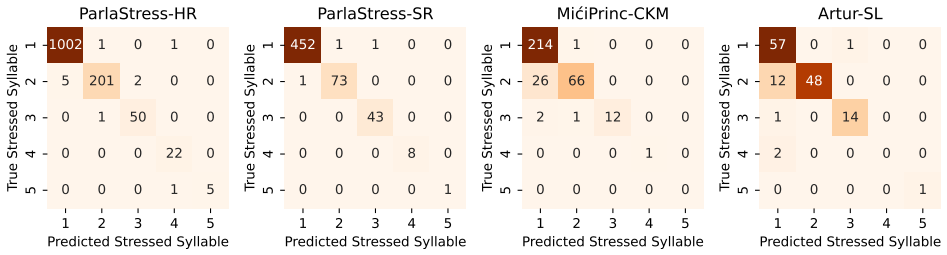
Fine-tuning the pre-trained w2v-bert-2.0 speech encoder with a binary audio frame classification head yields word-level primary-stress accuracy of 99.1% on Croatian and 99.3% on Serbian, 88.9% on the Chakavian dialect, and 89.0% on Slovenian, compared with 74.0–80.2% for an SVM trained on intensity, pitch, sonority, and duration features. The near-perfect results on Croatian and Serbian fall by about ten points on the more distant Chakavian and Slovenian test sets, and the drop is traced to the model's strong first-syllable bias learned from Croatian training data. A few hundred training words already reach the performance obtained with the full ten-thousand-word training set on the distant varieties, while Croatian and Serbian continue to improve with more data.
Load-bearing premise
The accuracy numbers are measured against a single human-selected stressed syllable per word, but the paper itself reports that about 6% of frequent Croatian words have variable stress positions, so if stress is not reliably discrete, word-level accuracy against these labels is not a fully well-defined target.
Editorial extensions
If this is right
- Primary stress can be treated as a frame-labeling task on raw audio, eliminating the need for phonemic transcription or hand-engineered prosodic features.
- A model fine-tuned on Croatian transfers to mutually intelligible Serbian at near-perfect accuracy and retains about 89% accuracy on more distant Chakavian and Slovenian.
- Only a few hundred annotated multi-syllabic words are needed to reach useful performance, so new languages and dialects can be supported with very small annotation efforts.
- The dominant failure mode on distant varieties is a first-syllable bias inherited from Croatian training data, pointing to label-distribution shift rather than lack of acoustic information.
- For Croatian and Serbian, accuracy keeps growing as training data grows beyond one thousand words, so more data still pays off for close languages.
Reading between the lines
- A testable extension is to apply the same frame-classification fine-tuning to lexical stress in unrelated languages or to other word-level prosodic phenomena such as tone or pitch accent, since the method does not depend on South Slavic phonology.
- Because the paper's own data analysis finds that about 6% of frequent Croatian words have variable stress positions, evaluating the model against a second annotator's labels on the same audio would clarify whether near-perfect accuracy is genuine phonetic detection or partly an artifact of a single chosen label.
- A likely implicit consequence is that large spoken corpora can now be annotated for primary stress automatically, enabling studies of dialectal variation at a scale that manual annotation cannot reach.
- The 10-point gap on Slovenian may shrink if the classifier is trained with stress-position-balanced sampling or if a small amount of Slovenian data is added, but the paper does not test this.
Editorial analysis
A structured set of objections, weighed in public.
Referee Report
Summary. The manuscript introduces new training and test datasets for primary stress identification in Croatian, Serbian, Chakavian, and Slovenian. It fine-tunes the w2v-bert-2.0 speech encoder with a frame-level binary classification head on a Croatian training set and compares it with an SVM classifier using traditional acoustic features. Word-level accuracies on held-out test sets are 99.1% (Croatian), 99.3% (Serbian), 88.9% (Chakavian), and 89.0% (Slovenian), each 11–25 points above the SVM. A third experiment varies the amount of training data while keeping the number of training steps fixed at 1,200, and the paper claims that a few hundred words reach the full-data performance. The datasets and the fine-tuned model are publicly released.
Significance. The main accuracy comparison is a solid empirical contribution: speaker-disjoint held-out test sets, 95% confidence intervals, inter-annotator agreement on the hardest test set, and a confusion-matrix analysis support the central comparison. The release of new open data resources and a strong model for Croatian and Serbian is valuable for a relatively low-resource area. If the data-efficiency claim were supported, the paper would also show that small annotated samples suffice for cross-lingual stress detection, which would be practically important. However, the learning-curve experiment as reported conflates dataset size with the number of optimization epochs, so this contribution is not yet established.
major comments (2)
- [5.3 and Figure 2] The data-efficiency experiment holds the number of training steps constant at 1,200 for every training-set size, while the main model in Section 4.1 is trained for 20 epochs with batch size 32, which corresponds to roughly 6,500 updates on the full 10,443-word training set. Under the 1,200-step budget, a 500-word subset is trained for about 76.8 epochs, whereas the full training set receives only about 3.7 epochs. The text states that the learning curves are compared with the performance of 10 models trained on all data and also with the final transformer model trained on all available instances, but it is not clear which reference is plotted as 'Full Train Data' in Figure 2. Because the two training budgets are not comparable, the conclusion that '500 annotated words for fine-tuning already generate peak performance in Chakavian and Slovenian' is not supported as stated. Please rerun the experiment with the number of epochs matched to the final protocol, or report both step-matched and epoch-matched curves with the full-data reference clearly identified.
- [3.3 and 3.4] The evaluation target is a single manually chosen syllable nucleus per word, and Section 3.4 reports that around 6% of frequent Croatian words have varying stress positions and that 65% of the 20 identical-word overlaps with Slovenian have a different stress position. Inter-annotator agreement is reported only for the Chakavian test set (96.2%). Because the near-ceiling Croatian and Serbian results are measured against one annotator's labels, the manuscript should report inter-annotator agreement for the other test sets (or a sample) or otherwise quantify the expected effect of label noise; otherwise the reader cannot separate model error from annotation variability.
minor comments (6)
- [4.1] The hyperparameter search is described only as showing 'highly stable results on various splits of our training set'; please specify the validation splits, the metric used, and the actual scores so that the choice of learning rate and 20 epochs is reproducible.
- [5.3] Please clarify how the 10 random subsets per training size were sampled (seeds, stratification by speaker or word) and whether the reported standard deviation reflects random data selection, fine-tuning initialization, or both.
- [5.1] The paper reports 95% confidence intervals but does not state the estimator; please identify the method (e.g., Wilson interval, bootstrap) used to compute them.
- [5.3 and Figure 2] Figure 2 would be easier to interpret if the standard deviations were shown as error bars or shaded regions, and if the caption stated explicitly what training protocol was used for the 'Full Train Data' curves.
- [3.4] The statement that 65% of identical-word overlaps with Slovenian have a different stress position is based on only 20 words; please state this small-sample caveat directly in the sentence reporting the percentage.
- [2] A direct experimental comparison with the feature-extraction approach of [6] on the new datasets would strengthen the claim that fine-tuning is the preferred use of pre-trained speech encoders for this task; as written, the superiority over traditional features is demonstrated only against the SVM baseline.
Circularity Check
No significant circularity: headline results are held-out measurements; the noted learning-curve confound is a methodological issue, not a reduction by construction.
full rationale
The paper contains no derivation chain in which an output is equivalent to an input by definition. The headline accuracies (Table 2) are word-level measurements on held-out test sets (ParlaStress-HR, ParlaStress-SR, MićiPrinc-CKM, Artur-SL) for models whose hyperparameters (learning rate 1e-5, 20 epochs, batch 32, SVM C=10) were selected on the training data only; no test labels enter the fitting process. The claim that a few hundred training words suffice (Section 5.3) is an empirical comparison of learning curves, not a fitted-input-called-prediction step; the skeptic's observation that the 1,200-step budget gives small subsets many more epochs is a genuine experimental confound, but it does not make any prediction equivalent to its training input by construction. Self-citations appear only as references to released resources (ParlaSpeech-HR [18], Mići Princ [19], the Kaldi ParlaSpeech aligner [24]) and to the pre-trained w2v-bert-2.0 encoder [30]; these are not load-bearing derivations, and no uniqueness theorem or ansatz is imported from the authors' prior work. The double annotation of the Chakavian set is an external reliability check, not an argument that reduces to the model's own output. The discreteness of the stress target is a task-definition assumption, not a circularity. No step in the paper reduces, by its own equations or by self-citation, to its own inputs.
Assumptions & free parameters
free parameters (6)
- Transformer learning rate =
1e-5
- Transformer epochs =
20
- Transformer batch size =
32
- Gradient accumulation steps =
1 (no accumulation)
- SVM kernel and C =
RBF kernel, C=10
- Training steps for learning curves =
1200
assumptions (4)
- domain assumption Each multi-syllabic word has exactly one primary-stressed syllable nucleus.
- domain assumption Native-speaker manual annotation is reliable ground truth.
- domain assumption Kaldi forced alignment yields correct grapheme-level boundaries.
- domain assumption Orthographic nuclei with three digraph rules suffice for all target languages.
Cite this review
Pith. "Pith review of Identifying Primary Stress Across Related Languages and Dialects with Transformer-based Speech Encoder Models." pith.science (2026). https://pith.science/paper/YGM4FTSC
@misc{pith2026250524571,
  author       = {Pith},
  title        = {Pith review of: Identifying Primary Stress Across Related Languages and Dialects with Transformer-based Speech Encoder Models},
  year         = {2026},
  howpublished = {\url{https://pith.science/paper/YGM4FTSC}},
  note         = {Machine review of arXiv:2505.24571}
}
read the original abstract
Automating primary stress identification has been an active research field due to the role of stress in encoding meaning and aiding speech comprehension. Previous studies relied mainly on traditional acoustic features and English datasets. In this paper, we investigate the approach of fine-tuning a pre-trained transformer model with an audio frame classification head. Our experiments use a new Croatian training dataset, with test sets in Croatian, Serbian, the Chakavian dialect, and Slovenian. By comparing an SVM classifier using traditional acoustic features with the fine-tuned speech transformer, we demonstrate the transformer's superiority across the board, achieving near-perfect results for Croatian and Serbian, with a 10-point performance drop for the more distant Chakavian and Slovenian. Finally, we show that only a few hundred multi-syllabic training words suffice for strong performance. We release our datasets and model under permissive licenses.
Figures


Reference graph
Works this paper leans on
-
[1]
Introduction Primary stress is a feature of each multi-syllabic word, where one syllable is perceived to stand out from its environment [1]. It has an important and varying function in different languages, including distinguishing word meaning and function, aiding speech comprehension, as well as communicating various so- ciolinguistic cues [2, 3, 4]. Aut...
-
[2]
Related work The traditional way of performing primary stress identification has been to use prosodic features, such as nucleus duration, in- tensity and pitch (F0) [1, 7, 12], as well as the sonority-based TCSSBC feature contour [14, 15]. These features are mostly exploited in a supervised ma- chine learning setup, with infrequent takes on unsupervised a...
-
[3]
Data 3.1. Sources We construct new training and test datasets by exploiting re- cently released open datasets in three South Slavic languages and one dialect. The Croatian ParlaStress-HR training and test datasets are constructed from a sample of the ParlaSpeech-HR open dataset of sentence-aligned parliamentary recordings and transcripts of the Croatian p...
-
[4]
Methods 4.1. Pre-trained transformer model Our solution for the problem at hand is the fine-tuning of the w2v-bert-2.0 model 2 with an audio frame classification head on top of the transformer model [29], allowing for every 20 ms frame to be classified into a specific category. The raw trans- former model is a 580-million-parameters conformer model which ...
-
[5]
Results 5.1. Traditional vs. deep features In the first experiment, we compare the performance of the SVM classifier, trained on traditional acoustic features, with that of the transformer model. Each classifier was trained on the whole training dataset. The results of each classifier are given in Table 2. The results show significant dominance of the tra...
-
[6]
Conclusion This paper has investigated the performance of pre-trained transformer speech encoders on the task of primary stress iden- tification, comparing them to SVM classifiers trained on tradi- tional acoustic features. The experiments were performed on a newly constructed training and four test datasets in various South-Slavic languages and dialects....
-
[7]
Spoken Lan- guage Resources and Speech Technologies for the Slovenian Language
Acknowledgements This work was supported in part by the Projects “Spoken Lan- guage Resources and Speech Technologies for the Slovenian Language” (Grant J7-4642), “Large Language Models for Dig- ital Humanities” (Grant GC-0002), the Research Programme “Language Resources and Technologies for Slovene” (Grant P6-0411), and the Research Infrastructure DARIAH...
-
[8]
J. Tepperman and S. Narayanan, “Automatic syllable stress detec- tion using prosodic features for pronunciation evaluation of lan- guage learners,” inProceedings.(ICASSP’05). IEEE International Conference on Acoustics, Speech, and Signal Processing, 2005. , vol. 1. IEEE, 2005, pp. I–937
work page 2005
Show all 37 references
-
[9]
Garde, Naglasak
P. Garde, Naglasak. ˇSkolska knjiga, Zagreb, 1993
1993
-
[10]
ˇSkari´c, Fonetika hrvatskoga knji ˇzevnoga jezika
I. ˇSkari´c, Fonetika hrvatskoga knji ˇzevnoga jezika . Zagreb: Nakladni zavod Globus, 2007, pp. 16–157
2007
-
[11]
Fonetika i fonologija: ortoepska i ortografska norma standardnog srpskog jezika,
L. Suboti ´c, D. Sredojevi ´c, and I. Bjelakovi ´c, “Fonetika i fonologija: ortoepska i ortografska norma standardnog srpskog jezika,” Novi Sad: Filozofski fakultet, 2012
2012
-
[12]
The processing of stress in end-to-end automatic speech recognition models,
M. Bentum, L. ten Bosch, and T. Lentz, “The processing of stress in end-to-end automatic speech recognition models,” in Proc. In- terspeech 2024, 2024, pp. 2350–2354
2024
-
[13]
Exploring the use of self-supervised representations for automatic syllable stress detec- tion,
J. Mallela, S. H. Aluru, and C. Yarra, “Exploring the use of self-supervised representations for automatic syllable stress detec- tion,” in 2024 National Conference on Communications (NCC) . IEEE, 2024, pp. 1–6
2024
-
[14]
Prominence model for prosodic features in automatic lexical stress and pitch accent detection,
K. Li, S. Zhang, M. Li, W.-K. Lo, and H. Meng, “Prominence model for prosodic features in automatic lexical stress and pitch accent detection,” in Twelfth Annual Conference of the Interna- tional Speech Communication Association, 2011
2011
-
[15]
Word independent model for syllable stress evaluation,
A. Verma, K. Lal, Y . Y . Lo, and J. Basak, “Word independent model for syllable stress evaluation,” in 2006 IEEE International Conference on Acoustics Speech and Signal Processing Proceed- ings, vol. 1. IEEE, 2006, pp. I–I
2006
-
[16]
Classification of lexical stress patterns using deep neural network architecture,
M. A. Shahin, B. Ahmed, and K. J. Ballard, “Classification of lexical stress patterns using deep neural network architecture,” in 2014 IEEE Spoken Language Technology Workshop (SLT) . IEEE, 2014, pp. 478–482
2014
-
[17]
An automated lexical stress classification tool for assessing dysprosody in childhood apraxia of speech,
J. McKechnie, M. Shahin, B. Ahmed, P. McCabe, J. Arciuli, and K. J. Ballard, “An automated lexical stress classification tool for assessing dysprosody in childhood apraxia of speech,” Brain Sci- ences, vol. 11, no. 11, p. 1408, 2021
2021
-
[18]
Automatic classification of lexical stress errors for German CAPT
A. S. Vakil and J. Trouvain, “Automatic classification of lexical stress errors for German CAPT.” in SLaTE, 2015, pp. 47–52
2015
-
[19]
Automatic classification of lexical stress in English and Arabic languages using deep learn- ing
M. A. Shahin, J. Epps, and B. Ahmed, “Automatic classification of lexical stress in English and Arabic languages using deep learn- ing.” in Interspeech, 2016, pp. 175–179
2016
-
[20]
M. L. Greenberg, A short reference grammar of Standard Slovene. SEELRC Reference Grammar Network, 2006
2006
-
[21]
Speech rate estimation via tempo- ral correlation and selected sub-band correlation,
S. Narayanan and D. Wang, “Speech rate estimation via tempo- ral correlation and selected sub-band correlation,” in Proceed- ings.(ICASSP’05). IEEE International Conference on Acoustics, Speech, and Signal Processing, 2005. , vol. 1. IEEE, 2005, pp. I–413
2005
-
[22]
Automatic detec- tion of syllable stress using sonority based prominence features for pronunciation evaluation,
C. Yarra, O. D. Deshmukh, and P. K. Ghosh, “Automatic detec- tion of syllable stress using sonority based prominence features for pronunciation evaluation,” in 2017 IEEE International Con- ference on Acoustics, Speech and Signal Processing (ICASSP) . IEEE, 2017, pp. 5845–5849
2017
-
[23]
ASR inspired syllable stress detection for pronunciation evaluation without us- ing a supervised classifier and syllable level features
M. K. Ramanathi, C. Yarra, and P. K. Ghosh, “ASR inspired syllable stress detection for pronunciation evaluation without us- ing a supervised classifier and syllable level features.” in INTER- SPEECH, 2019, pp. 924–928
2019
-
[24]
A hierarchical ap- proach to automatic stress detection in English sentences,
M. Lai, Y . Chen, M. Chu, Y . Zhao, and F. Hu, “A hierarchical ap- proach to automatic stress detection in English sentences,” in2006 IEEE International Conference on Acoustics Speech and Signal Processing Proceedings, vol. 1. IEEE, 2006, pp. I–I
2006
-
[25]
The ParlaSpeech collection of automatically generated speech and text datasets from parliamentary proceedings,
N. Ljube ˇsi´c, P. Rupnik, and D. Kor ˇzinek, “The ParlaSpeech collection of automatically generated speech and text datasets from parliamentary proceedings,” in International Conference on Speech and Computer. Springer, 2024, pp. 137–150
2024
-
[26]
Mi ´ci Princ - A little boy teaching speech technologies the Chakavian dialect,
N. Ljube ˇsi´c, P. Rupnik, and T. Perin ˇci´c, “Mi ´ci Princ - A little boy teaching speech technologies the Chakavian dialect,” 2024. [Online]. Available: https://doi.org/10.5281/zenodo.13936404
2024 doi
-
[27]
Strategies for man- aging time and costs in speech corpus creation: insights from the Slovenian ARTUR corpus,
D. Verdonik, A. Bizjak, A. ˇZgank, M. S. Mauˇcec, M. Trojar, J. ˇZ. Gros, M. Bajec, I. L. Bajec, and S. Dobriˇsek, “Strategies for man- aging time and costs in speech corpus creation: insights from the Slovenian ARTUR corpus,”Language Resources and Evaluation, pp. 1–26, 2024
2024
-
[28]
Gos 2: A new reference corpus of spoken Slovenian,
D. Verdonik, K. Dobrovoljc, T. Erjavec, and N. Ljube ˇsi´c, “Gos 2: A new reference corpus of spoken Slovenian,” in Proceedings of the 2024 Joint International Conference on Computational Lin- guistics, Language Resources and Evaluation (LREC-COLING 2024), 2024, pp. 7825–7830
2024
-
[29]
Utilizing forced align- ment for phonetic analysis of Slovene speech,
J. Kri ˇzaj, J. ˇZganec Gros, and S. Dobriˇsek, “Utilizing forced align- ment for phonetic analysis of Slovene speech,” in Proceedings of the Language Technologies and Digital Humanities Conference 2024, 2024
2024
-
[30]
The Kaldi speech recognition toolkit,
D. Povey, A. Ghoshal, G. Boulianne, L. Burget, O. Glembek, N. Goel, M. Hannemann, P. Motlicek, Y . Qian, P. Schwarzet al., “The Kaldi speech recognition toolkit,” in IEEE 2011 workshop on automatic speech recognition and understanding. IEEE Sig- nal Processing Society, 2011
2011
-
[31]
ParlaSpeech-HR – a freely available ASR dataset for Croatian bootstrapped from the ParlaMint corpus,
N. Ljube ˇsi´c, D. Kor ˇzinek, P. Rupnik, and I.-P. Jazbec, “ParlaSpeech-HR – a freely available ASR dataset for Croatian bootstrapped from the ParlaMint corpus,” in Proceedings of the workshop ParlaCLARIN III within the 13th language resources and evaluation Conference, 2022,...
2022
-
[32]
Praat: doing phonetics by com- puter,
P. Boersma and D. Weenink, “Praat: doing phonetics by com- puter,” http://www.praat.org/, 2001, version 6.4, accessed 2024- 01-30
2001
-
[33]
Computing Krippendorff’s alpha-reliability,
K. Krippendorff, “Computing Krippendorff’s alpha-reliability,” 2011
2011
-
[34]
Analyzing dataset annotation quality management in the wild,
J.-C. Klie, R. E. d. Castilho, and I. Gurevych, “Analyzing dataset annotation quality management in the wild,” Computational Lin- guistics, vol. 50, no. 3, pp. 817–866, 2024
2024
-
[35]
The ISLE corpus of non-native spoken English,
W. Menzel, E. Atwell, P. Bonaventura, D. Herron, P. Howarth, R. Morton, and C. Souter, “The ISLE corpus of non-native spoken English,” inProceedings of LREC 2000: Language Resources and Evaluation Conference, vol. 2 . European Language Resources Association, 2000, pp. 957–964
2000
-
[36]
Transformers: State-of-the-art natural language processing,
T. Wolf, L. Debut, V . Sanh, J. Chaumond, C. Delangue, A. Moi, P. Cistac, T. Rault, R. Louf, M. Funtowicz, J. Davison, S. Shleifer, P. von Platen, C. Ma, Y . Jernite, J. Plu, C. Xu, T. L. Scao, S. Gugger, M. Drame, Q. Lhoest, and A. M. Rush, “Transformers: State-of-the-art nat...
2020
-
[37]
Seamless: Multilingual Expressive and Streaming Speech Translation,
L. Barrault, Y .-A. Chung, M. C. Meglioli, D. Dale, N. Dong, and et al., “Seamless: Multilingual Expressive and Streaming Speech Translation,” 2023. [Online]. Available: https://arxiv.org/ abs/2312.05187
2023 arXiv
Reviewed August 7, 2026 · model on record in the stance chip above.
Discussion (0). Sign in to comment.