REVIEW 4 major objections 5 minor 66 references
AutoChemSchematic AI: Agentic Physics-Aware Automation for Chemical Manufacturing Scale-Up
T0 review · 4 major / 5 minor · reviewed 2026-08-07 · deepseek-v4-flash
Pith's one-line read An AI framework claims to auto-generate manufacturing blueprints for novel chemicals, verified by physics simulation in the loop.
desk verdict A detailed and honest pipeline paper that overclaims 'simulator-validated' generation — the DWSIM evidence is two manually assembled flowsheets and the correctness metrics are LLM-against-LLM. read the letter →
The pith
A machine-rendered reading of the paper's core claim, the machinery that carries it, and where it could break.
The reading
What carries the argument
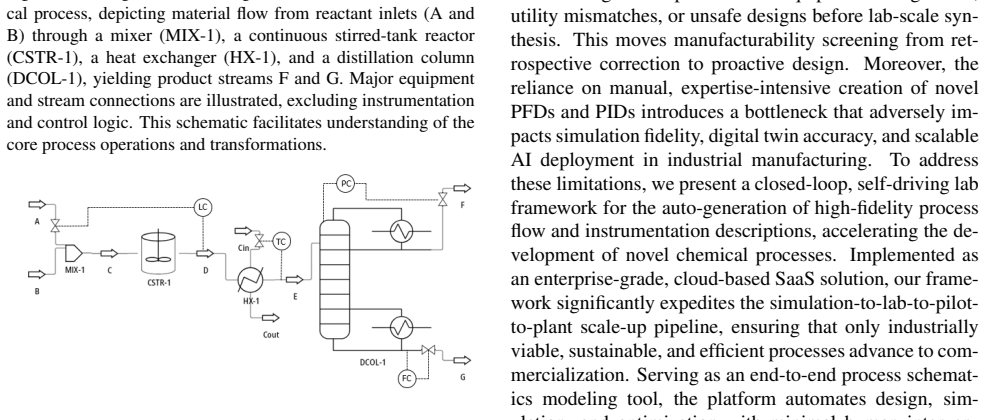
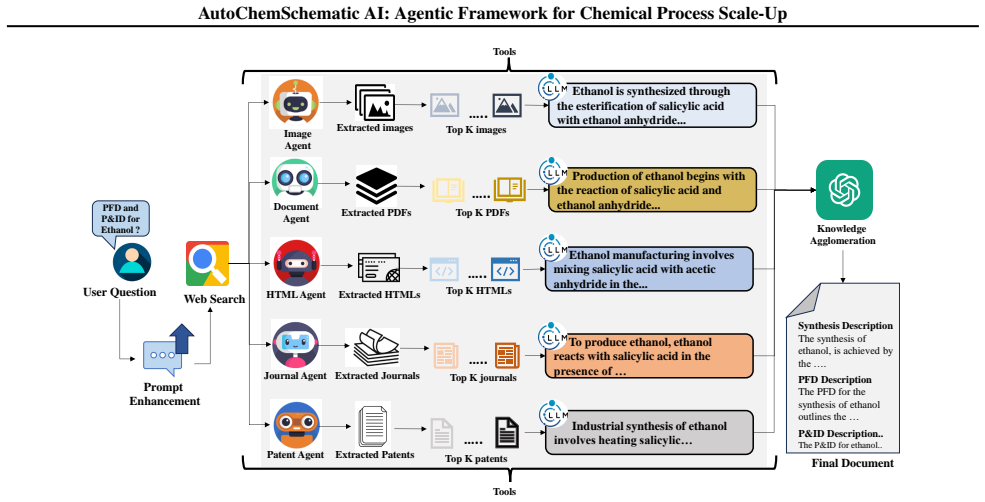
Three components carry the argument. First, the ChemAtlas knowledge graph: agentic web retrieval supplies process descriptions for 1,020+ chemicals; a teacher model turns text chunks into subject-predicate-object triples; entities are canonicalized by embedding and string similarity; and the Leiden algorithm partitions the graph into hierarchical communities so that retrieval can pick top-K communities and assemble a query-specific subgraph. Second, the small language models (one-billion and 135-million parameter open models), fine-tuned with QLoRA on 20,000 synthetic QA pairs spanning factual knowledge, schematic description, multi-step reasoning, preference pairs, and local/global retrieval-augmented instruction pairs, under either a sequential SFT-to-DPO-to-RAIT schedule or the GRPO reinforcement schedule. Third, DWSIM, the open-source process simulator that plays the physics-aware validator: generated PFD text is re-expressed as flowsheets whose material/energy balances and thermodynamic consistency are checked, and PID text is validated by implementing its control loops. Around these sit the inference stack (structural pruning, FlashAttention, PagedAttention with KV-cache quantization, Lookahead Decoding, and test-time scaling) and a critique agent that decides whether a draft is revised before release.
What would settle it
Feed a held-out chemical's generated PFD text directly into DWSIM through an automated script with no human editing and record whether the flowsheet converges to consistent material and energy balances; if manual rearrangement is needed before most simulations run, the closed-loop claim is not yet established. A second check would have an engineer who did not see the paper rebuild the flowsheet from the text and count how many corrections are required to reach a converged, energy-balanced simulation.
Extended reading notes
Core claim
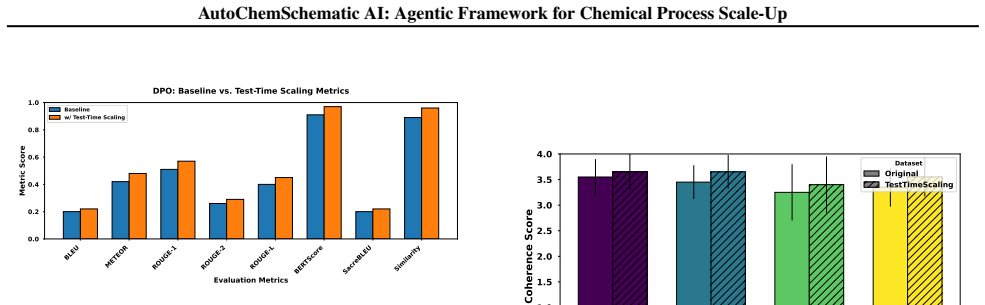
The paper's central claim is that a small language model fine-tuned on synthetic process-engineering data, augmented by graph-based retrieval over curated chemical process knowledge, can write textual descriptions of PFDs and PIDs that survive first-principles simulation in DWSIM, for chemicals it has seen and, zero-shot, for chemicals it has not. Quality is measured against LLM-generated reference answers with n-gram overlaps, embedding similarity, and reward-model scores; the fine-tuned one-billion-parameter model is reported to sit just below GPT-4o on these axes while running far cheaper, and the fully augmented variant (fine-tuning plus graph retrieval plus critique feedback) outperforms every ablated configuration. The paper also claims that reinforcement fine-tuning (GRPO) generalizes better than the modular SFT-plus-DPO pipeline on held-out chemicals, and that test-time scaling with multiple sampled trajectories, confidence-weighted selection, self-reflective revision, and consensus voting raises factual correctness without retraining.
Load-bearing premise
The simulator-validation claim assumes that turning the generated text into a DWSIM simulation is an automatic link in the loop, but the paper's own captions for Figures 6 and 7 say the flowsheets were 'manually assembled' by people, so the demonstration depends on an unstated human in the loop.
Editorial extensions
If this is right
- For a chemical not present in training, the framework claims to produce PFD and PID descriptions that pass DWSIM simulation, making zero-shot schematic generation a practical route for AI-discovered molecules.
- Feasibility screening moves before the lab: the simulator flags equipment sizing errors, utility mismatches, and unsafe designs in generated descriptions instead of waiting for post-hoc checks.
- Fine-tuning, graph retrieval, and critique feedback each contribute independently, and their combination beats every subset, while graph retrieval alone partially compensates for missing fine-tuning.
- Pruning and the inference optimizations keep a one-billion-parameter model fast enough for practical use, and GRPO-trained variants generalize better on held-out chemicals than the sequential SFT pipeline.
- Because retrieval retains source traces in the knowledge graph, generated schematics are in principle attributable to documented industrial processes rather than free invention.
Reading between the lines
- A fair extension of the paper's own figure captions: the DWSIM flowsheets shown were manually assembled from the generated text, so the text is sufficient for an expert to build a working simulation; fully closing the loop would mean automating that translation, for example through a DWSIM scripting layer, and reporting convergence statistics without human edits.
- Since the ChemEval reference answers are themselves written by large language models, an independent audit by process engineers on a sample of chemicals would anchor the reported correctness numbers to industrial practice.
- If the loop holds, the same architecture can slide sideways to downstream engineering documents, equipment datasheets, control-loop tuning parameters, and safety-review notes, because they are all derived from the same PFD/PID descriptions.
- A cheap probe of the zero-shot claim would be to generate descriptions for chemicals whose real plant flowsheets are public and compare unit counts, stream order, and operating conditions against the published diagrams.
Editorial analysis
A structured set of objections, weighed in public.
Referee Report
Summary. The paper proposes AutoChemSchematic AI, a framework that combines small language models (Llama-3.2-1B, SmolLM2-135M) fine-tuned on synthetic QA datasets, a hierarchical knowledge graph for retrieval-augmented generation, inference optimizations (pruning, PagedAttention, Lookahead Decoding, test-time scaling), and the DWSIM process simulator to automatically generate text descriptions of PFDs and PIDs for chemical processes. The central claim is that the framework produces 'simulator-validated process descriptions' that outperform baselines and generalize to unseen chemicals. The experiments report reward-model and NLP-metric scores on a 100-chemical ChemEval benchmark, ablation studies over fine-tuning and GraphRAG components, inference-efficiency measurements, and two DWSIM-based case studies for nitric acid and sulfuric acid.
Significance. If the central claims were established, the framework would address a real bottleneck in chemical manufacturing scale-up: the automatic creation of industrially viable PFDs and PIDs for novel molecules. The authors provide a substantial methodological pipeline, including explicit descriptions of dataset construction, training protocols, graph construction, and carbon-cost accounting, and they are transparent about the manual assembly of DWSIM flowsheets in figure captions and about the use of teacher LLMs for benchmark ground truth. These disclosures are commendable, but they also expose two load-bearing weaknesses: the evaluation is largely circular (the same LLM families generate the training data, the benchmark references, and the scoring judgments), and the 'simulator-in-the-loop' validation reduces to two human-assembled flowsheets with no reported quantitative simulation results. The usefulness of the contribution therefore hinges on evidence that the current paper does not provide.
major comments (4)
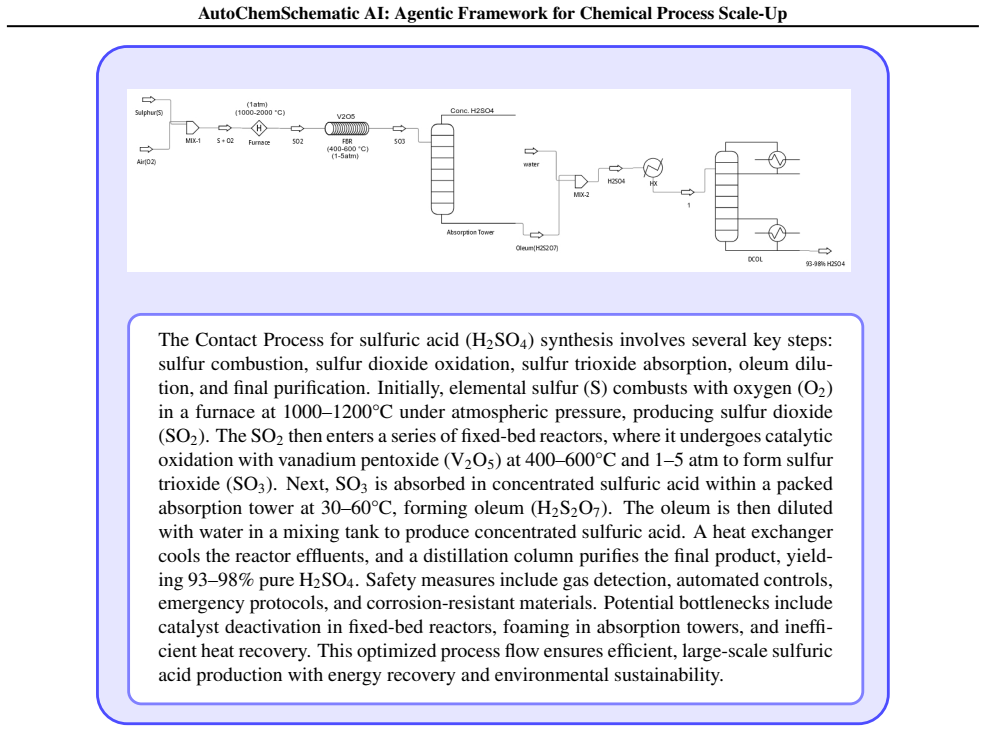
- [Section 3.2, Figures 6 and 7] The captions state that the DWSIM flowsheets were 'constructed in DWSIM based on textual outputs generated by our framework and manually assembled using DWSIM's unit operation blocks, thermodynamic models, and stream configuration tools.' This contradicts the closed-loop automation claim in the abstract and Section 2: the text-to-flowsheet translation is performed by a human, not by the framework. Moreover, no quantitative simulation results are reported for these two examples: no convergence status, mass/energy balance residuals, stream tables, or control-performance metrics. The claim that the framework generates 'simulator-validated process descriptions' is therefore unsupported by the experimental record; the manual assembly acts as an unmeasured oracle.
- [Section 2 (ChemEval) and Section 3.2 (Figure 5 note)] The evaluation is circular. The SynDIP training data are generated by GPT-4o and Claude Haiku (Section 2, 'teacher LLMs'), and the ChemEval reference targets are also generated by GPT-4o and Claude Haiku, with the final ground truth produced by OpenAI o3/o3-mini (Section 3.2 note). Student outputs are then scored with BLEU/ROUGE/BERTScore against these teacher-generated references and with the Nemotron-4-340B reward model. High scores therefore measure how closely the students imitate the teacher LLMs, not whether the generated PFD/PID descriptions are physically correct or industrially viable. An independent evaluation by human process engineers, or a simulator-based metric applied to automatically assembled flowsheets, is needed to support the correctness and generalization claims.
- [Section 3.1 and Section 3.2] The 'unseen chemicals' generalization claim is weakened because the ground truth for ChemEval is generated by general-purpose LLMs (GPT-4o, Claude Haiku, o3/o3-mini) that very likely have pretraining knowledge of the 100 held-out chemicals, even if those chemicals are absent from ChemAtlas. The benchmark therefore does not isolate the framework's zero-shot capability; it conflates generalization to novel chemistry with retrieval and imitation of teacher-model knowledge. The authors should either demonstrate that the teacher models have no knowledge of the ChemEval chemicals or evaluate on a set of genuinely novel, expert-validated processes.
- [Section 3.1, GRPO reward] The composite reward for GRPO in Section 3.1 (ROUGE-L F1, length penalty, and an LLM-as-a-judge score) is also used as an evaluation criterion in the results. Since the same reward components appear in training and in the reported 'quality' metrics, the reported gains of GRPO over SFT partially reflect optimization toward the evaluation metric itself rather than independent quality improvement. This internal consistency should be separated from external validation, for example by reporting human expert scores or simulator-based feasibility on held-out cases.
minor comments (5)
- [Section 3.1] The model names are used inconsistently: the text alternates between 'Llama-3-1B' (Section 3.1), 'Llama-3.2-1B' (most places), 'Llama-3 1B' (Section 5.4.1), and 'Llama-3.2 1B' (figure captions). Please standardize to the exact architecture name.
- [Figure 5] The captions and text mention 'larger error bars' and variance, but the figure descriptions do not show visible error bars or statistical significance tests. Please add error bars or confidence intervals, or state explicitly that they are omitted.
- [Section 3.2, Figure 5(a)] The comparison against GPT-4o is underspecified: it is unclear whether GPT-4o is run with the framework's GraphRAG retrieval, test-time scaling, and feedback components, or as a zero-shot baseline. This makes the 'upper bound' interpretation ambiguous.
- [Introduction, Section 2] The text describes the framework as an 'enterprise-grade, cloud-based SaaS solution' and a 'self-driving lab,' but no system architecture, deployment details, or user-facing components are provided. This is marketing language that should either be supported with technical details or removed.
- [Section 2] The guardrails mentioned in Figure 3 and the Critique-Agent feedback loop are not formally defined or ablated independently. Please specify what the guardrails verify and how feedback decisions are made, and provide an ablation that isolates the feedback mechanism from test-time scaling.
Circularity Check
Correctness and generalization results reduce to teacher imitation: ChemEval ground truth is generated by the same LLMs (GPT-4o, Claude Haiku, o3/o3-mini) that produced the training target distribution.
-
fitted input called prediction
[Section 2, Methodology (ChemEval evaluation paragraph); Section 3.2 Figure 5 note]
"Finally, we evaluate the framework’s ability to generate accurate PFD and PID descriptions for unseen chemicals using ChemEval. Specifically, for each chemical in ChemEval, GPT-4o and Claude Haiku produced process flow and instrumentation descriptions in the form of QA pairs using the same self-instruct bootstrapping method. These QA pairs served as reference targets (ground truth) for quantitative evaluation."
The student SLMs are trained on SynDIP QA pairs generated by GPT-4o and Claude Haiku using the same self-instruct method, and the ChemEval 'ground truth' is produced by those same two LLMs. The reported correctness scores therefore measure how closely student text matches the teacher distribution the students were optimized to imitate. The Figure 5 note that ground truth is generated with o3/o3-mini does not break the loop: the target is still LLM-generated text with no independent engineering validation. The claimed 'outperforms baseline methods in correctness' thus reduces to a teacher-imitation score.
-
fitted input called prediction
[Section 2, Methodology (OOD benchmark paragraph)]
"In addition, we construct a 1.5K QA-pair out-of-distribution (OOD) benchmark dataset fromChemAtlas using a self-instruct approach with teacher LLMs (OpenAI o3 and o1-mini) to generate synthetic QA pairs. These pairs are iteratively created from SynDIP-retrieved information and filtered for quality using a reward model."
The benchmark labeled out-of-distribution is generated with teacher LLMs from SynDIP-retrieved information, the same source content used to build the SynDIP training dataset. The 'OOD' evaluation is therefore not an independent distribution over new process-engineering facts; it is a rephrased sample of the training source. Performance on it measures paraphrase consistency with the teacher/source, not external generalization, making the 'generalizes effectively to unseen chemicals' claim a fit to the training information by construction.
full rationale
The central correctness/generalization evaluation is circular: training labels (SynDIP) and test references (ChemEval and the 1.5K 'OOD' benchmark) are both generated by the same LLM family with the same self-instruct bootstrapping, so the metrics measure teacher imitation rather than agreement with an external engineering standard. The abstract's 'simulator-validated process descriptions' claim is additionally not backed by an automated loop: Figures 6 and 7 were 'manually assembled' in DWSIM, which is an evidence gap (human oracle) rather than a circular reduction. No load-bearing self-citation chain was found; the citation to the authors' prior work (Srinivas et al., 2024) is not used to justify the central derivation. Because the paper's headline correctness and generalization results reduce by construction to a fit to the teacher-generated text distribution, while the efficiency and pruning measurements retain independent content, the circularity score is 8 rather than 10.
Assumptions & free parameters
free parameters (4)
- GRPO composite reward weights =
0.3 (ROUGE-L), 0.2 (length), 0.5 (LLM-as-judge)
- Test-time scaling entropy-weight lambda =
0.5
- Reward model filtering thresholds =
tau, tauDPO, tauSYN, tauLogic (values not reported)
- Entity resolution similarity thresholds =
tau_sim, tau_str (values not reported)
assumptions (3)
- domain assumption GPT-4o and Claude Haiku generated descriptions of chemical production processes are accurate enough to serve as ground truth for training and evaluation.
- ad hoc to paper DWSIM simulations of manually assembled flowsheets verify the automated framework's outputs.
- domain assumption The agentic web navigation extracts reliable PFD/PID descriptions from public web sources.
Cite this review
Pith. "Pith review of AutoChemSchematic AI: Agentic Physics-Aware Automation for Chemical Manufacturing Scale-Up." pith.science (2026). https://pith.science/paper/57XXW3PY
@misc{pith2026250524584,
  author       = {Pith},
  title        = {Pith review of: AutoChemSchematic AI: Agentic Physics-Aware Automation for Chemical Manufacturing Scale-Up},
  year         = {2026},
  howpublished = {\url{https://pith.science/paper/57XXW3PY}},
  note         = {Machine review of arXiv:2505.24584}
}
read the original abstract
Recent advances in generative AI have accelerated the discovery of novel chemicals and materials. However, scaling these discoveries to industrial production remains a major bottleneck due to the synthesis gap -- the need to develop entirely new manufacturing processes. This challenge requires detailed engineering blueprints: PFDs for equipment layouts and material/energy flows, and PIDs for process plant operations. Current AI systems cannot yet reliably generate these critical engineering schematics, creating a fundamental obstacle to manufacturing scale-up of novel discoveries. We present a closed-loop, physics-aware framework for automated generation of industrially viable PFDs and PIDs. The framework integrates three key components: (1) domain-specialized small language models (SLMs) trained for auto-generation of PFDs and PIDs, (2) a hierarchical knowledge graph containing process flow and instrumentation descriptions for 1,020+ chemicals for Graph Retrieval-Augmented Generation (GRAG), and (3) an open-source chemical process simulator for modeling, simulation, optimization, and analysis of novel chemical processes. The SLMs are trained through a multi-stage pipeline on synthetic datasets, with process simulator-in-the-loop validation ensuring feasibility. To enhance computational efficiency, the framework implements structural pruning (width and depth) guided by importance heuristics to reduce language model size while preserving accuracy, followed by advanced inference optimizations including FlashAttention, Lookahead Decoding, PagedAttention with KV-cache quantization, and Test-Time Inference Scaling. Experimental results demonstrate that our framework generates simulator-validated process descriptions with high fidelity.
Figures


Figures from the paper (51 more)












Reference graph
Works this paper leans on
-
[1]
FlashAttention on a Napkin: A Diagrammatic Approach to Deep Learning IO-Awareness
Abbott, V. and Zardini, G. Flashattention on a napkin: A diagrammatic approach to deep learning io-awareness. arXiv preprint arXiv:2412.03317, 2024
work page Pith review arXiv 2024
-
[2]
Alimin, A. A., Goldstein, D. P., Balhorn, L. S., and Schweidtmann, A. M. Talking like piping and instrumentation diagrams (p&ids). arXiv preprint arXiv:2502.18928, 2025
-
[3]
Inference-time scaling for complex tasks: Where we stand and what lies ahead
Balachandran, V., Chen, J., Chen, L., Garg, S., Joshi, N., Lara, Y., Langford, J., Nushi, B., Vineet, V., Wu, Y., et al. Inference-time scaling for complex tasks: Where we stand and what lies ahead. arXiv preprint arXiv:2504.00294, 2025
arXiv 2025
-
[4]
Forest-of-thought: Scaling test-time compute for enhancing llm reasoning
Bi, Z., Han, K., Liu, C., Tang, Y., and Wang, Y. Forest-of-thought: Scaling test-time compute for enhancing llm reasoning. arXiv preprint arXiv:2412.09078, 2024
arXiv 2024
-
[5]
Chen, J., Ren, J., Chen, X., Yang, C., Sun, R., and Ar k, S. \"O . Sets: Leveraging self-verification and self-correction for improved test-time scaling. arXiv preprint arXiv:2501.19306, 2025
arXiv 2025
-
[6]
Int-flashattention: Enabling flash attention for int8 quantization
Chen, S., Liu, Z., Wu, Z., Zheng, C., Cong, P., Jiang, Z., Wu, Y., Su, L., and Yang, T. Int-flashattention: Enabling flash attention for int8 quantization. arXiv preprint arXiv:2409.16997, 2024
arXiv 2024
-
[7]
Chiang, Y., Hsieh, E., Chou, C.-H., and Riebesell, J. LLAMP: Large language model made powerful for high-fidelity materials knowledge retrieval and distillation . arXiv preprint arXiv:2401.17244, 2024
arXiv 2024
-
[8]
Flashattention-2: Faster attention with better parallelism and work partitioning
Dao, T. Flashattention-2: Faster attention with better parallelism and work partitioning. arXiv preprint arXiv:2307.08691, 2023
arXiv 2023
Show all 66 references
-
[9]
Flashattention: Fast and memory-efficient exact attention with io-awareness
Dao, T., Fu, D., Ermon, S., Rudra, A., and R \'e , C. Flashattention: Fast and memory-efficient exact attention with io-awareness. Advances in neural information processing systems, 35: 0 16344--16359, 2022
2022
-
[10]
Qlora: Efficient finetuning of quantized llms
Dettmers, T., Pagnoni, A., Holtzman, A., and Zettlemoyer, L. Qlora: Efficient finetuning of quantized llms. Advances in neural information processing systems, 36: 0 10088--10115, 2023
2023
-
[11]
O., and Larson, J
Edge, D., Trinh, H., Cheng, N., Bradley, J., Chao, A., Mody, A., Truitt, S., Metropolitansky, D., Ness, R. O., and Larson, J. From local to global: A graph rag approach to query-focused summarization. arXiv preprint arXiv:2404.16130, 2024
2024 arXiv
-
[12]
Break the sequential dependency of llm inference using lookahead decoding
Fu, Y., Bailis, P., Stoica, I., and Zhang, H. Break the sequential dependency of llm inference using lookahead decoding. arXiv preprint arXiv:2402.02057, 2024
2024 arXiv
-
[13]
Bypass back-propagation: Optimization-based structural pruning for large language models via policy gradient
Gao, Y., Liu, Z., Zhang, W., Du, B., and Xia, G.-S. Bypass back-propagation: Optimization-based structural pruning for large language models via policy gradient. arXiv preprint arXiv:2406.10576, 2024
2024 arXiv
-
[14]
An agentic approach to automatic creation of p&id diagrams from natural language descriptions
Gowiakar, S., Iyengar, S., Segal, S., and Kalyanaraman, S. An agentic approach to automatic creation of p&id diagrams from natural language descriptions. arXiv preprint arXiv:2412.12898, 2024
2024 arXiv
-
[15]
Deepseek-r1: Incentivizing reasoning capability in llms via reinforcement learning
Guo, D., Yang, D., Zhang, H., Song, J., Zhang, R., Xu, R., Zhu, Q., Ma, S., Wang, P., Bi, X., et al. Deepseek-r1: Incentivizing reasoning capability in llms via reinforcement learning. arXiv preprint arXiv:2501.12948, 2025
2025 arXiv
-
[16]
and Schwaller, P
Guo, J. and Schwaller, P. Saturn: Sample-efficient generative molecular design using memory manipulation. arXiv preprint arXiv:2405.17066, 2024
2024 arXiv
-
[17]
A., Mukherjee, S., Tang, X., et al
Han, H., Wang, Y., Shomer, H., Guo, K., Ding, J., Lei, Y., Halappanavar, M., Rossi, R. A., Mukherjee, S., Tang, X., et al. Retrieval-augmented generation with graphs (graphrag). arXiv preprint arXiv:2501.00309, 2024
2024 arXiv
-
[18]
G-retriever: Retrieval-augmented generation for textual graph understanding and question answering
He, X., Tian, Y., Sun, Y., Chawla, N., Laurent, T., LeCun, Y., Bresson, X., and Hooi, B. G-retriever: Retrieval-augmented generation for textual graph understanding and question answering. Advances in Neural Information Processing Systems, 37: 0 132876--132907, 2024
2024
-
[19]
S., and Schweidtmann, A
Hirretier, E., Balhorn, L. S., and Schweidtmann, A. M. Towards automatic generation of piping and instrumentation diagrams (p&ids) with artificial intelligence. arXiv preprint arXiv:2211.05583, 2022
2022 arXiv
-
[20]
Retrointext: A multimodal large language model enhanced framework for retrosynthetic planning via in-context representation learning
Kang, C., Liu, X., and Guo, F. Retrointext: A multimodal large language model enhanced framework for retrosynthetic planning via in-context representation learning. In The Thirteenth International Conference on Learning Representations
-
[21]
R., and Srivastava, S
Kendapadi, A., Zaman, K., Menon, R. R., and Srivastava, S. Interact: Enabling interactive, question-driven learning in large language models. arXiv preprint arXiv:2412.11388, 2024
2024 arXiv
-
[22]
Shortened llama: Depth pruning for large language models with comparison of retraining methods
Kim, B.-K., Kim, G., Kim, T.-H., Castells, T., Choi, S., Shin, J., and Song, H.-K. Shortened llama: Depth pruning for large language models with comparison of retraining methods. arXiv preprint arXiv:2402.02834, 2024
2024 arXiv
-
[23]
A sober look at llms for material discovery: Are they actually good for bayesian optimization over molecules? arXiv preprint arXiv:2402.05015, 2024
Kristiadi, A., Strieth-Kalthoff, F., Skreta, M., Poupart, P., Aspuru-Guzik, A., and Pleiss, G. A sober look at llms for material discovery: Are they actually good for bayesian optimization over molecules? arXiv preprint arXiv:2402.05015, 2024
2024 arXiv
-
[24]
H., Gonzalez, J., Zhang, H., and Stoica, I
Kwon, W., Li, Z., Zhuang, S., Sheng, Y., Zheng, L., Yu, C. H., Gonzalez, J., Zhang, H., and Stoica, I. Efficient memory management for large language model serving with pagedattention. In Proceedings of the 29th Symposium on Operating Systems Principles, pp.\ 611--626, 2023
2023
-
[25]
A survey on llm test-time compute via search: Tasks, llm profiling, search algorithms, and relevant frameworks
Li, X. A survey on llm test-time compute via search: Tasks, llm profiling, search algorithms, and relevant frameworks. arXiv preprint arXiv:2501.10069, 2025
2025 arXiv
-
[26]
Cppo: Accelerating the training of group relative policy optimization-based reasoning models
Lin, Z., Lin, M., Xie, Y., and Ji, R. Cppo: Accelerating the training of group relative policy optimization-based reasoning models. arXiv preprint arXiv:2503.22342, 2025
2025
-
[27]
Deepseek-v3 technical report
Liu, A., Feng, B., Xue, B., Wang, B., Wu, B., Lu, C., Zhao, C., Deng, C., Zhang, C., Ruan, C., et al. Deepseek-v3 technical report. arXiv preprint arXiv:2412.19437, 2024
2024 arXiv
-
[28]
Y., Wang, F., Zhang, S., Poon, H., and Chen, M
Liu, Q., Zhou, W., Xu, N., Huang, J. Y., Wang, F., Zhang, S., Poon, H., and Chen, M. Metascale: Test-time scaling with evolving meta-thoughts. arXiv preprint arXiv:2503.13447, 2025 a
2025 arXiv
-
[29]
Efficient inference for large reasoning models: A survey
Liu, Y., Wu, J., He, Y., Gao, H., Chen, H., Bi, B., Zhang, J., Huang, Z., and Hooi, B. Efficient inference for large reasoning models: A survey. arXiv preprint arXiv:2503.23077, 2025 b
2025 arXiv
-
[30]
W., and Yang, Y
Lu, H., Zhou, Y., Liu, S., Wang, Z., Mahoney, M. W., and Yang, Y. Alphapruning: Using heavy-tailed self regularization theory for improved layer-wise pruning of large language models. Advances in Neural Information Processing Systems, 37: 0 9117--9152, 2024
2024
-
[31]
Dynamic speculation lookahead accelerates speculative decoding of large language models
Mamou, J., Pereg, O., Korat, D., Berchansky, M., Timor, N., Wasserblat, M., and Schwartz, R. Dynamic speculation lookahead accelerates speculative decoding of large language models. arXiv preprint arXiv:2405.04304, 2024
2024 arXiv
-
[32]
Dwsim: Open source process simulator, 2025
Medeiros, D. Dwsim: Open source process simulator, 2025. URL https://dwsim.fossee.in. Accessed April 15, 2025
2025
-
[33]
text-embedding-3-small model
OpenAI. text-embedding-3-small model. https://platform.openai.com/docs/guides/embeddings, 2024. Accessed: August 2024
2024
-
[34]
A chemically-guided generative diffusion model for materials synthesis planning
Pan, E., Kwon, S., Liu, S., Xie, M., Duan, Y., Prein, T., Sheriff, K., Roman, Y., Moliner, M., G \'o mez-Bombarelli, R., et al. A chemically-guided generative diffusion model for materials synthesis planning. In AI for Accelerated Materials Design--NeurIPS 2024, 2024
2024
-
[35]
vattention: Dynamic memory management for serving llms without pagedattention
Prabhu, R., Nayak, A., Mohan, J., Ramjee, R., and Panwar, A. vattention: Dynamic memory management for serving llms without pagedattention. arXiv preprint arXiv:2405.04437, 2024
2024 arXiv
-
[36]
Y., Setlur, A., Tunstall, L., Beeching, E
Qu, Y., Yang, M. Y., Setlur, A., Tunstall, L., Beeching, E. E., Salakhutdinov, R., and Kumar, A. Optimizing test-time compute via meta reinforcement fine-tuning. arXiv preprint arXiv:2503.07572, 2025
2025 arXiv
-
[37]
S., Sadhanala, V., Rostamizadeh, A., Chakrabarti, A., Jitkrittum, W., Feinberg, V., Kim, S., Harutyunyan, H., Saunshi, N., Nado, Z., et al
Rawat, A. S., Sadhanala, V., Rostamizadeh, A., Chakrabarti, A., Jitkrittum, W., Feinberg, V., Kim, S., Harutyunyan, H., Saunshi, N., Nado, Z., et al. A little help goes a long way: Efficient llm training by leveraging small lms. arXiv preprint arXiv:2410.18779, 2024
-
[38]
Kv-compress: Paged kv-cache compression with variable compression rates per attention head
Rehg, I. Kv-compress: Paged kv-cache compression with variable compression rates per attention head. arXiv preprint arXiv:2410.00161, 2024
2024 arXiv
-
[39]
2ssp: A two-stage framework for structured pruning of llms
Sandri, F., Cunegatti, E., and Iacca, G. 2ssp: A two-stage framework for structured pruning of llms. arXiv preprint arXiv:2501.17771, 2025
2025 arXiv
-
[40]
Proximal policy optimization algorithms
Schulman, J., Wolski, F., Dhariwal, P., Radford, A., and Klimov, O. Proximal policy optimization algorithms. arXiv preprint arXiv:1707.06347, 2017
2017 arXiv
-
[41]
Schulze Balhorn, L., Hirretier, E., Luderer, L., and Schweidtmann, A. M. Data augmentation for machine learning of chemical process flowsheets. arXiv e-prints, pp.\ arXiv--2302, 2023
2023
-
[42]
Flashattention-3: Fast and accurate attention with asynchrony and low-precision
Shah, J., Bikshandi, G., Zhang, Y., Thakkar, V., Ramani, P., and Dao, T. Flashattention-3: Fast and accurate attention with asynchrony and low-precision. Advances in Neural Information Processing Systems, 37: 0 68658--68685, 2024
2024
-
[43]
Deepseekmath: Pushing the limits of mathematical reasoning in open language models
Shao, Z., Wang, P., Zhu, Q., Xu, R., Song, J., Bi, X., Zhang, H., Zhang, M., Li, Y., Wu, Y., et al. Deepseekmath: Pushing the limits of mathematical reasoning in open language models. arXiv preprint arXiv:2402.03300, 2024
2024 arXiv
-
[44]
When to solve, when to verify: Compute-optimal problem solving and generative verification for llm reasoning
Singhi, N., Bansal, H., Hosseini, A., Grover, A., Chang, K.-W., Rohrbach, M., and Rohrbach, A. When to solve, when to verify: Compute-optimal problem solving and generative verification for llm reasoning. arXiv preprint arXiv:2504.01005, 2025
2025
-
[45]
Scaling llm test-time compute optimally can be more effective than scaling model parameters
Snell, C., Lee, J., Xu, K., and Kumar, A. Scaling llm test-time compute optimally can be more effective than scaling model parameters. arXiv preprint arXiv:2408.03314, 2024
2024 arXiv
-
[46]
W., Edwards, C., Agarwal, K., Olarte, M
Sprueill, H. W., Edwards, C., Agarwal, K., Olarte, M. V., Sanyal, U., Johnston, C., Liu, H., Ji, H., and Choudhury, S. Chemreasoner: Heuristic search over a large language model's knowledge space using quantum-chemical feedback. arXiv preprint arXiv:2402.10980, 2024
2024 arXiv
-
[47]
S., Das, A., Gupta, S., and Runkana, V
Srinivas, S. S., Das, A., Gupta, S., and Runkana, V. Accelerating manufacturing scale-up from material discovery using agentic web navigation and retrieval-augmented ai for process engineering schematics design. arXiv preprint arXiv:2412.05937, 2024
2024 arXiv
-
[48]
Sun, M., Liu, Z., Bair, A., and Kolter, J. Z. A simple and effective pruning approach for large language models. arXiv preprint arXiv:2306.11695, 2023
2023 arXiv
-
[49]
The curse of depth in large language models
Sun, W., Song, X., Li, P., Yin, L., Zheng, Y., and Liu, S. The curse of depth in large language models. arXiv preprint arXiv:2502.05795, 2025
2025
-
[50]
Darwinlm: Evolutionary structured pruning of large language models
Tang, S., Sieberling, O., Kurtic, E., Shen, Z., and Alistarh, D. Darwinlm: Evolutionary structured pruning of large language models. arXiv preprint arXiv:2502.07780, 2025
2025 arXiv
-
[51]
Tian, Y., Han, Y., Chen, X., Wang, W., and Chawla, N. V. Beyond answers: Transferring reasoning capabilities to smaller llms using multi-teacher knowledge distillation. In Proceedings of the Eighteenth ACM International Conference on Web Search and Data Mining, pp.\ 251--260, 2025
2025
-
[52]
A., Waltman, L., and Van Eck, N
Traag, V. A., Waltman, L., and Van Eck, N. J. From louvain to leiden: guaranteeing well-connected communities. Scientific reports, 9 0 (1): 0 1--12, 2019
2019
-
[53]
S., and Schweidtmann, A
Vogel, G., Balhorn, L. S., and Schweidtmann, A. M. Learning from flowsheets: A generative transformer model for autocompletion of flowsheets. Computers & Chemical Engineering, 171: 0 108162, 2023
2023
-
[54]
Efficient evolutionary search over chemical space with large language models
Wang, H., Skreta, M., Ser, C.-T., Gao, W., Kong, L., Strieth-Kalthoff, F., Duan, C., Zhuang, Y., Yu, Y., Zhu, Y., et al. Efficient evolutionary search over chemical space with large language models. arXiv preprint arXiv:2406.16976, 2024
2024 arXiv
-
[55]
Llm-bip: Structured pruning for large language models with block-wise forward importance propagation
Wu, H. Llm-bip: Structured pruning for large language models with block-wise forward importance propagation. arXiv preprint arXiv:2412.06419, 2024
2024 arXiv
-
[56]
Qa-lora: Quantization-aware low-rank adaptation of large language models
Xu, Y., Xie, L., Gu, X., Chen, X., Chang, H., Zhang, H., Chen, Z., Zhang, X., and Tian, Q. Qa-lora: Quantization-aware low-rank adaptation of large language models. arXiv preprint arXiv:2309.14717, 2023
2023 arXiv
-
[57]
X., Song, X., Zhang, Y., Niu, Q., Peng, B., et al
Yang, J., Song, J., Han, X., Bi, Z., Wang, T., Liang, C. X., Song, X., Zhang, Y., Niu, Q., Peng, B., et al. Feature alignment and representation transfer in knowledge distillation for large language models. arXiv preprint arXiv:2504.13825, 2025 a
2025 arXiv
-
[58]
C., Jimenez Rezende, D., Schuurmans, D., Mordatch, I., and Cubuk, E
Yang, S., Batzner, S., Gao, R., Aykol, M., Gaunt, A., McMorrow, B. C., Jimenez Rezende, D., Schuurmans, D., Mordatch, I., and Cubuk, E. D. Generative hierarchical materials search. Advances in Neural Information Processing Systems, 37: 0 38799--38819, 2024
2024
-
[59]
Towards thinking-optimal scaling of test-time compute for llm reasoning
Yang, W., Ma, S., Lin, Y., and Wei, F. Towards thinking-optimal scaling of test-time compute for llm reasoning. arXiv preprint arXiv:2502.18080, 2025 b
2025
-
[60]
Z1: Efficient test-time scaling with code
Yu, Z., Wu, Y., Zhao, Y., Cohan, A., and Zhang, X.-P. Z1: Efficient test-time scaling with code. arXiv preprint arXiv:2504.00810, 2025
2025 arXiv
-
[61]
Honeycomb: A flexible llm-based agent system for materials science
Zhang, H., Song, Y., Hou, Z., Miret, S., and Liu, B. Honeycomb: A flexible llm-based agent system for materials science. arXiv preprint arXiv:2409.00155, 2024
2024 arXiv
-
[62]
What, how, where, and how well? a survey on test-time scaling in large language models
Zhang, Q., Lyu, F., Sun, Z., Wang, L., Zhang, W., Guo, Z., Wang, Y., King, I., Liu, X., and Ma, C. What, how, where, and how well? a survey on test-time scaling in large language models. arXiv preprint arXiv:2503.24235, 2025
2025 arXiv
-
[63]
Lookahead: An inference acceleration framework for large language model with lossless generation accuracy
Zhao, Y., Xie, Z., Liang, C., Zhuang, C., and Gu, J. Lookahead: An inference acceleration framework for large language model with lossless generation accuracy. In Proceedings of the 30th ACM SIGKDD Conference on Knowledge Discovery and Data Mining, pp.\ 6344--6355, 2024
2024
-
[64]
Seeking neural nuggets: Knowledge transfer in large language models from a parametric perspective
Zhong, M., An, C., Chen, W., Han, J., and He, P. Seeking neural nuggets: Knowledge transfer in large language models from a parametric perspective. arXiv preprint arXiv:2310.11451, 2023
2023 arXiv
-
[65]
A survey on model compression for large language models
Zhu, X., Li, J., Liu, Y., Ma, C., and Wang, W. A survey on model compression for large language models. Transactions of the Association for Computational Linguistics, 12: 0 1556--1577, 2024
2024
-
[66]
write newline
" write newline "" before.all 'output.state := FUNCTION n.dashify 't := "" t empty not t #1 #1 substring "-" = t #1 #2 substring "--" = not "--" * t #2 global.max substring 't := t #1 #1 substring "-" = "-" * t #2 global.max substring 't := while if t #1 #1 substring * t #2 gl...
Reviewed August 7, 2026 · model on record in the stance chip above.
Discussion (0). Sign in to comment.