REVIEW 4 major objections 5 minor 72 references
Interpretable phenotyping of Heart Failure patients with Dutch discharge letters
T0 review · 4 major / 5 minor · reviewed 2026-08-07 · deepseek-v4-flash
Pith's one-line read The paper claims that Dutch discharge letters alone can separate heart-failure subtypes with an external AUC of 0.84, with an interpretable Aug-Linear model close behind at 0.81 and explanations that align better with clinicians than SHAP…
desk verdict The interpretability comparison is the real contribution; the external-validation AUC of 0.84 is inflated by label leakage and the gold-set numbers are the honest estimate. read the letter →
The pith
A machine-rendered reading of the paper's core claim, the machinery that carries it, and where it could break.
The reading
What carries the argument
The load-bearing mechanism is the Aug-Linear model: each discharge letter is split into n-grams, every n-gram is embedded with a pretrained clinical BERT model, and a logistic regression or explainable boosting machine is fitted on the embeddings, optionally concatenated with structured covariates. Because every n-gram has its own weight vector, the model produces intrinsic per-phrase importance scores without any post-hoc explanation step, and this is what the paper compares against SHAP and LIME. The best Aug-Linear variants use trigrams, leading the authors to conclude that the clinically decisive information lives in short local spans rather than long-range discourse.
What would settle it
Train and evaluate the same models on a cohort where every HFrEF/HFpEF label comes from manually adjudicated echocardiography and all numerical LVEF expressions are masked in the letter; if the letter-only AUC falls to the structured-data baseline of about 0.76 or lower, the claim that discharge letters alone carry the phenotyping signal is refuted.
Extended reading notes
Core claim
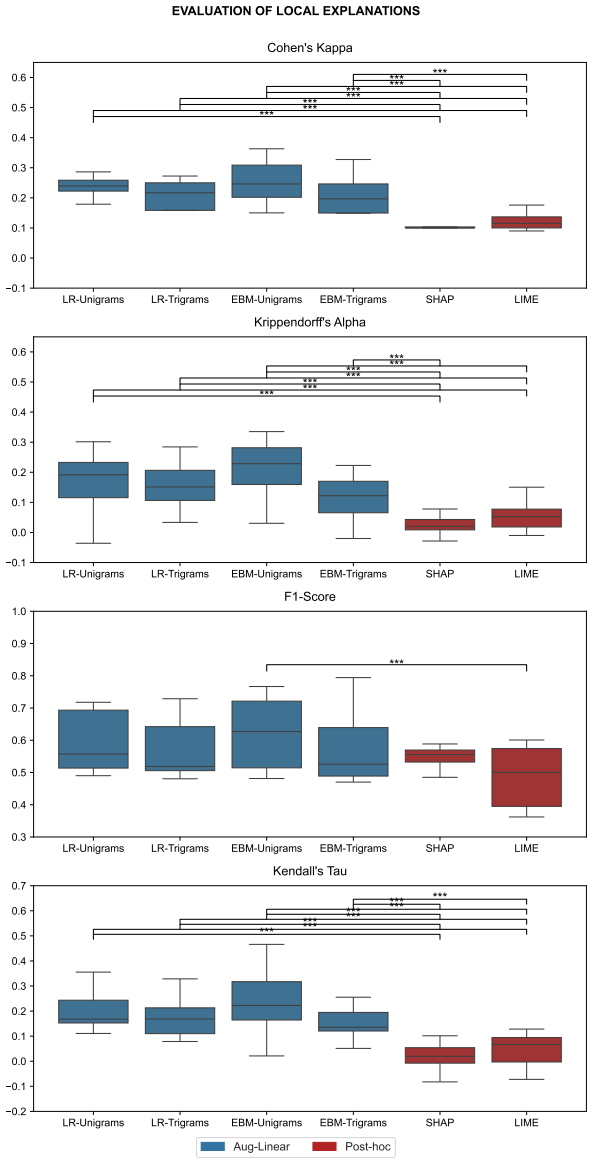
The paper's central claim is that the narrative discharge letter is the most informative data source for LVEF-based phenotyping of hospitalized heart-failure patients, and that the interpretability/performance trade-off is small enough for transparent models to be practical. On an external validation cohort from a second Dutch hospital site, a clinical BERT model fine-tuned on letters alone achieved AUC 0.84 for HFrEF versus HFpEF, while Aug-Linear, an inherently interpretable linear model built on BERT n-gram embeddings, achieved AUC 0.81; both outperformed logistic-regression and EBM baselines using 20 structured variables, whose best AUC was 0.76. The interpretability evaluation on 20 clinician-annotated letters shows the white-box model's intrinsic explanations align better with clinician reasoning (Kappa 0.25) than SHAP or LIME explanations of the black-box model (Kappa 0.11).
Load-bearing premise
The entire comparison rests on the assumption that the automatically generated silver labels are trustworthy enough; because about 5,000 of them were derived from the very letters the models read, and silver labels agree with manual gold labels only at Kappa 0.383, label noise could be inflating every reported accuracy.
Editorial extensions
If this is right
- Hospitals could phenotype heart-failure patients from discharge letters alone when structured LVEF values are missing or delayed, which would help cohort definition and treatment decisions.
- The small accuracy gap between the white-box Aug-Linear model and the best black-box BERT model makes transparent models a defensible choice for clinical deployment.
- Adding structured data to the letter-based Aug-Linear models did not improve performance, so in this setting the letter alone is the sufficient data source.
- The trigram result suggests future text-based phenotyping systems can concentrate on local phrase patterns instead of full-document modeling.
Reading between the lines
- Because 5,094 of the silver labels come from regular-expression extraction in the letters themselves and silver-gold agreement is only Kappa 0.383, a replication with purely echo-derived gold labels could shrink the reported AUC gap between letter-based and structured-data models; this is my inference, not the paper's claim.
- The clinician-alignment result rests on 20 letters and only fair inter-annotator agreement, so the superiority of Aug-Linear explanations may not transfer to other note types such as outpatient notes or echocardiography reports without re-evaluation.
- The same recipe could be transferred to other label-scarce phenotype classifications in clinical text, but the two hospital sites share one documentation infrastructure, so external validation in a different healthcare system is the natural next test.
Editorial analysis
A structured set of objections, weighed in public.
Referee Report
Summary. The paper develops and evaluates NLP classifiers that predict whether a heart-failure patient has reduced or preserved ejection fraction (HFrEF vs. HFpEF) from Dutch discharge letters. Training and external validation use silver labels derived from diagnosis codes, echocardiography measurements, and regular-expression extraction of LVEF mentions from the same discharge letters, while a smaller manually annotated gold set is used for testing. The authors report that MedRoBERTa.nl achieves external-validation AUC 83.52% and Aug-Linear models AUC 80.77%, outperforming structured-data baselines, and that Aug-Linear explanations agree better with clinician annotations than SHAP/LIME explanations (Cohen's Kappa 0.25 vs 0.11). The paper also contributes a detailed interpretability evaluation protocol and several appendices describing the labelling, models, and annotation guidelines.
Significance. If the central claims held, the paper would be a useful contribution to clinical NLP for Dutch hospital data: it would show that discharge letters contain sufficient signal for LVEF phenotyping, that interpretable linear models can approach transformer performance, and that their explanations are more clinically aligned than post-hoc methods. The authors are transparent about several limitations, including the small gold set, the silver-label noise, and the masking procedure. Credit is due for reporting the silver-gold agreement (Kappa 0.383), testing the MedRoBERTa.nl pretraining overlap (Table C.5), and providing detailed annotation guidelines. However, the headline external-validation result is not currently an independent test of the paper's stated goal, because a large fraction of the silver labels are derived by regex from the same discharge letters the model reads, with LVEF expressions unmasked at test time. The central quantitative claim therefore needs substantiation through leakage-free evaluations before the results can be accepted.
major comments (4)
- [§3.1.2, §3.4.1, Table 1, Figure 1] The external-validation AUCs do not measure the stated task of classifying from discharge letters 'in the absence of mentions of LVEF values' (§2.3). According to Figure 1 and §3.1.2, 5,094 cases receive silver labels by regular-expression extraction of LVEF from the discharge letter itself, and §3.4.1 states that LVEF expressions are masked only in the training set and kept in the test set. For the regex-labelled subset, the label is a deterministic function of the input text, so a model can achieve high AUC by detecting 'EF 25%' rather than by learning indirect narrative features. The observed gap between the gold-labelled AUC (73.17 for MedRoBERTa.nl, 68.54 for Aug-LinearLR) and the external silver AUC (83.52 and 80.77) is exactly the pattern expected under this leakage. Please re-report external validation on (i) gold-labelled VUmc cases if any, (ii) silver cases labelled only by diagnosis codes or echocardiography (excluding the 5,094 regex-labelled cases), and (iii) external texts with LVEF expressions masked, with confidence intervals. Without this analysis the headline external AUCs cannot be interpreted as evidence of phenotyping performance.
- [Appendix B.2, Table B.1, Table 1] The gold test set is too small and too unbalanced to serve as the sole non-circular evaluation. After excluding 131 uncertain patients, only 169 remain, with roughly 148 HFrEF versus 21 HFpEF by gold label (Table B.1), and the silver-gold agreement is only Cohen's Kappa 0.383. The paper's statement in §5.2 that the gold-external gap is 'probably' due to limited sample size and class imbalance is not supported; label leakage is an equally or more plausible explanation. Please report per-class precision/recall on the gold set, bootstrap confidence intervals for the AUCs, and a stratified analysis by label source. If possible, enlarging the VUmc gold set would materially strengthen the external claim.
- [§3.4.3, Appendix D.4, Appendix E, Table E.1] The interpretability conclusion rests on a small and only fairly reliable annotation set. Local explanations were evaluated on 20 documents, and the final inter-annotator agreement is Cohen's Kappa 0.3843 (Table E.1), which is conventionally 'fair'. The conversion of continuous explanation scores into discrete annotation categories uses ad hoc cutoffs (scores > 0.8, > 0.2, < −0.3; Appendix D.4) with no sensitivity analysis. In addition, the comparison mixes granularities: LIME and SHAP scores are token-level while Aug-Linear explanations are n-gram-level. Please provide bootstrap confidence intervals for the agreement differences, a sensitivity analysis of the cutoffs, and a token-aligned comparison. As presented, the claim that Aug-Linear explanations 'align more closely' with clinicians is not yet robust.
- [Table C.4, §5.2] The internal cross-validation results in Table C.4 are not reconciled with the gold-set results. For the final chunking setup with EF masked only in training, MedRoBERTa.nl reaches CV AUC 85.03 on the silver-labelled training data, which is far above its gold-set AUC of 73.17. This large gap is consistent with the silver labels being partly derived from the same text and should be discussed explicitly. The paper should report whether the same model's performance on the gold set changes when the gold labels are restricted to patients whose silver label came from codes or echocardiography rather than regex.
minor comments (5)
- [Table 1] The row 'Aug-LinearLR+struct' appears twice in the table; the second occurrence is presumably Aug-LinearEBM+struct and should be relabelled.
- [Figure 1] The numbers in the flow diagram do not clearly sum to the stated cohort sizes. Please add explicit counts for each branch so the reader can see how the 27,773 hospitalizations split into training/dev, external validation, and gold-labelled sets.
- [Throughout] Model names are inconsistent: 'MedRoBER T a.nl', 'MedRoBERTa.nl', 'RobBER T', and 'RobBERT' are used interchangeably. Please standardize the notation.
- [Table C.4] GEITje is reported without an AUC in several rows; a brief explanation of why AUC is not computed for this model would be helpful.
- [Abstract and §3.1.1] The abstract refers to 'LVEF classes' generally, but the classification task is binary (HFrEF versus HFpEF). Please state the binary scope explicitly in the abstract and title-adjacent text to avoid overclaiming.
Circularity Check
External-validation AUC is partially self-referential: 5,094 silver labels are regex-extracted from the same discharge letters whose LVEF expressions are unmasked at test time.
-
self definitional
[Sections 3.1.2, 3.4.1, 4 (Table 1), Appendix B.2]
"When neither codes nor echocardiography results provide silver labels, we analyze the text of discharge letters. In some cases, they contain explicit mentions of LVEF values, and we extract such information using regular expressions to derive silver labels. [...] Since our silver labels can be partially derived from the content in the letters, for models using text data we masked LVEF expressions in the training set, while we kept these expressions in the test set [...] 5,094 via free text search"
For 5,094 of 8,547 silver-labelled cases the target y is the output of a regex applied to the discharge letter x, so y = regex(x) by construction. Because Section 3.4.1 keeps LVEF expressions unmasked in the external test set, a model can reach the headline AUCs by detecting the explicit numeric LVEF mentions whose thresholding generated the label; for that subset the 'prediction' reduces to pattern-matching the label-defining signal rather than phenotyping from indirect narrative. The paper's own gold set shows exactly this signature: with manual labels independent of the text, MedRoBERTa.nl AUC falls from 83.52 to 73.17 and Aug-Linear from 80.77 to 68.54 (Table 1), and silver-gold agreement is only Kappa 0.383 (Appendix B.2).
full rationale
The central claim—MedRoBERTa.nl AUC 0.84 and Aug-Linear 0.81 on external validation (Table 1)—is partially circular by construction. Section 3.1.2 derives silver labels from the discharge letters themselves when codes and echo results are absent ('we extract such information using regular expressions'), and Section 4 reports 5,094 of 8,547 silver labels come from that free-text search. Section 3.4.1 then keeps LVEF expressions unmasked in the test set. For these cases the target y is a deterministic function of the input x (y = regex over explicit LVEF mentions), so achieving a high external AUC by detecting 'EF 25%'-type strings is rewarded for reading out the exact signal that defined the label; such numbers do not validate the stated goal of classifying 'in the absence of mentions of LVEF values' (Section 2.3) for that subset. The signature of this reduction is visible in the paper's own numbers: on the manually labelled gold set, where labels are independent of the text, MedRoBERTa.nl AUC drops to 73.17 and Aug-Linear to 68.54, and silver-gold agreement is only Cohen's Kappa 0.383 (Appendix B.2). Training-time masking is a genuine mitigation against memorization, and the 3,356 echo-labelled and 97 code-labelled cases plus the gold set supply independent content, so the circularity is partial (6/10), not total. The paper's limitation section (5.3) acknowledges silver-label noise, but Appendix B.2 attributes the gold-external gap 'mostly to the limited sample size and to larger class unbalance,' underweighting the more parsimonious constructional dependence. The interpretability comparison rests on independent clinician annotations and is not circular, though the top Aug-Linear n-grams (Table 4) mirror the explicit-LVEF cues used both by the regex labels and by the Appendix E.1 annotation guidelines. The only self-citation (Uijl et al. [15]) is a retrained baseline and is not load-bearing; MedRoBERTa pre-training overlap is checked in Appendix C.2.2 and shows no material difference.
Assumptions & free parameters
free parameters (5)
- n-gram frequency thresholds =
50 to 10000 depending on n-gram order
- L2 regularization C =
1e-3 to 1e3
- EBM learning rate =
2e-3 to 5e-2
- GEITje temperature =
0.1 to 0.4
- Explanation score cutoffs =
0.8, 0.2, -0.3
assumptions (5)
- domain assumption Silver labels are missing at random (MAR)
- domain assumption The 90-day window around hospitalization captures the relevant LVEF measurement
- domain assumption ESC thresholds (LVEF<40 for HFrEF, >50 for HFpEF) are the correct class definitions and HFmrEF can be ignored
- ad hoc to paper Masking LVEF expressions in training text removes label leakage from regex-derived silver labels
- domain assumption The two Amsterdam UMC hospitals are sufficiently distinct to serve as external validation
Cite this review
Pith. "Pith review of Interpretable phenotyping of Heart Failure patients with Dutch discharge letters." pith.science (2026). https://pith.science/paper/S7EKQOF3
@misc{pith2026250524619,
  author       = {Pith},
  title        = {Pith review of: Interpretable phenotyping of Heart Failure patients with Dutch discharge letters},
  year         = {2026},
  howpublished = {\url{https://pith.science/paper/S7EKQOF3}},
  note         = {Machine review of arXiv:2505.24619}
}
read the original abstract
Objective: Heart failure (HF) patients present with diverse phenotypes affecting treatment and prognosis. This study evaluates models for phenotyping HF patients based on left ventricular ejection fraction (LVEF) classes, using structured and unstructured data, assessing performance and interpretability. Materials and Methods: The study analyzes all HF hospitalizations at both Amsterdam UMC hospitals (AMC and VUmc) from 2015 to 2023 (33,105 hospitalizations, 16,334 patients). Data from AMC were used for model training, and from VUmc for external validation. The dataset was unlabelled and included tabular clinical measurements and discharge letters. Silver labels for LVEF classes were generated by combining diagnosis codes, echocardiography results, and textual mentions. Gold labels were manually annotated for 300 patients for testing. Multiple Transformer-based (black-box) and Aug-Linear (white-box) models were trained and compared with baselines on structured and unstructured data. To evaluate interpretability, two clinicians annotated 20 discharge letters by highlighting information they considered relevant for LVEF classification. These were compared to SHAP and LIME explanations from black-box models and the inherent explanations of Aug-Linear models. Results: BERT-based and Aug-Linear models, using discharge letters alone, achieved the highest classification results (AUC=0.84 for BERT, 0.81 for Aug-Linear on external validation), outperforming baselines. Aug-Linear explanations aligned more closely with clinicians' explanations than post-hoc explanations on black-box models. Conclusions: Discharge letters emerged as the most informative source for phenotyping HF patients. Aug-Linear models matched black-box performance while providing clinician-aligned interpretability, supporting their use in transparent clinical decision-making.
Figures


Figures from the paper (2 more)

Reference graph
Works this paper leans on
-
[1]
Theresa A McDonagh, Marco Metra, Marianna Adamo, Roy S Gardner, Andreas Baum- bach, Michael B¨ ohm, Haran Burri, Javed Butler, JelenaˇCelutkien˙ e, Ovidiu Chioncel, et al. 2021 ESC Guidelines for the diagnosis and treatment of acute and chronic heart failure: Developed by the Task Force for the diagnosis and treatment of acute and chronic heart failure of...
work page 2021
-
[2]
Amy Groenewegen, Frans H Rutten, Arend Mosterd, and Arno W Hoes. Epidemiology of heart failure. European journal of heart failure , 22(8):1342–1356, 2020
work page 2020
-
[3]
Challenges and opportunities beyond structured data in analysis of electronic health records
Maryam Tayefi, Phuong Ngo, Taridzo Chomutare, Hercules Dalianis, Elisa Salvi, Andrius Budrionis, and Fred Godtliebsen. Challenges and opportunities beyond structured data in analysis of electronic health records. Wiley Interdisciplinary Reviews: Computational Statistics, 13(6):e1549, 2021
work page 2021
-
[4]
Electronic health records to facilitate clinical research
Martin R Cowie, Juuso I Blomster, Lesley H Curtis, Sylvie Duclaux, Ian Ford, Fleur Fritz, Samantha Goldman, Salim Janmohamed, J¨ org Kreuzer, Mark Leenay, et al. Electronic health records to facilitate clinical research. Clinical Research in Cardiology, 106:1–9, 2017
work page 2017
-
[5]
Bert: Pre-training of deep bidirectional transformers for language understanding
Jacob Devlin Ming-Wei Chang Kenton and Lee Kristina Toutanova. Bert: Pre-training of deep bidirectional transformers for language understanding. In Proceedings of naacL-HLT, volume 1, page 2, 2019
2019
-
[6]
Albert Q Jiang, Alexandre Sablayrolles, Arthur Mensch, Chris Bamford, Devendra Singh Chaplot, Diego de las Casas, Florian Bressand, Gianna Lengyel, Guillaume Lample, Lucile Saulnier, et al. Mistral 7B. arXiv preprint arXiv:2310.06825 , 2023
-
[7]
Augmenting interpretable models with large language models during training
Chandan Singh, Armin Askari, Rich Caruana, and Jianfeng Gao. Augmenting interpretable models with large language models during training. Nature Communications, 14(1):7913, 2023
work page 2023
-
[8]
” why should i trust you?” explaining the predictions of any classifier
Marco Tulio Ribeiro, Sameer Singh, and Carlos Guestrin. ” why should i trust you?” explaining the predictions of any classifier. In Proceedings of the 22nd ACM SIGKDD international conference on knowledge discovery and data mining , pages 1135–1144, 2016
work page 2016
Show all 72 references
-
[9]
A unified approach to interpreting model predictions
Scott M Lundberg and Su-In Lee. A unified approach to interpreting model predictions. Advances in neural information processing systems , 30, 2017
2017
-
[10]
Noncardiac comorbidities in heart failure with reduced versus preserved ejection fraction
Robert J Mentz, Jacob P Kelly, Thomas G von Lueder, Adriaan A Voors, Carolyn SP Lam, Martin R Cowie, Keld Kjeldsen, Ewa A Jankowska, Dan Atar, Javed Butler, et al. Noncardiac comorbidities in heart failure with reduced versus preserved ejection fraction. Journal of the America...
2014
-
[11]
Identifying pathophysiological mechanisms in heart failure with reduced versus preserved ejection fraction
Jasper Tromp, B Daan Westenbrink, Wouter Ouwerkerk, Dirk J van Veldhuisen, Nilesh J Samani, Piotr Ponikowski, Marco Metra, Stefan D Anker, John G Cleland, Kenneth Dick- stein, et al. Identifying pathophysiological mechanisms in heart failure with reduced versus preserved eject...
2018
-
[12]
Left ventricular ejection fraction and heart failure: an indissoluble marriage? European Journal of Heart Failure, 20(3):427– 430, 2018
Donato Mele, Marianna Nardozza, and Roberto Ferrari. Left ventricular ejection fraction and heart failure: an indissoluble marriage? European Journal of Heart Failure, 20(3):427– 430, 2018
2018
-
[13]
Differential pathophysiological mechanisms in heart failure with a reduced or preserved ejection fraction in diabetes
Milton Packer. Differential pathophysiological mechanisms in heart failure with a reduced or preserved ejection fraction in diabetes. Heart Failure, 9(8):535–549, 2021
2021
-
[14]
Josephine Lauritsen, Finn Gustafsson, and Jawdat Abdulla. Characteristics and long-term prognosis of patients with heart failure and mid-range ejection fraction compared with reduced and preserved ejection fraction: a systematic review and meta-analysis. ESC heart failure, 5(4...
2018
-
[15]
A registry-based algorithm to predict ejection fraction in patients with heart failure
Alicia Uijl, Lars H Lund, Ilonca Vaartjes, Jasper J Brugts, Gerard C Linssen, Folkert W Asselbergs, Arno W Hoes, Ulf Dahlstr¨ om, Stefan Koudstaal, and Gianluigi Savarese. A registry-based algorithm to predict ejection fraction in patients with heart failure. ESC heart failure...
2020
-
[16]
Epidemiologic characterization of heart failure with reduced or preserved ejection fraction populations identified using medicare claims
Rishi J Desai, Mufaddal Mahesri, Kristyn Chin, Raisa Levin, Raquel Lahoz, Rachel Studer, Muthiah Vaduganathan, and Elisabetta Patorno. Epidemiologic characterization of heart failure with reduced or preserved ejection fraction populations identified using medicare claims. The ...
2021
-
[17]
Predicting heart failure with reduced or preserved ejection fraction from health records: external validation study
Nariman Sepehrvand, Douglas C Dover, Sunjidatul Islam, Padma Kaul, Finlay A McAl- ister, Robert JH Miller, Nowell M Fine, Jonathan G Howlett, Paul W Armstrong, and Justin A Ezekowitz. Predicting heart failure with reduced or preserved ejection fraction from health records: ext...
2023
-
[18]
Natural language processing of clinical notes on chronic diseases: systematic review
Seyedmostafa Sheikhalishahi, Riccardo Miotto, Joel T Dudley, Alberto Lavelli, Fabio Ri- naldi, Venet Osmani, et al. Natural language processing of clinical notes on chronic diseases: systematic review. JMIR medical informatics , 7(2):e12239, 2019
2019
-
[19]
Health natural language processing: methodology development and applications
Tianyong Hao, Zhengxing Huang, Likeng Liang, Heng Weng, Buzhou Tang, et al. Health natural language processing: methodology development and applications. JMIR medical informatics, 9(10):e23898, 2021
2021
-
[20]
Biobert: a pre-trained biomedical language representation model for biomedical text mining
Jinhyuk Lee, Wonjin Yoon, Sungdong Kim, Donghyeon Kim, Sunkyu Kim, Chan Ho So, and Jaewoo Kang. Biobert: a pre-trained biomedical language representation model for biomedical text mining. Bioinformatics, 36(4):1234–1240, 2020
2020
-
[21]
Clinical natural language processing in languages other than english: op- portunities and challenges
Aur´ elie N´ ev´ eol, Hercules Dalianis, Sumithra Velupillai, Guergana Savova, and Pierre Zweigenbaum. Clinical natural language processing in languages other than english: op- portunities and challenges. Journal of biomedical semantics , 9:1–13, 2018
2018
-
[22]
Natural language processing in dutch free text radiology reports: challenges in a small language area staging pulmonary oncology
J Martijn Nobel, Sander Puts, Frans CH Bakers, Simon GF Robben, and Andr´ e LAJ Dekker. Natural language processing in dutch free text radiology reports: challenges in a small language area staging pulmonary oncology. Journal of digital imaging , 33:1002–1008, 2020
2020
-
[23]
Automatic icd-10 classification of diseases from dutch discharge let- ters
Ayoub Bagheri, Arjan Sammani, Peter GM Van der Heijden, Folkert W Asselbergs, and Daniel L Oberski. Automatic icd-10 classification of diseases from dutch discharge let- ters. In BIOINFORMATICS 2020-11th International Conference on Bioinformatics Mod- els, Methods and Algorith...
2020
-
[24]
Automatic mul- tilabel detection of icd10 codes in dutch cardiology discharge letters using neural networks
Arjan Sammani, Ayoub Bagheri, Peter GM van der Heijden, Anneline SJM Te Riele, Annette F Baas, CAJ Oosters, Daniel Oberski, and Folkert W Asselbergs. Automatic mul- tilabel detection of icd10 codes in dutch cardiology discharge letters using neural networks. NPJ digital medici...
2021
-
[25]
The added value of text from dutch general practitioner notes in predictive modeling
Tom M Seinen, Jan A Kors, Erik M van Mulligen, Egill Fridgeirsson, and Peter R Rijnbeek. The added value of text from dutch general practitioner notes in predictive modeling. Journal of the American Medical Informatics Association , 30(12):1973–1984, 2023
1973
-
[26]
Predicting future falls in older people using natural language processing of general practitioners’ clinical notes
Noman Dormosh, Martijn C Schut, Martijn W Heymans, Otto Maarsingh, Jonathan Bouman, Nathalie van der Velde, and Ameen Abu-Hanna. Predicting future falls in older people using natural language processing of general practitioners’ clinical notes. Age and ageing, 52(4):afad046, 2023
2023
-
[27]
Maarten Homburg, Eline Meijer, Matthijs Berends, Thijmen Kupers, Tim Olde Hartman, Jean Muris, Evelien de Schepper, Premysl Velek, Jeroen Kuiper, Marjolein Berger, et al. A natural language processing model for covid-19 detection based on dutch general practice electronic heal...
2023
-
[28]
Medroberta
Stella Verkijk and Piek Vossen. Medroberta. nl: a language model for dutch electronic health records. In Computational Linguistics in the Netherlands , volume 11, pages 141– 159, 2021
2021
-
[29]
Underestimated prevalence of heart failure in hospital inpatients: a comparison of icd codes and discharge letter information
Mathias Kaspar, Georg Fette, G¨ ulmisal G¨ uder, Lea Seidlmayer, Maximilian Ertl, Georg Di- etrich, Helmut Greger, Frank Puppe, and Stefan St¨ ork. Underestimated prevalence of heart failure in hospital inpatients: a comparison of icd codes and discharge letter information. Cl...
2018
-
[30]
Carlton R Moore, Saumya Jain, Stephanie Haas, Harish Yadav, Eric Whitsel, Wayne Rosamand, Gerardo Heiss, and Anna M Kucharska-Newton. Ascertaining framingham heart failure phenotype from inpatient electronic health record data using natural lan- guage processing: a multicentre...
2021
-
[31]
Kti- rnn: Recognition of heart failure from clinical notes
Dengao Li, Huiting Ma, Wenjing Li, Baofeng Zhao, Jumin Zhao, Yi Liu, and Jian Fu. Kti- rnn: Recognition of heart failure from clinical notes. Tsinghua Science and Technology , 28(1):117–130, 2022
2022
-
[32]
Predicting heart failure readmission from clinical notes using deep learning
Xiong Liu, Yu Chen, Jay Bae, Hu Li, Joseph Johnston, and Todd Sanger. Predicting heart failure readmission from clinical notes using deep learning. In 2019 IEEE International Conference on Bioinformatics and Biomedicine (BIBM) , pages 2642–2648. IEEE, 2019
2019
-
[33]
A natural language processing–based approach for identifying hospitaliza- tions for worsening heart failure within an integrated health care delivery system
Andrew P Ambrosy, Rishi V Parikh, Sue Hee Sung, Anand Narayanan, Rajeev Masson, Phuong-Quang Lam, Kevin Kheder, Alan Iwahashi, Alexander B Hardwick, Jesse K Fitz- patrick, et al. A natural language processing–based approach for identifying hospitaliza- tions for worsening hear...
2021
-
[34]
Auto- mated extraction of ejection fraction for quality measurement using regular expressions in unstructured information management architecture (uima) for heart failure
Jennifer H Garvin, Scott L DuVall, Brett R South, Bruce E Bray, Daniel Bolton, Julia Heavirland, Steve Pickard, Paul Heidenreich, Shuying Shen, Charlene Weir, et al. Auto- mated extraction of ejection fraction for quality measurement using regular expressions in unstructured i...
2012
-
[35]
Extraction of left ventricular ejection fraction information from various types of clinical reports
Youngjun Kim, Jennifer H Garvin, Mary K Goldstein, Tammy S Hwang, Andrew Redd, Dan Bolton, Paul A Heidenreich, and St´ ephane M Meystre. Extraction of left ventricular ejection fraction information from various types of clinical reports. Journal of biomedical informatics, 67:4...
2017
-
[36]
Extraction of ejection fraction from echocardiography notes for constructing a cohort of patients having heart failure with reduced ejection fraction (hfref)
Kavishwar B Wagholikar, Christina M Fischer, Alyssa Goodson, Christopher D Herrick, Martin Rees, Eloy Toscano, Calum A MacRae, Benjamin M Scirica, Akshay S Desai, and Shawn N Murphy. Extraction of ejection fraction from echocardiography notes for constructing a cohort of patie...
2018
-
[37]
Explanation in artificial intelligence: Insights from the social sciences
Tim Miller. Explanation in artificial intelligence: Insights from the social sciences. Artificial intelligence, 267:1–38, 2019
2019
-
[38]
An ex- plainable transformer-based deep learning model for the prediction of incident heart failure
Shishir Rao, Yikuan Li, Rema Ramakrishnan, Abdelaali Hassaine, Dexter Canoy, John Cleland, Thomas Lukasiewicz, Gholamreza Salimi-Khorshidi, and Kazem Rahimi. An ex- plainable transformer-based deep learning model for the prediction of incident heart failure. ieee journal of bi...
2022
-
[39]
Predicting acute onset of heart failure complicating acute coronary syndrome: an explainable machine learning approach
Hao Ren, Yu Sun, Chenyu Xu, Ming Fang, Zhongzhi Xu, Fengshi Jing, Weilan Wang, Gary Tse, Qingpeng Zhang, Weibin Cheng, et al. Predicting acute onset of heart failure complicating acute coronary syndrome: an explainable machine learning approach. Current Problems in Cardiology,...
2023
-
[40]
Explainable mortality prediction model for congestive heart failure with nature-based feature selection method
Nusrat Tasnim, Shamim Al Mamun, Mohammad Shahidul Islam, M Shamim Kaiser, and Mufti Mahmud. Explainable mortality prediction model for congestive heart failure with nature-based feature selection method. Applied Sciences, 13(10):6138, 2023
2023
-
[41]
Hypertension identification using inpatient clinical notes from electronic medical records: an explainable, data-driven algorithm study
Elliot A Martin, Adam G D’Souza, Seungwon Lee, Chelsea Doktorchik, Cathy A East- wood, and Hude Quan. Hypertension identification using inpatient clinical notes from electronic medical records: an explainable, data-driven algorithm study. Canadian Medical Association Open Acce...
2023
-
[42]
Explainable prediction of adverse outcomes using clinical notes
Justin R Lovelace, Nathan C Hurley, Adrian D Haimovich, and Bobak J Mor- tazavi. Explainable prediction of adverse outcomes using clinical notes. arXiv preprint arXiv:1910.14095, 2019. 18
1910 arXiv
-
[43]
Explainable health risk predictor with transformer-based medicare claim encoder.arXiv preprint arXiv:2105.09428, 2021
Chuhong Lahlou, Ancil Crayton, Caroline Trier, and Evan Willett. Explainable health risk predictor with transformer-based medicare claim encoder.arXiv preprint arXiv:2105.09428, 2021
2021 arXiv
-
[44]
Automated icd coding for primary diagnosis via clinically interpretable machine learning
Xiaolin Diao, Yanni Huo, Shuai Zhao, Jing Yuan, Meng Cui, Yuxin Wang, Xiaodan Lian, and Wei Zhao. Automated icd coding for primary diagnosis via clinically interpretable machine learning. International journal of medical informatics , 153:104543, 2021
2021
-
[45]
Evaluation of lime and shap in explaining automatic icd-10 classifications of swedish gastrointestinal discharge summaries
Alexander Dolk, Hjalmar Davidsen, Hercules Dalianis, and Thomas Vakili. Evaluation of lime and shap in explaining automatic icd-10 classifications of swedish gastrointestinal discharge summaries. In Scandinavian Conference on Health Informatics , pages 166–173, 2022
2022
-
[46]
Im- plementation of specialised attention mechanisms: Icd-10 classification of gastrointestinal discharge summaries in english, spanish and swedish
Alberto Blanco, Sonja Remmer, Alicia Perez, Hercules Dalianis, and Arantza Casillas. Im- plementation of specialised attention mechanisms: Icd-10 classification of gastrointestinal discharge summaries in english, spanish and swedish. Journal of Biomedical Informatics , 130:104...
2022
-
[47]
Jia Li, Xinghao Wang, Linkun Cai, Jing Sun, Zhenghan Yang, Wenjuan Liu, Zhenchang Wang, and Han Lv. An interpretable deep learning framework for predicting liver metas- tases in postoperative colorectal cancer patients using natural language processing and clinical data integr...
2023
-
[48]
Alon Jacovi and Yoav Goldberg. Towards faithfully interpretable NLP systems: How should we define and evaluate faithfulness? In Dan Jurafsky, Joyce Chai, Natalie Schluter, and Joel Tetreault, editors, Proceedings of the 58th Annual Meeting of the Association for Com- putationa...
2020
-
[49]
On the failings of shapley values for explainabil- ity
Xuanxiang Huang and Joao Marques-Silva. On the failings of shapley values for explainabil- ity. International Journal of Approximate Reasoning , 171:109112, 2024. Synergies between Machine Learning and Reasoning
2024
-
[50]
Fixing confirmation bias in feature attribution methods via semantic match
Giovanni Cin` a, Daniel Fernandez-Llaneza, Ludovico Deponte, Nishant Mishra, Tabea E R¨ ober, Sandro Pezzelle, Iacer Calixto, Rob Goedhart, and S ¸ ˙Ilker Birbil. Fixing confirmation bias in feature attribution methods via semantic match. arXiv preprint arXiv:2307.00897, 2023
2023 arXiv
-
[51]
Attention is not not explanation
Sarah Wiegreffe and Yuval Pinter. Attention is not not explanation. In Proceedings of the 2019 Conference on Empirical Methods in Natural Language Processing and the 9th International Joint Conference on Natural Language Processing (EMNLP-IJCNLP) , pages 11–20, 2019
2019
-
[52]
Agnieszka Kap lon-Cie´ slicka, Lina Benson, Ovidiu Chioncel, Maria G Crespo-Leiro, An- drew JS Coats, Stefan D Anker, Gerasimos Filippatos, Frank Ruschitzka, Camilla Hage, Jaros law Dro˙ zd˙ z, et al. A comprehensive characterization of acute heart failure with pre- served ver...
2022
-
[53]
Accurate intelligible mod- els with pairwise interactions
Yin Lou, Rich Caruana, Johannes Gehrke, and Giles Hooker. Accurate intelligible mod- els with pairwise interactions. In Proceedings of the 19th ACM SIGKDD international conference on Knowledge discovery and data mining , pages 623–631, 2013
2013
-
[54]
Mining of massive data sets
Jure Leskovec, Anand Rajaraman, and Jeffrey David Ullman. Mining of massive data sets . Cambridge university press, 2020
2020
-
[55]
Robbert: a dutch roberta-based language model
Pieter Delobelle, Thomas Winters, and Bettina Berendt. Robbert: a dutch roberta-based language model. In Findings of the Association for Computational Linguistics: EMNLP 2020, pages 3255–3265, 2020
2020
-
[56]
Language resources for dutch large language modelling
Bram Vanroy. Language resources for dutch large language modelling. arXiv preprint arXiv:2312.12852, 2023. 19
2023 arXiv
-
[57]
Interpretable machine learning: A guide for making black box models explainable
Molnar Christoph. Interpretable machine learning: A guide for making black box models explainable. Leanpub, 2020
2020
-
[58]
Index for rating diagnostic tests
William J Youden. Index for rating diagnostic tests. Cancer, 3(1):32–35, 1950
1950
-
[59]
Interrater reliability: the kappa statistic
Mary L McHugh. Interrater reliability: the kappa statistic. Biochemia medica, 22(3):276– 282, 2012
2012
-
[60]
Computing Krippendorff’s alpha-reliability, 2011
Klaus Krippendorff. Computing Krippendorff’s alpha-reliability, 2011
2011
-
[61]
A new measure of rank correlation
Maurice G Kendall. A new measure of rank correlation. Biometrika, 30(1-2):81–93, 1938. 20 A Appendix A - Population characteristics A.1 ICD-10-CM codes for cohort selection of hospitalized HF patients The following ICD-10-CM codes are those used to select the hospitalizations ...
1938
-
[62]
4D and 3D estimation methods
-
[63]
Biplane measurements, including automatic calculations and manual calculations using both Apical 2 Chamber (A2C) and Apical 4 Chamber (A4C) views
-
[64]
Single-plane measurements, including: automatic and manual calculations from A2C or A4C views; area-length method; cube formula; geometric modelling
-
[65]
In these cases, we discard results with range > 10%, since they are not reliable and they are likely to indicate issues in the image acquisition
Teichholz estimation method In some cases, a range of estimated L VEF values is reported in echocardiographic results. In these cases, we discard results with range > 10%, since they are not reliable and they are likely to indicate issues in the image acquisition. For those wi...
2017
-
[66]
Randomly draw si in [1, d], where d is the number of distinct words in x
-
[67]
Randomly draw a subset Si ⊆ {1, .., d} with cardinality si
-
[68]
All the words in x with indices in Si are removed from x, generating xi
-
[69]
Define zi ∈ {0, 1}d as a binary vector representing the absence or presence of the original words of x in xi
-
[70]
The labels of the perturbed points are obtained by applying the classification model to be explained
The weight of zi in the linear model is defined as πi = p (exp( −(cos dist(1, zi) · 100)2 ν2 )) with ν = 25 In this way, the weight depends only on the number of deleted words The linear model is a weighted ridge regression fitted on z1, ..., zn with the weights π1, ..., πn an...
-
[71]
Extraction of n-grams
-
[72]
For n-grams embedding, we compute them using our best black-box transformer-based clas- sifier, i.e
Embedding of n-grams For n-grams extraction, we experiment with n from 1 to 5, and at each n, we filter out n-grams with a frequency lower than a threshold, selected via grid search (see Tables D.1 and D.2). For n-grams embedding, we compute them using our best black-box trans...
2015
Reviewed August 7, 2026 · model on record in the stance chip above.
Discussion (0). Sign in to comment.