REVIEW 3 major objections 6 minor 16 references
Multi-Domain ABSA Conversation Dataset Generation via LLMs for Real-World Evaluation and Model Comparison
T0 review · 3 major / 6 minor · reviewed 2026-08-07 · deepseek-v4-flash
Pith's one-line read This paper claims that LLM-based synthetic data generation is a viable, flexible method for building aspect-based sentiment analysis (ABSA) conversation datasets, and that the resulting balanced multi-domain data lets state-of-the-art…
desk verdict Solid synthetic-data pipeline and four new ABSA datasets, but the real-world validity claim rests on self-confirmatory labels and needs external anchoring. read the letter →
The pith
A machine-rendered reading of the paper's core claim, the machinery that carries it, and where it could break.
The reading
What carries the argument
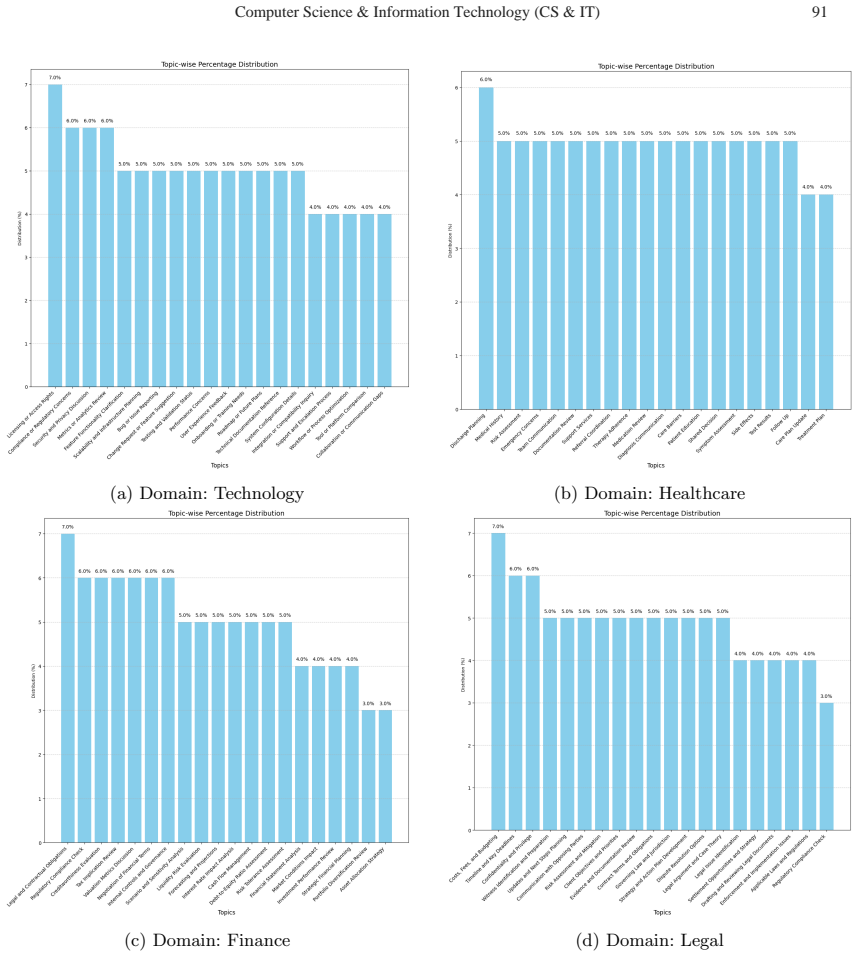
The load-bearing machinery is the multi-stage generation pipeline. It starts with GPT-4o proposing ten conversation scenario templates per domain, then ten topics per scenario, then a GPT-4o reduction to 20 representative topics per domain. Algorithm 1 enforces near-symmetric topic frequencies and sentiment proportions by iterating over topics, randomly pairing each with two or three other topics, and reassigning sentiments when all selected topics share the same label, ensuring label balance. The resulting prompts are fed to GPT-4o to produce multi-turn dialogues, which are then filtered: Gemini 1.5 Pro serves as an LLM judge to verify topic-sentiment consistency, and Sentence-BERT embeddings with cosine similarity (threshold 0.8) identify near-duplicate conversations for pruning. This machinery is what allegedly makes the data both balanced and realistic enough for model evaluation.
What would settle it
A direct test would be to take a sample of the generated conversations alongside human-authored conversations from the same four domains, have human annotators judge which are authentic and whether the assigned topic-sentiment labels match the content, and compare the error rates; if the synthetic conversations are measurably less realistic or mislabeled, the benchmark's validity fails. A second check would be to fine-tune an ABSA model on this synthetic data and evaluate it on real-world datasets like SemEval-2014 Task 4: strong transfer would support the claim, while a large drop would indicate the synthetic data misses nuances of genuine language.
Extended reading notes
Core claim
The central discovery claim is that a controlled, prompt-based generation pipeline using GPT-4o can create a multi-domain ABSA conversation dataset with consistent, balanced topic and sentiment distributions, and that the resulting data is challenging enough for state-of-the-art LLMs to reveal clear performance differences. On topic classification, DeepSeek-R1 consistently leads in precision and F1, Gemini 1.5 Pro and Claude 3.5 Sonnet show stronger recall, and Gemini is far faster at inference; on sentiment classification the models are broadly similar except for a divergence in the healthcare domain. The authors take the strong, generally high performance as evidence that the synthetic conversations are relevant and realistic, and as support for the broader claim that LLM-generated synthetic data can substitute for limited real-world labeled ABSA data.
Load-bearing premise
The whole dataset and benchmark rest on the assumption that GPT-4o, when prompted with a domain, scenario, and topic-sentiment pair, produces conversations that faithfully resemble real human communication.
Editorial extensions
If this is right
- If the claim holds, LLM-generated synthetic data becomes a practical route for building ABSA resources in any domain or language without manual annotation.
- Researchers can use the reported trade-offs (DeepSeek-R1 for precision, Gemini and Claude for recall, Gemini for latency) to select a model for real-time versus accuracy-critical ABSA applications.
- The balanced topic and sentiment distributions make the dataset usable for training and evaluating multi-aspect, contrastive sentiment models across four domains.
- Because the pipeline is prompt-based, it can be extended to new sentiments (such as conflict) or new conversation types by editing prompts, making scalable benchmark construction feasible.
Reading between the lines
- The paper does not test whether models trained on this synthetic data transfer to real-world ABSA datasets; a transfer experiment would be the natural next validation and could either strengthen or undermine the realism assumption.
- Algorithm 1's distribution control could be repurposed to deliberately create imbalanced or adversarial sentiment distributions, enabling stress-testing of ABSA models' robustness.
- The lack of any human evaluation means the realism claim is untested; a low-cost extension would be a small human study comparing these dialogues with real transcripts from customer service or forums.
- The 'LLM as judge' filtering using Gemini 1.5 Pro may inherit the same generation-model biases as GPT-4o, so a judge-model independent of the generator would be a more stringent validation.
Editorial analysis
A structured set of objections, weighed in public.
Referee Report
Summary. The paper proposes a pipeline for generating a synthetic multi-domain ABSA conversation dataset using GPT-4o, with topic/sentiment balancing, Gemini 1.5 Pro as an LLM judge, and SBERT similarity filtering. The dataset covers Technology, Healthcare, Finance, and Legal domains, with roughly 2,000 conversations per domain after filtering. The utility is evaluated by having three LLMs (Gemini 1.5 Pro, Claude 3.5 Sonnet, DeepSeek-R1) perform topic and sentiment classification on the generated data, reporting precision, recall, and F1, plus latency. The authors conclude that LLM-based synthetic data generation is viable and flexible for creating valuable ABSA resources, facilitating research and model evaluation without reliance on limited real-world labeled data.
Significance. If the ground-truth labels were independently validated, the balanced multi-domain conversation dataset and the comparison of three LLMs with latency would be useful for ABSA research. The pipeline is clearly described and the code/data appear to be released. However, the central claim that the data is valuable for real-world evaluation is not supported by the evidence: label validity rests solely on an LLM judge that is also one of the evaluated models, no human annotation or real-data benchmark comparison is provided, and the filtering statistics are missing. These are correctable issues, but they are load-bearing for the paper's main conclusion.
major comments (3)
- [3.2] The validity of the dataset's labels is the load-bearing assumption for the central claim that the synthetic data are 'valuable for real-world evaluation' (Abstract). Section 3.2 validates generated conversations only through Gemini 1.5 Pro as an LLM judge and an SBERT cosine-similarity filter; no human evaluation, no inter-annotator agreement, no count of rejected samples, and no comparison against human-labeled ABSA datasets are reported. Because Gemini 1.5 Pro is itself one of the models evaluated in Tables 2–5, the reported recall values of 0.96–0.99 for Gemini may partly reflect that the filter was written by the same model being scored, making the benchmark results in Section 4.1.2 uninterpretable as evidence of real-world ABSA quality.
- [4.1.2] Tables 2–5 report high F1 scores across all three models, and Section 4.1.3 interprets these as evidence that the synthetic data 'successfully created relevant and challenging examples.' This interpretation requires that the aspect-sentiment labels themselves be correct, but the labels were generated by GPT-4o and validated only by Gemini 1.5 Pro. The paper itself notes a 'certain anomaly introduced during label generation' in the Healthcare domain (Section 4.1.2) but does not investigate it. Without an independent annotation sample or a head-to-head evaluation on an existing human-labeled ABSA dataset, every precision, recall, and F1 value in Tables 2–5 could reflect label artifacts rather than genuine ABSA skill.
- [3.2] The 'manual review and pruning' step is mentioned as part of the filtering pipeline, but its outcome is not reported: how many of the top 33% of conversations with the longest similarity lists were pruned, how many conversations were rejected by the Gemini judge, what the judge's agreement rate was, and whether any of the flagged conversations remain in the final dataset. Table 1 presents post-filtering statistics, but the effect of filtering on label quality cannot be assessed without these numbers. This is a load-bearing omission because the final dataset is claimed to be 'semantically distinct' and 'suitable for downstream tasks' on the basis of this step.
minor comments (6)
- [3] In the first paragraph of Section 3, 'abstract based sentiment analysis' should be 'aspect-based sentiment analysis.'
- [4.1.2] The text says 'We similarly assessed the sentiment classification as represented in Figure 3,' but the figure caption defines Fig. 2 as 'Metrics for Sentiment Classification Across LLMs' and Fig. 3 as 'Topic Distribution Charts.' The cross-references to Figures 2 and 3 need to be corrected.
- [3.1.3] Algorithm 1 takes 'sentiment proportions' as input, but the values used in the experiments are not stated in the paper; reporting these parameters is necessary for reproducibility of the balanced distributions shown in Table 1.
- [3.1.3] Algorithm 1 lines 26–28 contain redundant operations ('Add generated prompt to conversations list' followed by 'Add prompt to conversations'); this should be a single append operation.
- [3.2] The statement that using an LLM as a judge 'mimics the two-annotator approach' is misleading, since a single LLM judge is not equivalent to two independent human annotators; this should be reworded or substantiated.
- [Abstract] The spelling of 'DeepSeek-R1' is inconsistent ('Deepseek-R1' appears in the abstract, keywords, and some sections); the authors should standardize it.
Circularity Check
No formal circularity; results are an empirical consistency check, though the Gemini-as-filter/evaluee design introduces selection bias.
full rationale
The paper's derivation chain is not circular in the technical sense. The dataset labels are produced by GPT-4o prompts, not by the evaluated models; the evaluation measures zero-shot classification accuracy against those labels. No parameter is fitted to a subset and renamed as a prediction; no load-bearing self-citation or imported uniqueness theorem appears. The claim that strong model performance indicates data quality is an empirical, falsifiable inference, not a definitional equivalence. The self-referential use of Gemini 1.5 Pro as both the validation filter (Section 3.2) and an evaluated model (Section 4) is a genuine selection-bias limitation: the test set is enriched for samples Gemini's own judgment retained, potentially inflating its reported metrics. However, this does not make the reported F1 scores equal to the filter outputs by construction, nor does it affect the logical independence of the Claude and DeepSeek evaluations. The absence of human annotation or real-data comparison is a validity gap, not a circularity.
Assumptions & free parameters
free parameters (5)
- Sentiment proportions (positive/negative/neutral) =
approximately 33%/33%/33% per domain
- SBERT similarity threshold =
0.8
- Top-33% pruning rule =
Top 33% of conversations ranked by similarity-list length
- Number of topics per conversation =
2 or 3
- Topic frequency per domain =
m/n = 3000/20 = 150 outputs per topic before filtering
assumptions (4)
- domain assumption GPT-4o can generate realistic, multi-turn conversations that reflect real-world sentiment dynamics and topic distributions in the four chosen domains.
- domain assumption Gemini 1.5 Pro, used as a judge, reliably verifies topic-sentiment consistency in the generated conversations.
- domain assumption SBERT cosine similarity ≥ 0.8 is a valid criterion for finding semantically near-duplicate conversations.
- domain assumption Performance of three LLMs on the synthetic data is a meaningful proxy for data quality and utility for real-world ABSA.
Cite this review
Pith. "Pith review of Multi-Domain ABSA Conversation Dataset Generation via LLMs for Real-World Evaluation and Model Comparison." pith.science (2026). https://pith.science/paper/NUYAOATB
@misc{pith2026250524701,
  author       = {Pith},
  title        = {Pith review of: Multi-Domain ABSA Conversation Dataset Generation via LLMs for Real-World Evaluation and Model Comparison},
  year         = {2026},
  howpublished = {\url{https://pith.science/paper/NUYAOATB}},
  note         = {Machine review of arXiv:2505.24701}
}
read the original abstract
Aspect-Based Sentiment Analysis (ABSA) offers granular insights into opinions but often suffers from the scarcity of diverse, labeled datasets that reflect real-world conversational nuances. This paper presents an approach for generating synthetic ABSA data using Large Language Models (LLMs) to address this gap. We detail the generation process aimed at producing data with consistent topic and sentiment distributions across multiple domains using GPT-4o. The quality and utility of the generated data were evaluated by assessing the performance of three state-of-the-art LLMs (Gemini 1.5 Pro, Claude 3.5 Sonnet, and DeepSeek-R1) on topic and sentiment classification tasks. Our results demonstrate the effectiveness of the synthetic data, revealing distinct performance trade-offs among the models: DeepSeekR1 showed higher precision, Gemini 1.5 Pro and Claude 3.5 Sonnet exhibited strong recall, and Gemini 1.5 Pro offered significantly faster inference. We conclude that LLM-based synthetic data generation is a viable and flexible method for creating valuable ABSA resources, facilitating research and model evaluation without reliance on limited or inaccessible real-world labeled data.
Figures


Reference graph
Works this paper leans on
-
[1]
SemEval-2014 task 4: Aspect based sentiment analysis,
Pontiki, M., Galanis, D., Pavlopoulos, J., Papageorgiou, H., Androutsopoulos, I., and Manandhar, S., “SemEval-2014 task 4: Aspect based sentiment analysis,” in [ Proceedings of the 8th International Workshop on Semantic Evaluation (SemEval 2014) ], Nakov, P. and Zesch, T., eds., 27–35, Association for Computational Linguistics, Dublin, Ireland (aug 2014)
work page 2014
-
[2]
SemEval-2015 task 12: Aspect based sentiment analysis,
Pontiki, M., Galanis, D., Papageorgiou, H., Manandhar, S., and Androutsopoulos, I., “SemEval-2015 task 12: Aspect based sentiment analysis,” in [ Proceedings of the 9th International Workshop on Se- mantic Evaluation (SemEval 2015) ], Nakov, P., Zesch, T., Cer, D., and Jurgens, D., eds., 486–495, Association for Computational Linguistics, Denver, Colorado...
work page 2015
-
[3]
SemEval-2016 task 5: Aspect based sentiment analysis,
Pontiki, M., Galanis, D., Papageorgiou, H., Androutsopoulos, I., Manandhar, S., AL-Smadi, M., Al- Ayyoub, M., Zhao, Y., Qin, B., De Clercq, O., Hoste, V., Apidianaki, M., Tannier, X., Loukachevitch, N., Kotelnikov, E., Bel, N., Jim´ enez-Zafra, S. M., and Eryi˘ git, G., “SemEval-2016 task 5: Aspect based sentiment analysis,” in [Proceedings of the 10th In...
work page 2016
-
[4]
Aware: Aspect-based sentiment analysis dataset of apps reviews for requirements elicitation,
Alturaief, N., Aljamaan, H., and Baslyman, M., “Aware: Aspect-based sentiment analysis dataset of apps reviews for requirements elicitation,” in [ 2021 36th IEEE/ACM International Conference on Automated Software Engineering Workshops (ASEW) ], 211–218 (2021)
work page 2021
-
[5]
Gemini 1.5: Unlocking multimodal understanding across millions of tokens of context,
Gemini Team, G., “Gemini 1.5: Unlocking multimodal understanding across millions of tokens of context,” (2024)
work page 2024
- [6]
-
[7]
Deepseek-r1: Incentivizing reasoning capability in llms via reinforcement learning,
DeepSeek-AI, “Deepseek-r1: Incentivizing reasoning capability in llms via reinforcement learning,” (2025)
work page 2025
-
[8]
A systematic review of aspect-based sentiment analysis: domains, methods, and trends,
Hua, Y. C., Denny, P., Wicker, J., and Taskova, K., “A systematic review of aspect-based sentiment analysis: domains, methods, and trends,” Artificial Intelligence Review 57 (sep 2024)
work page 2024
Show all 16 references
-
[9]
Survey of aspect-based sentiment analysis datasets,
Chebolu, S. U. S., Dernoncourt, F., Lipka, N., and Solorio, T., “Survey of aspect-based sentiment analysis datasets,” (2023)
2023
-
[10]
Bert: Pre-training of deep bidirectional trans- formers for language understanding,
Devlin, J., Chang, M.-W., Lee, K., and Toutanova, K., “Bert: Pre-training of deep bidirectional trans- formers for language understanding,” (2019)
2019
-
[11]
Improving language understanding by generative pre-training,
Radford, A. and Narasimhan, K., “Improving language understanding by generative pre-training,” (2018)
2018
-
[12]
Fabsa: An aspect-based sentiment analysis dataset of user reviews,
Kontonatsios, G., Clive, J., Harrison, G., Metcalfe, T., Sliwiak, P., Tahir, H., and Ghose, A., “Fabsa: An aspect-based sentiment analysis dataset of user reviews,” Neurocomputing 562, 126867 (2023)
2023
-
[13]
M-absa: A multilingual dataset for aspect-based sentiment analysis,
Wu, C., Ma, B., Liu, Y., Zhang, Z., Deng, N., Li, Y., Chen, B., Zhang, Y., Plank, B., and Xue, Y., “M-absa: A multilingual dataset for aspect-based sentiment analysis,” (2025)
2025
-
[14]
Bert-based model and llms-generated syn- thetic data for conflict sentiment identification in aspect-based sentiment analysis,
Nuryani, N., Munir, R., Purwarianti, A., and Lestari, D. P., “Bert-based model and llms-generated syn- thetic data for conflict sentiment identification in aspect-based sentiment analysis,” Interdisciplinary Journal of Information, Knowledge, and Management (2025)
2025
-
[15]
Gpt-4o system card,
Team, O., “Gpt-4o system card,” (2024)
2024
-
[16]
Sentence-bert: Sentence embeddings using siamese bert-networks,
Reimers, N. and Gurevych, I., “Sentence-bert: Sentence embeddings using siamese bert-networks,” in [Proceedings of the 2019 Conference on Empirical Methods in Natural Language Processing ], Associa- tion for Computational Linguistics (11 2019). A Topic Distribution Bar chart r...
2019
Reviewed August 7, 2026 · model on record in the stance chip above.
Discussion (0). Sign in to comment.