REVIEW 4 major objections 4 minor 1 cited by
Diffusion-Based Symbolic Regression
T0 review · 4 major / 4 minor · reviewed 2026-08-07 · deepseek-v4-flash
Pith's one-line read DDSR, a mask-based discrete diffusion model for symbolic regression, recovers known ground-truth equations at almost double the rate of the deep-learning baseline DSR (46.5% vs 24.8% at zero noise) while writing simpler expressions.
desk verdict Strong empirical results for a diffusion-based SR method, but the paper's own appendix contradicts its reverse-process description and no code is provided, so the central claim is not yet verifiable. read the letter →
The pith
A machine-rendered reading of the paper's core claim, the machinery that carries it, and where it could break.
The reading
What carries the argument
The load-bearing object is the random mask-based discrete diffusion process: a forward chain that masks exactly one token of the expression matrix $X_0$ per step, $X_t = Q_t \cdots Q_1 X_0$ with $Q_t = I - \mathrm{diag}(e_{q_t})$, and a reverse chain that reconstructs masked tokens from the Transformer's predicted distribution $q(X_0)$. Two further mechanisms carry the learning. The token-wise GRPO update assigns each token of a top-$\alpha$ expression the relative reward $A_i = R(\tau^{(i)}) - R_\alpha$, clips the likelihood ratio $h_{\theta k t}$ to $[1-\epsilon, 1+\epsilon]$, and adds a KL penalty to a reference model, so the objective in equation (6) — the reward-scaled log-likelihood of the true expression under the predicted distribution — is optimized inside a trust region. The long short-term risk-seeking policy maintains a candidate pool $S_\alpha \leftarrow S_\alpha \cup S^k_\alpha$ that keeps the top expressions from all epochs, which the paper credits with balancing short-term and long-term exploitation.
What would settle it
Run the generation loop in Algorithm 2 on a toy expression of length 5 and instrument how many tokens remain masked after each backward step: the claimed one-token-at-a-time reconstruction requires the mask count to fall by exactly one per iteration. If applying equation (5) after sampling the masked tokens produces a state with one fewer mask, the description holds; if the mask count drops by more than one per step, or the sampled tokens get overwritten, the reverse process differs from the paper's account and the reported results would depend on the actual implementation.
Extended reading notes
Core claim
The central claim is that a discrete diffusion model built on random token masking can serve as an effective generator for symbolic regression when trained with reinforcement learning rather than likelihood maximization alone. DDSR's forward process hides exactly one token of the expression at each step, blurring structure gradually instead of perturbing every token at once as the standard D3PM discrete diffusion does; the reverse process starts from a fully masked sequence and reconstructs tokens step by step under a Transformer that predicts the complete token-distribution matrix from the partially masked input. Training uses a token-wise adaptation of GRPO: only the top $\alpha$% of sampled expressions by reward enter the update, each token's likelihood is weighted by the expression's relative reward, and updates are clipped to a trust region with a KL penalty toward a reference model. A long short-term risk-seeking policy widens the candidate set to include top expressions from every prior epoch, preventing hard-to-sample high-reward expressions from being forgotten. The paper reports that this combination roughly doubles DSR's symbolic solution rate at zero noise (46.5% vs 24.8%), beats most genetic-programming methods while writing far simpler expressions, and places DDSR on the Pareto frontier of the black-box problems, with ablations attributing separate gains to each component.
Load-bearing premise
The printed description of the backward denoising loop is internally inconsistent — it says the model samples all masked tokens at once, which conflicts with the claimed one-token-at-a-time reconstruction — and the whole method depends on that loop actually working as intended.
Editorial extensions
If this is right
- Deep learning for symbolic regression does not need an RNN: a diffusion generator trained with reward-weighted denoising reports roughly double DSR's symbolic solution rate at zero noise, so the autoregressive front end is replaceable.
- Accuracy and interpretability can come together: with average simplified complexity 17.7 versus 35.4 for GP-GOMEA and 61.4 for TPSR, DDSR sits on the Pareto frontier of R-squared versus model size on SRBench's black-box problems.
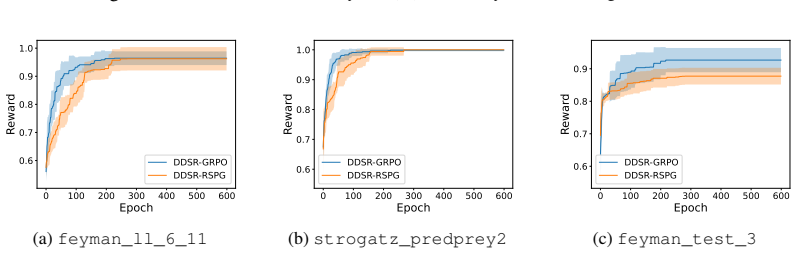
- Token-wise trust-region updates speed up training: GRPO converges about 30 epochs earlier than the standard risk-seeking policy gradient on the reported learning curves, making reinforcement learning for expressions more sample-efficient.
- Surviving expressions from past epochs are a reusable asset: the long short-term risk-seeking buffer can be added to other deep symbolic regression trainers, since it only changes which expressions enter the policy update.
- Diffusion-based expression models are plug-in components for ensembles: the paper argues DDSR can replace or complement DSR inside the uDSR pipeline, combining its high solution rate with the ensemble's coverage.
Reading between the lines
- The claimed 35.7-point accuracy gain over D3PM on the Strogatz set suggests the one-token-per-step mask is the structurally critical choice; a natural test is to run DDSR with a two-token or adaptive-rate mask on the same problems to see whether the gain comes from mask sparsity or from preserving tree locality.
- The paper's conclusion concedes weaker robustness to high noise, and its Table 1 shows DSR without constant tokens overtaking DDSR at 10% noise (16.61% vs 10.69%); one could test whether a noise-scaled masking rate or reward shaping restores the advantage in that regime.
- The LST buffer is effectively a replay set for exploitation; a variant that resamples the buffer with priority weighting rather than keeping only the global top $\alpha$% might train faster still, though that is not explored in the paper.
- The runtime measurement (14,441 s vs 27,131 s for DSR with the same token space) indicates the mask-based schedule halves wall-clock cost; if that holds, masked-diffusion generators are a promising backbone for the supervised foundation-model regime the paper names as future work.
Editorial analysis
A structured set of objections, weighed in public.
Referee Report
Summary. The paper proposes DDSR, a random mask-based discrete diffusion model for symbolic regression, trained with token-wise Group Relative Policy Optimization (GRPO) and a long short-term risk-seeking policy. The method is evaluated on SRBench against eighteen baselines, reporting improved symbolic solution rates and accuracy relative to DSR, and simpler expressions than GP-based methods. The authors also provide ablations of the diffusion model, the GRPO component, and the long short-term policy.
Significance. The empirical evaluation is extensive and well-structured, with eight runs per problem, ablations of each component, and a broad baseline set. If the method works as described, the application of masked discrete diffusion to symbolic regression with RL training is a potentially useful contribution. However, the significance is substantially undermined by the unclear and internally inconsistent description of the generation process, which prevents a reader from verifying that the reported results are produced by the claimed diffusion-based method.
major comments (4)
- [Section 3.1 and Algorithm 2] The reverse diffusion process is not executable as written. The text states that at each backward step t the model inputs X_t, predicts q(X_0), samples all masked tokens in X_t to form an intermediate X_0, and then applies Eq. (5) to obtain X_{t-1}; this would either reconstruct all masked tokens at once (contradicting the claim that tokens are reconstructed one at a time) or, if Eq. (5) is applied as a forward-masking operator, would re-mask tokens and increase the number of masked tokens rather than decrease it. Moreover, the only sampling procedure given in Appendix A.1 (Algorithm 2) is an autoregressive token-by-token sampler with valid-token constraints that does not use X_t, the predicted q(X_0), or Eq. (5) at all. Because no code is released, the reader cannot determine which procedure was actually implemented; this ambiguity is load-bearing because the diffusion-based generation is the paper's core contribution.
- [Eq. (5) in Section 3.1] The definition of the forward process is notationally inconsistent. In the same equation, Q_t is used both for the single-step mask operator I − diag(e_q_t) and for the cumulative product Q_t Q_{t−1} ... Q_1; the latter definition is self-referential. This makes it impossible to reproduce the forward process without additional interpretation.
- [Section 3.2 and Algorithm 1] The training objective applies the reward-weighted likelihood to a randomly selected diffusion step t, but the generation procedure in Algorithm 2 is independent of the diffusion process. If generation is actually performed by Algorithm 2, then the method is a transformer-based autoregressive sampler trained with an additional denoising loss, and the claim that DDSR is a diffusion-based generator is not validated by the reported experiments. The paper needs to clarify how the denoising objective in Eq. (6) relates to the sampling procedure used at test time.
- [Section 5.2 and Figure 4] The ablation results do not consistently support the claimed benefit of GRPO. On the Feynman dataset, DDSR-RSPG (55.6%) slightly outperforms DDSR-GRPO (55.2%), while on Strogatz DDSR-GRPO is better (96.4% vs 92.9%). The statement that 'GRPO accelerates training' by 30 epochs is not a substitute for a statistically supported accuracy comparison; the paper should either report significance tests or temper the claim.
minor comments (4)
- [Section 1] In the second contribution bullet, 'GPRO' should be spelled 'GRPO'.
- [Section 3.2] The entropy-gradient term is mentioned but its exact form is not specified; please provide the formula.
- [Section 3.3] The description of the candidate pool as containing 'all model versions seen so far' is inconsistent with Algorithm 1, which removes the bottom α% of expressions every epoch; please clarify whether the pool is a fixed-size replay buffer or a true history.
- [Table 1] Table 1 reports no confidence intervals; consider adding them to support the claim of statistical significance.
Circularity Check
No circularity: rewards are external-data-driven NRMSE, and the claimed predictions do not reduce by construction to fitted inputs or a self-citation chain.
full rationale
The derivation chain is self-contained in the relevant sense. The reward in Eq. (3) is R(τ)=1/(1+NRMSE(τ,x,y)), computed from the measurement dataset D, not from the diffusion model's own outputs; the training objective in Eq. (6) weights the model's likelihood of proposed expressions by that external reward. The 'predictions' (generated expressions) are therefore evaluated against ground-truth data rather than being forced by construction. The only author-overlap citation is Bingo (Randall et al., 2022, co-authored by Hochhalter), and it is used as a baseline for comparison, not as load-bearing support for the method or as a uniqueness argument. The long short-term replay pool in Eq. (8) reuses the model's own past samples, but the rewards attached to those samples remain fixed external NRMSE values; this is standard self-training/on-policy RL, not the pattern of renaming a fitted parameter as a prediction. The reverse-process text in Section 3.1 has an internal consistency issue (sampling all masked tokens at once versus one-at-a-time reconstruction, and applying Eq. (5) to an intermediate X0 would produce Xt rather than Xt−1), but that is an implementation/correctness concern, not circularity. Absence of released code affects reproducibility but does not by itself establish circularity. Since no central claim reduces to its inputs by definition or by self-citation, the circularity score is 0.
Assumptions & free parameters
free parameters (9)
- risk_percent_alpha =
5
- KL_coefficient_beta =
0.01
- clip_epsilon =
0.2
- entropy_coefficient_lambda =
0.0005
- max_expression_depth =
32
- batch_size_B =
1000
- reference_model_update_interval_G =
5
- gradient_steps_per_epoch_C =
5
- oversampling =
3
assumptions (5)
- domain assumption The forward masking process in equation (5) defines a valid generative model that can be trained by maximizing the reconstruction likelihood p(X0 | φθ(Xt)).
- domain assumption Expressions can be represented as fixed-length BFS-ordered token sequences with a predefined token library and validity constraints.
- domain assumption The reward R(τ) = 1/(1+NRMSE) is a suitable scalar objective for guiding symbolic regression.
- ad hoc to paper The reverse generation process described in Section 3.1, in which masked tokens are sampled and then equation (5) is applied to obtain the next state, is implementable and produces valid expressions.
- domain assumption GRPO's trust region and KL regularization guarantee stable RL training in this setting.
Cite this review
Pith. "Pith review of Diffusion-Based Symbolic Regression." pith.science (2026). https://pith.science/paper/KZWTEUED
@misc{pith2026250524776,
  author       = {Pith},
  title        = {Pith review of: Diffusion-Based Symbolic Regression},
  year         = {2026},
  howpublished = {\url{https://pith.science/paper/KZWTEUED}},
  note         = {Machine review of arXiv:2505.24776}
}
read the original abstract
Diffusion has emerged as a powerful framework for generative modeling, achieving remarkable success in applications such as image and audio synthesis. Enlightened by this progress, we propose a novel diffusion-based approach for symbolic regression. We construct a random mask-based diffusion and denoising process to generate diverse and high-quality equations. We integrate this generative processes with a token-wise Group Relative Policy Optimization (GRPO) method to conduct efficient reinforcement learning on the given measurement dataset. In addition, we introduce a long short-term risk-seeking policy to expand the pool of top-performing candidates, further enhancing performance. Extensive experiments and ablation studies have demonstrated the effectiveness of our approach.
Figures


Figures from the paper (5 more)



Forward citations
Cited by 1 Pith paper
-
Verifier-Guided Model Discovery for Physical Dynamical Systems with Pretrained Symbolic Transformers
Verifier-guided selection lets a pretrained symbolic transformer transfer from synthetic ODEs to high-dimensional cylinder-flow data, recovering symbolic vortex-shedding models that generalize across Reynolds numbers.
Reference graph
Works this paper leans on
-
[1]
Arnaldo, I., Krawiec, K., and O'Reilly, U.-M. (2014). Multiple regression genetic programming. In Proceedings of the 2014 Annual Conference on Genetic and Evolutionary Computation , GECCO '14, page 879–886, New York, NY, USA. Association for Computing Machinery
work page 2014
-
[2]
D., Ho, J., Tarlow, D., and Van Den Berg, R
Austin, J., Johnson, D. D., Ho, J., Tarlow, D., and Van Den Berg, R. (2021). Structured denoising diffusion models in discrete state-spaces. Advances in neural information processing systems , 34:17981--17993
work page 2021
-
[3]
Biggio, L., Bendinelli, T., Neitz, A., Lucchi, A., and Parascandolo, G. (2021). Neural symbolic regression that scales. In International Conference on Machine Learning (ICML) , pages 936--945. Pmlr
work page 2021
-
[4]
B., Powley, E., Whitehouse, D., Lucas, S
Browne, C. B., Powley, E., Whitehouse, D., Lucas, S. M., Cowling, P. I., Rohlfshagen, P., Tavener, S., Perez, D., Samothrakis, S., and Colton, S. (2012). A survey of monte carlo tree search methods. IEEE Transactions on Computational Intelligence and AI in games , 4(1):1--43
work page 2012
-
[5]
Burlacu, B., Kronberger, G., and Kommenda, M. (2020). Operon C ++: an efficient genetic programming framework for symbolic regression. In Proceedings of the 2020 Genetic and Evolutionary Computation Conference Companion , GECCO '20, pages 1562--1570, New York, NY, USA. Association for Computing Machinery
work page 2020
-
[6]
Ho, J., Jain, A., and Abbeel, P. (2020). Denoising diffusion probabilistic models. Advances in neural information processing systems , 33:6840--6851
work page 2020
-
[7]
Holt, S., Qian, Z., and van der Schaar, M. (2023). Deep generative symbolic regression. In The Eleventh International Conference on Learning Representations
work page 2023
-
[8]
Huang, Q., Park, D. S., Wang, T., Denk, T. I., Ly, A., Chen, N., Zhang, Z., Zhang, Z., Yu, J., Frank, C., Engel, J., Le, Q. V., Chan, W., Chen, Z., and Han, W. (2023). Noise2music: Text-conditioned music generation with diffusion models
work page 2023
Show all 33 references
-
[9]
Jiang, N., Nasim, M., and Xue, Y. (2024). Vertical symbolic regression via deep policy gradient. In Proceedings of the Thirty-Third International Joint Conference on Artificial Intelligence (IJCAI) , pages 5891--5899
2024
-
[10]
Kamienny, P.-A., d'Ascoli, S., Lample, G., and Charton, F. (2022). End-to-end Symbolic Regression with Transformers
2022
-
[11]
Kamienny, P.-A., Lample, G., Lamprier, S., and Virgolin, M. (2023). Deep generative symbolic regression with monte-carlo-tree-search
2023
-
[12]
Koza, J. R. (1994). Genetic programming as a means for programming computers by natural selection. Statistics and Computing , 4(2):87--112
1994
-
[13]
O., Virgolin, M., Jin, Y., Kommenda, M., and Moore, J
La Cava, W., Orzechowski, P., Burlacu, B., de França, F. O., Virgolin, M., Jin, Y., Kommenda, M., and Moore, J. H. (2021). Contemporary Symbolic Regression Methods and their Relative Performance . arXiv:2107.14351 [cs]
2021 arXiv
-
[14]
P., Aravena, I., Mundhenk, T
Landajuela, M., Lee, C., Yang, J., Glatt, R., Santiago, C. P., Aravena, I., Mundhenk, T. N., Mulcahy, G., and Petersen, B. K. (2022). A unified framework for deep symbolic regression. In Oh, A. H., Agarwal, A., Belgrave, D., and Cho, K., editors, Advances in Neural Information...
2022
-
[15]
Levenberg, K. (1944). A method for the solution of certain non-linear problems in least squares. Quarterly of Applied Mathematics , 2(2):164--168
1944
-
[16]
Li, M., Shitole, V., Chien, E., Man, C., Wang, Z., Srinivas, Zhang, Y., Krishna, T., and Li, P. (2024). Layer DAG : A layerwise autoregressive diffusion model of directed acyclic graphs for system. In Machine Learning for Computer Architecture and Systems 2024
2024
-
[17]
P., faissol, D., and Petersen, B
Mundhenk, T., Landajuela, M., Glatt, R., Santiago, C. P., faissol, D., and Petersen, B. K. (2021). Symbolic regression via deep reinforcement learning enhanced genetic programming seeding. In Ranzato, M., Beygelzimer, A., Dauphin, Y., Liang, P., and Vaughan, J. W., editors, Ad...
2021
-
[18]
Nie, S., Zhu, F., You, Z., Zhang, X., Ou, J., Hu, J., Zhou, J., Lin, Y., Wen, J.-R., and Li, C. (2025). Large language diffusion models
2025
-
[19]
K., Landajuela, M., Mundhenk, T
Petersen, B. K., Landajuela, M., Mundhenk, T. N., Santiago, C. P., Kim, S. K., and Kim, J. T. (2019). Deep symbolic regression: Recovering mathematical expressions from data via risk-seeking policy gradients
2019
-
[20]
L., Townsend, T
Randall, D. L., Townsend, T. S., Hochhalter, J. D., and Bomarito, G. F. (2022). Bingo: a customizable framework for symbolic regression with genetic programming. In Proceedings of the Genetic and Evolutionary Computation Conference Companion , GECCO '22, pages 2282--2288, New ...
2022
-
[21]
Rombach, R., Blattmann, A., Lorenz, D., Esser, P., and Ommer, B. (2022). High-resolution image synthesis with latent diffusion models
2022
-
[22]
Shao, Z., Wang, P., Zhu, Q., Xu, R., Song, J., Bi, X., Zhang, H., Zhang, M., Li, Y., Wu, Y., et al. (2024a). Deepseekmath: Pushing the limits of mathematical reasoning in open language models. arXiv preprint arXiv:2402.03300
2024 arXiv
-
[23]
K., Wu, Y., and Guo, D
Shao, Z., Wang, P., Zhu, Q., Xu, R., Song, J., Bi, X., Zhang, H., Zhang, M., Li, Y. K., Wu, Y., and Guo, D. (2024b). Deepseekmath: Pushing the limits of mathematical reasoning in open language models
2024
-
[24]
B., and Reddy, C
Shojaee, P., Meidani, K., Farimani, A. B., and Reddy, C. K. (2023). Transformer-based Planning for Symbolic Regression
2023
-
[25]
Sun, F., Liu, Y., Wang, J.-X., and Sun, H. (2023). Symbolic physics learner: Discovering governing equations via monte carlo tree search. In The Eleventh International Conference on Learning Representations
2023
-
[26]
Tenachi, W., Ibata, R., and Diakogiannis, F. I. (2023). Deep symbolic regression for physics guided by units constraints: toward the automated discovery of physical laws. The Astrophysical Journal , 959(2):99
2023
-
[27]
and Tegmark, M
Udrescu, S.-M. and Tegmark, M. (2020). AI Feynman : a Physics - Inspired Method for Symbolic Regression . arXiv:1905.11481 [hep-th, physics:physics]
2020 arXiv
-
[28]
Valipour, M., You, B., Panju, M., and Ghodsi, A. (2021). SymbolicGPT : A Generative Transformer Model for Symbolic Regression . arXiv:2106.14131 [cs]
2021 arXiv
-
[29]
Vastl, M., Kulhánek, J., Kubalík, J., Derner, E., and Babuška, R. (2022). SymFormer : End -to-end symbolic regression using transformer-based architecture. arXiv:2205.15764 [cs]
2022 arXiv
-
[30]
Vignac, C., Krawczuk, I., Siraudin, A., Wang, B., Cevher, V., and Frossard, P. (2023). Digress: Discrete denoising diffusion for graph generation
2023
-
[31]
Virgolin, M., Alderliesten, T., and Bosman, P. A. N. (2019). Linear scaling with and within semantic backpropagation-based genetic programming for symbolic regression. In Proceedings of the Genetic and Evolutionary Computation Conference , GECCO '19, page 1084–1092, New York, ...
2019
-
[32]
Virgolin, M., Alderliesten, T., Witteveen, C., and Bosman, P. A. N. (2021). Improving Model -based Genetic Programming for Symbolic Regression of Small Expressions . Evolutionary Computation , 29(2):211--237. arXiv:1904.02050 [cs]
2021 arXiv
-
[33]
Xu, Y., Liu, Y., and Sun, H. (2024). Reinforcement symbolic regression machine. In The Twelfth International Conference on Learning Representations
2024
Reviewed August 7, 2026 · model on record in the stance chip above.
Discussion (0). Sign in to comment.