REVIEW 3 major objections 4 minor 42 references
A frozen symbolic transformer pretrained on synthetic ODEs can discover vortex-shedding equations from raw flow fields, provided beam-decoded candidates are pooled across trajectories and screened by executable physics checks.
Reviewed by Pith at T0; open to challenge. T0 means a machine referee read the full paper against a public rubric. the ladder, T0–T4 →
T0 review · deepseek-v4-flash
2026-08-05 00:43 UTC pith:XFA6I57P
load-bearing objection The verifier-guided workflow is a real methodological novelty, and the fixed-Re cylinder results are convincing, but the lift from verification is not isolated and the cross-Re success hangs on a single uncontrolled autoencoder run. the 3 major comments →
Verifier-Guided Model Discovery for Physical Dynamical Systems with Pretrained Symbolic Transformers
The pith
A machine-rendered reading of the paper's core claim, the machinery that carries it, and where it could break.
Core claim
Central claim: a frozen ODEFormer backbone — a transformer pretrained on synthetic ODEs — can serve as the hypothesis generator for reduced coordinates of a 60,000-dimensional vorticity field, provided selection is driven by multi-trajectory verification, not single-trajectory reconstruction. Pooled, verifier-screened candidates yield a six-equation system whose three oscillator pairs run at angular frequencies 1.060, 2.109, and 3.177 — the fundamental shedding cycle and its second and third harmonics, ratio 1 : 1.99 : 3.00. With Reynolds number appended as a conserved coordinate, one three-equation model with conserved combination z3 + 1.247 z2 produces bounded, oscillatory rollouts at all
What carries the argument
The load-bearing mechanism is the verifier-guided (VG) selection loop. The frozen backbone decodes candidate equations independently from multiple trajectory windows; candidates are pooled and deduplicated, ranked by mean rollout error across all discovery trajectories, and the top shortlist is subjected to executable verifiers: local vector-field agreement against numerically estimated derivatives, long-horizon boundedness, oscillation amplitude, dominant period or frequency, consistency across starting states, and — for the parametric case — exact conservation of the appended Reynolds coordinate and its participation in at least one state equation. The lowest-loss candidate passing every v
Load-bearing premise
Everything rests on the reduced coordinates (POD modes or autoencoder latents) behaving almost like a self-contained autonomous system whose equations the pretrained transformer can actually express: when unresolved wake modes or memory effects matter, no verifier can save the symbolic equation — the paper concedes exactly this limitation in its conclusion.
What would settle it
Run the identical VG pipeline on a deliberately non-closable wake — the same cylinder flow with unsteady inflow forcing, or with spanwise three-dimensional instabilities feeding back on the two-dimensional modes — so that no autonomous ODE in the chosen coordinates can be exact. If the workflow still returns an admissible symbolic system that generalizes to withheld forcing histories, the verifier suite is too permissive; if the admissible set comes back empty, coordinate closure is confirmed as the binding constraint. A cheaper control: at sub-critical Re = 40 with a steady wake, VG should re
If this is right
- Symbolic reduced-order models for fluid wakes can be found without a wake-specific candidate library or prescribed Navier–Stokes ansatz; the frozen pretrained generator plus multi-trajectory verification supplies the structure.
- The same frozen backbone transfers to fresh regimes without retraining: re-running the pool-and-verify loop on new data is the transfer mechanism.
- Parameter-dependent dynamics can be captured in a single symbolic system: appending the Reynolds number as a conserved coordinate yields a model that predicts at withheld interpolation values and extrapolates to Re = 500.
- Latent representations must be chosen with symbolic discoverability in mind: reconstruction fidelity is necessary but not sufficient, since most better-reconstructing autoencoders yielded no admissible equation.
- The returned equations are auditable objects: the 1 : 1.99 : 3.00 frequency ratio identifies the fundamental shedding oscillator and its higher harmonics, and the conserved combination in the cross-parameter model defines an invariant surface.
Where Pith is reading between the lines
- The harmonic-ratio signature (about 1 : 2 : 3) is a cheap audit test the authors do not fully exploit: future wake models whose dominant linearized frequencies are not near integer ratios are probably not representing the same shedding instability, and the ratio could filter candidates before any rollout.
- The parameter-as-conserved-coordinate recipe is generic and could be applied to any scalar regime parameter (Mach, Rayleigh, magnetic-field strength), but the discovered form only shifts a shared oscillator additively; regimes where the dynamics change qualitatively across the parameter would need the parameter inside nonlinear couplings, which the current single decoded system does not express.
- A directly testable extension, in the direction the authors point to at the end, is a closed loop in which admissibility feedback reshapes the latent coordinates — alternating autoencoder fitting with verifier checks to select embeddings that are both reconstructive and closed.
- The empty-set case is informative: applying the pipeline to a provably non-closable system (a forced or three-dimensionalized wake) should return no admissible equation; that outcome would confirm coordinate closure, not symbolic vocabulary, as the binding constraint.
Editorial analysis
A structured set of objections, weighed in public.
Referee Report
Summary. The paper proposes a verifier-guided (VG) workflow that wraps the pretrained symbolic transformer ODEFormer. Candidate equations are generated independently from multiple trajectory windows, pooled, ranked by multi-trajectory rollout error, then filtered through executable verifiers (local vector-field agreement, boundedness, oscillation amplitude/frequency, starting-state consistency, and, for parametric cases, parameter conservation and participation). The selected structure is coefficient-refined and reverified. The workflow is tested on Van der Pol oscillators and on cylinder-flow vortex shedding at fixed Re=300 using POD coordinates, and across Re=150--450 using a three-dimensional autoencoder latent space with a frozen Reynolds coordinate. The paper claims that VG transfers the frozen synthetic-ODE transformer to reduced physical coordinates, recovers the fundamental shedding oscillator and higher harmonics without a wake-specific library, and produces a cross-parameter model that generalizes to withheld interpolation and extrapolation Reynolds numbers.
Significance. If the claims hold, the paper makes a useful step: it shows that a frozen symbolic transformer can serve as a search distribution for reduced-order physical dynamics, and it provides a concrete, executable filtering scheme that is more transparent than single-trajectory beam selection. The verifier definitions are precise, the sensitivity analysis in Appendix S2.7 is a positive sign, and the paper is unusually honest about the closure/vocabulary limitation of its coordinates in Section 6. The main significance is therefore conditional: the cross-Re discovery result, which is the paper's strongest evidence of transfer beyond the pretraining distribution, currently rests on a single uncontrolled autoencoder realization, and the specific contribution of the verifier is not isolated from rollout ranking in the controlled experiments.
major comments (3)
- [§5.3 and Appendix S5 (Tables S6–S7)] The central cross-Re transfer claim rests on a single uncontrolled autoencoder realization. Of the 12 controlled runs (shallow/deep × 3/4 latent dims × three seeds), only AE3D with seed 17 produced a raw admissible equation, and that equation became inadmissible after coefficient optimization. The only fully successful representation is the 'independent shallow reference,' which has the same architecture but no prespecified, recorded seed. The success could therefore be a favorable draw from the architecture/seed distribution rather than a reproducible property of the VG workflow. Because this experiment is the principal evidence for the paper's beyond-pretraining-distribution claim, the manuscript needs controlled replication across several seeds and architectures, or a substantially weakened interpretation of this demonstration.
- [§4, §5.1, Appendix S3.2] The contribution of the verifier is not isolated from rollout ranking. In the Van der Pol case, the only verifier-admissible shortlist member also had the lowest rollout error (S3.2), so verification did not change the selected candidate in the controlled ODE setting. For the fixed-Re and cross-Re cases, the paper reports admissible counts but does not compare selection by Lroll alone against selection with verification. To support 'verifier-guided' as the operative mechanism, the authors should report a rank-only ablation (selection without verifier filtering) and tally rejections per verifier. Without this, the method's advantage may be attributable to multi-trajectory pooling and rollout ranking rather than to the verifier suite.
- [Appendix S2.2, Eq. (S3)] The local vector-field verifier uses a relative threshold (≤2× the shortlist minimum), so at least one candidate always passes this check whenever the shortlist is nonempty. This component is therefore a ranking constraint rather than an absolute admissibility test. The paper is transparent about the case-specific reference, but the main-text phrasing in §4—'physical-admissibility criteria' and 'admissible set'—is stronger than this construction supports for the local verifier. Please either state this explicitly in the main text or add an absolute-threshold variant in the sensitivity analysis.
minor comments (4)
- [Section 6] The stated limitation—that symbolic discovery requires the supplied coordinates to admit an approximately closed autonomous description compatible with the backbone's learned vocabulary and pretraining distribution—is appropriately flagged and should be retained prominently. It also implies that 'transfer' in the abstract should be read as conditional on this compatibility.
- [Code and Data Availability] The code and data are promised only 'upon acceptance,' which prevents independent verification of the uncontrolled AE run. At minimum, please provide the seed and full training configuration of the independent shallow autoencoder, or better, release the code and data in the revision.
- [§5.2, Eq. (12)] The reciprocal term −0.0679(11.746 − 0.8668 z2)^−1 has a pole at z2≈13.55. This is outside the observed standardized range, but the domain on which the equation is claimed should be stated explicitly, and the boundedness verifier should confirm that the rollout does not approach this singularity.
- [Appendix S3.3] The representative-case selection rule is described after Figure S1 is referenced. Consider moving the rule before the figure or adding a cross-reference to avoid the appearance of post-hoc selection.
Circularity Check
No load-bearing circularity: core held-out claims are self-contained; caveats are robustness issues, not circularity.
full rationale
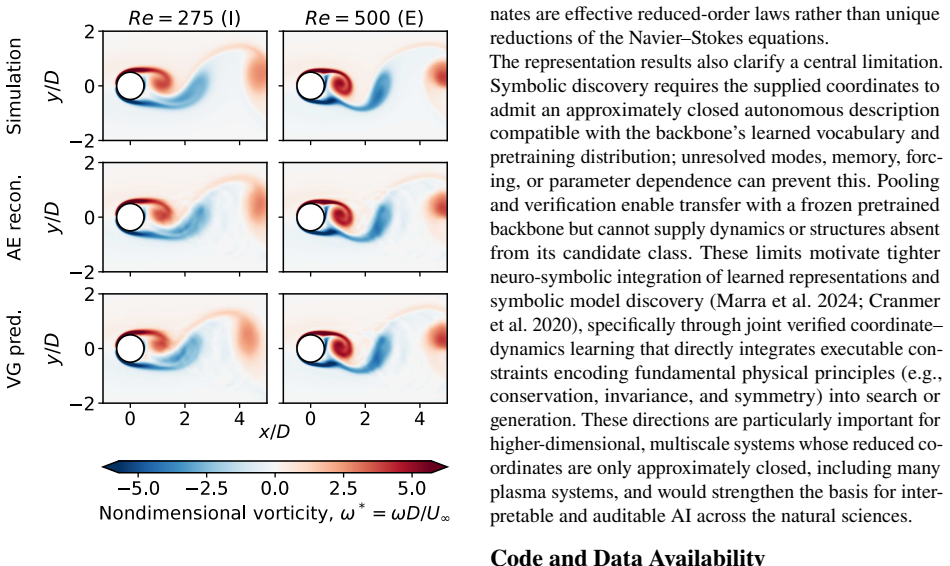
The derivation chain is not circular. ODEFormer is a frozen pretrained backbone; VG only pools, ranks with rollout error on development trajectories, filters by executable verifiers, and refines coefficients. The headline results are measured on data excluded from selection: eight unseen Van der Pol initial conditions (Section 5.1), a held-out 150-snapshot fixed-Re interval (Section 5.2, Table 1), and Reynolds numbers 175/275/425/500 withheld from symbolic discovery (Section 5.3, Table 2). None of the reported test targets enter Lroll, the verifier thresholds, or coefficient optimization. The recovered frequencies in Eq. (12) are post-hoc readings of fitted linear coefficients, not quantities used in the fit; the verifier's frequency check (Eq. S6) is a selection constraint, not a hidden injection of the reported harmonic ratios. Self-citations (Faraji et al. 2025 for numerical preprocessing; Faraji and Reza 2025 for background) are not load-bearing. The paper itself flags the closure-compatibility limitation, and the single successful cross-Re autoencoder is an uncontrolled-run robustness concern, not an Eq.-X-equals-Eq.-Y reduction. Therefore no circular step is exhibited.
Axiom & Free-Parameter Ledger
free parameters (4)
- Verifier tolerances (amplitude, period, CV, local factor, bound factor) =
amplitude 0.15, period 0.10, amplitude CV 0.10, period CV 0.05, local factor 2.0, bound factor 1.5 (VdP) / 3.0 (flow)
- Beam size and sampling temperature =
beam=20, temperature=0.1
- POD rank and decoding window count (fixed-Re) =
rank=6, windows=8
- Autoencoder architecture (cross-Re) =
shallow, one hidden layer width 256
axioms (4)
- domain assumption Reduced coordinates form an approximately closed autonomous dynamical system
- domain assumption ODEFormer's pretrained symbolic vocabulary can express the reduced dynamics
- standard math Numerical integration, POD, FFT, and autoencoder training are correct and sufficiently accurate
- domain assumption 2D cylinder flow at Re 150-500 is characterized by periodic vortex shedding with low-dimensional attractor
Cite this review
Pith. "Pith review of Verifier-Guided Model Discovery for Physical Dynamical Systems with Pretrained Symbolic Transformers." pith.science (2026). https://pith.science/paper/XFA6I57P
@misc{pith2026260802662,
  author       = {Pith},
  title        = {Pith review of: Verifier-Guided Model Discovery for Physical Dynamical Systems with Pretrained Symbolic Transformers},
  year         = {2026},
  howpublished = {\url{https://pith.science/paper/XFA6I57P}},
  note         = {Machine review of arXiv:2608.02662}
}
read the original abstract
Reliable forecasting of nonlinear physical systems underpins scientific discovery and engineering decision-making. Yet high-fidelity simulations are prohibitively costly, and machine-learning surrogates can be opaque and encode assumptions about system dynamics, limiting generalizability. Pretrained transformers mapping synthetic ODE trajectories to equations offer interpretable alternatives, promising transfer without system-specific equation knowledge. Transferring them reliably to high-dimensional physical data, however, remains an open challenge. We develop a verifier-guided (VG) workflow around ODEFormer as a symbolic backbone, using dynamical and physical-admissibility criteria to select from a multi-trajectory candidate equation pool, enabling transfer. On canonical Van der Pol oscillators, VG outperforms the original ODEFormer workflow across held-out initial conditions. We then address vortex shedding, a phenomenon occurring in atmospheric and plasma systems of societal relevance, through coordinate reduction and symbolic discovery at fixed and varying Reynolds numbers. VG discovers fixed-parameter reduced-order equations that recover the fundamental shedding oscillator and higher harmonics without a wake-specific candidate library or prescribed Navier-Stokes structure, while the cross-parameter model generalizes to withheld regimes. Reconstruction fidelity alone did not determine symbolic discoverability, highlighting the importance of compatibility between latent dynamics and the backbone's pretraining distribution. This work establishes a verifier-guided neural-to-symbolic methodology for interpretable and physically auditable forecasting in the natural sciences.
Figures


Reference graph
Works this paper leans on
- [1]
-
[2]
Collection of Images Captured by Himawari-8/9: Karman Vortex , year =
-
[3]
Meteorology and Atmospheric Physics , volume =
Etling, Dieter , title =. Meteorology and Atmospheric Physics , volume =. 1990 , doi =
work page 1990
-
[4]
Williamson, C. H. K. and Govardhan, R. , title =. Annual Review of Fluid Mechanics , volume =. 2004 , doi =
work page 2004
-
[5]
Gruszecki, M. and Nakariakov, V. M. and Van Doorsselaere, T. and Arber, T. D. , title =. Physical Review Letters , volume =. 2010 , doi =
work page 2010
-
[6]
Bailung, Y. and Chutia, B. and Deka, T. and Boruah, A. and Sharma, S. K. and Kumar, S. and Chutia, J. and Nakamura, Y. and Bailung, H. , title =. Physics of Plasmas , volume =. 2020 , doi =
work page 2020
-
[7]
Quarterly of Applied Mathematics , volume =
Sirovich, Lawrence , title =. Quarterly of Applied Mathematics , volume =. 1987 , doi =
work page 1987
- [8]
-
[9]
and Proctor, Joshua L
Brunton, Steven L. and Proctor, Joshua L. and Kutz, J. Nathan , title =. Proceedings of the National Academy of Sciences , volume =. 2016 , doi =
2016
-
[10]
Askham, Travis and Kutz, J. Nathan , title =. SIAM Journal on Applied Dynamical Systems , volume =. 2018 , doi =
work page 2018
-
[11]
Faraji, Farbod and Reza, Maryam and Knoll, Aaron and Kutz, J. Nathan , title =. Journal of Physics D: Applied Physics , volume =. 2024 , doi =
work page 2024
-
[12]
Chen, Ricky T. Q. and Rubanova, Yulia and Bettencourt, Jesse and Duvenaud, David K. , title =. Advances in Neural Information Processing Systems , volume =
-
[13]
International Conference on Learning Representations , year =
Li, Zongyi and Kovachki, Nikola and Azizzadenesheli, Kamyar and Liu, Burigede and Bhattacharya, Kaushik and Stuart, Andrew and Anandkumar, Anima , title =. International Conference on Learning Representations , year =
-
[14]
Journal of Computational Physics , volume =
Raissi, Maziar and Perdikaris, Paris and Karniadakis, George Em , title =. Journal of Computational Physics , volume =. 2019 , doi =
2019
-
[15]
Advances in Neural Information Processing Systems , volume =
Greydanus, Samuel and Dzamba, Misko and Yosinski, Jason , title =. Advances in Neural Information Processing Systems , volume =
-
[16]
Physics-Informed Neural Networks with Hard Constraints for Inverse Design , journal =
Lu, Lu and Pestourie, Rapha. Physics-Informed Neural Networks with Hard Constraints for Inverse Design , journal =. 2021 , doi =
work page 2021
-
[17]
Messenger, Daniel A. and Bortz, David M. , title =. Journal of Computational Physics , volume =. 2021 , doi =
work page 2021
-
[18]
Fasel, Urban and Kutz, J. Nathan and Brunton, Bingni W. and Brunton, Steven L. , title =. Proceedings of the Royal Society A: Mathematical, Physical and Engineering Sciences , volume =. 2022 , doi =
work page 2022
- [19]
- [20]
-
[21]
Journal of Applied Physics , volume =
Faraji, Farbod and Reza, Maryam and Knoll, Aaron , title =. Journal of Applied Physics , volume =. 2025 , doi =
work page 2025
-
[22]
Discovery of Nonlinear Dynamics with Automated Basis Function Generation
Basiri, Mohammad Amin and Nicholson, Charles , title =. arXiv preprint arXiv:2605.09696 , year =
work page internal anchor Pith review Pith/arXiv arXiv
-
[23]
Udrescu, Silviu-Marian and Tegmark, Max , title =. Science Advances , volume =. 2020 , doi =
work page 2020
-
[24]
arXiv preprint arXiv:2107.07345 , year =
Weilbach, Juliane and Gerwinn, Sebastian and Weilbach, Christian and Kandemir, Melih , title =. arXiv preprint arXiv:2107.07345 , year =
-
[25]
Probabilistic Grammars for Equation Discovery , journal =
Brence, Jure and Todorovski, Ljup. Probabilistic Grammars for Equation Discovery , journal =. 2021 , doi =
work page 2021
-
[26]
Omejc, Nina and Gec, Bo. Probabilistic Grammars for Modeling Dynamical Systems from Coarse, Noisy, and Partial Data , journal =. 2024 , doi =
work page 2024
-
[27]
and Landajuela, Mikel and Mundhenk, T
Petersen, Brenden K. and Landajuela, Mikel and Mundhenk, T. Nathan and Santiago, Claudio P. and Kim, Soo K. and Kim, Joanne T. , title =. International Conference on Learning Representations , year =
-
[28]
arXiv preprint arXiv:2106.14131 , year =
Valipour, Mojtaba and You, Bowen and Panju, Maysum and Ghodsi, Ali , title =. arXiv preprint arXiv:2106.14131 , year =
- [29]
-
[30]
The Twelfth International Conference on Learning Representations , year =
d'Ascoli, St. The Twelfth International Conference on Learning Representations , year =
-
[31]
and Hochhalter, Jacob and Zhe, Shandian , title =
Bastiani, Zachary and Kirby, Robert M. and Hochhalter, Jacob and Zhe, Shandian , title =. arXiv preprint arXiv:2505.24776 , year =
-
[32]
Taskin, Bilge and Xie, Wenxiong and Lazebnik, Teddy , title =. Scientific Reports , volume =. 2026 , doi =
work page 2026
-
[33]
arXiv preprint arXiv:2602.13021 , year =
Xiao, Jing and Chen, Xinhai and Peng, Jiaming and Wang, Qinglin and Jia, Menghan and Lai, Zhiquan and Yu, Guangping and Li, Dongsheng and Li, Tiejun and Liu, Jie , title =. arXiv preprint arXiv:2602.13021 , year =. doi:10.48550/arXiv.2602.13021 , url =
-
[34]
Neuro-Symbolic ODE Discovery with Latent Grammar Flow
Yu, Karin and Chatzi, Eleni and Kissas, Georgios , title =. arXiv preprint arXiv:2604.16232 , year =. doi:10.48550/arXiv.2604.16232 , url =
work page internal anchor Pith review Pith/arXiv arXiv doi:10.48550/arxiv.2604.16232
-
[35]
NeurIPS 2025 Workshop on Machine Learning and the Physical Sciences , year =
Predicting Symbolic. NeurIPS 2025 Workshop on Machine Learning and the Physical Sciences , year =. doi:10.48550/arXiv.2510.23295 , url =
-
[36]
arXiv preprint arXiv:2305.01582 , year =
Cranmer, Miles , title =. arXiv preprint arXiv:2305.01582 , year =
-
[37]
Journal of Physics D: Applied Physics , volume =
Faraji, Farbod and Reza, Maryam , title =. Journal of Physics D: Applied Physics , volume =. 2025 , doi =
work page 2025
-
[38]
Eldredge, Jeff D. , title =. 2021 , howpublished =. doi:10.5281/zenodo.4776967 , url =
-
[39]
From Statistical Relational to Neurosymbolic Artificial Intelligence: A Survey , journal =
Marra, Giuseppe and Duman. From Statistical Relational to Neurosymbolic Artificial Intelligence: A Survey , journal =. 2024 , doi =
work page 2024
-
[40]
Advances in Neural Information Processing Systems , volume =
Cranmer, Miles and Sanchez-Gonzalez, Alvaro and Battaglia, Peter and Xu, Rui and Cranmer, Kyle and Spergel, David and Ho, Shirley , title =. Advances in Neural Information Processing Systems , volume =
-
[41]
Proceedings of the 38th International Conference on Machine Learning , series =
Neural Symbolic Regression That Scales , author =. Proceedings of the 38th International Conference on Machine Learning , series =. 2021 , publisher =
work page 2021
-
[42]
Advances in Neural Information Processing Systems , volume =
End-to-End Symbolic Regression with Transformers , author =. Advances in Neural Information Processing Systems , volume =
discussion (0)
Sign in with ORCID, Apple, or X to comment. Anyone can read and Pith papers without signing in.