REVIEW 2 major objections 7 minor 1 cited by
Emergent boundary supersymmetry in a one dimensional superconductor
T0 review · 2 major / 7 minor · reviewed 2026-08-07 · deepseek-v4-flash
Pith's one-line read Coupling a one-dimensional spin-singlet superconductor to spin-1/2 impurities at both ends produces a nine-fold degenerate boundary spectrum at a special coupling point, organized by the supersymmetric algebra spl(2,1)⊗spl(2,1) and giving…
desk verdict Read this one: a real two-impurity Bethe ansatz extension with a clean derivation of the supersymmetric point, but the nine-state counting rests on an unproven boundary-string classification that a referee should push to tighten. read the letter →
The pith
A machine-rendered reading of the paper's core claim, the machinery that carries it, and where it could break.
The reading
What carries the argument
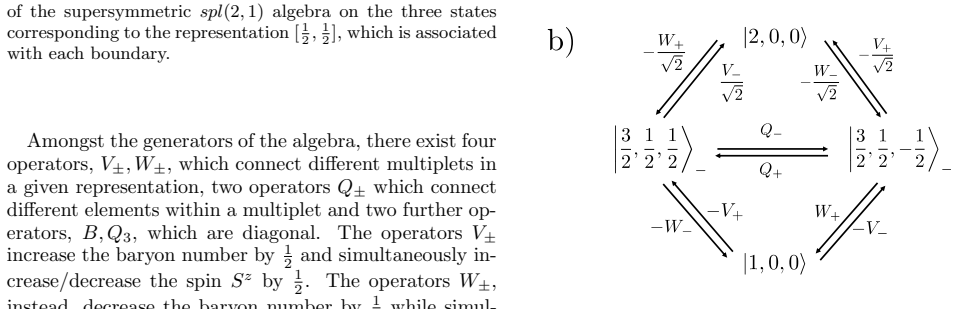
The argument runs through the nested coordinate Bethe ansatz for the Gross-Neveu model with two boundary impurities. The single-particle momenta are quantized by boundary S-matrices satisfying reflection equations; the spin sector is governed by Bethe equations whose RG-invariant boundary parameters d_m (real or imaginary, d_m = i a_m) encode the impurity couplings. The low-energy states correspond to real Bethe roots plus a unique short boundary string λ_bs = ±i(a_m - 1/2) per edge, which represents a bound state of energy -Δ sin(a_m π). The screened and unscreened impurity configurations form the three-state representation [1/2,1/2] of the spl(2,1) superalgebra at each edge, and their tensor product splits as [1,1]⊕[3/2,1/2]; at a_A=a_B=1 the generators V±, W±, Q±, Q3, B of each edge combine into the exact zero-energy operators Σ^x_+, Σ^x_-, Σ^z.
What would settle it
Solve the two-boundary Bethe equations (19) numerically in the regime 1/2 < a < 3/2 and enumerate all solutions with |Im λ| < 1; finding any short string other than ±i(a - 1/2) would add states beyond the nine and break the claimed degeneracy. Alternatively, diagonalize a lattice regularization of the model (for example with DMRG) at a_A = a_B = 1 and check whether exactly nine states become degenerate in the thermodynamic limit and whether the operators Σ^x_+, Σ^x_-, Σ^z of Eqs. (47)-(49) act as zero-energy modes with the stated action on those states.
Extended reading notes
Core claim
The central claim is that at the supersymmetric point a_A=a_B=1, the boundary bound state at each edge has spin energy E_spin,m = -Δ sin(a_m π), which vanishes exactly; consequently the nine low-energy states tabulated in Table I are degenerate in the thermodynamic limit. These nine states decompose as [1/2,1/2]⊗[1/2,1/2] = [1,1]⊕[3/2,1/2] under spl(2,1)⊗spl(2,1), and the operators Σ^x_+, Σ^x_-, and Σ^z in Eqs. (47)-(49) are exact zero-energy modes in the odd fermion parity sector, mapping the states of the [1,1] representation onto those of [3/2,1/2] and vice versa.
Load-bearing premise
The calculation assumes that the Bethe ansatz is complete: that only real Bethe roots plus the short boundary string λ_bs = ±i(a_m - 1/2) contribute to the low-energy spectrum, and no other string solutions or missing roots add states; the uniqueness of that boundary string is asserted by observation (Appendix B.4) rather than proven, and no completeness proof for the two-boundary Bethe ansatz is given.
Editorial extensions
If this is right
- At a_A=a_B=1, the ground-state manifold of the YSR-YSR phase is nine-fold degenerate, and the supersymmetry of the boundary degrees of freedom is restored in the thermodynamic limit.
- The boundary bound-state energy E_spin = -Δ sin(a π) changes sign across a=1, so each impurity undergoes a first-order quantum phase transition between screened and unscreened ground states.
- The three operators Σ^x_+, Σ^x_-, Σ^z are exact zero-energy modes in the odd fermion parity sector at the supersymmetric point.
- Exact zero-energy modes require two boundaries: with a single impurity no exact ZEM exists, because removing the boundary bound state costs a charging energy of order 1/L.
Reading between the lines
- If the nine-fold degeneracy is robust to perturbations that preserve the spl(2,1) algebra, the boundary Hilbert space at the supersymmetric point could serve as a protected degenerate subspace, potentially useful for quantum information; the paper does not claim this.
- The same algebra structure may appear in other exactly solvable models with dynamical boundaries, such as coupled Kondo impurities in gapped spin chains; checking for an analogous supersymmetric point in those models would test the generality of the mechanism.
- A direct numerical check of Bethe-string completeness—enumerating all low-lying solutions of the two-boundary Bethe equations—would settle whether the supersymmetric degeneracy at a=1 is exact or an artifact of the assumed root configuration; the paper leaves this open.
- The open question the authors raise, whether the nine degenerate ground states carry local fractional boundary quantum numbers, could be addressed by computing spin profiles and entanglement spectra in a lattice realization of the model.
Editorial analysis
A structured set of objections, weighed in public.
Referee Report
Summary. This paper studies a one-dimensional spin-singlet superconductor (Gross-Neveu model) coupled at both boundaries to spin-1/2 magnetic impurities via spin-exchange interactions. Using nested coordinate Bethe ansatz, the authors solve the model and obtain a boundary phase diagram with Kondo, Yu-Shiba-Rusinov (YSR), and unscreened phases at each edge. In the YSR-YSR phase the low-energy boundary Hilbert space contains nine states; at the point a_A=a_B=1, where the boundary string energy E_bound=-Delta sin(a pi) vanishes, these nine states become degenerate in the thermodynamic limit. The authors show that they realize the representation [1/2,1/2] tensor [1/2,1/2] = [1,1] direct sum [3/2,1/2] of spl(2,1) tensor spl(2,1), and construct operators Sigma^x_+, Sigma^x_-, and Sigma^z, Eqs. (47)-(49), that map between odd-parity states and are claimed to be exact zero-energy modes.
Significance. If the low-energy spectral classification is complete, this is a significant exact result: a two-boundary integrable model with dynamical boundary degrees of freedom exhibiting emergent boundary supersymmetry, an explicit zero-energy-mode construction, and a full phase diagram. The derivation of the boundary string energy, the integral-equation analysis, and the explicit Clebsch-Gordan decomposition are careful and internally consistent, and the paper is unusually self-contained. The central caveat is that the nine-state counting relies on an unproven completeness assumption for the boundary Bethe ansatz, so the result is conditional on closing that gap.
major comments (2)
- [Appendix B.4, Eq. (19)] The nine-state counting at the YSR-YSR supersymmetric point, and hence the irreducible decomposition in Eq. (44) and the zero-energy operators in Eqs. (47)-(52), rests on the assumption that the low-energy spectrum contains exactly the states built from real Bethe roots plus the two boundary strings lambda_bs = +/-i(a_m-1/2) and lambda_bs' = +/-i(3/2-a_m). In Appendix B.2 the uniqueness of lambda_bs is asserted 'by observation', and in Appendix B.4 a second boundary string is introduced without a systematic derivation. No completeness proof for the two-boundary coordinate Bethe ansatz is provided, and it is not shown that other complex-root configurations (bulk strings, additional boundary strings) cannot produce states inside the superconducting gap. Since an extra low-energy state would change the dimension of the low-energy Hilbert space and destroy the claimed multiplet structure, this gap is load-bearing. I request a proof of completeness of the Bethe ansatz solution, or at least a systematic classification of all solutions to Eq. (19) in the thermodynamic limit, supplemented where possible by independent numerical evidence (for example DMRG) that the low-energy spectrum at a_A=a_B=1 is exactly nine-dimensional.
- [Secs. IV.B.1 and VI.A, Eqs. (47)-(52)] The paper calls the operators (47)-(52) 'exact zero energy modes', but their action is demonstrated only on the four odd-parity states, and the degeneracy of those states at the supersymmetric point is stated to hold only up to exponential accuracy e^{-L} in the system size. At finite L, the full Hamiltonian therefore does not strictly commute with these operators on the ground subspace, and no computation of [H,Sigma] is given. Please clarify in what sense the modes are 'exact' -- for example, by specifying that they are zero modes of the effective low-energy Hamiltonian in the thermodynamic limit -- or provide a proof that the commutator vanishes exactly in that limit.
minor comments (7)
- [Eq. (A7)] The definition of c_m in Eq. (A7) appears inverted relative to Eq. (13); it should read c_m = 2J_m/(1-3J_m^2/4), and the denominator '2J' should be '2J_m'.
- [Fig. 2 caption] The caption contains the typo 'irreducbible'; it should be 'irreducible'.
- [Appendix B.2 heading] The phase heading 'YSR-Kondo (YSR-K)' is inconsistent with the main-text notation 'Kondo-YSR (K-YSR)'; please unify the terminology.
- [Sec. IV.B.1] The phrase 'exponentially degenerated' should be 'exponentially degenerate'.
- [References] Reference [8] duplicates reference [4], and the author list of [12] appears corrupted ('Glazman, and Glazman').
- [Eq. (49)] The operator B_A in Eq. (49) is not explicitly defined; please state that it is the baryon number operator at edge A.
- [Sec. V] The algebra name is typeset inconsistently ('spl(2,1)' in the text and 'SPL(2,1)' in Appendix C); please unify the notation.
Circularity Check
No circular reduction found: the a_A=a_B=1 supersymmetric point, the nine-state degeneracy, and the Σ^x_±, Σ^z zero modes follow from a self-contained Bethe-ansatz derivation of E_bound = −Δ sin(πa) plus an explicit Clebsch–Gordan check; the load-bearing weakness is an unproven boundary-string exhaustiveness assertion (App. B.2/B.4), a completeness gap, not circularity.
full rationale
The derivation chain is: bare couplings (g, J_A, J_B) → RG invariants b and d_m (Eq. 20, d_m = √(b² − 2b/c_m − 1)) → Bethe equations (19)/(A34) via the two-boundary transfer matrix (App. A) → boundary string classification (App. B) → bound-state spin energy E_spin,m = −Δ sin(π a_m) (Eq. B27, obtained by evaluating the Fourier integral B24) → supersymmetric point a_A = a_B = 1 where both bound states cost zero spin energy → nine degenerate states (Table I) → spl(2,1)⊗spl(2,1) labels with decomposition [1/2,1/2]⊗[1/2,1/2] = [1,1]⊕[3/2,1/2], verified by explicit generator actions in App. C and the Clebsch–Gordan table (Table III) → zero-energy operators Σ (47)–(49) verified by the explicit actions (50)–(52). No target quantity is inserted as an input. The supersymmetric point is not fitted: a_m is fixed by the coupling constants, and the condition a = 1 is the derived zero of the derived function E_spin = −Δ sin(π a). The nine-state degeneracy likewise follows from that energy formula plus the a_A = a_B symmetry, with the e^{−L} odd-parity and 1/L even-parity caveats stated honestly in Secs. IV.B.1 and VI. The ZEM claim is a verification: Σ^z = 4B_A − 3 maps the symmetric to the antisymmetric odd-parity combination by direct computation of the baryon-number eigenvalues, and the odd-parity states are degenerate because both one-string states carry the same bound-state energy, which vanishes at a = 1. The representation-theory input is external (Ref. [46], Scheunert–Nahm–Rittenberg), and the matching of physical states to multiplets is checked, not assumed. Self-citations [36, 41] supply single-impurity inputs (Kondo temperature (27), the impurity DOS (25), the wide-string terminology) that are background for the central YSR-YSR claim; the two-impurity Bethe equations and the bound-state energy formula are rederived in-paper (Apps. A–B), so the self-citations are not load-bearing. Flagged per the in-scope-evidence rule: the paper's weakest step is the string classification. App. B.2 asserts 'By observation we see that, in the limit N_e → ∞, for a_B > 1/2, the Bethe equations (19) have a unique solution λ_bsB = ±i(a_B − 1/2)', and App. B.4 then introduces 'another boundary string solution λ_bsB′ = ±i(3/2 − a_B)' with no exhaustiveness proof. The nine-state count, the supersymmetric degeneracy at a = 1, and the Σ zero-mode claim all rest on this classification being complete.
Assumptions & free parameters
assumptions (3)
- domain assumption Bethe ansatz completeness: the N-particle wavefunction with the given S-matrices and transfer matrices diagonalizes the full spectrum.
- domain assumption The only relevant Bethe root configurations below the gap are real roots and short boundary strings; wide boundary strings do not produce mid-gap states.
- ad hoc to paper The physical boundary states at each edge form the [1/2,1/2] representation of spl(2,1), and the low-energy effective Hamiltonian is governed by the abstract generators Q, V, W.
Cite this review
Pith. "Pith review of Emergent boundary supersymmetry in a one dimensional superconductor." pith.science (2026). https://pith.science/paper/3H4MLDWB
@misc{pith2026250524777,
  author       = {Pith},
  title        = {Pith review of: Emergent boundary supersymmetry in a one dimensional superconductor},
  year         = {2026},
  howpublished = {\url{https://pith.science/paper/3H4MLDWB}},
  note         = {Machine review of arXiv:2505.24777}
}
abstract
The interplay between bulk properties and boundary conditions in one-dimensional quantum systems, gives rise to many intriguing phenomena. These include the emergence of zero energy modes which are of significant interest to a variety of fields. In this work we investigate the presence of such zero modes in cases where the boundary conditions are dynamical and arise due to the coupling to some quantum degrees of freedom. In particular, we study a one-dimensional spin-singlet superconductor, modeled by the Gross-Neveu field theory, coupled to spin $\frac{1}{2}$ magnetic impurities at its boundaries via a spin-exchange interaction. We solve the model exactly for arbitrary values of the bulk and the impurity coupling strengths using nested coordinate Bethe ansatz and show that the system exhibits a rich boundary phase structure. For a range of couplings, the low energy degrees of freedom form irreducible representations of the supersymmetric $spl(2,1)\otimes spl(2,1)$ algebra which become degenerate at a specific point, indicating the emergence of supersymmetry in the low energy boundary degrees of freedom. We show that at the supersymmetric point there exist exact zero energy modes that map one ground state with the other. We express these in terms of the generators of the algebra.
Figures


Figures from the paper (1 more)
Forward citations
Cited by 1 Pith paper
-
Thermodynamics in a split Hilbert space: Quantum impurity at the edge of a one-dimensional superconductor
A Bethe-ansatz analysis yields the impurity entropy across the four phases and predicts entropy overshoots above ln 2 when a midgap YSR bound state is thermally activated.
Reference graph
Works this paper leans on
-
[1]
Due to this, these two states are degenerate up to exponential in the system size∼e −L
Supersymmetric point Notice that in the YSR-YSR phase, whena A =a B, the two states|S;US⟩ ±1/2 and|US;S⟩ ±1/2, in which one of the impurity is screened whereas the other is unscreened belong to the odd fermionic parity sector, and the en- ergy of the bound state corresponding to the left and the right boundaries has the same energy. Due to this, these two...
-
[2]
Chen, Z.-C
X. Chen, Z.-C. Gu, Z.-X. Liu, and X.-G. Wen, Phys. Rev. B87, 155114 (2013)
2013
-
[3]
Affleck, T
I. Affleck, T. Kennedy, E. H. Lieb, and H. Tasaki, Phys. Rev. Lett.59, 799 (1987)
1987
-
[4]
Haldane, Physics Letters A93, 464 (1983)
F. Haldane, Physics Letters A93, 464 (1983)
1983
-
[6]
S. D. Sarma, M. Freedman, and C. Nayak, npj Quantum Information1, 15001 (2015)
2015
-
[7]
Alicea, Reports on Progress in Physics75, 076501 (2012)
J. Alicea, Reports on Progress in Physics75, 076501 (2012)
2012
-
[8]
Realizing a symmetry protected topological phase in a superconduct- ing circuit,
P. R. Pasnoori, P. Azaria, and A. Mizel, “Realizing a symmetry protected topological phase in a superconduct- ing circuit,” (2025), arXiv:2503.13406 [quant-ph]
arXiv 2025
-
[9]
Keselman and E
A. Keselman and E. Berg, Phys. Rev. B91, 235309 (2015)
2015
Show all 63 references
-
[10]
Boulat, P
E. Boulat, P. Azaria, and P. Lecheminant, Nucl. Phys. B.822, 367 (2009). 12
2009
-
[11]
C. Chen, W. Yan, C. Ting, Y. Chen, and F. Burnell, Phys. Rev. B48, 161106 (2018)
2018
-
[12]
Iemini, L
F. Iemini, L. Mazza, D. Rossini, R. Fazio, and S. Diehl, Phys. Rev. Lett.115, 156402 (2015)
2015
-
[13]
O. A. Starykh, D. L. Maslov, W. H¨ ausler, L. I. Glazman, and Glazman, inLow-Dimensional Systems, edited by T. Brandes (Springer Berlin Heidelberg, Berlin, Heidel- berg, 2000) pp. 37–78
2000
-
[14]
Ruhman, E
J. Ruhman, E. G. Dalla Torre, S. D. Huber, and E. Alt- man, Phys. Rev. B85, 125121 (2012)
2012
-
[15]
C. V. Kraus, M. Dalmonte, M. A. Baranov, A. M. L¨ auchli, and P. Zoller, Phys. Rev. Lett.111, 173004 (2013)
2013
-
[16]
J. Sun, S. Gangadharaiah, and O. A. Starykh, Phys. Rev. Lett.98, 126408 (2007)
2007
-
[17]
den Nijs and K
M. den Nijs and K. Rommelse, Phys. Rev. B40, 4709 (1989)
1989
-
[18]
Pollmann, A
F. Pollmann, A. M. Turner, E. Berg, and M. Oshikawa, Phys. Rev. B81, 064439 (2010)
2010
-
[19]
Duality symmetry, zero energy modes and boundary spectrum of the sine-gordon/massive thirring model,
P. R. Pasnoori, A. Mizel, and P. Azaria, “Duality symmetry, zero energy modes and boundary spectrum of the sine-gordon/massive thirring model,” (2025), arXiv:2503.14776 [hep-th]
2025 arXiv
-
[20]
Fendley, Journal of Physics A: Mathematical and The- oretical49, 30LT01 (2016)
P. Fendley, Journal of Physics A: Mathematical and The- oretical49, 30LT01 (2016)
2016
-
[21]
Grijalva, J
S. Grijalva, J. Nardis, and V. Terras, SciPost Physics7 (2019), 10.21468/SciPostPhys.7.2.023
2019 doi
-
[22]
Spin fractionalization and zero modes in the spin- 1 2 xxz chain with boundary fields,
P. R. Pasnoori, Y. Tang, J. Lee, J. H. Pixley, N. Andrei, and P. Azaria, “Spin fractionalization and zero modes in the spin- 1 2 xxz chain with boundary fields,” (2023), arXiv:2312.05970 [cond-mat.str-el]
2023 arXiv
-
[23]
P. R. Pasnoori, N. Andrei, and P. Azaria, Phys. Rev. B 104, 134519 (2021)
2021
-
[24]
P. R. Pasnoori, N. Andrei, and P. Azaria, Phys. Rev. B 102, 214511 (2020)
2020
-
[25]
Kondo, Progress of Theoretical Physics32, 37 (1964)
J. Kondo, Progress of Theoretical Physics32, 37 (1964)
1964
-
[26]
C. P. Moca, I. Weymann, M. A. Werner, and G. Zar´ and, Phys. Rev. Lett.127, 186804 (2021)
2021
-
[27]
Kattel, P
P. Kattel, P. R. Pasnoori, J. H. Pixley, P. Azaria, and N. Andrei, Phys. Rev. B109, 174416 (2024)
2024
-
[28]
Kattel, P
P. Kattel, P. R. Pasnoori, J. H. Pixley, and N. Andrei, Phys. Rev. B111, 174430 (2025)
2025
-
[29]
Kattel, A
P. Kattel, A. Zhakenov, P. R. Pasnoori, P. Azaria, and N. Andrei, Phys. Rev. B111, L201106 (2025)
2025
-
[30]
Kattel, P
P. Kattel, P. R. Pasnoori, J. H. Pixley, and N. Andrei, Phys. Rev. B (2025), 10.1103/sj42-jxrh
2025 doi
-
[31]
Manaparambil, C
A. Manaparambil, C. P. Moca, G. Zar´ and, and I. Wey- mann, (2024), arXiv:2412.13687 [cond-mat.mes-hall]
2024
-
[32]
Andrei, Phys
N. Andrei, Phys. Rev. Lett.45, 379 (1980)
1980
-
[33]
Andrei, K
N. Andrei, K. Furuya, and J. H. Lowenstein, Rev. Mod. Phys.55, 331 (1983)
1983
-
[34]
Luh, Acta Physica Sinica21, 75 (1965)
Y. Luh, Acta Physica Sinica21, 75 (1965)
1965
-
[35]
Shiba, Progress of Theoretical Physics40, 435 (1968)
H. Shiba, Progress of Theoretical Physics40, 435 (1968)
1968
-
[36]
A. I. Rusinov, JETP Lett. (USSR) (Engl. Transl.); (United States)9(1969)
1969
-
[37]
P. R. Pasnoori, N. Andrei, C. Rylands, and P. Azaria, Phys. Rev. B105, 174517 (2022)
2022
-
[38]
We do naturally expect that the impurity is partially screened, but eventually be- comes unscreened deep in the unscreened phasea≫1
In the unscreened phase, there exists residual antiferro- magnetic coupling between the impurity and the bulk, but the interaction strength is not strong enough to com- pletely screen the impurity. We do naturally expect that the impurity is partially screened, but eventually ...
-
[39]
Andrei and J
N. Andrei and J. H. Lowenstein, Phys. Rev. Lett.46, 356 (1981)
1981
-
[40]
Andrei and J
N. Andrei and J. H. Lowenstein, Phys. Rev. Lett.43, 1698 (1979)
1979
-
[41]
Destri and J
C. Destri and J. Lowenstein, Nuclear Physics B205, 369 (1982)
1982
-
[42]
P. R. Pasnoori, C. Rylands, and N. Andrei, Phys. Rev. Research2, 013006 (2020)
2020
-
[43]
E. K. Sklyanin, Journal of Physics A Mathematical Gen- eral21, 2375 (1988)
1988
-
[44]
I. V. Cherednik, Theoretical and Mathematical Physics 61, 977 (1984)
1984
-
[45]
Wang, W.-L
Y. Wang, W.-L. Yang, J. Cao, and K. Shi,Off-diagonal Bethe ansatz for exactly solvable models(Springer, Berlin, 2015)
2015
-
[46]
Wang, Phys
Y. Wang, Phys. Rev. B56, 14045 (1997)
1997
-
[47]
Scheunert, W
M. Scheunert, W. Nahm, and V. Rittenberg, Journal of Mathematical Physics18, 155 (1977)
1977
-
[48]
Jackiw, A
R. Jackiw, A. Kerman, I. Klebanov, and G. Semenoff, Nuclear Physics B225, 233 (1983)
1983
-
[49]
Jackiw and C
R. Jackiw and C. Rebbi, Phys. Rev. D13, 3398 (1976)
1976
-
[50]
Rajaraman,Solitons and Instantons: An Introduc- tion to Solitons and Instantons in Quantum Field The- ory, North-Holland personal library (North-Holland Pub- lishing Company, 1982)
R. Rajaraman,Solitons and Instantons: An Introduc- tion to Solitons and Instantons in Quantum Field The- ory, North-Holland personal library (North-Holland Pub- lishing Company, 1982)
1982
-
[51]
Andrei,Integrable Models in Condensed Matter Physics, Series on Modern Condensed Matter Physics - Vol
N. Andrei,Integrable Models in Condensed Matter Physics, Series on Modern Condensed Matter Physics - Vol. 6, Lecture Notes of ICTP Summer Course, edited by S. Lundquist, G. Morandi, and Y. Lu (World Scientific, 1992, cond-mat/9408101) pp. 458 – 551
1992 arXiv
-
[52]
Quantum inverse scattering method and correlation functions,
V. E. Korepin, A. G. Izergin, and N. M. Bogoliubov, “Quantum inverse scattering method and correlation functions,” (1993), arXiv:cond-mat/9301031 [cond-mat]
1993 arXiv
-
[53]
Ghoshal, International Journal of Modern Physics A 09, 4801 (1994)
S. Ghoshal, International Journal of Modern Physics A 09, 4801 (1994)
1994
-
[54]
Skorik and H
S. Skorik and H. Saleur, Journal of Physics A: Mathe- matical and General28, 6605 (1995). Appendix A: Bethe Ansatz
1995
-
[55]
Hamiltonian The Hamiltonian of the system is H=H GN +H imp,(A1) 13 whereH GN = R L/2 −L/2 dxH GN is the Hamiltonian of the Gross-Neveu (GN) model with HGN =−i(ψ † Ra∂xψRa −ψ † La∂xψLa)−(A2) −2gψ † Raψ† Lc (σx abσx cd +σ y abσy cd +σ z abσz cd)ψ RbψLd, and Himp =−J A⃗ σab · ⃗Sα...
-
[56]
SinceNis a good quantum number we may construct the eigenstates by examining the differentNparticle sectors separately
N-particle solution The Hamiltonian commutes with total particle number, N= R ψ† +(x)ψ+(x) +ψ † −(x)ψ−(x) andHcan be diagonalized by constructing the exact eigenstates in eachNsector. SinceNis a good quantum number we may construct the eigenstates by examining the differentNpa...
-
[57]
Nand the operatorZ j is the transfer matrix for thej th particle given by Z j =W jj−1
Bethe equations Enforcing the boundary conditions on the eigenstate (A22) we obtain the following eigenvalue problem which constrains thek j, e−2ikj LA{σ} {a} [1] = (Zj){σ},{σ} ′ {a},{a}′ A[1]⃗ σ′ ⃗ a′ .(A27) Here1denotes the identity element ofS N , i.e.1= 12. . . Nand the op...
-
[58]
In this phase both impurities are in Kondo phase
Kondo-Kondo phase TheKondo-Kondo(K-K) phase occurs for values ofd A, dB both real or both imaginary witha A, aB < 1 2 . In this phase both impurities are in Kondo phase. Consider first the case whered A, dB are real. The ground state is given by the particular choice of charge...
-
[59]
In this phase the impurity at the left boundary is in YSR phase, where as the impurity at the right boundary is in its Kondo phase
Kondo-YSR phase TheYSR-Kondo(YSR-K) phase occurs ford A real or imaginary witha A < 1 2 andd B imaginary with 1 2 < aB < 3 2 . In this phase the impurity at the left boundary is in YSR phase, where as the impurity at the right boundary is in its Kondo phase. There are two sub-...
-
[60]
In this phase the impurity at the left boundary is in Kondo phase whereas the impurity at the right boundary is in its unscreened phase
Kondo-US phase TheKondo-unscreened(K-US) phase occurs fora B > 3 2 andd A real or imaginary witha A < 1 2 . In this phase the impurity at the left boundary is in Kondo phase whereas the impurity at the right boundary is in its unscreened phase. By considering the state with al...
-
[61]
There are four sub-phases depending on the values ofa A, aB
YSR-YSR phase This phase occurs for 1 2 < aA, aB < 3 2 and both impurities are inY SRphase. There are four sub-phases depending on the values ofa A, aB. Consider the state with all realλ α. Applying logarithm to Bethe equations (19) we obtain X σ=± NeΘ(λα +σb,1/2) + X m=A,B Θ(...
-
[62]
There are four states in which both the impurities are unscreened
-
[63]
There are four states in which one impurity is screened and the other is unscreened
-
[64]
The algebra corresponding to these states isSP L(2,1)
There is one state in which both the impurities are screened. The algebra corresponding to these states isSP L(2,1). In the following we briefly describe this algebra and construct the irreducible representation of the nine degenerate states. There exists a baryon numberband t...
Reviewed August 7, 2026 · model on record in the stance chip above.
Discussion (0). Continue with ORCID to comment.