REVIEW 3 major objections 5 minor 22 references
Closed-form survival probabilities for biased random walks at arbitrary step number
T0 review · 3 major / 5 minor · reviewed 2026-08-07 · deepseek-v4-flash
Pith's one-line read This paper derives exact finite-N formulas for the survival probability of a biased random walker, and finds a critical bias near $1/\sqrt{3}$ where the last-passage tail changes shape.
desk verdict The exact survival-probability formulas are solid and useful, but the headline critical-bias claim about last-passage tails is not established in the manuscript as submitted. read the letter →
The pith
A machine-rendered reading of the paper's core claim, the machinery that carries it, and where it could break.
The reading
What carries the argument
The $m$th Catalan trapezoid $C_m(n,k)$ counts the number of $n$-right, $k$-left sequences whose running sum never falls below $1-m$; multiplying each count by $p^{N-k}q^k$ and summing gives $R(N)$ as a finite sum. The paper's key move is to re-index that sum and identify the resulting sums with Gauss hypergeometric functions, yielding closed forms whose arguments depend on the parity of $N+m$. For the last-passage probability, the load-bearing pieces are the closed-form recurrence survival probabilities $S_{\mathrm{odd}}$ and $S_{\mathrm{even}}$ (Eqs. 17 and 18), which multiply the probability of being at the target at step $n$. The critical-bias criterion comes from the sign of the difference between the last two nonzero values of the last-passage probability, $\mathrm{PLP}(N-2)-\mathrm{PLP}(N)$ or $\mathrm{PLP}(N-3)-\mathrm{PLP}(N-1)$.
What would settle it
For a fixed $m$ and large $N$ (say $m=5$, $N=200$), choose $B$ just above the Eq. 19 threshold and enumerate $\mathrm{PLP}(n)$ for every $n$ with $n+m$ even; if the tail from $n=N-10$ to $n=N$ contains any rise between adjacent values, the monotonic-tail criterion is false. Alternatively, evaluating Eq. 8 against direct enumeration of Eq. 2 at small $N$ (say $N=10$, $m=4$, $p=0.3$) would expose any error in the closed form.
Extended reading notes
Core claim
The paper's central assertion is that the survival probability $R(N)$ of a biased random walker who starts at the origin and must avoid a target at $-m$ can be written exactly and in closed form for every $N$, with one formula when $N+m$ is even (Eq. 8) and another when $N+m$ is odd (Eq. 9). The formulas are sums of binomial coefficients and Gauss hypergeometric functions ${}_2F_1$, obtained by evaluating the Catalan-trapezoid sum, and the paper verifies them numerically against Feller's integral expression. From these, first-passage probabilities follow by subtracting adjacent survival probabilities, and the probability of last passage is built as the product of the probability of being at the target at step $n$ and a closed-form recurrence survival probability $S(N-n)$. The paper further claims that the right tail of the last-passage probability becomes monotonic once $|B|$ exceeds the critical value given by Eqs. 19 and 20, which tends to $1/\sqrt{3}$ for large $N$; this contradicts the large-$N$ approximation's prediction of a diverging peak at the end of the walk.
Load-bearing premise
The critical-bias claim assumes that monotonicity of the last-passage tail is decided by the sign of the difference between the final two nonzero values, and the paper's derivation of the inequality is deferred to supplemental material rather than proved in the text.
Editorial extensions
If this is right
- If Eqs. 8 and 9 are right, survival probabilities for any finite $N$ can be evaluated in microseconds rather than by numerically integrating Feller's formula, so intermediate-step and large-$N$ behavior become directly comparable.
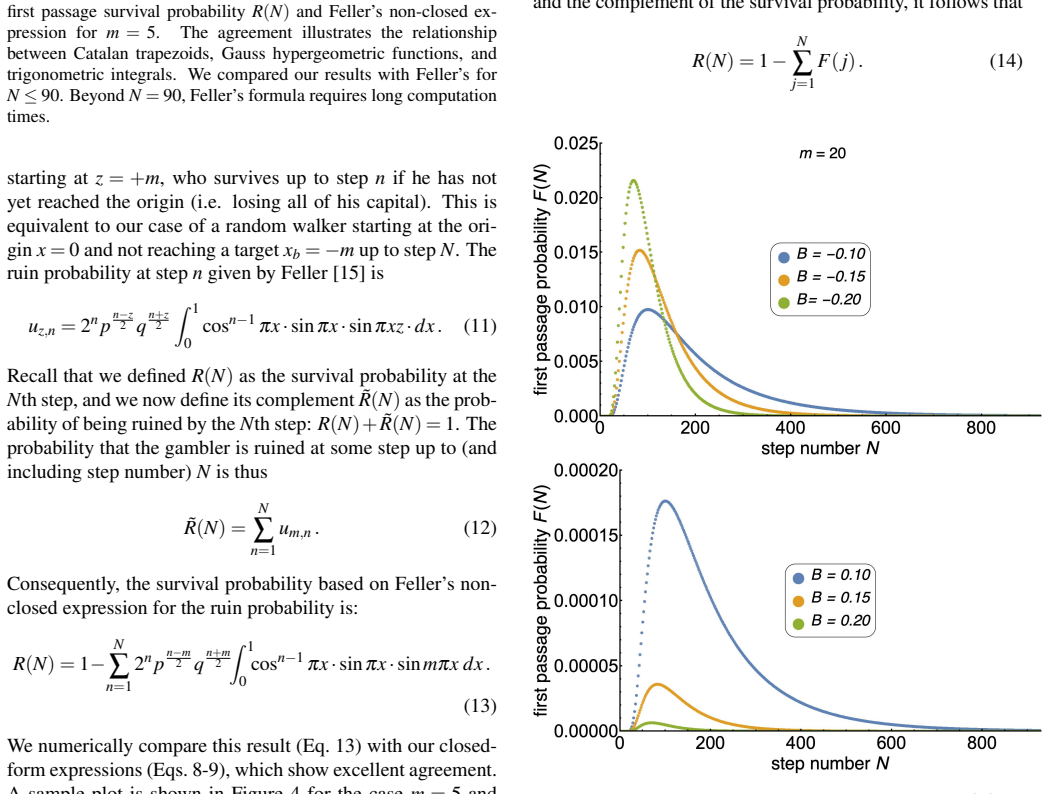
- First-passage probabilities follow immediately as $F(j+1)=-(R(j+1)-R(j))$, giving closed-form finite-$N$ first-passage distributions.
- For positive bias, the survival probability saturates to $1-\gamma^m$; for $p\le q$ it decays to zero.
- For large $N$, any bias magnitude above about $0.577$ forces the last-passage tail to decay monotonically, a finite-$N$ effect hidden by the large-$N$ approximation.
- The same expressions handle a target to the right of the origin after substituting $\gamma=p/q$ and $q$ in place of $p$.
Reading between the lines
- A natural extension is that the same path-enumeration and hypergeometric-summing strategy may yield finite-$N$ closed forms for other countably constrained walk problems, such as walks with multiple targets or absorbing boundaries in higher dimensions.
- The large-$N$ limit $|B_c|\to 1/\sqrt{3}$ is independent of the target distance $m$, suggesting that the monotonic-tail threshold is a universal feature of biased last-passage statistics that could be tested in single-particle tracking or neuronal firing data.
- Because the critical-bias criterion is derived only from the sign of the final two nonzero last-passage values, a direct numerical scan of the full PLP sequence just above the stated threshold would either confirm the monotonic tail or expose a counterexample.
Editorial analysis
A structured set of objections, weighed in public.
Referee Report
Summary. The manuscript derives closed-form expressions for the survival probability of a biased one-dimensional lattice random walker that must avoid a target at -m up to step N. Using Catalan trapezoid path counts and Gauss hypergeometric functions, the authors present formulas R_e(N) and R_o(N) for N+m even and odd (Eqs. 8-9), verify them against Feller's integral formula for N up to 90, and note 10^5-10^6 speedups. They then write the probability of last passage (PLP) as the product of the probability to be at the target at step n and a recurrence survival probability S(N-n) taken from their prior EPL paper, and from the final two nonzero PLP values derive critical bias thresholds (Eqs. 19-20) beyond which the right tail of the PLP is claimed to decay monotonically. The large-N limit of the threshold is |B_c| = 1/sqrt(3), which the authors present as a counterexample to the behavior predicted by the large-N last-return approximation.
Significance. If the results are correct, Eqs. 8-9 provide a genuinely closed-form, finite-N alternative to Feller's integral representation, with practical computational advantages, and the PLP tail criterion would be a useful finite-size correction to large-N bimodal last-passage approximations. The m>N and m=N limits and the numerical comparison with Feller's formula up to N=90 offer credible support for the survival probability formulas. However, the paper's most novel claim, the critical-bias tail-monotonicity threshold, is not supported by any derivation in the submitted manuscript: the proof is relegated to an absent supplemental file, and the criterion that a single final-pair inequality controls the whole tail is not demonstrated. The paper also imports the recurrence survival probability S(N) from the authors' own EPL article without re-derivation, so the critical-bias result rests on a self-cited result.
major comments (3)
- [Section on the critical bias (Eqs. 19-20)] The statement that the sign of PLP(N-2)-PLP(N) (or PLP(N-3)-PLP(N-1)) determines whether the entire right tail of the PLP decreases monotonically is an unproven leap. For even N+m, writing r=(N-m)/2 and P_s=PLP(N-2s) for s=0,...,r, monotone decay requires P_s/P_{s-1}>1 for every s, and this ratio involves S(2s)/S(2s-2) and a coefficient b_s=(r-s+1)(N-r-s+1)/((N-2s+2)(N-2s+1)) that is not constant in s. No argument shows that the final-pair inequality R_1>1 implies all earlier same-parity inequalities. Since the full derivation is deferred to Supplemental Material [20], which is not included with the arXiv submission, the headline critical-bias claim is currently unsupported. Please provide a complete proof or a verifiable derivation.
- [PLP formula, Eq. (16) and Eqs. (17)-(18)] The PLP expression imports the recurrence survival probability S(N) from the authors' own EPL paper [21] without derivation or independent confirmation in this manuscript. Because the critical-bias inequalities are obtained by combining Eq. (16) with these self-cited S_odd and S_even formulas, the central claim depends on an external result that is not re-derived or stated in a self-contained way. The manuscript should either re-derive S(N) or provide a complete, accessible derivation in the supplemental material, and should justify why the recurrence survival probability from [21] is exact for the parity combinations used in the PLP.
- [Derivation of Eqs. (8)-(9)] The central survival probability formulas are presented as end results with the derivation 'provided in the Supplemental Material [20]', but no supplemental file accompanies the arXiv version. Since the exactness of Eqs. (8)-(9) for arbitrary N and bias is the main result, the derivation (or at least the key hypergeometric summation identities and their domains of validity) must appear in the paper or in an accessible supplement. The numerical comparison with Feller and the m>N, m=N checks are reassuring, but they do not replace the derivation.
minor comments (5)
- [Computing time statement after Eq. (13)] The phrase '10^{-5} to 10^{-6} times shorter' should read '10^5 to 10^6 times shorter' (or '10^{-5} to 10^{-6} times as long').
- [Reference [18]] The listed publication year for Abramowitz and Stegun is incorrect; the Handbook was first published in 1964, with later printings, not 1942.
- [Equation (13)] The exponents of p and q are typeset ambiguously; please write p^{(n-m)/2} q^{(n+m)/2} explicitly.
- [Figure 3 and adjacent-step equality] The claim that survival probabilities at adjacent step numbers are equal for N≥m could be stated precisely as R(j)=R(j+1) when arrival at xb=-m is impossible at step j+1, and a short combinatorial proof would help.
- [End of introduction/quote] Please ensure the Feller quote is reproduced verbatim and that the citation includes the correct edition and section.
Circularity Check
The survival-probability closed forms are independently derived and benchmarked, but the PLP critical-bias claim rests on a self-cited recurrence survival formula and on a monotonicity proof deferred to absent Supplemental Material.
-
self citation load bearing
[Section on last passage, Eqs. 16-20]
"The survival probability S(N) appearing in Eq. 16 can be expressed in closed form for odd and even N as [21]: ... Using Eqs. 16, 17, and 18, we find that these inequalities reduce to: |B| > sqrt((N^2 - 2N + m^2)/(3N^2 - 2N - m^2)) for even N + m (19)."
The PLP and hence the critical-bias inequalities (Eqs. 19-20), a headline result, are built on the recurrence survival probability S(N) imported from the authors' own EPL paper [21] without re-derivation or independent check in this manuscript. The critical-bias threshold is not derived from first principles here; it is inherited from a self-cited closed form, making the citation load-bearing. No fitting is involved, but the new claim's foundation is the authors' prior result rather than an external or re-derived one.
-
other
[Critical-bias section, after Eqs. 19-20]
"The sign of this difference determines whether the right tail of the PLP monotonically decreases. Such a condition yields the inequalities ... The full derivation, which we omit here for brevity, can be found in the Supplemental Material [20]."
Not a circular reduction, but an omitted proof that affects the verdict: the manuscript compares only the final two nonzero PLP values (PLP(N-2) vs PLP(N), or PLP(N-3) vs PLP(N-1)) and asserts this controls monotonicity of the entire right tail. The supporting derivation is deferred to a Supplemental Material file not included in the arXiv submission, so the central critical-bias claim cannot be verified from the manuscript alone.
full rationale
The R(N) derivation (Eqs. 1-9) is self-contained: it enumerates survival paths via Catalan trapezoids (Eq. 1), sums them (Eqs. 2-7), and converts the sum to hypergeometric closed forms (Eqs. 8-9). This part is benchmarked against Feller's non-closed integral formula (Eq. 13) with excellent agreement, so it is independently supported and not circular. The PLP calculation (Eq. 16), however, imports S(N) from the authors' own EPL paper [21] without re-derivation, and the critical-bias threshold (Eqs. 19-20) is derived from that self-cited input. Moreover, the paper's claim that the final-pair PLP difference controls monotonicity of the whole tail is explicitly deferred to Supplemental Material [20], which is absent from the arXiv submission. These two issues make the headline critical-bias result depend on self-citation and on an unverified monotonicity lemma, but they do not make the R(N) closed forms circular. Score 4 reflects partial circularity/unsupported loading on self-cited prior work, with an independent core.
Assumptions & free parameters
assumptions (4)
- standard math The number of survival paths with n right steps and k left steps is given by the mth Catalan trapezoid C_m(n,k).
- domain assumption The binomial sums in Eq. 7 can be represented by the Gauss hypergeometric functions shown in Eqs. 8 and 9.
- domain assumption The recurrence survival probability S(N) used for the last passage is given by Eqs. 17-18 from Ref [21], by the same authors.
- ad hoc to paper The sign of the final two nonzero values of the PLP determines monotonicity of the entire right tail.
Cite this review
Pith. "Pith review of Closed-form survival probabilities for biased random walks at arbitrary step number." pith.science (2026). https://pith.science/paper/K3PKRDKO
@misc{pith2026250524814,
  author       = {Pith},
  title        = {Pith review of: Closed-form survival probabilities for biased random walks at arbitrary step number},
  year         = {2026},
  howpublished = {\url{https://pith.science/paper/K3PKRDKO}},
  note         = {Machine review of arXiv:2505.24814}
}
abstract
We present a closed-form expression for the survival probability of a biased random walker to first reach a target site on a 1D lattice. The expression holds for any step number $N$ and is computationally faster than non-closed-form results in the literature. Because our result is exact even in the intermediate step number range, it serves as a tool to study convergence to the large $N$ limit. We also obtain a closed-form expression for the probability of last passage. In contrast to predictions of the large $N$ approximation, the new expression reveals a critical value of the bias beyond which the tail of the last-passage probability decays monotonically.
Figures


Figures from the paper (4 more)



Reference graph
Works this paper leans on
-
[20]
See Supplemental Material
-
[21]
Mookerjee, D. and Kostinski, S., Europhys. Lett. , 149 (6), 62002 (2025)
work page 2025
-
[1]
Bouchaud, J.P., Chaos 15, 26104 (2005)
work page 2005
-
[2]
Bouchaud, J.P., Mezard, M., Potters, M., Quantitative Finance 2, 251 (2002)
work page 2002
-
[3]
Hallatschek, O., Hersen, P., Ramanathan, S., Nelson, DR., Proc. Natl. Acad. Sci. USA 104, 19926 (2007)
work page 2007
-
[4]
Gentili, M., Martini, L., Sponziello, M., and Becchetti, L., Bioinformatics 38, 4145 (2022)
work page 2022
-
[5]
and Avise, J., Genetics 135, 1209 (1993)
Neigel, J. and Avise, J., Genetics 135, 1209 (1993)
work page 1993
-
[6]
Bookstein, F., Paleobiology 13, 446 (1987)
work page 1987
Show all 22 references
-
[7]
Sawyer, S., The Annals of Probability 4, 699 (1976)
1976
-
[8]
Redner, A Guide to First-Passage Processes (Cambridge University Press, New York) 2001
S. Redner, A Guide to First-Passage Processes (Cambridge University Press, New York) 2001
2001
-
[9]
and Haller, E.E., Science 281, 945 (1998)
Queisser, H.J. and Haller, E.E., Science 281, 945 (1998)
1998
-
[10]
and Edgar, T., J
Prabhu, A. and Edgar, T., J. Process Control 19, 1149 (2009)
2009
-
[11]
and Zhang, X.,Chemometrics and Intelligent Laboratory Systems 136, 47 (2014)
Li, Y . and Zhang, X.,Chemometrics and Intelligent Laboratory Systems 136, 47 (2014)
2014
-
[12]
N., Sahlberg, I., P ¨oyh¨onen, K., Ojanen, T., Phys
Duda, R., Ivaki, M. N., Sahlberg, I., P ¨oyh¨onen, K., Ojanen, T., Phys. Rev. Res. 5 023150 (2023)
2023
-
[13]
and Mandelbrot, B., Biophys
Gerstein, G.L. and Mandelbrot, B., Biophys. J. 4, 41 (1964)
1964
-
[14]
Metzler, G
R. Metzler, G. Oshanin, and S. Redner, First-Passage Phenom- ena and Their Applications (World Scientific) 2014
2014
-
[15]
, V ol.1 (John Wiley & Sons, New York) 1967
Feller W., An Introduction to Probability Theory and Its Appli- 7 cations, 3rd ed. , V ol.1 (John Wiley & Sons, New York) 1967. For the cited quote, see Section XI.4 on partial fraction expan- sions
1967
-
[16]
and Amir, A., Am
Kostinski, S. and Amir, A., Am. J. Phys. 84, 1 (2016)
2016
-
[17]
and Majumdar, S., Phys
Chupeau, M., B ´enichou, O. and Majumdar, S., Phys. Rev. E 91, 032106 (2015)
2015
-
[18]
and Stegun I
Abramowitz M. and Stegun I. A., Handbook of Mathematical Functions with F ormulas, Graphs, and Mathematical Tables, 9th ed. (Dover, New York) 1942
1942
-
[19]
Reuveni, S., Probability in the Engineering and Informational Sciences 28, 353 (2014)
2014
-
[22]
Clauset, A., Kogan, M., and Redner, S.,Phys. Rev. E, 91 062815 (2015)
2015
Reviewed August 7, 2026 · model on record in the stance chip above.
Discussion (0). Sign in to comment.