REVIEW 3 major objections 5 minor 15 references
Mis-prompt: Benchmarking Large Language Models for Proactive Error Handling
T0 review · 3 major / 5 minor · reviewed 2026-08-07 · deepseek-v4-flash
Pith's one-line read The paper introduces Mis-prompt, a benchmark testing whether LLMs can detect, identify, correct, and guide users about errors in prompts without being explicitly told to do so, and finds they largely cannot until fine-tuned.
desk verdict The proactive error-handling benchmark is a real contribution, but the GPT-4o-generated gold answers and GPT-4o judge make the headline F1 scores provisional until an independent blind rescoring is done. read the letter →
The pith
A machine-rendered reading of the paper's core claim, the machinery that carries it, and where it could break.
The reading
What carries the argument
The Mis-prompt benchmark itself is the carrying mechanism. It operationalizes proactive error handling as four subtasks, each scored with binary labels: error detection (is there an error?), error identification (did the model attempt, and was it correct?), error correction (attempt and accuracy), and error guidance (does it help the user rephrase?). The dataset is built by converting FEVEROUS, CommonsenseQA, and ROCStories into erroneous prompts and by directly generating prompts across four primary and fourteen secondary error categories, with GPT-4o producing the ground-truth responses and a manual review pass checking quality. Evaluation uses GPT-4o as an automated judge that compares model responses to gold answers, with F1 as the metric.
What would settle it
Re-score a random subset of model responses with a judge model that is not GPT-4o, or with human raters, and check whether the SFT gains persist; if they shrink to near chance, the benchmark's automated measure is style-sensitive.
Extended reading notes
Core claim
The central claim is that current LLMs lack sufficient proactive error-handling capabilities, particularly in error correction and guidance, and that SFT on error-handling instances is an effective remedy. The evidence is a benchmark where a model must decide whether a user's prompt contains an error, identify what is wrong, correct it, and guide the user to rephrase — without being told to do any of this. Across 13 models in the zero-shot setting, the average F1 is 37.53%, with accurate correction at 22.62% and guidance at 29.41%, while closed-source models such as Claude-3.5 reach 50.83%. After LoRA-based SFT on the Mis-prompt training split, the same open models jump to 81–89% average F1, and human evaluation on a 10% sample agrees with the automated scores within 5.59 percentage points.
Load-bearing premise
That a GPT-4o-written gold answer plus a GPT-4o judge gives a valid measure of error-handling correctness; if the judge favors responses that resemble its own style, the reported gains from fine-tuning could be partly mimicry rather than genuine handling.
Editorial extensions
If this is right
- If proactive error handling is as weak as reported, models deployed in chatbots and assistants may silently propagate wrong assumptions in user queries.
- SFT on error-handling instances offers a concrete recipe for improving this behavior, with LoRA fine-tuning sufficient for large gains.
- The benchmark provides a reusable testbed for comparing future models on the four subtasks, making the capability measurable rather than anecdotal.
- Few-shot prompting and chain-of-thought yield smaller gains than SFT, suggesting the skill is not easily elicited by instructions alone.
Reading between the lines
- Because the same GPT-4o model writes the gold answers and serves as the judge, part of the measured SFT improvement may reflect stylistic mimicry of the judge's preferred format; this could be tested by re-scoring with a different judge model.
- The taxonomy's uneven results, such as near-chance performance on language errors, hint that future work could build specialized data or training for under-served error types.
- One could extend the benchmark to measure whether proactive error handling actually changes the final answer the model gives, which would connect the capability to downstream correctness.
- The findings suggest a testable hypothesis for real products: logging cases where users later correct the model's output could serve as a continual source of error-handling training data.
Editorial analysis
A structured set of objections, weighed in public.
Referee Report
Summary. The paper introduces Mis-prompt, a benchmark for proactive error handling in user prompts, defining four tasks (error detection, identification, correction, and guidance), a taxonomy of four primary and fourteen secondary error categories, and a dataset of roughly 15,000 erroneous prompts with GPT-4o-generated ground-truth responses. The authors evaluate 13 LLMs under zero-shot, 1-shot, 3-shot, CoT, and SFT settings, reporting that current LLMs achieve low zero-shot F1 scores (average 37.53%) and that SFT on error-handling instances substantially improves performance. The two headline claims are that current LLMs lack sufficient proactive error-handling capabilities and that SFT is an effective way to improve them.
Significance. If the evaluation were independently validated, Mis-prompt would fill a genuine gap: most existing error-handling benchmarks operate in a passive mode with explicit instructions, while Mis-prompt targets proactive handling of erroneous user prompts. The dataset, taxonomy, and the broad comparison across 13 models and five settings would be a useful community resource, and the authors are transparent about making the dataset publicly available. However, the current quantitative claims rest on an evaluation loop in which GPT-4o generates the gold answers, acts as the automatic judge, and also supplies the SFT training labels; the human evaluation does not break this loop because it uses the same gold answers as the reference. Consequently, the headline F1 numbers and the SFT gains are not yet supported as measures of genuine error-handling ability rather than stylistic mimicry.
major comments (3)
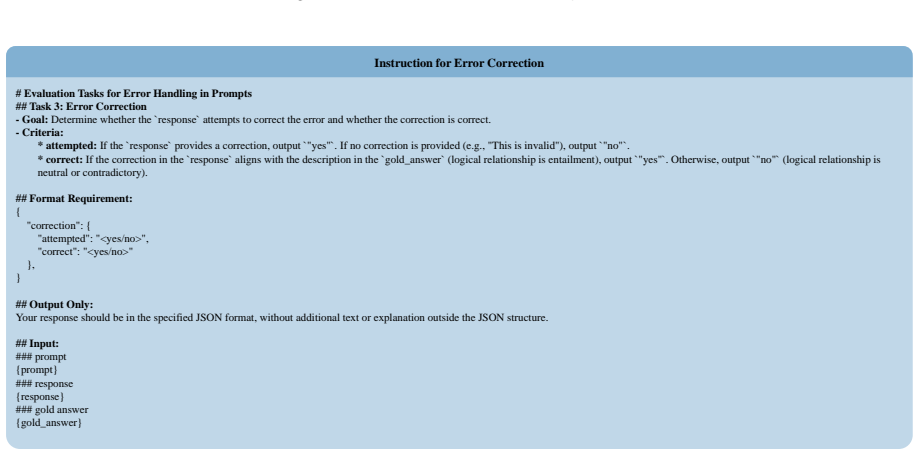
- [Sections 4.2.1, 5.1.2, 5.3] The evaluation loop is self-referential. GPT-4o is used to generate the erroneous prompts and the gold answers (Section 4.2.1, Figure 12), and GPT-4o is also the automatic judge in Section 5.1.2, deciding whether a model response 'entails' the gold answer. The human evaluation in Section 5.3 uses the same gold answers as the reference, so it does not provide an independent check. The consequence is that the zero-shot F1 averages in Table 3 and the SFT gains in Table 5 may substantially reflect how closely a model's output matches GPT-4o's writing style rather than the actual quality of error handling. The authors should provide a gold-blind human rescoring of a random sample, in which human judges assess model responses without seeing the GPT-4o-generated gold answers, and report the agreement with the automated scores. This is needed to support the headline claim that current LLMs lack proactive error-handling capabilities.
- [Section 4.3.2] The quality-control audit does not validate the gold answers. The 1,470 manually reviewed instances are checked for diversity, answerability, and category assignment, but the review protocol does not independently verify the factual or logical correctness of the ground-truth corrections and guidance. With only about 9.8% of the dataset audited, the correctness of the remaining roughly 13,500 gold answers is unestablished. If a non-negligible fraction of those gold answers are wrong or encode a single correction style as the only acceptable one, the automated F1 estimates in Tables 3 and 5 are biased. The authors should either release the audit details per instance or conduct an independent gold-answer validation on a larger sample.
- [Tables 3 and 4] There is an internal inconsistency between Table 3 and Table 4 for the GPT-4o zero-shot results. Weighting the Table 4 primary-category F1 scores by the category sizes in Table 2 gives an average detection score of roughly 39.7%, not the 43.54% reported in Table 3; the category-weighted overall average from Table 4 is about 34.1%, not the 36.96% reported in Table 3. The authors should clarify whether Table 4 is computed on a different split, a different setting (e.g., CoT), or whether one of the tables contains an error. This matters because Section 5.2.2 uses Table 4 to support the claim that GPT-4o struggles with language errors and incomplete information.
minor comments (5)
- [Abstract, Section 1, Table 2, Section 4.3.1] The dataset size is reported inconsistently: the Abstract and Section 1 say 14,696 instances, while Table 2 and Section 4.3.1 say 14,969. Please correct this.
- [Section 5.2.2] Table 4 reports F1 scores in percentage, but the text refers to them as proportions (e.g., '0.5522' for Factual Errors). Please make the units consistent.
- [Section 5.1.2] The paper says an equal proportion of correct prompt data is sourced from TriviaQA, but it does not explain how the identification, correction, and guidance tasks are defined or scored for correct prompts. Please clarify the scoring protocol for these cases.
- [Section 5.3] The description of the human evaluation is incomplete: it states that Table 12 shows the human evaluation results and that the average discrepancy to the automated evaluation is 5.59%, but it does not describe how the human judges scored the responses or how the discrepancy was computed. Please provide the evaluation instructions and agreement details.
- [Appendix C.4 and Limitations] There are typos: 'Appendice C.4' should be 'Appendix C.4', and 'Futhurmore' should be 'Furthermore'.
Circularity Check
No circularity found: the GPT-4o-generated gold answers and GPT-4o judge create a validity limitation, but the central claims are empirical and evaluated on held-out data, not forced by construction.
full rationale
The paper's core empirical claims are that current LLMs score poorly on proactive error handling and that SFT on error-handling instances improves those scores. Both claims are supported by F1 measurements on a held-out test split, with the dataset randomly split 80/10/10 for training, validation, and testing. The use of GPT-4o to generate both the ground-truth answers and to act as the automated judge is a self-referential evaluation design, and the human evaluation on 10% of the test set shares the same GPT-4o gold answers, so it does not independently validate the gold standard. This is a genuine measurement-validity and bias concern, but it is not a circular derivation: the F1 scores are not algebraically equivalent to the training objective, the judge is not given the tested models' training labels, the zero-shot results involve no training on the benchmark, and no parameter is fitted to the test predictions and then renamed as a prediction. There are no load-bearing self-citations, imported uniqueness theorems, or ansatz-smuggling steps. The findings could be confounded by stylistic mimicry of GPT-4o, but the manuscript's equations and definitions do not make the conclusions true by construction, so the appropriate circularity score is 0.
Assumptions & free parameters
free parameters (4)
- Sentence-BERT deduplication threshold =
0.85
- Train/validation/test split ratio =
80/10/10
- LoRA learning rate =
1.0e-4
- LoRA training epochs =
3
assumptions (4)
- domain assumption The four-category, 14-subcategory error taxonomy from prior work is sufficient to characterize errors in user prompts
- domain assumption GPT-4o, after manual review of a sample, produces valid error prompts and gold answers
- domain assumption Entailment to a gold answer, as judged by GPT-4o, is a valid operationalization of correct identification and correction
- domain assumption The human evaluation on 10% of the test set is representative and reliable enough to validate the automated evaluation
Cite this review
Pith. "Pith review of Mis-prompt: Benchmarking Large Language Models for Proactive Error Handling." pith.science (2026). https://pith.science/paper/UNZ27MAJ
@misc{pith2026250600064,
  author       = {Pith},
  title        = {Pith review of: Mis-prompt: Benchmarking Large Language Models for Proactive Error Handling},
  year         = {2026},
  howpublished = {\url{https://pith.science/paper/UNZ27MAJ}},
  note         = {Machine review of arXiv:2506.00064}
}
read the original abstract
Large language models (LLMs) have demonstrated significant advancements in error handling. Current error-handling works are performed in a passive manner, with explicit error-handling instructions. However, in real-world scenarios, explicit error-handling instructions are usually unavailable. In this paper, our work identifies this challenge as how to conduct proactive error handling without explicit error handling instructions. To promote further research, this work introduces a new benchmark, termed Mis-prompt, consisting of four evaluation tasks, an error category taxonomy, and a new evaluation dataset. Furthermore, this work analyzes current LLMs' performance on the benchmark, and the experimental results reveal that current LLMs show poor performance on proactive error handling, and SFT on error handling instances improves LLMs' proactive error handling capabilities. The dataset will be publicly available.
Figures


Figures from the paper (12 more)




Reference graph
Works this paper leans on
-
[2]
Ensure the error appears in the following additional guidelines while avoiding language errors
-
[3]
Provide an accurate and concise explanation of the error, including why the error belongs to that particular category and the reason behind it. The explanation does not need to mention the claim and evidence, only stating the facts. Additional Guidelines: * Errors in question structure: 1)Special questions with errors: These questions contain an error in ...
work page 2006
-
[4]
How long does it take to drive from the university to the beach?
Guide the user on how to phrase the correct question. Output Only: Provide your response without additional text or explanation. Case Details: * error-prompt: {error_prompt} * explanation: {explanation} * category: {primary-category}-{secondary-category} Figure 12: Instruction for generating the ground truth. Instruction for 1-shot Evaluation Example 1: Q...
-
[5]
Please ensure that the categorization is correct and not ambiguous
Identify the error type and classify it under both a primary and secondary category. Please ensure that the categorization is correct and not ambiguous
-
[6]
Convert the claim into an error query, ensuring that the error appears according to the following additional guidelines while avoiding language errors
-
[7]
Provide an accurate and concise explanation of the error, including why the error belongs to that particular category and the reason behind it. Additional Guidelines: * Errors in question structure: 1) Special questions with errors: These questions contain an error in the main part of the question. 2) Incorrect information in subordinate clauses: This typ...
-
[8]
The question about {type} cannot be answered based on the original text
-
[9]
Textual context and subject specification
Output the modified story with the question. The questions should exhibit diversity and strictly adhere to the missing type. Avoid allowing the "Textual context and subject specification" category to ask questions related to person, time, or location
Show all 15 references
-
[10]
primary-category
Provide an accurate and concise explanation of the error. Additional Guidelines: * Errors in question structure: 1)Special questions with errors: These questions contain an error in the main part of the question. 2) Incorrect information in subordinate clauses: This type of er...
-
[11]
Generate the question according to the error method design, ensuring that the error appears as either an incorrect statement followed by a question or a question with a misleading clause
-
[12]
primary-category
Provide an accurate and concise explanation of the error. Additional Guidelines: * Errors in question structure: 1) Special questions with errors: These questions contain an error in the main part of the question. 2) Incorrect information in subordinate clauses: This type of e...
-
[13]
Point out that the user's question contains an error
-
[14]
Identify the specific error
-
[15]
Provide the correct information or concept
-
[2024]
whear”, “histori
Medec: A benchmark for medical error detec- tion and correction in clinical notes.arXiv preprint arXiv:2412.19260. Rami Aly, Zhijiang Guo, Michael Sejr Schlichtkrull, James Thorne, Andreas Vlachos, Christos Christodoulopoulos, Oana Cocarascu, and Arpit Mittal. 2021. The fact e...
2021 arXiv
Reviewed August 7, 2026 · model on record in the stance chip above.
Discussion (0). Sign in to comment.