REVIEW 4 major objections 6 minor 46 references
SwitchLingua: The First Large-Scale Multilingual and Multi-Ethnic Code-Switching Dataset
T0 review · 4 major / 6 minor · reviewed 2026-08-07 · deepseek-v4-flash
Pith's one-line read A linguistically constrained multi-agent pipeline can synthesize authentic code-switching at scale; the 12-language SwitchLingua corpus exposes large ASR gaps and motivates a new semantic-aware error metric.
desk verdict Dataset is large and useful, but the SAER numbers are internally inconsistent and the evaluation is too self-referential to support the claims. read the letter →
The pith
A machine-rendered reading of the paper's core claim, the machinery that carries it, and where it could break.
The reading
What carries the argument
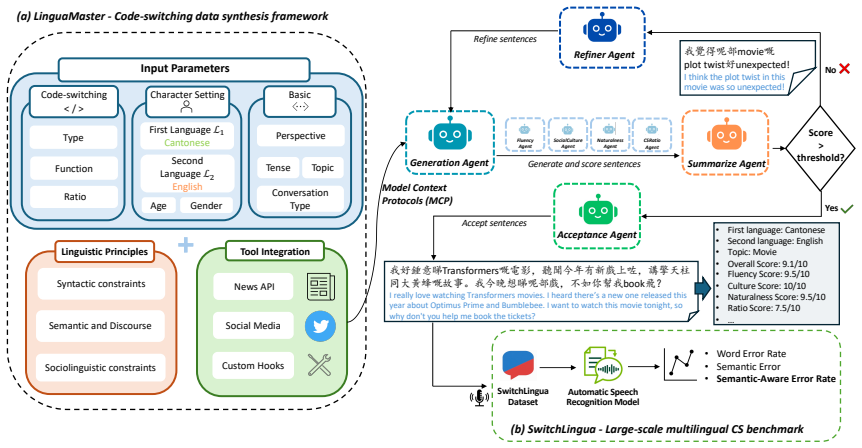
The load-bearing mechanism is LinguaMaster's generate, evaluate, and refine loop, where generation is not free-form LLM sampling but a Structure & Switch routine: a dependency parse of the L1 sentence, a translation and token alignment against L2, and switch points filtered by Poplack's free-morpheme constraint (a bound morpheme cannot be stranded) and equivalence constraint (a switch is allowed only where the surface word order of the two languages coincides), followed by sampling one permissible span and splicing it into the skeleton. Four evaluator agents score fluency, naturalness, code-switching ratio, and socio-cultural fit; a summarizer aggregates the scores; and an acceptance agent or refiner decides the candidate's fate, with an MCP tool layer supplying current news and social-media context. The second mechanism is the proposed metric SAER, written $\text{SAER}_\alpha(\hat{y},y) = (1-\alpha)\,\varepsilon_{\text{sem}} + \alpha\,\langle \delta(\lambda(y)), F\rangle$, where $\varepsilon_{\text{sem}} = 1 - \cos\bigl(f(\hat{y}), f(y)\bigr)$ is the cosine distance between LaBSE multilingual embeddings of the hypothesis and reference, and $F$ contributes character error rate for logographic-script matrix languages and word error rate for alphabetic-script ones, selected by the indicator $\delta(\lambda(y))$.
What would settle it
Run a blinded comparison in which native speakers of the 12 languages rate SwitchLingua samples against naturally recorded code-switched speech from the same communities and topics, with per-language sample counts and inter-annotator agreement reported; if the natural speech is judged more realistic, natural, and diverse, or if an independent rating by a different judge reverses GPT-4o's rankings, the claim that LinguaMaster reproduces authentic code-switching would be refuted.
Extended reading notes
Core claim
The paper's central claim, stated on its own terms, is that high-quality code-switching data can be synthesized at a scale no existing corpus reaches, and that this breadth is exactly what speech models are missing. LinguaMaster frames generation as a constrained act: parse the matrix-language sentence, translate it into the embedded language, token-align the two, mark only switch points that obey the free-morpheme constraint (no switch after a bound morpheme) and the equivalence constraint (switch only where surface word orders coincide), then splice an L2 fragment at a sampled permissible point. Four scoring agents, for fluency, naturalness, code-switching ratio, and socio-cultural fit, judge each candidate, and a refiner re-enters the loop until the aggregate score passes a threshold, with external news and social-media snippets injected to keep the lexicon current. The resulting SwitchLingua corpus (420K text samples, 80+ hours of speech, 12 languages, 63 ethnic backgrounds, 27 topics) is then used as a benchmark: Whisper-Large-v3 leads the tested ASR models but still shows sizable SAER for most languages, and other models degrade sharply, so the paper concludes that code-switched speech remains a largely unsolved ASR problem. Finally, the paper argues that WER and CER misread such output because they ignore semantic equivalence, and proposes SAER, defined as a weighted blend of a semantic error term and a language-appropriate form error, as a more context-aware evaluation.
Load-bearing premise
The central claim depends on the assumption that the GPT-4o and human judges' scores genuinely measure linguistic authenticity and diversity rather than reflecting the generator's own stylistic preferences or the evaluators' expectations, because the same model family both produces the samples and decides which ones are good enough to accept.
Editorial extensions
If this is right
- On SwitchLingua audio, Whisper-Large-v3 posts the best SAER in 8 of 12 languages yet still leaves large error rates, so state-of-the-art ASR is far from mastering code-switched speech and the corpus gives the field a shared yardstick.
- Because SAER rewards semantic preservation, evaluations of mixed-language ASR under it will diverge from WER and CER for scripts and transliterations where many spellings are valid, so reported error rates will better reflect whether a listener could understand the transcription.
- The ablation results show that linguistic principles, multi-agent collaboration, and tool integration each raise the human and LLM quality scores, implying that the synthesis recipe, not only the scale, explains the dataset's reported authenticity.
- With its 12 languages, 63 ethnic backgrounds, single- and multi-turn formats, and 27 topics, SwitchLingua is positioned to support code-switching ASR, mixed-language text-to-speech, and cross-lingual retrieval research that previously lacked a common large-scale resource.
- The authors release the audio under license terms that restrict misuse such as voice synthesis for impersonation, acknowledging that broad multilingual speech data carries dual-use risk.
Reading between the lines
- The quality scores come from the same model family (GPT-4o) that generated and accepted the samples, so a natural next test, not run in this paper, is an independent, blinded native-speaker rating with reported inter-annotator agreement before the superiority margins are treated as settled.
- The constraint-based recipe should transfer to low-resource language pairs: wherever parallel text can be aligned, dependency parsing can locate permissible switch points, so the framework could plausibly extend the corpus well beyond 12 languages at modest cost.
- SAER's semantic term makes a concrete, testable prediction: human comprehension ratings of transcriptions should track SAER more closely than WER or CER for code-switched audio, and measuring that correlation would confirm or refute the metric's central motivation.
- Because the tool-integration layer pulls fresh news and social-media context at generation time, the pipeline could be re-run periodically to refresh the benchmark as slang, loanwords, and code-mixing norms evolve, something static corpora cannot do.
Editorial analysis
A structured set of objections, weighed in public.
Referee Report
Summary. The paper introduces SwitchLingua, a large-scale multilingual and multi-ethnic code-switching dataset generated by a multi-agent LLM framework called LinguaMaster, and proposes a new ASR evaluation metric, Semantic-Aware Error Rate (SAER). SwitchLingua is reported to contain 420K textual code-switching samples across 12 languages and over 80 hours of audio from 174 speakers representing 18 countries/regions and 63 ethnic backgrounds. The paper evaluates dataset quality via human and GPT-4o judgments, presents ASR benchmark results across six models, and provides ablations of the LinguaMaster components. The central claims are that SwitchLingua is the first such large-scale resource, that it outperforms existing code-switching datasets in quality and diversity, and that SAER better captures semantic equivalence in code-switched ASR evaluation.
Significance. If the claims are sound, SwitchLingua would be a valuable resource: it is larger and more diverse than existing code-switching corpora, and the SAER metric addresses a real limitation of WER/CER in multilingual ASR evaluation. The paper also provides code and data links and includes a formal information-theoretic appendix, which are positive reproducibility features. However, the current evidence is undermined by a mathematically impossible value in the central benchmark table, by quality validation that relies on the same model that generated the data, and by unexplained discrepancies in the reported improvement percentages. These issues must be resolved before the dataset's utility as a rigorous benchmark can be accepted.
major comments (4)
- [Table 3, Eq. (3)] Table 3, Korean/English, Whisper-Large-v3 row: the reported CER=0.1143, SEM=0.9458, and SAER=0.8561 are mutually inconsistent under Eq. (3). With epsilon_sem=1-SEM=0.0542 and F=CER=0.1143, SAER_alpha is a convex combination of these two values for any alpha in [0,1], so it must lie in [0.0542, 0.1143]; the reported 0.8561 is impossible (it would require alpha approximately 13.3). The value of alpha used in the experiments is never reported, so Table 3 is not reproducible even apart from this row.
- [Section 4.2, Figure 2, Appendix B.1] The quality validation is circular. GPT-4o acts as the GenerationAgent, AcceptanceAgent, and RefinerAgent in LinguaMaster, and the same model is used as the LLM judge in Table 2 and as the baseline evaluator in the Table 4 ablation. Without a control for self-preference, the large reported margins (e.g., +25.9% in Linguistic Richness) could reflect the model's own stylistic biases rather than genuine code-switching quality. The human evaluation is described only as involving 'native speakers from 40 distinct linguistic and ethnic backgrounds'; the paper gives no sample size, per-language counts, selection procedure, blinding, or inter-annotator agreement, so it cannot independently validate Table 2.
- [Table 2, red-text percentages] The claimed relative improvements over the second-best dataset do not match the table's scores. For Linguistic Richness, the second-best human/LLM scores are 12.1/13.0 (SEAME), which yields (16.2-12.1)/12.1=33.9% and (17.7-13.0)/13.0=36.2%, averaging about 35.0%, not 25.9%. Similar mismatches occur for Language and Racial Diversity and Realism. The basis for the reported percentages needs to be stated precisely or corrected.
- [Appendix E, Algorithm 1, Eq. (3)] The information-theoretic justification assumes Q(C_j|x)=1 for the human distribution, which is unverified, and the practical reading equating lower entropy with less hallucination is an interpretive leap. In addition, the acceptance threshold tau and the weights used by SummarizeAgent are never reported, so the generate-evaluate-refine loop is underspecified and not fully reproducible.
minor comments (6)
- [Abstract vs. Figure 1] The abstract and Appendix A.3 state 420K textual samples, while Figure 1 states 440K; please reconcile the dataset size.
- [Table 2 header] The header 'Language and Rac. Diversity' is truncated; it should read 'Language and Racial Diversity'.
- [Appendix B.2] Appendix B.2 states 'Instead of providing a proof sketch, we present the entire workflow'; for an ablation claim, the lack of a controlled quantitative analysis should be acknowledged or supplied.
- [Limitations section] The Limitations section addresses only voice-synthesis misuse; it does not discuss the synthetic generation process's potential biases or the evaluation protocol's limitations.
- [Introduction] The claim of being the 'first' large-scale multilingual and multi-ethnic code-switching dataset is strong; the comparison in Table A.1 is not exhaustive, so consider softening the claim to 'to our knowledge'.
- [Eq. (3)] Equation (3) should specify the allowed range of alpha and the value used in all experiments; it should also clarify how WER versus CER is chosen for each language pair.
Circularity Check
Quality validation is self-referential: GPT-4o generates, accepts, and scores SwitchLingua, and the naturalness criterion is defined by the generator's own switch-point constraints.
-
self definitional
[Section 3.2, 'Linguistically constrained generation' and Table B.2, 'Switching Naturalness' criterion in Appendix C.1]
"Locate all switch points that respect (a) the Free-Morpheme and (b) the Equivalence constraints. (4) sample one permissible span and splice the L2 fragment back into the L1 skeleton. The generator's search space is filtered by these syntactic rules, and every output is guaranteed clause-internal well-formedness in both languages. ... Switching Naturalness (10): Evaluates whether language switching in speech is natural and aligns with authentic code-switching behaviors. Does the switching occur at reasonable points (e.g., at grammatically permissible switch points)?"
The 'Switching Naturalness' evaluation criterion is operationalized as switches occurring at grammatically permissible switch points, which is exactly the property LinguaMaster enforces when it restricts generation to Free-Morpheme- and Equivalence-compliant switch points and guarantees clause-internal well-formedness. The high SwitchLingua Switching Naturalness score in Table 2 (16.4 human / 17.0 LLM vs 12.3/11.7 for the second-best dataset) is therefore partially built into the data-generation procedure rather than discovered by independent evaluation. The LLM portion of that score is also produced by GPT-4o, the same model that generated and accepted the samples.
-
other
[Section 3.2, 'The LinguaMaster Framework'; Section 4.1, 'Implementation details'; Table 2 and Table 4]
"GenerationAgent produces an initial code-switched candidate. (2) Four linguistic evaluator agents assess the candidate ... AcceptanceAgent finalizes high-quality outputs ... LLM agents are based on GPT-4o Achiam et al. (2023) with different input prompts. ... For LLM evaluation, we leverage GPT-4o Achiam et al. (2023) as the evaluation model for the textual data, capitalizing on its advanced language understanding capabilities."
GPT-4o is simultaneously the generator (GenerationAgent), the four linguistic evaluator agents, the aggregator (SummarizeAgent), the acceptance referee, and the LLM judge in Table 2 and Table 4. The textual-quality margins in Table 2 are therefore not independent evidence: the judge is the generator, so high scores can reflect GPT-4o's self-preference rather than dataset quality. The paper provides no control using a different judge model, and the human evaluation is reported only as 'native speakers from 40 distinct linguistic and ethnic backgrounds' with no sample size, per-language counts, blinding, or inter-annotator agreement, so it does not by itself break the loop. The claimed 'comprehensive superiority' in Section 4.2 is thus substantially self-referential.
full rationale
The dataset's 'utility as a rigorous benchmark' is supported by Table 3, an external ASR benchmark using independent models (Whisper, Seamless, Qwen2-Audio, etc.), and the SAER metric is anchored to external LaBSE embeddings, so those parts are not circular. The circularity is confined to the quality-validation loop: (i) the Switching Naturalness criterion is defined by the same grammatical constraints the generator enforces, making that score partly tautological; and (ii) the LLM-quality comparison in Table 2 and the ablation in Table 4 use GPT-4o as both producer and judge. The human evaluation is present but underdescribed, with no counts, agreement, or blinding, so it cannot fully certify independence. These are partial, not total, circularity: the central dataset-construction and benchmark-utility claims do not reduce to the evaluation alone, but the headline quality margins in Table 2 are substantially self-referential.
Assumptions & free parameters
free parameters (2)
- alpha (SAER weighting) =
not reported
- Acceptance threshold tau (LinguaMaster) =
not reported
assumptions (4)
- domain assumption Poplack's Free-Morpheme and Equivalence constraints are necessary and sufficient for natural code-switching.
- ad hoc to paper The pipeline's generate-evaluate-refine steps implement a formal conditioning operation that reduces entropy and KL divergence to the human distribution.
- domain assumption LaBSE embeddings provide a valid semantic similarity measure for code-switched utterances.
- domain assumption The human evaluators recruited for scoring are representative and unbiased.
Cite this review
Pith. "Pith review of SwitchLingua: The First Large-Scale Multilingual and Multi-Ethnic Code-Switching Dataset." pith.science (2026). https://pith.science/paper/PTUZA3I6
@misc{pith2026250600087,
  author       = {Pith},
  title        = {Pith review of: SwitchLingua: The First Large-Scale Multilingual and Multi-Ethnic Code-Switching Dataset},
  year         = {2026},
  howpublished = {\url{https://pith.science/paper/PTUZA3I6}},
  note         = {Machine review of arXiv:2506.00087}
}
read the original abstract
Code-switching (CS) is the alternating use of two or more languages within a conversation or utterance, often influenced by social context and speaker identity. This linguistic phenomenon poses challenges for Automatic Speech Recognition (ASR) systems, which are typically designed for a single language and struggle to handle multilingual inputs. The growing global demand for multilingual applications, including Code-Switching ASR (CSASR), Text-to-Speech (CSTTS), and Cross-Lingual Information Retrieval (CLIR), highlights the inadequacy of existing monolingual datasets. Although some code-switching datasets exist, most are limited to bilingual mixing within homogeneous ethnic groups, leaving a critical need for a large-scale, diverse benchmark akin to ImageNet in computer vision. To bridge this gap, we introduce \textbf{LinguaMaster}, a multi-agent collaboration framework specifically designed for efficient and scalable multilingual data synthesis. Leveraging this framework, we curate \textbf{SwitchLingua}, the first large-scale multilingual and multi-ethnic code-switching dataset, including: (1) 420K CS textual samples across 12 languages, and (2) over 80 hours of audio recordings from 174 speakers representing 18 countries/regions and 63 racial/ethnic backgrounds, based on the textual data. This dataset captures rich linguistic and cultural diversity, offering a foundational resource for advancing multilingual and multicultural research. Furthermore, to address the issue that existing ASR evaluation metrics lack sensitivity to code-switching scenarios, we propose the \textbf{Semantic-Aware Error Rate (SAER)}, a novel evaluation metric that incorporates semantic information, providing a more accurate and context-aware assessment of system performance.
Figures

Reference graph
Works this paper leans on
-
[1]
write newline
" write newline "" before.all 'output.state := FUNCTION n.dashify 't := "" t empty not t #1 #1 substring "-" = t #1 #2 substring "--" = not "--" * t #2 global.max substring 't := t #1 #1 substring "-" = "-" * t #2 global.max substring 't := while if t #1 #1 substring * t #2 global.max substring 't := if while FUNCTION format.date year duplicate empty "emp...
-
[2]
Bangortalk dataset. https://bangortalk.org.uk/. Accessed: 2025-03-17
work page 2025
-
[3]
Josh Achiam, Steven Adler, Sandhini Agarwal, Lama Ahmad, Ilge Akkaya, Florencia Leoni Aleman, Diogo Almeida, Janko Altenschmidt, Sam Altman, Shyamal Anadkat, et al. Gpt-4 technical report. arXiv preprint arXiv:2303.08774, 2023
arXiv 2023
-
[4]
Multi-reference wer for evaluating asr for languages with no orthographic rules
Ahmed Ali, Walid Magdy, Peter Bell, and Steve Renais. Multi-reference wer for evaluating asr for languages with no orthographic rules. In 2015 IEEE Workshop on Automatic Speech Recognition and Understanding (ASRU), pages 576--580. IEEE, 2015
work page 2015
-
[5]
Keyu An, Qian Chen, Chong Deng, Zhihao Du, Changfeng Gao, Zhifu Gao, Yue Gu, Ting He, Hangrui Hu, Kai Hu, et al. Funaudiollm: Voice understanding and generation foundation models for natural interaction between humans and llms. arXiv preprint arXiv:2407.04051, 2024
arXiv 2024
-
[6]
Peter Auer. Bilingual Conversation. John Benjamins, Amsterdam, 1984
work page 1984
-
[7]
wav2vec 2.0: A framework for self-supervised learning of speech representations
Alexei Baevski, Yuhao Zhou, Abdelrahman Mohamed, and Michael Auli. wav2vec 2.0: A framework for self-supervised learning of speech representations. Advances in neural information processing systems, 33: 0 12449--12460, 2020
2020
-
[8]
Arindam Banerjee, Srujana Merugu, Inderjit S. Dhillon, and Joydeep Ghosh. Clustering with Bregman divergences. Journal of Machine Learning Research, 6: 0 1705--1749, 2005. Theorem 1 gives the KL-projection (Pythagorean) property used in our proof
work page 2005
Show all 46 references
-
[9]
Seamless: Multilingual expressive and streaming speech translation
Lo \" c Barrault, Yu-An Chung, Mariano Coria Meglioli, David Dale, Ning Dong, Mark Duppenthaler, Paul-Ambroise Duquenne, Brian Ellis, Hady Elsahar, Justin Haaheim, et al. Seamless: Multilingual expressive and streaming speech translation. arXiv preprint arXiv:2312.05187, 2023
2023 arXiv
-
[10]
Jan-Petter Blom and John J. Gumperz. Social meaning in linguistic structures: Code-switching in norway. In Directions in Sociolinguistics, pages 407--434. Holt, Rinehart and Winston, New York, 1972
1972
-
[11]
Qwen2-audio technical report
Yunfei Chu, Jin Xu, Qian Yang, Haojie Wei, Xipin Wei, Zhifang Guo, Yichong Leng, Yuanjun Lv, Jinzheng He, Junyang Lin, et al. Qwen2-audio technical report. arXiv preprint arXiv:2407.10759, 2024
2024 arXiv
-
[12]
Unsupervised cross-lingual representation learning for speech recognition
Alexis Conneau, Alexei Baevski, Ronan Collobert, Abdelrahman Mohamed, and Michael Auli. Unsupervised cross-lingual representation learning for speech recognition. arXiv preprint arXiv:2006.13979, 2020
2006 arXiv
-
[13]
Imagenet: A large-scale hierarchical image database
Jia Deng, Wei Dong, Richard Socher, Li-Jia Li, Kai Li, and Li Fei-Fei. Imagenet: A large-scale hierarchical image database. In 2009 IEEE conference on computer vision and pattern recognition, pages 248--255. Ieee, 2009
2009
-
[14]
Language-agnostic bert sentence embedding
Fangxiaoyu Feng, Yinfei Yang, Daniel Cer, Naveen Arivazhagan, and Wei Wang. Language-agnostic bert sentence embedding. arXiv preprint arXiv:2007.01852, 2020
2007 arXiv
-
[15]
Language Shift: Social Determinants of Linguistic Change in Bilingual Austria
Susan Gal. Language Shift: Social Determinants of Linguistic Change in Bilingual Austria. Academic Press, New York, 1979
1979
-
[16]
John J. Gumperz. Discourse Strategies. Cambridge University Press, Cambridge, 1982
1982
-
[17]
Arzen: A speech corpus for code-switched egyptian arabic-english
Injy Hamed, Ngoc Thang Vu, and Slim Abdennadher. Arzen: A speech corpus for code-switched egyptian arabic-english. In Proceedings of the twelfth language resources and evaluation conference, pages 4237--4246, 2020
2020
-
[18]
The politics of code-switching and language choice
Monica Heller. The politics of code-switching and language choice. Journal of Multilingual and Multicultural Development, 13 0 (1 /2): 0 123--142, 1992
1992
-
[19]
Mediaparl: Bilingual mixed language accented speech database
David Imseng, Herv \'e Bourlard, Holger Caesar, Philip N Garner, Gw \'e nol \'e Lecorv \'e , and Alexandre Nanchen. Mediaparl: Bilingual mixed language accented speech database. In 2012 IEEE spoken language technology workshop (SLT), pages 263--268. IEEE, 2012
2012
-
[20]
Advocating character error rate for multilingual asr evaluation
Jesin James, Deepa P Gopinath, et al. Advocating character error rate for multilingual asr evaluation. arXiv preprint arXiv:2410.07400, 2024
2024 arXiv
-
[21]
Polywer: A holistic evaluation framework for code-switched speech recognition
Karima Kadaoui, Maryam Ali, Hawau Toyin, Ibrahim Mohammed, and Hanan Aldarmaki. Polywer: A holistic evaluation framework for code-switched speech recognition. In Findings Of The Association For Computational Linguistics: EMNLP 2024, pages 6144--6153, 2024
2024
-
[22]
Embedded english verbs in arabic-english code-switching in egypt
Ma gorzata Knia \'z and Magdalena Zawrotna. Embedded english verbs in arabic-english code-switching in egypt. International Journal of Bilingualism, 25 0 (3): 0 622--639, 2021
2021
-
[23]
Linguistics theory meets llm: Code-switched text generation via equivalence constrained large language models
Garry Kuwanto, Chaitanya Agarwal, Genta Indra Winata, and Derry Tanti Wijaya. Linguistics theory meets llm: Code-switched text generation via equivalence constrained large language models. arXiv preprint arXiv:2410.22660, 2024
-
[24]
Cantonese-english code-switching research in hong kong: A y2k review
David CS Li. Cantonese-english code-switching research in hong kong: A y2k review. World Englishes, 19 0 (3): 0 305--322, 2000
2000
-
[25]
Camel: Communicative agents for" mind" exploration of large language model society
Guohao Li, Hasan Hammoud, Hani Itani, Dmitrii Khizbullin, and Bernard Ghanem. Camel: Communicative agents for" mind" exploration of large language model society. Advances in Neural Information Processing Systems, 36: 0 51991--52008, 2023
2023
-
[26]
A survey on llm-based multi-agent systems: workflow, infrastructure, and challenges
Xinyi Li, Sai Wang, Siqi Zeng, Yu Wu, and Yi Yang. A survey on llm-based multi-agent systems: workflow, infrastructure, and challenges. Vicinagearth, 1 0 (1): 0 9, 2024
2024
-
[27]
Ascend: A spontaneous chinese-english dataset for code-switching in multi-turn conversation
Holy Lovenia, Samuel Cahyawijaya, Genta Indra Winata, Peng Xu, Xu Yan, Zihan Liu, Rita Frieske, Tiezheng Yu, Wenliang Dai, Elham J Barezi, et al. Ascend: A spontaneous chinese-english dataset for code-switching in multi-turn conversation. arXiv preprint arXiv:2112.06223, 2021
2021 arXiv
-
[28]
Seame: a mandarin-english code-switching speech corpus in south-east asia
Dau-Cheng Lyu, Tien Ping Tan, Engsiong Chng, and Haizhou Li. Seame: a mandarin-english code-switching speech corpus in south-east asia. In Interspeech, pages 1986--1989, 2010
1986
-
[29]
A Minimalist Approach to Intrasentential Code Switching
Jeff MacSwan. A Minimalist Approach to Intrasentential Code Switching. Garland Publishing, New York, 1999
1999
-
[30]
Duelling Languages: Grammatical Structure in Codeswitching
Carol Myers-Scotton. Duelling Languages: Grammatical Structure in Codeswitching. Clarendon Press, Oxford, 1993
1993
-
[31]
Synthetic data for deep learning
Sergey I Nikolenko et al. Synthetic data for deep learning. Springer, 2021
2021
-
[32]
Sometimes i'll start a sentence in spanish y termino en español: Toward a typology of code-switching
Shana Poplack. Sometimes i'll start a sentence in spanish y termino en español: Toward a typology of code-switching. Linguistics, 18 0 (7 -8): 0 581--618, 1980
1980
-
[33]
Less is more: Accurate speech recognition & translation without web-scale data
Krishna C Puvvada, Piotr \.Z elasko, He Huang, Oleksii Hrinchuk, Nithin Rao Koluguri, Kunal Dhawan, Somshubra Majumdar, Elena Rastorgueva, Zhehuai Chen, Vitaly Lavrukhin, et al. Less is more: Accurate speech recognition & translation without web-scale data. arXiv preprint arXi...
2024 arXiv
-
[34]
Robust speech recognition via large-scale weak supervision
Alec Radford, Jong Wook Kim, Tao Xu, Greg Brockman, Christine McLeavey, and Ilya Sutskever. Robust speech recognition via large-scale weak supervision. In International conference on machine learning, pages 28492--28518. PMLR, 2023
2023
-
[35]
Using monolingual speech recognition for spoken term detection in code-switched hindi-english speech
Sanket Shah and Sunayana Sitaram. Using monolingual speech recognition for spoken term detection in code-switched hindi-english speech. In 2019 International Conference on Data Mining Workshops (ICDMW), pages 1--5. IEEE, 2019
2019
-
[36]
Hugginggpt: Solving ai tasks with chatgpt and its friends in hugging face
Yongliang Shen, Kaitao Song, Xu Tan, Dongsheng Li, Weiming Lu, and Yueting Zhuang. Hugginggpt: Solving ai tasks with chatgpt and its friends in hugging face. Advances in Neural Information Processing Systems, 36: 0 38154--38180, 2023
2023
-
[37]
Multi-agent collaboration: Harnessing the power of intelligent llm agents
Yashar Talebirad and Amirhossein Nadiri. Multi-agent collaboration: Harnessing the power of intelligent llm agents. arXiv preprint arXiv:2306.03314, 2023
2023 arXiv
-
[38]
A first speech recognition system for mandarin-english code-switch conversational speech
Ngoc Thang Vu, Dau-Cheng Lyu, Jochen Weiner, Dominic Telaar, Tim Schlippe, Fabian Blaicher, Eng-Siong Chng, Tanja Schultz, and Haizhou Li. A first speech recognition system for mandarin-english code-switch conversational speech. In 2012 IEEE International Conference on Acousti...
2012
-
[39]
Is word error rate a good indicator for spoken language understanding accuracy
Ye-Yi Wang, Alex Acero, and Ciprian Chelba. Is word error rate a good indicator for spoken language understanding accuracy. In 2003 IEEE workshop on automatic speech recognition and understanding (IEEE Cat. No. 03EX721), pages 577--582. IEEE, 2003
2003
-
[40]
Autogen: Enabling next-gen llm applications via multi-agent conversation
Qingyun Wu, Gagan Bansal, Jieyu Zhang, Yiran Wu, Beibin Li, Erkang Zhu, Li Jiang, Xiaoyun Zhang, Shaokun Zhang, Jiale Liu, et al. Autogen: Enabling next-gen llm applications via multi-agent conversation. arXiv preprint arXiv:2308.08155, 2023
2023 arXiv
-
[41]
Developing a multilingual dataset and evaluation metrics for code-switching: A focus on hong kong’s polylingual dynamics
Peng Xie and Kani Chen. Developing a multilingual dataset and evaluation metrics for code-switching: A focus on hong kong’s polylingual dynamics. In ICASSP 2025-2025 IEEE International Conference on Acoustics, Speech and Signal Processing (ICASSP), pages 1--5. IEEE, 2025
2025
-
[42]
Code-switching text generation and injection in mandarin-english asr
Haibin Yu, Yuxuan Hu, Yao Qian, Ma Jin, Linquan Liu, Shujie Liu, Yu Shi, Yanmin Qian, Edward Lin, and Michael Zeng. Code-switching text generation and injection in mandarin-english asr. In ICASSP 2023-2023 IEEE International Conference on Acoustics, Speech and Signal Processin...
2023
-
[43]
Automatic speech recognition datasets in cantonese: A survey and new dataset
Tiezheng Yu, Rita Frieske, Peng Xu, Samuel Cahyawijaya, Cheuk Tung Shadow Yiu, Holy Lovenia, Wenliang Dai, Elham J Barezi, Qifeng Chen, Xiaojuan Ma, et al. Automatic speech recognition datasets in cantonese: A survey and new dataset. arXiv preprint arXiv:2201.02419, 2022
2022 arXiv
-
[44]
End-to-end code-switching asr for low-resourced language pairs
Xianghu Yue, Grandee Lee, Emre Y lmaz, Fang Deng, and Haizhou Li. End-to-end code-switching asr for low-resourced language pairs. In 2019 IEEE automatic speech recognition and understanding workshop (ASRU), pages 972--979. IEEE, 2019
2019
-
[45]
Reducing language context confusion for end-to-end code-switching automatic speech recognition
Shuai Zhang, Jiangyan Yi, Zhengkun Tian, Jianhua Tao, Yu Ting Yeung, and Liqun Deng. Reducing language context confusion for end-to-end code-switching automatic speech recognition. arXiv preprint arXiv:2201.12155, 2022
2022 arXiv
-
[46]
Language without borders: A dataset and benchmark for code-switching lip reading
Xueyi Zhang, Mingrui Lao, Peng Zhao, Jun Tang, Yanming Guo, Siqi Cai, Xianghu Yue, and Haizhou Li. Language without borders: A dataset and benchmark for code-switching lip reading. Advances in Neural Information Processing Systems, 37: 0 30727--30739, 2024
2024
Reviewed August 7, 2026 · model on record in the stance chip above.
Discussion (0). Sign in to comment.