REVIEW 4 major objections 5 minor 73 references
Accurate Estimation of Mutual Information in High Dimensional Data
T0 review · 4 major / 5 minor · reviewed 2026-08-07 · deepseek-v4-flash
Pith's one-line read This paper claims neural mutual-information estimators become reliable in high-dimensional data when the dependence between the variables lives on a low-dimensional latent space, and builds a protocol with error bars and built-in failure…
desk verdict A practical protocol for neural MI estimation with error bars and honest diagnostics, but the promised CIFAR results are missing and the stopping rule needs stronger justification. read the letter →
The pith
A machine-rendered reading of the paper's core claim, the machinery that carries it, and where it could break.
The reading
What carries the argument
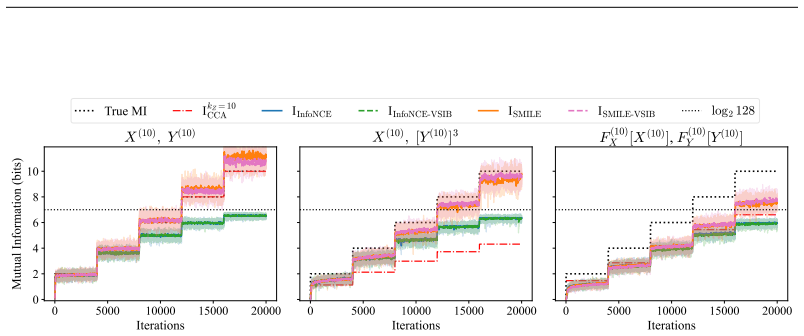
Three mechanisms carry the argument. First, the generalized critic $T(x,y) = f(g(x), h(y))$: separable embeddings force the estimator through a latent bottleneck of dimension $k_Z$, and the paper shows a critic needs $k_Z \ge K_Z$ to capture all dependence, while modestly exceeding $K_Z$ is harmless—turning the embedding dimension into a dial that reveals the structure of the data. Second, the max-test stopping rule: because MI is a nonlinear functional of the distribution, unbiased density estimates do not yield unbiased MI, and the held-out MI curve rises then collapses as the critic overfits; the paper selects the checkpoint with peak test MI and reports the corresponding training MI, arguing in Appx. A.3 that the test value is systematically biased downward while the training value at the best-generalizing checkpoint tracks the truth. Third, the random-matrix-theory detection bound: in a spiked-covariance model of the latent dependence, a signal spike separates from sampling noise only when $N$ exceeds $N^*_Z \approx 2K_Z/\theta^2$, which scales as $K_Z^2$ in the weak-signal limit—this is what makes 'sample the latent space, not the data space' quantitative. The VSIB probabilistic critics add a fourth piece: stochastic encoders with the loss $I_E(X;Z_X) + I_E(Y;Z_Y) - \beta I_D(Z_X;Z_Y)$ regularize the critic and control variance in the high-MI regime.
What would settle it
On a teacher-network generator with known latent dimension ($K_Z = 10$) embedded into $K = 500$ dimensions but with latent variables drawn from a distribution the paper did not test—e.g., heavy-tailed, discrete, or concentrated on a low-dimensional curved manifold—run the full protocol at $N = 256$ and $N = 1024$ and check whether the reported estimate plus prediction interval covers the known true MI. If the coverage fails, or if the bias changes sign when the embedding map is varied with $K_Z$ held fixed, the max-test stopping rule's core premise is falsified. A sharper test removes the paper's own escape hatch: restrict the critic family so that the optimal density-ratio critic is provably outside it, since the Appx. A.3 justification for preferring the training value over the test value requires the trained critic to be near-optimal.
Extended reading notes
Core claim
The paper establishes a regime-shift principle: the difficulty of estimating MI is governed by the dimensionality of the statistical dependence itself, not of the observed variables. For data generated by a latent model with $K_Z \le 10$ hidden variables embedded into $K = 500$ observed dimensions, trained critics recover the ground-truth MI once the number of samples satisfies $N \gg K_Z$, even when $N$ is far below $K$; the estimate only begins to form once $N$ passes a latent-space detection threshold $N^*_Z$ that scales roughly as $K_Z^2/I$, matching the spiked-covariance phase transition of random matrix theory. The paper also establishes a protocol that makes this usable: stop the critic at the epoch where held-out MI peaks and report the training value at that checkpoint; grow the critic embedding until the estimate plateaus at $k^*_Z$; subsample into $\gamma$ equal parts and extrapolate a weighted linear fit to $\gamma \to 0$; report the intercept as the MI estimate with a prediction interval, and refuse to report anything if the fit is nonlinear. A new family of probabilistic critics, VSIB, wraps InfoNCE or SMILE in stochastic encoders regularized by an information-bottleneck objective, and the paper shows this suppresses SMILE's severe overestimation at high MI. Empirically, the pipeline stays within error bars of the true MI on the benchmark suite and recovers $3.13 \pm 0.12$ bits against a true $\log_2 10 \approx 3.32$ bits on 784-dimensional noisy MNIST from 16,384 samples, without ever significantly overshooting.
Load-bearing premise
The load-bearing premise is that the training MI at the checkpoint where held-out MI peaks is a better estimate of true MI than the held-out value itself; the paper's justification of this rule indirectly assumes the trained critic is already close to the ideal critic, so distributions for which that closeness fails could make the reported values and their error bars wrong even when low-dimensional latent structure exists.
Editorial extensions
If this is right
- Mutual information can be estimated with honest error bars from a few hundred samples in problems with ambient dimension $K \approx 500$, provided the true dependence is low-dimensional ($K_Z \approx 10$).
- The data requirement grows roughly quadratically with the latent dimension, so the plateau in the critic-embedding curve both diagnoses the latent dimension and sets the sample budget needed for a trustworthy estimate.
- Compressive embeddings are not an optional convenience in high dimensions; an estimator that does not project into a low-dimensional space cannot exploit the latent structure that makes estimation possible.
- In high-MI regimes, the VSIB probabilistic critics keep estimates stable where InfoNCE saturates near $\log(\text{batch size}) \approx 7$ bits and plain SMILE overfits upward.
- The protocol returns a falsifiable output: if the $\gamma$-extrapolation is nonlinear or the fit range shrinks below $\gamma = 5$, the pipeline refuses to report a number, giving scientists a built-in failure signal that existing neural estimators lack.
Reading between the lines
- If the latent-dimension principle holds generally, practitioners can pre-register a data budget: estimate $K_Z$ from the critic-plateau curve and collect $N \gtrsim K_Z^2$ samples, rather than treating ambient dimension as the driver of sample complexity.
- The random-matrix-theory connection suggests a diagnostic the paper does not itself build: comparing the observed onset of nonzero MI against the $N^*_Z$ prediction for candidate $K_Z$ values could estimate the effective latent dimension of a real dataset directly from the data.
- The validation set is concentrated on smooth, continuous dependence structures (teacher networks, Gaussian links, image labels); an untested stress case is dependence carried by discrete or non-smooth structure, where the critic's smoothness assumptions and the linear $\gamma$-extrapolation could fail even with small $K_Z$.
- The paper's inversion of standard practice—trust the training value at the peak-test checkpoint rather than the test value—rests on MI being a nonlinear functional; the same logic may apply to other nonlinear population functionals such as entropy or divergences, but the paper does not test that generalization.
Editorial analysis
A structured set of objections, weighed in public.
Referee Report
Summary. The paper proposes a practical protocol for neural mutual information (MI) estimation in high-dimensional, finite-sample settings. The protocol combines a max-test early-stopping rule, subsampling-based bias extrapolation, explicit unreliability flags, and confidence intervals, and it introduces probabilistic VSIB critics claimed to reduce bias and variance at high MI values. The central claim is that reliable MI estimation is governed by the true latent dimensionality K_Z rather than the ambient dimension K, so that MI can be estimated from hundreds to thousands of samples in problems where K is 500-784, provided the dependence is low-dimensional. The evidence includes synthetic teacher-network experiments with K=500, a subset of the Czyz et al. (2023) benchmark suite, and a noisy MNIST experiment with K=784. The abstract also claims validation on CIFAR-10/100 with a ResNet-20 backbone, but no such results appear in the body.
Significance. If the central claims hold, this would be a practically valuable contribution: it would turn neural MI estimators into more trustworthy scientific instruments by adding consistency checks, confidence intervals, and a clear statement of when estimates should not be trusted. The synthetic experiments are well designed for the latent-dimensionality hypothesis, and the MNIST result is a plausible demonstration of the proposed regime shift. The comparison to the Czyz et al. (2023) benchmarks is useful and generally favorable. However, the paper's theoretical grounding is a heuristic random-matrix calculation, and the load-bearing max-test stopping rule is justified only by a loose inequality plus empirical observation. The abstract's CIFAR-10/100 claim is unsupported in the body. These issues need to be resolved before the stronger claims of the paper can be accepted.
major comments (4)
- [Sec. 4.2, Appx. A.3, Eq. (33)] The max-test stopping rule is the component that converts neural training curves into point estimates with error bars, and it is used for every headline estimate in Figs. 4-7 and Tables 1-2. However, the formal justification in Appx. A.3 proves only that the expected test MI is bounded above by the expected training MI, and this only under the assumption that the trained critic is close to the globally optimal critic. That inequality does not establish that the training MI evaluated at the checkpoint selected by the argmax of a noisy test curve is close to the true MI; it is compatible with selection bias in either direction. The appendix itself labels the proof 'loose' and then falls back on empirical observation. Given the central role of this rule, the authors should either provide a sharper bound that accounts for selection over epochs or an explicit calibration/ablation study showing that the reported training value at the peak-test checkpoint is unbiased (or at least consistently closer to the truth than the test value) across a broader family of distributions.
- [Abstract, Sec. 4.3] The abstract states that the protocol is validated on CIFAR-10/100 with a ResNet-20 backbone, but the full text contains no CIFAR experiments, no ResNet-20 results, and no tables or figures reporting CIFAR numbers. This is a load-bearing discrepancy because the abstract's claim of reliable MI detection 'well below the ambient pixel dimension on real images' rests on that validation. The authors should either add the missing experiments or remove the CIFAR-10/100 claim from the abstract and any summary statements.
- [Appx. A.5, Eqs. (36)-(39)] The claim that sample complexity is 'grounded theoretically via random matrix theory' is stronger than what the appendix delivers. Equation (38) and the quadratic scaling in Eq. (39) are derived from a spiked-covariance detection threshold for linear Gaussian latent-variable models, and the derivation explicitly requires conditions ('if K_Z >> 1 and rank v << 2K_Z') that the authors state are 'neither strictly true in our model.' The extension to nonlinear teacher networks and to neural critics is asserted rather than derived, and the appendix acknowledges that the bound is optimistic because it ignores the cost of learning the nonlinear embedding. As written, this is a heuristic analogy, not a proof. The authors should either present the RMT analysis as a heuristic that motivates the empirical scaling, or prove a formal sample-complexity result for the nonlinear latent-variable setting.
- [Sec. 4.3, Appx. A.4, Figs. 6-7, Tables 1-2] The paper's claim to be 'the only approach to report confidence intervals and flag unreliable estimates' is not backed by any calibration study. The reported intervals in Figs. 6-7 and Tables 1-2 are prediction intervals from weighted least squares fits and subset standard deviations, but there is no experiment measuring coverage, i.e., the fraction of trials in which the reported interval contains the true MI. Similarly, the unreliability thresholds (delta > 0.1 and gamma_max <= 5) are introduced in Appx. A.4 without sensitivity analysis. Because the practical value of the protocol depends on these intervals and flags being meaningful, the authors should add a coverage analysis on synthetic data where the true MI is known, and should test how the estimates and flags vary with the choice of delta and the gamma cutoff.
minor comments (5)
- [Abstract and Sec. 1] There are typographical errors, e.g., 'estimators do not provide' should be 'estimators do not provide' with subject-verb agreement; a careful proofread is needed.
- [Fig. 5 caption] The vertical lines N*_Z and N* are defined only in Appx. A.5; the caption should give a one-sentence definition so the figure is self-contained.
- [Fig. 3 caption] The phrase 'we do not show the negative values' is ambiguous: it should state whether the displayed curves were clipped at zero or whether negative values simply fall outside the plotted range.
- [Notation throughout] The symbol k_Z is used for the critic's embedding dimension, while K_Z is the true latent dimension; the distinction is important and should be stated consistently in every figure caption where both appear.
- [Tables 2-3] The grey rows that mark unreliable fits may not be visually distinguishable in all rendering environments; consider adding an explicit symbol or column so the flag is readable regardless of color/greyscale reproduction.
Circularity Check
No circular reduction found; minor self-citation for VSIB origin is not load-bearing.
full rationale
The paper's central claim — that reliable neural MI estimation in high dimensions is governed by the latent dimensionality K_Z rather than the ambient dimension — is supported by controlled synthetic experiments with known ground truth and by external benchmarks (Czyz et al., noisy MNIST, CIFAR). The RMT-based sample-complexity thresholds in Appendix A.5 are derived from a stated latent Gaussian model and then compared with the empirical onset of nonzero estimates in Fig. 5; they are not fitted to the target values. The max-test stopping rule of Sec. 4.2 is a heuristic whose formal justification in Appendix A.3 explicitly assumes T*_train is close to the globally optimal critic and proves only an exchangeability inequality (Eq. 33). This is an exposed, unproven premise — a correctness risk — but not a circularity, because the reported training MI at the selected checkpoint is not defined in terms of the true MI. The VSIB probabilistic critic is imported from the authors' prior work (Abdelaleem et al., 2025), and the abstract calls it 'new', which is a minor self-citation/attribution concern; however, the empirical demonstration of reduced bias and variance is carried out in this paper against known ground truth, so the central estimation claim does not reduce to that citation. No invoked uniqueness theorem or hidden ansatz makes the output equivalent to the input by construction. Therefore no circular step is exhibited; the score reflects only the minor, non-load-bearing self-citation regarding VSIB's origin.
Assumptions & free parameters
free parameters (7)
- beta (VSIB weighting) =
512
- SMILE clipping threshold tau =
5
- WLS linearity threshold delta =
0.1
- Unreliable gamma cutoff =
5
- Early-stopping patience =
50 epochs
- Smoothing window sizes =
40 steps (Figs 1-2), 5 steps (other figures)
- Batch size =
128
assumptions (5)
- domain assumption The data distribution admits an accurate low-dimensional latent representation with K_Z much less than K.
- standard math The DV representation and variational bounds (MINE, SMILE, InfoNCE) provide valid lower bounds on MI, and the critic family is expressive enough to approach the optimum.
- ad hoc to paper The spiked covariance detection threshold from random matrix theory predicts the sample size at which neural MI estimation becomes possible in nonlinear latent-variable models.
- ad hoc to paper Test MI is expected to underestimate true MI, so the training MI evaluated at the checkpoint with peak test MI is the appropriate reported estimate.
- standard math Data processing inequality gives I(Z_X;Z_Y) <= I(X;Y), so estimating MI in the latent space is a valid lower bound.
Cite this review
Pith. "Pith review of Accurate Estimation of Mutual Information in High Dimensional Data." pith.science (2026). https://pith.science/paper/JJ5Z55QU
@misc{pith2026250600330,
  author       = {Pith},
  title        = {Pith review of: Accurate Estimation of Mutual Information in High Dimensional Data},
  year         = {2026},
  howpublished = {\url{https://pith.science/paper/JJ5Z55QU}},
  note         = {Machine review of arXiv:2506.00330}
}
abstract
Mutual information (MI) quantifies statistical dependence between variables and is widely used across scientific disciplines, yet accurate estimation from finite data remains notoriously difficult. Common approaches fail in high-dimensional, undersampled regimes ($N \lesssim K$) typical of modern experiments, and no accepted tests exist to detect when neural network-based estimators fail, making them effectively unusable as scientific instruments. We show that neural MI estimators can be made reliable when the statistical dependencies admit a low-dimensional latent representation. Sample complexity is then governed by the latent dimensionality $K_Z \ll K$ rather than the ambient dimension -- a regime shift we confirm empirically and ground theoretically via random matrix theory. Building on this insight, we develop a practical protocol that provides neural estimators with explicit statistical consistency checks, bias correction, and confidence intervals. We additionally introduce a new class of probabilistic critics (the VSIB family) that substantially reduce bias and variance at higher MI values where standard estimators break down. We validate the protocol on synthetic benchmarks ($K=500$, $N$ as low as $256$), on the standard 40-dataset benchmark suite of Czyz et al. (2023), on noisy MNIST ($K=784$), and on CIFAR-10/100 ($K=3072$) with a ResNet-20 backbone. Our protocol consistently matches or exceeds existing methods while being the only approach to report confidence intervals and flag unreliable estimates, achieving reliable MI detection well below the ambient pixel dimension on real images.
Figures


Figures from the paper (8 more)


Reference graph
Works this paper leans on
-
[1]
Michael Martini, and Ilya Nemenman
Eslam Abdelaleem, Ahmed Roman, K. Michael Martini, and Ilya Nemenman. Simultaneous dimensionality reduction: A data efficient approach for multimodal representations learning. Transactions on Machine Learning Research, 2024. ISSN 2835-8856. URL https://openreview.net/forum?id=Ni14fXbyTV. arXiv preprint arXiv:2310.04458
arXiv 2024
-
[2]
Deep variational multivariate information bottleneck-a framework for variational losses
Eslam Abdelaleem, Ilya Nemenman, and K Michael Martini. Deep variational multivariate information bottleneck-a framework for variational losses. Journal of Machine Learning Research, 26 0 (140): 0 1--50, 2025
work page 2025
-
[3]
Estimation of mutual information by the fuzzy histogram
Maryam Amir Haeri and Mohammad Mehdi Ebadzadeh. Estimation of mutual information by the fuzzy histogram. Fuzzy Optimization and Decision Making, 13: 0 287--318, 2014
work page 2014
-
[4]
Phase transition of the largest eigenvalue for nonnull complex sample covariance matrices
Jinho Baik, Gerard Ben Arous , and Sadrine Peche. Phase transition of the largest eigenvalue for nonnull complex sample covariance matrices. Ann.\ Probab., 33 0 (5): 0 1643--1697, 2005
work page 2005
-
[5]
Information maximization in noisy channels: A variational approach
David Barber and Felix Agakov. Information maximization in noisy channels: A variational approach. Adv.\ Neural Inf.\ Proc.\ Syst., 16, 2003
work page 2003
-
[6]
The IM algorithm: A variational approach to information maximization
David Barber and Felix Agakov. The IM algorithm: A variational approach to information maximization. Adv.\ Neural Inf.\ Proc.\ Syst., 16 0 (320): 0 201, 2004
work page 2004
-
[7]
Mutual information neural estimation
Mohamed Ishmael Belghazi, Aristide Baratin, Sai Rajeswar, Sherjil Ozair, Yoshua Bengio, Aaron Courville, and R Devon Hjelm. Mutual information neural estimation . In 35th International Conference on Machine Learning, ICML 2018, volume 2, pp.\ 864--873, 2018. ISBN 9781510867963
work page 2018
-
[8]
Large dimension forecasting models and random singular value spectra
J-P Bouchaud, Laurent Laloux, M Augusta Miceli, and Marc Potters. Large dimension forecasting models and random singular value spectra. The European Physical Journal B, 55: 0 201--207, 2007
work page 2007
Show all 73 references
-
[9]
Cca-zoo: A collection of regularized, deep learning based, kernel, and probabilistic cca methods in a scikit-learn style framework
James Chapman and Hao-Ting Wang. Cca-zoo: A collection of regularized, deep learning based, kernel, and probabilistic cca methods in a scikit-learn style framework. Journal of Open Source Software, 6 0 (68): 0 3823, 2021
2021
-
[10]
Regularized mutual information neural estimation
Kwanghee Choi and Siyeong Lee. Regularized mutual information neural estimation. OpenReview, 2020
2020
-
[11]
Beyond normal: On the evaluation of mutual information estimators
Pawel Czyz, Frederic Grabowski, Julia Vogt, Niko Beerenwinkel, and Alexander Marx. Beyond normal: On the evaluation of mutual information estimators. Advances in Neural Information Processing Systems, 36: 0 16957--16990, 2023
2023
-
[12]
Estimating mutual information using b-spline functions--an improved similarity measure for analysing gene expression data
Carsten O Daub, Ralf Steuer, Joachim Selbig, and Sebastian Kloska. Estimating mutual information using b-spline functions--an improved similarity measure for analysing gene expression data. BMC bioinformatics, 5: 0 1--12, 2004
2004
-
[13]
Asymptotic evaluation of certain markov process expectations for large time
Monroe D Donsker and SR Srinivasa Varadhan. Asymptotic evaluation of certain markov process expectations for large time. iv. Communications on pure and applied mathematics, 36 0 (2): 0 183--212, 1983
1983
-
[14]
Multimodal and multiband image registration using mutual information
Rik Fransens, Christoph Strecha, and LV Gool. Multimodal and multiband image registration using mutual information. Proc. Theory and Applications of Knowledge-Driven Image Information Mining with Focus on Earth Observation (ESA-EUSC), 2004
2004
-
[15]
Multivariate information bottleneck
Nir Friedman, Ori Mosenzon, Noam Slonim, and Naftali Tishby. Multivariate information bottleneck. arXiv preprint arXiv:1301.2270, 2013
2013 arXiv
-
[16]
Efficient estimation of mutual information for strongly dependent variables
Shuyang Gao, Greg Ver Steeg, and Aram Galstyan. Efficient estimation of mutual information for strongly dependent variables. In Artificial intelligence and statistics, pp.\ 277--286. PMLR, 2015
2015
-
[17]
Calculation of the amount of information about a random function contained in another such function
Izrail Moiseevich Gelfand and AM Iaglom. Calculation of the amount of information about a random function contained in another such function. American Mathematical Society Providence, RI, 1959
1959
-
[18]
Understanding the difficulty of training deep feedforward neural networks
Xavier Glorot and Yoshua Bengio. Understanding the difficulty of training deep feedforward neural networks. In Proceedings of the thirteenth international conference on artificial intelligence and statistics, pp.\ 249--256. JMLR Workshop and Conference Proceedings, 2010
2010
-
[19]
Sliced mutual information: A scalable measure of statistical dependence
Ziv Goldfeld and Kristjan Greenewald. Sliced mutual information: A scalable measure of statistical dependence. Advances in Neural Information Processing Systems, 34: 0 17567--17578, 2021
2021
-
[20]
Approximating mutual information of high-dimensional variables using learned representations
Gokul Gowri, Xiaokang Lun, Allon Klein, and Peng Yin. Approximating mutual information of high-dimensional variables using learned representations. Advances in Neural Information Processing Systems, 37: 0 132843--132875, 2024
2024
-
[21]
Tight mutual information estimation with contrastive fenchel-legendre optimization
Qing Guo, Junya Chen, Dong Wang, Yuewei Yang, Xinwei Deng, Jing Huang, Larry Carin, Fan Li, and Chenyang Tao. Tight mutual information estimation with contrastive fenchel-legendre optimization. Advances in Neural Information Processing Systems, 35: 0 28319--28334, 2022
2022
-
[22]
Functional connectivity in resting-state fmri: is linear correlation sufficient? NeuroImage, 54 0 (3): 0 2218--2225, 2011
Jaroslav Hlinka, Milan Palu s , Martin Vejmelka, Dante Mantini, and Maurizio Corbetta. Functional connectivity in resting-state fmri: is linear correlation sufficient? NeuroImage, 54 0 (3): 0 2218--2225, 2011
2011
-
[23]
Estimation of mutual information for real-valued data with error bars and controlled bias
Caroline M Holmes and Ilya Nemenman. Estimation of mutual information for real-valued data with error bars and controlled bias. Phys.\ Rev.\ E, 100 0 (2): 0 022404, 2019
2019
-
[24]
On impossibility of learning in a reparameterization covariant way
Timothy Holy and Ilya Nemenman. On impossibility of learning in a reparameterization covariant way. Technical report, Tech.\ Rep.\ NSF-KITP-03-123, KITP, UCSB, 2002
2002
-
[25]
Relations between two sets of variates
Harold Hotelling. Relations between two sets of variates. Biometrika, 1936. doi:10.1007/978-1-4612-4380-9_14
1936 doi
-
[26]
On the distribution of the information density of gaussian random vectors: Explicit formulas and tight approximations
Jonathan EW Huffmann and Martin Mittelbach. On the distribution of the information density of gaussian random vectors: Explicit formulas and tight approximations. Entropy, 24 0 (7): 0 924, 2022
2022
-
[27]
A statistical framework for neuroimaging data analysis based on mutual information estimated via a gaussian copula
Robin AA Ince, Bruno L Giordano, Christoph Kayser, Guillaume A Rousselet, Joachim Gross, and Philippe G Schyns. A statistical framework for neuroimaging data analysis based on mutual information estimated via a gaussian copula. Human brain mapping, 38 0 (3): 0 1541--1573, 2017
2017
-
[28]
Nonparametric von mises estimators for entropies, divergences and mutual informations
Kirthevasan Kandasamy, Akshay Krishnamurthy, Barnabas Poczos, Larry Wasserman, et al. Nonparametric von mises estimators for entropies, divergences and mutual informations. Advances in Neural Information Processing Systems, 28, 2015
2015
-
[29]
Relative performance of mutual information estimation methods for quantifying the dependence among short and noisy data
Shiraj Khan, Sharba Bandyopadhyay, Auroop R Ganguly, Sunil Saigal, David J Erickson III, Vladimir Protopopescu, and George Ostrouchov. Relative performance of mutual information estimation methods for quantifying the dependence among short and noisy data. Physical Review E—Sta...
2007
-
[30]
Estimating mutual information
Alexander Kraskov, Harald St \"o gbauer, and Peter Grassberger. Estimating mutual information. Phys.\ Rev.\ E, 69 0 (6): 0 066138, 2004
2004
-
[31]
Information theory and statistics
S Kullback. Information theory and statistics. John Wiley & Sons, New York, NY, 1959
1959
-
[32]
Information theory and statistics
Solomon Kullback. Information theory and statistics. Courier Corporation, 1997
1997
-
[33]
Gradient-based learning applied to document recognition
Yann LeCun, L \'e on Bottou, Yoshua Bengio, and Patrick Haffner. Gradient-based learning applied to document recognition. Proc.\ IEEE, 86 0 (11): 0 2278--2324, 1998
1998
-
[34]
Deep learning
Yann LeCun, Yoshua Bengio, and Geoffrey Hinton. Deep learning. Nature, 521 0 (7553): 0 436--444, 2015
2015
-
[35]
Functional connectivity inference from fmri data using multivariate information measures
Qiang Li. Functional connectivity inference from fmri data using multivariate information measures. Neural Networks, 146: 0 85--97, 2022
2022
-
[36]
Data-efficient mutual information neural estimator
Xiao Lin, Indranil Sur, Samuel A Nastase, Ajay Divakaran, Uri Hasson, and Mohamed R Amer. Data-efficient mutual information neural estimator. arXiv preprint arXiv:1905.03319, 2019
1905 arXiv
-
[37]
Self-supervised contrastive learning of protein representations by mutual information maximization
Amy X Lu, Haoran Zhang, Marzyeh Ghassemi, and Alan Moses. Self-supervised contrastive learning of protein representations by mutual information maximization. BioRxiv, pp.\ 2020--09, 2020
2020
-
[38]
Aracne: an algorithm for the reconstruction of gene regulatory networks in a mammalian cellular context
Adam A Margolin, Ilya Nemenman, Katia Basso, Chris Wiggins, Gustavo Stolovitzky, Riccardo Dalla Favera, and Andrea Califano. Aracne: an algorithm for the reconstruction of gene regulatory networks in a mammalian cellular context. BMC bioinformatics, 7: 0 S7, 2006
2006
-
[39]
Protein 3d structure computed from evolutionary sequence variation
Debora S Marks, Lucy J Colwell, Robert Sheridan, Thomas A Hopf, Andrea Pagnani, Riccardo Zecchina, and Chris Sander. Protein 3d structure computed from evolutionary sequence variation. PloS one, 6 0 (12): 0 e28766, 2011
2011
-
[40]
Estimating mutual information via geodesic k-nn
Alexander Marx and Jonas Fischer. Estimating mutual information via geodesic k-nn. In Proceedings of the 2022 SIAM International Conference on Data Mining (SDM), pp.\ 415--423. SIAM, 2022
2022
-
[41]
Estimation of mutual information using kernel density estimators
Young-Il Moon, Balaji Rajagopalan, and Upmanu Lall. Estimation of mutual information using kernel density estimators. Physical Review E, 52 0 (3): 0 2318, 1995
1995
-
[42]
Entropy and inference, revisited
Ilya Nemenman, Fariel Shafee, and William Bialek. Entropy and inference, revisited. Advances in neural information processing systems, 14, 2001
2001
-
[43]
Entropy and information in neural spike trains: Progress on the sampling problem
Ilya Nemenman, William Bialek, and Rob de Ruyter van Steveninck. Entropy and information in neural spike trains: Progress on the sampling problem. Phys.\ Rev.\ E, 69 0 (5): 0 056111, 2004
2004
-
[44]
Estimating divergence functionals and the likelihood ratio by convex risk minimization
XuanLong Nguyen, Martin J Wainwright, and Michael I Jordan. Estimating divergence functionals and the likelihood ratio by convex risk minimization. IEEE Trans.\ Information Theory, 56 0 (11): 0 5847--5861, 2010
2010
-
[45]
Predictive information in a sensory population
Stephanie E Palmer, Olivier Marre, Michael J Berry, and William Bialek. Predictive information in a sensory population. Proc.\ Natl.\ Acad.\ Sci., 112 0 (22): 0 6908--6913, 2015
2015
-
[46]
Estimation of entropy and mutual information
Liam Paninski. Estimation of entropy and mutual information. Neural Comput., 15 0 (6): 0 1191--1253, 2003
2003
-
[47]
The role of spike timing in the coding of stimulus location in rat somatosensory cortex
Stefano Panzeri, Rasmus S Petersen, Simon R Schultz, Michael Lebedev, and Mathew E Diamond. The role of spike timing in the coding of stimulus location in rat somatosensory cortex. Neuron, 29 0 (3): 0 769--777, 2001
2001
-
[48]
Millisecond-scale motor coding precedes sensorimotor learning in songbirds
Leila May M Pascual, Aanya Vusirikala, Ilya M Nemenman, Samuel J Sober, and Michael Pasek. Millisecond-scale motor coding precedes sensorimotor learning in songbirds. bioRxiv, 2024
2024
-
[49]
Quantifying how much sensory information in a neural code is relevant for behavior
Giuseppe Pica, Eugenio Piasini, Houman Safaai, Caroline Runyan, Christopher Harvey, Mathew Diamond, Christoph Kayser, Tommaso Fellin, and Stefano Panzeri. Quantifying how much sensory information in a neural code is relevant for behavior. Advances in Neural Information Process...
2017
-
[50]
On variational bounds of mutual information
Ben Poole, Sherjil Ozair, Aaron Van Den Oord, Alex Alemi, and George Tucker. On variational bounds of mutual information. In Int.\ Conf.\ Machine Learning, pp.\ 5171--5180. PMLR, 2019
2019
-
[51]
A first course in random matrix theory: for physicists, engineers and data scientists
Marc Potters and Jean-Philippe Bouchaud. A first course in random matrix theory: for physicists, engineers and data scientists. Cambridge University Press, 2020
2020
-
[52]
Learning transferable visual models from natural language supervision
Alec Radford, Jong Wook Kim, Chris Hallacy, Aditya Ramesh, Gabriel Goh, Sandhini Agarwal, Girish Sastry, Amanda Askell, Pamela Mishkin, Jack Clark, et al. Learning transferable visual models from natural language supervision. In International conference on machine learning, pp...
2021
-
[53]
Mutual information between discrete and continuous data sets
Brian C Ross. Mutual information between discrete and continuous data sets. PloS one, 9 0 (2): 0 e87357, 2014
2014
-
[54]
Distinct timescales of population coding across cortex
Caroline A Runyan, Eugenio Piasini, Stefano Panzeri, and Christopher D Harvey. Distinct timescales of population coding across cortex. Nature, 548 0 (7665): 0 92--96, 2017
2017
-
[55]
Generative power of a protein language model trained on multiple sequence alignments
Damiano Sgarbossa, Umberto Lupo, and Anne-Florence Bitbol. Generative power of a protein language model trained on multiple sequence alignments. Elife, 12: 0 e79854, 2023
2023
-
[56]
A mathematical theory of communication
Claude Elwood Shannon. A mathematical theory of communication. Bell Syst.\ Techn.\ J., 27 0 (3): 0 379--423, 1948
1948
-
[57]
Understanding the limitations of variational mutual information estimators
Jiaming Song and Stefano Ermon. Understanding the limitations of variational mutual information estimators. arXiv preprint arXiv:1910.06222, 2019
1910 arXiv
-
[58]
The mutual information: detecting and evaluating dependencies between variables
Ralf Steuer, J \"u rgen Kurths, Carsten O Daub, Janko Weise, and Joachim Selbig. The mutual information: detecting and evaluating dependencies between variables. Bioinformatics, 18 0 (suppl\_2): 0 S231--S240, 2002
2002
-
[59]
Entropy and information in neural spike trains
Steven P Strong, Roland Koberle, Rob R De Ruyter Van Steveninck, and William Bialek. Entropy and information in neural spike trains. Physical review letters, 80 0 (1): 0 197, 1998
1998
-
[60]
Distribution of singular values in large sample cross-covariance matrices
Arabind Swain, Sean Alexander Ridout, and Ilya Nemenman. Distribution of singular values in large sample cross-covariance matrices. arXiv preprint arXiv:2502.05254, 2025
2025 arXiv
-
[61]
Millisecond-scale motor encoding in a cortical vocal area
Claire Tang, Diala Chehayeb, Kyle Srivastava, Ilya Nemenman, and Samuel J Sober. Millisecond-scale motor encoding in a cortical vocal area. PLoS Biol., 12 0 (12): 0 e1002018, 2014
2014
-
[62]
Input variable selection: mutual information and linear mixing measures
Thomas Trappenberg, Jie Ouyang, and Andrew Back. Input variable selection: mutual information and linear mixing measures. IEEE Transactions on Knowledge and Data Engineering, 18 0 (1): 0 37--46, 2005
2005
-
[63]
Representation learning with contrastive predictive coding
Aaron van den Oord, Yazhe Li, and Oriol Vinyals. Representation learning with contrastive predictive coding. arXiv preprint arXiv:1807.03748, 2018
2018 arXiv
-
[64]
Attention is all you need
Ashish Vaswani, Noam Shazeer, Niki Parmar, Jakob Uszkoreit, Llion Jones, Aidan N Gomez, ukasz Kaiser, and Illia Polosukhin. Attention is all you need. Advances in neural information processing systems, 30, 2017
2017
-
[65]
Alignment by maximization of mutual information
Paul Viola and William M Wells III. Alignment by maximization of mutual information. International journal of computer vision, 24 0 (2): 0 137--154, 1997
1997
-
[66]
Estimation of mutual information: A survey
Janett Walters-Williams and Yan Li. Estimation of mutual information: A survey. In Rough Sets and Knowledge Technology: 4th International Conference, RSKT 2009, Gold Coast, Australia, July 14-16, 2009. Proceedings 4, pp.\ 389--396. Springer, 2009
2009
-
[67]
On deep multi-view representation learning
Weiran Wang, Raman Arora, Karen Livescu, and Jeff Bilmes. On deep multi-view representation learning. In International conference on machine learning, pp.\ 1083--1092. PMLR, 2015
2015
-
[68]
Deep variational canonical correlation analysis
Weiran Wang, Xinchen Yan2 Honglak Lee, and Karen Livescu. Deep variational canonical correlation analysis. arXiv preprint arXiv:1610.03454, 2016
2016 arXiv
-
[69]
Barlow twins: Self-supervised learning via redundancy reduction
Jure Zbontar, Li Jing, Ishan Misra, Yann LeCun, and St \'e phane Deny. Barlow twins: Self-supervised learning via redundancy reduction. In International Conference on Machine Learning, pp.\ 12310--12320. PMLR, 2021
2021
-
[70]
write newline
" write newline "" before.all 'output.state := FUNCTION n.dashify 't := "" t empty not t #1 #1 substring "-" = t #1 #2 substring "--" = not "--" * t #2 global.max substring 't := t #1 #1 substring "-" = "-" * t #2 global.max substring 't := while if t #1 #1 substring * t #2 gl...
-
[71]
@esa (Ref
\@ifxundefined[1] #1\@undefined \@firstoftwo \@secondoftwo \@ifnum[1] #1 \@firstoftwo \@secondoftwo \@ifx[1] #1 \@firstoftwo \@secondoftwo [2] @ #1 \@temptokena #2 #1 @ \@temptokena \@ifclassloaded agu2001 natbib The agu2001 class already includes natbib coding, so you should ...
-
[72]
\@lbibitem[] @bibitem@first@sw\@secondoftwo \@lbibitem[#1]#2 \@extra@b@citeb \@ifundefined br@#2\@extra@b@citeb \@namedef br@#2 \@nameuse br@#2\@extra@b@citeb \@ifundefined b@#2\@extra@b@citeb @num @parse #2 @tmp #1 NAT@b@open@#2 NAT@b@shut@#2 \@ifnum @merge>\@ne @bibitem@firs...
-
[73]
>9@:2҃Ƚ풥2^ k х @G [) GHY^Z5ln4Nx6 Ҏ @nk^Yʟg
@open @close @open @close and [1] URL: #1 \@ifundefined chapter * \@mkboth \@ifxundefined @sectionbib * \@mkboth * \@mkboth\@gobbletwo \@ifclassloaded amsart * \@ifclassloaded amsbook * \@ifxundefined @heading @heading NAT@ctr thebibliography [1] @ \@biblabel @NAT@ctr \@bibset...
2000
Reviewed August 7, 2026 · model on record in the stance chip above.
Discussion (0). Sign in to comment.