REVIEW 4 major objections 5 minor 34 references
Efficient Latent Semantic Clustering for Scaling Test-Time Computation of LLMs
T0 review · 4 major / 5 minor · reviewed 2026-08-07 · deepseek-v4-flash
Pith's one-line read The paper proposes Latent Semantic Clustering, which groups LLM outputs by meaning using the generator's own hidden states and removes the need for external NLI and embedding models in test-time scaling.
desk verdict Worthwhile empirical paper that deserves peer review: LSC's core idea of clustering on generator hidden states is practical and mostly holds up, but the cluster-count heuristic is under-justified and the undisclosed layer index could be load-bearing. read the letter →
The pith
A machine-rendered reading of the paper's core claim, the machinery that carries it, and where it could break.
The reading
What carries the argument
The load-bearing object is the symmetric normalized Laplacian $L = I - D^{-1/2} A D^{-1/2}$ of the cosine-similarity adjacency matrix $A$ built from the generator's hidden states. Spectral clustering uses the eigenvectors of $L$, and the number of semantic clusters $k$ is estimated by counting eigenvalues below a threshold $\tau$. In the binary-adjacency case, a standard spectral-clustering theorem guarantees that the multiplicity of the zero eigenvalue equals the number of connected components; the paper extends this heuristic to continuous similarities, where the small eigenvalues are interpreted as indicating semantically distinct meanings. Hidden states are extracted from an intermediate Transformer layer at the last generated token, giving representations that carry the context because they were computed while the model was reading that context.
What would settle it
On a prompt set with known semantic-equivalence labels, compute the cosine-similarity Laplacian from a chosen intermediate layer, count eigenvalues below the paper's threshold, and compare that cluster count with the true number of semantic meanings; any prompt where the count is wrong shows the eigenvalue heuristic, not the labels, is what decides the clusters.
Extended reading notes
Core claim
The central discovery is that semantic relations among generated sequences can be read off from the generator's own latent states. For each sequence the paper takes the hidden state at a fixed intermediate layer of the last generated token, forms an $N \times N$ adjacency matrix $A$ from pairwise cosine similarities $a_{m,n} = h_m \cdot h_n / (\|h_m\| \|h_n\|)$, and applies spectral clustering to the normalized Laplacian $L = I - D^{-1/2} A D^{-1/2}$. The number of clusters $k$ is chosen by counting eigenvalues of $L$ below a per-task threshold $\tau$. The paper reports that clusters obtained this way are as good as or better than clusters from external NLI models, improving uncertainty estimates on QA benchmarks and reducing redundant exploration in tree-search reasoning.
Load-bearing premise
Everything downstream depends on a visible gap in the small eigenvalues of the hidden-state similarity graph appearing exactly where the true number of distinct meanings lies, and the threshold that locates that gap is tuned per task on just 100 examples.
Editorial extensions
If this is right
- SE-LSC and DSE-LSC match or improve AUROC on BioASQ, SQuAD, and TriviaQA while removing the NLI inference step from semantic-entropy uncertainty estimation.
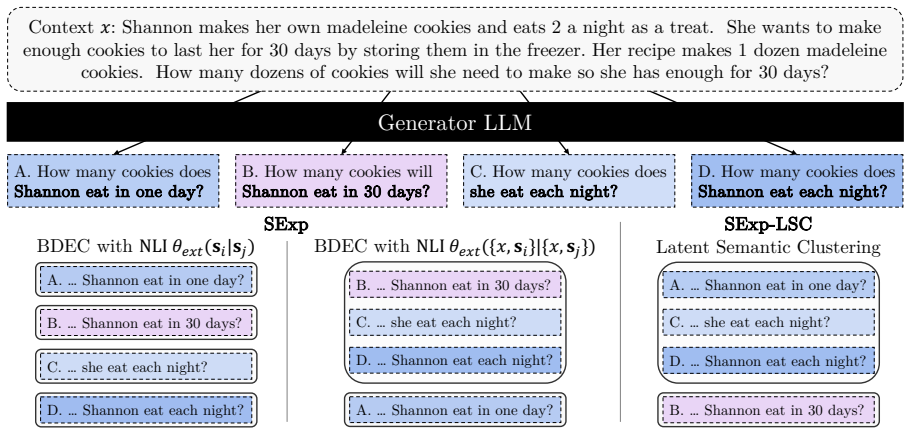
- SExp-LSC reduces LLM inferences by up to 22.58 percent on ARC with no loss in accuracy, because context-conditioned hidden states merge redundant reasoning paths more accurately.
- The hidden-state cosine-similarity adjacency can replace the NLI-based adjacency inside soft spectral methods (KLE, Deg, EigV, ECC), so the benefit extends beyond hard clustering.
- Larger generators show larger gains: on BioASQ, Llama3-70B improves more over NLI baselines than Llama3.2-1B does.
- Because the hidden states are already computed during generation, LSC adds only similarity and eigendecomposition work and no additional model forward pass.
Reading between the lines
- Extension beyond the paper: if the eigenvalue-gap heuristic proves stable, the per-task threshold could in principle become a fixed model-level constant, since normalized-Laplacian eigenvalues lie in a bounded range; the paper only tunes it per task.
- The paper's own Limitations section notes that LSC uses a single intermediate layer and the last token, and that it requires white-box access to the generator; averaging over tokens or layers and probing black-box models are natural next steps.
- If the hidden-state adjacency carries the same information as NLI judgments on harder open-ended generation, the same matrix could also be used to aggregate rewards or rank reasoning paths in other test-time scaling schemes, not only the uncertainty and tree-search settings evaluated here.
- An unstated consequence is that LSC's marginal cost approaches zero when the hidden states are already being produced for generation, so semantic clustering could become a default component of test-time scaling rather than a separate model call.
Editorial analysis
A structured set of objections, weighed in public.
Referee Report
Summary. The paper proposes Latent Semantic Clustering (LSC), a method that uses the hidden states of the generator LLM itself, rather than external NLI or sentence-embedding models, to build a semantic similarity graph over sampled outputs and cluster them via spectral clustering. The number of clusters is determined automatically by thresholding the small eigenvalues of the normalized Laplacian. LSC is evaluated in two test-time-computation settings: uncertainty quantification (SE-LSC and DSE-LSC replace the NLI-based clustering in Semantic Entropy and Degree-based Semantic Entropy) and multi-step reasoning (SExp-LSC replaces the NLI-based semantic exploration in SExp). The experiments report that LSC matches or improves AUROC/AUARC relative to baselines in most settings and reduces LLM inference counts in reasoning, e.g., by 22.58% on ARC with equal accuracy. Additional analyses compare clustering quality and latency against NLI and embedding models.
Significance. If the results hold, LSC is a significant practical advance: it removes the need for external models in semantic clustering for test-time scaling, which is a major computational bottleneck in methods like semantic entropy and semantic tree search. The paper provides broad empirical coverage (two LLMs, three QA datasets for uncertainty, two reasoning benchmarks, and a clustering-quality study) and the efficiency gains are concrete (e.g., 22.58% fewer LLM inferences on ARC). The central idea of using the generator's own context-conditioned hidden states is well motivated and aligns with prior evidence that intermediate LLM layers carry semantic information. However, the significance is currently conditional on resolving two load-bearing issues: the theoretical and practical validity of the eigenvalue-thresholding heuristic for choosing the number of clusters, and the complete reporting of hyperparameters (layer index l and threshold τ) that can dominate the comparison. With those addressed, the paper could be a solid contribution to efficient test-time scaling.
major comments (4)
- [Section 3, Eq. (7) and the paragraph after Theorem 1] The claim that the distribution of small eigenvalues of the normalized Laplacian can estimate the number of semantically distinct meanings is not justified. The cited Theorem 1 (Von Luxburg, 2007) equates the multiplicity of the zero eigenvalue with the number of connected components only for binary adjacency matrices; for the continuous cosine-similarity matrix A in Eq. (6), the graph is generically a single connected component, so λ1=0 has multiplicity one and the small positive eigenvalues have no proven correspondence to clusters. Since k = |{λ_i < τ}| is fed directly into spectral clustering, every downstream result in Tables 1–3 and the reasoning experiments is conditional on this heuristic. The paper should either supply a theoretical argument (e.g., a perturbation or near-block-structure analysis) or demonstrate empirically that the eigengap or thresholded count reliably recovers the true number of semantic clusters on held-out data, with sensitivity to τ reported.
- [Appendix B and Table A1] The clustering threshold τ is selected per task on a validation set of only 100 examples, but the paper does not report the selected τ values, the search grid, or the criterion used for selection (clustering F1 vs. downstream AUROC/accuracy). If τ is chosen to maximize the final metric, the reported gains of SE-LSC/DSE-LSC and SExp-LSC may reflect per-task tuning of a sensitive hyperparameter rather than an inherent advantage of hidden-state clustering. The authors should report τ for each dataset/model, show the sensitivity of the main results to τ (e.g., a sweep), and ideally use a fixed τ across tasks or a principled automatic selection rule.
- [Section 3, Eq. (4), and Figure 5] The layer index l used to extract hidden states is never specified for any experiment. Figure 5 shows that clustering F1 varies from about 0.6 to 0.9 depending on the chosen layer, so the unreported l can dominate the comparison. If l was selected on the validation set per model/dataset, that is an additional per-task hyperparameter; if it was fixed arbitrarily, the reader cannot reproduce the results. The paper must report the exact l used for each model (and dataset, if it varies) and justify the choice, or show that the main conclusions are robust across layers.
- [Tables 1 and A3] The claim that LSC 'maintains or exceeds the performance of existing methods' is not uniformly supported by the data. On Mistral-7B-Instruct with TriviaQA, SE-LSC and DSE-LSC achieve lower AUROC than the corresponding SE and DSE baselines (0.8234 vs. 0.8338 and 0.8161 vs. 0.8245). Moreover, no variance or significance measures are reported anywhere; the observed differences (e.g., +0.03 AUROC on BioASQ for Llama3-8B) may be within noise. The authors should add error bars or statistical tests over multiple seeds, and temper the abstract's phrasing to reflect the settings where LSC is not clearly superior.
minor comments (5)
- [Section 3] The result labeled 'Theorem 1' is a direct citation of Von Luxburg (2007); it should be presented as a known result from the literature rather than as a contribution of this paper. Also, the statement should clarify that it applies to binary or nonnegative adjacency matrices, as the following paragraph acknowledges.
- [Section 5] There is a typo: 'demostrated' should be 'demonstrated'. Please also proofread for other spelling errors.
- [Table 3] The LSC row reports memory usage as '≈0 GB'. Please specify how this was measured (e.g., hidden-state tensors stored during generation) and clarify the comparison to the 4.6–20 GB memory of decoder-only LLM baselines.
- [Section 4.2 and Table 2] The paper does not state the number of generated sequences N or the branching factor d used in the reasoning experiments beyond the MCTS settings in Table A2. Since the computational overhead of spectral clustering is O(N^3), please state N explicitly for the reader to assess the claimed 'virtually no additional computation'.
- [Appendix B] Table A1 lists 'threshold for clustering' as a hyperparameter but does not give its value or selection criterion; please provide a concrete description of the validation procedure, including which metric is optimized and the range of τ searched.
Circularity Check
No significant circularity: LSC is an empirical method validated against external NLI and embedding baselines, with only minor self-citation of the authors' prior SExp work as a baseline.
full rationale
The paper's central claim is that hidden states of the generator LLM can replace external NLI or embedding models for semantic clustering in test-time scaling. This claim is supported by direct comparisons to external baselines (DeBERTa-MNLI, Sentence-BERT, T5-XXL) on clustering F1, latency, and memory, and by downstream uncertainty quantification and reasoning experiments. The number of clusters k is obtained by thresholding eigenvalues of the normalized Laplacian, with the threshold τ tuned on a 100-example validation set per task. This is standard hyperparameter selection, not a fitted parameter disguised as a prediction: the reported test metrics are not forced by construction. The eigenvalue heuristic based on Von Luxburg's Theorem 1 is acknowledged by the authors to be a heuristic for continuous-valued adjacency matrices, and the undisclosed layer index l is a reproducibility concern; these are correctness risks, not circularity. The only self-citation is to the authors' prior SExp method, which is used as a baseline and building block; the improvements of SExp-LSC over SExp are measured empirically, not derived from the citation itself. No step in the derivation reduces to its own input by construction.
Assumptions & free parameters
free parameters (2)
- clustering threshold τ =
not reported; tuned on 100-example validation set per task (Appendix B)
- hidden layer index l =
not reported; Figure 5 shows a layer sweep
assumptions (3)
- standard math Spectral clustering theorem: for a binary adjacency matrix, the multiplicity of the zero eigenvalue of the normalized Laplacian equals the number of connected components
- domain assumption Hidden states of the generator LLM encode semantic content such that cosine similarity in hidden space reflects semantic equivalence
- ad hoc to paper For continuous-valued adjacency matrices, the small-eigenvalue distribution can estimate the number of semantically distinct meanings
Cite this review
Pith. "Pith review of Efficient Latent Semantic Clustering for Scaling Test-Time Computation of LLMs." pith.science (2026). https://pith.science/paper/PF3FNG6H
@misc{pith2026250600344,
  author       = {Pith},
  title        = {Pith review of: Efficient Latent Semantic Clustering for Scaling Test-Time Computation of LLMs},
  year         = {2026},
  howpublished = {\url{https://pith.science/paper/PF3FNG6H}},
  note         = {Machine review of arXiv:2506.00344}
}
read the original abstract
Scaling test-time computation--generating and analyzing multiple or sequential outputs for a single input--has become a promising strategy for improving the reliability and quality of large language models (LLMs), as evidenced by advances in uncertainty quantification and multi-step reasoning. A key shared component is semantic clustering, which groups outputs that differ in form but convey the same meaning. Semantic clustering enables estimation of the distribution over the semantics of outputs and helps avoid redundant exploration of reasoning paths. However, existing approaches typically rely on external models, which introduce substantial computational overhead and often fail to capture context-aware semantics. We propose Latent Semantic Clustering (LSC), a lightweight and context-sensitive method that leverages the generator LLM's internal hidden states for clustering, eliminating the need for external models. Our extensive experiment across various LLMs and datasets shows that LSC significantly improves the computational efficiency of test-time scaling while maintaining or exceeding the performance of existing methods.
Figures


Figures from the paper (3 more)


Reference graph
Works this paper leans on
-
[1]
online" 'onlinestring :=
ENTRY address archivePrefix author booktitle chapter edition editor eid eprint eprinttype howpublished institution journal key month note number organization pages publisher school series title type volume year doi pubmed url lastchecked label extra.label sort.label short.list INTEGERS output.state before.all mid.sentence after.sentence after.block STRING...
-
[2]
write newline
" write newline "" before.all 'output.state := FUNCTION n.dashify 't := "" t empty not t #1 #1 substring "-" = t #1 #2 substring "--" = not "--" * t #2 global.max substring 't := t #1 #1 substring "-" = "-" * t #2 global.max substring 't := while if t #1 #1 substring * t #2 global.max substring 't := if while FUNCTION word.in bbl.in capitalize " " * FUNCT...
-
[3]
Samir Abdaljalil, Hasan Kurban, Parichit Sharma, Erchin Serpedin, and Rachad Atat. 2025. Sindex: Semantic inconsistency index for hallucination detection in llms. arXiv preprint arXiv:2503.05980
arXiv 2025
-
[4]
Karl Cobbe, Vineet Kosaraju, Mohammad Bavarian, Mark Chen, Heewoo Jun, Lukasz Kaiser, Matthias Plappert, Jerry Tworek, Jacob Hilton, Reiichiro Nakano, Christopher Hesse, and John Schulman. 2021. Training verifiers to solve math word problems. arXiv preprint arXiv:2110.14168
arXiv 2021
-
[5]
Jacob Devlin, Ming-Wei Chang, Kenton Lee, and Kristina Toutanova. 2019. Bert: Pre-training of deep bidirectional transformers for language understanding. In Proceedings of the 2019 conference of the North American chapter of the association for computational linguistics: human language technologies, volume 1 (long and short papers), pages 4171--4186
2019
-
[6]
Aaron Grattafiori, Abhimanyu Dubey, Abhinav Jauhri, Abhinav Pandey, Abhishek Kadian, Ahmad Al-Dahle, Aiesha Letman, Akhil Mathur, Alan Schelten, Alex Vaughan, et al. 2024. The llama 3 herd of models. arXiv e-prints, pages arXiv--2407
2024
-
[7]
Jiatong Han, Jannik Kossen, Muhammed Razzak, and Yarin Gal. 2024. Semantic entropy neurons: Encoding semantic uncertainty in the latent space of llms. In MINT: Foundation Model Interventions
work page 2024
-
[8]
Shibo Hao, Yi Gu, Haodi Ma, Joshua Hong, Zhen Wang, Daisy Wang, and Zhiting Hu. 2023. Reasoning with language model is planning with world model. In Proceedings of the 2023 Conference on Empirical Methods in Natural Language Processing, pages 8154--8173
2023
Show all 34 references
-
[9]
Shibo Hao, Sainbayar Sukhbaatar, DiJia Su, Xian Li, Zhiting Hu, Jason Weston, and Yuandong Tian. 2024. Training large language models to reason in a continuous latent space. arXiv preprint arXiv:2412.06769
2024 arXiv
-
[10]
Pengcheng He, Xiaodong Liu, Jianfeng Gao, and Weizhu Chen. 2020. Deberta: Decoding-enhanced bert with disentangled attention. arXiv preprint arXiv:2006.03654
2020 arXiv
- [11]
-
[12]
Mandar Joshi, Eunsol Choi, Daniel S Weld, and Luke Zettlemoyer. 2017. Triviaqa: A large scale distantly supervised challenge dataset for reading comprehension. In Proceedings of the 55th Annual Meeting of the Association for Computational Linguistics (Volume 1: Long Papers), p...
2017
-
[13]
Saurav Kadavath, Tom Conerly, Amanda Askell, Tom Henighan, Dawn Drain, Ethan Perez, Nicholas Schiefer, Zac Hatfield-Dodds, Nova DasSarma, Eli Tran-Johnson, et al. 2022. Language models (mostly) know what they know. arXiv preprint arXiv:2207.05221
2022 arXiv
-
[14]
Jannik Kossen, Jiatong Han, Muhammed Razzak, Lisa Schut, Shreshth Malik, and Yarin Gal. 2024. Semantic entropy probes: Robust and cheap hallucination detection in llms. arXiv preprint arXiv:2406.15927
2024 arXiv
-
[15]
Anastasia Krithara, Anastasios Nentidis, Konstantinos Bougiatiotis, and Georgios Paliouras. 2023. Bioasq-qa: A manually curated corpus for biomedical question answering. Scientific Data, 10(1):170
2023
-
[16]
Lorenz Kuhn, Yarin Gal, and Sebastian Farquhar. 2023. Semantic uncertainty: Linguistic invariances for uncertainty estimation in natural language generation. In The Eleventh International Conference on Learning Representations
2023
-
[17]
Sungjae Lee, Hyejin Park, Jaechang Kim, and Jungseul Ok. 2025. Semantic exploration with adaptive gating for efficient problem solving with language models. Association for Computational Linguistics
2025
-
[18]
Zhen Lin, Shubhendu Trivedi, and Jimeng Sun. 2024. Generating with confidence: Uncertainty quantification for black-box large language models. Transactions on Machine Learning Research
2024
-
[19]
Andrey Malinin and Mark Gales. 2020. Uncertainty estimation in autoregressive structured prediction. arXiv preprint arXiv:2002.07650
2020 arXiv
-
[20]
MetaAI. 2024. Llama 3.2-1b-instruct. https://huggingface.co/meta-llama/Llama-3.2-1B-Instruct. Instruction-tuned multilingual language model
2024
-
[21]
Alexander Nikitin, Jannik Kossen, Yarin Gal, and Pekka Marttinen. 2024. Kernel language entropy: Fine-grained uncertainty quantification for llms from semantic similarities. Advances in Neural Information Processing Systems, 37:8901--8929
2024
-
[22]
Alina Petukhova, Jo \ a o P Matos-Carvalho, and Nuno Fachada. 2025. Text clustering with large language model embeddings. International Journal of Cognitive Computing in Engineering, 6:100--108
2025
-
[23]
Xin Qiu and Risto Miikkulainen. 2024. Semantic density: Uncertainty quantification for large language models through confidence measurement in semantic space. Advances in neural information processing systems
2024
-
[24]
Pranav Rajpurkar, Jian Zhang, Konstantin Lopyrev, and Percy Liang. 2016. Squad: 100,000+ questions for machine comprehension of text. In Proceedings of the 2016 Conference on Empirical Methods in Natural Language Processing, pages 2383--2392
2016
-
[25]
Nils Reimers and Iryna Gurevych. 2019. https://doi.org/10.18653/v1/D19-1410 Sentence- BERT : Sentence embeddings using S iamese BERT -networks . In Proceedings of the 2019 Conference on Empirical Methods in Natural Language Processing and the 9th International Joint Conference...
2019 doi
-
[26]
Oscar Skean, Md Rifat Arefin, Dan Zhao, Niket Patel, Jalal Naghiyev, Yann LeCun, and Ravid Shwartz-Ziv. 2025. Layer by layer: Uncovering hidden representations in language models. International conference on machine learning
2025
-
[27]
Charlie Snell, Jaehoon Lee, Kelvin Xu, and Aviral Kumar. 2025. Scaling llm test-time compute optimally can be more effective than scaling model parameters. The Eleventh International Conference on Learning Representations
2025
-
[28]
Ulrike Von Luxburg. 2007. A tutorial on spectral clustering. Statistics and computing, 17:395--416
2007
-
[29]
Ante Wang, Linfeng Song, Ye Tian, Dian Yu, Haitao Mi, Xiangyu Duan, Zhaopeng Tu, Jinsong Su, and Dong Yu. 2025 a . Don't get lost in the trees: Streamlining llm reasoning by overcoming tree search exploration pitfalls. arXiv preprint arXiv:2502.11183
2025 arXiv
-
[30]
Xuezhi Wang, Jason Wei, Dale Schuurmans, Quoc Le, Ed Chi, Sharan Narang, Aakanksha Chowdhery, and Denny Zhou. 2022. Self-consistency improves chain of thought reasoning in language models. arXiv preprint arXiv:2203.11171
2022 arXiv
-
[31]
Wong, and Rui Wang
Yiming Wang, Pei Zhang, Baosong Yang, Derek F. Wong, and Rui Wang. 2025 b . https://openreview.net/forum?id=jxo70B9fQo Latent space chain-of-embedding enables output-free LLM self-evaluation . In The Thirteenth International Conference on Learning Representations
2025
-
[32]
Jason Wei, Xuezhi Wang, Dale Schuurmans, Maarten Bosma, Fei Xia, Ed Chi, Quoc V Le, Denny Zhou, et al. 2022. Chain-of-thought prompting elicits reasoning in large language models. Advances in neural information processing systems, 35:24824--24837
2022
-
[33]
Miao Xiong, Zhiyuan Hu, Xinyang Lu, Yifei Li, Jie Fu, Junxian He, and Bryan Hooi. 2024. Can llms express their uncertainty? an empirical evaluation of confidence elicitation in llms. The Eleventh International Conference on Learning Representations
2024
-
[34]
Shunyu Yao, Dian Yu, Jeffrey Zhao, Izhak Shafran, Tom Griffiths, Yuan Cao, and Karthik Narasimhan. 2023. Tree of thoughts: Deliberate problem solving with large language models. Advances in neural information processing systems, 36:11809--11822
2023
Reviewed August 7, 2026 · model on record in the stance chip above.
Discussion (0). Sign in to comment.