REVIEW 3 major objections 3 minor 51 references
Causal Structure Discovery for Error Diagnostics of Children's ASR
T0 review · 3 major / 3 minor · reviewed 2026-08-07 · deepseek-v4-flash
Pith's one-line read The paper claims that automatic causal structure discovery from children's ASR data yields a simpler and more accurate causal graph than the hand-coded one, with age mainly driving substitution errors, noise mainly driving insertion…
desk verdict A useful data-driven DAG comparison that overreaches on causal quantification: the ACE values in Table 3 are associational, not interventional. read the letter →
The pith
A machine-rendered reading of the paper's core claim, the machinery that carries it, and where it could break.
The reading
What carries the argument
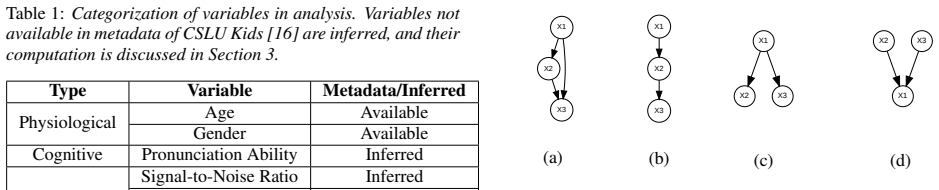
The central machinery is a two-stage causal pipeline: structure discovery followed by causal quantification. Structure discovery uses the PC algorithm, a conditional-independence-based search that assumes causal sufficiency, and the FCI algorithm, which allows hidden confounders; in this study both produce the same graph. Quantification uses the average causal effect, defined as the expected outcome when the cause takes one value minus the expected outcome when it takes another value, applied through Bayesian network inference. The comparison object is the prior hand-coded DAG, against which the automatically discovered edges are judged both structurally and by effect magnitude.
What would settle it
Recompute the average causal effect for each edge using backdoor adjustment for age, pronunciation ability, and utterance length; if the adjusted effect of age on insertion or deletion errors is comparable to its adjusted effect on substitution errors, the central distinction between the hard-coded and data-driven graphs collapses.
Extended reading notes
Core claim
Applying the PC and FCI causal structure discovery algorithms to children's ASR data produces a directed acyclic graph in which age has a direct edge only to substitution errors, SNR has a direct edge only to insertion errors, and gender has no direct edge to any error type. The data-driven graph also shows that utterance length directly affects substitution and deletion errors, while mispronunciation affects substitution and insertion errors. Quantifying the edges with the average causal effect, the authors find that fine-tuning substantially lowers the age effect in both the hard-coded and data-driven graphs, but the effect of utterance length remains very high. They conclude that the hard-coded graph forced weak causal associations that the data do not support, and that the automated graph gives a simpler account of the root causes of children's ASR errors.
Load-bearing premise
The load-bearing premise is that the average causal effect can be read from the difference in conditional expectations in Equation (1) without first adjusting for confounders such as age; if age or utterance length is a common cause of both the measured covariates and the error types, the reported effects are associations rather than causes.
Editorial extensions
If this is right
- If the data-driven graph is correct, age-based interventions should focus on substitution errors rather than insertion or deletion errors.
- If noise mainly drives insertions, noise-robust training for classroom settings should target suppression of inserted words rather than general error reduction.
- If gender has no causal edge, gender-specific model adaptation is unnecessary for these error types.
- Because the utterance-length effect remains high after fine-tuning, short-utterance data augmentation or architectures suited to short queries should be prioritized.
- The same discovery pipeline can be reapplied to other child speech corpora with age and gender metadata to test whether the graph transfers across datasets and ASR models.
Reading between the lines
- The authors leave implicit that if utterance length dominates even after fine-tuning, evaluation corpora that mix short and long utterances may overstate model improvements that apply mainly to longer utterances.
- The absent gender edge is the most directly testable claim: a matched comparison of boy and girl recordings with equal length and SNR should show no word-error-rate gap if the graph is right.
- Because the average causal effect is computed from conditional expectations without an explicit backdoor adjustment, a reanalysis adjusting for age and pronunciation could change the reported magnitudes; this is a natural next check rather than a claim the paper makes.
- The same PC/FCI pipeline could be run on fine-tuned models with imputed age and gender metadata, for example by predicting those labels from speech, to see whether the discovered graph itself changes after fine-tuning.
Editorial analysis
A structured set of objections, weighed in public.
Referee Report
Summary. This paper proposes replacing the hand-coded causal DAG of prior work [7] with a data-driven DAG learned from CSLU Kids using PC and FCI, with nodes for age, gender, goodness-of-pronunciation (GoP), vocabulary difficulty, SNR, utterance length, and three ASR error types (substitution, deletion, insertion). The authors then quantify 'average causal effects' via Eq. (1) on pretrained and fine-tuned Whisper-small and Wav2Vec2.0-large models, concluding that age acts mainly through substitution errors, SNR mainly through insertions, gender has no direct role, and fine-tuning reduces age effects but not utterance-length effects. The paper also compares its data-driven DAG with the hardcoded DAG from prior work.
Significance. The applied question is worthwhile: knowing which factors remain resistant to fine-tuning could guide data collection, augmentation, and architecture choices for children's ASR. The use of two causal discovery algorithms and two speech foundation models gives the study a broad empirical surface, and the comparison with the earlier hardcoded DAG is a useful check on prior assumptions. However, the quantitative causal layer is currently unsupported because Eq. (1) defines ACE as an associational conditional-expectation contrast rather than an interventional effect, and the discovery pipeline lacks the procedural detail needed to reproduce the reported DAG. If the identification and reporting issues are fixed, the structural findings could be a useful contribution to the children's ASR community.
major comments (3)
- [§2.3, Eq. (1); §4.2, Table 3] The ACE in Eq. (1) is defined as E[X_j | X_i=x_1] - E[X_j | X_i=x_0], a difference of conditional expectations. This equals an average causal effect only when X_i is unconfounded with respect to X_j or after appropriate adjustment. In the discovered DAG in Fig. 2(b), GoP has parents Age, Vocabulary Difficulty, and No. Words, and these parents also plausibly affect the error nodes; similar confounding applies to SNR and No. Words. The paper does not describe any backdoor adjustment, do-calculus derivation, or intervention simulation in the Bayesian network quantification. The reported ACE values in Table 3 are therefore associational contrasts, and the conclusions that fine-tuning reduces the causal impact of Age and that No. Words remains a dominant, fine-tuning-resistant causal factor are not established by the current analysis.
- [§4.1, Fig. 2(b)] The paper states that both PC and FCI 'have produced the same DAG' but provides none of the details needed to reproduce or interpret that result: the conditional independence test used, the significance level alpha, the treatment of the discrete ordinal variables, the orientation rules, and whether the final objects are CPDAGs/PAGs rather than fully directed DAGs. This matters because PC and FCI generally return equivalence classes (CPDAG/PAG), and FCI is designed to represent latent-variable uncertainty; drawing them as a single DAG presupposes identifiability. Without these details, the central structural claims—that age affects only substitution errors, that SNR affects only insertion errors, and that gender has no edge—are not supported by the evidence shown.
- [§4.2, Table 3] The ACE values in Table 3 are reported without confidence intervals, standard errors, or significance tests, and the text interprets small numerical differences between models and DAGs (e.g., Age open-source -4.36 vs -5.21 for Wav2Vec2.0) as meaningful. In addition, the paper does not state how the x0/x1 contrast is defined for the three-level discretized variables (Low/Average/High for GoP and Vocabulary Difficulty; Clean/Average/Noisy for SNR), so the reader cannot tell which pairwise comparison each number refers to. These reporting gaps should be addressed alongside the identification issue in Eq. (1).
minor comments (3)
- [§3.3, §4.2] There are several typos and wording errors: 'tartget phone' in §3.3, 'for for fine-tuned model' in §4.2, and 'CLSU Kids' in §3.1 should be 'CSLU Kids'.
- [§3.3] The thresholds for GoP and Vocabulary Difficulty discretization are not reported; only SNR thresholds (Clean/Average/Noisy) are given, so the discretization is not reproducible.
- [References] Reference [7] is an SSRN preprint; since the hardcoded DAG in Fig. 2(a) and its previous ACE values are central comparison targets, a published or more accessible version would help the reader verify the baseline structure.
Circularity Check
No significant circularity: the data-driven DAG and ACE values come from standard algorithms applied to observed data; the authors' own hardcoded DAG [7] is a comparison baseline, not a fitted target.
full rationale
The paper's derivation chain is data → PC/FCI conditional-independence discovery on CSLU Kids → a single data-driven DAG (identical for PC and FCI) → ACE quantification (Eq. 1) → comparison with the hardcoded DAG from the authors' prior work [7] and with fine-tuned models evaluated on the same corpus. The headline conclusions—age primarily edges into substitution errors, SNR primarily into insertion errors, gender has no edge to errors, and No. Words retains large ACE after fine-tuning—are contingent outputs of the independence tests and the measured error-rate differences; none is forced by a fitted parameter renamed as a prediction, and none is defined into existence by Eq. (1). The principal self-citation is [7], which contributes the hardcoded baseline DAG, the variable set, the GoP metric, the discretization, and the Bayesian-network quantification; this inheritance is real but not load-bearing, because nothing in [7] is used as a uniqueness theorem or as a restriction on the hypothesis space, and the novel structural findings would stand or fall on the CSLU Kids data alone. The most serious weakness is that Eq. (1) defines ACE as a conditional mean difference; for nodes with parents (GoP, SNR, No. Words) this equals the interventional average causal effect only after backdoor adjustment, which the paper never describes. That is an identification/correctness concern about whether Table 3 is causal or associational, not a circular derivation, and per the review criteria it is excluded from the circularity score. Overall the paper is self-contained against its data: no circular step was found.
Assumptions & free parameters
free parameters (4)
- SNR discretization thresholds =
Clean >= 20 dB, Average 5-20 dB, Noisy <= 5 dB
- GoP discretization thresholds (Low/Average/High) =
not specified numerically
- Vocabulary difficulty discretization thresholds =
not specified numerically
- Conditional independence test significance level (alpha) =
not stated
assumptions (4)
- domain assumption Causal Markov condition and faithfulness hold for the observed variables
- domain assumption Causal sufficiency for PC, and the learned graph is treated as correct despite FCI's relaxation
- ad hoc to paper The difference E[Xj|Xi=x1]-E[Xj|Xi=x0] equals the average causal effect of Xi on Xj
- domain assumption GoP score is a valid measure of pronunciation ability independent of the ASR model
Cite this review
Pith. "Pith review of Causal Structure Discovery for Error Diagnostics of Children's ASR." pith.science (2026). https://pith.science/paper/X2XADXTM
@misc{pith2026250600402,
  author       = {Pith},
  title        = {Pith review of: Causal Structure Discovery for Error Diagnostics of Children's ASR},
  year         = {2026},
  howpublished = {\url{https://pith.science/paper/X2XADXTM}},
  note         = {Machine review of arXiv:2506.00402}
}
read the original abstract
Children's automatic speech recognition (ASR) often underperforms compared to that of adults due to a confluence of interdependent factors: physiological (e.g., smaller vocal tracts), cognitive (e.g., underdeveloped pronunciation), and extrinsic (e.g., vocabulary limitations, background noise). Existing analysis methods examine the impact of these factors in isolation, neglecting interdependencies-such as age affecting ASR accuracy both directly and indirectly via pronunciation skills. In this paper, we introduce a causal structure discovery to unravel these interdependent relationships among physiology, cognition, extrinsic factors, and ASR errors. Then, we employ causal quantification to measure each factor's impact on children's ASR. We extend the analysis to fine-tuned models to identify which factors are mitigated by fine-tuning and which remain largely unaffected. Experiments on Whisper and Wav2Vec2.0 demonstrate the generalizability of our findings across different ASR systems.
Figures

Reference graph
Works this paper leans on
-
[7]
Causes of degradation in children’s ASR Prior Knowledge Bayesian Network Our Causes of degradation in children’s ASR PC [33] and FCI [34] Bayesian Network This allows us to quantify the causal impact of specific vari- ables on ASR performance, helping identify which factors con- siderably influence outcomes such as word error rates. 2.4. Causality in Mach...
-
[1]
Introduction Automatic speech recognition (ASR) is in the growing demand for child-centric technological solutions [1, 2, 3]. Unfortu- nately, the performance of ASR for children lags considerably behind that for adults [4, 5].Speech foundation models(SFM) followed by fine-tuning is the current approach for improving performance for children’s ASR [2, 6, ...
work page Pith review arXiv 2025
-
[2]
A Primer in Causality Causal analysis aims to establish cause-and-effect relation- ships that go beyond mere statistical (correlational) associa- tions [25, 24]. Causal relations are formalized through adi- rected acyclic graph(DAG), whose nodes represent the vari- ables and edges represent the cause-effect relations. Causal analysis is typically conducte...
-
[3]
Experimental Setup 3.1. Dataset Following [7], we use CSLU Kids [16] for causal analysis due to the availability of diverse age groups and gender metadata. Since no standard protocol (training/development/test split) is available for CLSU Kids, we use the publicly available protocol from [3, 7]. We also include MyST [15] dataset for fine-tuning the SFMs t...
-
[4]
Results and Discussion Unlike [7], which uses a hardcoded DAG and focuses solely on causal quantification, we perform both causal structure discov- ery and causal quantification. 4.1. Causal Structure Discovery First, we examine the differences between the hardcoded DAG used in a prior study [7] and the data-driven DAG obtained us- ing PC and FCI, as show...
-
[5]
Conclusion We presented an approach for the construction of causal graphs for analyzing ASR errors in children. Unlike prior studies with hardcoded causal link assumptions, our data-driven method learns the causality relations automatically and removes un- necessary edges from the causal graph, thereby simplifying the analysis. ACE analysis identifies key...
-
[6]
Acknowledgements The authors wish to acknowledge CSC – IT Center for Science, Finland, for computational resources
-
[8]
R. Jainet al., “A wav2vec2-based experimental study on self- supervised learning methods to improve child speech recogni- tion,”IEEE Access, vol. 11, pp. 46 938–46 948, 2023
work page 2023
Show all 51 references
-
[9]
Towards better domain adaptation for self- supervised models: a case study of child asr,
R. Fanet al., “Towards better domain adaptation for self- supervised models: a case study of child asr,”IEEE Journal of Selected Topics in Signal Processing, vol. 16, 2022
2022
-
[10]
Analysis of chil- dren’s speech, pitch and formant frequency,
S. Lee, A. Potamianos, and S. S. Narayanan, “Analysis of chil- dren’s speech, pitch and formant frequency,”Journal of the Acoustical Society of America, vol. 101, 1997
1997
-
[11]
New technologies and 21st century children,
J. H. Graafland, “New technologies and 21st century children,” Organization for Economic Co-operation and Development (OECD), no. 179, 2018. [Online]. Available: www.oecd-ilibrary. org/content/paper/e071a505-en
2018
-
[12]
Benchmarking children’s asr with supervised and self-supervised speech foundation models,
R. Fan, N. Shankar, and A. Alwan, “Benchmarking children’s asr with supervised and self-supervised speech foundation models,” inProc. Interspeech, 2024
2024
-
[13]
Childaugment: Data augmentation methods for zero-resource children’s speaker verification,
V . P. Singh, M. Sahidullah, and T. Kinnunen, “Childaugment: Data augmentation methods for zero-resource children’s speaker verification,”J. Acoust. Soc. Am., vol. 155, pp. 2221–2232, 2024
2024
-
[14]
Improving end-to-end models for children’s speech recognition,
T. Patel and O. Scharenborg, “Improving end-to-end models for children’s speech recognition,”Applied Sciences, vol. 14, 2024
2024
-
[15]
Spectral modification based data augmenta- tion for improving end-to-end asr for children’s speech,
V . P. Singhet al., “Spectral modification based data augmenta- tion for improving end-to-end asr for children’s speech,” inProc. Interspeech, 2022
2022
-
[16]
Adaptation of whisper models to child speech recognition,
R. Jainet al., “Adaptation of whisper models to child speech recognition,” inIn Proc. Interspeech, 2023
2023
-
[17]
Causal analysis of asr errors for children: Quantifying the impact of physiological, cognitive, and extrinsic factors,
V . P. Singh, M. Sahidullah, and T. Kinnunen, “Causal analysis of asr errors for children: Quantifying the impact of physiological, cognitive, and extrinsic factors,” Available at SSRN, 2024. [Online]. Available: https://ssrn.com/abstract=5125557
2024
-
[18]
Thank you for attention: A survey on attention-based artificial neural networks for automatic speech recognition,
P. Karmakaret al., “Thank you for attention: A survey on attention-based artificial neural networks for automatic speech recognition,”Intelligent Systems with Applications, vol. 23, 2024
2024
-
[19]
A comparative analysis of automatic speech recog- nition errors in small group classroom discourse,
J. Caoet al., “A comparative analysis of automatic speech recog- nition errors in small group classroom discourse,” inProc. of the 31st ACM Conference on User Modeling, Adaptation and Person- alization, 2023
2023
-
[20]
Allen and B
Institute of Medicine (IOM) and National Research Council (NRC),Transforming the Workforce for Children Birth Through Age 8: A Unifying Foundation, L. Allen and B. B. Kelly, Eds. The National Academies Press, 2015
2015
-
[21]
Acoustics of children’s speech: Developmental changes of temporal and spectral parameters,
S. Leeet al., “Acoustics of children’s speech: Developmental changes of temporal and spectral parameters,”Journal of the Acoustical Society of America, vol. 105, 1999
1999
-
[22]
An analysis of the causes of increased error rates in children’s speech recognition,
Q. Li and M. Russell, “An analysis of the causes of increased error rates in children’s speech recognition,” inProc. ICSLP, 2002
2002
-
[23]
How pronunciation distance impacts word recog- nition in children and adults,
T. Bentet al., “How pronunciation distance impacts word recog- nition in children and adults,”J Acoust Soc Am, vol. 150, no. 6, p. 4103, 2021
2021
-
[24]
Function words in early speech perception,
R. Shiet al., “Function words in early speech perception,” inProc. International Congress of Phonetic Sciences, 2003
2003
-
[25]
My Science Tutor (MyST) – a large corpus of children’s conversational speech,
S. Pradhanet al., “My Science Tutor (MyST) – a large corpus of children’s conversational speech,” inProc. Joint International Conference on Computational Linguistics, Language Resources and Evaluation (LREC-COLING 2024), 2024
2024
-
[26]
The OGI Kids’ speech corpus and recogniz- ers,
K. Shobakiet al., “The OGI Kids’ speech corpus and recogniz- ers,” inProc. Interspeech, 2000
2000
-
[27]
End-to-end neural systems for automatic children speech recognition: An empirical study,
P. Gurunath Shivakumar and S. Narayanan, “End-to-end neural systems for automatic children speech recognition: An empirical study,”Computer Speech & Language, vol. 72, p. 101289, 2022
2022
-
[28]
Robust speech recognition via large-scale weak supervision,
A. Radfordet al., “Robust speech recognition via large-scale weak supervision,” inIn Proc. ICML, 2023
2023
-
[29]
Animal Behavioral Modeling PC-MI [30] Graph Neural Network
-
[30]
Detecting and quantifying causal associations in large nonlinear time series datasets,
J. Runge, P. Nowack, M. Kretschmer, S. Flaxman, and D. Se- jdinovic, “Detecting and quantifying causal associations in large nonlinear time series datasets,”Science Advances, vol. 5, no. 11, p. eaau4996, 2019
2019
-
[31]
Explainability in Recommendation System Domain Knowledge Logistic Regression
-
[32]
Sentiment Classification in NLP Domain Knowledge Bayesian Network
-
[33]
The development of temporal concepts: linguistic factors and cognitive processes,
M. Zhang and J. Hudson, “The development of temporal concepts: linguistic factors and cognitive processes,”Frontiers in Psychol- ogy, vol. 9, p. 2451, 12 2018
2018
-
[34]
The foundations of causal inference,
J. Pearl, “The foundations of causal inference,”Sociological Methodology, vol. 40, pp. 75–149, 2010
2010
-
[35]
Causal-learn: Causal discovery in python,
Y . Zhenget al., “Causal-learn: Causal discovery in python,”Jour- nal of Machine Learning Research, vol. 25, no. 60, 2024
2024
-
[36]
Quantifying causal influences,
D. Janzing,et al., “Quantifying causal influences,”The Annals of Statistics, vol. 41, no. 5, pp. 2324–2358, 2013
2013
-
[37]
A survey on causal inference,
L. Yao, Z. Chu, S. Li, Y . Li, J. Gao, and A. Zhang, “A survey on causal inference,”ACM Transactions on Knowledge Discovery from Data, vol. 15, no. 5, 2021
2021
-
[38]
Causal analysis of speech recognition failure in adverse environments,
G. Zhouet al., “Causal analysis of speech recognition failure in adverse environments,” inProc. ICASSP, 2002
2002
-
[39]
wav2vec 2.0: A framework for self-supervised learning of speech representations,
A. Baevskiet al., “wav2vec 2.0: A framework for self-supervised learning of speech representations,” inIn Proc. Advances in Neu- ral Information Processing Systems, 2020
2020
-
[40]
Behaviour modelling of social animals via causal structure discovery and graph neural networks,
G. Gendronet al., “Behaviour modelling of social animals via causal structure discovery and graph neural networks,” inIn. Proc. International Conference on Autonomous Agents and Multiagent Systems, 2024
2024
-
[41]
Learn- ing post-hoc causal explanations for recommendation,
S. Xu, Y . Li, S. Liu, Z. Fu, Y . Ge, X. Chen, and Y . Zhang, “Learn- ing post-hoc causal explanations for recommendation,”arXiv preprint, vol. arXiv:2006.16977, 2020
2006 arXiv
-
[42]
Causalabsc: Causal inference for aspect debiasing in aspect- based sentiment classification,
J. Zhou, Y . Lin, Q. Chen, Q. Zhang, X. Huang, and L. He, “Causalabsc: Causal inference for aspect debiasing in aspect- based sentiment classification,”IEEE/ACM Transactions on Au- dio, Speech, and Language Processing, vol. 32, pp. 830–840, 2024
2024
-
[43]
Spirtes, C
P. Spirtes, C. N. Glymour, R. Scheines, and D. Heckerman,Cau- sation, Prediction, and Search. MIT Press, 2000
2000
-
[44]
Causal inference in the presence of latent vari- ables and selection bias,
P. Spirteset al., “Causal inference in the presence of latent vari- ables and selection bias,” inProc. UAI, 1995, pp. 499–506
1995
-
[45]
Review of causal discov- ery methods based on graphical models,
C. Glymour, K. Zhang, and P. Spirtes, “Review of causal discov- ery methods based on graphical models,”Frontiers in Genetics, vol. 10, p. 524, 2019
2019
-
[46]
Examples are not enough, learn to criticize! criticism for interpretability,
B. Kim, R. Khanna, and O. O. Koyejo, “Examples are not enough, learn to criticize! criticism for interpretability,” inProc. Advances in Neural Information Processing Systems, 2016
2016
-
[47]
Toward an instructionally oriented theory of example- based learning,
A. Renkl, “Toward an instructionally oriented theory of example- based learning,”Cognitive Science, vol. 38, no. 1, pp. 1–37, 2014
2014
-
[48]
Kernel-based conditional independence test and application in causal discovery,
K. Zhanget al., “Kernel-based conditional independence test and application in causal discovery,” inPro. UAI, 2011, pp. 804–813
2011
-
[49]
Automatic speech recognition and pronunciation error detection of Dutch non-native speech: Cumulating speech resources in a pluricentric language,
X. Weiet al., “Automatic speech recognition and pronunciation error detection of Dutch non-native speech: Cumulating speech resources in a pluricentric language,”Speech Communication, vol. 144, pp. 1–9, 2022
2022
-
[50]
Estimating word difficulty in english using python: A practical guide,
O. Duskin, “Estimating word difficulty in english using python: A practical guide,” 2023, avail- able online: https://medium.com/@omerduskin/ estimating-word-difficulty-in-english-using-python-\protect\ @normalcr\relaxa-practical-guide-8f6812de5122
2023
-
[51]
C. M. Bishop,Deep Learning: Foundations and Concepts. Springer, 2024
2024
Reviewed August 7, 2026 · model on record in the stance chip above.
Discussion (0). Sign in to comment.