REVIEW 4 major objections 7 minor 47 references
DYNAC: Dynamic Vocabulary based Non-Autoregressive Contextualization for Speech Recognition
T0 review · 4 major / 7 minor · reviewed 2026-08-07 · deepseek-v4-flash
Pith's one-line read DYNAC claims that non-autoregressive CTC can handle dynamic-vocabulary contextual biasing at near-autoregressive accuracy, cutting real-time factor by 81% on LibriSpeech test-clean.
desk verdict DYNAC is a solid engineering contribution that gives NAR ASR near-AR biasing accuracy at 5x lower RTF, but the paper needs a controlled baseline for the inference-time bias weight. read the letter →
The pith
A machine-rendered reading of the paper's core claim, the machinery that carries it, and where it could break.
The reading
What carries the argument
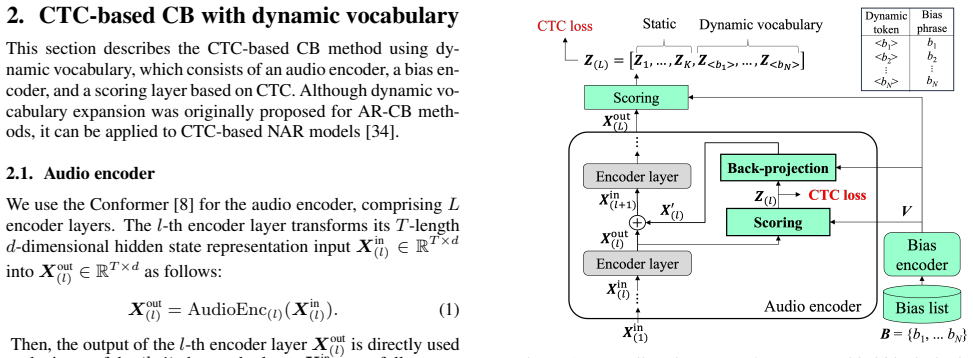
The load-bearing object is the back-projection residual of self-conditioned CTC. A scoring layer at the $l$-th encoder layer produces a joint posterior over static and dynamic vocabulary, $Z^{(l)} = \mathrm{Softmax}(\mathrm{Concat}(S^{(l)}_{\mathrm{static}}, S^{(l)}_{\mathrm{dynamic}}))$; the back-projection splits it and forms $X'(l) = \mathrm{Linear}(Z^{(l)}_{\mathrm{static}}) + Z^{(l)}_{\mathrm{dynamic}} V$, where $V$ is the matrix of bias-phrase embeddings from the bias encoder. This sum is added to the encoder layer's output before the next self-attention block, and the dynamic term contains no trainable parameters, so it can handle a vocabulary that changes between sessions. An auxiliary CTC loss on the same intermediate layers trains the encoder to make these posteriors useful early. The mechanism's job is to let the encoder's self-attention see, at every middle layer, where dynamic tokens are likely to appear, so static and dynamic tokens are modeled jointly despite CTC's frame-wise independence.
What would settle it
Run DYNAC with the back-projection in Eq. (11) replaced by $\mathrm{Linear}(Z^{(l)}_{\mathrm{static}})$ alone, keeping the intermediate CTC loss and everything else fixed; if biased-phrase word error on LibriSpeech test-clean does not rise well above DYNAC's reported 3.2%, the dynamic feedback term is not carrying the claim.
Extended reading notes
Core claim
The paper's central claim is that the conditional-independence weakness of CTC-based non-autoregressive contextual biasing can be repaired by conditioning the encoder on dynamic vocabulary inside the network, not only at the final scoring layer. In a dynamic-vocabulary setup, each bias phrase such as 'Raphael' is represented as one expandable token whose embedding comes from a bias encoder, alongside the fixed subword vocabulary. DYNAC applies the CTC scoring operation at intermediate Conformer layers (layers 3, 6, and 9), splits the resulting posterior into static and dynamic parts, and feeds a back-projected combination into the encoder as a residual. The reported effect is that the dynamic token no longer hogs probability mass: ordinary words keep scores above the blank token, so unbiased speech is not harmed while biased phrases are recognized reliably. The result is a non-autoregressive model whose overall and biased-phrase word error rates are nearly identical to the autoregressive dynamic-vocabulary system, at roughly one-fifth the real-time factor.
Load-bearing premise
The load-bearing premise is that injecting a weighted blend of ordinary-word predictions and bias-phrase embeddings into intermediate encoder layers is what lets the model recognize biased phrases without hurting ordinary speech; if that injection is not doing the work, the reported improvement disappears, and the paper reports no ablation isolating it.
Editorial extensions
If this is right
- Contextual biasing becomes usable in latency-sensitive settings: with a 1000-phrase bias list, DYNAC reports a CPU real-time factor of 0.031, versus 0.165 for the autoregressive dynamic-vocabulary system.
- Rare and unseen phrases improve without extra data or retraining: on LibriSpeech, phrases with fewer than 20 training occurrences gain the most, and phrases never seen in training reach a biased-phrase word error rate of 14.6%.
- Because the dynamic feedback path is parameter-free, the bias list can be swapped at inference time without re-encoding or fine-tuning the model.
- The approach transfers across languages with different vocabulary structures: on a Japanese dataset, biased-character error falls from 25.9% for self-conditioned CTC to 10.6%, at the same real-time factor.
Reading between the lines
- The paper never isolates the contribution of the $Z^{(l)}_{\mathrm{dynamic}} V$ term from the static self-conditioning; a natural follow-up is to ablate just that term and watch biased-phrase word error.
- Because the dynamic feedback path is parameter-free, the same residual design should compose with other non-autoregressive relaxations such as masked prediction or iterative refinement, though DYNAC does not test those combinations.
- The token-score plots suggest the mechanism works by preventing over-confidence on dynamic tokens; if that is right, DYNAC's advantage should grow with bias-list size and phrase rarity, a trend the reported scaling experiments already point toward.
Editorial analysis
A structured set of objections, weighed in public.
Referee Report
Summary. The paper proposes DYNAC, a non-autoregressive CTC-based contextual biasing method that integrates dynamic vocabulary into intermediate encoder layers via self-conditioned CTC. The method introduces scoring and back-projection layers that feed dynamic-vocabulary posteriors back into the encoder, aiming to capture dependencies between static and dynamic tokens. Experiments on LibriSpeech 960 and a Japanese corpus show that DYNAC achieves a WER of 2.1 with RTF 0.031 on test-clean, corresponding to an 81% RTF reduction compared to the autoregressive dynamic-vocabulary baseline (WER 2.0, RTF 0.165), while improving biased-phrase WER over self-conditioned CTC from 14.1 to 3.2. The paper also analyzes token-wise scores and reports robustness across bias-list sizes and phrase frequencies.
Significance. If the claims are substantiated, this is a meaningful advance: it brings dynamic-vocabulary contextualization to non-autoregressive models, achieving near-autoregressive accuracy at much lower inference cost, with large gains on rare and unseen phrases. The paper provides a clear architectural idea, comprehensive benchmarks against several baselines, and a token-level analysis that supports the qualitative explanation. The use of an external benchmark (LibriSpeech) and an in-house Japanese dataset adds credibility. However, the central attribution of the improvement to the proposed self-conditioning mechanism is not yet fully controlled, and the absence of statistical replicates makes the headline margins difficult to assess.
major comments (4)
- [Section 3.3 & Table 1] The comparison between the Section 2 baseline (B2) and DYNAC (B3) is not controlled for the inference-time bias weight mu. The paper specifies mu=0.1 for DYNAC (Section 4.1) but never states whether B2 uses the same weight and the same dynamic-token probability renormalization. If B2 uses no bias weight (i.e., mu=1), its U-WER of 45.2 could reflect unconstrained dynamic-token hallucination, and the B3 improvement could be largely due to the 10-fold downweighting rather than the self-conditioned back-projection in Eq. (11). Please report B2 with the identical inference settings as B3, and ideally provide a sweep of mu for both models.
- [Section 3.1, Eq. (11)] No ablation isolates the contribution of the proposed back-projection formulation. In particular, there is no experiment that removes the Z_dynamic^(l) V term, replaces it with a trainable projection, or varies the intermediate-layer set S. Without such ablations, the claim that the non-parametric dynamic term is the key mechanism for capturing static-dynamic dependencies is not established. Please include ablations that separately test the static linear term, the dynamic term, and the choice of layers S.
- [Section 4.1 & Table 1] All reported results are single runs without error bars, confidence intervals, or significance tests. The headline claim of a "0.1-point degradation in WER" (A3 vs B3) is within the typical run-to-run spread for such models, so the paper should report multiple seeds or at least state the number of runs and the variance; otherwise the precision of the comparison is unclear.
- [Section 4.4 & Table 2] The adaptation of the existing methods CPPNet [24] and Intermediate CB [25] to CTC-based NAR models is described in a single sentence ("we apply them to CTC-based NAR models for a fair comparison") without specifying the modifications, such as where the biasing loss or intermediate prediction is inserted and whether the inference-time bias weight mu is applied to them. This limits reproducibility and makes it difficult to judge whether the comparison is equitable. Please provide implementation details for these adapted baselines.
minor comments (7)
- [Title] The title contains an errant space in "V ocabulary"; please fix it to "Vocabulary".
- [Figure 3 caption] The caption "Comparison in token-wise score" should be "Comparison of token-wise scores".
- [Table 2] The DYNAC row is visually difficult to parse because the numbers are not separated; please format the table so each cell is clearly distinguishable.
- [Section 4.2] The phrase "DYNAC significantly reduces RTF" uses "significantly" in a non-statistical sense; consider "substantially" to avoid confusion with significance testing.
- [Section 4.5] The phrase "words occuring" should be "words occurring".
- [Section 4.1] The bias encoder is excluded from RTF measurement, which is reasonable, but please clarify whether the same exclusion applies to the autoregressive baseline's bias encoder for a fair RTF comparison.
- [Eq. (14)] The loss weights are lambda for both L_ctc and L_inter and (1-2*lambda) for L_att; consider explicitly noting that lambda=0.15 yields weights 0.15, 0.15, and 0.7 to preempt confusion.
Circularity Check
No significant circularity: DYNAC's headline claims are empirical and benchmarked on external corpora; the self-citations used for dynamic vocabulary and baselines are not load-bearing for the central comparison.
full rationale
The paper's derivation chain is an empirical architecture proposal, not a mathematical derivation whose output equals its input by construction. The headline RTF/WER comparison (Table 1, A3 vs B3) is measured on LibriSpeech 960 test-clean and on a Japanese corpus, both external to the fitted model; the RTF reduction follows from measured inference time on a CPU, not from a definition. The back-projection Eq. (11) X' = Linear(Z_static) + Z_dynamic V is presented as a mechanism whose benefit is verified by the B1/B2/B3 WER comparisons and token-score analysis, not as a theorem guaranteed to capture static-dynamic dependencies. No parameter is renamed as a prediction; lambda and mu are reported hyperparameters, and the claimed B-WER improvements are test-set measurements. The self-citations [34] (dynamic vocabulary) and [25] (intermediate biasing) define baseline technology, but the paper's contribution is evaluated against those baselines rather than assumed from them; no uniqueness theorem is imported, and no ansatz is justified solely by a self-citation. One experimental-validity caveat is that Section 4.1 sets mu=0.1 for DYNAC but the paper never states whether the B2 baseline in Table 1 uses the same bias weight or posterior renormalization, and there is no ablation isolating the Z_dynamic V term in Eq. (11). That is a potential confound in the B2-vs-B3 attribution, but it is not circularity: the reported numbers are measured outputs, not quantities forced to equal the model's inputs by construction. Accordingly no circular step meets the evidence bar of this review.
Assumptions & free parameters
free parameters (4)
- Bias weight mu =
0.1
- Loss weight lambda =
0.15
- Intermediate layer set S =
{3, 6, 9}
- Training bias-list size N =
50 to 200 phrases per batch
assumptions (4)
- standard math CTC conditional independence across time frames (Eq. 5)
- domain assumption Bias list B is available at inference and contains the phrases users want recognized
- ad hoc to paper Residual back-projection X'(l) = Linear(Z_static) + Z_dynamic * V preserves enough dynamic-token information for subsequent layers
- domain assumption Bias-encoder embeddings V serve as dynamic-token representations in CTC scoring and back-projection
Cite this review
Pith. "Pith review of DYNAC: Dynamic Vocabulary based Non-Autoregressive Contextualization for Speech Recognition." pith.science (2026). https://pith.science/paper/SJ3FU2L3
@misc{pith2026250600422,
  author       = {Pith},
  title        = {Pith review of: DYNAC: Dynamic Vocabulary based Non-Autoregressive Contextualization for Speech Recognition},
  year         = {2026},
  howpublished = {\url{https://pith.science/paper/SJ3FU2L3}},
  note         = {Machine review of arXiv:2506.00422}
}
read the original abstract
Contextual biasing (CB) improves automatic speech recognition for rare and unseen phrases. Recent studies have introduced dynamic vocabulary, which represents context phrases as expandable tokens in autoregressive (AR) models. This method improves CB accuracy but with slow inference speed. While dynamic vocabulary can be applied to non-autoregressive (NAR) models, such as connectionist temporal classification (CTC), the conditional independence assumption fails to capture dependencies between static and dynamic tokens. This paper proposes DYNAC (Dynamic Vocabulary-based NAR Contextualization), a self-conditioned CTC method that integrates dynamic vocabulary into intermediate layers. Conditioning the encoder on dynamic vocabulary, DYNAC effectively captures dependencies between static and dynamic tokens while reducing the real-time factor (RTF). Experimental results show that DYNAC reduces RTF by 81% with a 0.1-point degradation in word error rate on the LibriSpeech 960 test-clean set.
Figures


Reference graph
Works this paper leans on
-
[24]
Deep context: End-to-end contextual speech recogni- tion,
G. Pundak, T. N. Sainath, R. Prabhavalkar, A. Kannan, and D. Zhao, “Deep context: End-to-end contextual speech recogni- tion,” inProc. SLT, 2018, pp. 418–425
2018
-
[25]
Contextual RNN-T for open domain ASR,
M. Jain, G. Keren, J. Mahadeokar, and Y . Saraf, “Contextual RNN-T for open domain ASR,” inProc. Interspeech, 2020, pp. 11–15
work page 2020
-
[1]
DYNAC: Dynamic Vocabulary based Non-Autoregressive Contextualization for Speech Recognition
Introduction End-to-end automatic speech recognition (E2E-ASR) [1, 2] can be classified into autoregressive (AR) and non-autoregressive (NAR) models. AR models, such as the attention-based encoder-decoder [3–6] and recurrent neural network transducer (RNN-T) [7,8], predict the next token based on the previous to- ken sequence in an AR manner. In contrast,...
work page Pith review arXiv 2025
-
[2]
CTC-based CB with dynamic vocabulary This section describes the CTC-based CB method using dy- namic vocabulary, which consists of an audio encoder, a bias en- coder, and a scoring layer based on CTC. Although dynamic vo- cabulary expansion was originally proposed for AR-CB meth- ods, it can be applied to CTC-based NAR models [34]. 2.1. Audio encoder We us...
-
[3]
DYNAC To address the limitation described in Section 2.3, we intro- duce scoring and back-projection layers into the intermediate encoder layers. This architecture extends the conventional self- conditioned CTC [18], enabling the integration of dynamic vo- cabulary into intermediate representations of the encoder, as shown in Figure 1. 3.1. Self-condition...
-
[4]
Experiment We conduct several experiments to verify the effectiveness of the proposed method. Table 1:Comparison between AR and NAR models on the Lib- riSpeech 960 test-clean set.Boldvalues represent the best re- sults among the same category. ID Model WER U-WER B-WER RTF Autoregressive A1 CTC/attention 3.01.912.3 0.213 A2 BPB beam search [23] 3.5 3.0 7.7...
-
[5]
Conclusion This paper proposes DYNAC (Dynamic V ocabulary-based NAR Contextualization), an NAR-CB method that integrates dynamic vocabulary into intermediate encoder layers using self- conditioned CTC, enabling efficient inference with low RTF. Experimental results demonstrate that DYNAC significantly re- duces RTF while maintaining WER comparable to AR-C...
-
[6]
End-to-end speech recognition: A survey,
R. Prabhavalkar, T. Hori, T. N. Sainath, R. Schluter, and S. Watan- abe, “End-to-end speech recognition: A survey,”IEEE/ACM Transactions on Audio, Speech, and Language Processing, vol. 32, pp. 325–351, 2023
work page 2023
Show all 47 references
-
[7]
Recent advances in end-to-end automatic speech recogni- tion,
J. Li, “Recent advances in end-to-end automatic speech recogni- tion,”APSIPA Transactions on Signal and Information Process- ing, vol. 11, no. 1, 2022
2022
-
[8]
Attention-based models for speech recognition,
J. K. Chorowski, D. Bahdanau, D. Serdyuk, K. Cho, and Y . Ben- gio, “Attention-based models for speech recognition,”Advances in neural information processing systems, vol. 28, 2015
2015
-
[9]
Listen, attend and spell: A neural network for large vocabulary conversational speech recognition,
W. Chan, N. Jaitly, Q. Le, and O. Vinyals, “Listen, attend and spell: A neural network for large vocabulary conversational speech recognition,” inProc. ICASSP, 2016, pp. 4960–4964
2016
-
[10]
Robust speech recognition via large-scale weak su- pervision,
A. Radford, J. W. Kim, T. Xu, G. Brockman, C. McLeavey, and I. Sutskever, “Robust speech recognition via large-scale weak su- pervision,” inProc. ICML, 2023, pp. 28 492–28 518
2023
-
[11]
OWSM v3.1: Better and faster open Whisper-style speech models based on e- branchformer,
Y . Peng, J. Tian, W. Chen, S. Arora, B. Yanet al., “OWSM v3.1: Better and faster open Whisper-style speech models based on e- branchformer,” inProc. Interspeech, 2024, pp. 352–356
2024
-
[12]
Sequence transduction with recurrent neural net- works,
A. Graves, “Sequence transduction with recurrent neural net- works,” inProc. ICML, 2012
2012
-
[13]
Con- former: Convolution-augmented transformer for speech recogni- tion,
A. Gulati, J. Qin, C.-C. Chiu, N. Parmar, Y . Zhanget al., “Con- former: Convolution-augmented transformer for speech recogni- tion,” inProc. Interspeech, 2020, pp. 5036–5040
2020
-
[14]
Con- nectionist temporal classification: Labelling unsegmented se- quence data with recurrent neural networks,
A. Graves, S. Fern ´andez, F. Gomez, and J. Schmidhuber, “Con- nectionist temporal classification: Labelling unsegmented se- quence data with recurrent neural networks,” inProc. ICML, 2006, pp. 369–376
2006
-
[15]
Towards end-to-end speech recognition with recurrent neural networks,
A. Graves and N. Jaitly, “Towards end-to-end speech recognition with recurrent neural networks,” inProc. ICML, 2014, pp. 1764– 1772
2014
-
[16]
OWSM-CTC: An open encoder-only speech foundation model for speech recog- nition, translation, and language identification,
Y . Peng, Y . Sudo, M. Shakeel, and S. Watanabe, “OWSM-CTC: An open encoder-only speech foundation model for speech recog- nition, translation, and language identification,” inProc. ACL, 2024, pp. 10 192–10 209
2024
-
[17]
A comparative study on non-autoregressive modelings for speech- to-text generation,
Y . Higuchi, N. Chen, Y . Fujita, H. Inaguma, T. Komatsuet al., “A comparative study on non-autoregressive modelings for speech- to-text generation,” inProc. ASRU, 2021, pp. 47–54
2021
-
[18]
Intermediate loss regularization for CTC-based speech recognition,
J. Lee and S. Watanabe, “Intermediate loss regularization for CTC-based speech recognition,” inProc. ICASSP, 2021, pp. 6224–6228
2021
-
[19]
Imputer: Sequence modelling via imputation and dynamic pro- gramming,
W. Chan, C. Saharia, G. E. Hinton, M. Norouzi, and N. Jaitly, “Imputer: Sequence modelling via imputation and dynamic pro- gramming,” inProc. ICML, 2020, pp. 1403–1413
2020
-
[20]
Mask CTC: Non-autoregressive end-to-end asr with CTC and mask predict,
Y . Higuchi, S. Watanabe, N. Chen, T. Ogawa, and T. Kobayashi, “Mask CTC: Non-autoregressive end-to-end asr with CTC and mask predict,” inProc. Interspeech, 2020, pp. 3655–3659
2020
-
[21]
Align-refine: Non- autoregressive speech recognition via iterative realignment,
E. A. Chi, J. Salazar, and K. Kirchhoff, “Align-refine: Non- autoregressive speech recognition via iterative realignment,” in Proc. NAACL HLT, 2021, pp. 1920–1927
2021
-
[22]
Deja-vu: Double feature presentation and iterated loss in deep transformer networks,
A. Tjandra, C. Liu, F. Zhang, X. Zhang, Y . Wanget al., “Deja-vu: Double feature presentation and iterated loss in deep transformer networks,” inProc. ICASSP, 2020, pp. 6899–6903
2020
-
[23]
Relaxing the conditional indepen- dence assumption of CTC-based asr by conditioning on interme- diate predictions,
J. Nozaki and T. Komatsu, “Relaxing the conditional indepen- dence assumption of CTC-based asr by conditioning on interme- diate predictions,” inProc. Interspeech, 2021, pp. 3735–3739
2021
-
[26]
Instant one-shot word-learning for context-specific neural sequence-to-sequence speech recognition,
C. Huber, J. Hussain, S. St ¨uker, and A. Waibel, “Instant one-shot word-learning for context-specific neural sequence-to-sequence speech recognition,” inProc. ASRU, 2021, pp. 1–7
2021
-
[27]
Copyne: Better contextual ASR by copying named entities,
S. Zhou, Z. Li, Y . Hong, M. Zhang, Z. Wang, and B. Huai, “Copyne: Better contextual ASR by copying named entities,” arXiv preprint arXiv:2305.12839, 2023
2023 arXiv
-
[28]
Contextualized automatic speech recognition with attention- based bias phrase boosted beam search,
Y . Sudo, M. Shakeel, Y . Fukumoto, Y . Peng, and S. Watan- abe, “Contextualized automatic speech recognition with attention- based bias phrase boosted beam search,” inProc. ICASSP, 2024, pp. 10 896–10 900
2024
-
[29]
Contextu- alized end-to-end speech recognition with contextual phrase pre- diction network,
K. Huang, A. Zhang, Z. Yang, P. Guo, B. Muet al., “Contextu- alized end-to-end speech recognition with contextual phrase pre- diction network,” inProc. Interspeech, 2023, pp. 4933–4937
2023
-
[30]
Contextualized end-to-end automatic speech recognition with intermediate bias- ing loss,
M. Shakeel, Y . Sudo, Y . Peng, and S. Watanabe, “Contextualized end-to-end automatic speech recognition with intermediate bias- ing loss,” inProc. Interspeech, 2024, pp. 3909–3913
2024
-
[31]
Interbiasing: Boost unseen word recognition through biasing intermediate predictions,
Y . Nakagome and M. Hentschel, “Interbiasing: Boost unseen word recognition through biasing intermediate predictions,” in Proc. Interspeech, 2024, pp. 207–211
2024
-
[32]
Contextualized streaming end-to-end speech recognition with trie-based deep biasing and shallow fusion,
D. Le, M. Jain, G. Keren, S. Kimet al., “Contextualized streaming end-to-end speech recognition with trie-based deep biasing and shallow fusion,” inProc. Interspeech, 2021, pp. 1772–1776
2021
-
[33]
Improving large-scale deep biasing with phoneme features and text-only data in streaming transducer,
J. Qiu, L. Huang, B. Li, J. Zhang, L. Lu, and Z. Ma, “Improving large-scale deep biasing with phoneme features and text-only data in streaming transducer,” inProc. ASRU, 2023, pp. 1–8
2023
-
[34]
To- wards contextual spelling correction for customization of end- to-end speech recognition systems,
X. Wang, Y . Liu, J. Li, V . Miljanic, S. Zhao, and H. Khalil, “To- wards contextual spelling correction for customization of end- to-end speech recognition systems,”IEEE Trans. Audio, Speech, Lang. Process., vol. 30, pp. 3089–3097, 2022
2022
-
[35]
Improving contextual spelling correction by external acoustics attention and semantic aware data augmentation,
X. Wang, Y . Liu, J. Li, and S. Zhao, “Improving contextual spelling correction by external acoustics attention and semantic aware data augmentation,” inProc. ICASSP, 2023, pp. 1–5
2023
-
[36]
Phoebe: Pronunciation-aware contextualization for end-to-end speech recognition,
A. Bruguier, R. Prabhavalkar, G. Pundak, and T. N. Sainath, “Phoebe: Pronunciation-aware contextualization for end-to-end speech recognition,” inProc. ICASSP, 2019, pp. 6171–6175
2019
-
[37]
Phoneme-aware encoding for prefix-tree-based contextual asr,
H. Futami, E. Tsunoo, Y . Kashiwagi, H. Ogawa, S. Arora, and S. Watanabe, “Phoneme-aware encoding for prefix-tree-based contextual asr,” inProc. ICASSP, 2024
2024
-
[38]
Retraining-free customized ASR for enharmonic words based on a named-entity-aware model and phoneme similarity estimation,
Y . Sudo, K. Hata, and K. Nakadai, “Retraining-free customized ASR for enharmonic words based on a named-entity-aware model and phoneme similarity estimation,” inProc. Interspeech, 2023, pp. 3312–3316
2023
-
[39]
Contextualized automatic speech recognition with dynamic vo- cabulary,
Y . Sudo, Y . Fukumoto, M. Shakeel, Y . Peng, and S. Watanabe, “Contextualized automatic speech recognition with dynamic vo- cabulary,” inProc. SLT, 2024, pp. 78–85
2024
-
[40]
Hy- brid ctc/attention architecture for end-to-end speech recognition,
S. Watanabe, T. Hori, S. Kim, J. R. Hershey, and T. Hayashi, “Hy- brid ctc/attention architecture for end-to-end speech recognition,” IEEE Journal of Selected Topics in Signal Processing, vol. 11, no. 8, pp. 1240–1253, 2017
2017
-
[41]
Joint beam search integrating ctc, attention, and transducer decoders,
Y . Sudo, M. Shakeel, Y . Fukumoto, B. Yan, J. Shi, Y . Peng, and S. Watanabe, “Joint beam search integrating ctc, attention, and transducer decoders,”IEEE/ACM Trans. Audio, Speech, Lang. Process., vol. 33, pp. 598–612, 2025
2025
-
[42]
Attention is all you need,
A. Vaswani, N. Shazeer, N. Parmar, J. Uszkoreit, L. Jones, A. N. Gomez, L. u. Kaiser, and I. Polosukhin, “Attention is all you need,” inProc. NeurIPS, 2017, pp. 5998–6008
2017
-
[43]
SpecAugment: A simple data augmentation method for automatic speech recog- nition,
D. S. Park, W. Chan, Y . Zhang, C.-C. Chiuet al., “SpecAugment: A simple data augmentation method for automatic speech recog- nition,” inProc. Interspeech, 2019, pp. 2613–2617
2019
-
[44]
Lib- rispeech: an ASR corpus based on public domain audio books,
V . Panayotov, G. Chen, D. Povey, and S. Khudanpur, “Lib- rispeech: an ASR corpus based on public domain audio books,” inProc. ICASSP, 2015, pp. 5206–5210
2015
-
[45]
ESPnet: End-to-end speech processing toolkit,
S. Watanabe, T. Hori, S. Karita, T. Hayashi, J. Nishitobaet al., “ESPnet: End-to-end speech processing toolkit,” inProc. Inter- speech, 2018, pp. 2207–2211
2018
-
[46]
Corpus of spontaneous Japanese: Its design and evaluation,
K. Maekawa, “Corpus of spontaneous Japanese: Its design and evaluation,” inISCA & IEEE Workshop on Spontaneous Speech Processing and Recognition, 2003
2003
-
[47]
ATR Japanese speech database as a tool of speech recognition and synthesis,
A. Kurematsu, K. Takeda, Y . Sagisaka, S. Katagiri, H. Kuwabara, and K. Shikano, “ATR Japanese speech database as a tool of speech recognition and synthesis,”Speech Communication, vol. 9, no. 4, pp. 357–363, 1990
1990
Reviewed August 7, 2026 · model on record in the stance chip above.
Discussion (0). Sign in to comment.