REVIEW 4 major objections 5 minor 1 cited by
Learning MMSE Filters for OFDM Channel Estimation: Attention Transformer Gains at Linear Inference
T0 review · 4 major / 5 minor · reviewed 2026-08-07 · deepseek-v4-flash
Pith's one-line read Attention learns a single linear filter that beats LMMSE on OFDM.
desk verdict A useful idea and strong reported numbers, but the paper's central linear-inference claim is internally inconsistent and the complexity table is off by two orders of magnitude; needs revision before it can be trusted. read the letter →
The pith
A machine-rendered reading of the paper's core claim, the machinery that carries it, and where it could break.
The reading
What carries the argument
The load-bearing object is the two-stage Attention encoder. It consists of a Frequency Encoder and a Temporal Encoder, each using multi-head self-attention with embedding dimensions matched to the number of subcarriers and to the total number of channel elements, respectively. This structure is motivated by the separable correlation model $\mathbf{R}_{\text{full}} \approx \mathbf{R}_f \otimes \mathbf{R}_t$ for WSSUS channels: the first stage learns frequency correlations among pilots and subcarriers, and the second learns temporal correlations across OFDM symbols. A residual fully-connected decoder then maps the encoded features to the real and imaginary parts of the complex filter matrix $\mathbf{W}_{\text{A-MMSE}} \in \mathbb{C}^{NM \times L}$. At inference the encoder and decoder are discarded: estimation is the single multiplication of the fixed filter with the pilot vector.
What would settle it
Compare A-MMSE's fixed filter against a directly optimized linear filter built from the empirical covariance of the same training frames, evaluated on the same test frames; if the directly optimized filter matches or beats A-MMSE, the attention machinery is not the source of the gain. Alternatively, take the final filter and test it on frames separated from the training set by an increasing time gap; if NMSE grows with the gap, the fixed-filter assumption fails.
Extended reading notes
Core claim
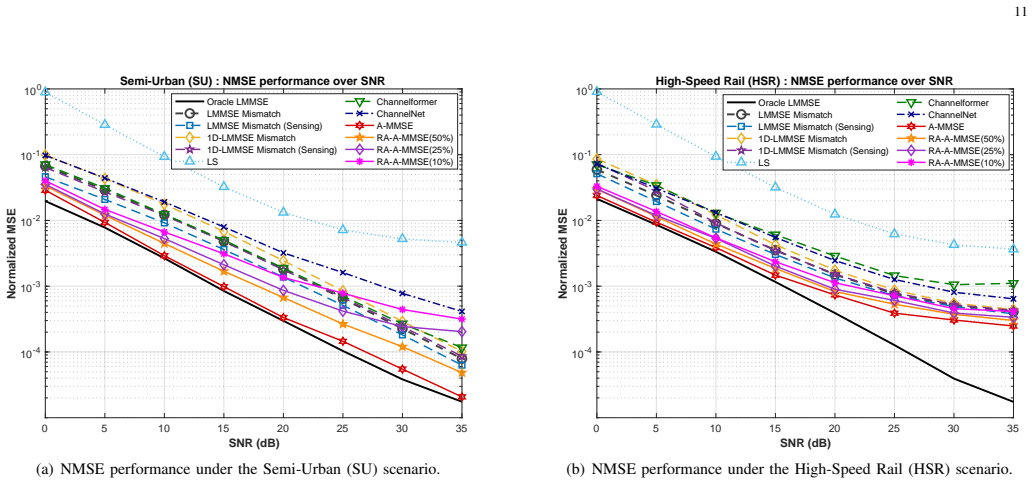
The central claim is that a linear MMSE filter can be learned end-to-end by an attention-based encoder-decoder, and that the resulting fixed filter is better matched to real, nonstationary OFDM channels than covariance-based LMMSE filters estimated from training samples. The filter is applied as $\mathrm{vec}(\hat{\mathbf{H}}_{\text{A-MMSE}}) = \mathbf{W}_{\text{A-MMSE}} \mathbf{y}_p$, where $\mathbf{W}_{\text{A-MMSE}}$ is produced by the network from the pilot observations during training. After training, one final filter is fixed and applied to all test frames. The paper reports that this fixed filter outperforms both mismatched LMMSE and Channelformer across SNR levels in semi-urban and high-speed-rail COST2100 scenarios, with larger gains in the semi-urban case.
Load-bearing premise
The load-bearing premise is that a single fixed linear filter, trained on the first 40,000 frames, stays near-optimal for the 4,000 subsequent nonstationary test frames and across SNR levels, rather than needing to be recomputed from each pilot observation.
Editorial extensions
If this is right
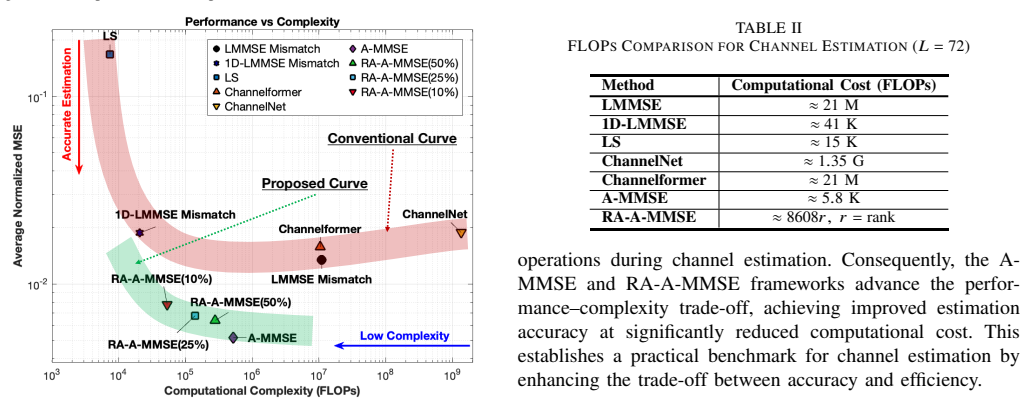
- Once trained, A-MMSE runs channel estimation as one matrix-vector product, so per-inference FLOPs drop to about 5.8k for the configured frame, roughly 95% less than LMMSE or Channelformer.
- The reported NMSE gains imply that a data-driven linear filter can beat both mismatched classical LMMSE and a nonlinear Transformer baseline under nonstationary COST2100 channels.
- The rank-adaptive extension means the same trained filter can be deployed at reduced rank, with complexity scaling as $\mathcal{O}(NMr + Lr)$ and still retaining most of the full-rank accuracy.
- Robustness results suggest that training at a moderate SNR of 20 dB gives one filter that works over a wide SNR range, avoiding per-SNR retraining.
Reading between the lines
- A key test not fully addressed in the paper is whether the single fixed filter remains near-optimal as channel statistics drift beyond the 4,000 consecutive test frames; one could quantify this by increasing the temporal gap between training and test frames.
- If the A-MMSE filter is truly input-independent after training, then the attention encoder is a training-time device, and the method's advantage over directly optimized linear filters, such as an empirical-covariance LMMSE, should be verified on the same data; the paper's baseline LMMSE is mismatched, which is the relevant comparison but should be made explicit.
- The same recipe of learning a linear operator and then deploying it linearly could carry over to other structured estimation problems, such as MIMO detection or channel prediction, where the covariance has a similar separable structure.
- The paper mentions an online adaptation framework only in supplementary material; if the online version updates the filter per frame, the linear-inference complexity claim would need to be restated to include the update cost.
Editorial analysis
A structured set of objections, weighed in public.
Referee Report
Summary. The paper proposes A-MMSE, a model-based OFDM channel estimator in which a two-stage attention transformer is trained to produce a linear filter W_A-MMSE, so that channel estimates are obtained at inference as vec(H_hat) = W_A-MMSE Y_p. A rank-adaptive extension, RA-A-MMSE, factorizes the filter to reduce complexity. The authors report large NMSE reductions relative to LMMSE and Channelformer on COST2100 Semi-Urban and High-Speed Rail scenarios, and claim very low per-inference FLOPs. The core value proposition is that nonlinear operations are confined to the training phase and inference is a single matrix-vector product.
Significance. If the central claims were fully supported, the paper would provide a practical channel estimator that combines the accuracy of a learned model with the inference cost of a linear filter, and the rank-adaptive extension would offer a useful deployment-time complexity knob. The manuscript has strengths: it makes source code publicly available, evaluates on standard COST2100 scenarios with a temporal train/test split, and explicitly targets the interpretability and complexity limitations of end-to-end neural estimators. However, the current text contains a load-bearing inconsistency between the input-dependent definition of W_A-MMSE in Eq. (19) and the fixed-filter statement in Sec. IV-B.3, an internally inconsistent FLOP table, and no comparison against a directly optimized fixed linear filter. Until these issues are resolved, the significance of the contribution cannot be properly assessed.
major comments (4)
- [IV-A, Eq. (19), and IV-B.3] Eq. (19) defines W_A-MMSE as a function of the current pilot observation, F_A-MMSE([Re(Y); Im(Y)]_P | theta). Under that definition, the estimator in Eq. (18) is input-dependent and nonlinear, because the attention encoder's softmax, FFN, and LayerNorm must be executed at inference, contradicting the paper's core claim of a single linear operation. Section IV-B.3 instead states that one final filter is produced from the entire training dataset and applied fixed to all test data. Please reconcile these statements: if the filter is fixed, rewrite Eq. (19) so that W_A-MMSE is produced from the training data only, and add the missing baseline of the optimal fixed linear filter estimated from the same data (e.g., sample-covariance LMMSE or ridge regression). Without that baseline, the claimed gains of the attention-trained filter over a directly optimized linear filter are not demonstrated.
- [Table II and Sec. V, Eq. (35)] The FLOP count for A-MMSE is internally inconsistent. With N=72, M=14, and L=72, the full-rank cost 8NML equals roughly 5.8e5 real FLOPs, not the approximately 5.8K listed in Table II. The RA-A-MMSE row (approximately 8608 r) and Eq. (35)'s 18% reduction for r=12 are consistent with a full-rank cost of 8NML about 5.8e5, so the A-MMSE row appears to be low by a factor of 100. In addition, clarify whether the LMMSE row is the per-inference cost with a precomputed filter or includes filter computation and matrix inversion; if the filter is precomputed, LMMSE inference also costs approximately 8NML, and the complexity comparison must be stated on the same basis.
- [VI-A and IV-B.3] The nonstationarity claim is tested only on 4,000 test frames that immediately follow the 40,000 training/validation frames. Because the A-MMSE filter is fixed after training, this experiment does not establish robustness to long-term statistical drift. Please either extend the evaluation horizon or temper the claim that the method effectively captures nonstationary channel statistics over time.
- [IV-B.1 and VI] The two-stage attention encoder is motivated by the separable covariance model in Eq. (21), but no ablation is provided to isolate its contribution. Under the fixed-filter interpretation, the encoder and decoder run only during training, so the reader cannot tell whether the reported gains come from the two-stage structure, from the Huber loss, or simply from learning any linear filter on this data. Please add ablations, for example replacing the attention encoder with an unstructured MLP or with direct empirical-risk minimization of W, and a sensitivity analysis for the Huber threshold delta.
minor comments (5)
- [IV-C.2] The parameter count is inconsistent: the text says the filter requires 2(NM x L) real-valued parameters, which for N=72, M=14, L=72 is 145,152, but the next sentence says approximately 70,000 (= NM x L) parameters. Please correct this.
- [Abstract, Sec. I, Sec. VI-B] The reported performance gains are inconsistent across the manuscript: the abstract says 56% lower NMSE than LMMSE and 72% lower than Channelformer, the introduction says 61% and 67%, while Section VI-B reports 73.8% and 82.2% in the SU scenario at 35 dB. Please harmonize the numbers and state the operating point for each claim.
- [Table II] The table should state explicitly whether FLOPs are counted per OFDM slot, per frame, or per resource block, and should specify the complex-arithmetic convention (e.g., one complex multiplication equals six real FLOPs) in the caption or text.
- [Notations and Eq. (19)] The notation [Re(Y); Im(Y)]_P uses vertical stacking, while the notation section defines [.,.] as horizontal stacking and [.;.] as vertical stacking; please clarify this usage in Eq. (19).
- [VI-B] The NMSE curves in Figs. 6 and 7 are presented without error bars or multiple-seed variability; please indicate the variance across independent training runs or state that a single run was used.
Circularity Check
No significant circularity: held-out COST2100 test frames determine the reported NMSE; the Eq. (19) vs. fixed-filter wording is an unresolved consistency issue, not a circular reduction.
full rationale
The A-MMSE filter is trained end-to-end by minimizing a supervised MSE/Huber loss (Eq. (31)) over a training split, and all reported NMSE numbers are computed on 4,000 test frames that follow the 40,000 training/validation frames (Sec. VI.A). The evaluation is therefore external to the training objective, and the fact that a least-squares-trained linear filter behaves like an MMSE filter is a restatement of the loss choice, not an independent prediction that needs to be derived from elsewhere. The comparisons against LMMSE mismatch, 1D-LMMSE, Oracle LMMSE, ChannelNet, and Channelformer provide independent empirical baselines. The main caveat is internal consistency, not circularity: Eq. (19) writes W_A-MMSE as F_A-MMSE([Re(Y); Im(Y)]_P | theta), i.e., a function of the current pilot observation, while Sec. IV-B.3 states that 'one final A-MMSE filter is produced from the entire training dataset' and then 'remains fixed and is consistently applied to all test data.' If the former is taken literally, the inference is not a single linear operation; if the latter is taken literally, Eq. (19) describes only training and the deployed filter is a fixed empirical linear filter that must be compared against a directly fitted least-squares filter, which the LMMSE-mismatch baseline approximates. This is a definitional ambiguity that should be corrected, but it does not make the test-set performance reduce to the training loss by construction. The separable covariance motivation in Eqs. (20)-(21) is cited to [33] and used as architectural motivation, not as the source of the numerical results. No load-bearing self-citation appears: [28], [37], and [39] are background, code-availability, and future-work citations. Table II's A-MMSE FLOP count (~5.8K) is inconsistent with the paper's own 8NML complexity formula (~5.8e5 for N=72, M=14, L=72), but an arithmetic/rounding error is a correctness issue, not a circularity. Overall, the central derivation is self-contained against external benchmarks; score 2 reflects the unresolved Eq. (19)/fixed-filter ambiguity, not a circular reduction.
Assumptions & free parameters
free parameters (2)
- Huber loss transition threshold delta =
not reported
- Training hyperparameters (learning rate, batch size, epochs) =
not reported
assumptions (3)
- standard math The LMMSE filter expression in Eq (9) under jointly Gaussian H and Z
- domain assumption WSSUS environment with separable scattering function, so R_full approx R_f tensor R_t (Eqs 20-21)
- domain assumption A single fixed linear filter trained on the first 36,000 frames generalizes to the subsequent 4,000 test frames under continuing Doppler drift
Cite this review
Pith. "Pith review of Learning MMSE Filters for OFDM Channel Estimation: Attention Transformer Gains at Linear Inference." pith.science (2026). https://pith.science/paper/BM4ZWAUE
@misc{pith2026250600452,
  author       = {Pith},
  title        = {Pith review of: Learning MMSE Filters for OFDM Channel Estimation: Attention Transformer Gains at Linear Inference},
  year         = {2026},
  howpublished = {\url{https://pith.science/paper/BM4ZWAUE}},
  note         = {Machine review of arXiv:2506.00452}
}
read the original abstract
In orthogonal frequency division multiplexing (OFDM), accurate channel estimation is crucial. Classical signal processing-based approaches, such as linear minimum mean-squared error (LMMSE) estimation, often require second-order statistics that are difficult to obtain in practice. Recent deep neural network (DNN)-based methods have been introduced to address this, but they often suffer from high inference complexity. This paper proposes an Attention-aided MMSE (A-MMSE), a model-based DNN framework that learns the linear MMSE filter via the Attention Transformer. Once trained, the A-MMSE performs channel estimation through a single linear operation, eliminating nonlinear activations during inference and thus reducing computational complexity. To improve the learning efficiency of the A-MMSE, we develop a two-stage Attention encoder that captures the frequency and temporal correlation structure of OFDM channels. We also introduce a rank-adaptive extension that adjusts the filter rank at deployment time, enabling efficient operation under resource-constrained receivers. Numerical simulations show that A-MMSE consistently outperforms baseline methods across a wide range of signal-to-noise ratio (SNR) conditions. In particular, the A-MMSE and its rank-adaptive extension provide an improved performance-complexity trade-off.
Figures


Figures from the paper (5 more)



Forward citations
Cited by 1 Pith paper
-
When 5G MIMO Scaling Breaks: Toward 6G Upper-Mid-Band Extreme MIMO
Scaling 5G MIMO to 256+ ports at 7–8 GHz breaks on common-channel coverage, RF/array power, and CSI overhead; the paper maps a roadmap that decouples radiating elements, RF chains, and acquired channel dimensions.
Reference graph
Works this paper leans on
-
[1]
5G: A tutorial overview of standards, trials, challenges, deployment, and practice,
M. Shafi, A. F. Molisch, P. J. Smith, T. Haustein, P. Zhu, P. De Silva, F. Tufvesson, A. Benjebbour, and G. Wunder, “5G: A tutorial overview of standards, trials, challenges, deployment, and practice,”IEEE J. Sel. Areas Commun., vol. 35, no. 6, pp. 1201–1221, 2017
work page 2017
-
[2]
5G field trials: OFDM-based wave- forms and mixed numerologies,
P. Guan, D. Wu, T. Tian, J. Zhou, X. Zhang, L. Gu, A. Benjebbour, M. Iwabuchi, and Y . Kishiyama, “5G field trials: OFDM-based wave- forms and mixed numerologies,”IEEE J. Sel. Areas Commun., vol. 35, no. 6, pp. 1234–1243, 2017
work page 2017
-
[3]
Optimized waveforms for 5G–6G communication with sensing: Theory, simulations and experiments,
S. D. Liyanaarachchi, T. Riihonen, C. B. Barneto, and M. Valkama, “Optimized waveforms for 5G–6G communication with sensing: Theory, simulations and experiments,”IEEE Trans. Wireless Commun., vol. 20, no. 12, pp. 8301–8315, 2021
work page 2021
-
[4]
OFDM channel estimation by singular value decomposition,
O. Edfors, M. Sandell, J.-J. van de Beek, S. Wilson, and P. Borjesson, “OFDM channel estimation by singular value decomposition,”IEEE Trans. Commun., vol. 46, no. 7, pp. 931–939, 1998
work page 1998
-
[5]
Pilot-symbol-aided channel estimation for OFDM in wireless systems,
Y . Li, “Pilot-symbol-aided channel estimation for OFDM in wireless systems,”IEEE Trans. Veh. Technol., vol. 49, no. 4, pp. 1207–1215, 2000
work page 2000
-
[6]
Y . Liu, Z. Tan, H. Hu, L. J. Cimini, and G. Y . Li, “Channel estimation for OFDM,”IEEE Commun. Surveys & Tutorials, vol. 16, no. 4, pp. 1891–1908, 2014
work page 1908
-
[7]
Deep learning-based channel estimation,
M. Soltani, V . Pourahmadi, A. Mirzaei, and H. Sheikhzadeh, “Deep learning-based channel estimation,”IEEE Commun. Lett., vol. 23, no. 4, pp. 652–655, 2019
work page 2019
-
[8]
Deep residual learning meets OFDM channel estimation,
L. Li, H. Chen, H.-H. Chang, and L. Liu, “Deep residual learning meets OFDM channel estimation,”IEEE Wireless Commun. Lett., vol. 9, no. 5, pp. 615–618, 2020
work page 2020
Show all 39 references
-
[9]
Low complexity channel estimation with neural network solutions,
D. Luan and J. Thompson, “Low complexity channel estimation with neural network solutions,” inProc. 25th International ITG Workshop on Smart Antennas (WSA), 2021, pp. 1–6
2021
-
[10]
High dimensional channel estimation using deep generative networks,
E. Balevi, A. Doshi, A. Jalal, A. Dimakis, and J. G. Andrews, “High dimensional channel estimation using deep generative networks,”IEEE J. Sel. Areas Commun., vol. 39, no. 1, pp. 18–30, 2021
2021
-
[11]
Attention is all you need,
A. Vaswani, N. Shazeer, N. Parmar, J. Uszkoreit, L. Jones, A. N. Gomez, Ł. Kaiser, and I. Polosukhin, “Attention is all you need,”arXiv preprint arXiv:1706.03762, 2017
2017 arXiv
-
[12]
Wireless channel estimation based on transformer and super-resolution,
J. Li, R. Wang, Y . Yuan, W. Zheng, B. He, and M. Li, “Wireless channel estimation based on transformer and super-resolution,” 2023
2023
-
[13]
Channelformer: Attention based neural solution for wireless channel estimation and effective online training,
D. Luan and J. S. Thompson, “Channelformer: Attention based neural solution for wireless channel estimation and effective online training,” IEEE Trans. Wireless Commun., vol. 22, no. 10, pp. 6562–6577, 2023
2023
-
[14]
Rectified linear units improve restricted boltzmann machines,
V . Nair and G. E. Hinton, “Rectified linear units improve restricted boltzmann machines,” inProceedings of the International Conference on Machine Learning (ICML), 2010, pp. 807–814
2010
-
[15]
Efficient backprop,
Y . LeCun, L. Bottou, G. B. Orr, and K. R. M ¨uller, “Efficient backprop,” inNeural Networks: Tricks of the Trade. Springer, 2012, pp. 9–48
2012
-
[16]
Fast and accurate deep network learning by exponential linear units (ELUs),
D. A. Clevert, T. Unterthiner, and S. Hochreiter, “Fast and accurate deep network learning by exponential linear units (ELUs),”arXiv preprint arXiv:1511.07289, 2015
2015 arXiv
-
[17]
Evaluation of pooling operations in convolutional architectures for object recognition,
D. Scherer, A. M ¨uller, and S. Behnke, “Evaluation of pooling operations in convolutional architectures for object recognition,” inArtificial Neural Networks–ICANN 2010. Springer, 2010, pp. 92–101
2010
-
[18]
Optimization or architecture: How to hack Kalman filtering,
I. Greenberg, N. Yannay, and S. Mannor, “Optimization or architecture: How to hack Kalman filtering,” inProc. of the Int. Conf. on Neural Information Processing Systems (NeurIPS), 2023
2023
-
[19]
Leveraging deep neural networks for massive MIMO data detection,
L. V . Nguyen, N. T. Nguyen, N. H. Tran, M. Juntti, A. L. Swindlehurst, and D. H. N. Nguyen, “Leveraging deep neural networks for massive MIMO data detection,”IEEE Wireless Commun., vol. 30, no. 1, pp. 174–180, 2023
2023
-
[20]
Model-based deep learning,
N. Shlezinger and Y . C. Eldar, “Model-based deep learning,”Founda- tions and Trends® in Signal Processing, vol. 17, no. 4, pp. 291–416, 2023
2023
-
[21]
KalmanNet: Neural network aided kalman filtering for partially known dynamics,
G. Revach, N. Shlezinger, X. Ni, A. L. Escoriza, R. J. G. van Sloun, and Y . C. Eldar, “KalmanNet: Neural network aided kalman filtering for partially known dynamics,”IEEE Trans. Signal Process., vol. 70, pp. 1532–1547, 2022
2022
-
[22]
Long short-term memory,
S. Hochreiter and J. Schmidhuber, “Long short-term memory,”Neural Computation, vol. 9, no. 8, pp. 1735–1780, 1997
1997
-
[23]
Learning phrase representations using RNN encoder–decoder for statistical machine translation,
K. Cho, B. van Merri ¨enboer, C. Gulcehre, D. Bahdanau, F. Bougares, H. Schwenk, and Y . Bengio, “Learning phrase representations using RNN encoder–decoder for statistical machine translation,” inProc. the Conference on Empirical Methods in Natural Language Process. (EMNLP), O...
2014
-
[24]
An introduction to the Kalman filter,
G. Welch and G. Bishop, “An introduction to the Kalman filter,” University of North Carolina at Chapel Hill, USA, Tech. Rep., 1995
1995
-
[25]
Split- KalmanNet: A robust model-based deep learning approach for state estimation,
G. Choi, J. Park, N. Shlezinger, Y . C. Eldar, and N. Lee, “Split- KalmanNet: A robust model-based deep learning approach for state estimation,”IEEE Trans. Veh. Technol., vol. 72, no. 9, pp. 12 326–12 331, 2023
2023
-
[26]
Kalmanformer: Using transformer to model the kalman gain in kalman filters,
S. Shen, J. Chen, G. Yu, Z. Zhai, and P. Han, “Kalmanformer: Using transformer to model the kalman gain in kalman filters,”Frontiers in Neurorobotics, vol. 18, p. 1460255, 2025
2025
-
[27]
Artificial intelligence-aided Kalman filters: AI-augmented designs for Kalman- type algorithms,
N. Shlezinger, G. Revach, A. Ghosh, S. Chatterjee, S. Tang, T. Im- biriba, J. Dunik, O. Straka, P. Closas, and Y . C. Eldar, “Artificial intelligence-aided Kalman filters: AI-augmented designs for Kalman- type algorithms,”IEEE Signal Process. Mag., vol. 42, no. 3, pp. 52–76, 2025
2025
-
[28]
State estimation with 1-bit observations and imperfect models: Bussgang meets Kalman in neural networks,
C. Jung, T. Ha, H. Kim, and J. Park, “State estimation with 1-bit observations and imperfect models: Bussgang meets Kalman in neural networks,” 2025. [Online]. Available: https://arxiv.org/abs/2507.17284
2025 arXiv
-
[29]
Efficient MU-MIMO beamforming based on majorization-minimization and deep unfolding,
Q. Xu, J. Sun, and Z. Xu, “Efficient MU-MIMO beamforming based on majorization-minimization and deep unfolding,”IEEE Trans. Wireless Commun., pp. 1–1, 2025
2025
-
[30]
Adaptive neural signal detection for massive MIMO,
M. Khani, M. Alizadeh, J. Hoydis, and P. Fleming, “Adaptive neural signal detection for massive MIMO,”IEEE Trans. Wireless Commun., vol. 19, no. 8, pp. 5635–5648, 2020
2020
-
[31]
The COST 2100 MIMO channel model,
L. Liu, C. Oestges, J. Poutanen, K. Haneda, P. Vainikainen, F. Quitin, F. Tufvesson, and P. D. Doncker, “The COST 2100 MIMO channel model,”IEEE Wireless Commun., vol. 19, no. 6, pp. 92–99, 2012
2012
-
[32]
Channel estimation techniques based on pilot arrangement in OFDM systems,
S. Coleri, M. Ergen, A. Puri, and A. Bahai, “Channel estimation techniques based on pilot arrangement in OFDM systems,”IEEE Trans. Broadcast., vol. 48, no. 3, pp. 223–229, 2002
2002
-
[33]
Low-complexity 2D LMMSE channel estimation for ofdm systems,
Y . Choi, J. H. Bae, and J. Lee, “Low-complexity 2D LMMSE channel estimation for ofdm systems,” inProc. IEEE Veh. Technol. Conf., 2015, pp. 1–5
2015
-
[34]
Adam: A method for stochastic optimization,
D. P. Kingma and J. Ba, “Adam: A method for stochastic optimization,” arXiv preprint arXiv:1412.6980, 2014
2014 arXiv
-
[35]
Robust estimation of a location parameter,
P. J. Huber, “Robust estimation of a location parameter,”Annals of Mathematical Statistics, vol. 35, no. 1, pp. 73–101, 1964
1964
-
[36]
NR; physical channels and modulation,
3rd Generation Partnership Project (3GPP), “NR; physical channels and modulation,” 3GPP, Tech. Rep. TS 38.211, April 2025, release 18
2025
-
[37]
Ha, https://github.com/TaeJun1999/Attention-aided-MMSE
T. Ha, https://github.com/TaeJun1999/Attention-aided-MMSE
-
[38]
Sensing- aided channel estimation in ofdm systems by leveraging communication echoes,
C. Qing, W. Hu, Z. Liu, G. Ling, X. Cai, and P. Du, “Sensing- aided channel estimation in ofdm systems by leveraging communication echoes,”IEEE Internet of Things J., vol. 11, no. 23, pp. 38 023–38 039, 2024
2024
-
[39]
Splitting messages in the dark- Rate-splitting multiple access for FDD massive MIMO without CSI feedback,
N. Kim, I. P. Roberts, and J. Park, “Splitting messages in the dark- Rate-splitting multiple access for FDD massive MIMO without CSI feedback,”IEEE Trans. Wireless Commun., vol. 24, no. 4, pp. 3320– 3332, 2025
2025
Reviewed August 7, 2026 · model on record in the stance chip above.
Discussion (0). Sign in to comment.