REVIEW 4 major objections 5 minor 21 references
Sarc7: Evaluating Sarcasm Detection and Generation with Seven Types and Emotion-Informed Techniques
T0 review · 4 major / 5 minor · reviewed 2026-08-07 · deepseek-v4-flash
Pith's one-line read Emotion-incongruity prompting is the key to fine-grained sarcasm classification in Sarc7.
desk verdict Useful benchmark resource, but the headline emotion-prompting win is built on labels too noisy to support the claim. read the letter →
The pith
A machine-rendered reading of the paper's core claim, the machinery that carries it, and where it could break.
The reading
What carries the argument
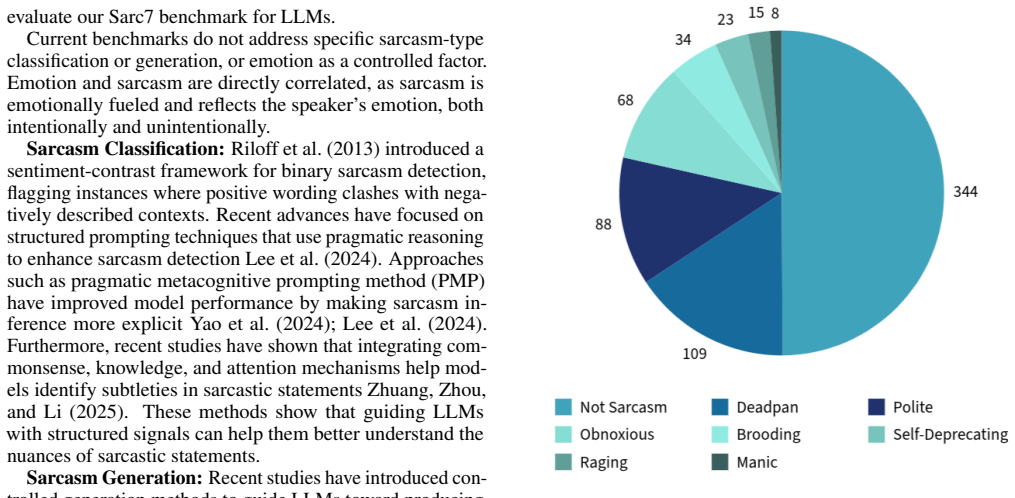
Sarc7 is the central artifact: 690 MUStARD dialogue segments re-annotated by four trained annotators into seven sarcasm subtypes, with a flowchart-based annotation protocol. The argument's load-bearing mechanism is the emotion-incongruity prompt, a three-step script that makes the model compare the expected emotion of the context with the expressed emotion of the utterance, using a fixed list of six basic emotions plus neutral, then classify the sarcasm type from the mismatch. On the generation side, the mechanism is a four-dimension conditioning template—incongruity, shock value, context dependency, and target emotion—with fixed values assigned per subtype so that each output is steered toward a consistent tone.
What would settle it
Re-annotate the same 690 MUStARD utterances with a fresh team that has not seen the original labels and measure inter-team kappa; if kappa falls well below the reported 0.6694, the model scores are comparisons against an unstable target. Alternatively, rerun the classification with class-balanced sampling; if the emotion-based macro-F1 advantage disappears, it is an artifact of rare-class weighting rather than evidence of emotional reasoning.
Extended reading notes
Core claim
The paper's central claim is that explicit emotional incongruity reasoning is a usable key to fine-grained sarcasm. Concretely, the authors propose replacing a single sarcasm label with seven types (self-deprecating, brooding, deadpan, polite, obnoxious, raging, manic), adapted from the linguistic taxonomy of Qasim (2021)/Lamb (2011), and then prompting LLMs to assign one of six basic emotions plus neutral to the dialogue context, assign one to the utterance, and infer the sarcasm subtype from the emotional mismatch. Across five LLMs, this emotion-based prompt gives the best macro-averaged F1 (a per-type average that weights rare subtypes as heavily as common ones, reaching 0.3664 with Gemini 2.5), beating chain-of-thought on macro-F1 even though CoT achieves the best raw accuracy; the authors attribute the F1 gain to better handling of low-frequency subtypes. On generation, the same emotion framing, operationalized as fixed per-subtype values for incongruity, shock value, context dependency, and emotion, yields subtype-aligned outputs that human evaluators prefer 38.46% more often than zero-shot baselines. The paper is careful to report that the ground truth itself is hard: Cohen's kappa 0.6694 on a fifth annotator and per-class human agreement as low as 39.39% for brooding sarcasm mark the practical ceiling for text-only models.
Load-bearing premise
The load-bearing premise is that the seven-type taxonomy, borrowed from classroom and interview studies, transfers cleanly to sitcom dialogue so that the human-annotated labels are reliable ground truth; the paper's own figures of Cohen's kappa 0.6694 and per-class agreement as low as 39.39% for brooding sarcasm show that this premise is shaky.
Editorial extensions
If this is right
- If emotion-incongruity prompting is the best macro-F1 configuration, fine-grained sarcasm evaluation should report per-subtype scores rather than binary accuracy alone.
- Because CoT still leads in raw accuracy, the results imply that structured reasoning and emotional cues capture different signals, making hybrid prompting a natural next target.
- The four-dimension generation protocol provides a reproducible recipe for steering LLM outputs toward a desired sarcasm type without additional fine-tuning.
- The low per-class human agreement on brooding, deadpan, and polite sarcasm sets an upper bound that any text-only model should be measured against.
- The confusion pattern of deadpan as a default label identifies a concrete failure mode that future pragmatic reasoning should try to avoid.
Reading between the lines
- The emotion-incongruity argument might transfer to related pragmatic phenomena such as irony, teasing, or deception detection, where a mismatch between expected and expressed affect is also diagnostic.
- The macro-F1 advantage could partly reflect class-imbalance mechanics: emotion cues may help rare classes at the cost of precision on 'not sarcasm'; a class-balanced re-evaluation would separate genuine pragmatic understanding from rebalancing.
- The generation claim rests on 100 outputs from one model, Claude 3.5 Sonnet; extending the human preference test to other models, multi-turn contexts, and non-English dialogues is a natural next check.
- Because the emotion prompts fix one emotion per subtype, a testable refinement is to infer emotion from context dynamically rather than using the fixed table, which might reduce the paper's reported 24.82-point drop on non-sarcastic cases.
Editorial analysis
A structured set of objections, weighed in public.
Referee Report
Summary. Sarc7 annotates the MUStARD dataset with seven sarcasm subtypes (self-deprecating, brooding, deadpan, polite, obnoxious, raging, manic) and evaluates five LLMs under zero-shot, few-shot, chain-of-thought, and a proposed emotion-based prompting strategy. The paper also proposes an emotion-conditioned generation method. The headline results are a macro-F1 of 0.3664 for Gemini 2.5 with emotion-based prompting (Table 4) and a generation success rate of 72/100 vs 52/100 for Claude 3.5 Sonnet (Table 6).
Significance. The paper addresses an important gap by moving from binary sarcasm detection to subtype-level evaluation, and the emotion-incongruity prompting idea is interpretable and clearly specified. The authors provide code and data under an open license and include a detailed reproducibility statement. However, the reliability evidence for the benchmark and the statistical grounding of the comparative results are currently too weak to support the central claims as stated. If the label-stability and multiple-run concerns are resolved, Sarc7 could become a useful resource for fine-grained pragmatic evaluation.
major comments (4)
- [§3.2, Table 5] The ground-truth labels for the seven Sarc7 subtypes are less stable than the headline comparisons require. Cohen's kappa against a fifth annotator is 0.6694, and per-class human agreement in Table 5 falls to 39.39% for brooding, 55.45% for deadpan, and 57.30% for polite sarcasm. These are the very subtypes where emotion-based prompting is claimed to produce gains (Table 5: brooding +3.04%, polite +23.0%, deadpan +17.47% for Claude). Since macro-averaged F1 (Table 4) weights every class equally, a small number of label changes in these low-agreement classes could move the reported Gemini 2.5 emotion-based advantage (0.3664 vs 0.3141 for CoT) by more than the observed gap. Please add a label-stability analysis, for example by bootstrapping over annotator labels or reporting performance against both the majority label set and the fifth annotator's labels, and provide confidence intervals for the F1 scores.
- [§4.2, Tables 3–4] All classification scores are single point estimates from a single API run. LLM outputs are stochastic, and the ranking of prompting methods could change across runs. The paper should report at least 3–5 repetitions per condition with mean and standard deviation, or use a significance test, before claiming that emotion-based prompting outperforms CoT and few-shot prompting.
- [§5.5, Table 6] The generation result (72/100 vs 52/100) is the entire basis for the 38.46% preference claim, but Section 4.2 states only that 'each rated by a human,' with no information on the number of raters, their instructions, or inter-annotator agreement. A single subjective judgment of 'successful generation' is not sufficient evidence for the abstract's claim. Provide multiple raters, agreement statistics, and a confidence interval for the success-rate difference.
- [§3.1–3.2] The Sarc7 taxonomy is adapted from Qasim (2021) and Lamb (2011), whose categories were developed on classroom and social-interview speech. No validation is provided showing that these subtypes transfer to MUStARD's scripted sitcom dialogues. The paper's own Limitations (Section 7) acknowledge the forced single-label scheme and class skew, but do not address the transfer question. Show that annotators can distinguish the categories on this corpus, for example with an annotator confusion matrix, or discuss the transfer limitation explicitly and temper the benchmark claims accordingly.
minor comments (5)
- [§5.1] The first paragraph says CoT 'consistently outperformed' the other methods, while the second paragraph says emotion-based prompting 'outperformed' CoT. Clarify that the first refers to accuracy (Table 3) and the second to macro-F1 (Table 4).
- [Abstract / §5.5] Use a single consistent number for the generation improvement: the abstract says 38.46%, while Section 5.5 says 38.42%.
- [§3.2] The text says 'Each sarcastic utterance in the MUStARD dataset (n=690)' but the classification task includes a 'not sarcasm' class; specify whether all 690 utterances were annotated or only those originally marked sarcastic.
- [§3.5, Appendix C] The emotion lists in the prompts include 'neutral' alongside Ekman's six basic emotions, but Section 3.5 says 'six basic emotions'; align the terminology.
- [Table 2] The dimension settings in Table 2 are fixed by the authors' intuition; an ablation showing which dimensions drive the generation improvements would strengthen the controllability claim.
Circularity Check
No significant circularity: the benchmark labels are human-annotated, the emotion-based prompts are pre-specified external taxonomies, and the generation dimensions are hand-set rather than fitted.
full rationale
The paper's derivation chain is empirical rather than definitional. Sarc7 labels are produced by four human annotators using an external taxonomy (Qasim 2021/Lamb 2011); the fifth-annotator Cohen's kappa of 0.6694 is a genuine reliability measurement, not a parameter fitted to the benchmark. The emotion-based classification prompt is pre-specified using Ekman's six basic emotions and fixed step-by-step instructions; it never reads Sarc7 label statistics back into its definition, so the reported macro-F1 of 0.3664 is a zero-shot outcome against human-annotated labels, not a quantity forced by construction. The generation dimensions in Table 2 are hand-assigned per subtype and explicitly not tuned (the paper states 'we assigned fixed values for each subtype based on our intuitive understanding'), so the 72/100 versus 52/100 human-preference result is an empirical comparison, not a renamed fit. The only self-citation (Lee et al. 2024, overlapping author Kevin Zhu) appears in Related Work as background motivation for structured prompting and is not used to justify the benchmark, to validate the emotion-based method, or to exclude alternatives. Concerns about label noise (kappa 0.6694, 39.39% brooding human agreement, forced single-label scheme) bear on reliability and validity of the evaluation target, not on circularity of the derivation. No step in the paper reduces a claimed prediction to its own input.
Assumptions & free parameters
free parameters (1)
- Per-subtype generation dimension settings =
Table 2: e.g., self-deprecating (3-5, low, medium, sadness)
assumptions (3)
- domain assumption Sarcasm can be partitioned into the seven types in Table 1.
- domain assumption Ekman's six basic emotions plus neutral are sufficient for representing the emotional incongruity of sarcasm.
- domain assumption Text-only context and utterance are sufficient for sarcasm type annotation and evaluation.
Cite this review
Pith. "Pith review of Sarc7: Evaluating Sarcasm Detection and Generation with Seven Types and Emotion-Informed Techniques." pith.science (2026). https://pith.science/paper/7ZUKUSPK
@misc{pith2026250600658,
  author       = {Pith},
  title        = {Pith review of: Sarc7: Evaluating Sarcasm Detection and Generation with Seven Types and Emotion-Informed Techniques},
  year         = {2026},
  howpublished = {\url{https://pith.science/paper/7ZUKUSPK}},
  note         = {Machine review of arXiv:2506.00658}
}
read the original abstract
Sarcasm is a form of humor where expressions convey meanings opposite to their literal interpretations. Classifying and generating sarcasm using large language models is vital for interpreting human communication. Sarcasm poses challenges for computational models, due to its nuanced nature. We introduce Sarc7, a benchmark that classifies 7 types of sarcasm: self-deprecating, brooding, deadpan, polite, obnoxious, raging, and manic by annotating entries of the MUStARD dataset. Classification was evaluated using zero-shot, few-shot, chain-of-thought (CoT), and a novel emotion-based prompting technique. We propose an emotion-based generation method developed by identifying key components of sarcasm-incongruity, shock value, and context dependency. Our classification experiments show that Gemini 2.5, using emotion-based prompting, outperforms other setups with an F1 score of 0.3664. Human evaluators preferred our emotion-based prompting, with 38.46% more successful generations than zero-shot prompting.
Figures


Figures from the paper (1 more)

Reference graph
Works this paper leans on
-
[1]
Anthropic. 2024. The claude 3 model family: Opus, sonnet, haiku. Anthropic Report
work page 2024
-
[2]
Biswas, P.; Ray, A.; and Bhattacharyya, P. 2019. Computational model for understanding emotions in sarcasm: A survey. CFILT Technical Report, Indian Institute of Technology Bombay
work page 2019
-
[3]
Castro, S.; Hazarika, D.; P \'e rez-Rosas, V.; Zimmermann, R.; Mihalcea, R.; and Poria, S. 2019. Towards multimodal sarcasm detection (an \_ O bviously \_ perfect paper). In Korhonen, A.; Traum, D.; and M \`a rquez, L., eds., Proceedings of the 57th Annual Meeting of the Association for Computational Linguistics , 4619--4629. Florence, Italy: Association ...
work page 2019
-
[4]
DeepMind, G.; Anil, R.; Arolfo, S.; Babuschkin, I.; Beyer, L.; Bosma, M.; and ... 2023. Gemini: A family of highly capable multimodal models. arXiv preprint arXiv:2312.11805
arXiv 2023
-
[5]
Ekman, P. 1992. Are there basic emotions? Psychological Review 99(3)
work page 1992
-
[6]
Gole, M.; Nwadiugwu, W.-P.; and Miranskyy, A. 2024. On sarcasm detection with openai gpt-based models. In 2024 34th International Conference on Collaborative Advances in Software and COmputiNg (CASCON) , 1--6. IEEE
work page 2024
-
[7]
Helal, N. A.; Hassan, A.; Badr, N. L.; and Afify, Y. M. 2024. A contextual-based approach for sarcasm detection. Scientific Reports 14(1):15415
work page 2024
-
[8]
Landis, J. R., and Koch, G. G. 1977. The measurement of observer agreement for categorical data. Biometrics 33(1):159--174
work page 1977
Show all 21 references
-
[9]
Lee, J.; Fong, W.; Le, A.; Shah, S.; Han, K.; and Zhu, K. 2024. Pragmatic metacognitive prompting improves llm performance on sarcasm detection. arXiv preprint arXiv:2412.04509
2024 arXiv
-
[10]
S., and Gibbs, R
Leggitt, J. S., and Gibbs, R. W. 2000. Emotional reactions to verbal irony. Discourse processes 29(1):1--24
2000
-
[11]
Meta AI . 2024. Llama-4-maverick-17b-128e-original. Hugging Face Model Hub: https://huggingface.co/meta-llama/Llama-4-Maverick-17B-128E-Original. Accessed: 2025-06-27
2024
-
[12]
OpenAI. 2024. Gpt-4o system card. arXiv preprint arXiv:2410.21276
2024 arXiv
-
[13]
Qasim, S. A.-M. 2021. A critical pragmatic study of sarcasm in american and british social interviews. Journal of Strategic Research in Social Science
2021
-
[14]
Riloff, E.; Qadir, A.; Surve, P.; De Silva, L.; Gilbert, N.; and Huang, R. 2013. Sarcasm as contrast between a positive sentiment and negative situation. In Proceedings of the 2013 Conference on Empirical Methods in Natural Language Processing , 704--714. ACL
2013
-
[15]
Skalicky, S., and Crossley, S. 2018. Linguistic features of sarcasm and metaphor production quality. Proceedings of the Workshop on Figurative Language Processing
2018
-
[16]
Team, Q. 2024. Qwen2.5 technical report. arXiv preprint arXiv:2412.15115
2024 arXiv
-
[17]
Yao, B.; Zhang, Y.; Li, Q.; and Qin, J. 2024. Is sarcasm detection a step-by-step reasoning process in large language models? arXiv preprint arXiv:2407.12725
2024 arXiv
-
[18]
Zhang, Y.; Zou, C.; Lian, Z.; Tiwari, P.; and Qin, J. 2024. Sarcasmbench: Towards evaluating large language models on sarcasm understanding. arXiv preprint arXiv:2408.11319
2024 arXiv
-
[19]
Zhuang, X.; Zhou, F.; and Li, Z. 2025. Multi-modal sarcasm detection via knowledge-aware focused graph convolutional networks. ACM Transactions on Multimedia Computing, Communications and Applications
2025
-
[20]
T., and Sagala, R
Zuhri, A. T., and Sagala, R. W. 2022. Irony and sarcasm detection on public figure speech. Journal of Elementary School Education 1(1):41--45
2022
-
[21]
write newline
" write newline "" before.all 'output.state := FUNCTION fin.entry add.period write newline FUNCTION new.block output.state before.all = 'skip after.block 'output.state := if FUNCTION new.sentence output.state after.block = 'skip output.state before.all = 'skip after.sentence '...
Reviewed August 7, 2026 · model on record in the stance chip above.
Discussion (0). Continue with ORCID to comment.