REVIEW 5 major objections 5 minor 2 cited by
RelDiff: Relational Data Generative Modeling with Graph-Based Diffusion Models
T0 review · 5 major / 5 minor · reviewed 2026-08-07 · deepseek-v4-flash
Pith's one-line read RelDiff generates complete relational databases by modeling the foreign-key graph with a Bayesian stochastic block model and synthesizing table attributes through a joint graph-conditioned diffusion process, preserving cross-table…
desk verdict RelDiff is a genuinely new joint graph-diffusion approach to relational data synthesis with strong results, but it overclaims small wins and needs a GNN-depth ablation to secure its deep-schema fidelity. read the letter →
The pith
A machine-rendered reading of the paper's core claim, the machinery that carries it, and where it could break.
The reading
What carries the argument
The machinery has two coupled parts. 2K+SBM is a nonparametric Bayesian stochastic block model whose partition is learned by nested description-length minimization, constrained so blocks respect table types; it resamples each relationship's edge set under fixed node degree sequences and edge counts, preserving 2K statistics (the joint degree distribution) and hierarchy, which yields referential integrity and correct cardinalities by construction. The attribute model is a hybrid Gaussian-plus-masked diffusion run jointly across all tables: numerical columns use score-based Gaussian diffusion, categorical columns use masked diffusion with a [MASK] state, and dimension tables are handled as fixed lookup embeddings. The denoiser is a heterogeneous GraphSAGE GNN with per-table transformer encoders and decoders, and the key conditional-independence assumption is p_theta(x_v^s | x_v^t, N_k(v)_t), meaning each row's reverse step sees only its noisy k-hop neighborhood, with k=2 GNN layers in the experiments.
What would settle it
On a schema with a foreign-key chain A-B-C-D, engineer an attribute in D that is a deterministic function of an attribute in A, a 3-hop dependency. Train RelDiff and measure the A-D column correlation in the generated data; if the synthetic correlation is near zero while all 1-hop correlations are preserved, the k-hop locality assumption is the limiting factor and the fidelity claim does not extend to deep schemas.
Extended reading notes
Core claim
RelDiff's central claim is that explicitly decoupling relational database generation into a microcanonical degree-corrected nested stochastic block model, called 2K+SBM, which resamples the foreign-key entity graph while preserving joint degree distributions and hierarchical structure, and a joint hybrid diffusion process over all tables' numerical and categorical attributes conditioned on the graph through a heterogeneous GNN, yields synthetic databases with both high fidelity and exact referential integrity. The paper argues that prior approaches fail because they reduce relational data to conditionally generated flat tables with fixed orderings and structural assumptions, losing inter-table dependencies. RelDiff instead samples structure first, then denoises the attributes of all entities simultaneously, with each node's denoising step conditioned on its noisy k-hop neighborhood. In experiments across 11 real-world datasets and 8 metrics, the paper reports consistent improvements over ClavaDDPM, RCTGAN, REaLTabFormer, SDV, TabularARGN, and PrivLava, including up to 80% improvement on column correlations between connected tables and a roughly 7x smaller drop from single-table to multi-table fidelity than the closest competitor.
Load-bearing premise
The load-bearing premise is that a row's attributes can be generated from its noisy two-hop neighborhood alone: any inter-table dependency that travels through a longer foreign-key path will not shape the generated values, so on deep schemas the claimed multi-table fidelity would degrade.
Editorial extensions
If this is right
- Referential integrity is guaranteed by the structure sampler rather than by post-hoc repair, so every generated database is schema-consistent.
- Multi-table fidelity no longer depends on a fixed table generation order: all tables are denoised jointly, preventing errors from cascading down the hierarchy.
- The method handles arbitrary schemas, including multi-child, multi-parent, and deep hierarchies, not just single-parent or many-to-many structures.
- Column correlations across connected tables are preserved up to the k-hop neighborhood radius, with measured improvements of up to 80% over the previous state of the art.
- Single-table fidelity degrades far less when moving to the relational setting, about seven times less than the closest competitor, indicating that joint generation helps rather than hurts per-table quality.
Reading between the lines
- The k-hop locality assumption bounds the dependencies RelDiff can represent: schemas where meaningful correlations span more than two foreign-key hops would likely need deeper GNNs or larger k, suggesting a testable trade-off between scalability and fidelity.
- Because structure generation is classical and attribute diffusion is Joint, the two components could be swapped independently: a stronger structure generator preserving 3K or motif statistics could upgrade RelDiff without retraining the attribute model.
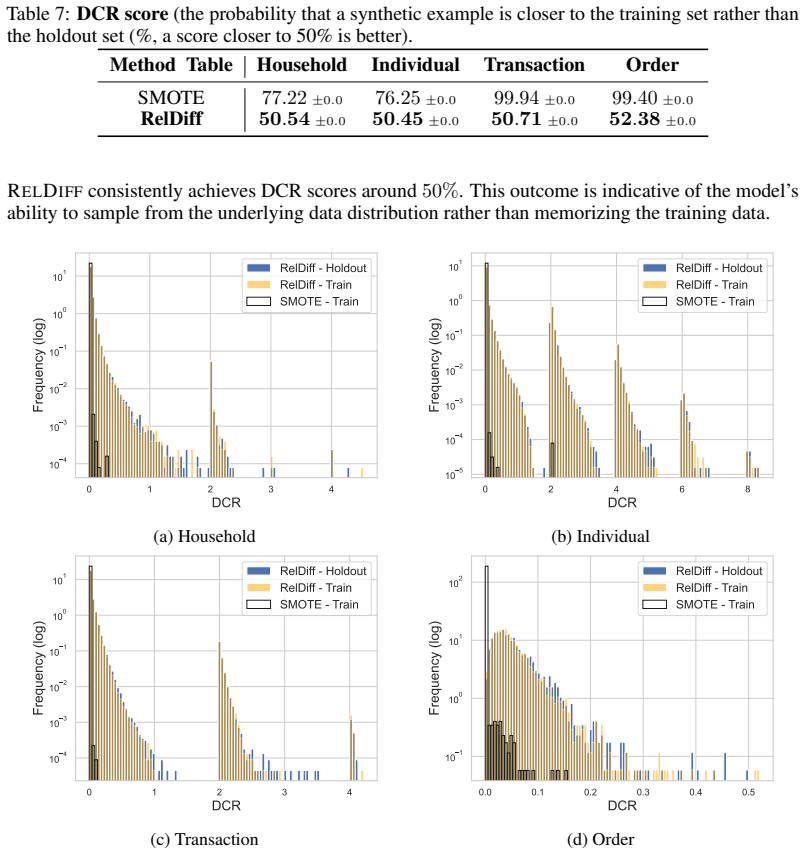
- The DCR scores near 50% are empirical evidence against memorization, but the paper itself notes there is no provable privacy guarantee; adding differential privacy would likely require modifying the diffusion objective rather than the graph sampler.
- A natural extension is missing-value imputation: conditioning on partially observed attributes instead of fully masked initial states could turn RelDiff into a relational imputation engine.
Editorial analysis
A structured set of objections, weighed in public.
Referee Report
Summary. The paper proposes RELDIFF, a two-stage generative model for relational databases. Structure is generated by a 2K+SBM random graph model that preserves node degree sequences and hierarchical block structure, with referential integrity enforced by construction. Attributes are synthesized by a joint graph-conditioned diffusion process over the heterogeneous entity graph, parameterized by a GNN with local-neighborhood conditioning, combined with tabular transformer encoders/decoders and per-table MLPs. The method is evaluated on 11 datasets from two benchmarks (SyntheRela and ClavaDDPM) against six baselines using fidelity metrics (Shape, Trend, C2ST, C2ST-Agg, k-hop correlation, cardinality similarity), RDL downstream utility, and a DCR privacy sanity check. The central claims are that RELDIFF consistently outperforms prior methods and achieves up to 80% improvement over the state of the art in preserving column correlations between connected tables.
Significance. If the empirical claims hold, RELDIFF is a strong practical contribution to neural relational database synthesis: it generates arbitrary schemas, guarantees referential integrity by construction, and appears to substantially improve multi-table k-hop correlations over ClavaDDPM and other baselines. The paper ships code and follows two established benchmarks, which aids reproducibility and comparability. The decomposition into structure generation and attribute diffusion is principled and extends the 2K+ framework with a Bayesian SBM. However, the strength of the claims needs to be tightened: the cardinality metric is satisfied by construction rather than learned, the SyntheRela baseline numbers are imported from a prior benchmark rather than rerun, the k=2 GNN receptive field is not shown to support the reported depth-3 correlation gains, and the claim of 'consistently outperforms' is contradicted by several table entries. These issues are fixable without changing the method's core, but they affect how the results should be interpreted.
major comments (5)
- [§5.2, Tables 1 and 2; §4.2] The reported cardinality similarity scores are circular for this method. Section 4.2 states that structure generation conditions on fixed row counts, exact entity and relationship cardinalities, and the node degree sequence, so the perfect cardinality scores in Tables 1 and 2 are guaranteed by input constraints rather than learned by the generative model. The 'Improv.' columns for Cardinality should not be counted as evidence of learned fidelity; this metric should be either removed from the headline comparisons or explicitly labeled as a constraint-satisfaction check.
- [§4.3, Appendix C, Table 1 (Berka 3-HOP), Table 2 (Instacart 2-HOP)] The paper approximates the denoising transition as pθ(x_v^s | x_v^t, N_k(v)_t) and sets the number of GNN layers to k=2 in Appendix C, yet it reports k-hop correlation gains at depth 3 on Berka and depth 2 on Instacart. A single denoising step can condition only on a 2-hop neighborhood; the paper provides no ablation on GNN depth and no analysis showing that the T=100 iterative reverse process propagates information along longer paths. Since preserving multi-table correlations is the paper's central empirical claim, an ablation or formal argument is needed to justify that the local-receptive-field assumption does not cap the achievable schema depth.
- [Table 1 caption] The SyntheRela results for all baselines are explicitly imported from Jurkovič et al. (2025) rather than rerun under the same preprocessing, random seeds, and evaluation pipeline as RELDIFF. This makes the head-to-head improvements in Table 1 and the abstract an uncontrolled comparison. Please rerun the baselines in the same environment, or provide a documented justification that the prior numbers are directly comparable to the RELDIFF runs.
- [Abstract and §5.2] The claim that RELDIFF 'consistently outperforms' prior methods is contradicted by several entries in the paper's own tables: Table 1 Cora C2ST-Agg (69.30 for RELDIFF vs. 68.80 for TabularARGN), Table 6 Cora C2ST (54.03 vs. 48.97 for RCTGAN), Table 6 IMDB C2ST (52.07 vs. 49.83 for ClavaDDPM), and Table 6 Walmart C2ST (60.30 vs. 53.50 for ClavaDDPM). The wording should be qualified to reflect that RELDIFF wins on most datasets but not on all, and the specific exceptions should be acknowledged.
- [§4.2] The preprocessing step that 'convert[s] tables with two parents and no children into many-to-many edges' is asserted to be a one-to-one, lossless transformation, but no formal condition or proof is given. If such a table contains attribute columns beyond its two foreign keys, collapsing it to an edge set can discard information and change the schema semantics. Please state the exact conditions under which the transformation is lossless, or restrict the supported schema class accordingly.
minor comments (5)
- [Table 2] The headers 'A VG 2-W AY' are garbled, and several cells are missing (e.g., PrivLava for Instacart 05); the table should be reformatted for readability.
- [Tables 1 and 6] The 'Improv.' columns should state explicitly that the percentages are relative to the best baseline excluding RELDIFF ORIG, and whether a lower-is-better metric like C2ST-Agg uses a signed improvement.
- [§5.2] The sentence noting that RELDIFF 'consistently achieves a perfect score' on cardinality because it preserves degree distributions would be better placed in the method section as a property of the design, rather than in the experimental results where it reads as an empirical win.
- [§4.3, Eq. (5)] The parenthetical remark 'we omit defining a common space on which q is defined' makes the notation hard to follow; a concise definition of the joint space and the per-type subspaces would improve readability.
- [Figure 2] The caption states that ClavaDDPM 'retains some hierarchy but not the degrees,' but since RELDIFF takes degrees as an input, the comparison would be clearer if the caption noted that the degree preservation of 2K+SBM is a constraint rather than a learned property.
Circularity Check
Cardinality similarity is reported as a learned fidelity result even though degree sequences and edge counts are fixed inputs to the structure generator; the diffusion-based attribute claims are not circular.
-
fitted input called prediction
[Section 4.2 (Graph Structure Generation) and Section 5.2 (Multi-Table Fidelity), Tables 1 and 2]
"conditioned on a fixed set of nodes v ∈ V, the number of edges mr = |Er| of each type r ∈ R and the node degree sequence krv = |v ∈ Er| ... This corresponds to fixed row counts, and exact entity and relationship cardinalities. ... In line with previous work, we also report cardinality similarity. However, our approach consistently achieves a perfect score as it preserves the degree distributions."
The 2K+SBM generator is given the node degree sequence and edge count per relationship type as hard inputs, and the cardinality-similarity metric measures the distribution of child-row counts per parent row, which is exactly the degree sequence of the foreign-key edge type. Reporting 100.0 cardinality scores in Tables 1 and 2 is therefore not a learned prediction but a guarantee from the input constraints. The paper's own wording acknowledges this ('preserves the degree distributions'), yet the scores are still presented as evidence of multi-table fidelity and as improvements over baselines.
full rationale
The central diffusion derivation is self-contained: the joint reverse process in Eq. (5), the k-hop conditional independence assumption, and the training objective in Eq. (6) are standard denoising objectives applied to a heterogeneous graph, and the main fidelity claims are tested against real data using external metrics such as k-hop Trend, C2ST-Agg, RDL utility, and DCR. The cardinality-similarity result, however, is circular in the narrower sense: Section 4.2 fixes the degree sequence and edge multiplicities as inputs to 2K+SBM sampling, and Section 5.2 reports perfect cardinality scores as a model achievement. The paper even states that the perfect score occurs 'as it preserves the degree distributions,' confirming that this particular evaluation measures an input constraint rather than a generative capability. The k=2 GNN receptive field versus reported 3-hop correlations is a substantive correctness risk but not a circularity, since the iterative denoising could in principle propagate information across steps and the claim is empirically testable. Self-citations to prior benchmarks and baselines are used for comparison and context, not to justify the method's derivation. Overall, the paper contains one by-construction evaluation result among several independent external evaluations, so partial circularity is present but the core method is not a self-referential derivation.
Assumptions & free parameters
free parameters (4)
- Noise schedule bounds =
σmin=0.002, σmax=80.0, δ=1e-3
- Loss weights =
λcat=1.0, λnum linearly decays from 1.0 to 0.0
- Architecture dimensions =
d=4, dim_h=128, GNN layers k=2
- Per-dataset training budget =
10000 epochs (most), 400 (Instacart), 4000 (MovieLens)
assumptions (6)
- domain assumption A relational database can be decomposed as p(V,E)=p(E)p(V|E), with structure and attributes modeled independently.
- domain assumption Conditional independence of each node given its noisy k-hop neighborhood: pθ(x_v^s | x_v^t, N_k(v)_t) suffices to capture inter-table dependencies.
- domain assumption The reverse process factorizes over entities: q(Vs|Gt)=∏ q(vs|xt,Gt).
- standard math Microcanonical degree-corrected SBM with partition b constrained by node types preserves joint degree distribution and hierarchy.
- ad hoc to paper Preprocessing that converts tables with two parents and no children into many-to-many edges is a lossless one-to-one transformation.
- domain assumption Dimension tables can be treated as fixed-size vocabulary lookups instead of generated data.
Cite this review
Pith. "Pith review of RelDiff: Relational Data Generative Modeling with Graph-Based Diffusion Models." pith.science (2026). https://pith.science/paper/7HPBJHZB
@misc{pith2026250600710,
  author       = {Pith},
  title        = {Pith review of: RelDiff: Relational Data Generative Modeling with Graph-Based Diffusion Models},
  year         = {2026},
  howpublished = {\url{https://pith.science/paper/7HPBJHZB}},
  note         = {Machine review of arXiv:2506.00710}
}
abstract
Real-world databases are predominantly relational, comprising multiple interlinked tables that contain complex structural and statistical dependencies. Learning generative models on relational data has shown great promise in generating synthetic data and imputing missing values. However, existing methods often struggle to capture this complexity, typically reducing relational data to conditionally generated flat tables and imposing limiting structural assumptions. To address these limitations, we introduce RelDiff, a novel diffusion generative model that synthesizes complete relational databases by explicitly modeling their foreign key graph structure. RelDiff combines a joint graph-conditioned diffusion process across all tables for attribute synthesis, and a $2K+$SBM graph generator based on the Stochastic Block Model for structure generation. The decomposition of graph structure and relational attributes ensures both high fidelity and referential integrity, both of which are crucial aspects of synthetic relational database generation. Experiments on 11 benchmark datasets demonstrate that RelDiff consistently outperforms prior methods in producing realistic and coherent synthetic relational databases. Code is available at https://github.com/ValterH/RelDiff.
Figures


Figures from the paper (1 more)
Forward citations
Cited by 2 Pith papers
-
Do Generative Models Keep Time? A Time-Aware Evaluation of Synthetic Sequential Tabular Data
Static-distribution fidelity is a poor proxy for temporal fidelity in synthetic sequential tabular data; measuring timestamp, trajectory, cross-sectional, and relational structure over time changes model rankings.
-
PluRel-to-RDB-PFN: Schema-Guided Synthetic Relational Pretraining
External synthetic relational data from PluRel, when curated with a real-world-schema-first curriculum, recovers 87.6-93.8% of RDB-PFN's performance using ~33K tasks instead of ~1.8M.
Reference graph
Works this paper leans on
-
[1]
Differentially Private Synthetic Data Generation for Relational Databases
Alimohammadi Kaveh, Wang Hao, Gulati Ojas, Srivastava Akash, Azizan Navid . Differentially Private Synthetic Data Generation for Relational Databases. 2025
work page 2025
-
[2]
Privacy and utility of private synthetic data for medical data analyses // Applied Sciences
Appenzeller Arno, Leitner Moritz, Philipp Patrick, Krempel Erik, Beyerer J \"u rgen . Privacy and utility of private synthetic data for medical data analyses // Applied Sciences. 2022. 12, 23. 12320
work page 2022
-
[3]
Assefa Samuel A, Dervovic Danial, Mahfouz Mahmoud, Tillman Robert E, Reddy Prashant, Veloso Manuela . Generating synthetic data in finance: opportunities, challenges and pitfalls // Proceedings of the First ACM International Conference on AI in Finance. 2020. 1--8
work page 2020
-
[4]
Guide to the financial data set // PKDD2000 discovery challenge
Berka Petr, others . Guide to the financial data set // PKDD2000 discovery challenge. 2000
work page 2000
-
[5]
Experiments In Predicting Biodegradability // Applied Artificial Intelligence
Blockeel Hendrik, Džeroski Sašo, Kompare Boris, Kramer Stefan, Pfahringer Bernhard, Laer Wim . Experiments In Predicting Biodegradability // Applied Artificial Intelligence. 06 1999. 18
work page 1999
-
[6]
Beyond Privacy: Navigating the Opportunities and Challenges of Synthetic Data
Breugel Boris van, Schaar Mihaela van der . Beyond Privacy: Navigating the Opportunities and Challenges of Synthetic Data. 2023
work page 2023
-
[7]
Breugel Boris van, Schaar Mihaela van der . Position: Why Tabular Foundation Models Should Be a Research Priority // Forty-first International Conference on Machine Learning. 2024
work page 2024
-
[8]
PrivLava: Synthesizing Relational Data with Foreign Keys under Differential Privacy // Proc
Cai Kuntai, Xiao Xiaokui, Cormode Graham . PrivLava: Synthesizing Relational Data with Foreign Keys under Differential Privacy // Proc. ACM Manag. Data. jun 2023. 1, 2
work page 2023
Show all 74 references
-
[9]
PrivPetal: Relational Data Synthesis via Permutation Relations
Cai Kuntai, Xiao Xiaokui, Yang Yin . PrivPetal: Relational Data Synthesis via Permutation Relations. 2025
2025
-
[10]
SMOTE: synthetic minority over-sampling technique // Journal of artificial intelligence research
Chawla Nitesh V, Bowyer Kevin W, Hall Lawrence O, Kegelmeyer W Philip . SMOTE: synthetic minority over-sampling technique // Journal of artificial intelligence research. 2002. 16. 321--357
2002
-
[11]
A relational model of data for large shared data banks // Communications of the ACM
Codd Edgar F . A relational model of data for large shared data banks // Communications of the ACM. 1970. 13, 6. 377--387
1970
-
[12]
DBMS popularity broken down by database model
DB-Engines . DBMS popularity broken down by database model . 2024
2024
-
[13]
Spectral analysis of random graphs with skewed degree distributions // 45th Annual IEEE Symposium on Foundations of Computer Science
Dasgupta Anirban, Hopcroft John E, McSherry Frank . Spectral analysis of random graphs with skewed degree distributions // 45th Annual IEEE Symposium on Foundations of Computer Science. 2004. 602--610
2004
-
[14]
Normalization and hierarchical dependencies in the relational data model // ACM Transactions on Database Systems (TODS)
Delobel Claude . Normalization and hierarchical dependencies in the relational data model // ACM Transactions on Database Systems (TODS). 1978. 3, 3. 201--222
1978
-
[15]
Position: relational deep learning-graph representation learning on relational databases // Proceedings of the 41st International Conference on Machine Learning
Fey Matthias, Hu Weihua, Huang Kexin, Lenssen Jan Eric, Ranjan Rishabh, Robinson Joshua, Ying Rex, You Jiaxuan, Leskovec Jure . Position: relational deep learning-graph representation learning on relational databases // Proceedings of the 41st International Conference on Machi...
2024
-
[16]
Rossmann Store Sales
FlorianKnauer Will Cukierski . Rossmann Store Sales. 2015
2015
-
[17]
Tabular and latent space synthetic data generation: a literature review // Journal of Big Data
Fonseca Joao, Bacao Fernando . Tabular and latent space synthetic data generation: a literature review // Journal of Big Data. 2023. 10, 1. 115
2023
-
[18]
Learning probabilistic relational models // IJCAI
Friedman Nir, Getoor Lise, Koller Daphne, Pfeffer Avi . Learning probabilistic relational models // IJCAI. 99. 1999. 1300--1309
1999
-
[19]
Database systems: the complete book
Garcia-Molina Hector . Database systems: the complete book. 2008
2008
-
[20]
KAMINO: Constraint-aware differentially private data synthesis // Proceedings of the VLDB Endowment
Ge Chang, Mohapatra Shubhankar, He Xi, Ilyas Ihab F . KAMINO: Constraint-aware differentially private data synthesis // Proceedings of the VLDB Endowment. 2021. 14, 10. 1886--1899
2021
-
[21]
Learning probabilistic relational models // Relational data mining
Getoor Lise, Friedman Nir, Koller Daphne, Pfeffer Avi . Learning probabilistic relational models // Relational data mining. 2001. 307--335
2001
-
[22]
Differentially private data release over multiple tables // Proceedings of the 42nd ACM SIGMOD-SIGACT-SIGAI Symposium on Principles of Database Systems
Ghazi Badih, Hu Xiao, Kumar Ravi, Manurangsi Pasin . Differentially private data release over multiple tables // Proceedings of the 42nd ACM SIGMOD-SIGACT-SIGAI Symposium on Principles of Database Systems. 2023. 207--219
2023
-
[23]
Synthetic data in health care: A narrative review // PLOS Digital Health
Gonzales Aldren, Guruswamy Guruprabha, Smith Scott R . Synthetic data in health care: A narrative review // PLOS Digital Health. 2023. 2, 1. e0000082
2023
-
[24]
Row Conditional-TGAN for generating synthetic relational databases // ICASSP 2023-2023 IEEE International Conference on Acoustics, Speech and Signal Processing (ICASSP)
Gueye Mohamed, Attabi Yazid, Dumas Maxime . Row Conditional-TGAN for generating synthetic relational databases // ICASSP 2023-2023 IEEE International Conference on Acoustics, Speech and Signal Processing (ICASSP). 2023. 1--5
2023
-
[25]
Inductive representation learning on large graphs // Advances in neural information processing systems
Hamilton Will, Ying Zhitao, Leskovec Jure . Inductive representation learning on large graphs // Advances in neural information processing systems. 2017. 30
2017
-
[26]
Reimagining synthetic tabular data generation through data-centric AI: A comprehensive benchmark // Advances in neural information processing systems
Hansen Lasse, Seedat Nabeel, Schaar Mihaela van der, Petrovic Andrija . Reimagining synthetic tabular data generation through data-centric AI: A comprehensive benchmark // Advances in neural information processing systems. 2023. 36. 33781--33823
2023
-
[27]
Maxwell, Konstan Joseph A
Harper F. Maxwell, Konstan Joseph A. The MovieLens Datasets: History and Context // ACM Trans. Interact. Intell. Syst. dec 2015. 5, 4
2015
-
[28]
Synthetic data generation for tabular health records: A systematic review // Neurocomputing
Hernandez Mikel, Epelde Gorka, Alberdi Ane, Cilla Rodrigo, Rankin Debbie . Synthetic data generation for tabular health records: A systematic review // Neurocomputing. 2022. 493. 28--45
2022
-
[29]
Stochastic blockmodels: First steps // Social networks
Holland Paul W, Laskey Kathryn Blackmond, Leinhardt Samuel . Stochastic blockmodels: First steps // Social networks. 1983. 5, 2. 109--137
1983
-
[30]
Relational Data Generation with Graph Neural Networks and Latent Diffusion Models // NeurIPS 2024 Third Table Representation Learning Workshop
Hudovernik Valter . Relational Data Generation with Graph Neural Networks and Latent Diffusion Models // NeurIPS 2024 Third Table Representation Learning Workshop. 2024
2024
-
[31]
Benchmarking the Fidelity and Utility of Synthetic Relational Data
Hudovernik Valter, Jurkovič Martin, Štrumbelj Erik . Benchmarking the Fidelity and Utility of Synthetic Relational Data. 2024
2024
-
[32]
A Simple and Scalable Representation for Graph Generation // The Twelfth International Conference on Learning Representations
Jang Yunhui, Lee Seul, Ahn Sungsoo . A Simple and Scalable Representation for Graph Generation // The Twelfth International Conference on Learning Representations. 2024
2024
-
[33]
SyntheRela: A Benchmark For Synthetic Relational Database Generation // Will Synthetic Data Finally Solve the Data Access Problem? 2025
Jurkovi c Martin, Hudovernik Valter, S trumbelj Erik . SyntheRela: A Benchmark For Synthetic Relational Database Generation // Will Synthetic Data Finally Solve the Data Access Problem? 2025
2025
-
[34]
Synthesizing Accurate Relational Data under Differential Privacy // 2024 IEEE International Conference on Big Data (BigData)
Kapenekakis Antheas, Dell’Aglio Daniele, Vesteghem Charles, Poulsen Laurids, B gsted Martin, Garofalakis Minos, Hose Katja . Synthesizing Accurate Relational Data under Differential Privacy // 2024 IEEE International Conference on Big Data (BigData). 2024. 433--439
2024
-
[35]
Elucidating the Design Space of Diffusion-Based Generative Models // Advances in Neural Information Processing Systems
Karras Tero, Aittala Miika, Aila Timo, Laine Samuli . Elucidating the Design Space of Diffusion-Based Generative Models // Advances in Neural Information Processing Systems. 2022
2022
-
[36]
Variational Diffusion Models // Advances in Neural Information Processing Systems
Kingma Diederik, Salimans Tim, Poole Ben, Ho Jonathan . Variational Diffusion Models // Advances in Neural Information Processing Systems. 34. 2021. 21696--21707
2021
-
[37]
Tabddpm: Modelling tabular data with diffusion models // International Conference on Machine Learning
Kotelnikov Akim, Baranchuk Dmitry, Rubachev Ivan, Babenko Artem . Tabddpm: Modelling tabular data with diffusion models // International Conference on Machine Learning. 2023. 17564--17579
2023
-
[38]
IRG: Generating Synthetic Relational Databases using GANs // arXiv preprint arXiv:2312.15187
Li Jiayu, Tay YC . IRG: Generating Synthetic Relational Databases using GANs // arXiv preprint arXiv:2312.15187. 2023
2023
-
[39]
GraphMaker: Can Diffusion Models Generate Large Attributed Graphs? // Transactions on Machine Learning Research
Li Mufei, Kreacic Eleonora, Potluru Vamsi K., Li Pan . GraphMaker: Can Diffusion Models Generate Large Attributed Graphs? // Transactions on Machine Learning Research. 2024
2024
-
[40]
Efficient graph generation with graph recurrent attention networks // Advances in neural information processing systems
Liao Renjie, Li Yujia, Song Yang, Wang Shenlong, Hamilton Will, Duvenaud David K, Urtasun Raquel, Zemel Richard . Efficient graph generation with graph recurrent attention networks // Advances in neural information processing systems. 2019. 32
2019
-
[41]
Graph normalizing flows // Advances in Neural Information Processing Systems
Liu Jenny, Kumar Aviral, Ba Jimmy, Kiros Jamie, Swersky Kevin . Graph normalizing flows // Advances in Neural Information Processing Systems. 2019. 32
2019
-
[42]
M. Center . Integrated Public Use Microdata Series, International: Version 7.3 [data set] . Minneapolis, MN, 2020. https://doi.org/10.18128/D020.V7.3
2020 doi
-
[43]
Systematic topology analysis and generation using degree correlations // ACM SIGCOMM Computer Communication Review
Mahadevan Priya, Krioukov Dmitri, Fall Kevin, Vahdat Amin . Systematic topology analysis and generation using degree correlations // ACM SIGCOMM Computer Communication Review. 2006. 36, 4. 135--146
2006
-
[44]
Generating Realistic Synthetic Relational Data through Graph Variational Autoencoders // NeurIPS 2022 Workshop on Synthetic Data for Empowering ML Research
Mami Ciro Antonio, coser andrea, Boudewijn Alexander Theodorus Petrus, Volpe Marco, Whitworth michael, Panfilo Daniele, Saccani Sebastiano . Generating Realistic Synthetic Relational Data through Graph Variational Autoencoders // NeurIPS 2022 Workshop on Synthetic Data for Emp...
2022
-
[45]
Automating the construction of internet portals with machine learning // Information Retrieval
McCallum Andrew Kachites, Nigam Kamal, Rennie Jason, Seymore Kristie . Automating the construction of internet portals with machine learning // Information Retrieval. 2000. 3. 127--163
2000
-
[46]
AIM: an adaptive and iterative mechanism for differentially private synthetic data // Proceedings of the VLDB Endowment
McKenna Ryan, Mullins Brett, Sheldon Daniel, Miklau Gerome . AIM: an adaptive and iterative mechanism for differentially private synthetic data // Proceedings of the VLDB Endowment. 2022. 15, 11
2022
-
[47]
Airbnb New User Bookings
Montoya Anna, LizSellier , O'Connell Meghan, Kan Wendy, alokgupta . Airbnb New User Bookings. 2015
2015
-
[48]
The CTU prague relational learning repository // arXiv preprint arXiv:1511.03086
Motl Jan, Schulte Oliver . The CTU prague relational learning repository // arXiv preprint arXiv:1511.03086. 2015
2015 arXiv
-
[49]
Bias in data-driven artificial intelligence systems—An introductory survey // Wiley Interdisciplinary Reviews: Data Mining and Knowledge Discovery
Ntoutsi Eirini, Fafalios Pavlos, Gadiraju Ujwal, Iosifidis Vasileios, Nejdl Wolfgang, Vidal Maria-Esther, Ruggieri Salvatore, Turini Franco, Papadopoulos Symeon, Krasanakis Emmanouil, others . Bias in data-driven artificial intelligence systems—An introductory survey // Wiley ...
2020
-
[50]
Clava DDPM : Multi-relational Data Synthesis with Cluster-guided Diffusion Models // The Thirty-eighth Annual Conference on Neural Information Processing Systems
Pang Wei, Shafieinejad Masoumeh, Liu Lucy, Hazlewood Stephanie, He Xi . Clava DDPM : Multi-relational Data Synthesis with Cluster-guided Diffusion Models // The Thirty-eighth Annual Conference on Neural Information Processing Systems. 2024
2024
-
[51]
The Synthetic Data Vault // 2016 IEEE International Conference on Data Science and Advanced Analytics (DSAA)
Patki Neha, Wedge Roy, Veeramachaneni Kalyan . The Synthetic Data Vault // 2016 IEEE International Conference on Data Science and Advanced Analytics (DSAA). 2016. 399--410
2016
-
[52]
Hierarchical block structures and high-resolution model selection in large networks // Physical Review X
Peixoto Tiago P . Hierarchical block structures and high-resolution model selection in large networks // Physical Review X. 2014. 4, 1. 011047
2014
-
[53]
Nonparametric Bayesian inference of the microcanonical stochastic block model // Physical Review E
Peixoto Tiago P . Nonparametric Bayesian inference of the microcanonical stochastic block model // Physical Review E. 2017. 95, 1. 012317
2017
-
[54]
Bayesian stochastic blockmodeling // Advances in network clustering and blockmodeling
Peixoto Tiago P . Bayesian stochastic blockmodeling // Advances in network clustering and blockmodeling. 2019. 289--332
2019
-
[55]
Synthetic Data Applications in Finance
Potluru Vamsi K., Borrajo Daniel, Coletta Andrea, Dalmasso Niccolò, El-Laham Yousef, Fons Elizabeth, Ghassemi Mohsen, Gopalakrishnan Sriram, Gosai Vikesh, Kreačić Eleonora, Mani Ganapathy, Obitayo Saheed, Paramanand Deepak, Raman Natraj, Solonin Mikhail, Sood Srijan, Vyetrenko...
2024
-
[56]
Synthetic data // Annual review of statistics and its application
Raghunathan Trivellore E . Synthetic data // Annual review of statistics and its application. 2021. 8, 1. 129--140
2021
-
[57]
RelBench: A Benchmark for Deep Learning on Relational Databases
Robinson Joshua, Ranjan Rishabh, Hu Weihua, Huang Kexin, Han Jiaqi, Dobles Alejandro, Fey Matthias, Lenssen Jan E., Yuan Yiwen, Zhang Zecheng, He Xinwei, Leskovec Jure . RelBench: A Benchmark for Deep Learning on Relational Databases. 2024
2024
-
[58]
Simple and Effective Masked Diffusion Language Models // The Thirty-eighth Annual Conference on Neural Information Processing Systems
Sahoo Subham Sekhar, Arriola Marianne, Gokaslan Aaron, Marroquin Edgar Mariano, Rush Alexander M, Schiff Yair, Chiu Justin T, Kuleshov Volodymyr . Simple and Effective Masked Diffusion Language Models // The Thirty-eighth Annual Conference on Neural Information Processing Syst...
2024
-
[59]
TabDiff: a Mixed-type Diffusion Model for Tabular Data Generation // The Thirteenth International Conference on Learning Representations
Shi Juntong, Xu Minkai, Hua Harper, Zhang Hengrui, Ermon Stefano, Leskovec Jure . TabDiff: a Mixed-type Diffusion Model for Tabular Data Generation // The Thirteenth International Conference on Learning Representations. 2025
2025
-
[60]
REaLTabFormer: Generating Realistic Relational and Tabular Data using Transformers
Solatorio Aivin V., Dupriez Olivier . REaLTabFormer: Generating Realistic Relational and Tabular Data using Transformers. 2023
2023
-
[61]
Instacart Market Basket Analysis
Stanley Jeremy, Risdal M., Sharathrao , Cukierski W. Instacart Market Basket Analysis. 2017. Kaggle competition dataset
2017
-
[62]
2k+ graph construction framework: Targeting joint degree matrix and beyond // IEEE/ACM Transactions on Networking
Tillman B \'a lint, Markopoulou Athina, Gjoka Minas, Buttsc Carter T . 2k+ graph construction framework: Targeting joint degree matrix and beyond // IEEE/ACM Transactions on Networking. 2019. 27, 2. 591--606
2019
-
[63]
TabularARGN: A Flexible and Efficient Auto-Regressive Framework for Generating High-Fidelity Synthetic Data
Tiwald Paul, Krchova Ivona, Sidorenko Andrey, Vargas-Vieyra Mariana, Scriminaci Mario, Platzer Michael . TabularARGN: A Flexible and Efficient Auto-Regressive Framework for Generating High-Fidelity Synthetic Data. 2025
2025
-
[64]
DiGress: Discrete Denoising diffusion for graph generation // The Eleventh International Conference on Learning Representations
Vignac Clement, Krawczuk Igor, Siraudin Antoine, Wang Bohan, Cevher Volkan, Frossard Pascal . DiGress: Discrete Denoising diffusion for graph generation // The Eleventh International Conference on Learning Representations. 2023
2023
-
[65]
Walmart Recruiting - Store Sales Forecasting
Walmart Will Cukierski . Walmart Recruiting - Store Sales Forecasting. 2014
2014
-
[66]
Synthetic Data Generation of Many-to-Many Datasets via Random Graph Generation // The Eleventh International Conference on Learning Representations
Xu Kai, Ganev Georgi, Joubert Emile, Davison Rees, Acker Olivier Van, Robinson Luke . Synthetic Data Generation of Many-to-Many Datasets via Random Graph Generation // The Eleventh International Conference on Learning Representations. 2023
2023
-
[67]
Modeling tabular data using conditional gan // Advances in neural information processing systems
Xu Lei, Skoularidou Maria, Cuesta-Infante Alfredo, Veeramachaneni Kalyan . Modeling tabular data using conditional gan // Advances in neural information processing systems. 2019. 32
2019
-
[68]
Handling missing data with graph representation learning // Advances in Neural Information Processing Systems
You Jiaxuan, Ma Xiaobai, Ding Yi, Kochenderfer Mykel J, Leskovec Jure . Handling missing data with graph representation learning // Advances in Neural Information Processing Systems. 2020. 33. 19075--19087
2020
-
[69]
Graphrnn: Generating realistic graphs with deep auto-regressive models // International conference on machine learning
You Jiaxuan, Ying Rex, Ren Xiang, Hamilton William, Leskovec Jure . Graphrnn: Generating realistic graphs with deep auto-regressive models // International conference on machine learning. 2018. 5708--5717
2018
-
[70]
Tabular Data Generation: Can We Fool XGB oost ? // NeurIPS 2022 First Table Representation Workshop
Zein EL Hacen, Urvoy Tanguy . Tabular Data Generation: Can We Fool XGB oost ? // NeurIPS 2022 First Table Representation Workshop. 2022
2022
-
[71]
DiffPuter: An EM -Driven Diffusion Model for Missing Data Imputation // The Thirteenth International Conference on Learning Representations
Zhang Hengrui, Fang Liancheng, Wu Qitian, Yu Philip S. DiffPuter: An EM -Driven Diffusion Model for Missing Data Imputation // The Thirteenth International Conference on Learning Representations. 2025
2025
-
[72]
Mixed-Type Tabular Data Synthesis with Score-based Diffusion in Latent Space // The Twelfth International Conference on Learning Representations
Zhang Hengrui, Zhang Jiani, Shen Zhengyuan, Srinivasan Balasubramaniam, Qin Xiao, Faloutsos Christos, Rangwala Huzefa, Karypis George . Mixed-Type Tabular Data Synthesis with Score-based Diffusion in Latent Space // The Twelfth International Conference on Learning Representati...
2024
-
[73]
Privbayes: Private data release via bayesian networks // ACM Transactions on Database Systems (TODS)
Zhang Jun, Cormode Graham, Procopiuc Cecilia M, Srivastava Divesh, Xiao Xiaokui . Privbayes: Private data release via bayesian networks // ACM Transactions on Database Systems (TODS). 2017. 42, 4. 1--41
2017
-
[74]
Ctab-gan: Effective table data synthesizing // Asian Conference on Machine Learning
Zhao Zilong, Kunar Aditya, Birke Robert, Chen Lydia Y . Ctab-gan: Effective table data synthesizing // Asian Conference on Machine Learning. 2021. 97--112
2021
Reviewed August 7, 2026 · model on record in the stance chip above.
Discussion (0). Sign in to comment.