REVIEW 4 major objections 5 minor 63 references
A Foundation Model for Non-Destructive Defect Identification from Vibrational Spectra
T0 review · 4 major / 5 minor · reviewed 2026-08-07 · deepseek-v4-flash
Pith's one-line read DefectNet predicts the chemical identity and concentration of substitutional point defects directly from phonon density-of-states spectra, with validation on inelastic neutron scattering data for SiGe alloys and MgB2.
desk verdict DefectNet introduces a genuinely new task — inverting phonon DOS to multi-element substitutional defect type and concentration — with sensible synthetic tests and real experimental checks, but the abstract overstates: no baselines or error bars, an undisclosed fine-tuning split, and only three SiGe points plus one usable MgB2 pair carry the transfer claim. read the letter →
The pith
A machine-rendered reading of the paper's core claim, the machinery that carries it, and where it could break.
The reading
What carries the argument
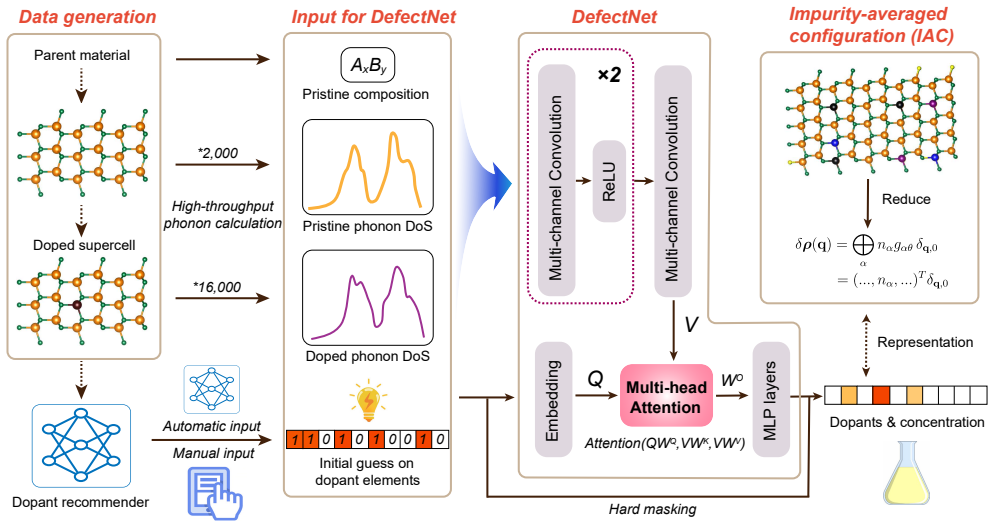
The load-bearing object is the Impurity-Averaged Configuration (IAC), a representation that replaces individual defect-atom positions with an ensemble-averaged feature vector per defect species, so that a defect is encoded by its chemical identity and density rather than by a specific atomic arrangement. In the model, the IAC is realized as a learnable embedding of the candidate dopants, and a multi-head attention mechanism uses that embedding as a query against the convolutional features of the pristine and doped spectra. The attention lets the model focus on the spectral regions that shift when a particular dopant is present, which is how it resolves low concentrations and multiple coexisting species. The final output is hard-masked to the candidate list, meaning the architecture only assigns concentrations to the elements the user or a dopant recommender suggested.
What would settle it
Take a bulk sample with a known dopant concentration, measure its PDoS, and run DefectNet with a candidate list that deliberately excludes the true dopant: if the model reports zero for that element while correctly identifying others, the closed-set limitation is confirmed; a model that flags an off-list element would refute it.
Extended reading notes
Core claim
The central claim is that a vibrational spectrum, specifically the phonon density-of-states, carries enough information to determine both which substitutional elements are present as point defects and how much of each is there, even when several dopants coexist. To show this, the authors build DefectNet, a convolutional-attention network that takes as input the parent crystal's composition, the pristine PDoS, the doped PDoS, and a candidate list of possible dopant elements. The model outputs concentrations for the candidates, and its best performance is on in-distribution materials, while held-out crystals still yield useful predictions. The experimental demonstrations use generalized phonon density-of-states from inelastic neutron scattering for SiGe alloys and Al-doped MgB2, where fine-tuned DefectNet tracks the reported doping trends.
Load-bearing premise
The true dopant elements must already be on the candidate list supplied by the user or recommender; because the output is hard-masked to that list, DefectNet cannot detect an unexpected or omitted defect species.
Editorial extensions
If this is right
- If the claim holds, inelastic neutron scattering becomes a quantitative, non-destructive way to measure dopant concentrations in bulk samples, including disordered or amorphous materials where the model does not need a detailed atomic structure.
- The pre-trained model generalizes across 56 elements and unseen parent crystals, which would let a lab apply it to a new semiconductor without retraining, then fine-tune it on a small set of measured spectra.
- Because the input is just two PDoS curves plus a composition string, the same architecture could be pointed at any spectrum that reflects phonon features, not only neutron data.
- The concentration range of roughly 0.2% to 25% defines the practical operating window: below it the spectral signatures become too subtle, and above it the training data do not cover the regime.
Reading between the lines
- A testable extension is to probe the model with spectra containing a deliberately unexpected dopant: the hard-masked output would show zero for that element, revealing that the current design solves a closed-set recognition problem rather than open-set discovery.
- The same IAC-plus-attention pipeline could be retrained on Raman or infrared spectra, which are far more accessible than neutron sources; if the spectral shifts survive, defect quantification could move into ordinary labs.
- The analytical link between PDoS changes and squared defect densities suggests that at higher concentrations the nonlinear defect-defect term might carry information about dopant spatial correlations, a quantity the current concentration-only output does not report.
Editorial analysis
A structured set of objections, weighed in public.
Referee Report
Summary. The paper introduces DefectNet, a machine-learning model that takes as input the pristine and doped phonon density-of-states (PDoS) together with a candidate list of possible dopant species, and outputs concentrations for up to six substitutional point defects. The model is pre-trained on roughly 16,000 simulated PDoS curves from 2,000 semiconductors using MLIP-based phonon calculations, and it is then fine-tuned on experimental inelastic neutron scattering data for SiGe alloys and Al-doped MgB2. The authors report accurate predictions on synthetic in-distribution and out-of-distribution tests, including tests with distractor candidate species, and they claim that fine-tuning on experimental data enables recovery of Ge concentrations in SiGe and Al concentrations in MgB2, establishing vibrational spectroscopy as a non-destructive defect quantification tool.
Significance. If the claims are fully substantiated, the work would be a valuable step toward non-destructive, spectroscopic quantification of point defects in bulk materials. The synthetic benchmark design is thoughtful, particularly the inclusion of distractor elements and the separation of in-distribution and out-of-distribution settings, and the experimental fine-tuning demonstrations are a welcome attempt to bridge the simulation-experiment gap. The paper also ships code and describes reproducible data-generation pipelines, which is a concrete strength. However, the central claims of chemical-identity prediction and experimental transferability are currently qualified by the hard-masking design and by the lack of aggregate metrics and baseline comparisons, so the significance is conditional on the evidence being tightened.
major comments (4)
- [Model architecture, main text; SI §2.3] The paper states that DefectNet's output is hard-masked to the initial candidate dopant list and that the loss is computed only over those candidates. This means the model cannot identify a defect species that is absent from the user-provided or recommender-generated candidate list. The abstract and introduction claim that DefectNet 'predicts the chemical identity' of defects, but the experimental demonstrations all use known or guessed dopants. This is a load-bearing limitation: the chemical-identity claim is only valid within a closed candidate set. Please either reframe the claim as conditional on the candidate list, or provide a test in which the candidate list is broad enough (e.g., all 56 elements) and the ground-truth dopant is an unexpected element, to demonstrate genuine chemical identification.
- [Results, Fine-tuning DefectNet on experimental data; SI §4.1] The fine-tuning procedure for SiGe is not fully specified. The main text says that 500 GPDoS curves are used to fine-tune DefectNet and that a test-set RMSE of 0.019 is achieved, but neither the main text nor SI §4.1 states how the 500 simulated curves were split into training and test sets. If the test set consists of simulated spectra drawn from the same distribution as the training curves, including at or near the experimental concentrations (x = 5%, 10%, 20%), then the subsequent predictions on the three experimental spectra are not a clean out-of-distribution transfer test. The paper should specify the split (e.g., hold out all simulated curves at concentrations matching the experimental values, or use a leave-one-concentration-out protocol) and, ideally, report performance on held-out experimental spectra from a second batch. The experimental validation currently rests on only three SiGe points and three MgB2 points (one of which fails), which is too thin to support the broad 'transferability' claim in the abstract.
- [Results, DefectNet for prediction of defect identity and concentration; Figure 4] The synthetic generalization results are presented only through quartile-based MSE distributions in Figure 4 and corresponding supplementary figures; no aggregate numbers (e.g., overall RMSE, MAE, or R²) are reported for the in-distribution or out-of-distribution settings. Moreover, no baseline comparisons are provided. Without a comparison to simpler regressors (e.g., linear regression, random forest, or a convolutional network without attention), the paper cannot support the claim that the attention mechanism or the foundation-model design is responsible for the observed performance. Please add aggregate error metrics and at least one non-attention baseline to the main text or SI, and state the exact train/test split used for the in-distribution and out-of-distribution evaluations.
- [Eq. 5 and SI §1.2] The main text presents Eq. 5 as if it were a direct expression for the difference between doped and pristine PDoS in terms of defect concentrations and embeddings. The SI derivation itself notes that this is 'a formal approximation, not a physically exact description of defect vibrations,' and the main text does not carry this caveat. In addition, the structure of Eq. S15 indicates that the cross terms include a term linear in n_alpha (the defect-pristine channel), while the explicit sum in Eq. 5 is quadratic; this distinction is not explained in the main text. Please add a sentence near Eq. 5 clarifying its status as a motivating, approximate formal relation rather than an exact physical law, and specify which terms are included in the 'Defect-pristine cross terms.'
minor comments (5)
- [Abstract] The abstract states the model 'generalizes well to unseen crystals across 56 elements,' but the evidence in Fig. 4b is qualitative and lacks aggregate metrics; please qualify this claim or add the supporting numbers.
- [Results, Fine-tuning DefectNet on experimental data] The text says DefectNet 'reproduces the experimental trend of dopant concentration up to 25%' for MgB2, but SI §4.2 explicitly reports a significant performance degradation at x = 0.50. Please make the main text consistent with the SI by specifying the range over which the model is reliable.
- [Methods, Dataset generation] The paper would benefit from reporting the number of training/validation/test samples in each split (in-distribution, out-of-distribution, and fine-tuning) and the hyperparameter settings for the convolutional and attention layers; currently only tensor shapes are given in SI §2.2.
- [Data and code availability] Only a code repository is listed; please clarify whether the 16,000 simulated spectra and the fine-tuning datasets are also publicly available, or state that they are available upon request.
- [Figure 3] Figure 3 does not include error bars or a quantitative error metric for the representative binary and ternary materials; adding per-material MAE or RMSE would help the reader assess the accuracy claims.
Circularity Check
No significant circularity: DefectNet's predictions are learned from simulated spectra and tested against held-out experimental INS data, not reduced to its inputs by construction.
full rationale
DefectNet's central claim is that a supervised model can infer defect identity and concentration from PDoS. The model is trained on simulated spectra and the reported experimental validations on SiGe and MgB2 are external checks: the fine-tuning procedure uses simulated SiGe and MgB2 spectra, while the experimental GPDoS curves are applied afterward for prediction. The SiGe text states that 500 simulated GPDoS curves are used to fine-tune DefectNet, and only then is the fine-tuned model applied to the experimental SiGe data from Ref. 50; similarly, the MgB2 validation in SI Section 4.2 fine-tunes on simulated Al-doped MgB2 and compares against measured x = 0.10, 0.25, 0.50 samples. No fitted parameter is renamed as a prediction. The IAC representation, including the identity that focusing on the first embedding column yields a concentration vector, is a formal descriptor and not the prediction mechanism; predictions come from the learned convolutional-attention-MLP network. The SI response-function derivation is explicitly labeled a formal approximation used to support feature construction, not an exact physical constraint on the model's outputs. Hard masking is a recognized scope limitation, stated in the paper as 'missed and incomplete guesses may prevent the model from recovering certain dopants,' but that is a design constraint, not a circular derivation. Self-citations in the paper are contextual or motivational and are not load-bearing for the central empirical claim. The absence of an explicit statement of the simulated fine-tuning train/test split is a reproducibility concern, but it is not evidence that the experimental results reduce by construction to the model's inputs.
Assumptions & free parameters
free parameters (1)
- Gaussian smearing width for PDoS =
not reported
assumptions (6)
- domain assumption Only substitutional point defects are considered; interstitials, vacancies, Frenkel pairs, and clusters are out of scope.
- domain assumption Defects are randomly and independently distributed, so the impurity-averaged configuration reduces to defect densities alone.
- domain assumption Machine-learned interatomic potentials (MACE-MP0, MatterSim) produce phonon DOS accurate enough for defect feature learning.
- ad hoc to paper The initial dopant candidate list contains all true defects in the sample.
- domain assumption A pristine reference PDoS is available for every doped sample at test time.
- ad hoc to paper The response-function derivation in SI Section 1 is a formal approximation, not an exact physical theory of defect vibrations.
Cite this review
Pith. "Pith review of A Foundation Model for Non-Destructive Defect Identification from Vibrational Spectra." pith.science (2026). https://pith.science/paper/FASGYMZO
@misc{pith2026250600725,
  author       = {Pith},
  title        = {Pith review of: A Foundation Model for Non-Destructive Defect Identification from Vibrational Spectra},
  year         = {2026},
  howpublished = {\url{https://pith.science/paper/FASGYMZO}},
  note         = {Machine review of arXiv:2506.00725}
}
abstract
Defects are ubiquitous in solids and strongly influence materials' mechanical and functional properties. However, non-destructive characterization and quantification of defects, especially when multiple types coexist, remain a long-standing challenge. Here we introduce DefectNet, a foundation machine learning model that predicts the chemical identity and concentration of substitutional point defects with multiple coexisting elements directly from vibrational spectra, specifically phonon density-of-states (PDoS). Trained on over 16,000 simulated spectra from 2,000 semiconductors, DefectNet employs a tailored attention mechanism to identify up to six distinct defect elements at concentrations ranging from 0.2% to 25%. The model generalizes well to unseen crystals across 56 elements and can be fine-tuned on experimental data. Validation using inelastic scattering measurements of SiGe alloys and MgB$_2$ superconductor demonstrates its accuracy and transferability. Our work establishes vibrational spectroscopy as a viable, non-destructive probe for point defect quantification in bulk materials, and highlights the promise of foundation models in data-driven defect engineering.
Figures


Figures from the paper (2 more)


Reference graph
Works this paper leans on
-
[1]
author Walsh, A. & author Zunger, A. journal title Instilling defect tolerance in new compounds . Nature materials volume 16 , pages 964--967 ( year 2017 )
work page 2017
-
[2]
author Ball, J. M. & author Petrozza, A. journal title Defects in perovskite-halides and their effects in solar cells . Nature Energy volume 1 , pages 1--13 ( year 2016 )
work page 2016
-
[3]
author Wu, C. et al. journal title Defect engineering advances thermoelectric materials . ACS nano volume 18 , pages 31660--31712 ( year 2024 )
work page 2024
-
[4]
author Fu, C.-L. et al. journal title Ai-driven defect engineering for advanced thermoelectric materials . arXiv preprint arXiv:2503.19148 ( year 2025 )
work page Pith review arXiv 2025
-
[5]
author Zhang, Y. et al. journal title Defect engineering on electrode materials for rechargeable batteries . Advanced Materials volume 32 , pages 1905923 ( year 2020 )
work page 2020
-
[6]
author Xie, C. et al. journal title Defect chemistry in heterogeneous catalysis: recognition, understanding, and utilization . Acs Catalysis volume 10 , pages 11082--11098 ( year 2020 )
work page 2020
-
[7]
author Wolfowicz, G. et al. journal title Quantum guidelines for solid-state spin defects . Nature Reviews Materials volume 6 , pages 906--925 ( year 2021 )
work page 2021
-
[8]
author Awschalom, D. D. , author Hanson, R. , author Wrachtrup, J. & author Zhou, B. B. journal title Quantum technologies with optically interfaced solid-state spins . Nature Photonics volume 12 , pages 516--527 ( year 2018 )
work page 2018
Show all 63 references
-
[9]
author Sun, H. et al. journal title Unveiling sulfur vacancy pairs as bright and stable color centers in monolayer ws2 . Nature Communications volume 15 , pages 9476 ( year 2024 )
2024
-
[10]
author Sze, S. M. , author Li, Y. & author Ng, K. K. title Physics of semiconductor devices ( publisher John wiley & sons , year 2021 )
2021
-
[11]
author Tsao, J. et al. journal title Ultrawide-bandgap semiconductors: research opportunities and challenges . Advanced Electronic Materials volume 4 , pages 1600501 ( year 2018 )
2018
-
[12]
& author Millis, A
author Orenstein, J. & author Millis, A. journal title Advances in the physics of high-temperature superconductivity . Science volume 288 , pages 468--474 ( year 2000 )
2000
-
[13]
author Zhou, X. et al. journal title High-temperature superconductivity . Nature Reviews Physics volume 3 , pages 462--465 ( year 2021 )
2021
-
[14]
author Kang, M. et al. journal title Topological flat bands in frustrated kagome lattice cosn . Nature communications volume 11 , pages 4004 ( year 2020 )
2020
-
[15]
author Checkelsky, J. G. , author Bernevig, B. A. , author Coleman, P. , author Si, Q. & author Paschen, S. journal title Flat bands, strange metals and the kondo effect . Nature Reviews Materials volume 9 , pages 509--526 ( year 2024 )
2024
-
[16]
author Chang, C.-Z. et al. journal title Experimental observation of the quantum anomalous hall effect in a magnetic topological insulator . Science volume 340 , pages 167--170 ( year 2013 )
2013
-
[17]
, author Kang, S
author Kang, S. , author Kang, S. , author Kim, H.-S. & author Yu, J. journal title Field-controlled quantum anomalous hall effect in electron-doped crsite3 monolayer . npj 2D Materials and Applications volume 7 , pages 13 ( year 2023 )
2023
-
[18]
author Li, P. et al. journal title Giant room temperature anomalous hall effect and tunable topology in a ferromagnetic topological semimetal co2mnal . Nature communications volume 11 , pages 3476 ( year 2020 )
2020
-
[19]
author Han, F. et al. journal title Quantized thermoelectric hall effect induces giant power factor in a topological semimetal . Nature communications volume 11 , pages 6167 ( year 2020 )
2020
-
[20]
journal title Positron annihilation spectroscopy of defects in nuclear and irradiated materials-a review
author Selim, F. journal title Positron annihilation spectroscopy of defects in nuclear and irradiated materials-a review . Materials Characterization volume 174 , pages 110952 ( year 2021 )
2021
-
[21]
journal title Deep-level transient spectroscopy: A new method to characterize traps in semiconductors
author Lang, D. journal title Deep-level transient spectroscopy: A new method to characterize traps in semiconductors . Journal of applied physics volume 45 , pages 3023--3032 ( year 1974 )
1974
-
[22]
author Rule, G. S. & author Hitchens, T. K. title NMR spectroscopy ( publisher Springer , year 2006 )
2006
-
[23]
author Al'tshuler, S. A. & author Kozyrev, B. M. title Electron paramagnetic resonance ( publisher Academic Press , year 2013 )
2013
-
[24]
author Bebb, H. B. & author Williams, E. title Photoluminescence i: theory . In booktitle Semiconductors and semimetals , vol. volume 8 , pages 181--320 ( publisher Elsevier , year 1972 )
1972
-
[25]
author Yacobi, B. G. , author Holt, D. B. , author Yacobi, B. & author Holt, D. title Cathodoluminescence ( publisher Springer , year 1990 )
1990
-
[26]
title Infrared and Raman spectroscopy: methods and applications ( publisher John Wiley & Sons , year 2008 )
author Schrader, B. title Infrared and Raman spectroscopy: methods and applications ( publisher John Wiley & Sons , year 2008 )
2008
-
[27]
journal title Multiplet effects in x-ray spectroscopy
author De Groot, F. journal title Multiplet effects in x-ray spectroscopy . Coordination Chemistry Reviews volume 249 , pages 31--63 ( year 2005 )
2005
-
[28]
author Williams, D. B. , author Carter, C. B. , author Williams, D. B. & author Carter, C. B. title The transmission electron microscope ( publisher Springer , year 2009 )
2009
-
[29]
author Kelly, T. F. & author Miller, M. K. journal title Atom probe tomography . Review of scientific instruments volume 78 ( year 2007 )
2007
-
[30]
journal title Quantum transport theory of electrons in solids: A single-particle approach
author Rammer, J. journal title Quantum transport theory of electrons in solids: A single-particle approach . Reviews of Modern Physics volume 63 , pages 781 ( year 1991 )
1991
-
[31]
& author Flensberg, K
author Bruus, H. & author Flensberg, K. title Many-body quantum theory in condensed matter physics: an introduction ( publisher Oxford university press , year 2004 )
2004
-
[32]
title Introduction to many-body physics ( publisher Cambridge University Press , year 2015 )
author Coleman, P. title Introduction to many-body physics ( publisher Cambridge University Press , year 2015 )
2015
-
[33]
& author Ong, S
author Chen, C. & author Ong, S. P. journal title A universal graph deep learning interatomic potential for the periodic table . Nature Computational Science volume 2 , pages 718--728 ( year 2022 )
2022
-
[34]
author Deng, B. et al. journal title Chgnet as a pretrained universal neural network potential for charge-informed atomistic modelling . Nature Machine Intelligence volume 5 , pages 1031--1041 ( year 2023 )
2023
-
[35]
author Batatia, I. et al. journal title A foundation model for atomistic materials chemistry . arXiv preprint arXiv:2401.00096 ( year 2023 )
2023 arXiv
-
[36]
author Yang, H. et al. journal title Mattersim: A deep learning atomistic model across elements, temperatures and pressures . arXiv preprint arXiv:2405.04967 ( year 2024 )
2024 arXiv
-
[37]
author Hung, N. T. , author Okabe, R. , author Chotrattanapituk, A. & author Li, M. journal title Universal ensemble-embedding graph neural network for direct prediction of optical spectra from crystal structures . Advanced Materials volume 36 , pages 2409175 ( year 2024 )
2024
-
[38]
author Kim, S. et al. journal title A band-gap database for semiconducting inorganic materials calculated with hybrid functional . Scientific Data volume 7 , pages 387 ( year 2020 )
2020
-
[39]
, author Fischer, C
author Hautier, G. , author Fischer, C. , author Ehrlacher, V. , author Jain, A. & author Ceder, G. journal title Data mined ionic substitutions for the discovery of new compounds . Inorganic chemistry volume 50 , pages 656--663 ( year 2011 )
2011
-
[40]
author Vaswani, A. et al. journal title Attention is all you need . Advances in neural information processing systems volume 30 ( year 2017 )
2017
-
[41]
author Fu, C. et al. journal title Anomalous neutron nuclear-magnetic interference spectroscopy . arXiv preprint arXiv:2403.13990 ( year 2024 )
2024 arXiv
-
[42]
, author Healy, J
author McInnes, L. , author Healy, J. & author Melville, J. journal title Umap: Uniform manifold approximation and projection for dimension reduction . arXiv preprint arXiv:1802.03426 ( year 2018 )
2018 arXiv
-
[43]
author Hudgins, J. L. journal title Wide and narrow bandgap semiconductors for power electronics: A new valuation . Journal of Electronic materials volume 32 , pages 471--477 ( year 2003 )
2003
-
[44]
, author Mitlehner, H
author Ruff, M. , author Mitlehner, H. & author Helbig, R. journal title Sic devices: physics and numerical simulation . IEEE Transactions on electron devices volume 41 , pages 1040--1054 ( year 1994 )
1994
-
[45]
author Paveliev, D. et al. journal title Experimental study of frequency multipliers based on a gaas/alas semiconductor superlattices in the terahertz frequency range . Semiconductors volume 46 , pages 121--125 ( year 2012 )
2012
-
[46]
author Huang, X. et al. journal title A density functional study of the structural, electronic, optical and lattice dynamical properties of aggas2 . Results in Physics volume 35 , pages 105309 ( year 2022 )
2022
-
[47]
, author Lin, C
author Zhang, S. , author Lin, C. , author Huang, B. , author Xue, Y. & author Huang, D. journal title A theoretical study on absorbers for the intermediate band solar cell from group-iv element (si, ge, sn) doped aggas2 . Computational and Theoretical Chemistry volume 1248 , ...
2025
-
[48]
, author Wei, S.-H
author Zhang, S. , author Wei, S.-H. , author Zunger, A. & author Katayama-Yoshida, H. journal title Defect physics of the cuinse 2 chalcopyrite semiconductor . Physical Review B volume 57 , pages 9642 ( year 1998 )
1998
-
[49]
author Ali, A. et al. journal title Highly efficient bifacial narrow bandgap ag-cuinse2 solar cells on ito . Advanced Energy Materials pages 2500899 ( year 2025 )
2025
-
[50]
author Dhital, C. et al. journal title Inelastic neutron scattering study of phonon density of states in nanostructured si 1- x ge x thermoelectrics . Physical Review B volume 86 , pages 214303 ( year 2012 )
2012
-
[51]
author Bart \'o k, A. P. , author Kermode, J. , author Bernstein, N. & author Cs \'a nyi, G. journal title Machine learning a general-purpose interatomic potential for silicon . Physical Review X volume 8 , pages 041048 ( year 2018 )
2018
-
[52]
author Sears, V. F. journal title Neutron scattering lengths and cross sections . Neutron news volume 3 , pages 26--37 ( year 1992 )
1992
-
[53]
author Yokoo, T. et al. journal title Evidence of electron--phonon interaction in Al -substituted Mg\(_ 1 -- x \)Al\(_x\)B\(_2\) . Journal of superconductivity volume 17 , pages 199--203 ( year 2004 )
2004
-
[54]
author Shannon, R. T. & author Prewitt, C. T. journal title Effective ionic radii in oxides and fluorides . Acta Crystallographica Section B: Structural Crystallography and Crystal Chemistry volume 25 , pages 925--946 ( year 1969 )
1969
-
[55]
author Shannon, R. D. journal title Revised effective ionic radii and systematic studies of interatomic distances in halides and chalcogenides . Foundations of Crystallography volume 32 , pages 751--767 ( year 1976 )
1976
-
[56]
author Ong, S. P. et al. journal title Python materials genomics (pymatgen): A robust, open-source python library for materials analysis . Computational Materials Science volume 68 , pages 314--319 ( year 2013 )
2013
-
[57]
author Larsen, A. H. et al. journal title The atomic simulation environment—a python library for working with atoms . Journal of Physics: Condensed Matter volume 29 , pages 273002 ( year 2017 )
2017
-
[58]
author Chen, Z. et al. journal title Direct prediction of phonon density of states with euclidean neural networks . Advanced Science volume 8 , pages 2004214 ( year 2021 )
2021
-
[59]
author Kong, S. et al. journal title Density of states prediction for materials discovery via contrastive learning from probabilistic embeddings . Nature communications volume 13 , pages 949 ( year 2022 )
2022
-
[60]
author Pedregosa, F. et al. journal title Scikit-learn: Machine learning in P ython . Journal of Machine Learning Research volume 12 , pages 2825--2830 ( year 2011 )
2011
-
[61]
author Paszke, A. et al. journal title Pytorch: An imperative style, high-performance deep learning library . Advances in neural information processing systems volume 32 ( year 2019 )
2019
-
[62]
, " * write output.state after.block = add.period write newline
ENTRY address archive author booktitle chapter edition editor eprint howpublished institution journal key month note number organization pages publisher school series title type url doi volume year label INTEGERS output.state before.all mid.sentence after.sentence after.block ...
-
[63]
write newline
" write newline "" before.all 'output.state := FUNCTION n.dashify 't := "" t empty not t #1 #1 substring "-" = t #1 #2 substring "--" = not "--" * t #2 global.max substring 't := t #1 #1 substring "-" = "-" * t #2 global.max substring 't := while if t #1 #1 substring * t #2 gl...
Reviewed August 7, 2026 · model on record in the stance chip above.
Discussion (0). Sign in to comment.