REVIEW 3 major objections 5 minor 2 cited by
Getting More from Less: Transfer Learning Improves Sleep Stage Decoding Accuracy in Peripheral Wearable Devices
T0 review · 3 major / 5 minor · reviewed 2026-08-07 · deepseek-v4-flash
Pith's one-line read Pretraining a transformer on EEG improves sleep-stage decoding from peripheral wearables from 67.6% to 76.6%.
desk verdict Cross-modal transfer for sleep staging is a worthwhile idea, but the paper never proves the pretraining and fine-tuning cohorts are disjoint, so the 9-point accuracy gain is currently unsupported. read the letter →
The pith
A machine-rendered reading of the paper's core claim, the machinery that carries it, and where it could break.
The reading
What carries the argument
The machinery is a two-stage transfer-learning setup: a transformer-based sequence classifier with about 3.9 million parameters, built from seven 1D convolutional layers followed by four transformer encoder layers with positional encoding, is first pretrained on 10,897 EEG/EOG sleep recordings from 9,013 individuals and then fine-tuned, with all weights updated, on abdomen respiration and pulse plethysmography signals. The transferable object is the internal representation of sleep architecture learned from EEG, which the fine-tuning stage adapts to noisy peripheral inputs while retaining the learned transition structure of sleep stages.
What would settle it
Compute subject-level overlap between the pretraining corpus and the 1,559 MESA subjects; if any MESA identifiers appear in pretraining, retrain both the baseline and transferred models with strict subject exclusion and check whether the 76.6% versus 67.6% gap persists.
Extended reading notes
Core claim
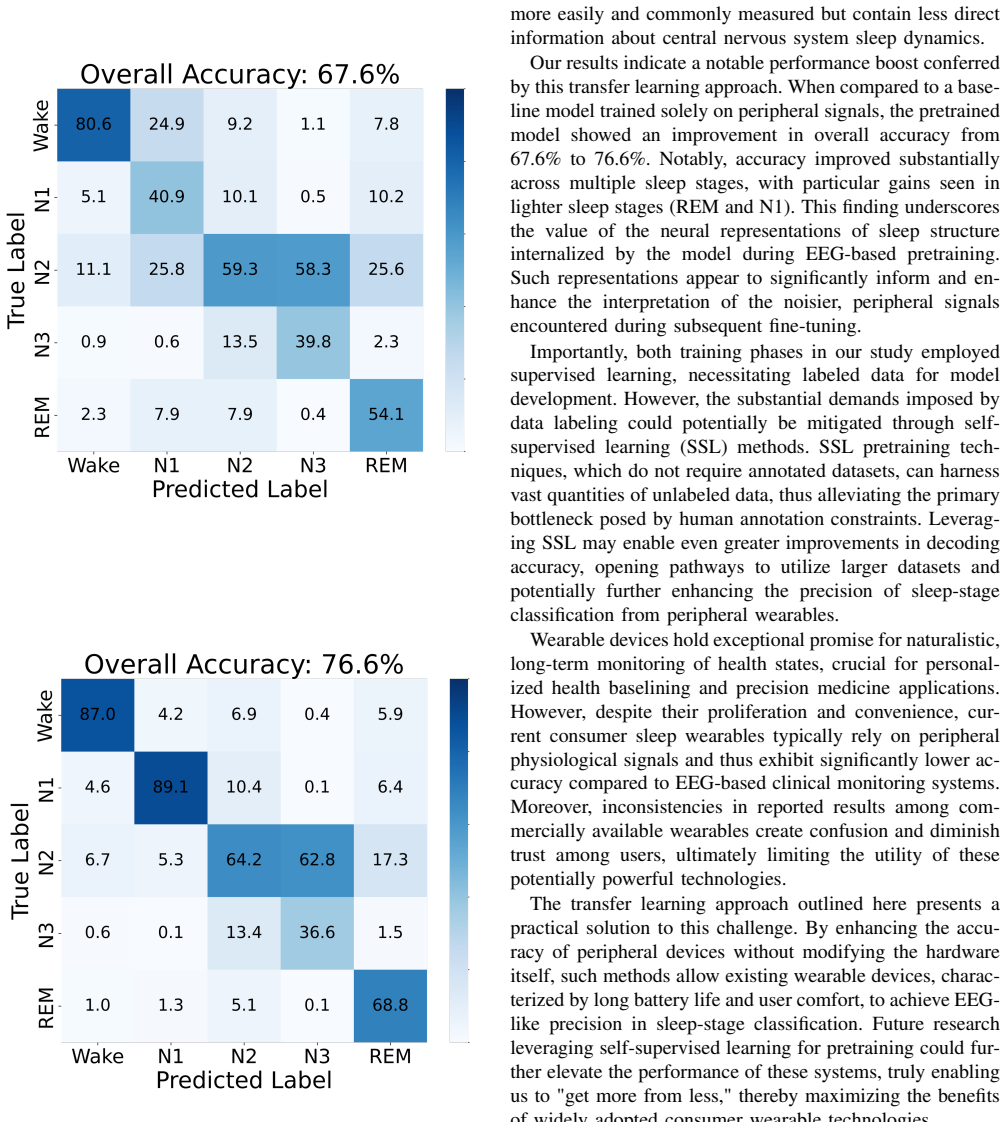
The central claim is that pretrained transformer-based models can transfer high-fidelity EEG-derived knowledge to improve sleep stage decoding from peripheral wearables. The paper demonstrates this by comparing a model fine-tuned from EEG pretraining to an identical architecture trained from scratch on the same PPG and respiration inputs; the transferred model reaches 76.6% overall accuracy versus 67.6% baseline on an unseen held-out set of 161 subjects. The improvements are concentrated in REM and N1, with N1 accuracy rising from 40.9% to 89.1% and REM from 54.1% to 68.8%, while N3 accuracy is essentially unchanged.
Load-bearing premise
The paper assumes the pretraining corpus and the fine-tuning/test subjects do not overlap, but since both are drawn from the same NSRR repository, which hosts the MESA dataset used for fine-tuning, and the paper never states that MESA subjects were excluded from pretraining, part of the 9-point gain could be explained by the model having already seen these subjects' sleep data.
Editorial extensions
If this is right
- Consumer wearables could report five-stage hypnograms at clinically more useful accuracy without any hardware changes.
- The largest benefit applies to light-stage detection, N1 and REM, which are the categories most often collapsed or misread by commercial devices.
- Modality transfer from a high-fidelity signal (EEG) to a lower-fidelity one (PPG and respiration) becomes a general recipe for improving other physiological decoding tasks.
- Because both training stages are supervised, the paper's own next step is self-supervised pretraining on unlabeled sleep data, which it argues is likely to raise accuracy further.
- The approach could make large longitudinal sleep datasets collected by wearables more scientifically usable for research and personalized health monitoring.
Reading between the lines
- Editorial extension: The reported N1 jump from 40.9% to 89.1% is far larger than typical transfer-learning gains, so an independent replication on non-NSRR wearable data would clarify whether this reflects genuine knowledge transfer or corpus leakage.
- Editorial extension: If the result is real, the same two-stage recipe could be applied to wrist accelerometry, skin temperature, or single-lead ECG, and to targets beyond sleep staging such as apnea severity or circadian phase.
- Editorial extension: The paper never reports a subject-exclusion check between the pretraining corpus and the MESA fine-tuning data, so the first experiment a reader should run before building on the claim is a strict subject-level overlap analysis.
Editorial analysis
A structured set of objections, weighed in public.
Referee Report
Summary. The paper investigates whether transfer learning from a transformer model pretrained on large-scale EEG sleep recordings can improve sleep-stage classification from peripheral wearable signals (PPG and respiration). The authors pretrain a transformer on 10,897 EEG/EOG sessions from 9,013 individuals (datasets not enumerated, deferred to a preprint), then fine-tune on peripheral signals from 1,559 MESA subjects, using a held-out set of 161 subjects for evaluation. They report an improvement in overall classification accuracy from 67.6% (baseline trained from scratch on peripheral signals) to 76.6% with transfer learning, with large gains in REM and N1. The paper includes a detailed architecture description and a clear baseline comparison.
Significance. If the central claim holds, the result would be practically valuable: it suggests that high-fidelity EEG knowledge can be transferred to noisy peripheral signals, potentially improving consumer wearable sleep staging without hardware changes. The study uses a large pretraining corpus and a reasonably detailed architectural description, which are strengths. However, the current manuscript does not provide enough information to validate the claim: the pretraining dataset composition is undisclosed, there is no uncertainty quantification, and the possibility of subject overlap between pretraining and fine-tuning corpora is not addressed. These gaps currently prevent the paper from supporting its headline accuracy improvement.
major comments (3)
- [Section II-A and II-B] The pretraining and fine-tuning cohorts may overlap. The pretraining data are described as sourced from NSRR with details deferred to Ogg and Coon [10], while the fine-tuning data come from MESA, which is also hosted by NSRR. The manuscript never states that the 1,559 MESA subjects were excluded from the pretraining set. If MESA EEG recordings were part of pretraining, the held-out 161 subjects would not be truly unseen, and the 9-point accuracy gain could reflect subject-specific memorization rather than transferable sleep representations. The authors must enumerate the pretraining datasets and explicitly confirm the disjointness of subject cohorts; merely citing an external preprint is not sufficient.
- [Section III] The results are reported as single accuracies on a held-out set of 161 subjects, with no confidence intervals, standard errors, or significance tests. The overall difference between 76.6% and 67.6% cannot be assessed without uncertainty measures, especially since per-stage results are mixed (N3 accuracy drops from 39.8% to 36.6% with transfer learning). The authors should provide per-subject accuracy distributions, bootstrap or binomial confidence intervals, or a statistical comparison (e.g., paired test across subjects).
- [Section II-B and III] The description of the validation scheme is ambiguous. The text states that all performance data were derived from the 'unseen' validation data and that model selection was based on the minimum validation loss, but it is not clear which split is used for model selection (the internal 90/10 validation) and which for the reported results (the external 161-subject held-out set). If model selection used any performance information from the external set, the reported accuracies are optimistic. The authors should clearly distinguish the internal validation set used for early stopping/model selection from the external held-out set used for final evaluation, and confirm that the latter was not used for any training decisions.
minor comments (5)
- [Section II-B, Ref. [14]] The word 'Artherosclerosis' is misspelled; it should be 'Atherosclerosis' in the text and in Reference [14].
- [Fig. 1 caption] 'pulse pleysmography' should be 'pulse plethysmography'.
- [Section III] The text references 'Fig. III' when describing the baseline result; this should be 'Fig. 3' for consistency with the other figure reference in the same paragraph.
- [Abstract] The phrase 'transfer learning, a technique commonly used in generative artificial intelligence' is imprecise; transfer learning is a general machine learning technique and is not specific to generative AI. The sentence should be reworded.
- [Section II-A] The pretraining dataset composition is deferred entirely to a bioRxiv preprint [10]. Since the data provenance is critical to the paper's claim, the manuscript itself should list the specific NSRR datasets used and their subject counts.
Circularity Check
No circular derivation: the transfer-learning accuracy gain is an empirical measurement, not a quantity forced by construction.
full rationale
The central claim is an empirical comparison of two models trained on the same peripheral fine-tuning data with identical architecture; the only difference is initialization from EEG pretraining. The reported accuracies (67.6% vs 76.6%) are measured on an explicitly held-out validation set, not derived from fitted constants or defined in terms of one another, so there is no equation-level circularity. Section II-D correctly distinguishes the baseline from the pretrained model, and Eq. (1) is a standard cross-entropy loss with no relation that equates the transfer outcome to the input. The self-citations (refs 5, 6, 10) are pointers to prior work by the same authors for EEG pretraining details and dataset composition; they are not the evidence for the transfer gain, which is produced by the present experiment. The unresolved concern that MESA subjects may overlap with the NSRR pretraining corpus (Section II-A vs II-B) is a data-provenance and potential leakage threat to validity, not circularity, and should be assessed under soundness. Therefore no circular step is identified, though the self-citations and the deferred dataset listing merit note.
Assumptions & free parameters
assumptions (3)
- domain assumption AASM sleep stage labels from PSG are treated as ground truth.
- domain assumption The pretraining corpus does not include MESA subjects used in the fine-tuning and evaluation splits.
- ad hoc to paper The 101-epoch window with a 25-epoch stride provides sufficient context for staging.
Cite this review
Pith. "Pith review of Getting More from Less: Transfer Learning Improves Sleep Stage Decoding Accuracy in Peripheral Wearable Devices." pith.science (2026). https://pith.science/paper/TFEOBKR5
@misc{pith2026250600730,
  author       = {Pith},
  title        = {Pith review of: Getting More from Less: Transfer Learning Improves Sleep Stage Decoding Accuracy in Peripheral Wearable Devices},
  year         = {2026},
  howpublished = {\url{https://pith.science/paper/TFEOBKR5}},
  note         = {Machine review of arXiv:2506.00730}
}
read the original abstract
Transfer learning, a technique commonly used in generative artificial intelligence, allows neural network models to bring prior knowledge to bear when learning a new task. This study demonstrates that transfer learning significantly enhances the accuracy of sleep-stage decoding from peripheral wearable devices by leveraging neural network models pretrained on electroencephalographic (EEG) signals. Consumer wearable technologies typically rely on peripheral physiological signals such as pulse plethysmography (PPG) and respiratory data, which, while convenient, lack the fidelity of clinical electroencephalography (EEG) for detailed sleep-stage classification. We pretrained a transformer-based neural network on a large, publicly available EEG dataset and subsequently fine-tuned this model on noisier peripheral signals. Our transfer learning approach improved overall classification accuracy from 67.6\% (baseline model trained solely on peripheral signals) to 76.6\%. Notable accuracy improvements were observed across sleep stages, particularly lighter sleep stages such as REM and N1. These results highlight transfer learning's potential to substantially enhance the accuracy and utility of consumer wearable devices without altering existing hardware. Future integration of self-supervised learning methods may further boost performance, facilitating more precise, longitudinal sleep monitoring for personalized health applications.
Figures


Forward citations
Cited by 2 Pith papers
-
Rethinking PPG-based Sleep Staging: Datasets, Metrics, and Benchmarks
Second-level pseudo-labels generated from coarse 30-second sleep stage labels improve PPG-based four-class sleep staging by 3.7-5.7 pp accuracy across six architectures.
-
StARS DCM: A Sleep Stage-Decoding Forehead EEG Patch for Real-time Modulation of Sleep Physiology
The paper introduces the DCM forehead EEG patch and the StARS platform for real-time sleep-stage-decoded auditory and thermal stimulation, without presenting validation data.
Reference graph
Works this paper leans on
-
[10]
Laying the foundation: Modern transform- ers for gold-standard sleep analysis,
W. G. Coon and M. Ogg, “Laying the foundation: Modern transform- ers for gold-standard sleep analysis,” bioRxiv, pp. 2024–01, 2024
work page 2024
- [1]
- [2]
-
[3]
Deep learning enables sleep staging from photoplethysmogram for patients with suspected sleep apnea,
H. Korkalainen, J. Aakko, B. Duce, S. Kainulainen, A. Leino, S. Nikkonen, I. O. Afara, S. Myllymaa, J. Töyräs, and T. Leppänen, “Deep learning enables sleep staging from photoplethysmogram for patients with suspected sleep apnea,” Sleep, vol. 43, no. 11, p. zsaa098, 2020
work page 2020
-
[4]
SleepFM: Multi-modal Representation Learning for Sleep across ECG, EEG and Respiratory Signals,
R. Thapa, B. He, M. R. Kjaer, H. M. Iv, G. Ganjoo, E. Mignot, and J. Y . Zou, “SleepFM: Multi-modal Representation Learning for Sleep across ECG, EEG and Respiratory Signals,” Mar. 2024. [Online]. Available: https://openreview.net/forum?id=cDXtscWCKC
work page 2024
-
[5]
Self-Supervised Transformer Model Training for a Sleep-EEG Foundation Model,
M. Ogg and W. G. Coon, “Self-Supervised Transformer Model Training for a Sleep-EEG Foundation Model,” in 2024 46th Annual International Conference of the IEEE Engineering in Medicine and Biology Society (EMBC) , Jul. 2024, pp. 1–6, iSSN: 2694-0604. [Online]. Available: https://ieeexplore.ieee.org/document/10782281
-
[6]
Laying the Foundation: Modern Transformers for Gold-Standard Sleep Analysis and Beyond,
W. G. Coon and M. Ogg, “Laying the Foundation: Modern Transformers for Gold-Standard Sleep Analysis and Beyond,” in 2024 46th Annual International Conference of the IEEE Engineering in Medicine and Biology Society (EMBC) , Jul. 2024, pp. 1–7, iSSN: 2694-0604. [Online]. Available: https: //ieeexplore.ieee.org/document/10782964
-
[7]
HuBERT: Self-Supervised Speech Representation Learning by Masked Prediction of Hidden Units,
W.-N. Hsu, B. Bolte, Y .-H. H. Tsai, K. Lakhotia, R. Salakhutdinov, and A. Mohamed, “HuBERT: Self-Supervised Speech Representation Learning by Masked Prediction of Hidden Units,” IEEE/ACM Transactions on Audio, Speech, and Language Processing , vol. 29, pp. 3451–3460, 2021, conference Name: IEEE/ACM Transactions on Audio, Speech, and Language Processing. ...
arXiv 2021
Show all 17 references
-
[8]
BERT: Pre-training of Deep Bidirectional Transformers for Language Understanding,
J. Devlin, M.-W. Chang, K. Lee, and K. Toutanova, “BERT: Pre-training of Deep Bidirectional Transformers for Language Understanding,” in Proceedings of the 2019 Conference of the North American Chapter of the Association for Computational Linguistics: Human Language Technologi...
2019
-
[9]
Robustsleepnet: Transfer learning for au- tomated sleep staging at scale,
A. Guillot and V . Thorey, “Robustsleepnet: Transfer learning for au- tomated sleep staging at scale,” IEEE Transactions on Neural Systems and Rehabilitation Engineering , vol. 29, pp. 1441–1451, 2021
2021
-
[11]
The National Sleep Research Resource: towards a sleep data commons,
G.-Q. Zhang, L. Cui, R. Mueller, S. Tao, M. Kim, M. Rueschman, S. Mariani, D. Mobley, and S. Redline, “The National Sleep Research Resource: towards a sleep data commons,” Journal of the American Medical Informatics Association , vol. 25, no. 10, pp. 1351–1358, Oct. 2018. [Onl...
2018 doi
-
[12]
MEG and EEG data analysis with MNE-Python,
A. Gramfort, “MEG and EEG data analysis with MNE-Python,” Frontiers in Neuroscience , vol. 7, 2013. [Online]. Available: http://journal.frontiersin.org/article/10.3389/fnins.2013.00267/abstract
2013
-
[13]
The Visual Scoring of Sleep in Adults,
M. H. Silber, I. S. Ancoli, M. H. Bonnet, S. Chokroverty, D. M. M. Grigg, M. Hirshkowitz, S. Kapen, S. A. Keenan, M. H. Kryger, T. Penzel, M. R. Pressman, and C. Iber, “The Visual Scoring of Sleep in Adults,” Journal of Clinical Sleep Medicine , vol. 03, no. 02, pp. 121–131, M...
2007 doi
-
[14]
Racial/Ethnic Differences in Sleep Disturbances: The Multi-Ethnic Study of Atherosclerosis (MESA),
X. Chen, R. Wang, P. Zee, P. L. Lutsey, S. Javaheri, C. Alcántara, C. L. Jackson, M. A. Williams, and S. Redline, “Racial/Ethnic Differences in Sleep Disturbances: The Multi-Ethnic Study of Atherosclerosis (MESA),” Sleep, vol. 38, no. 6, pp. 877–888, Jun
-
[15]
Attention is all you need,
A. Vaswani, N. Shazeer, N. Parmar, J. Uszkoreit, L. Jones, A. N. Gomez, Ł. Kaiser, and I. Polosukhin, “Attention is all you need,” Advances in neural information processing systems , vol. 30, 2017
2017
-
[16]
Interrater reliability for sleep scoring according to the Rechtschaffen & Kales and the new AASM standard,
H. Danker-Hopfe, P. Anderer, J. Zeitlhofer, M. Boeck, H. Dorn, G. Gruber, E. Heller, E. Loretz, D. Moser, S. Parapatics, B. Saletu, A. Schmidt, and G. Dorffner, “Interrater reliability for sleep scoring according to the Rechtschaffen & Kales and the new AASM standard,” Journal...
2009
-
[2015]
Available: https://doi.org/10.5665/sleep.4732
[Online]. Available: https://doi.org/10.5665/sleep.4732
Reviewed August 7, 2026 · model on record in the stance chip above.
Discussion (0). Sign in to comment.