REVIEW 3 major objections 5 minor 27 references
Uneven Event Modeling for Partially Relevant Video Retrieval
T0 review · 3 major / 5 minor · reviewed 2026-08-07 · deepseek-v4-flash
Pith's one-line read This paper claims that replacing fixed-length clip segmentation with similarity-guided uneven event boundaries, plus text-conditioned event refinement, sets a new state of the art in partially relevant video retrieval on ActivityNet…
desk verdict Useful empirical PRVR paper whose headline gains depend on an unanalyzed one-event selection step, so treat the SOTA claim as conditionally supported. read the letter →
The pith
A machine-rendered reading of the paper's core claim, the machinery that carries it, and where it could break.
The reading
What carries the argument
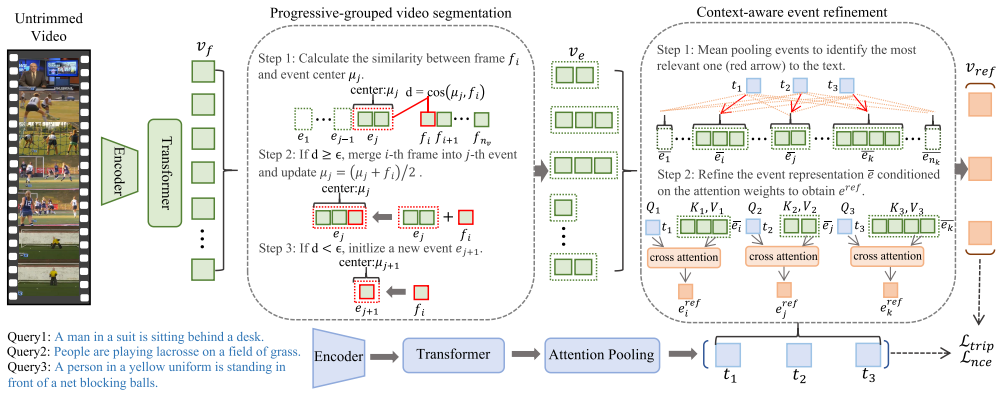
The load-bearing object is the event itself, redefined from a fixed-length clip to a variable-length cluster formed online. The PGVS pass (Algorithm 1) compares each frame with the current event center using $s(f_i, \mu) = f_i \cdot \mu / (\|f_i\| \|\mu\|)$, creating a new event when similarity falls below $\epsilon$; the CAER pass then computes $e_{\mathrm{ref}} = \operatorname{MLP}(\operatorname{softmax}(Q_t K_e^\top / \sqrt{D_p}) V_e)$ from the text query $Q_t$ and the selected event's frame keys and values. Together they convert the PRVR problem into: find the event that is most similar to the query, then sharpen its representation before scoring.
What would settle it
Take a subset of ActivityNet with ground-truth moment annotations, swap the coarse selection of $e_{\max}$ for an oracle that picks the annotated event, and rerun retrieval. If SumR barely changes, the coarse selection is not the bottleneck and the gain comes from refinement; if SumR rises sharply, the method is capped by its selection step. A second check: compute the fraction of queries whose coarse-picked $e_{\max}$ overlaps the annotated ground-truth moment; low overlap would show the single-event assumption is frequently violated.
Extended reading notes
Core claim
The paper's claim is that two coordinated changes to event modeling are enough to advance the state of the art in PRVR. First, the Progressive-Grouped Video Segmentation (PGVS) module replaces fixed equal-length clips with a one-pass temporal clustering: frames are added to the current event while their cosine similarity to the running event center stays above a threshold $\epsilon$, and a new event starts when it falls below. Second, the Context-Aware Event Refinement (CAER) module does not use mean-pooled event vectors directly; it selects the most relevant event by coarse cosine similarity to the text and then applies cross-attention from the text to that event's frames, producing a refined representation used for retrieval. With both modules, the paper reports SumR 171.2 on ActivityNet Captions and 225.4 on TVR, improvements of 10.5% and 19.6% over GMMFormer-v2.
Load-bearing premise
The approach assumes that the relevant content always lives in one contiguous chunk of frames, that the threshold-based segmentation places that chunk's boundaries correctly using pre-trained CLIP features, and that a coarse cosine pick of the event — made before any refinement — already identifies the right chunk; if any of these fails, the later refinement cannot recover.
Editorial extensions
If this is right
- PRVR no longer needs a preset event count; event boundaries emerge from frame similarity and temporal order.
- Because event representations are text-conditioned, frames within an event that are irrelevant to the query contribute less to the final score.
- Ablations show each module helps alone, and both together give the largest gain (SumR 154.5 to 171.2 on ActivityNet).
- On TVR the relative SumR gain over GMMFormer-v2 is 19.6%, suggesting the benefit is larger on densely annotated video-corpus data.
Reading between the lines
- A natural extension the paper does not test is to replace the single coarse event pick with a re-ranking over all events, or to run the refinement on several candidate events; if selection error dominates, this could raise scores without changing the segmentation.
- The global threshold $\epsilon$ is tuned per dataset and the paper's own analysis shows a unimodal response; a learned or per-video threshold could make the method less sensitive and transfer across domains.
- The method assumes one query matches one contiguous event; queries that describe content spread across several events would need multi-event aggregation, which would be a direct stress test.
Editorial analysis
A structured set of objections, weighed in public.
Referee Report
Summary. The manuscript proposes Uneven Event Modeling (UEM), a framework for partially relevant video retrieval. UEM has two main components: Progressive-Grouped Video Segmentation (PGVS), which sequentially groups frames into variable-length events based on cosine similarity to a running event center with a threshold, and Context-Aware Event Refinement (CAER), which selects the event most similar to the query by mean-pooled representations, applies text-conditioned cross-attention over that event's frames, and uses the refined representation for the final retrieval score. Experiments on ActivityNet Captions and TVR report large improvements over GMMFormer-v2, and ablations show that both components contribute. The code repository is publicly linked.
Significance. If the results are reproducible, the paper makes a useful contribution: it directly challenges the fixed-length-clip segmentation and mean-pooled event representation used by prior PRVR methods, and it releases code to support follow-up work. The reported gains are substantial, especially on TVR, and the two-module design is clearly motivated. However, the paper's central empirical claim is not yet fully supported: the inference path is gated by a single coarse event-selection step, and the paper provides no evaluation of that step's accuracy. In addition, the core segmentation pseudocode is internally inconsistent, and no error bars or multi-seed results are reported. These issues need to be addressed before the SOTA claim can be accepted with confidence.
major comments (3)
- [III-C, Algorithm 1] Algorithm 1 is internally inconsistent and cannot be implemented as written. In line 8, the update e_j ← e_j ∪ {f_i} uses an index j that is never initialized or incremented; line 11 creates e_{j+1} = {f_i}, but subsequently line 8 would still write to e_j, effectively merging future frames into the previous event. The expression v_e ← e_j ∪ e_{j+1} is also ill-defined for a list of event clusters, and it discards previously accumulated clusters. Because PGVS is one of the two central contributions, the paper does not currently specify the actual segmentation procedure. Please correct the pseudocode and align it with the released implementation.
- [III-C, Eqs. (7)-(8)] The final retrieval score is computed from only one event, e_max, which is selected before CAER refinement by coarse cosine similarity between the text embedding and the mean-pooled event representation. The paper reports no selection accuracy against ground-truth moments, no oracle experiment that passes the correct event to CAER, and no comparison with aggregating scores over all events after refinement. Without such evidence, the contribution of CAER is not isolated: the observed gains could come substantially from the selection step or from PGVS, and the method's ceiling is set by an untested hard decision. Please add selection-accuracy statistics, an oracle-selection ablation, and a discussion of how often CAER can recover from a wrong selection.
- [IV-B and IV-C] The SOTA claim rests on single-run results with per-dataset manually set hyperparameters: epsilon is set to 0.90 for ActivityNet Captions and 0.92 for TVR, and the loss weight is set to 0.02. No standard deviations or multiple-seed results are reported, and the sensitivity analysis in Fig. 3 is shown only for one dataset. Given the unusually large gaps over prior work (e.g., R@1 from 16.2 to 24.4 on TVR), please report mean and standard deviation over at least three seeds and provide epsilon-sensitivity curves for both datasets, along with the chosen values and their effect on the final SumR.
minor comments (5)
- [Eq. (11) and IV-A] The loss-balancing weight is denoted λ in Eq. (11) but is called γ in Section IV-A; please use a single symbol throughout.
- [IV-C] There is a typo in the epsilon values: the text reads "0,92" for the TVR threshold, which should be "0.92".
- [II, References] The citation range [11]–[15] in the Related Work section appears to include reference [14], which is titled "Tasar: Transfer-based attack on skeletal action recognition" and seems unrelated to PRVR; please verify the intended citations.
- [IV-A] The implementation details state that the learning schedule is the same as [20], but [20] is the TVR dataset paper; please specify the actual optimizer, scheduler, and warm-up settings used in the experiments.
- [III-C, Eqs. (4)-(6)] In Eqs. (4)-(6), the Layer Normalization is applied to e_max, but e_max is defined as a set of frame features; please clarify that LN and the projection matrices are applied to the stacked frame-feature tensor.
Circularity Check
No circularity: UEM is an empirical architecture paper; the retrieval claims rest on held-out benchmark splits, and the tuned hyperparameters (epsilon, lambda) are fitting choices, not predictions derived from the target metrics.
full rationale
The paper's central claim is that the proposed UEM framework (PGVS + CAER) improves partially relevant video retrieval on ActivityNet Captions and TVR. This is an empirical claim evaluated with R@K/SumR on separate test splits against published baselines. None of the method's equations define the output in terms of the target metric: PGVS (Eq. 3) segments frames by cosine similarity to a running event center using a threshold; CAER (Eqs. 4-7) computes a text-conditioned event representation via cross-attention; the retrieval score (Eq. 8) is cosine similarity between the refined event and the text embedding. The threshold epsilon (Sec. IV-B, Fig. 3) and the loss weight lambda (Eq. 11) are hyperparameters tuned per dataset, not fitted quantities renamed as predictions. The ablation studies (Tables III and IV) compare component variants under the same protocol, and the reported gains are measured differences, not algebraic restatements of the inputs. The single-event selection step (Eqs. 7-8, where e_max is chosen by coarse cosine similarity before CAER refinement) is an architectural choice that could cap performance if the selection is wrong, but that is an empirical weakness and a performance risk, not circular reasoning: the refinement and final score are still learned functions evaluated on held-out data. Background citations to prior T2VR work by some of the same authors (e.g., Refs. [1], [2], [8], [9], [25]-[27]) are ordinary related-work references and do not carry the derivation of PGVS or CAER; no load-bearing self-citation, uniqueness theorem, or ansatz-by-citation is present. Finding: no significant circularity.
Assumptions & free parameters
free parameters (2)
- similarity threshold epsilon =
0.90 (ActivityNet), 0.92 (TVR)
- loss weight lambda/gamma =
0.02
assumptions (4)
- domain assumption CLIP frame and text features are semantically comparable via cosine similarity.
- domain assumption Events are temporally contiguous and can be found by comparing each frame only to the current running mean.
- domain assumption Each query matches exactly one event in a video, so keeping only the top event e_max is sufficient.
- domain assumption Fixed CLIP features and shallow learned projections are sufficient to represent events without fine-tuning the visual backbone.
Cite this review
Pith. "Pith review of Uneven Event Modeling for Partially Relevant Video Retrieval." pith.science (2026). https://pith.science/paper/YI2PBSU5
@misc{pith2026250600891,
  author       = {Pith},
  title        = {Pith review of: Uneven Event Modeling for Partially Relevant Video Retrieval},
  year         = {2026},
  howpublished = {\url{https://pith.science/paper/YI2PBSU5}},
  note         = {Machine review of arXiv:2506.00891}
}
read the original abstract
Given a text query, partially relevant video retrieval (PRVR) aims to retrieve untrimmed videos containing relevant moments, wherein event modeling is crucial for partitioning the video into smaller temporal events that partially correspond to the text. Previous methods typically segment videos into a fixed number of equal-length clips, resulting in ambiguous event boundaries. Additionally, they rely on mean pooling to compute event representations, inevitably introducing undesired misalignment. To address these, we propose an Uneven Event Modeling (UEM) framework for PRVR. We first introduce the Progressive-Grouped Video Segmentation (PGVS) module, to iteratively formulate events in light of both temporal dependencies and semantic similarity between consecutive frames, enabling clear event boundaries. Furthermore, we also propose the Context-Aware Event Refinement (CAER) module to refine the event representation conditioned the text's cross-attention. This enables event representations to focus on the most relevant frames for a given text, facilitating more precise text-video alignment. Extensive experiments demonstrate that our method achieves state-of-the-art performance on two PRVR benchmarks. Code is available at https://github.com/Sasa77777779/UEM.git.
Figures


Figures from the paper (1 more)

Reference graph
Works this paper leans on
-
[1]
Dual alignment unsupervised domain adaptation for video-text retrieval,
Xiaoshuai Hao, Wanqian Zhang, Dayan Wu, et al., “Dual alignment unsupervised domain adaptation for video-text retrieval,” inCVPR, 2023, pp. 18962–18972
work page 2023
-
[2]
Uncertainty-aware alignment network for cross-domain video-text retrieval,
Xiaoshuai Hao, Wanqian Zhang, et al., “Uncertainty-aware alignment network for cross-domain video-text retrieval,”NeurIPS, vol. 36, pp. 38284–38296, 2023
work page 2023
-
[3]
Uatvr: Uncertainty-adaptive text-video retrieval,
Bo Fang, Wenhao Wu, Chang Liu, et al., “Uatvr: Uncertainty-adaptive text-video retrieval,” inICCV, 2023, pp. 13723–13733
work page 2023
-
[4]
Unified coarse-to-fine alignment for video-text retrieval,
Ziyang Wang, Yi-Lin Sung, Feng Cheng, et al., “Unified coarse-to-fine alignment for video-text retrieval,” inICCV, 2023, pp. 2816–2827
work page 2023
-
[5]
Text is mass: Modeling as stochastic embedding for text-video retrieval,
Jiamian Wang, Guohao Sun, Pichao Wang, Dongfang Liu, et al., “Text is mass: Modeling as stochastic embedding for text-video retrieval,” in CVPR, 2024, pp. 16551–16560
work page 2024
-
[6]
Dgl: Dynamic global-local prompt tuning for text-video retrieval,
Xiangpeng Yang, Linchao Zhu, Xiaohan Wang, et al., “Dgl: Dynamic global-local prompt tuning for text-video retrieval,” inAAAI, 2024, vol. 38, pp. 6540–6548
work page 2024
-
[7]
Text-video retrieval with disentangled conceptualization and set-to-set alignment,
Peng Jin, Hao Li, Zesen Cheng, Jinfa Huang, et al., “Text-video retrieval with disentangled conceptualization and set-to-set alignment,”arXiv preprint arXiv:2305.12218, 2023
arXiv 2023
-
[8]
Multi-feature graph attention network for cross-modal video-text retrieval,
Xiaoshuai Hao, Yucan Zhou, Dayan Wu, et al., “Multi-feature graph attention network for cross-modal video-text retrieval,” inICMR, 2021, pp. 135–143
work page 2021
Show all 27 references
-
[9]
What matters: Attentive and relational feature aggregation network for video-text retrieval,
Xiaoshuai Hao, Yucan Zhou, Dayan Wu, et al., “What matters: Attentive and relational feature aggregation network for video-text retrieval,” in ICME, 2021, pp. 1–6
2021
-
[10]
Partially relevant video retrieval,
Jianfeng Dong, Xianke Chen, Minsong Zhang, Xun Yang, et al., “Partially relevant video retrieval,” inACM MM, 2022, pp. 246–257
2022
-
[11]
Gmmformer v2: An uncertainty-aware framework for partially relevant video retrieval,
Yuting Wang, Jinpeng Wang, Bin Chen, et al., “Gmmformer v2: An uncertainty-aware framework for partially relevant video retrieval,” arXiv preprint arXiv:2405.13824, 2024
2024 arXiv
-
[12]
Gmmformer: Gaussian-mixture- model based transformer for efficient partially relevant video retrieval,
Yuting Wang, Jinpeng Wang, et al., “Gmmformer: Gaussian-mixture- model based transformer for efficient partially relevant video retrieval,” inAAAI, 2024, vol. 38, pp. 5767–5775
2024
-
[13]
Dual learning with dynamic knowledge distillation for partially relevant video retrieval,
Jianfeng Dong, Minsong Zhang, Zheng Zhang, Xianke Chen, et al., “Dual learning with dynamic knowledge distillation for partially relevant video retrieval,” inICCV, 2023, pp. 11302–11312
2023
-
[14]
Tasar: Transfer-based attack on skeletal action recognition,
Yunfeng Diao, Baiqi Wu, et al., “Tasar: Transfer-based attack on skeletal action recognition,”arXiv preprint arXiv:2409.02483, 2024
2024 arXiv
-
[15]
Progressive event alignment network for partial relevant video retrieval,
Xun Jiang, Zhiguo Chen, et al., “Progressive event alignment network for partial relevant video retrieval,” inICME, 2023, pp. 1973–1978
2023
-
[16]
Videotree: Adaptive tree-based video representation for llm reasoning on long videos,
Ziyang Wang, Shoubin Yu, Elias Stengel-Eskin, et al., “Videotree: Adaptive tree-based video representation for llm reasoning on long videos,”arXiv preprint arXiv:2405.19209, 2024
2024 arXiv
-
[17]
Improv- ing visual-semantic embeddings with hard negatives,
Fartash Faghri, David J Fleet, Jamie Ryan Kiros, et al., “Improv- ing visual-semantic embeddings with hard negatives,”arXiv preprint arXiv:1707.05612, pp. 7161–7170, 2017
2017 arXiv
-
[18]
Video corpus moment retrieval with contrastive learning,
Hao Zhang, Aixin Sun, et al., “Video corpus moment retrieval with contrastive learning,” inACM SIGIR, 2021, pp. 685–695
2021
-
[19]
Dense-captioning events in videos,
Ranjay Krishna, Kenji Hata, et al., “Dense-captioning events in videos,” inICCV, 2017, pp. 706–715
2017
-
[20]
Tvr: A large-scale dataset for video-subtitle moment retrieval,
Jie Lei, Licheng Yu, Tamara L Berg, et al., “Tvr: A large-scale dataset for video-subtitle moment retrieval,” inECCV. Springer, 2020, pp. 447– 463
2020
-
[21]
Dual encoding for zero- example video retrieval,
Jianfeng Dong, Xirong Li, Chaoxi Xu, et al., “Dual encoding for zero- example video retrieval,” inCVPR, 2019, pp. 9346–9355
2019
-
[22]
W2vv++ fully deep learning for ad-hoc video search,
Xirong Li, Chaoxi Xu, Gang Yang, et al., “W2vv++ fully deep learning for ad-hoc video search,” inACM MM, 2019, pp. 1786–1794
2019
-
[23]
Cap4video: What can auxiliary captions do for text-video retrieval?,
Wenhao Wu, Haipeng Luo, Bo Fang, Jingdong Wang, et al., “Cap4video: What can auxiliary captions do for text-video retrieval?,” inCVPR, 2023, pp. 10704–10713
2023
-
[24]
Conquer: Contextual query-aware ranking for video corpus moment retrieval,
Zhijian Hou, Chong-Wah Ngo, et al., “Conquer: Contextual query-aware ranking for video corpus moment retrieval,” inACM MM, 2021, pp. 3900–3908
2021
-
[25]
Listen and look: Multi-modal aggregation and co-attention network for video-audio retrieval,
Xiaoshuai Hao, Wanqian Zhang, Dayan Wu, et al., “Listen and look: Multi-modal aggregation and co-attention network for video-audio retrieval,” inICME, 2022, pp. 1–6
2022
-
[26]
Mixgen: A new multi-modal data augmentation,
Xiaoshuai Hao, Yi Zhu, Srikar Appalaraju, et al., “Mixgen: A new multi-modal data augmentation,” inWACV, 2023, pp. 379–389
2023
-
[27]
Mapfusion: A novel bev feature fusion network for multi-modal map construction,
Hao Xiaoshuai, Diao Yunfeng, Wei Mengchuan, et al., “Mapfusion: A novel bev feature fusion network for multi-modal map construction,” Information Fusion, vol. 119, pp. 103018, 2025
2025
Reviewed August 7, 2026 · model on record in the stance chip above.
Discussion (0). Sign in to comment.